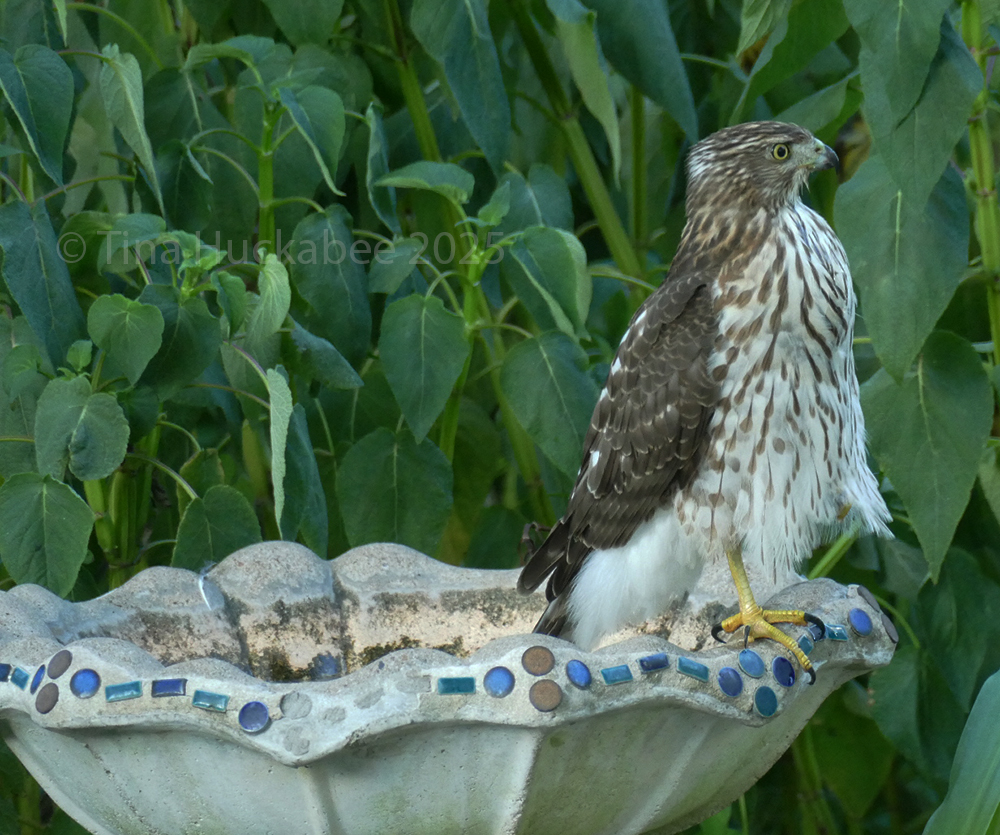
On a recent evening my back garden was honored with a visit from this immature Cooper’s Hawk, Astur cooperii, who spent time at one of my bird baths. The bird sat and surveyed its surroundings,
…took thirsty dives into the water,
…and with beak pointed to the sky, gulped, gulped, gulped, enjoying a cool water drink at the end of a day.
At first, I assumed he’d landed looking for dinner, but the squirrels were somewhat active (not directly under the hawk’s beak, but nearby) and birds were around, though giving this formidable predator its space. Cooper’s Hawks typically hunt birds, but I’ve witnessed one catch a squirrel. A successful predator will hunt whatever is available and catch-able.
I wouldn’t want to be on the catching end if these things–would you?
Given the hawk’s lack of interest in a meal and its focus on the water bowl, I wondered if this one had dined earlier, in some other venue, and was in my garden for its after dinner drink.
The hawk sat, sipped, looked around and eventually hopped to the opposite side of the water bowl. This young Cooper’s has a regal form: bright, intelligent eyes, glorious plumage, and a dignified figure.
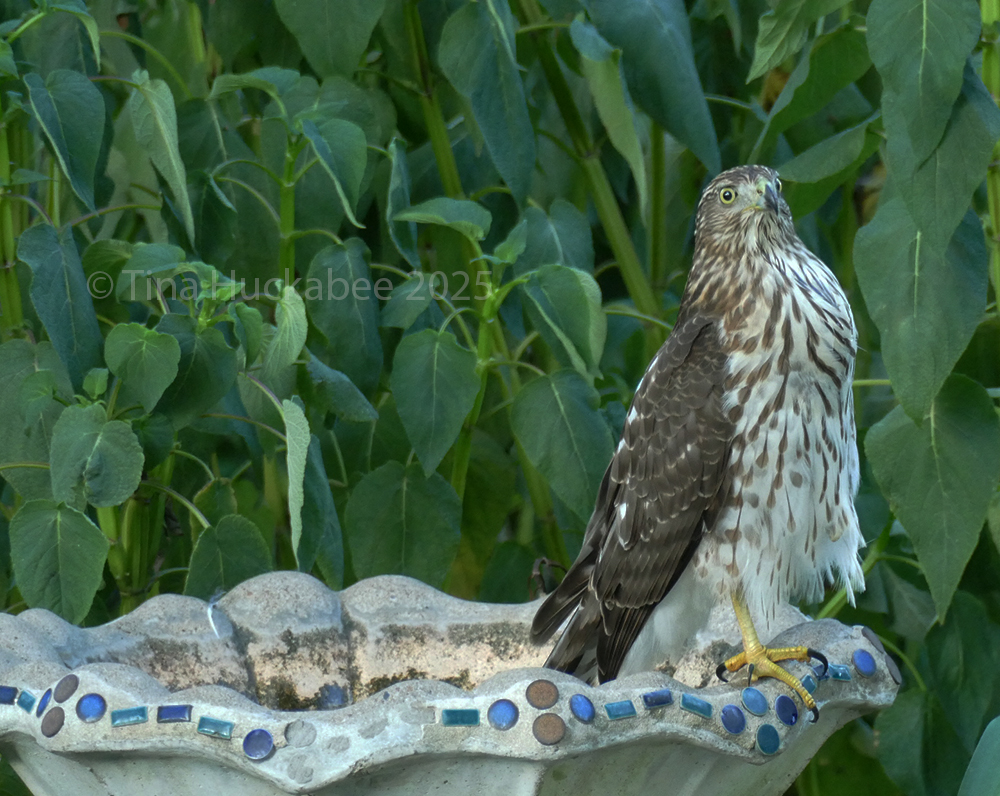
My favorite photo of this half hour of hawk watching is this one.
The hawk has a I meant to do that! look on its face. Maybe it took a page out of the White-winged Dove book and pooped in the water? Or perhaps it belched a bit and was embarrassed? Do hawks belch? Do hawks get embarrassed?
Shortly afterwards, my hawk buddy winged to the overhead utility wires behind my property and then onward to its perch for the night.
I love to spy on the flitty birds in my garden, both migratory and resident. They’re quick, agile, easily hidden in the foliage and a triumph when I get a good look and photograph. That said, it’s rewarding and so much easier to watch and appreciate a bigger bird. It’s truly a gift when one lands and spends time resting in the garden.
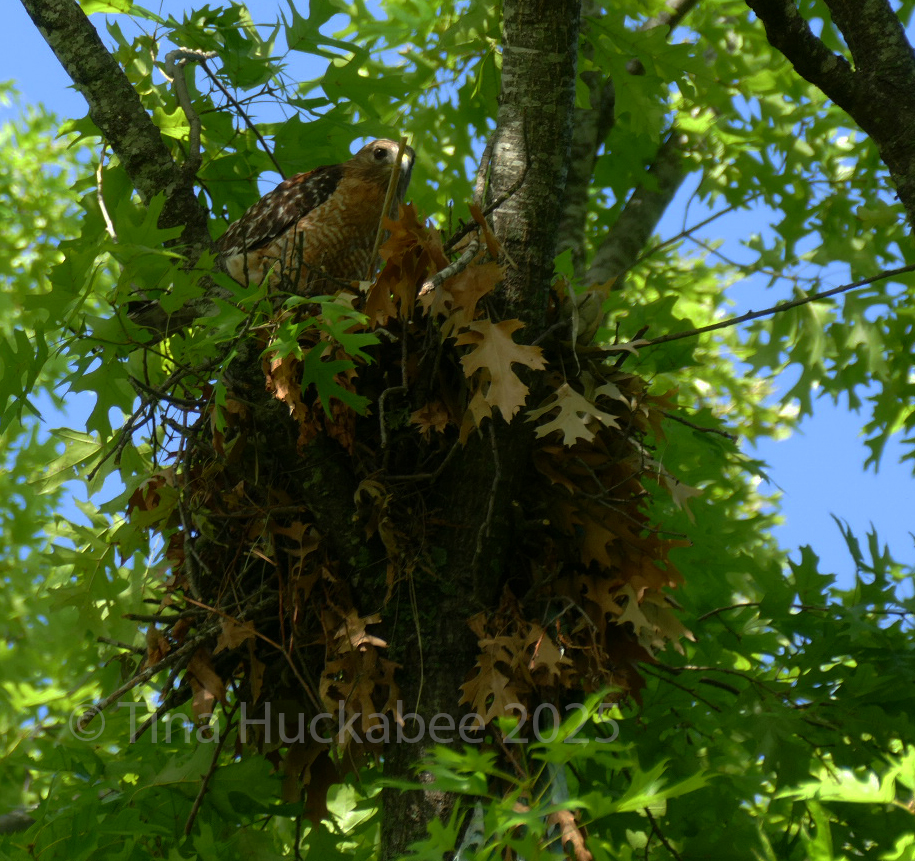
In February I wrote about the Red-shouldered Hawks who set up housekeeping in our Sycamore tree, adding their particular touches to an abandoned squirrel nest. Sadly, in March, after several days of high winds and the nest torn asunder, the hawks abandoned that tree. I didn’t see the hawks for a few days, but eventually found them busily building another nest in a huge, beautiful Red Oak, Quercus rubra, which grows just around the corner from my street. I guess the hawks chose well as that tree is taller and wider, with dense foliage for protection.
I’ve kept an eye on the hawk happenings, observing their new digs and parent hawk behavior. Typically, mom is on the nest, dad is nearby, serving as a protective sentry with his watchful hawk eyes.
I’ve only caught quick glimpses of fuzzy white chick heads, but never when I’m in possession of either my binoculars or my camera.
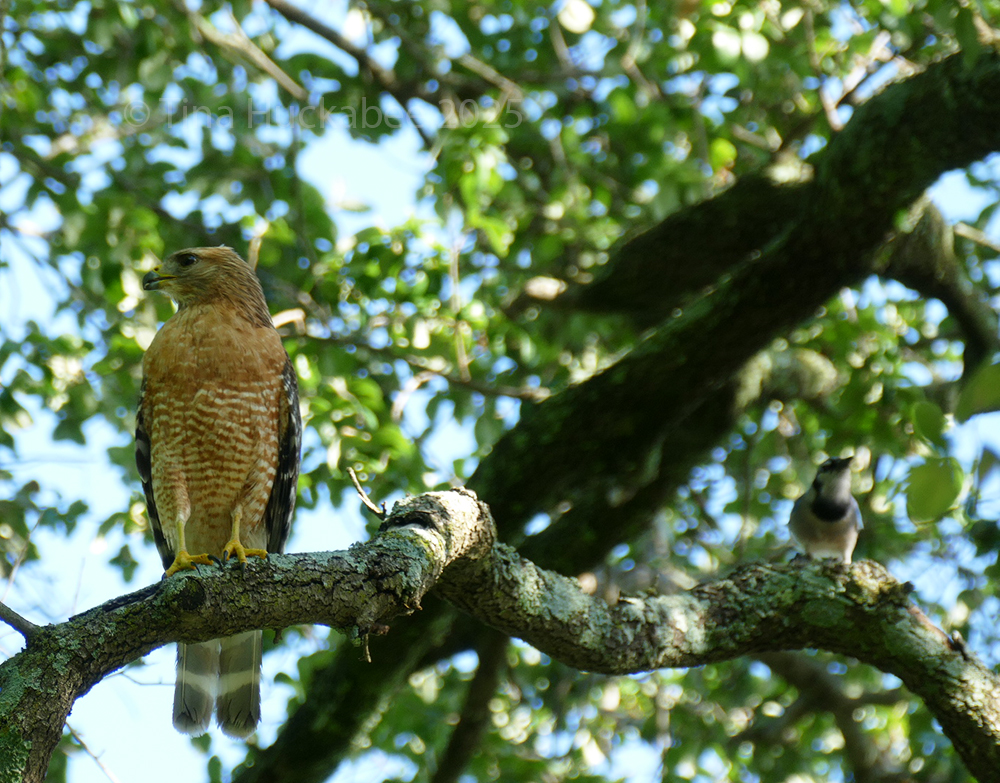
On this morning, dad was harassed by a vociferous Blue Jay, Cyanocitta cristata, off to his left.
Dad hawk looks rather disdainful of the intrusion; he flew to a different branch a minute later, jay in noisy pursuit.
Mom hawk is in the nest, caring for the wee ones, hunkered down in their solidly built oak-leafy nest.
My SIL has been luckier in getting great shots of the hawk family, including this one of the two chicks, fierce-n-fuzzy they are! Look at those darling, terrifying faces!
I’ve been watching the hawks since late March, but only two weeks ago discovered that across the street, situated in a large Live Oak, Quercus virginiana, a family of Yellow-crested Night Herons, Nyctanassa violacea, have also settled in for their chick-raising. Bird neighbors! I’m guessing these two feathery families don’t share meals or coordinate play dates for the kids! I find it fascinating that these two large predator birds are relatively close together and are raising successful families. That said, while both species hunt, they hunt different prey, so there’s probably not much competition for food, at least between the families.
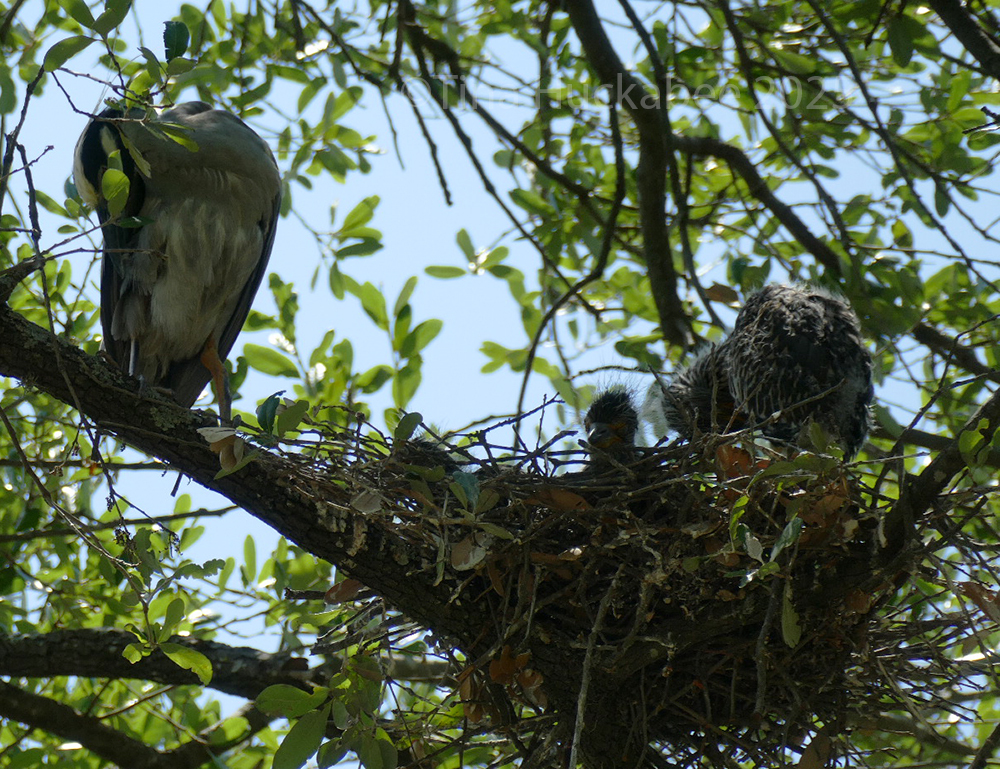
There’s always one adult heron near the nest, and often I see both adults, perched on opposite branches that book-end the large nest of babies in between. In this photo, one adult faces away from my camera, tail feathers and skinny legs in view. The other adult preens, its yellow crown visible in the morning sun.
The oldest chick (presumably) is on the left, the two younger in the nest, cuddled side-by-side.
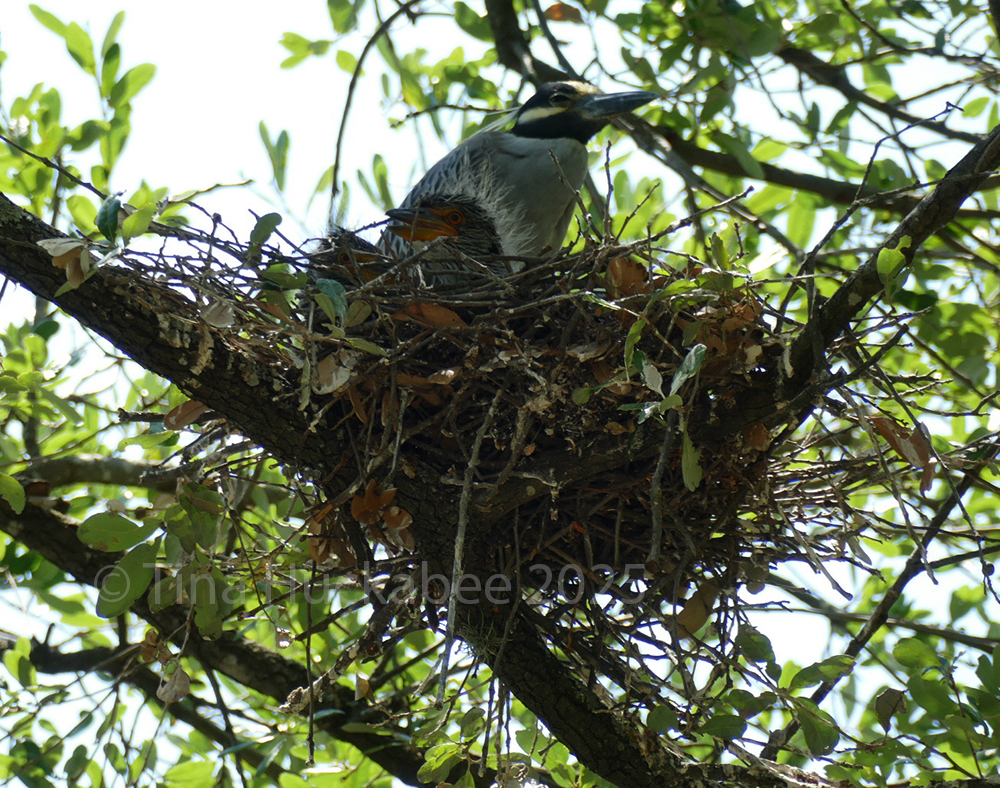
Here, one adult preens and the three chicks are being chicks. The one on the right is larger than the other two, a little heron head sits in the middle, and a blob of feathery fluff is barely visible on the left side of the nest.
Adult heron and baby heron, each stare in different directions.
Another stunning shot from my SIL! All beaks and eyes, these little critters rock their dinosaur past.
I expect these characters to fledge in the next week or two. They’ll be spotted on rooftops, residents’ cars, and on lawns, and hopefully not in the street. I also hope they’re too big for the hawks to predate, but I’m not so sure about that.
Puffy clouds act as a visual connection between the hawks’ home tree on the right and the herons’ home tree on the left. The street sits just below, bisecting the two properties.
There are at least four other nesting heron families in this part of our neighborhood and in the larger neighborhood area, a nesting family of Red-tailed Hawks, Buteo jamaicensis, and at least one family of Cooper’s Hawks, Astur cooperii, call this area home. Providing for these predatory birds, as well as for multitudes of song birds, wood peckers, finches, mammals, and countless insects is why trees exist. Large native trees are not only beautiful for people to enjoy, but provide life and protection for wild things.
Plant trees, especially native trees, and prune sparingly. Wildlife will cheer!
Sad addendum: we just experienced a strong thunderstorm with high winds, heavy rain, and hail. I walked over to the street where the nests are and I spoke with the young woman who is the owner of the house with the heron nest. The nest is completely gone, a major branch broke that was above the nest. The young woman said she found one nestling dead; she hasn’t seen the other herons. The hawk nest is undamaged. I didn’t see any chicks, but they aren’t always visible. I looked on the lawn and didn’t see any bodies or live birds. The young woman saw one of the adult hawks drying itself.
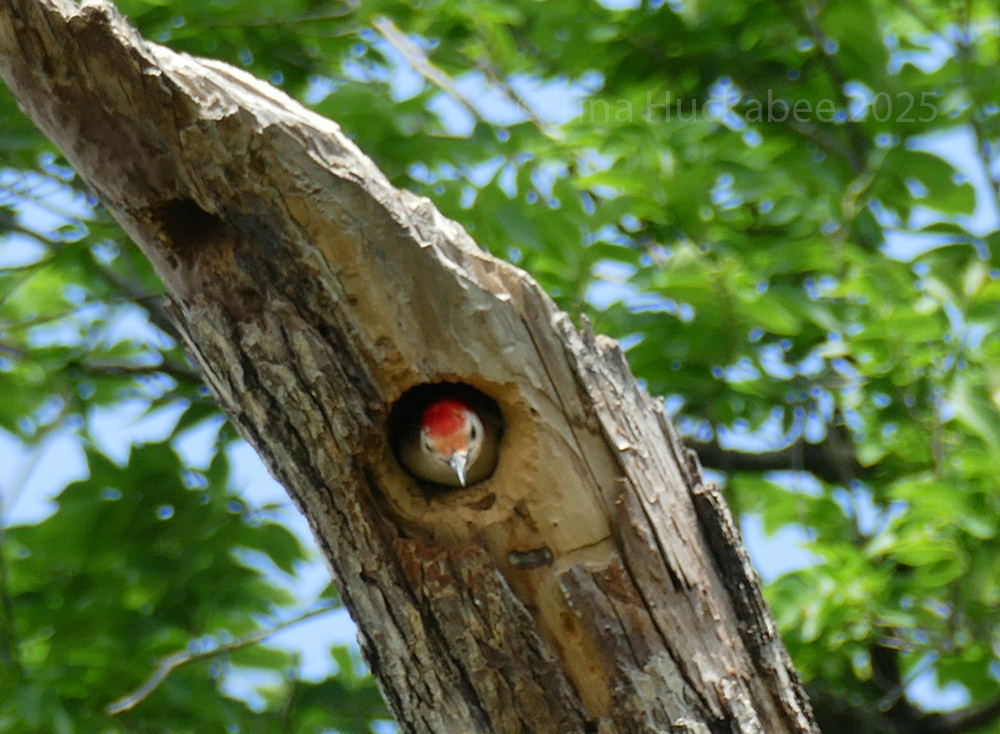
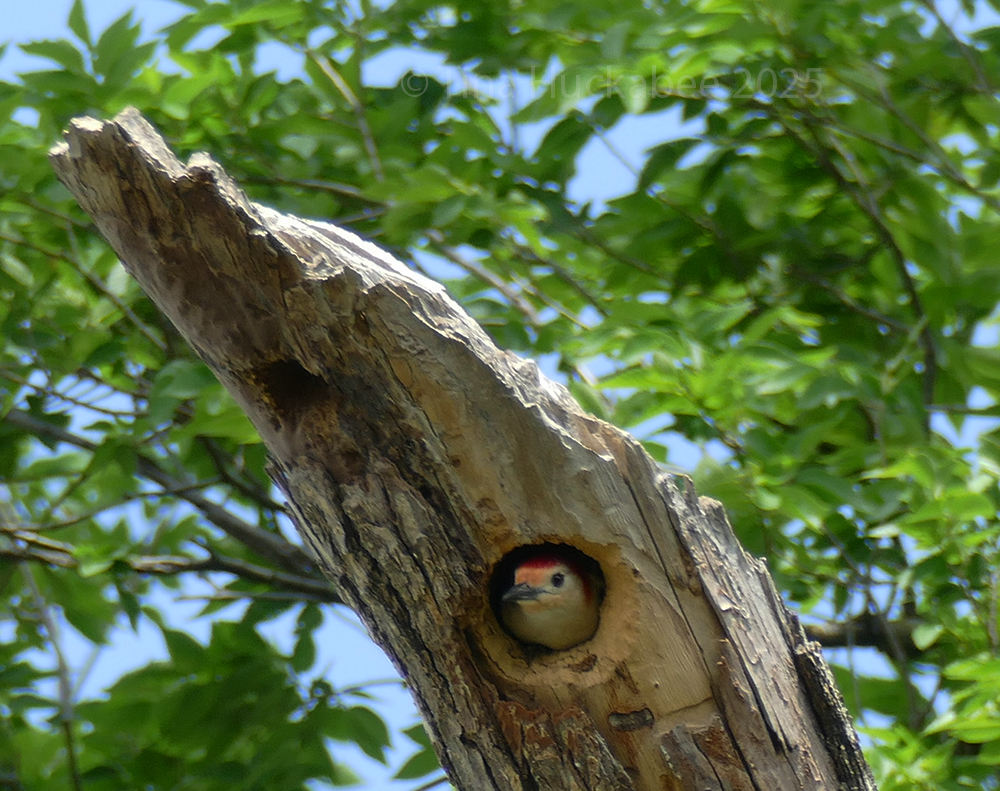
I’d heard the call when I was out and about in the back garden, but Red-bellied Woodpeckers, Melanerpes carolinus are common in my neighborhood and I didn’t pay much attention. After an extended session of woodpecker monologue, I looked up and sighted this cutey calling from a nesting site hole high up in my back neighbor’s tree.
It looks like he’s telling me off!
In January or early February, I’d seen a male Red-belly hammering away, creating a nice little niche for a future family. Then the stinkin’, bullying European Starlings began harassing the would-be dad, eventually driving him off to some other tree. Of course, the starlings didn’t even settle in the tree; I’m sure they moved on, looking for some other hapless native bird to harass.
His head is red from just above his eyes, completely covering the back of his head. Female Red-bellies’ red begins toward the top of their heads and doesn’t extend quite so far down.
Such a pretty fella. I don’t know if there’s missus; I’ve only spied this guy in his well-rounded hole, calling for anyone who will listen. I hope he finds a compatible gal-pal and they raise a family; woodpeckers are particularly charming birds. This could be his second go-round in the family business, as Red-bellies produce between one and three broods each year.
It’s been a disappointing spring in my garden regarding observing birds and their family ways. A pair of Bewick’s wrens sang, chirped, and brought grass and twigs to a little bird house at my back patio, then abandoned that effort. I suspect the Red-shouldered Hawks that were interested in my tall Sycamore tree might have given the wrens doubt about the neighborhood. But in recent days one is continuing the work, so maybe a second brood is planned or a different pair of wrens are reconsidering the real estate now that the hawks have removed to another place?
The majestic Red-shouldered Hawks that swooped, called, and mated in every tree in the vicinity, eventually relinquished the lame nest they occupied in my Sycamore after several days of high winds. They stayed nearby though, choosing a new nesting site in a large Red Oak just around the corner. This morning, I was alerted to their presence by noisy Blue Jays in the luscious oak, loudly voicing their opposition to the hawks’ nesting site. A stately adult hawk perched on a branch near the nest, tricky to spot in the foliage–a formidable sentry. I’m glad these two hawks didn’t opt for a chickless, carefree lifestyle, as young adults will do. They’ll be excellent parents, to the concern and detriment of other birds, small mammals and reptiles in the neighborhood. Such is the circle of wildlife.
Our Screech owl box remained owl-less this year, the couple choosing instead a hole further down this same tree now hosting the Red-belly. Just last night, looking for the owls, I saw both parents and two fledglings! They made it easy for me to observe them, as they were on utility wires, rather than in the trees. The owlets were calling for food, parents obliged with snacks. I mentioned to them that they’re welcome to the rat who visits the pond area each night.
I’m glad I listened and sighted this woodpecker in his chosen site. I wish him all good luck with a mate and brood. There’s plenty of time in the season to rear more darling woodpeckers.








 My Gardener Says...