A Royal Visit

Migration season has arrived and the first bird that I’ve identified as a non-resident and stranger to these parts is this handsome Eastern Kingbird, Tyrannus tyrannus. According to Cornell Lab of Ornithology’s map, my area here in Austin, Texas is on the edge of its breeding range, but I’ve never seen an Eastern Kingbird before, though Western Kingbirds are fairly common.

This visitor perched in the Red Oak tree near my pond, fluttering occasionally over the pond itself, presumably snacking on insects. A flycatcher, Eastern Kingbirds eat insects, hunting them on the wing. They also enjoy small reptiles and fruit, especially in their wintering grounds in South America.

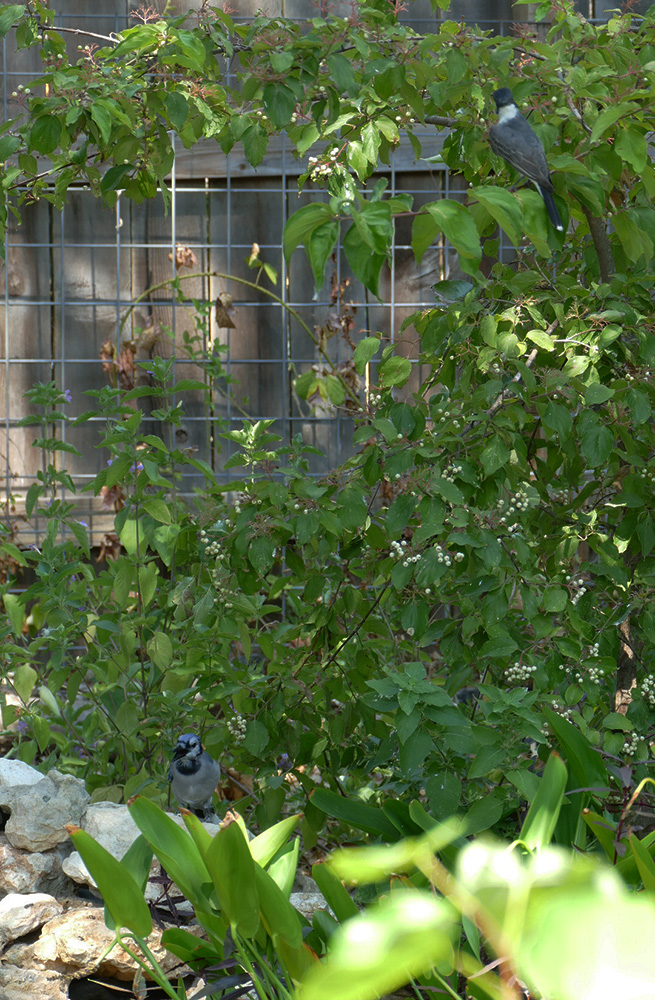
King then spent time in the smaller Roughleaf Dogwood tree, Cornus drummondii, which is full of ripe berries for the munching. I didn’t see the bird eat any fruit, but Kingbirds routinely nosh on fall and winter fruits, and that is exactly why I planted a couple of these hardy and attractive small trees: spring flowers for the pollinators, fruits in late summer/fall for the birds.

Cornell’s Kingbird information mentions a red crest that these territorial and aggressive birds flash as a challenge to a predator. This one didn’t exhibit any red that I saw, though it clearly has a defined crest. I’m guessing this is a female or juvenile male bird. As adorable as it looks, these birds are bullies! They have no problem going after bigger birds like hawks and crows, and are aggressive with other birds and small mammals. Apparently, this bird is appropriately named in both its common name (Kingbird) and its scientific name (Tyrannus tyrannus). The good folks at Cornell remind us that the term Tyrannus means “tyrant, despot, or king.”

The Hub and I are planning a wildlife/birding trip to Costa Rica in the not-too-distant future and in a phone call with the guide that we’ve hired for the trip, I mentioned that an Eastern Kingbird had visited my garden. He commented that Kingbirds were “good-looking birds” (I agree!) and mentioned that in Costa Rica, they travel in in big flocks. I wonder if this bird will be in Costa Rica at the same time we visit–maybe we can exchange travel stories!

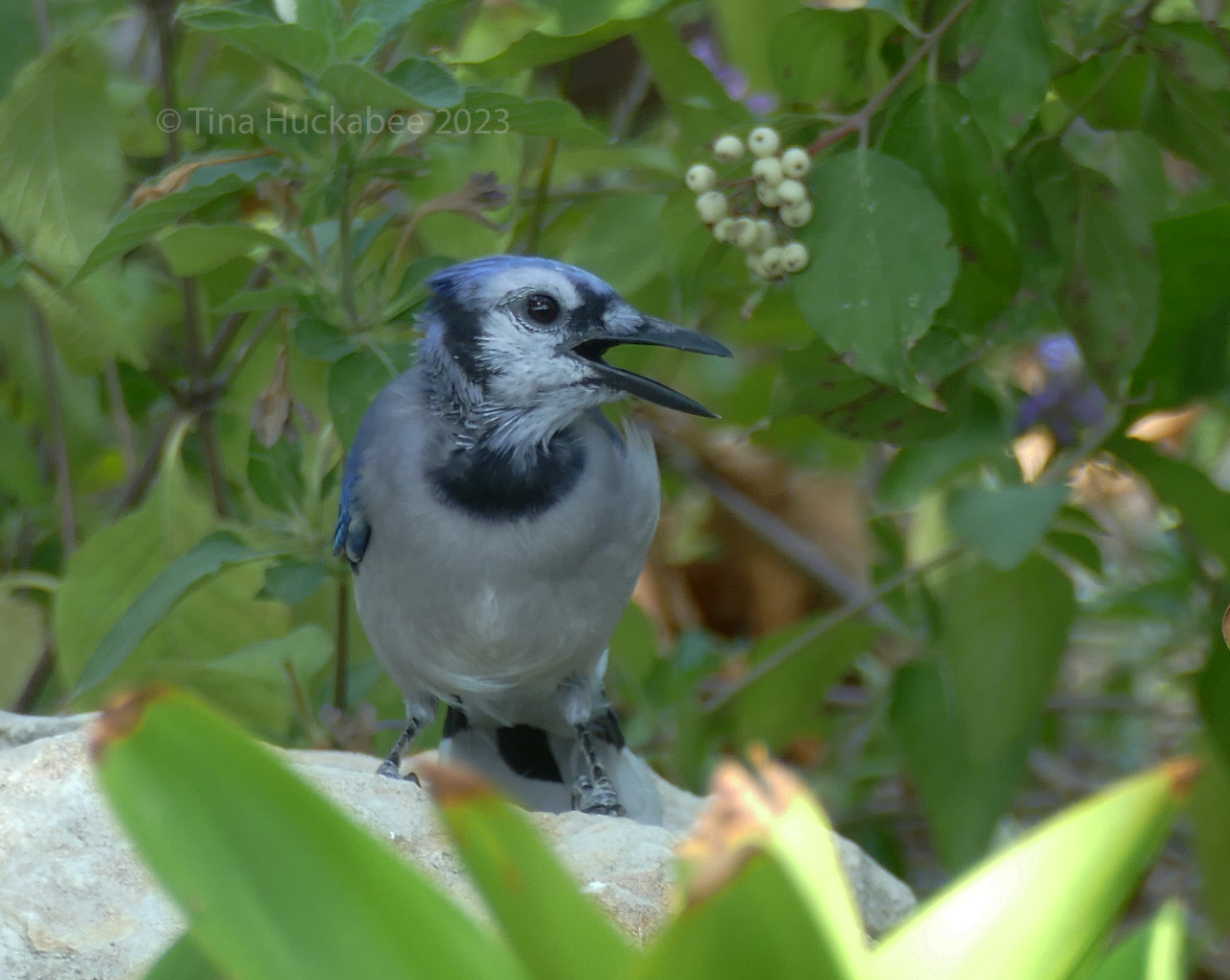
The King looks cute-n-goofy in these photos, but it was hot outside, thus the open beak.

A resident Blue Jay popped into the scene, but kept its distance from Royal Highness.

Kingbird perched in the Dogwood, above the lowly Jay, no doubt lording over its temporary territory. The Blue Jay stayed near the bog area of the pond, just hanging out, being a Jay.

Bird migratory season has arrived. I don’t see either the variety or numbers of birds in fall migration as during spring migration, but it’s time to keep a keen eye on the pond and gardens for more than the usual suspects. It’s time to observe and appreciate their beauty and contributions to diverse ecosystems. My garden will serve as a respite for shelter, food, and water for these remarkable creatures during their long, arduous travels.

Flowers in the Heat

Huzzah and Cheers all around! Yesterday, clouds gathered, rain fell on a thirsty Earth, and the temperature (at least in North Austin) didn’t pass the century mark! It’s amazing how life looks better with touch of the cool. (Note: it wasn’t really cool, it simply wasn’t oven-like.) I pay no attention to the weather folk this time of year (the ‘hot and dry!’ monotony reigns in weather reports!) so I didn’t know there was a chance of precipitation and would have been skeptical if I’d heard about it before hand. Even with the lovely few hours break from the heat and glaring sun, I’m under no illusion that autumn is just around the corner or that our toasty days are done. The 45 day streak of triple digit temperatures may be over, but a new one starts today; there is a heat advisory in place today and for those following. But the days are noticeably shorter, early mornings offer sweetness that was absent for July and most of August, and it is clear that the weather pattern is progressing toward a different, gentler paradigm.

The garden was happy this morning: foliage was fresh, flowers were fully open, bees were a’buzzing. The damage from this historically hot summer is clear though, with plenty of crinkly, brown foliage and yellow-to-pale leaves, bleached so by the relentless rays of the sun. No matter the second spring that we enjoy in September, October, and November, the garden will finish this season bearing scars from summer’s searing heat and devastating drought.

The following photos were taken in the past few weeks, the post planned during that time but not finished until today.

Mexican Orchid tree, Bauhinia mexicana, flowers with cool white blooms, with a blush of pink. Annual sunflowers, which have since been removed, accompany the little tree.

I grow two of the native-to-Mexico plants, the first photo is in full sun, this second photo in mostly shade. Larger butterflies, hummingbirds, and bees of all sorts love these graceful flowers.

Turk’s Cap, Malvaviscus arboreus, are great summer bloomers, producing rich, hot-red hibiscus-like flowers. I’ve noticed there are fewer of these diminutive blooms this summer, but still enough for interested pollinators.

The wowzer blooms of Pride of Barbados, Caesalpinia pulcherrima, thrive in the heat and take what our difficult summers dish out. I wish I had room for another of these beauties.

Native Rock Rose, Pavonia lasiopetala, blooms from May to October. The cheery little mallows flower on new wood, so pruning during the course of the growing season assures plenty of pretty pinks.

Barbie-pink blooms open before sunrise, but close in early afternoon when it’s hot. As we move into autumn, the flowers will stay open all day. I’m looking forward to that!

Another native Mexican plant, Mexican Honeysuckle, Justicia spicigera, shines orange in the heat. That being said, this is the first year I’ve seen wilting of the foliage in between sparse irrigation.

Clusters of bright, tubular flowers attract many pollinators, including hummingbirds, native bees and honeybees, and many types of butterflies.

Female Black-chinned hummingbird
American Bumblebee
I like how the bumble’s left leg helps her balance on the leaf as she’s proboscis-deep in the bloom.

Desert Willow, Chilopsis linearis, is another spring, summer, fall bloomer. This summer’s heat seemed to challenge the tree to bloom more than usual–and the tree met that challenge. The flowers are hard for me to photograph, as they tend to be high up in the tree and there’s often a healthy breeze; I have a tough time getting a good shot of a pollinator enjoying the flower’s bounty. The foliage has also weathered the heat well; it’s green, lush and a good place for birds to hide.

Fortunately, some pretty blooms grow closer to the gardener’s lens.

Not all plants have fared well in summer’s heat. Purple Coneflowers, Echinacea purpurea, are gorgeous in spring, but become crispy critters as summer drones on. I see finches occasionally nibbling on the seeds, so I leave the plants until I no longer see birds alighting on spent blooms or until I can’t stand looking at them anymore–whichever is first. The Coneflowers will return a muted bloom cycle if/when the autumn rains come. And next spring, they’ll be stars of the spring garden once again.

Summer–its heat and blasting sun–has a firm grip and won’t let go for a while.

But I see and feel a shift.

With yesterday’s dab of rain and glory of dramatic, dark clouds which blanketed the sun for a time, plus today’s rejuvenated garden (however long it lasts!), I’m reminded and reassured that cycles repeat, that there is a universal turning of time in partnership with seasons, allowing for transformation of a garden and the larger world beyond.

The Heat Goes On. And On.

Hellish.

Really, there’s no other way to describe this summer’s heat. Last week, Austin broke its 2011 record for consecutive days over 100F and there’s no end in sight. Don’t ask me how many days have skyrocketed over 100F, I haven’t kept up and I don’t want to know.

Despite the willful ignorance of some, this is the new normal.

As the days have become noticeably shorter, early mornings are lovely. I’m usually out in the garden before 6am, not-yet-perspiring, coffee-in-hand, enjoying the “cool” breeze. By 8am, sun up and death rays activated, it’s pretty hot. My son lives in Irbel, Iraq and we trade how hot was it today stories each time we talk. We’re about 7 degrees cooler than Irbel and with better infrastructure. Yes, Texas’ electric grid has held. So far.

All that said, the garden has held up well against the heat and drought. I water the whole garden with in-place soaker hoses (the tire-like kind that sweat) about every three weeks, with some targeted hand-watering as needed for new plants, plants that don’t have a soaker hose nearby, and container plants. It’s more watering than I usually do, but not so much to be annoying.

The photos which follow were all taken in early mornings, the garden being at its freshest when the day is young. At the end of each day (heck, by the middle of each day!), blooms are shuttered, leaves are crinkled, and the garden cringes with the heat, rendered bleached by the strength of the sun’s rays.

This is the shadiest section of my garden and it’s received almost no water this summer.

There aren’t many summer bloomers here, only the Turks’ cap, Malvaviscus arboreus, and Mexican Orchid tree (off photo) but the garden is green and lush; birds and squirrels bop through for seeds and such.

The main part of my back garden gets half-day sun at varying times of each day and the plants have been good sports about summer’s heat.

One of the best drought and heat tolerant plants I grow, and especially great in shade/part-shade, is the native Drummond’s Ruellia, Ruellia drummondiana.

The flowers close by mid-day (NO ONE likes this heat!) but are lavender lovelies each morning, open for bee business. I mostly grow this perennial in the back garden, as my full-sun front garden fries the foliage. I’m grateful it’s blooming, but it hasn’t bloomed as well as during a ‘normal’ summer.

In my back garden, I’ve opted for tough foliage plants that aren’t thirsty and needy like Soft-leaf Yucca, Yucca recurvifolia and Giant Liriope. Turk’s cap (tall plant, left in photo) and the Mexican Honeysuckle, Justicia spicigera (orange flowering shrub in background) are heat-loving prolific bloomers, providing for pollinators when other plants have shut down bloom production.

Earlier in the summer, the orange daylilies put on quite a show, but now, it’s all about their grassy foliage. Purple heart, Tradescantia pallida, is colorful and in wetter years, adds its pretty pink blooms, though they’re scarce now. Common Yarrow (right in photo) makes a lacy ground cover.

In the front garden, the searing Texas sun blasts its rays from early morning until late evening.

Native grasses are lush and full, smaller trees are growing apace, and perennials and shrubs are holding their own, some in bloom, others opting for dormancy. There are still a couple of sunflowers blooming; sadly, the American Basket flowers are done for the year.

The sitting area only hosts humans during early morning or at sundown, but the bougainvilleas don’t mind the lack of human company, as long as the sun is shining and they have their daily drink of water.

Overall, I’m pleased with how the garden is faring, but I’ll make some changes when summer is done and temperatures moderate. There are some mistakes (aren’t there always?) in plant choice and placement that are glaringly obvious with the challenging summer conditions.

As I recall, when the heat and drought finally broke in 2011, Austin enjoyed a most glorious autumn. Here’s hoping that this year is a repeat of that year: gentle rain at just the right time, September (and going forward) cooler days, a garden that flourishes, with gardener who is grateful.