They’re Off!

Winter placed its chilly hands on the garden these last two days, including gifting a thin layer of ice in the backyard birdbaths this morning. But the weather pattern is in flux with each passing day as the march toward winter’s end and spring’s beginning commences here in Central Texas. Later this week, the forecast is for high 70s, possibly warmer. Even without that warm smooch, the plants in my garden are raring to go and ramping up for the 2024 growing season.

On a cloudy day last week, I noticed (as yet uneaten) fruit on the Possumhaw Holly, Ilex decidua, keeping company with emerging new foliage. I like this great example of seasonal transition period. Blue Jays, Northern Mockingbirds, and Grey Squirrels are feasting on the fruit, but I’m waiting for a flock of Cedar Waxwings to swoop in and render the fruit a sweet memory.

Four-nerve Daisy, Tetraneuris scaposa, never stops blooming, though some of mine were freezer-burned in January during a very cold week. Now? The sunny yellow blooms are spring-bright and open for pollinator business.

This small (maybe?) native Halictidae bee found a sweet spot for nectar sipping and pollen gathering one afternoon. I didn’t disturb its hunt for the sweet stuff as I puttered in the garden.

Four-nerve Daisies are barely damaged by most freezes, but in the above photo, on the right side, you can see a bloom stalk that would have flowered in late January, except for that one deep-frozen week. The other bloom stalks emerged post-hard freeze.

On another day, another, different native Halictidae bee, busily works a daisy bloom.

Some of the earliest blooms in my garden (and occasionally some of the latest) are Spiderworts; a handful have emerged from green foliage to grace the garden and feed hungry pollinators. A favorite early flower for many types of bees, from mid-March until mid-May, my garden will be awash in an array of purple-to-pink blooms.

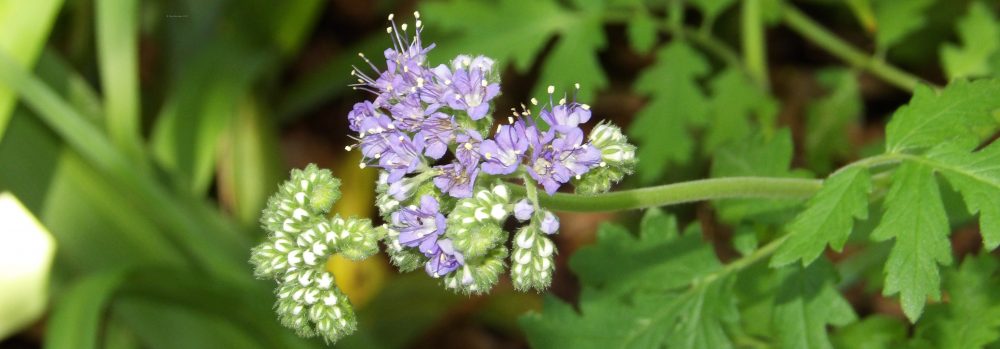
Those plants whose blooms appear later in spring and summer are flushing out with verdant foliage, like this rosette of Blue Curls (also called Caterpillars), Phacelia congesta.

A couple of young Blue Curls accompany a robust rosette of American Basket-flower, Centaurea americana. Both promise plenty of flowering and pollinator action later this year. The rich green foliage is a welcome change from winter’s muted tones.

This potted American Century Plant, Agave americana, enjoys some foliage friends in the form of one European Poppy (right), a Blue Curl (left), and a front-n-center Carolina geranium, Geranium carolinianum.

I grow five Desert Globemallow shrubs, Sphaeralcea ambigua. This gorgeous plant is a cool season bloomer here in Central Texas and requires full, blasting sun and decent drainage. Ruffly, sage-green leaves pairs beautifully with Dreamsicle orange blooms.

This globemallow withstands hard freezes, but if the temperature falls in the the teens–or lower–damage will occur. My shrubs experienced some freeze damage in January’s freeze, but all are producing blooms on the healthy stems–much to a variety of bees’ delight.

Honeybees are out and about, collecting for the the hive!

I fed the honeys during that cold week, but there’s been enough flowering (I think…) during most of this winter, plus both hives had honey stores. Our first hive check is on the to-do list for this next week to assess how the ladies are and how much honey, if any, remains from last season.

I’ve been engaged with winter pruning of the garden, but I’m nearly done. I let leaves remain on the ground, further protecting and nourishing life, and eventually decaying for future growing seasons.

The garden has awakened, its inhabitants ready to live and reproduce. Plants and critters are in sync with their companion life-cycles.

It begins, anew.

Roughleaf Dogwood (Cornus drummondii): A Seasonal Look

I became enamored with Texas native Roughleaf Dogwood, Cornus drummondii, during the time I managed the Green Garden at Austin’s Zilker Botanical Gardens. I knew about “Texas” dogwood, an understory small tree or shrub which blooms in spring and produces white fall fruits, but I had never planted one of my own. Nor did I originally pay attention to the stunning specimen situated in the woodlands plants section of the Green Garden, set back from the formal pathway. I recall the golden leaves which brightened the dogwoods’ limbs, and then the ground below it, during the December after I was hired. But it was in spring that the puffs of creamy dogwood flowers really caught my attention. Snowy floret clusters gracefully adorned the slender limbs of the Zilker dogwood, the little tree set off from a well-worn path to another Zilker garden, nonetheless demanding attention from passersby.

I was smitten.

I mulled purchasing my own little dogwood, but a gardening friend (thanks Deb!) gifted to me a seedling C drummondii from her Westlake garden. I planted my baby dogwood in the center-back section of my back perennial garden. Eager for it to grow up, I waited. And waited. Truthfully, it didn’t do much in the growth department until I removed a tired, old Tacoma stans ‘Esperanza’ that had been, for many years, the main actor in that garden and whose size hampered the growth of the dogwood. Once Tacoma was gone from the garden, the Roughleaf Dogwood grew apace and came into its own. 

I eventually added a second dogwood, purchased from a local nursery, and placed it at the back of the pond. 

A summer vignette from 2019, the two young dogwoods circled. Beloved Nuri the Cat checks out the fish in the pond.
December 2021 with early “autumn” color; the dogwoods have grown.

Since then, I’ve practiced botanical pay-it-forward by digging up and gifting my own dogwood starts to other eager dogwood lovers, plus I’ve planted one more in a different part of the back garden.

Roughleaf Dogwood is deciduous, which means leaves drop after the first freezes of the winter season. Multi-limbed with slim, spidery appendages, the tree can be prune for shape according to human preferences.

As I’m an admirer of nature’s evolutionary practices, I don’t typically prune much on my dogwoods, unless an extremity is nudging up against another plant in a way I find bothersome. Years ago, I’d read that dogwoods had a tendency to colonize out in a garden situation. In its first decade (under the shadow of the T. stans) that was never a problem. But as my first dogwood has matured, there are root-bound outreaches of new trunks.

Some of these I’ve dug up and either gifted or composted, but the ones near the original trunk I’ve let remain. Any that pop up further away from the mother plant I prune back to the soil once or twice each year; newbie trunks are easily spotted in winter. I could dig them out, but they’re a bit too deep-rooted for my back to handle, so it’s a snip-to-the-top-soil for these potentially pesky wannabee trees. If you have a larger space, let them go to grow, bloom, set fruit and be dogwoods. According to the Lady Bird Johnson Wildflower Center, various songbirds nest in dogwood thickets, so that’s a great reason for allowing thickets to develop–if you have the space. But for those in more restrictive urban plots, some management of dogwood enthusiasm is a must.

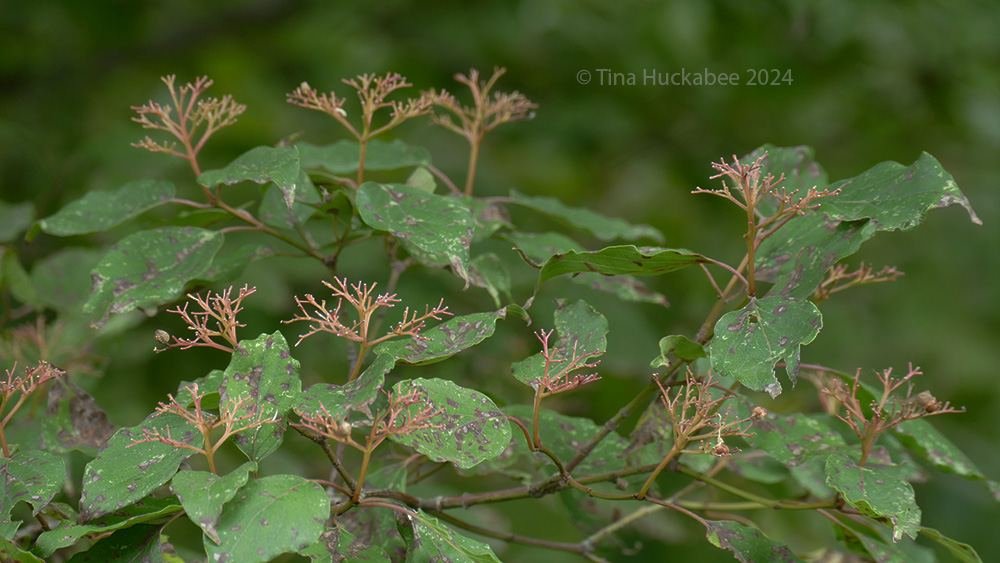
In early spring, usually March, the first, verdant leaves appear: tiny, bright green and delicate. Often, the branchlets that held last season’s flowers and fruits are still attached to the awakening tree. 

The spring green leaves make a statement about the longer and warmer days settling in. 

Oak pollen decorates the newly emerged dogwood leaves.

Flower clusters follow, though they take time to develop to the point of offering open blooms for feeding wildlife and admiration by humans. 

The flowers are constantly visited by a wide variety of pollinators. 

I see a multitude of flies and native bees on my flowers. Honeybees and skippers are also frequent sippers of the nectar provided. Sometimes, butterflies rest on the foliage.

The bloom season lasts into May for my two plants. 

Hot summer months see the dogwoods as lush and green, water-wise, and a good place for birds to rest. 

Yellow Warbler, Setophaga petechia, resting in the dogwood after a splash in the pond.

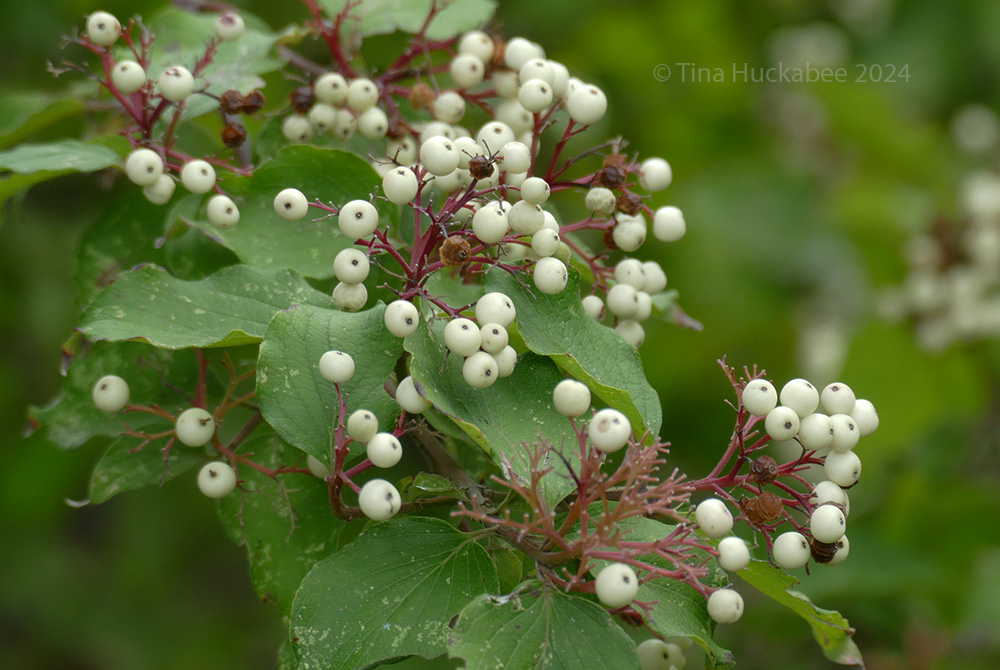
By late August/early September, luscious, creamy fruits are available for both resident and migratory birds.

I’ve mostly witnessed Blue Jays and Northern Mockingbirds at the berries, but they’re sneaky about nibbling while successfully hiding behind branches and clusters of leaves. 

Usually by late fall, no fruits are left on either of my dogwoods; this is when foliage color show commences. Shorter days and a couple of light freezes trigger dogwood foliage color changes, and is always reliably lovely. Typically, the early foliage color are yellows and pastels.

In time and with ongoing cold temperatures, deep burgundy covers many leaves, the dramatic colors remaining until leaf drop.

January and February bring bare dogwoods.

Bare limbs allow for easier bird watching.

Black-crested Titmouse, Baeolophus atricristatus  

Roughleaf Dogwood is native not only in Texas, but throughout a wide swath of the United States and also in Ontario, Canada. I’ve never experienced any disease or insect issues with either of my trees and drainage hasn’t been an issue. Roughleaf Dogwood is a tough plant which remains lush and green throughout our hot, long summers.  It is not deer resistant.

If you have the room in your garden, plant this lovely small tree or shrub. Roughleaf Dogwood is an ideal urban native plant. It’s easy to grow, provides for wildlife and is an attractive plant.

In Spring:

Summer:

Autumn:

Winter:

Ice in the Garden

As it happens most years during the first deep freeze of winter, Frostweed, Verbesina virginica, has graced my winter garden with its swirls of ice sculptures.

Along with the most common name of ‘Frostweed’ which pays descriptive homage to this winter phenomena, ‘Iceplant’ and ‘Iceweed’ are also names for V. virginica.

Twirls-n-curls of ice ribbons form, usually at the base of the plant, when the temperature drops significantly below freezing.

As the freeze deepens, water in the stems is released, freezing in beautiful formations along the stems, undulating around the base of the plant and often traveling upwards along the stem. 

In this photo, at the top left, notice burst open stems. Ice crystals have filled the gaps.

The ice sculptures themselves have many names: ice ribbons, ice flowers, ice fringes, ice fingers, ice filaments, ice leaves, frost flowers, frost ribbons, frost freaks, frost beards, frost castles (Forrest M. Mims III), crystallofolia (coined by Bob Harms at The University of Texas), rabbit ice and rabbit butter. I think ice flowers and frost flowers are the most poetic of the names, and frost freaks and frost castles the quirkiest. I typically refer to them as ice ribbons. 

Frostweed is particularly well known for extravagant ice ribbons, but many plants produce similar ice crystals during the first freeze. In my own garden I’ve seen various salvias, lantanas, and other asters form ice ribbons around their frozen stems, but none challenge the beauty, complexity, or size of those created by Frostweed.

All of these ice ribbons are from Frostweed plants and their appearance in the garden is as brief as they are beautiful. Once the freezing conditions are finished and the temperature rises, the delicate crystals melt. The ice ribbons will not form again until next winter’s first, hard freeze. Ice ribbons are once, and done, and ephemeral.

I pruned back this Frostweed in November, planning to remove it from the edge of my garden. I left just a bit of stem and root, mostly out of forgetfulness or laziness or some combination of both. I’m glad that I didn’t yet remove what’s left of the plant. 

What a lovely gift on this frigid day.

As I walked through the garden, bundled, but cold, a Northern Mockingbird chirped. It allowed let me get close to where it perch, fluffed feathers and all, in the Red Bud tree. We shared a moment in the quiet cold.