Reptilia

My little female cat, Astrud, stays mostly indoors.  However, she enjoys brief early morning tours of the garden and relishes her garden nightcaps after sundown.  I oblige her, especially with the evening forays, as the birds are done for the day, nestled in the trees and safe from cat eyes, teeth, and claws.  Astrud hasn’t exhibited much interest in nocturnal critters.  She watches the various moths and June bugs, wielding an occasional, lazy swat, but rarely acts upon any instinct to kill and eat.  As for the toads, she looks at them from a respectful distance and with slight disgust;  she has no interest in tangling with their warty hives.  However, Astrud has, once or twice, dismembered and partly devoured geckos.  I grieve at that bit of predator business, because I’m fond of geckos and like to see them whole and not scattered in bits and pieces.  But this time of year, there is little in the way of prey that she wants to dismantle.  She spends her evenings sprawled on the driveway, adjacent to the front garden, acting as guard cat, until she’s called in for the night. 

Recently, well before her time to come in for the night, I was surprised to hear her collar bell jingle near the back door.  I flipped on the patio light and saw what Astrud was interested in and jingling about.

It was a gaggle of reptiles!  Or maybe it would be called an assemblage of reptiles? Or troupe of reptiles?  I’m not really sure, especially since only one of the reptiles is actually a reptile.   A baby Texas Rat Snake, Elaphe obsoleta lindheimeri, had joined in a reptilian huddle on the back patio.  Its cohorts were inanimate reptiles, both made of metal and which once belonged to my late father-in-law:  one represents a turtle and the second, Texas Horned Lizard.

Not too many weeks before this, I’d seen an adult Texas Rat Snake at my pond, which you can read about here.  Is this little one an offspring of that big adult?  Are there more of these slithery beauties around?  No doubt there are more, though not necessarily in my garden; like all critters, rat snakes move in where the food sources are plentiful and they have plenty to eat around here:  insects of all sorts, birds (especially baby birds), rodents of all sizes, and anything else smaller than themselves.  It is odd for me to see two rat snakes within a few weeks of one another, but it’s been a banner year for reptiles in my garden.

I think the baby Rat Snake was annoyed and not with its companions or Astrud, but with the clumsy, noisy (and nosy) humans.  We took photos from different angles and strategized about how to encourage the snake to vacate the patio and enter the garden.  After some deliberation and a squeal by yours truly (I was going to pick up the snake, but didn’t…), The Hub and I herded slinky to the garden, where it was, I’m sure, glad to be rid of us.

I don’t know if the snake has returned to visit its kin, but I’m certain it’s still around and that we’ll cross paths again, perhaps when it’s grown a bit.

The turtle and the horned lizard remain at their posts:  protectors of the patio, keepers of the container plants. 


Lovely Lavender

This Althea, Rose of Sharon, Hibiscus syriacus, is full of big, showy blooms right now.  Its branches bent with the weight of the blooms, the hardy perennial will bloom on and off during our long warm season.  The rangy shrub buds and blooms profusely, especially after rain moistens the soil and flower production ramps up for the show.

I don’t remember which cultivar this is but I’m sure that I have the name tag stashed away somewhere.  

The Althea sits near my pond and last year I planted two specimens of another hibiscus cultivar, Lemon Rose Mallow, Hibiscus calyphyllus, just in front of the Althea.   I think they’ll be great bloom partners, yellow and lavender faces open to the sunshine, bodacious blooms both, cheering and thriving during summer’s heat.

I need some happy vibes today and these flowers are the ticket.  I’m joining in today with Anna’s Wednesday Vignette, to celebrate garden stories. 

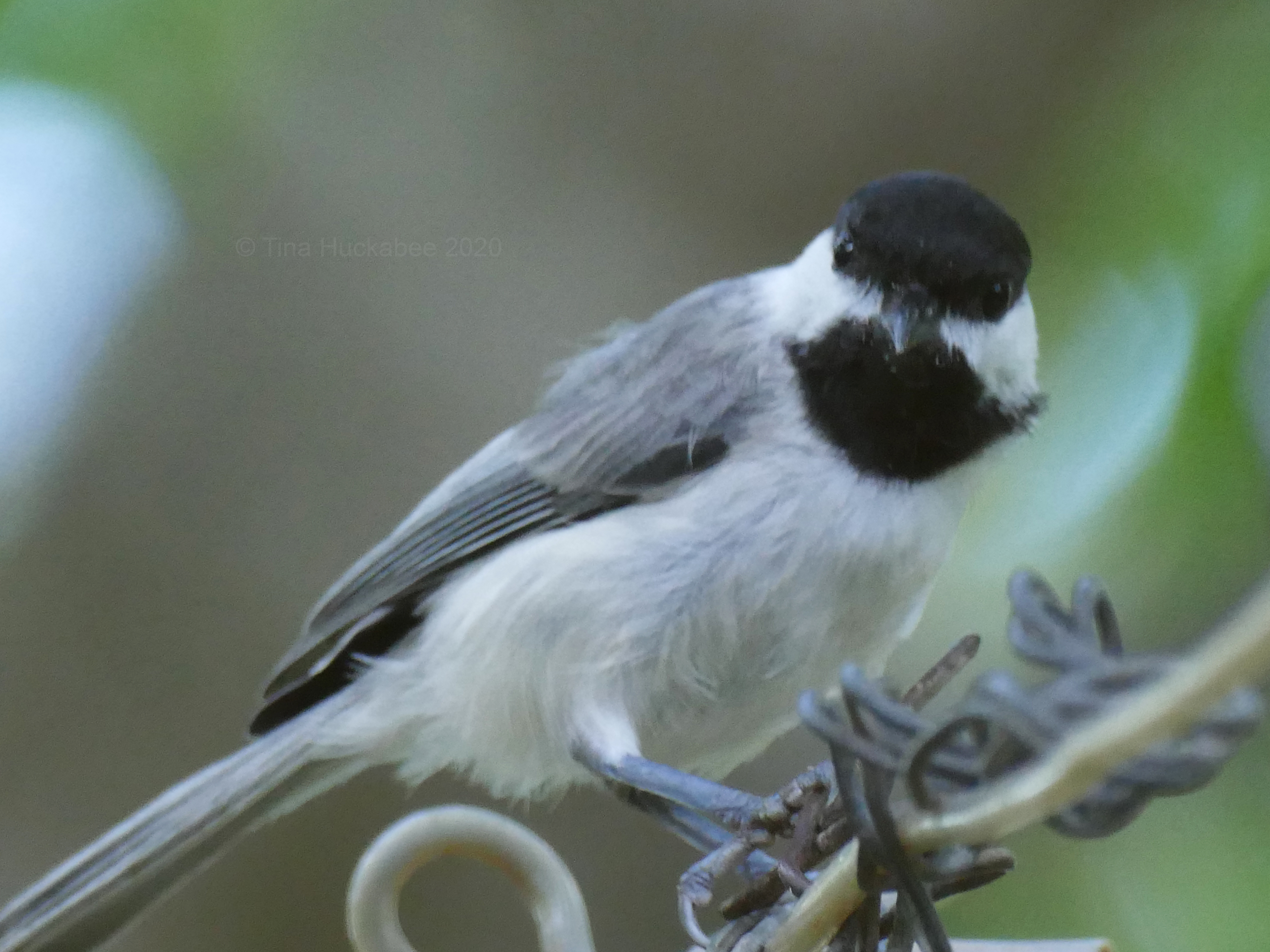
My Little Chickadee

I can’t lay claim to any true relationship with this young Carolina Chickadee, Poecile carolinensis.  Though it isn’t my little chickadee, I confess an affection toward the little bird as it satisfied my selfish desire to observe as it perched, relatively still, and fed for a period of time, long enough for this watcher to watch. 

The neophyte chickadee sat at the feeder, nibbling at the small pieces of peanut available.  No adult chickadee would consent to spend that much time at a feeder;  adult chickadees dash and perch, grab and go.   A mature–and wary–Carolina Chickadee would dart to the feeder, and lickety-split, grab a peanut, or part of a peanut, and sprint out of clear sight to a safe place to eat.  The young chickadee’s inexperience at peanut picking allowed me to watch for several minutes, appreciating its birdie beauty, even though I also recognize that it must be more careful:  move fast or become someone’s meal. 

I observed, then realized that maybe, just maybe, I could capture some of this darling since it was spending an un-chickadee-like amount of time at the feeder.

Successful photos of a Carolina Chickadee?  That’s a rare treat for me!

To its credit, when a parent Blue Jay muscled its way onto the feeder, the young bird flit to the tree, then to the cord from which the feeder hangs, then safely to an evergreen shrub.  Once the jay was done, the chickadee settled in for more of the peanut treats. 

Chickadees’ tiny beaks are better suited for gleaning spiders and other small insects from trees and shrubs, the birds protected by cover of foliage.  Their beaks are not as well designed to quickly dismantle a hard-coated seed or good-sized peanut, especially while acting as a sitting duck at a feeder.  A wise and experienced chickadee will snatch, fly, and eat under cover–and live to raise a clutch of his or her own.

A week or so ago, I watched as an adult Carolina Chickadee zoomed in from a neighbor’s property, grabbed a nosh–sometimes a peanut, sometimes a black-oiled sunflower.  It then zoomed back in the same direction, followed immediately by another adult, completing the same set of actions.  I realized that it was a couple, working in tandem, probably feeding hungry and growing chick(s).  I don’t know if this chickadee belonged to that clutch, but I’m confident that it is young, newly experiencing a dangerous world, finding its way to food and cover. 

Fledgling birds must learn many survival skills, including making high–speed trips to feeders and lightening retreats to safety.  As they perfect those skills, my ability to easily observe diminishes–as it should. 

My little chickadee’s life depends on well-learned lessons and well-executed skills.