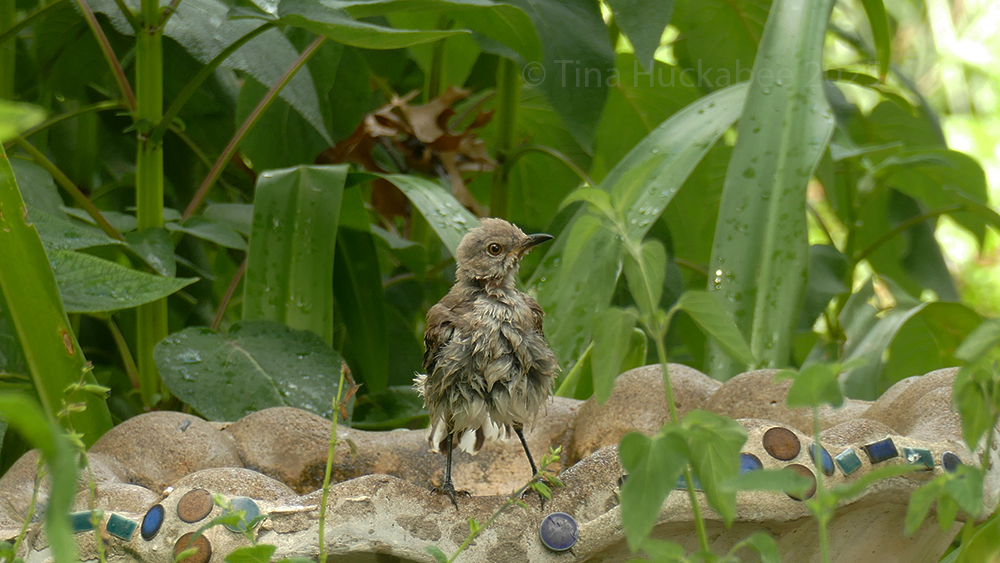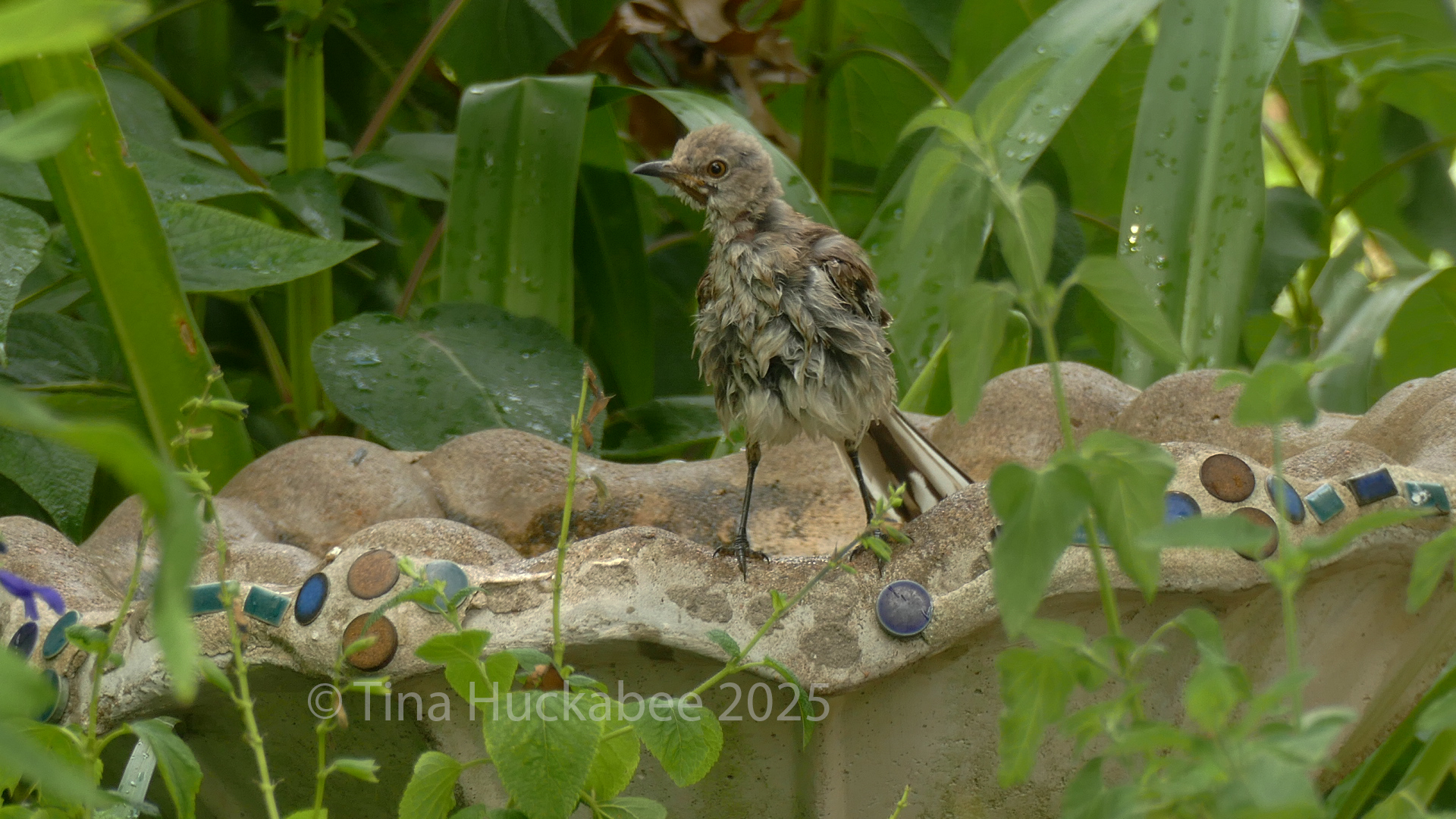
I initially planned to title this post ‘Bathing Beauty’ but realized that title was boring and obvious, and didn’t adequately describe the bird images I wanted to use. I mean, look at this silly goober.
The juvenile Northern Mockingbird, Mimus polyglottos, will become a beauty when older and dryer, but for this particular moment in time, in its wet-n-wild state, it’s a goofy, floofy, cutey bird.
The young Mockingbird, as well as a couple of its elders, have spent time in the back garden recently. Typically, I don’t see many mocks in my back garden, the exception to that observation being during native plant berry season, which has arrived.
American Beauty Berry, Callicarpa americana, is getting its purple on with each passing day. You might notice that not all the berries have gotten the message to change their hues, but enough of the clusters are trading their green for the outrageous purple of maturity and birds have noticed–and noshed.
My two Roughleaf Dogwood trees, Cornus drummondii, also sport berries, though their signature ripe color, creamy white, hasn’t yet appeared. That lack of color change, with its indication of full ready-to-eat ripeness, isn’t stopping the Mockingbirds, European Starlings, or Blue Jays from plucking and gulping, as I’ve observed all three species feeding on the green berries. I guess it’s similar to my eating a peach that isn’t quite ripe, still a little hard, but so delicious that I just can’t help myself.
I hope these resident birds will leave a few fruits for the migratory birds, but there’s probably enough for all who are interested. Besides, the Possumhaw and Yaupon Hollies will be adding their fruit selections to the garden menu in the not-too-distant future.
So bathe away, cutey Mockingbird–and make sure to get your share of the garden snacks!
On a morning when clouds hung low and rain threatened, a Dusky-blue Groundstreak, Calycopis isobeon, posed on a petal. The insect either completed a meal and was digesting, or was contemplating a meal for slurping. It didn’t share plans with me.
The Groundstreak perched, surrounded by sunny rays which brightened the clouds’ gloom. The hairstreak balanced for a time, then took flight and winged to a new spot in the garden.
In June we spent time in New Mexico, re-visiting favorite spots and adding a couple of new adventures to our itinerary. We’ve always wanted to visit Chaco Culture National Historic Park and finally made it happen. Chaco Canyon is located in the northwest corner of New Mexico, bordered on three sides by mountain ranges: the Chuska, the San Juan, and the San Pedro. The canyon was created by the Chaco Wash in the San Juan Basin which is part of the Colorado Plateau. All that geography is very interesting of course, but the bottom line is this: this remarkable place in North America is kind of in the middle of nowhere.
Obviously, this area isn’t nowhere. There are plenty of small communities, pueblos, and farms dotting the dramatic, harsh landscape. But for visitors to Chaco, other than camping in the park itself, most places to kip overnight are a decent drive from the park. We stayed outside of Cuba, a town about 75 miles from the park, the last 13 miles (and especially, the last mile!) a teeth-chattering rough dirt road.
You really must want to visit Chaco in order to get there!
We wanted to and we did!
Appointed a UNESCO World Heritage site in 1987, Chaco is located within a high desert landscape, vast and varied, beautiful even in the mid-day heat. We’d planned to be there at 8am, but events conspired and we rolled into the headquarter parking lot late morning. After checking in at headquarters for information and maps, and a bonus chat with the excellent National Park rangers, there was a short drive to the main pre-Columbian ruins. The remains of these structures are a testament to the thriving community and unique architecture that the ancient Puebloans created. There are outlying ruins and back country trails, but I’ll leave that for more adventuresome travelers (ahem, younger…) and those who visit for more than one day.
Chaco culture existed between about 800 and 1200 CE, eventually declining for unknown reasons. For a time, it was the major trading center in North America and a gathering place for regional ceremonies. The larger great houses, like Pueblo Bonito with its 650 rooms, are thought to have served as public buildings, utilized for a variety of things: food storage, administrative offices, and religious ceremonies. The architecture is particular to this culture, dissimilar to any other ancient sites, especially given the public nature of the monumental buildings.
Like many ancient cultures, Chaco’s architecture reflects knowledge of Earth’s connection to the sky and seasonal changes. We visited the day before the summer solstice and learned that there was an event at 5:15 the next morning, the sun rising at a particular point, aligning with two spiral petroglyphs at the Sun Dagger on Fajada Butte. It’s believed that petroglyph acts as a seasonal calendar. The National Park Service allows a maximum of 100 people for this kind of event and they don’t take reservations. We would have loved to participate, but with no guarantee of admission after a 75 mile drive beginning before 4am, it was a no-go for this vacation. Maybe next time…
The main area of the park includes a drive linking to each of the named sites, including the larger great houses, several smaller ruins, plus a trail and information to view petroglyphs.
Along this main road, drivers park, then hike short distances to the structures for easy, casual exploration, spending as much time at each structure as desired. At the sites themselves, visitors descend stairs and walk through rooms while meandering along ancient pathways. Climbing up other stairs to reach different sections, it’s easy to stop and admire the ingenuity and determination of the ancient Puebloans.
The Husband appreciating the handiwork of the ancient architects and their builders
Some areas are blocked off for safety and to protect from damage and erosion, but most rooms and pathways are accessible and fascinating to traverse, solidly built within this wider canyon. I found myself awed by the skill of the builders.
I think these folks were tiny people!
As hot as it was that day, I enjoyed the moments I found myself in the shadow of a wall, the sun’s blasting rays just out of reach. I imagine when these buildings were intact, with roof over head, windows and doors allowing breezes, that inside was reasonably comfortable.
I couldn’t resist a photo of the native Desert Mallow, Sphaeralcea ambigua, common in many parts of NM and a clear relative to one that I grow in my own garden.
For those who are staying in the campground for an extended visit, there are many trails which lead to other sites in the canyon and up along the mesa which borders the canyon. This is really the best way to visit Chaco: camp in the park, explore in the cool of the mornings and evenings, rest in the heat, and enjoy the stunning sunrises and sunsets in this extraordinary place.
One could easily spend more time in this special place, but even with only one hot day in June, we were impressed with the primary sites we visited. Standing in the midst of the main architectural ruins, the surrounding area beautifully quiet, except for the whispering of the gentle breeze, it wasn’t difficult to imagine the bustle of a vibrant community, the mass of individuals over many generations who designed and created this remarkable site, and who lived their lives here–real men, women, and children–offering their gift to this important chapter in the history of North America.
The Chaco culture exists today, with stories passed down from generation to generation, included in this list of modern indigenous communitiesof the Southwest.