Bee Mama Missive: Mufasa No More

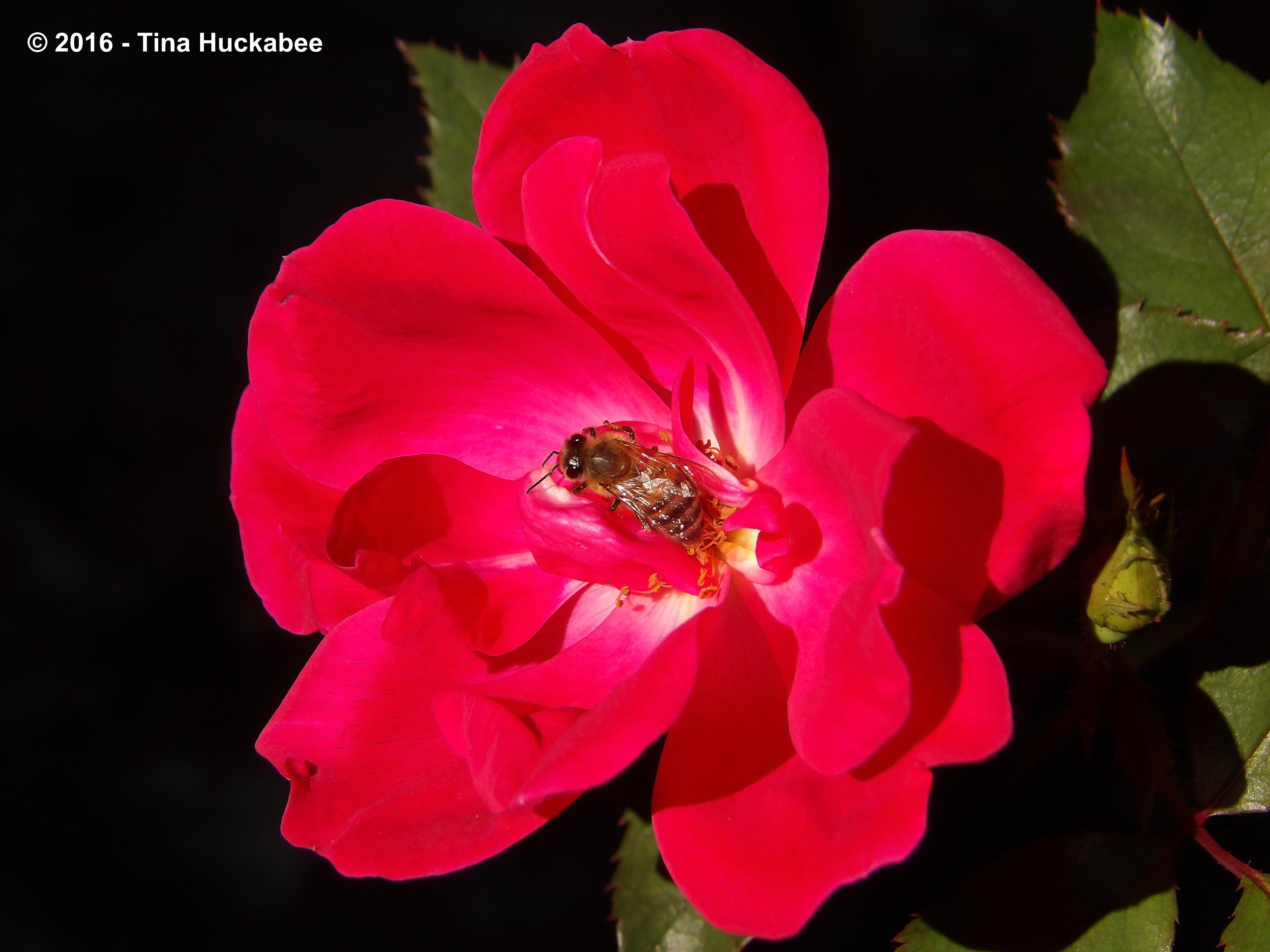
Mufasa, one of the two beehives that Bee Daddy and I have fretted and fussed over, has died, or if not dead,  is mostly on her way out.  Unlike her namesake, she wasn’t pushed off a steep edge by a rival, but sadly succumbed to an all too common infestation of honeybees:  varroa mites.

That’s what we think, anyhow.  In December, long after our last hive check of the year before the days grew chilly, I was out and about in the back garden.  I noticed some bees crawling along an open space in the garden a little ways in front of where Scar and Mufasa are situated.  Then I realized that it was more than just a few bees–indeed, there were hundreds of bees crawling along the ground.  I observed this massive and confused exit from the hive for several days, reading what I could about what I was observing.  I contacted a leader of the Austin Area Beekeepers Association and he confirmed what I suspected:  my honeys were abandoning the hive because of sickness from a varroa mite infestation. Varroa mites, Varroa destructor, are probably the greatest single threat to honeybees.  The mites have a complicated life cycle, but essentially they  feed on the blood of adult bees and the brood, causing disease, deformities, and general mayhem in honeybees.  I didn’t witness any deformed wings which is a common visual symptom of disease, but Mufasa’s honeys exited the hive in droves and that’s another sign that the bees are infected and dying.

The honeybee expert I consulted called the  honeybees leaving Mufasa, “walkers.”

Zom-bees.  That can’t be good.

Not only were the bees walking out of the hive, but they were dying in droves.  They died along the landing board,

IMGP3287.new

IMGP3285.new

…and were in piles on the ground around the beehives.

IMGP3288.new

Sob.

My bees are BeeWeaver bees, touted as  varroa resistant through genetic selection of queens resistant to the varroa mites.  Of course varroa resistant doesn’t necessarily mean varroa proof.  BeeWeaver claims that fewer than 5% of their queens will succumb to varroa mites and apparently, Mufasa’s queen landed in that statistical range.

BeeWeaver bees are the descendants of bees who survived the initial onslaught of varroa mites in the late ’80s.  An idea behind their survival is that they’re particularly tidy bees and they rid themselves of varroa when the varroa arrive–and sooner or later, varroa mites will arrive.  Varroa mites are the biggest invasive scourge that North American honeybees and their keepers must deal with.  Bee Daddy and I have been fortunate–this is the first hive we’ve lost in the almost two years since we began this buzzy backyard adventure.

In fact, in early summer of 2014 shortly after we started beekeeping, we removed a couple of frames of comb from one of our new hives and on some of the larvae  I saw several  varroa mites; I just knew that the hive was a goner right then and there. But true to their varroa resistant genetics, the bees rid the hive of the mites and the hive continued successfully,  despite occasional (some might say, constant) beekeeper ineptitude.

Until now.

I think my mistake was in assuming that my bees were immune to an infestation, rather than keeping a keen watch on the goings-on of the hive, year-round, winter included.  I became a complacent bee keeper.

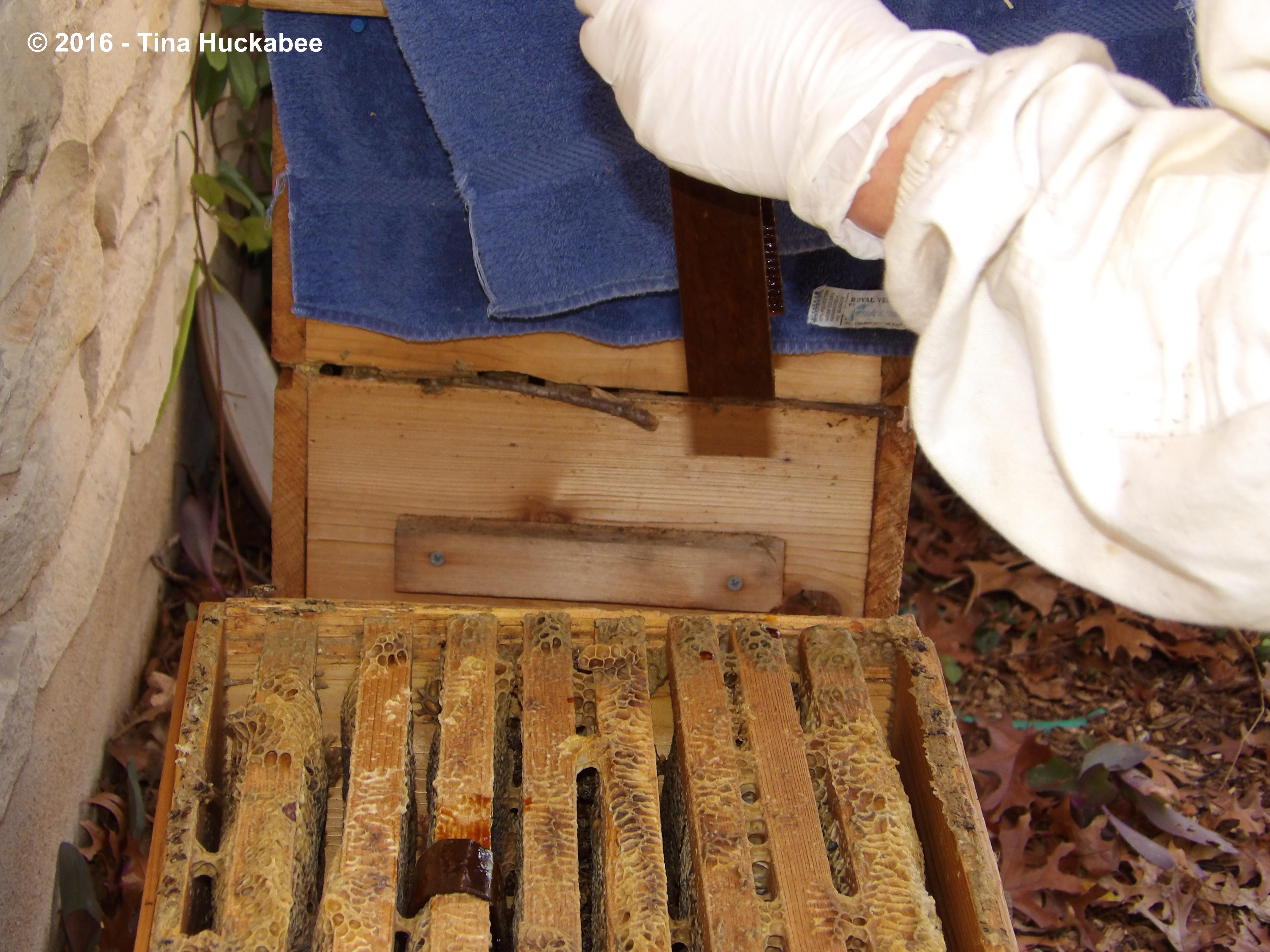
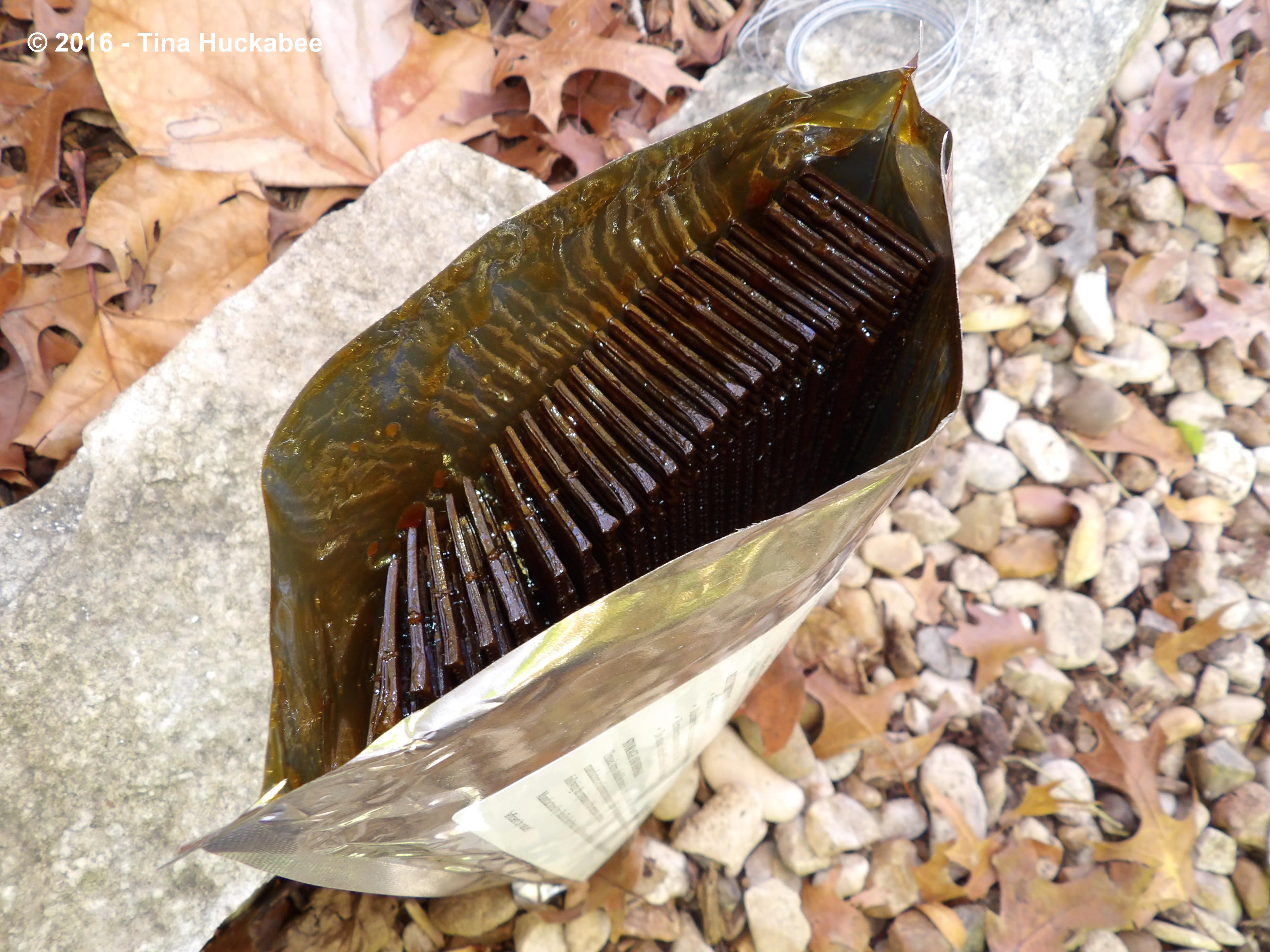
We treated Mufasa with an organic product called HopGuard II, which is made from hops.

IMGP3340.new

Apparently, beer helps all situations.

HopGuard comes in a sealed package and contains a series of strips coated with a thick and sticky hops solution.
IMGP3346.new

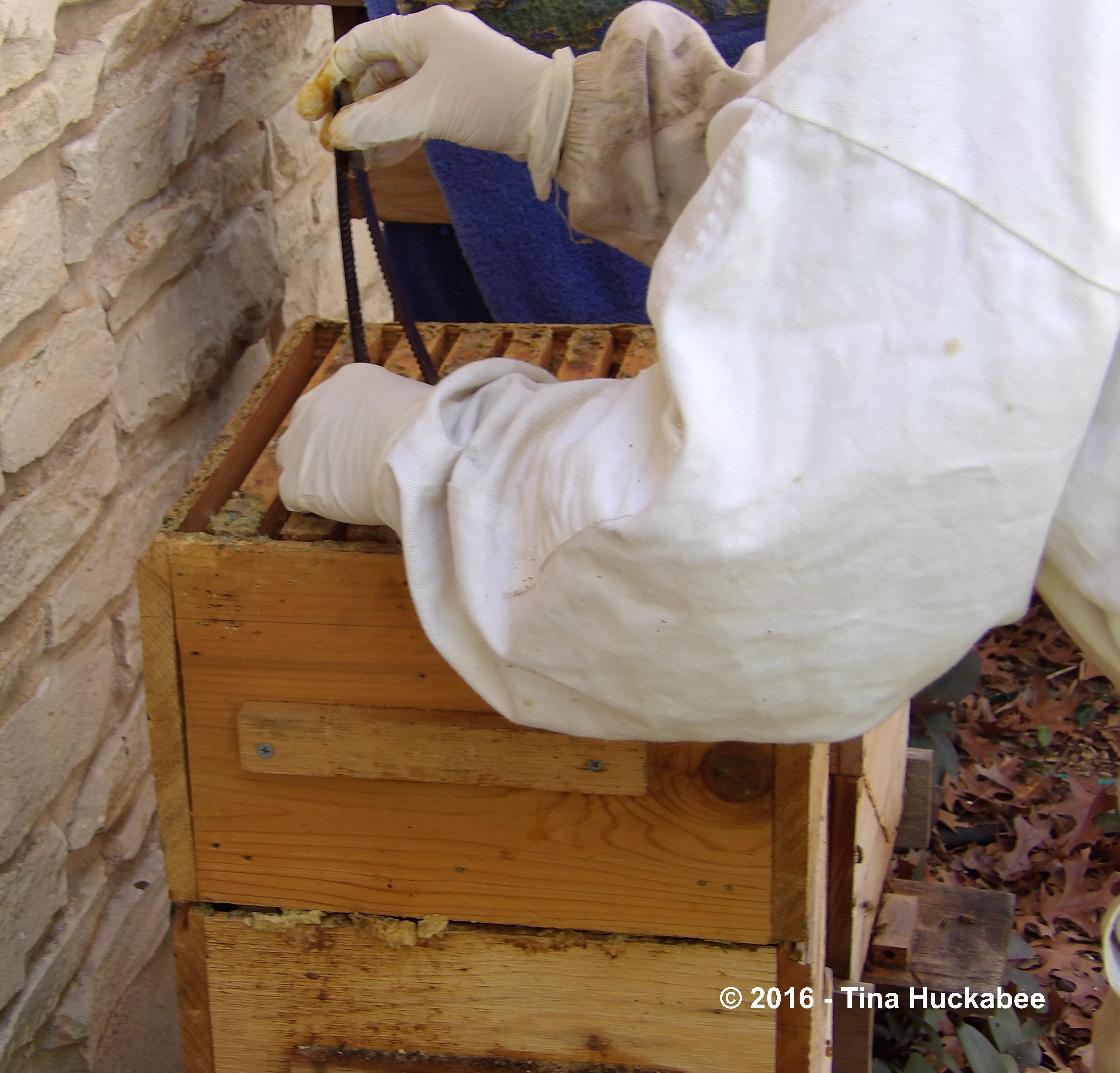
We placed two gooey hops strips in each box of each beehive, each draped over a comb.
IMGP3355_cropped_3419x3276..new

IMGP3351.new

IMGP3353.new

Though not showing any symptoms of infestation, we treated Scar because as Mufasa was dying, she was also robbed of her stores of honey (yes, honeybees do that) and it’s possible the mites could migrate from Mufasa to Scar if we don’t stay ahead of the mite situation.
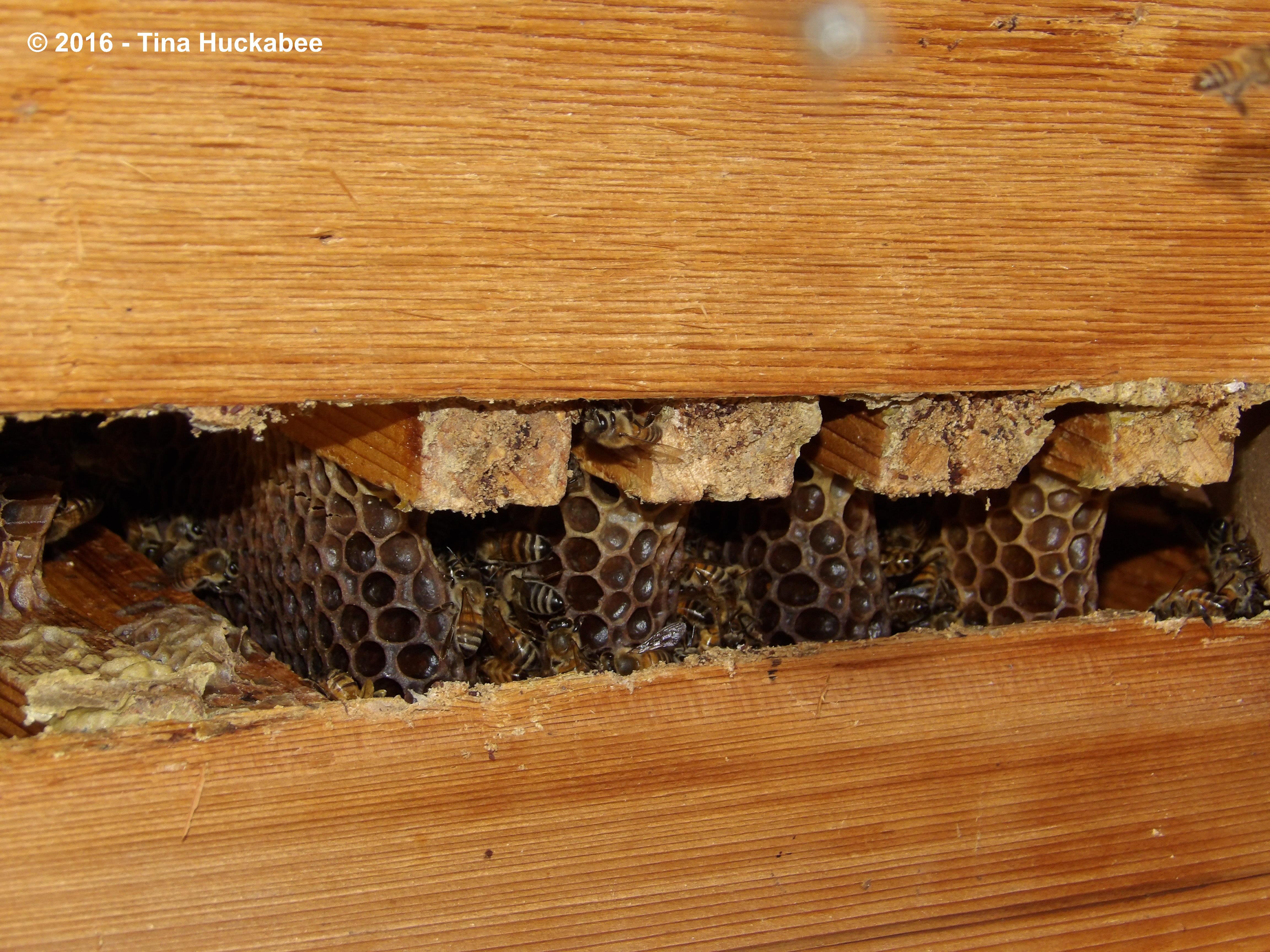
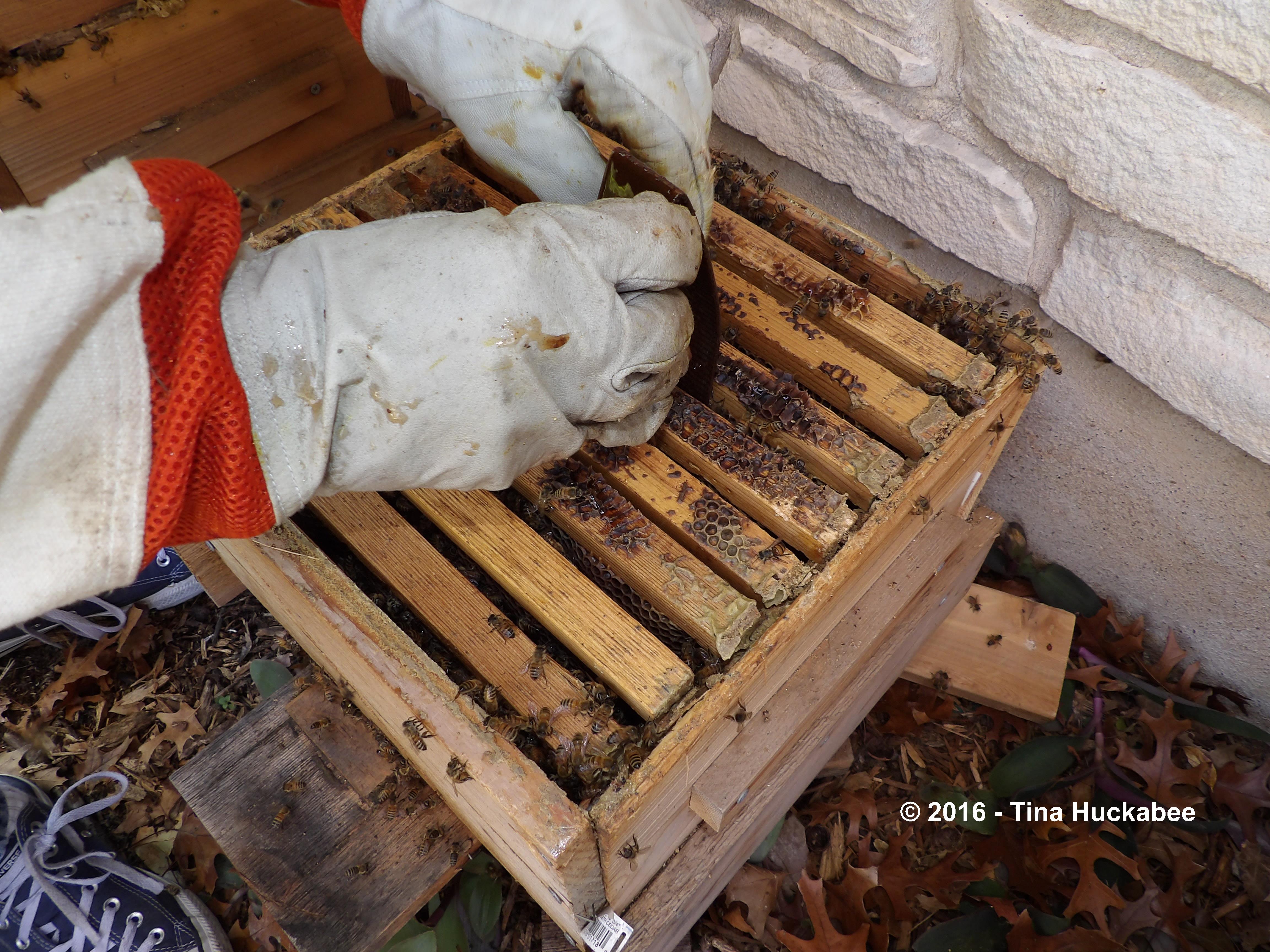
IMGP3373.new

IMGP3375.new

IMGP3376.new

In this picture,

IMGP3514.new

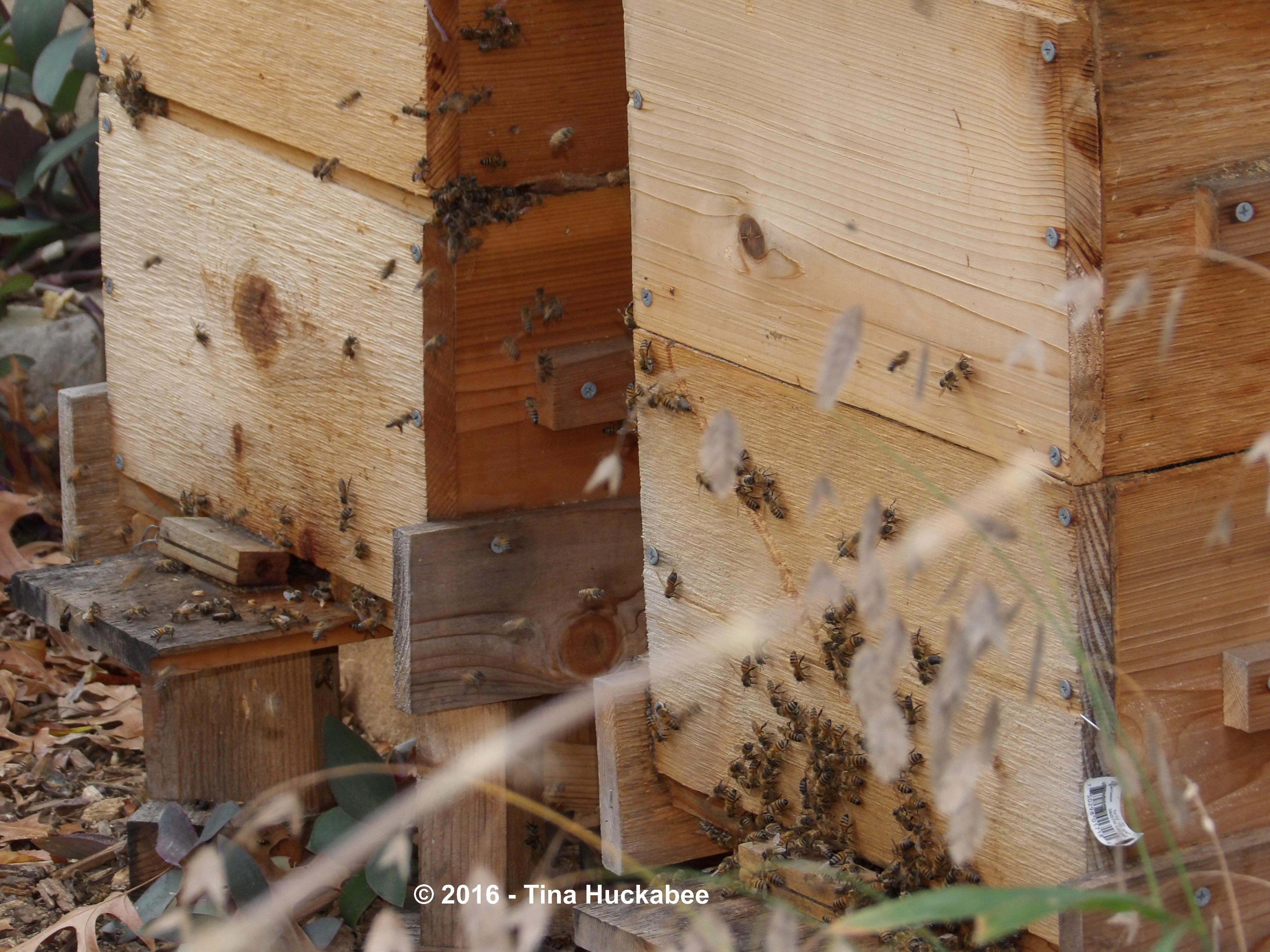
…there are lots of bees buzzing around Mufasa (left in the photo), but this was taken after many (most?) of Mufasa’s bees absconded and died.  I’m guessing that the bees are Scar’s bees, or even bees from another nearby hive, robbing poor Mufasa with abandon.

The HopGuard procedure was simple enough, though it’s messy.  I could smell the grainy fragrance for a day or so afterwards.

For the moment, Scar appears healthy and we’ll treat with HopGuard II again when temperatures are appropriate.  I’m sad about Mufasa’s death, but life is full of loss and one must learn from experience and move forward.  If we’re going to lose a hive, now is not a bad time.  Bee Daddy is busy making two new Langstroth hives and we’ll have two new  honeybee packages (mated queens each with 10,000 workers) delivered in April. With our plans in place to hive new honeybees in more easily managed and efficient hives, we were going to let Scar and Mufasa just…bee,  allowing them to swarm (if they want) or to just hang out to pollinate and nectar as they see fit.  For Scar and Mufasa we would become honeybee havers rather than honeybee keepers.

There is a bit of activity in Mufasa even now, though very little; the difference between Mufasa (left) and Scar (right) is telling.

IMGP3379.new

As of this post, I haven’t opened the hive up fully since treating with the HopGuard, but I did peek in about 10 days after treating and things were very quiet, certainly in the top two boxes–I can’t  see into the bottom box.  There was no buzzing and no concerned guard bee coming to the top to check me out, bum in the air ready to warn the rest of the hive of an invader, so I’m guessing there’s little life left. If this winter continues mild, it’s possible that there might be a bit of Mufasa by springtime, but I’m not hopeful about that.  We’ll just have to wait, be patient, and accept the outcome.

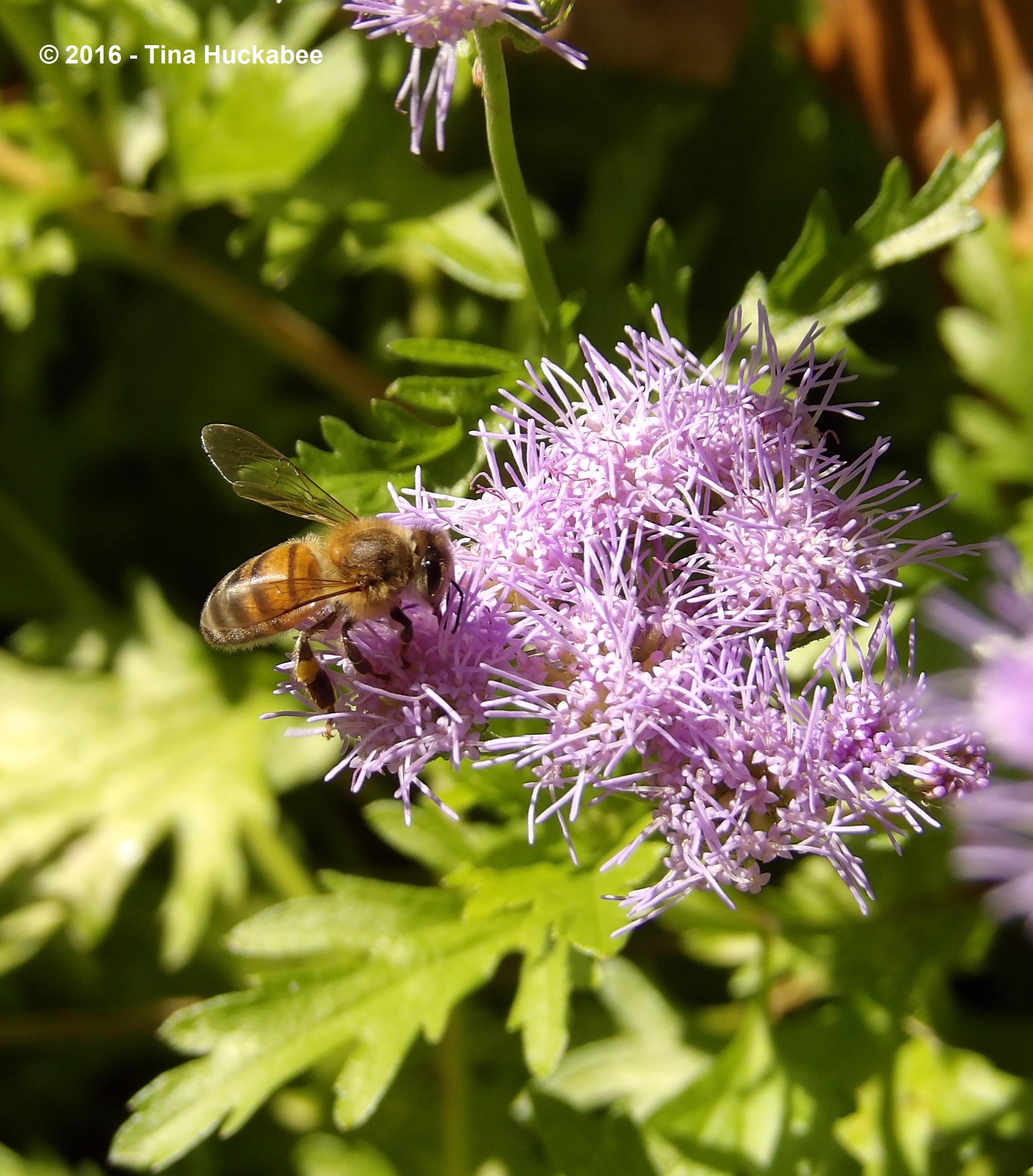
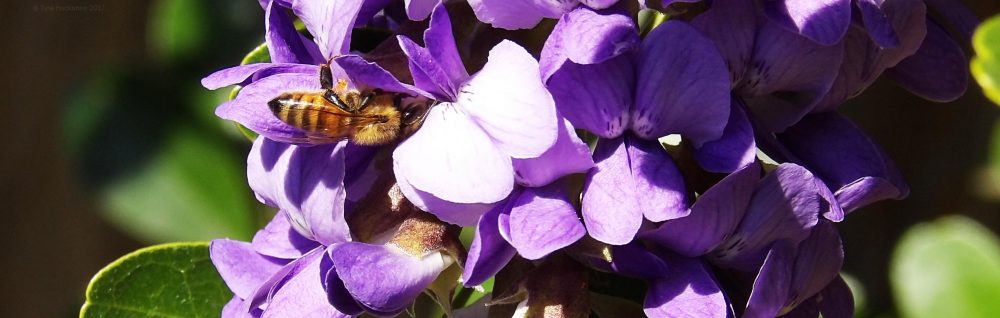
In the days that followed the revelation that we were losing Mufasa, I was out dealing with  leaves in the garden.  I spied a probable drowned honeybee in one of my birdbaths.  I hate to see their floating bodies, so I always fish them out and deposit them in a garden;  a garden  seems like an appropriate resting place for a dead bee.  This little girl vaguely waved a leg at me, so I cradled her in my palm in the hopes that my warm skin might revive her,  all the while depositing rakes and other garden utensils in their appropriate places with my other hand.  Within about 5 minutes, she’d revived, was licking off the offending bird bath water and then, without so much as a by-your-leave, she flew off to  her next pollinating date.

The resilience of that little bee was affirming in the wake of Mufasa’s death.  Her drive to live  and continue her community responsibilities and her acceptance of life in that moment, was touching and a good reminder of the importance of purpose.  It’s been a transformative adventure to learn about honeybees–to work in the garden closely with them and to learn about their remarkable lives.  Becoming a backyard bee keeper has also strengthened my commitment to providing for native bees and all the other pollinators so important to the health of our ecosystem.  I’ve loved and planted native plants, focusing on gardening for wildlife in my personal garden and beyond. By actively encouraging pollinators to live and breathe in my gardens by what I choose to plant–or not–I hope to continue an intentional repair of the world, in my own small space, giving respite and nourishment to wildlife despite occasional losses and setbacks.

Lastly, Bee Weaver shared a lovely and locally produced film by  Dylan Tidmore profiling two Austin beekeepers, Tanya Phillips and Chuck Rayburn–and of course, the real stars of the production: honeybees.

Enjoy…learn…appreciate.

Tree Following in January: Big Dudes

The American Sycamore,  Planatus occidentalis, has big dude leaves.

RICOH IMAGING

It has a few little dude leaves too.

RICOH IMAGING


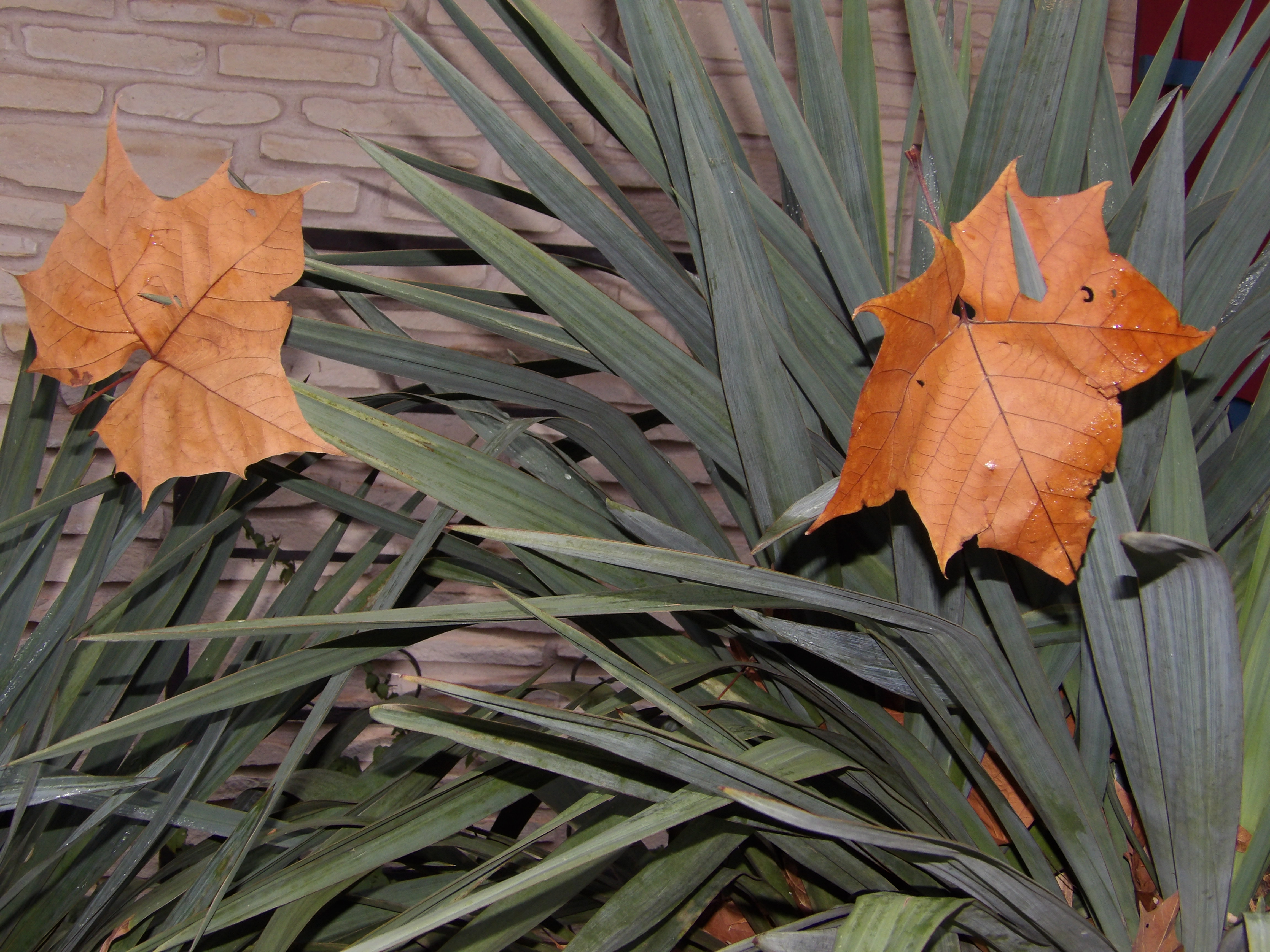
My Sycamore still hosts some leaves, both big and small, though most of its leaves are now on the ground.RICOH IMAGING

Shed has shed.

RICOH IMAGING


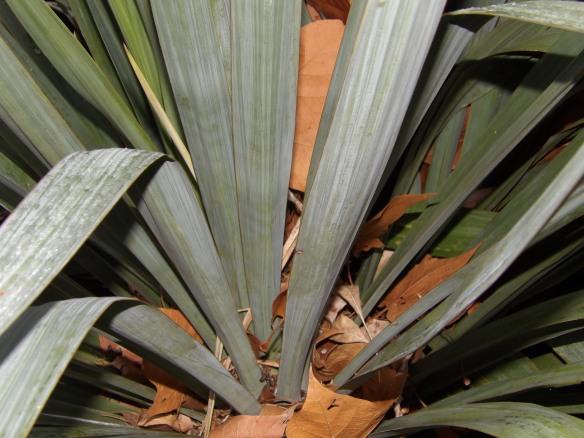
There are leaves over, under, and around shrubs, yuccas and all manner of plant material, as well.

RICOH IMAGING

RICOH IMAGING

RICOH IMAGING

RICOH IMAGING


Some have sacrificed their all for the life cycle of the deciduous tree.

RICOH IMAGING

In December’s Tree Following post, the Sycamore’s foliage had begun its autumnal color turn, courtesy of the slow down chlorophyll production and the visual uptick of carotenoid manufacture, but now that turn is essentially complete and leaf function for the tree is concluded for the year.  In botany, the process of leaf drop is called abscission.  Leaf drop typically occurs in late fall and winter, mostly in response to the lessening of light, but also in response to colder temperatures. Abscission also happens during tree stress and, despite its native tree status, the American Sycamore stresses during the hot and dry Texas summer months, some years more than others.  Many of these leaves dropped during July and August when our temperatures soared and the rain ceased.

RICOH IMAGING

RICOH IMAGING

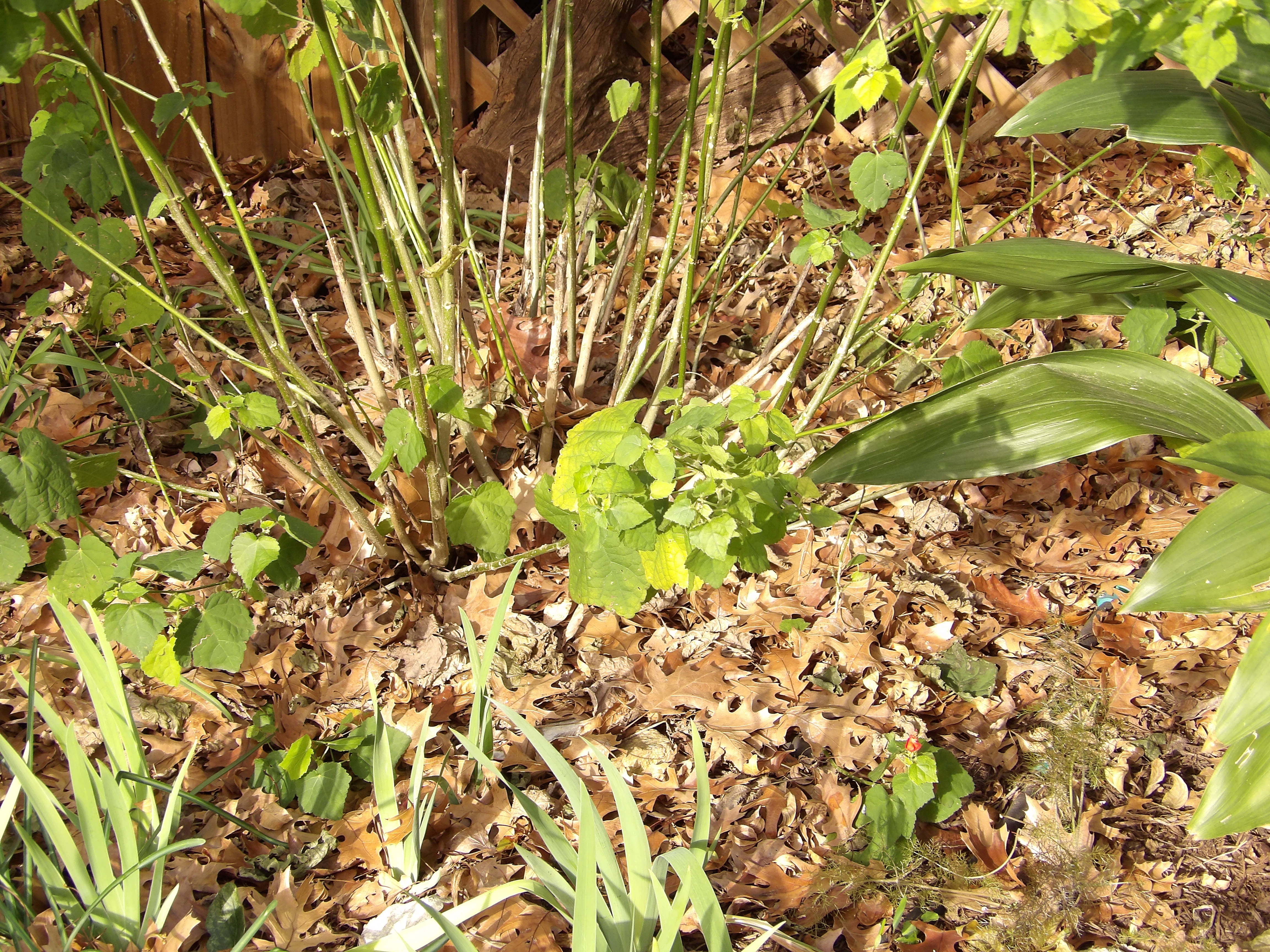
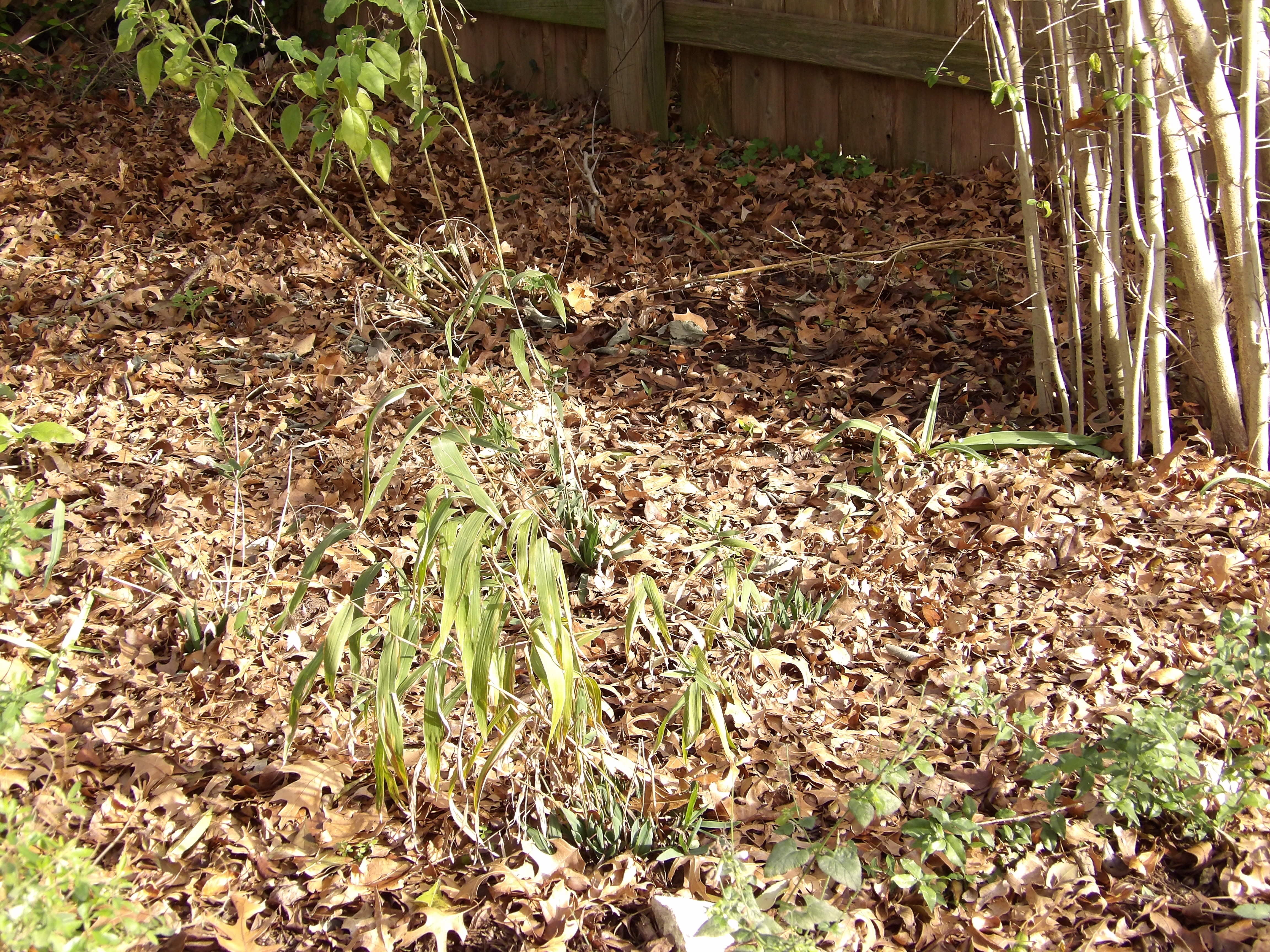
Except where I find them annoying (clustered ahead of the front and back doors, ready to hitch a ride on the dog’s fluffy tail or to get blown in with the slightest puffy breeze as the door opens), I allow leaves to stay on the ground to become leaf mold and to decay.  That’s especially true in the wildscape part of my urban property which doubles as a work area.

RICOH IMAGING

Leaf litter, as part of a wildlife habitat philosophy, is a good thing.  Somehow in the past decades, American society was sold on the idea that leaves on the ground are bad and ugly and must be aggressively removed.  With great fanaticism, we crank up the gas-guzzling blowers and mowers, add massive noise levels to all of our towns and cities, and spew fossil fuel exhaust into our world to rid ourselves of the offending masses of leaves.  Whatever happened to using a rake?

Yes, dropped  leaves are a little messy to the human eye,

RICOH IMAGING

RICOH IMAGING

…but leaf litter serves as mulch, as protection for insects during winter, and a part of the system of biological breakdown–all good for those who make nature their home.

RICOH IMAGING

Within reason, I let leaves lay where they fall. Giving in to my neat-freak tendencies and urban neighborhood standards,  I vacuum up large leaves (Sycamore and Oak) with an electric (though still noisy) shredder and place that shredded stuff in spots of my gardens,

RICOH IMAGING

RICOH IMAGING

…pathways,

RICOH IMAGING

…and compost bin.

As for the last of the leaves, especially the larger of the Sycamore beasties, I rake them up along with other garden detritus for yard waste pick up.  No worries  about garden “waste” being buried in a municipal landfill, the ex-garden stuff will be combined with treated sewage sludge and sold as a soil amendment.

RICOH IMAGING

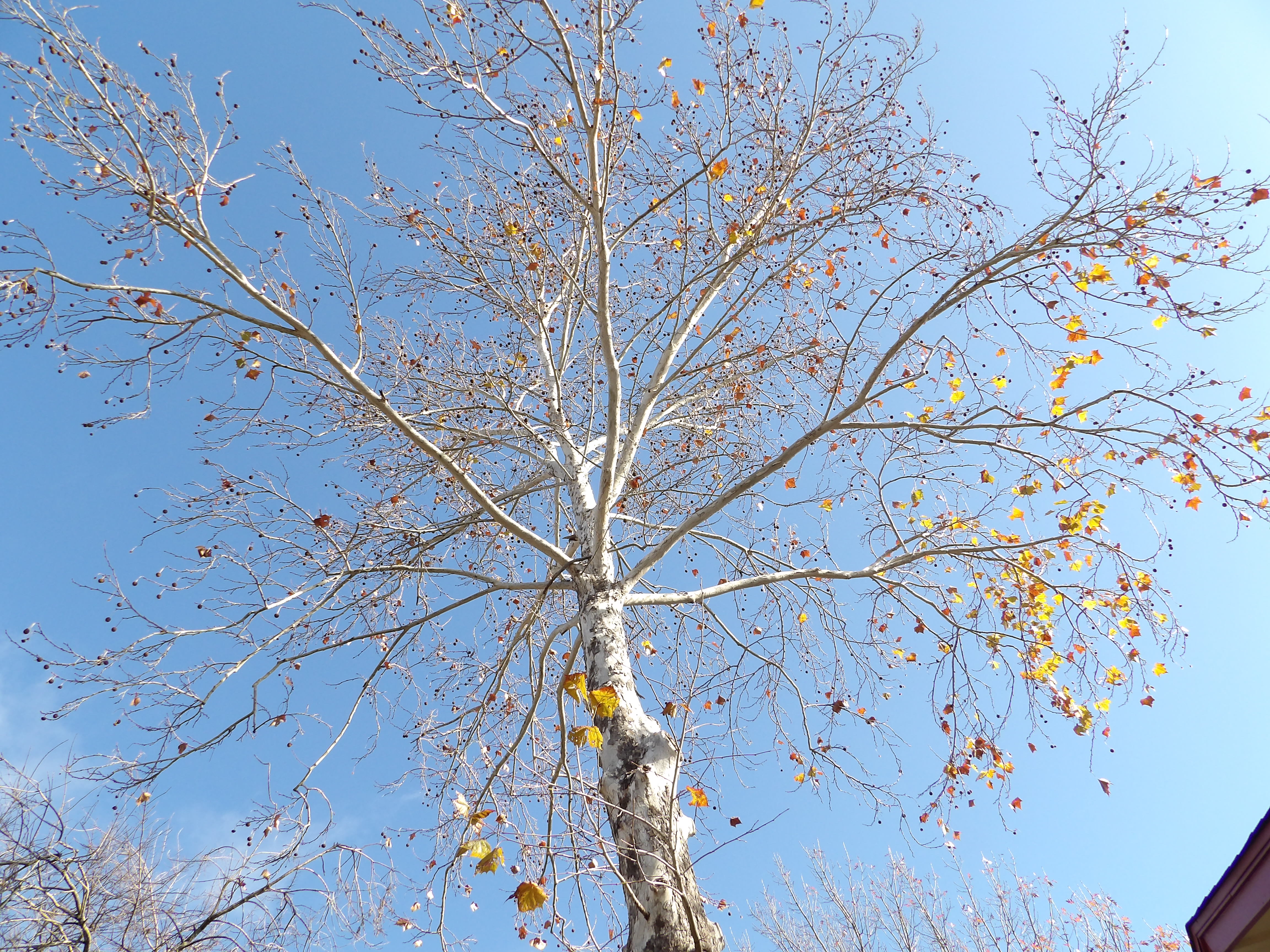
My American Sycamore is nearly barren of foliage now. Leaves have blown away, are blanketing gardens and pathways, or are mingling with other rotting material in the compost. Abscission is when the cells connecting the leaf petiole to the stem are sufficiently weakened and the leaf breaks from the branch. This process naturally occurs over the course of the growing season and when the cells are done-for,

RICOH IMAGING

…so are the leaves on the tree. Though most are down, some of my Sycamore leaves hang tough.

RICOH IMAGING

I expect the hangers-on to drop soon–today, tomorrow, this week–soon. Then all that will be left will be those dangly, decorative seed balls. Shall we count them?

Perhaps that’s better left until next month.

Many thanks to  Pat at The Squirrelbasket for hosting Tree Following.  Please pop over to her blog and learn what her tree and many others are up to for January’s Tree Following.

Wildlife Wednesday, January 2016: All About Birds

Welcome to a new year, with new beginnings, and new wildlife to observe and learn about.

How exciting!

In my gardens, this past month’s wildlife happenings have been all about the birds.

IMGP3020.new

Yes, I know that’s not a bird.  Nor are these.

IMGP3082.new

IMGP3094_cropped_2608x2968..new


But this handsome devil is most definitely a bird!

IMGP3278.new

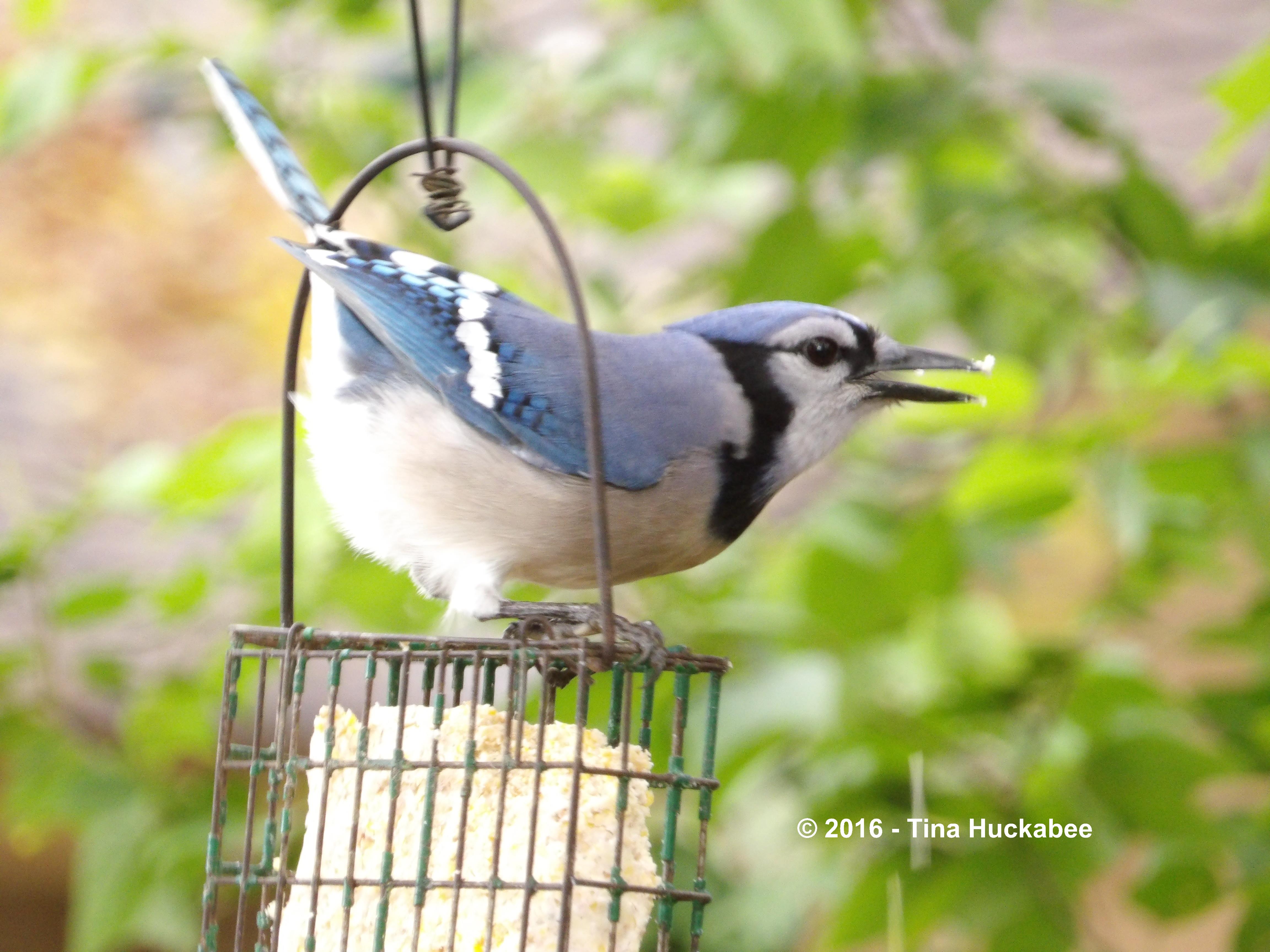
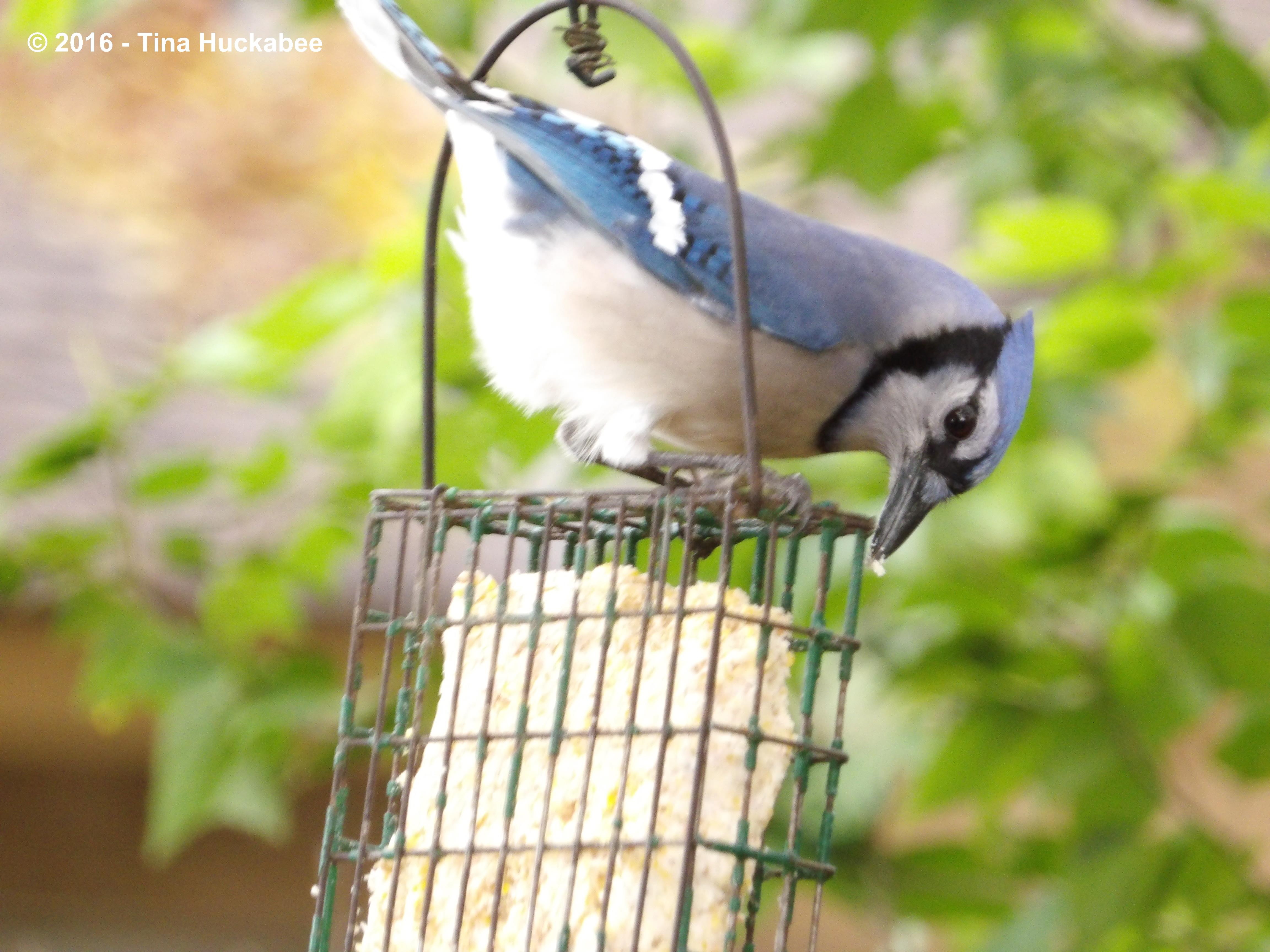
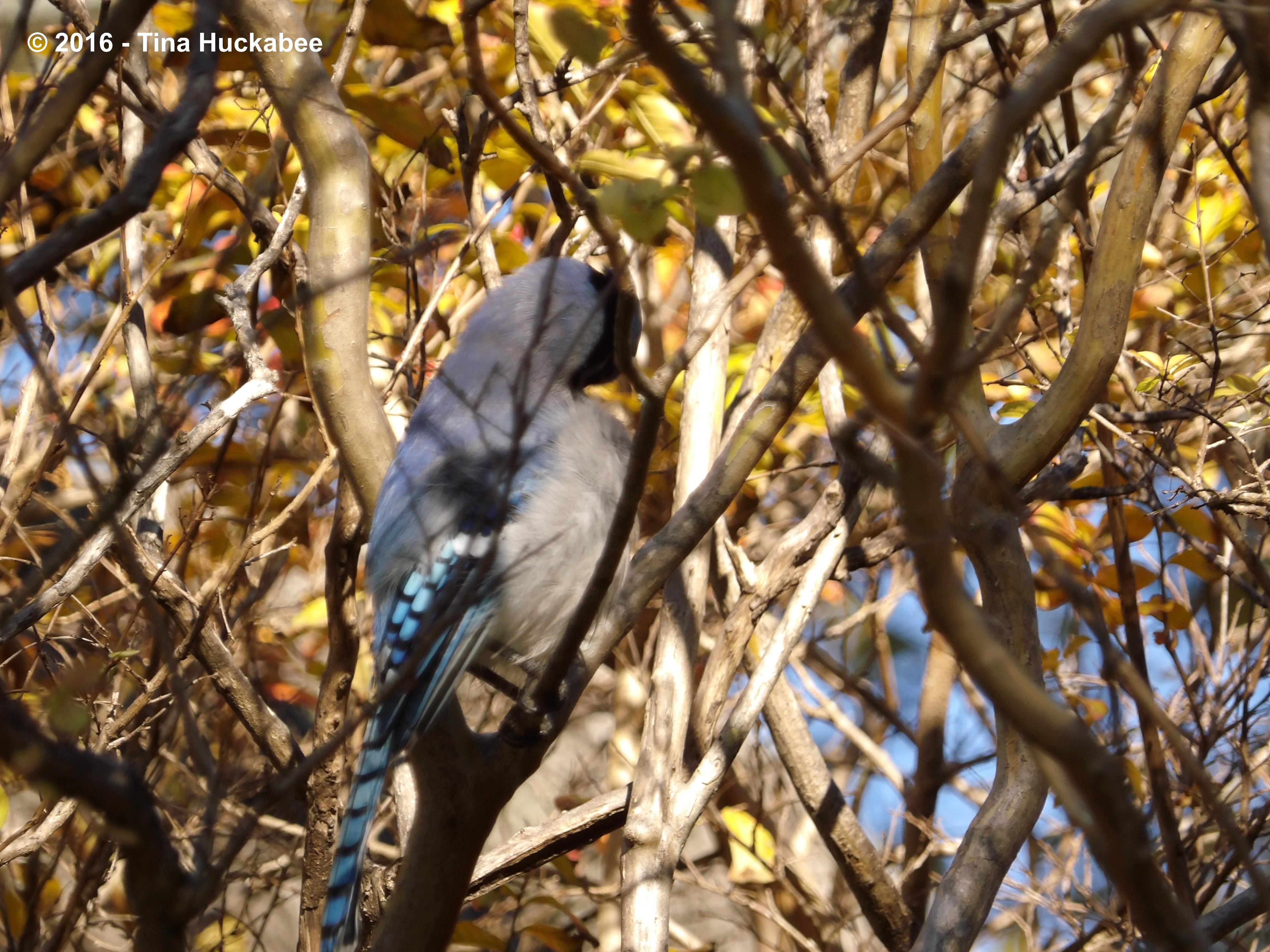
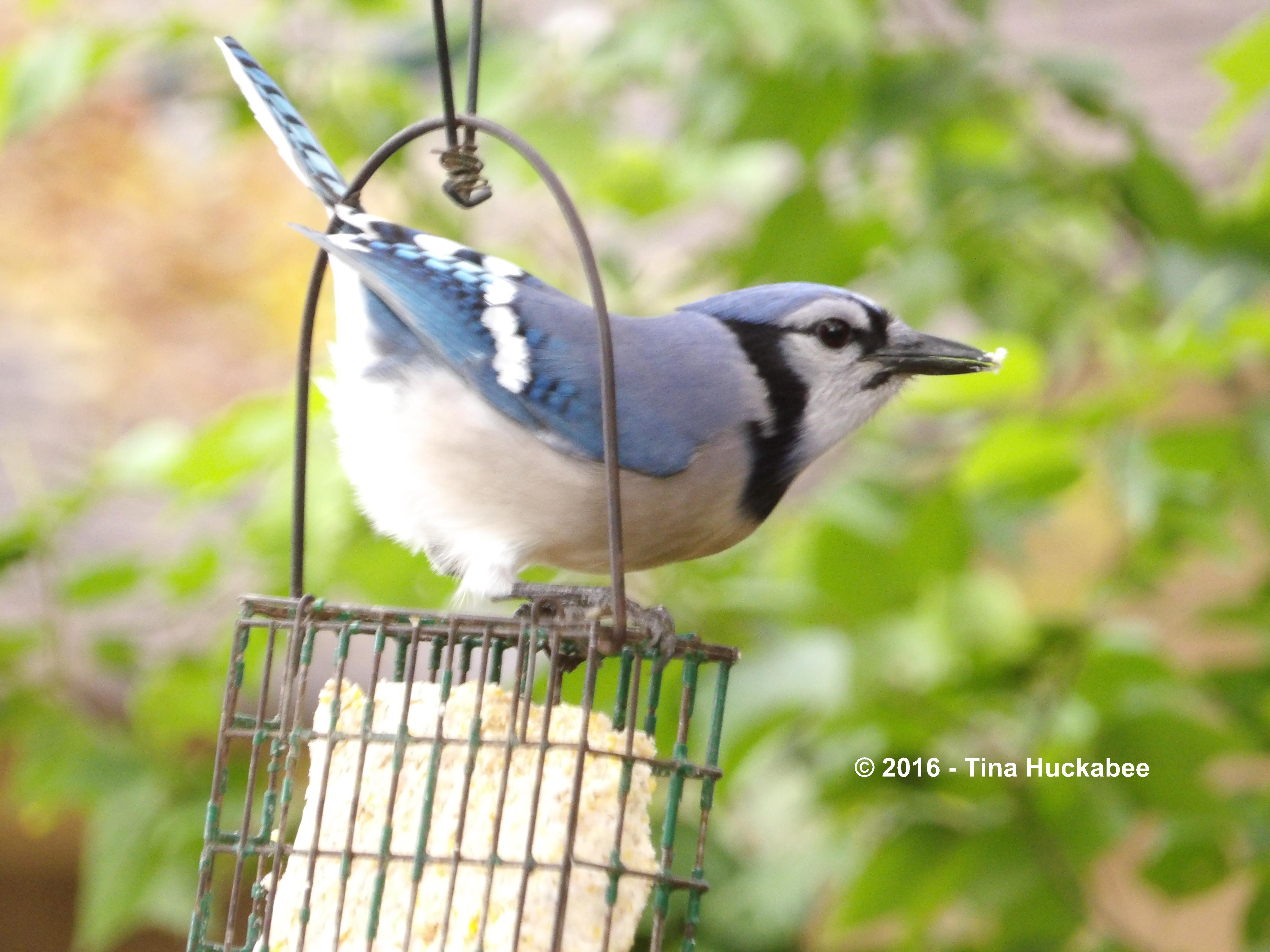
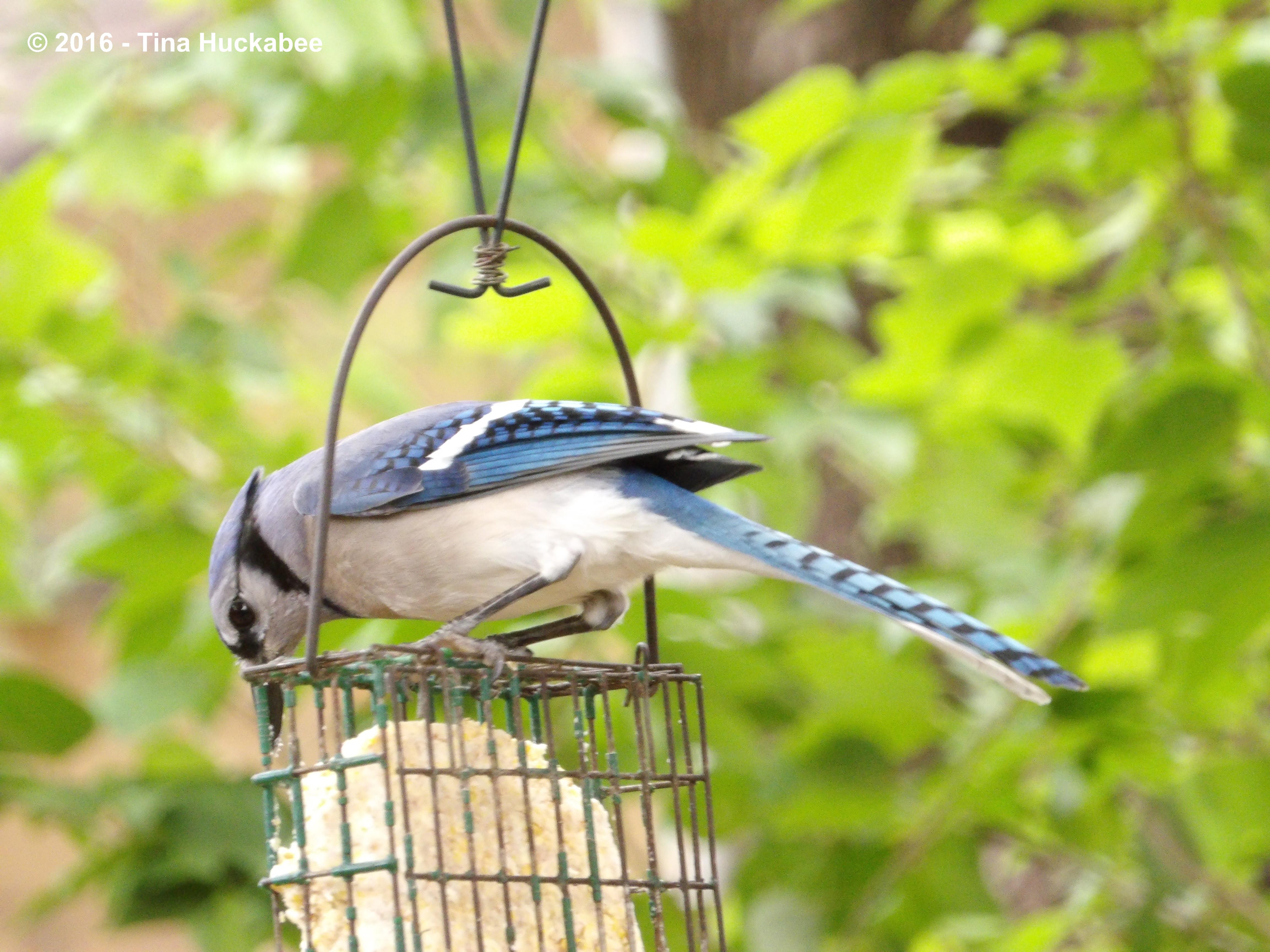
There are a number of native Blue Jay birdsCyanocitta cristata, who fly through my gardens, stopping on a regular basis to nosh,

IMGP3283.new

…and preen.

IMGP3106.new

Beautiful birds, Blue Jay males and females are difficult to tell apart.  Their feathers have the pigment melanin, which is brown, but the blue that we see and admire happens because of scattered light through specialized cells along the feathers.

Lots of folks don’t like Blue Jays because they are assertive and noisy, but I’m quite fond of them; their cheeky personalities and gorgeous good looks always cheer me.  I miss the flash of blue when I haven’t seen one swoop through the garden in a day or two, though their not being part of the landscape is rare.  Blue Jays are intelligent birds with complicated family structures and there’s still much that ornithologists don’t quite understand about their family habits and migration patterns.

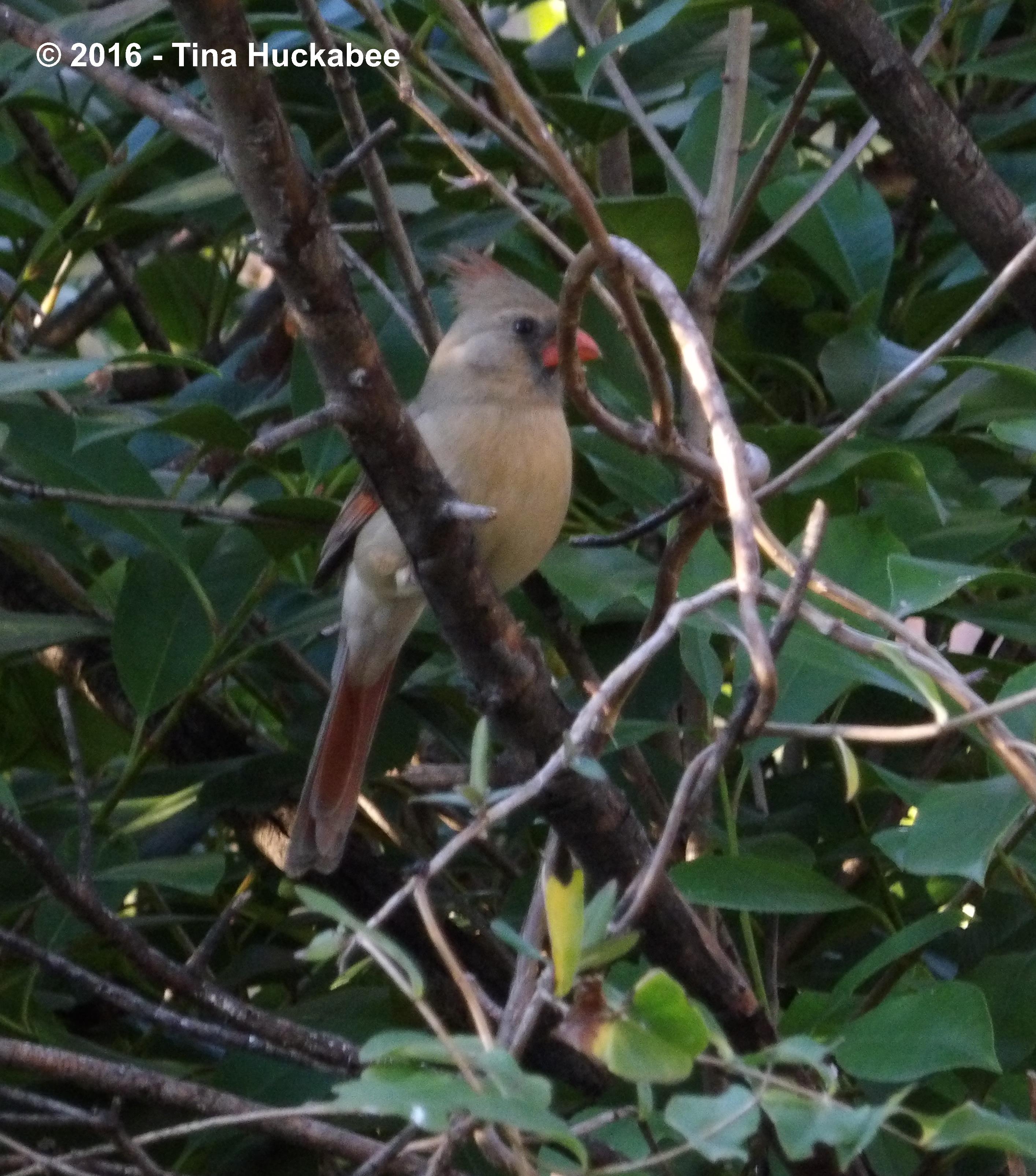
Occupying a different spot of the color wheel is this lovely girl,

IMGP3102_cropped_2829x3212..new

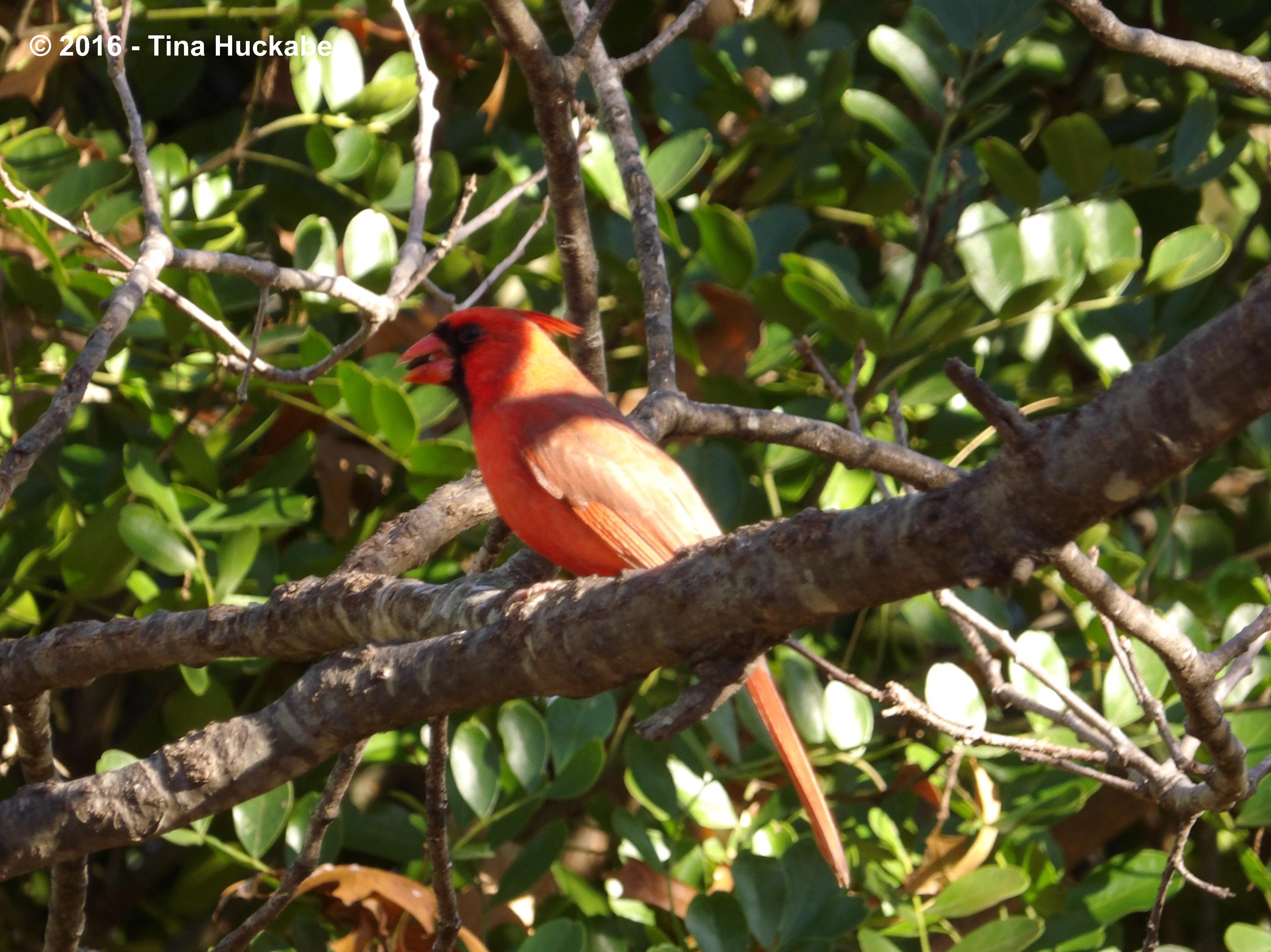
…and her male counterpart.

IMGP3613_cropped_4276x3203..new

Northern Cardinal,  Cardinalis cardinalis, birds  are common throughout  North America and adapt well to the backyard wildlife habitat.  There are two nesting pairs in my part of the neighborhood. They nest nearby and visit my gardens and feeders daily.  During summer, I’m likely to see dad training up his youngins’ on the best places to eat in the neighborhood and how to avoid the neighborhood cats.

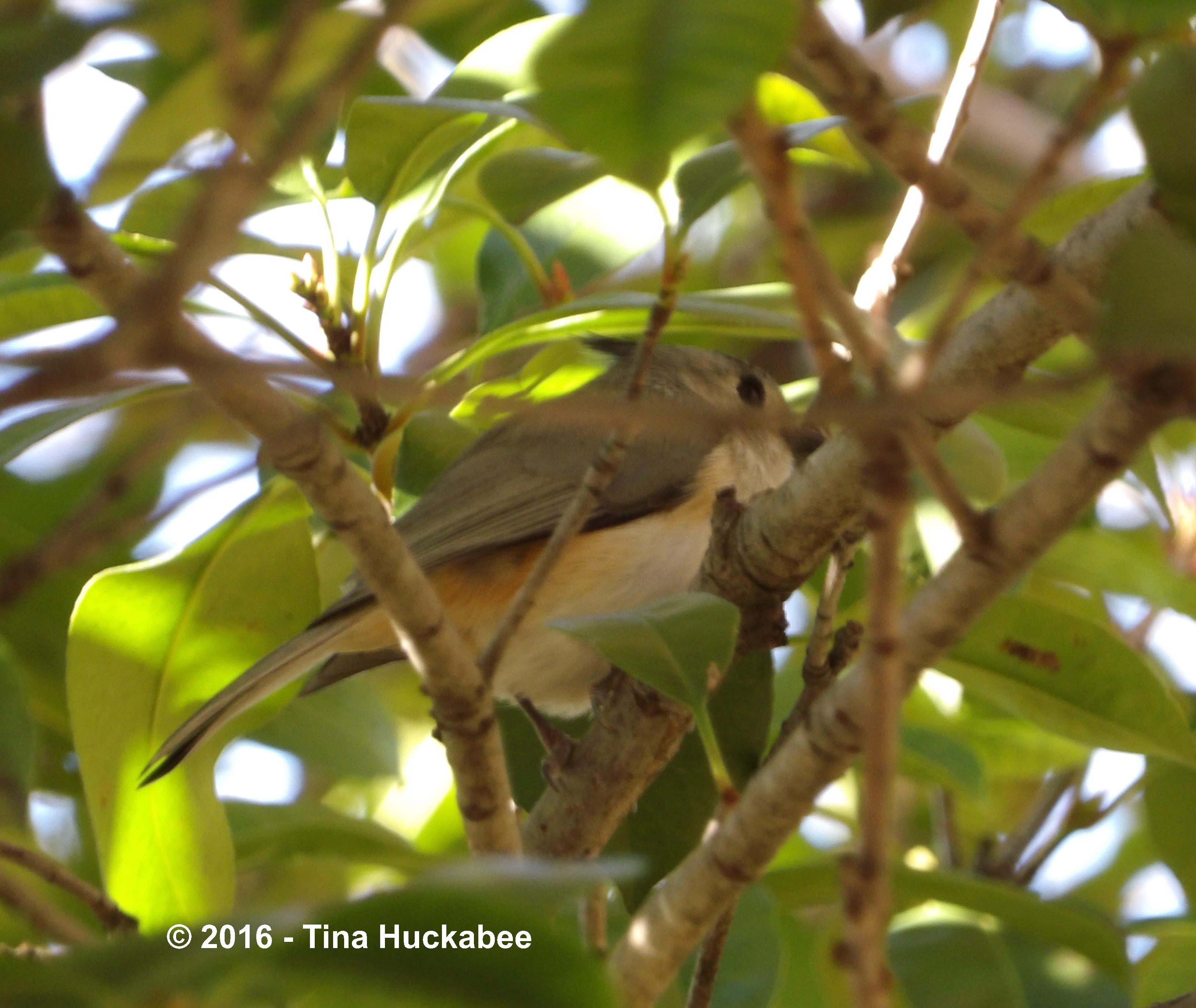
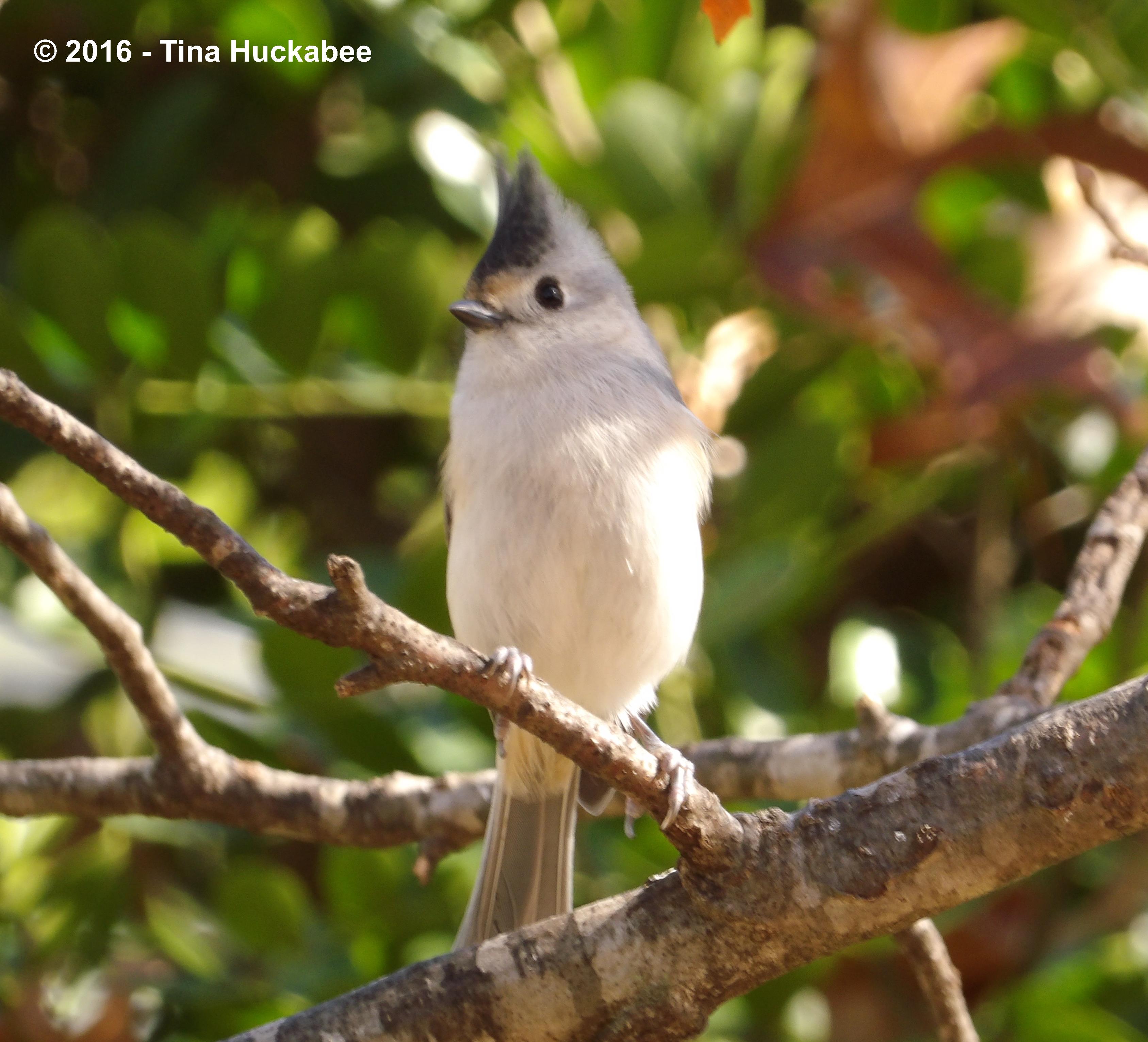
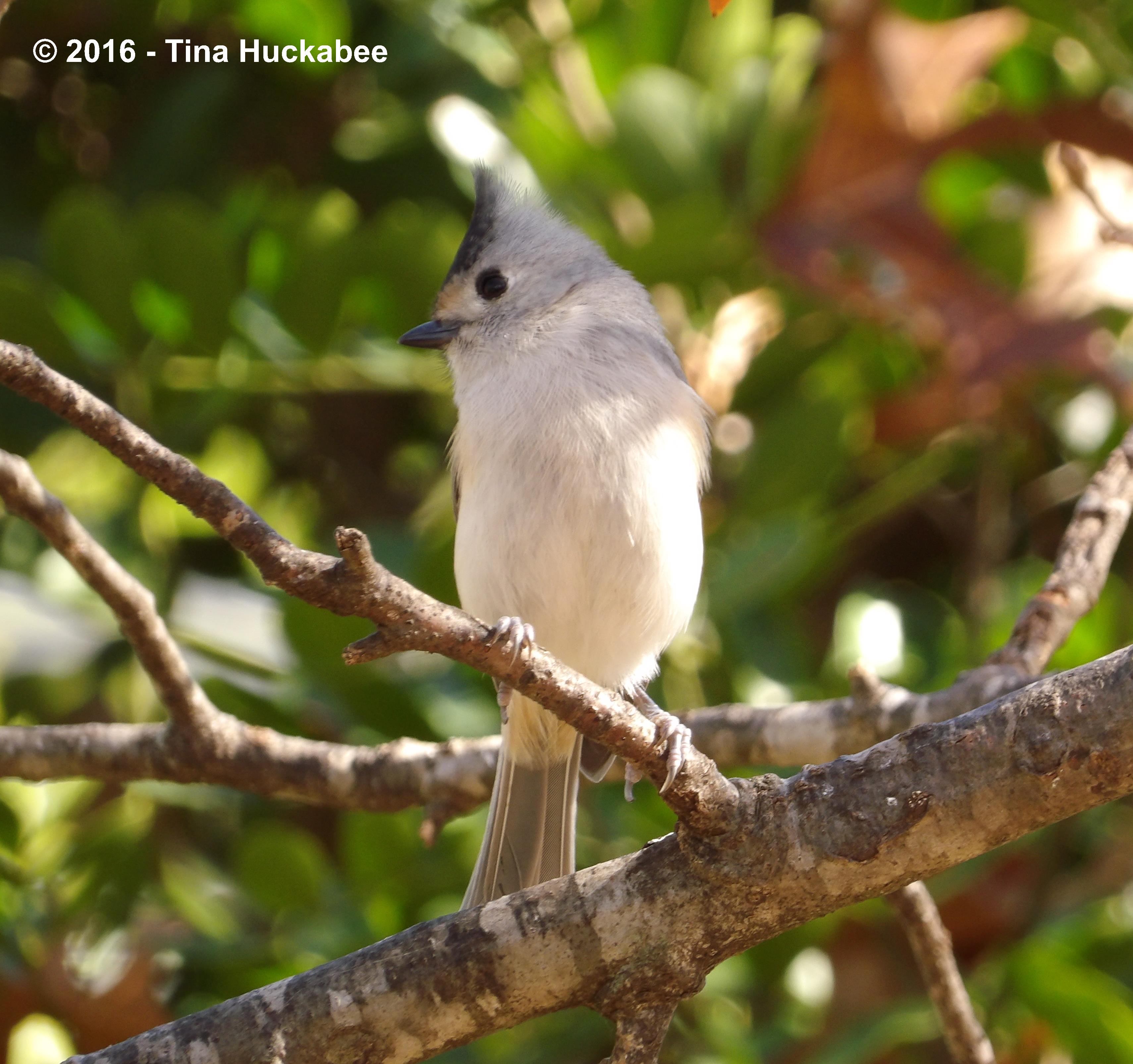
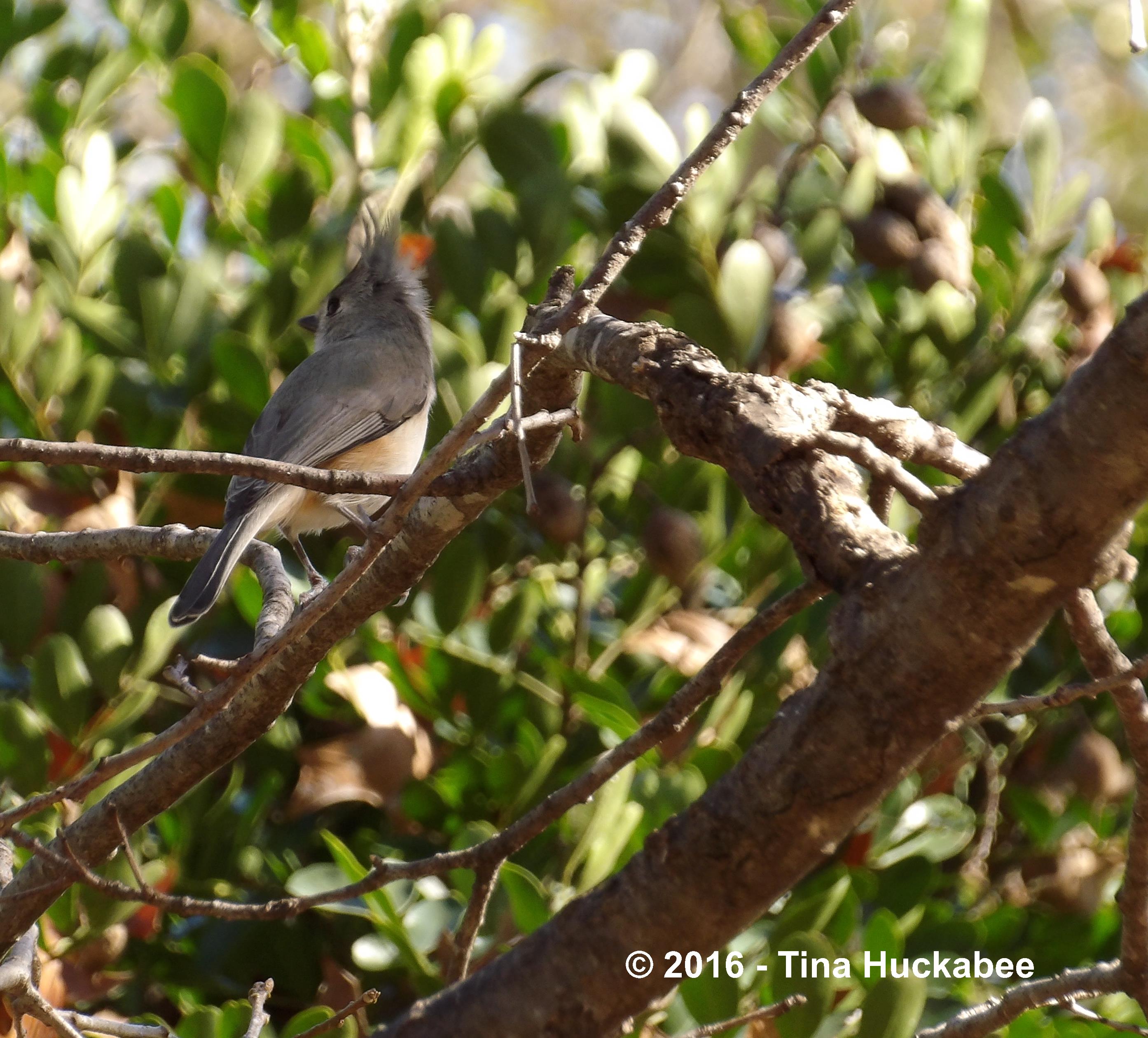
Last month, I attempted photos of the Black-crested Titmouse(s), Baeolophus atricristatus, who frequent my garden spaces. Their charming chirps allure, but their quick movements thwart photographic efforts–mine anyway.   Luckier this month, I captured some photos of some of these darling birds.  Resting between visits to a feeder,

IMGP3315_cropped_3253x2742..new

…and simply resting and looking adorable.

IMGP3576_cropped_3374x3061..new

IMGP3571_cropped_3420x3213..new

This one refused to turn around, smile and say “seeds!”  for the camera.

IMGP3542_cropped_2787x2521..new

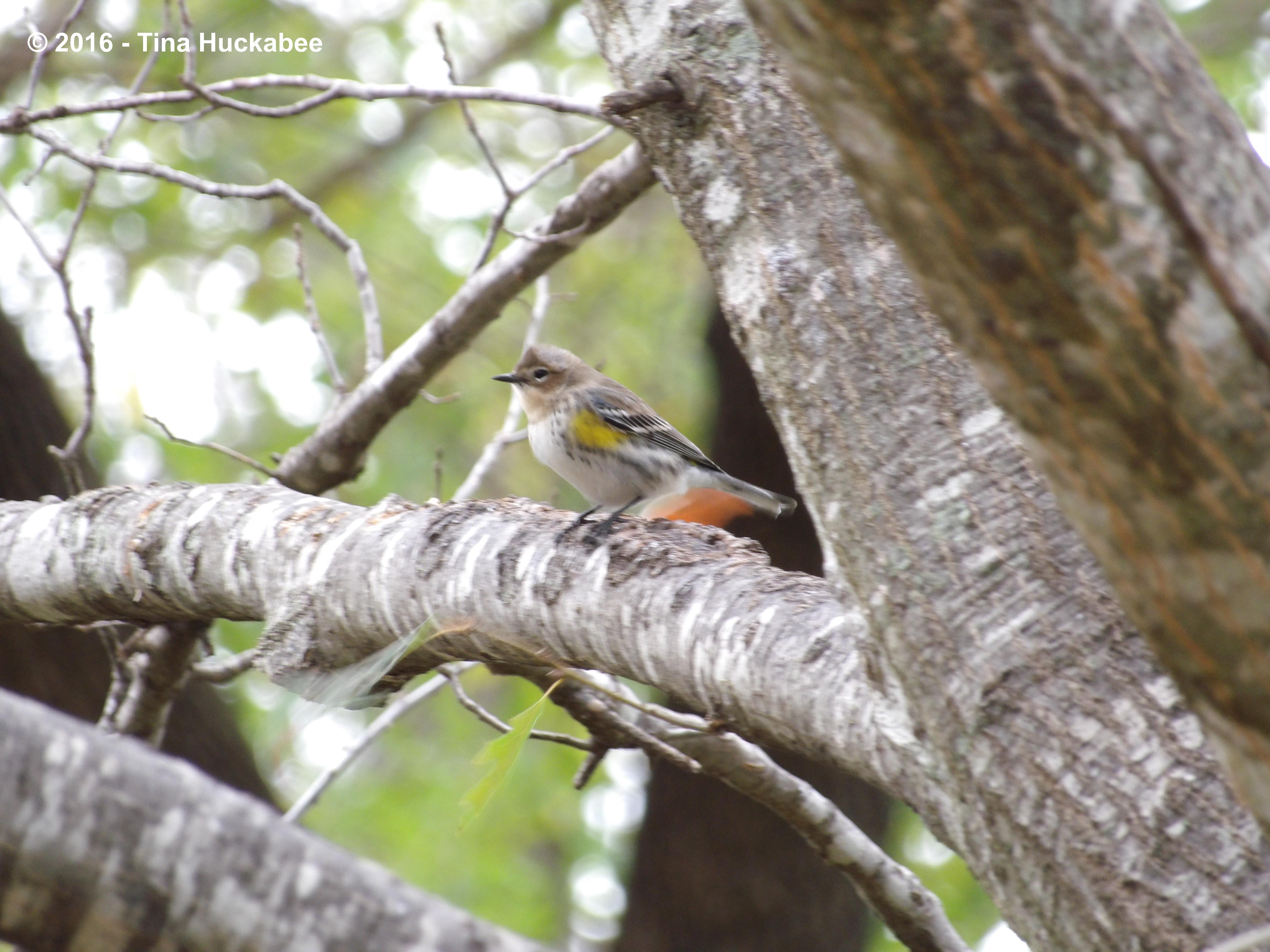
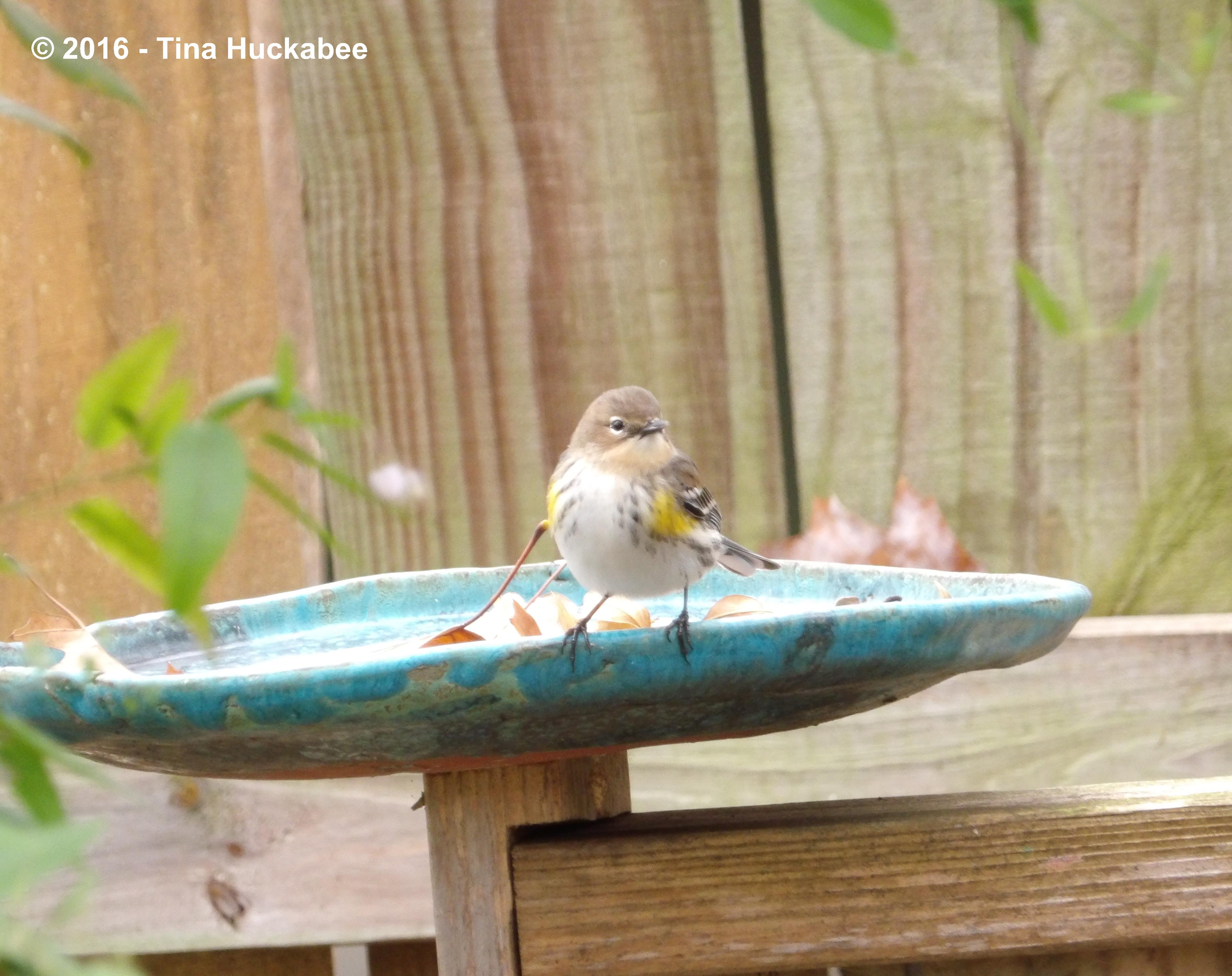
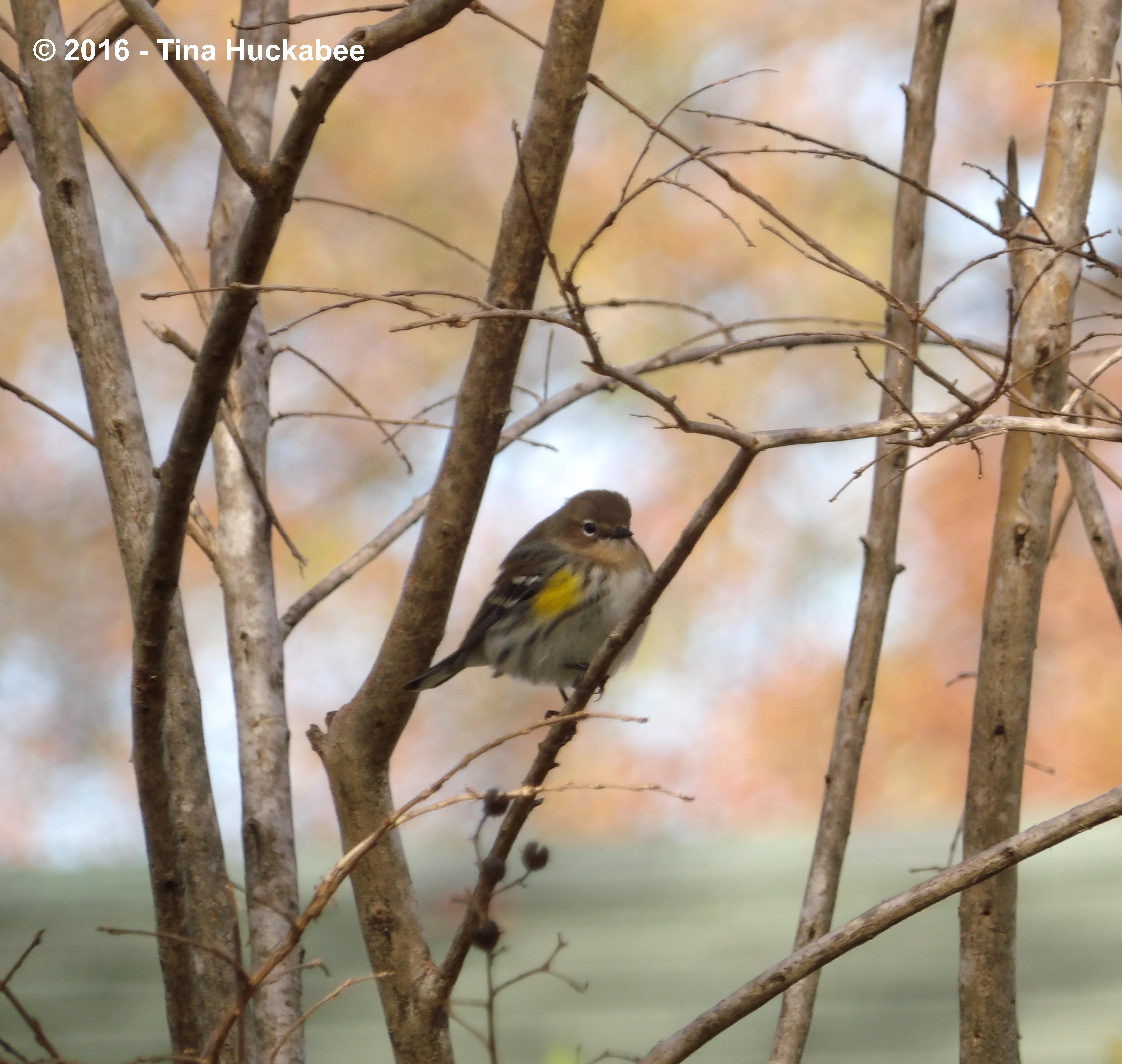
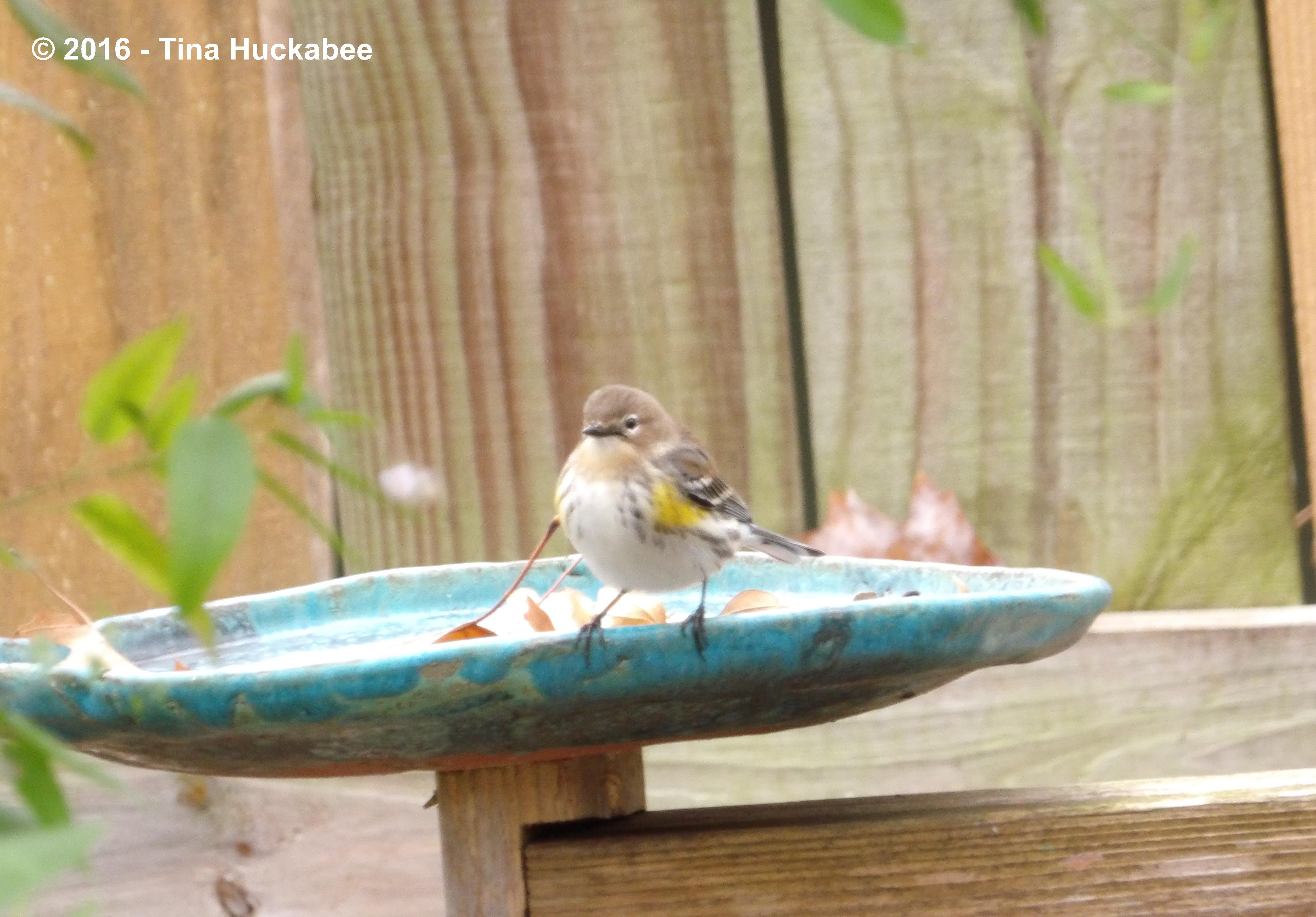
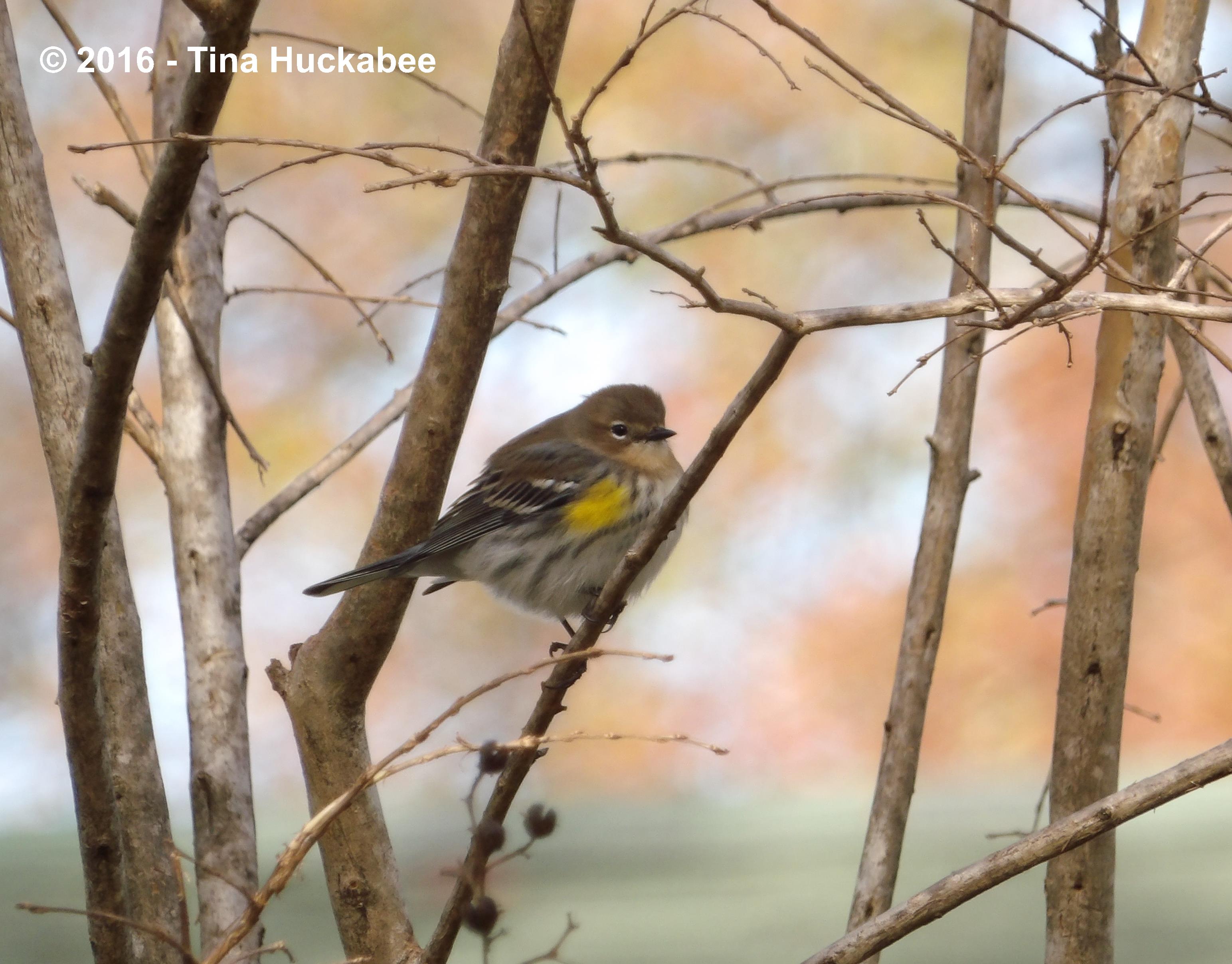
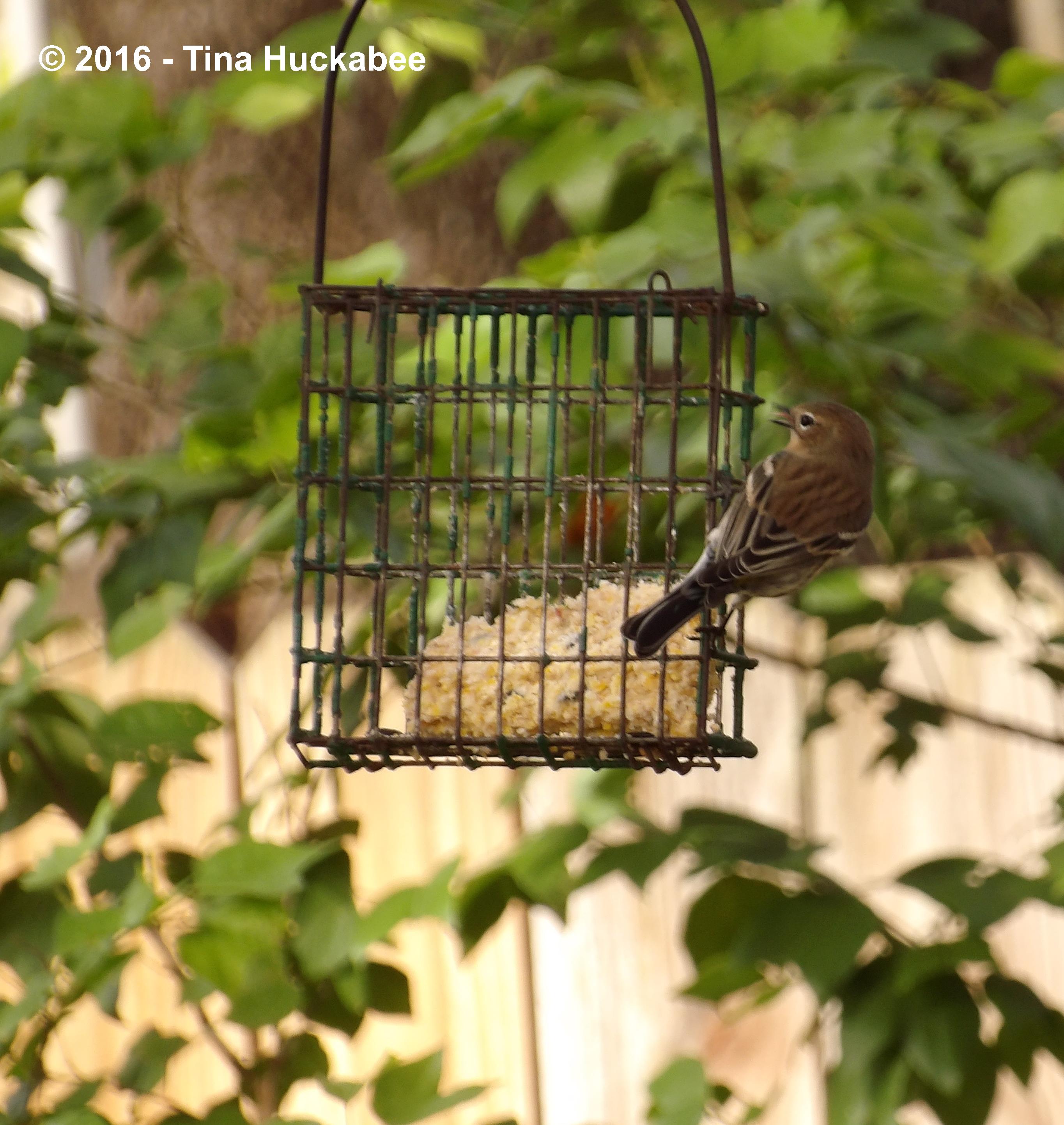
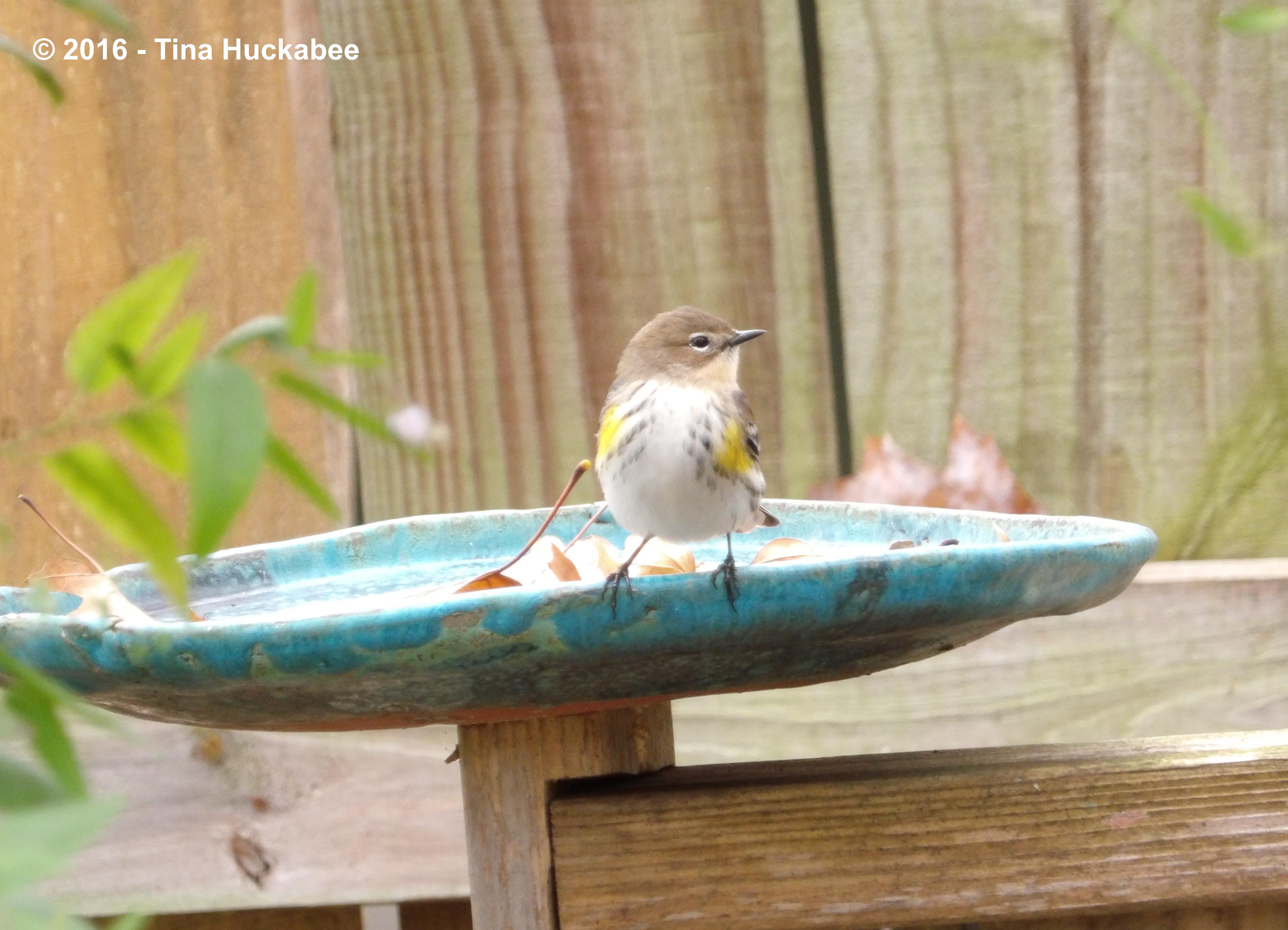
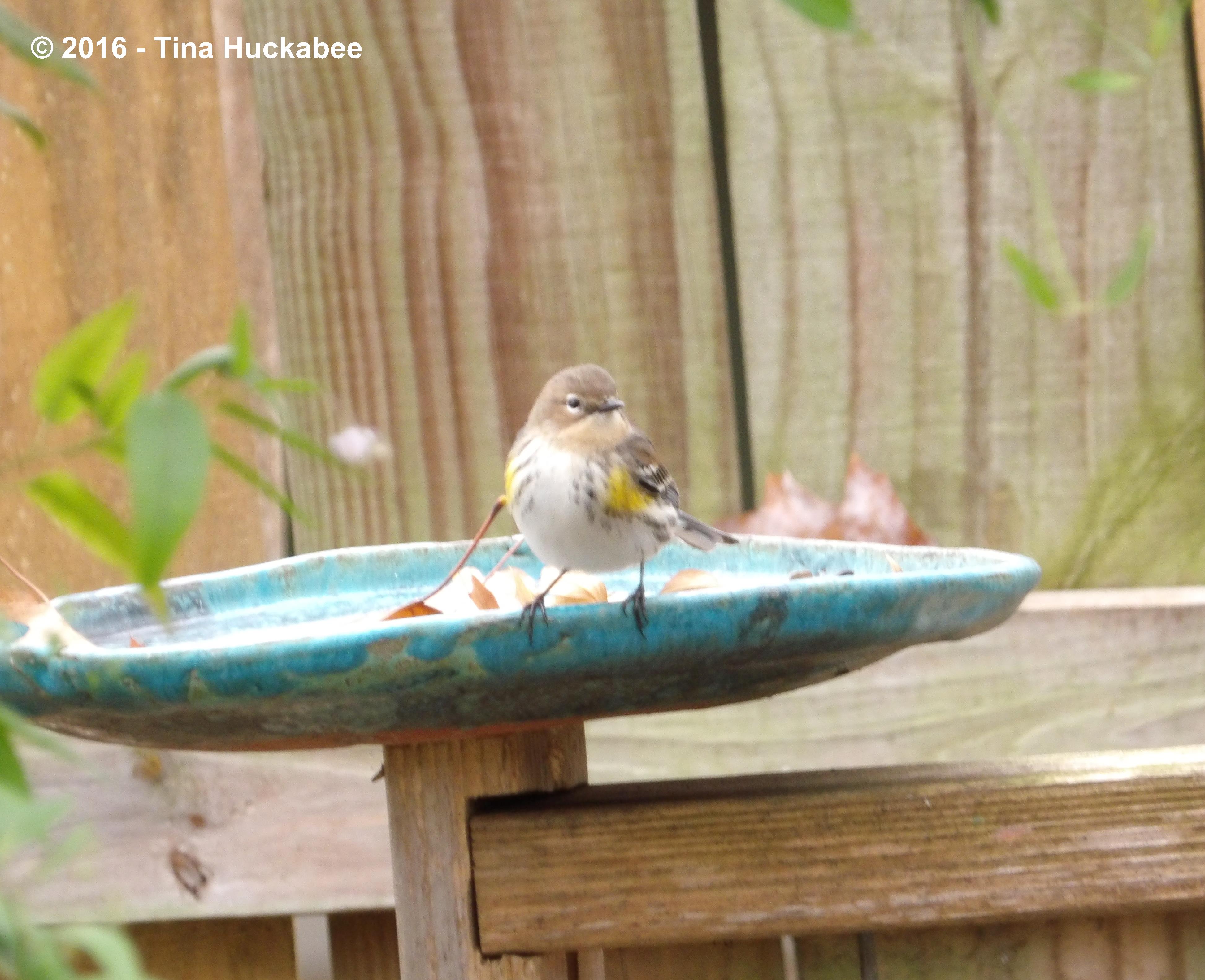
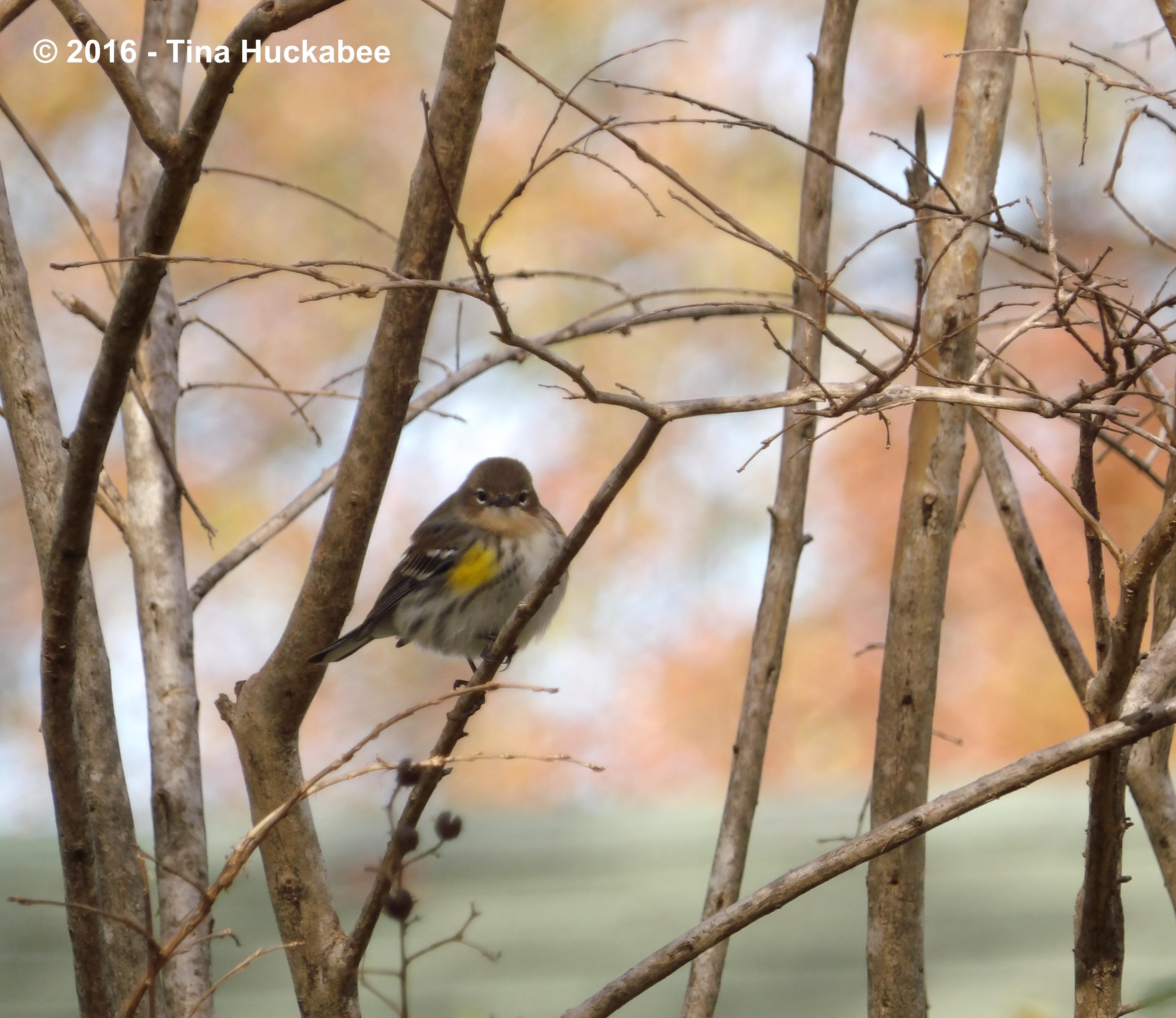
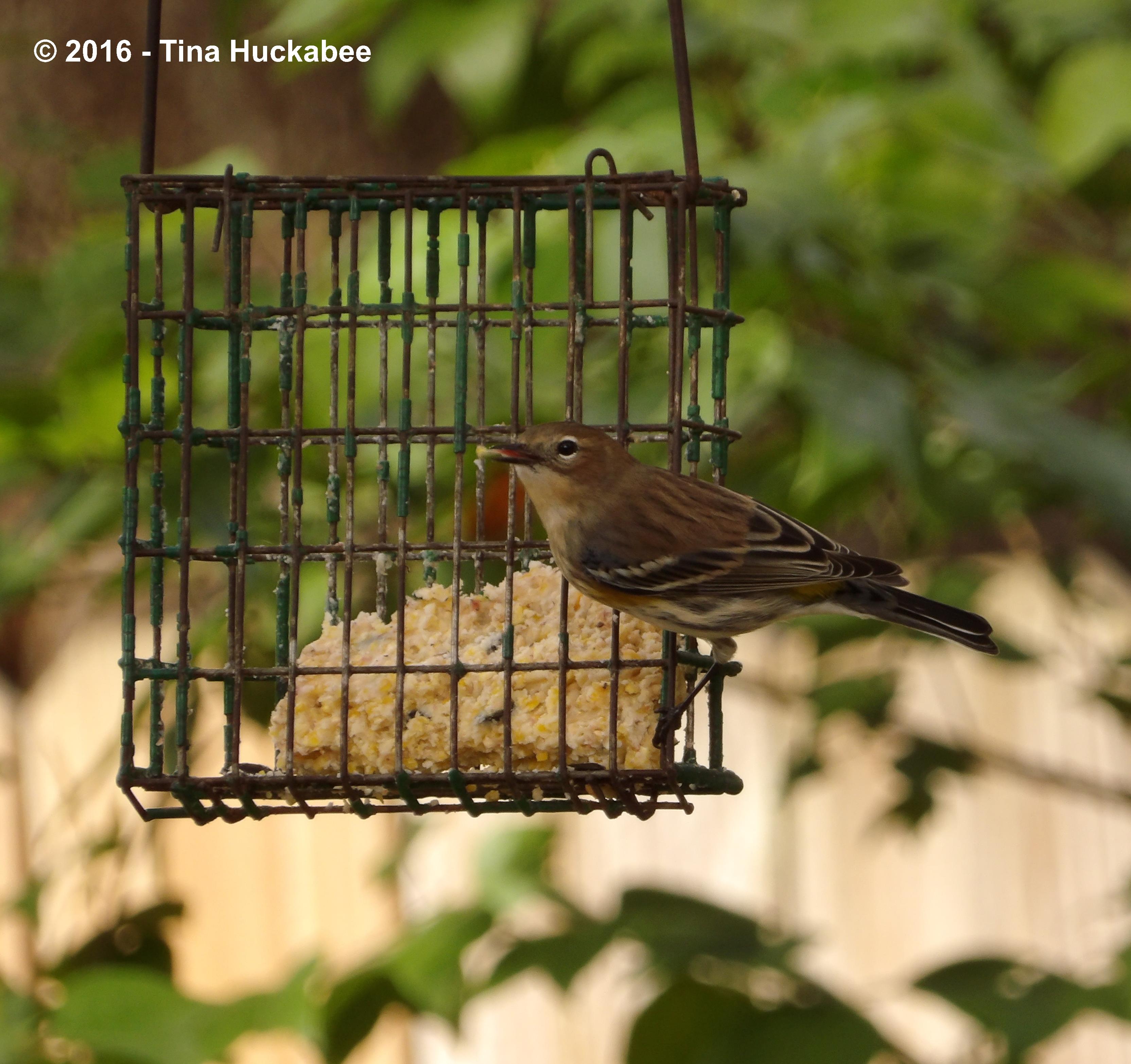
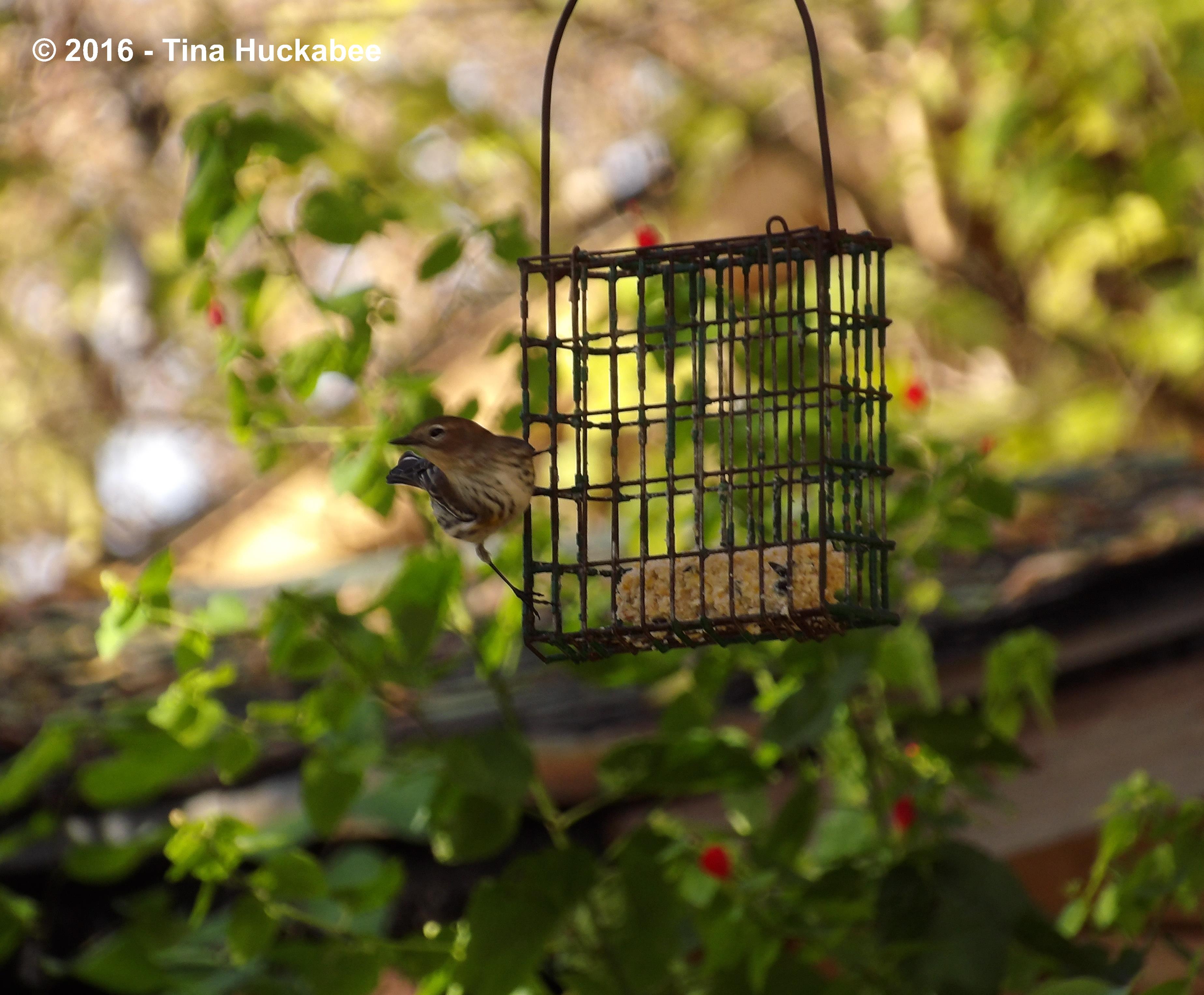
The birds I’m most excited about recently observing in my gardens are a couple of Yellow-rumped Warblers, Setophaga coronata.  This one is a male.

IMGP3508.new

IMGP3499_cropped_3922x3107..new

IMGP3389_cropped_3360x3185..new

Likely as not, I’ve seen this bird species before, because  it’s a common winter Texan.  As I’ve learned about birds, I’m becoming  aware that not all drab little birds are just more sparrows-of-some-sort.  I’m learning to discern their color patterns, size and beak differentiations, and vocalizations. The bird-learning curve is a steep one, to be sure.

IMGP3247_cropped_2976x2483..new

IMGP3235_cropped_2465x2300..new

One must observe closely and (ahem) read a bit about birds to decipher the often subtle dissimilarities between the many species of warblers, finches, and sparrows.

IMGP3226_cropped_3696x3055..new

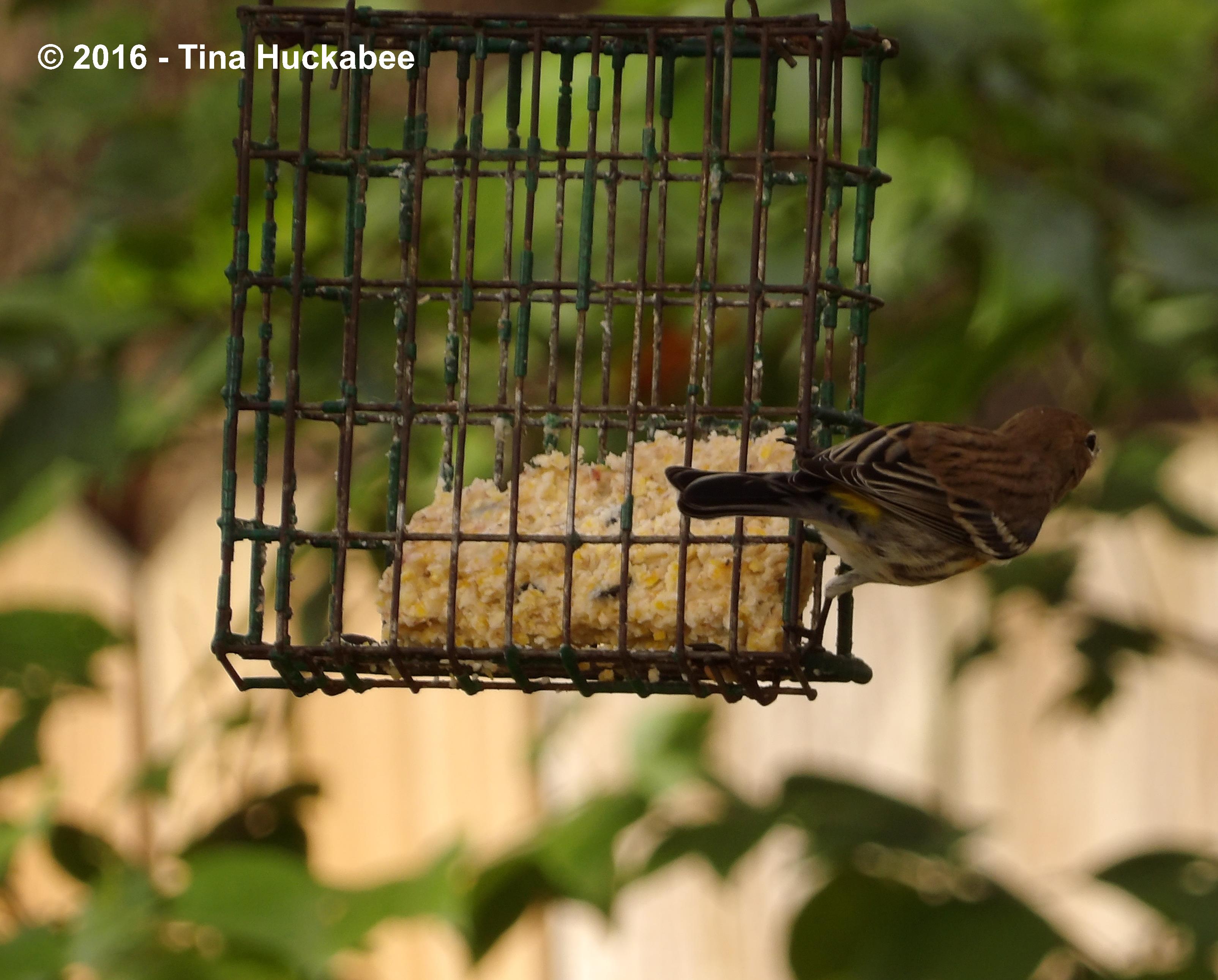
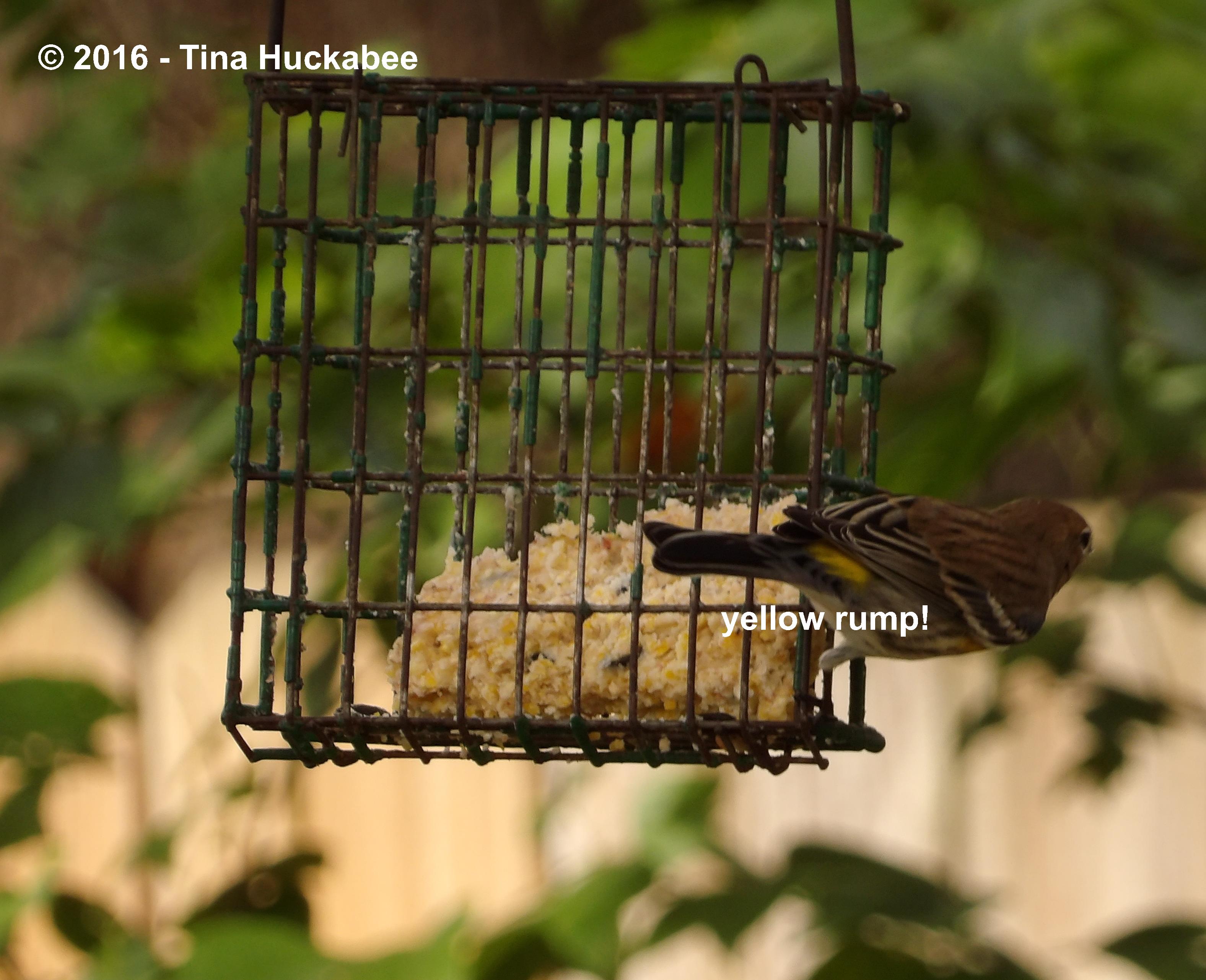
Most of the little “brown” birds sport colorful plumage here and there,

IMGP3186_cropped_3208x2581..new

…including on their bums.   Can you see the yellow rump in the above photo?

IMGP3182_cropped_3153x2563..new

I took a lots of photos before I finally got that yellow in action. There are at least two Yellow-rumps visiting my gardens regularly. This male I see most often,

IMGP3496_cropped_4134x2881..new

IMGP3381_cropped_3087x2415..new


…and a female,  “myrtle” form.

IMGP3155_cropped_2729x2885..new

As it turns out, there are multiple sub-species related to this particular warbler and currently, I’m not nearly enough of a birder to adequately understand, much less explain, variations.  For the time being, I’m content to observe these shy little birds, all yellow rumped and sweet peeps, as they flit about my garden this winter.

While I secured a couple of decent butt shots of the female, I’m still working on a photo capture of the male’s cute yellow posterior. Heretofore, he’s been too busy showing  how pretty he is in other poses.

IMGP3504_cropped_3917x2829..new

IMGP3498_cropped_3893x3166..new


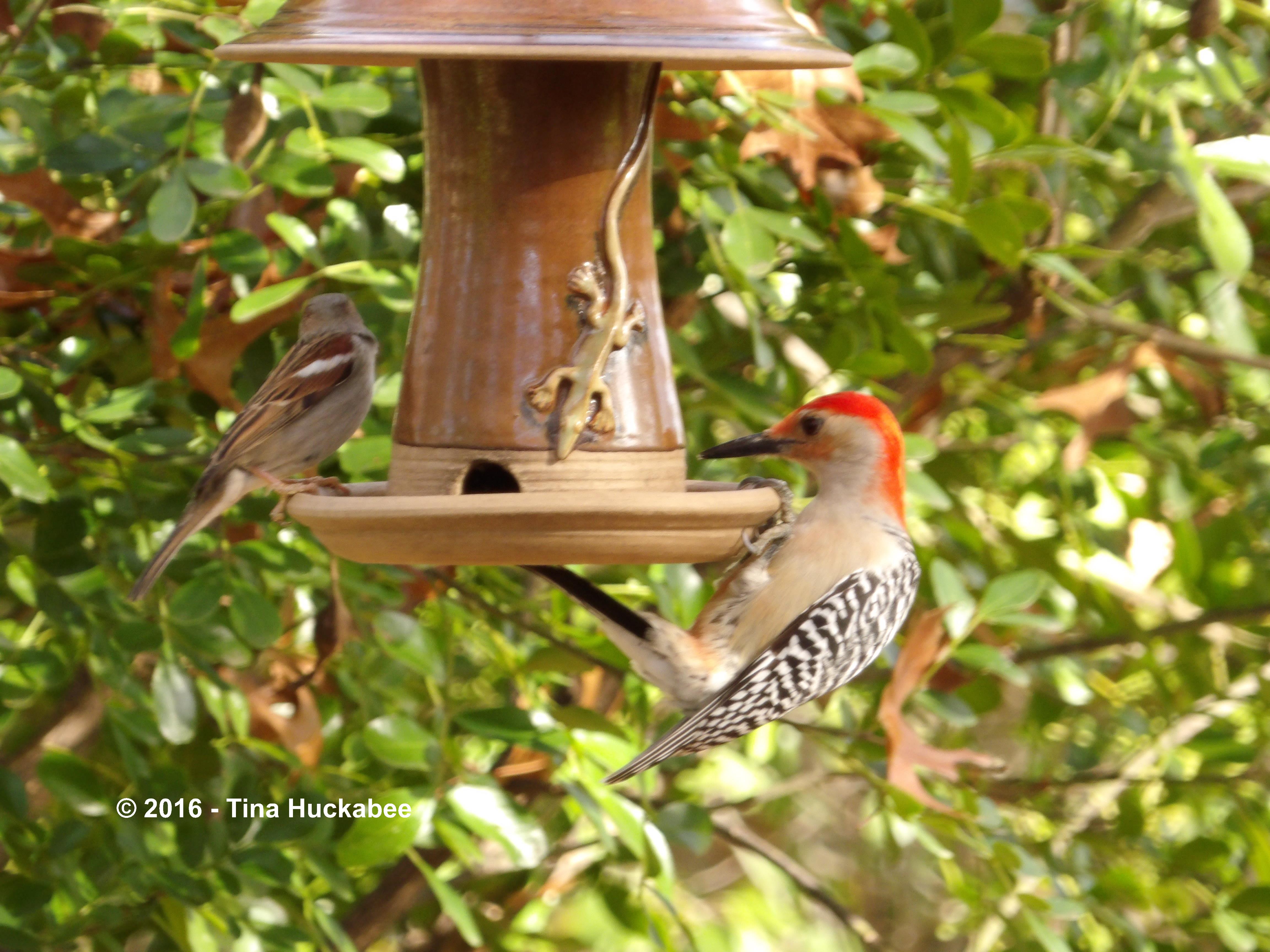
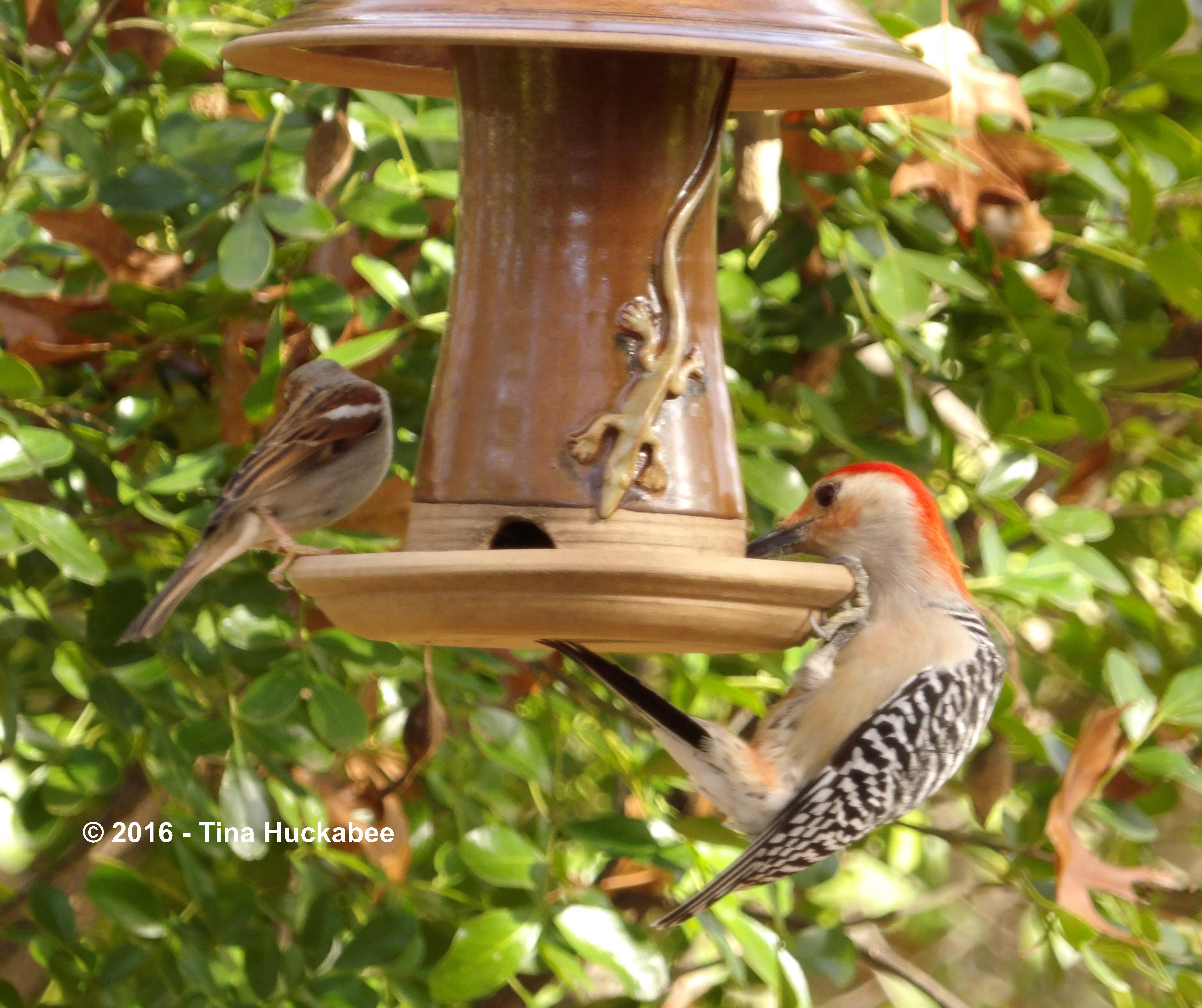
A Red-bellied Woodpecker,  Melanerpes carolinus, is another daily visitor to my feeders and up and down the oak trees.

IMGP3390.new

I love it when he is feeding at the suet and a Blue Jay flies toward and in no uncertain terms, the woodpecker lets the Blue Jay know that it’s NOT HIS TURN!

There’s plenty where that came from, so wait until Red-belly is finished, Mr. Jay.

IMGP3279.new

IMGP3261.new

At this feeder though, the Red-bellied Woodpecker doesn’t mind sharing the food bar with a House Sparrow, Passer domesticus.

IMGP3398_cropped_3830x3213..new

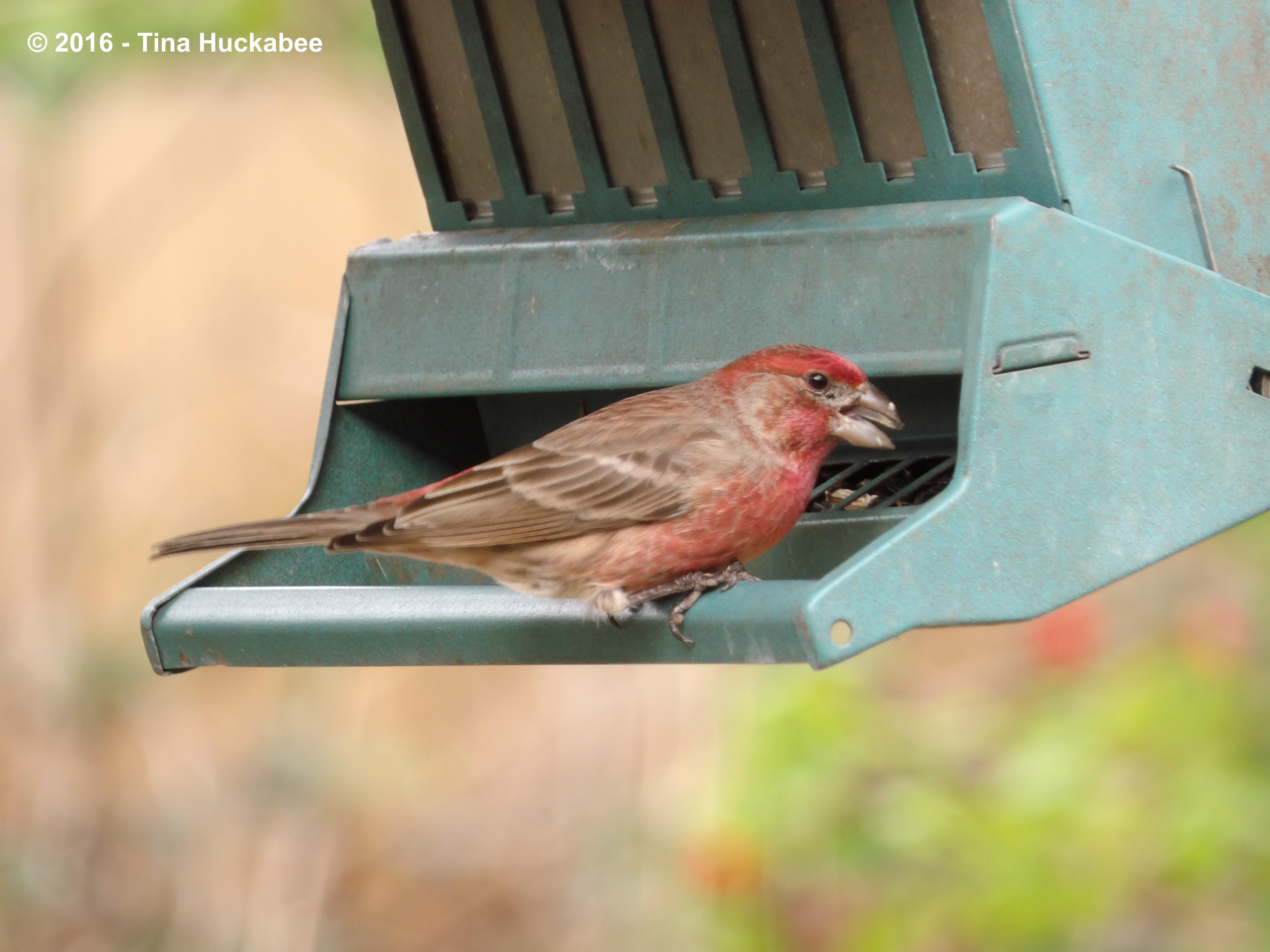
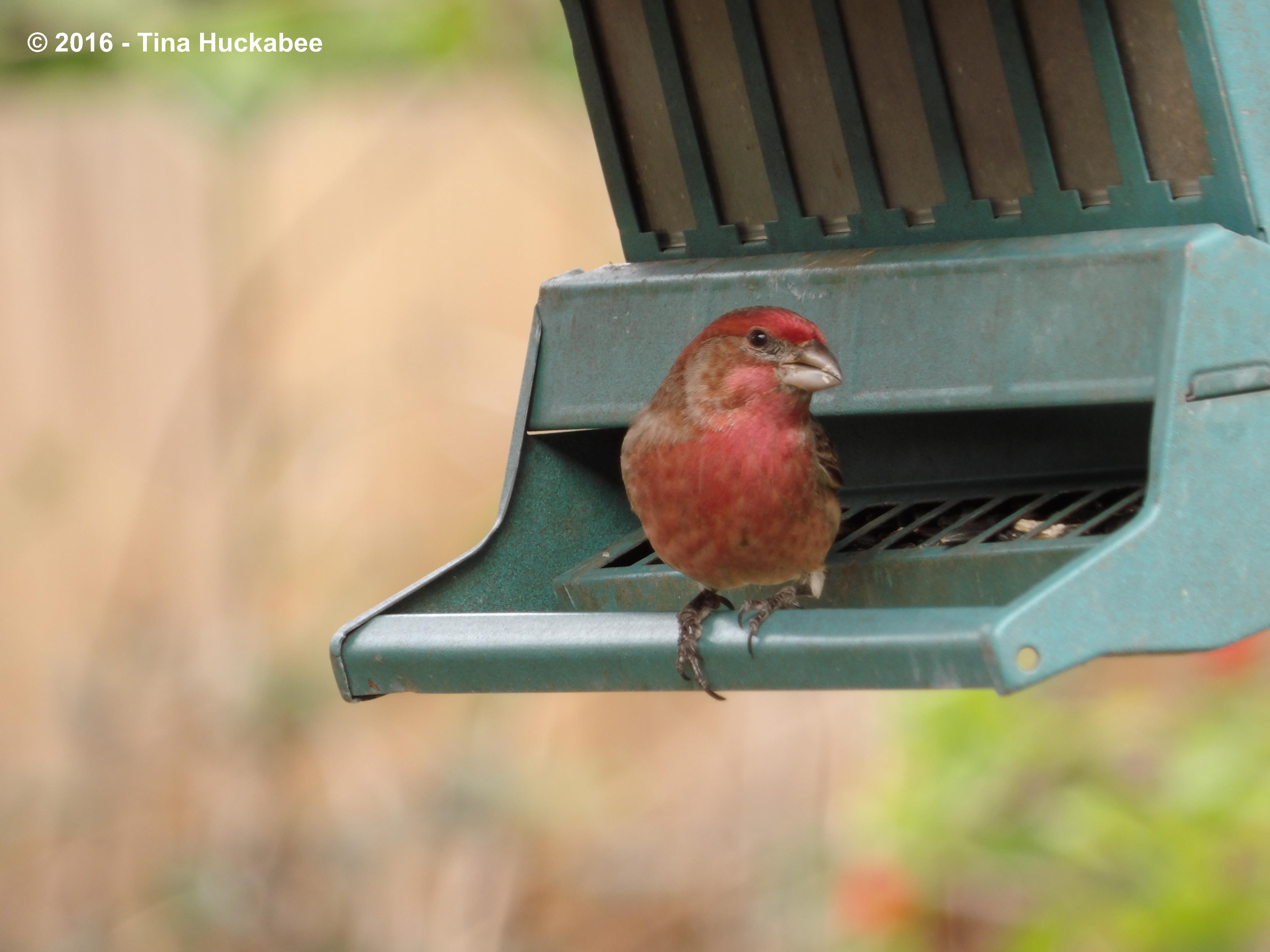
House Finches, Haemorhous mexicanus,   sit in the trees, on the ground, and at the feeders.  I love these chatty birds and I especially appreciate that they sit still, munching away contentedly for long enough to get good captures.  Usually, couples feed together, but at this particular moment, these two took turns–first him,

IMGP3633.new

IMGP3629.new

…then her.

IMGP3656.new

In November I signed up to participate in  Project FeederWatch, a yearly, months-long look at bird population trends organized by the Cornell Lab of Ornithology.  Mostly I did this because I felt the draw to participate in research on the status of North American birds, including migration and population  trends.  Also, I like the idea of being a citizen scientist.

 Snort.

Despite that trumped-up term, the information gleaned by the 200,000 participating volunteers throughout North America, is vital for research on how bird populations are trending up or down and, over time, whether native birds are declining, which, unfortunately, the project has documented.  Cornell Lab of Ornithology is all about the science of birds and through education, the conservation of our beloved and beleaguered native birds.  Cornell encourages concerned citizens to participate in this necessary research.

There are some rules and the counting method is specific and precise, though not difficult to understand or implement, even for novice bird watchers. Project FeederWatch spans November through April, book-ending the autumn and spring migration seasons, as well as the stable wintering population of your particular site. Ideally, observance is weekly, though there’s no penalty for skipping your count from time-to-time.  Cornell ornithologists are happy to get what information they can, when they can, to better understand how North American birds are faring.  Volunteers choose the same two consecutive days each week to observe and record what and how many birds are in the chosen area and for what length of time the area is observed.  Whether for one hour or many–it’s up to the volunteer–weather conditions are noted, and Cornell asks that particular rules of counting be followed to ensure no multiple counts of birds.  The process is well-tuned and the fine folks at Cornell Lab have done their utmost to make the activity easy to use and  educational. Data is either mailed in  hard copy form or entered directly into a user-friendly site; that’s my preferred method. Cornell requests an $18 participation donation for the starter kit, but  I think it’s well-worth that small amount to be part of a long-term scientific study and, like most scientific and educational organizations,  Cornell Lab of Ornithology can use all the moolah they can get.
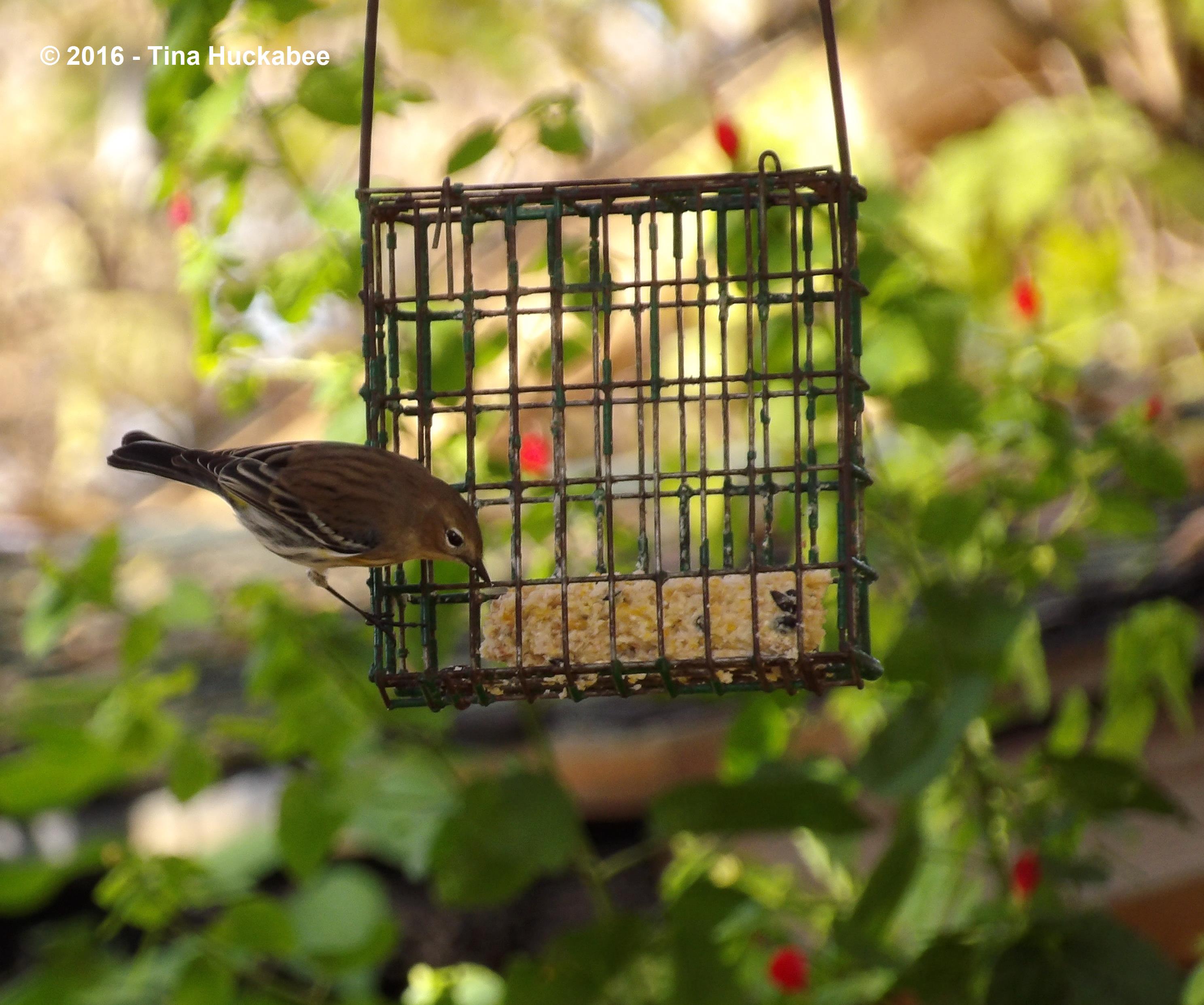
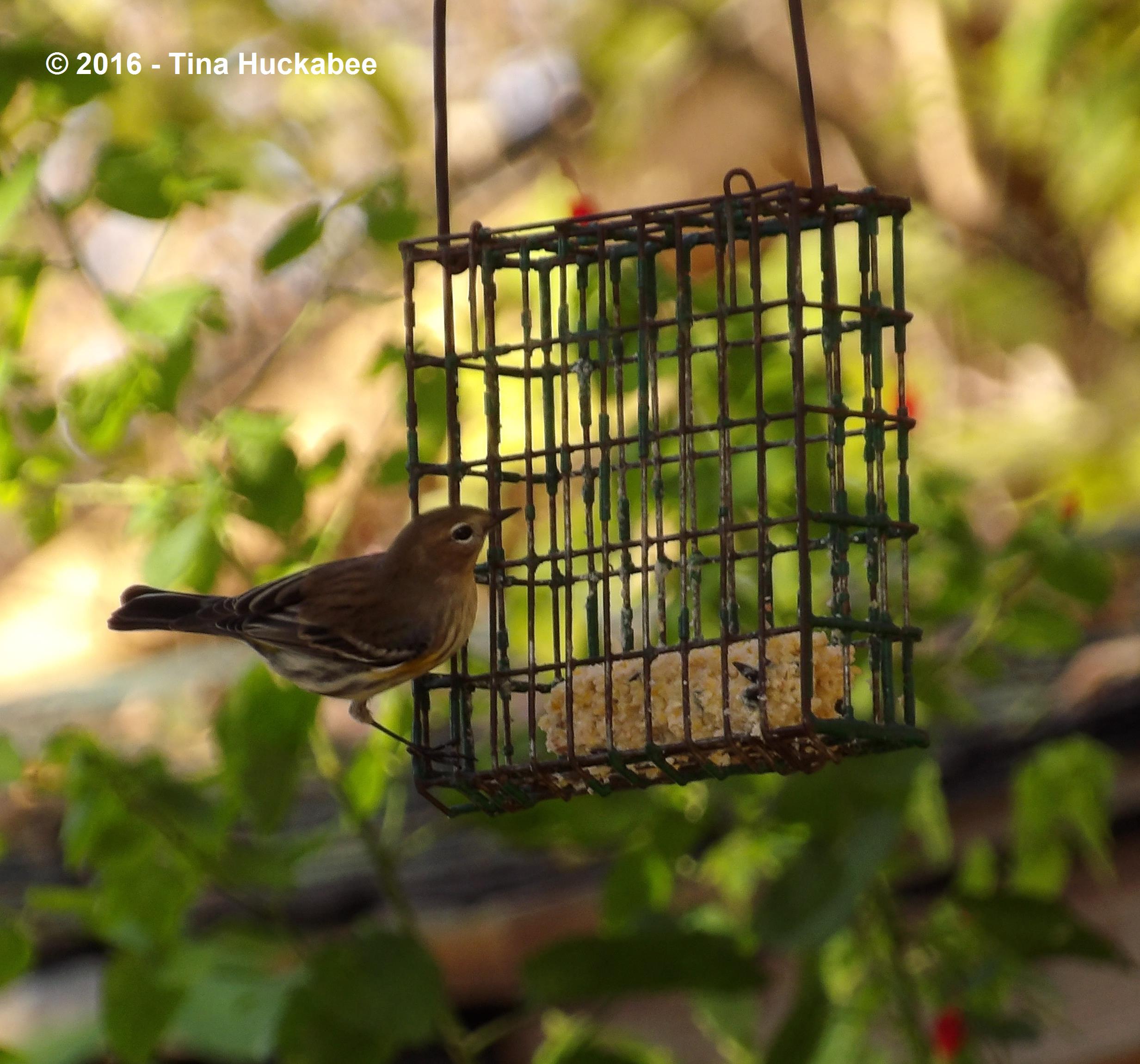
It’s not too late to participate for this season; check out Project FeederWatch for more information.

Any excuse to watch the backyard birdies!

Oh dear.  I’m becoming one of them. Yeah, that’s right, my binoculars are on the shelf by the back door, ready and waiting.  Ready and waiting for that little female Downy Woodpecker who’s too quick in the oak trees for me to get much of a look, much less a decent photograph.

Oh well, there’s always preparation and photographs for  next month’s Wildlife Wednesday!

Did wildlife visit your garden this past month? Please post for January Wildlife Wednesday–share the rare or mundane, funny or fascinating, beneficial or harmful critters you encounter. When you comment on my post, please remember to leave a link to your Wildlife Wednesday post so readers can enjoy a variety of garden wildlife observations.

Happy wildlife gardening!

IMGP3385_cropped_3525x3051..new

IMGP3195_cropped_3328x3130..new