Pond Blooms

The pond is a soothing focal point in my garden and as the days lengthen and warm, pond plants–blooms and foliage–add beauty, food, and protection for wildlife.

Resident and migrating birds bathe in the waterfall and bog. Bees, butterflies, damsel and dragon flies provide airborne energy, while the fish below add movement and color. There are three kind of fish in my pond: feeder goldfish (a whopping $.26/fish), ruby guppies (sort of mini-goldfish), and native gambusia (mosquito fish).

Bees, particularly honeybees, are regular visitors to the pond, choosing wet stones and wide, flat lily leaves that hold bee-sized puddles, as good places to pop in for a drink.

The eye-catchers of my pond flower in pink and purple. Pickerelweed, Pontederia cordata, is a pretty blue-purple native pollinator and aerator plant, the latter trait vital for a healthy pond environment. Pickerelweed sits in the bog section of the pond. For now, there’s plenty of space for water flow, after I separated the plant and replanted four sections with roots. The small fish swim in the area and the large raccoon who visits at night hopes to catch one of those fish. By winter, the plant will have grown and expanded, stems and foliage filling the bog, flowers topping the bunch. Water will still flow through the roots, mostly by way of the roots.

Often, though not on this day, dragonflies and damselflies flit above the water, perching gracefully on the tip of the bloom spike, their iridescence a jewel in the pond’s crown.

Lilies bloom year-round, though there are fewer after a hard freeze. The only time no lilies are found is during the period after I separate the plants, which I have not done this year. It needs doing, as water plants grow quickly and if I don’t separate the lily plants, the chore will be much more difficult next spring. But it’s painful to separate the plants and lose blooming lilies, even if it’s only for a few months. I would miss those lilies.

This pink-petaled, golden-centered beauty is a ‘Colorado’ lily and blooms happily in my Texas pond. I grow several lilies in my garden apart from pond lilies, one is a summer bloomer, the others open in late summer/fall.

I have a soft spot for lilies. My daughter’s name means lily.

For Shoshana: December 30, 1992–April 28, 2006

Sighting of a Site

I’d heard the call when I was out and about in the back garden, but Red-bellied Woodpeckers, Melanerpes carolinus are common in my neighborhood and I didn’t pay much attention. After an extended session of woodpecker monologue, I looked up and sighted this cutey calling from a nesting site hole high up in my back neighbor’s tree.

It looks like he’s telling me off!

In January or early February, I’d seen a male Red-belly hammering away, creating a nice little niche for a future family. Then the stinkin’, bullying European Starlings began harassing the would-be dad, eventually driving him off to some other tree. Of course, the starlings didn’t even settle in the tree; I’m sure they moved on, looking for some other hapless native bird to harass.

His head is red from just above his eyes, completely covering the back of his head. Female Red-bellies’ red begins toward the top of their heads and doesn’t extend quite so far down.

Such a pretty fella. I don’t know if there’s missus; I’ve only spied this guy in his well-rounded hole, calling for anyone who will listen. I hope he finds a compatible gal-pal and they raise a family; woodpeckers are particularly charming birds. This could be his second go-round in the family business, as Red-bellies produce between one and three broods each year.

It’s been a disappointing spring in my garden regarding observing birds and their family ways. A pair of Bewick’s wrens sang, chirped, and brought grass and twigs to a little bird house at my back patio, then abandoned that effort. I suspect the Red-shouldered Hawks that were interested in my tall Sycamore tree might have given the wrens doubt about the neighborhood. But in recent days one is continuing the work, so maybe a second brood is planned or a different pair of wrens are reconsidering the real estate now that the hawks have removed to another place?

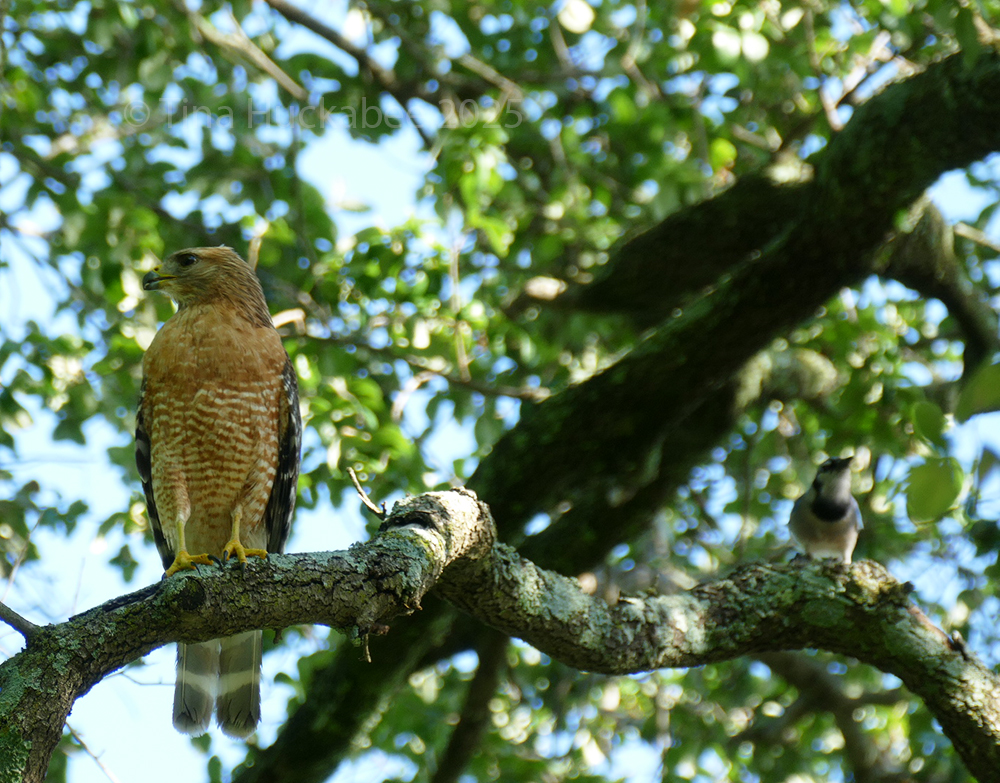
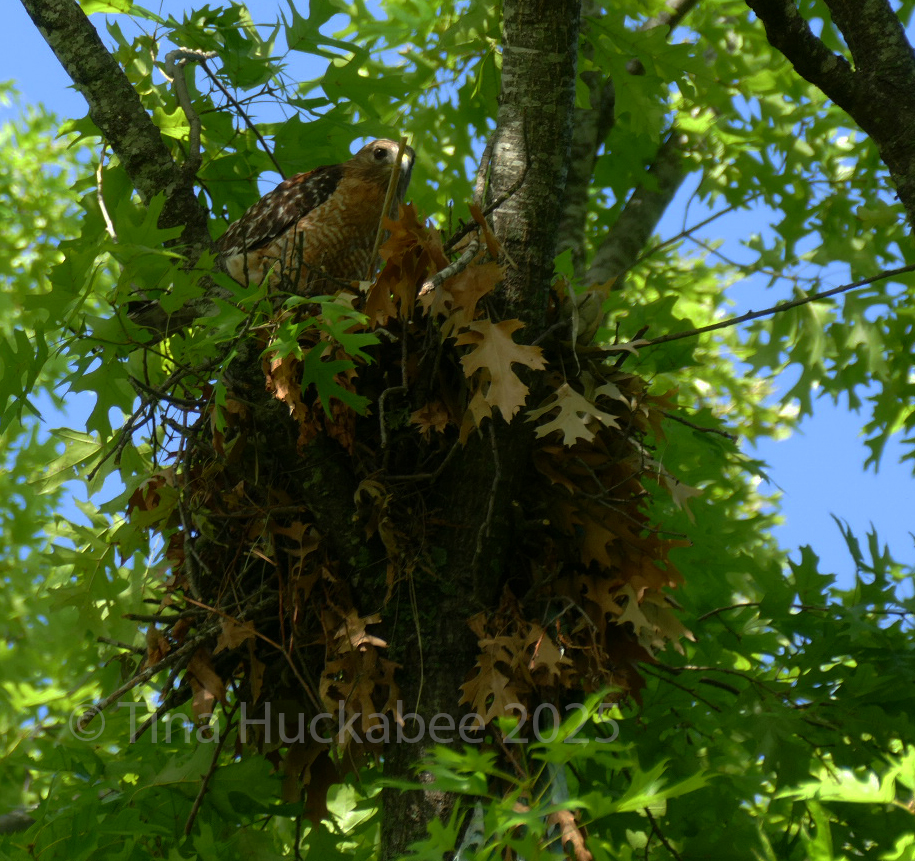
The majestic Red-shouldered Hawks that swooped, called, and mated in every tree in the vicinity, eventually relinquished the lame nest they occupied in my Sycamore after several days of high winds. They stayed nearby though, choosing a new nesting site in a large Red Oak just around the corner. This morning, I was alerted to their presence by noisy Blue Jays in the luscious oak, loudly voicing their opposition to the hawks’ nesting site. A stately adult hawk perched on a branch near the nest, tricky to spot in the foliage–a formidable sentry. I’m glad these two hawks didn’t opt for a chickless, carefree lifestyle, as young adults will do. They’ll be excellent parents, to the concern and detriment of other birds, small mammals and reptiles in the neighborhood. Such is the circle of wildlife.

Our Screech owl box remained owl-less this year, the couple choosing instead a hole further down this same tree now hosting the Red-belly. Just last night, looking for the owls, I saw both parents and two fledglings! They made it easy for me to observe them, as they were on utility wires, rather than in the trees. The owlets were calling for food, parents obliged with snacks. I mentioned to them that they’re welcome to the rat who visits the pond area each night.

I’m glad I listened and sighted this woodpecker in his chosen site. I wish him all good luck with a mate and brood. There’s plenty of time in the season to rear more darling woodpeckers.

It’s Spring, Y’all!

Poppies are poppin’ and honeybees are rockin’. Honeybees are all in the poppies’ innards, their pantaloons (corbiculae) laden with pollen as their work takes them from flower to flower. Most of my garden is abloom with native Texas plants, but this European poppy is the descendant of seeds given to me by a German neighbor decades ago. The poppies appear annually in January when delicate foliage rises upwards during the cool season, then buds reveal glorious red and purple in April.

It’s spring, y’all. Trees are leafing out, perennials and annuals are showing off their eye-catching wares. March was dry and warm, though rain and chilly temperatures have made a come back. Flowers are opening, pollinators are working, and birds entertain with song.

Two of my Soft Leaf yucca, Yucca recurvifolia, are in a blooming mood, guaranteeing they’re not outperformed by the red, red roses of Martha Gonzalez. I grow five of these yucca plants in my front garden. The plan was that each spring, upon maturity, the yuccas would all produce their dramatic flower spikes at the same time. This has never happened. This spring, three recalcitrant yucca individuals are refusing to send up spikes. Wishing the plants would bloom in concert with one another isn’t working. Alas, they will do their own thing.

Cool season, orangy Desert Mallow, Sphaeralcea ambigua pair nicely with pretty, purple Spiderwort. Tough plants both, they’re situated at the street side of the garden, full west sun. The mallow is a shrub, the spiderwort a cool season plant that will disappear in the heat, showing up again in late fall or winter.

Four-nerve Daisy, Tetraneuris scaposa, dances in the breeze, their yellow faces turned to the warm sun. But are they missing something?

There it is! A native bee, maybe in the Melittidae (oil collecting bee) family. The bee landed in the pollen-plenty center of the sweet daisy flower, working the flower for the bee’s benefit and the plant’s future.

A side view of the bee highlights pollen stockings on its legs and cool abdomen racing stripes.

Hill Country Penstemon, Penstemon triflorus, is in full swing now, with mostly night moths as its main pollinators. If there are hummingbirds around, I’ve yet to spot them, but they won’t miss this pink beauty when they arrive in my garden. In my last post, I profiled the first one to flower, but now all five individuals have caught up and are playing their parts in the pink parade.

The greens are greening-up too, thank you very much. Foliage certainly has its own beauty and purpose, not outdone by flashier colors. In this photo, two evergreen Red Yucca, Hesperaloe parviflora, mix with spring-green Yarrow, Achillea millefolium, and the foliage of other Texas perennials: Plateau Goldeneye, Viguiera dentata and Zexmenia, Wedelia acapulcensis var. hispida. Just emerging from the soil is the scalloped foliage of Pam Puryear’s Pink Turk’s Cap, a cultivar of native Turks Cap, Malvaviscus. The trunk of a young Red Oak, probably planted by a Grey Squirrel, bisects the greening vignette .

Beautiful Mexican Feathergrass, Nassella tenuissima, pops up here and there, graceful in form and color.

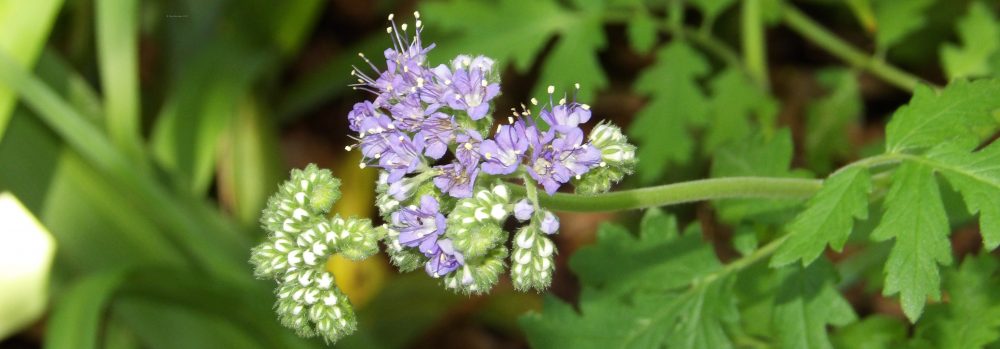
The primacy of Blue Curls or Caterpillars, Phacelia congesta, is nigh. Lovely blue-purple florets unfurl along a spine, beckoning pollinators to visit and gardeners to admire. There’s a tiny native bee on this cluster set, do you see it?

If not, here’s another flower cluster hosting a similar busy bee, one more zooming in for some action.

Each day, more of these annual wildflowers are opening for business. Soon, I’ll watch as myriad pollinators, particularly small native bees, skippers, and true bugs, visit these blooms. Aside from the color, texture and form of the plants, the garden is alive with movement and life of those who rely on the plants for survival.

Spring has definitely sprung. The weave of form and color mark each morning-to-nightfall, and change is a constant. Pollinators are in fine form and migrating songbirds are passing through, resting from their travels and nibbling insects and seeds that drop.

Spring is the definition of beginnings, a confirmation of living.

Red Yucca, Hesperaloe parviflora