Late last summer as I walked my dog, I would regularly pass by a house that is owned by a local family. With no one in residence for at least a decade, owners who don’t maintain the property nor answer queries about the property, the front lawn has become a repository for plants–many native. In my shambling ambles with my old dog, I kept an eye on a plant that had situated itself at the edge of the unkempt lawn and that seem to sport milkweed-like foliage. My curiosity piqued, one evening I whipped out my phone, tapped my handy Seek app, and learned that this milkweed-like foliage belongs to Zizotes Milkweed, Asclepias oenotheroides, one of the native milkweeds of Central Texas.
I hated the thought that this precious pollinator plant would be subjected to the occasional mowing and resulting temporary destruction. So one morning, shovel in hand and bucket at the ready, I dug up the plant and skittered home with my plant booty.
True confessions: I am a plant thief.
The purloined Zizotes transplanted beautifully. I dug it up, reaching well into the soil with the shovel, as I didn’t have a clue about the root system. It turns out the plant enjoys a large bulb, with some spindly roots that radiate from the bulb. After I removed the plant from its original home, I potted it and set it in a dappled light area of my back garden, near a water source so that I would remember to water the newly set milkweed. I watched it for the remainder of summer, watering as necessary, admiring the plant’s resilience. My plan was to donate the plant to our neighborhood elementary school, which has a set of gardens, including a pollinator garden. The caretakers of the school garden were happy with the offer, but I insisted that we wait until October to plant, an ideal time to plant perennials here in Austin.
In October, before I left for a trip to Europe, the thriving milkweed was ready to join other plants in the pollinator garden and I contacted one of the volunteer caretakers of the gardens. She was appreciative, but worried that she might “kill” the plant. I assured her that the Zizotes proved a remarkably hardy critter, but she suggested that I keep the plant.
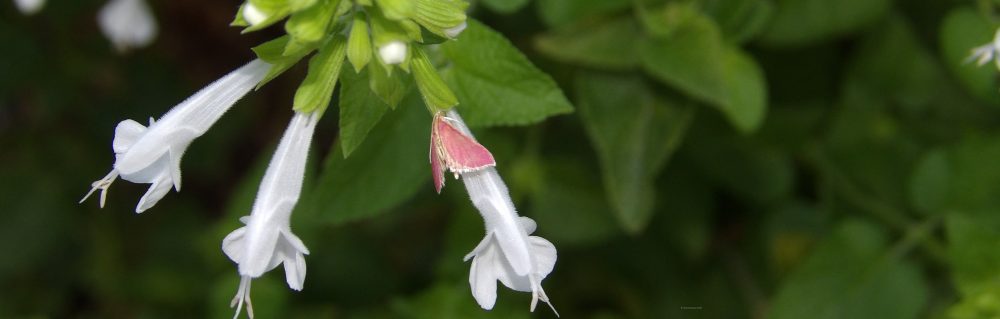
Well, I wasn’t inclined to argue with that! The Zizotes Milkweed now grows in my front garden, kept company by two volunteer Lyreleaf Sage, Salvia lyrata, and a host of other native plants nearby.

I’ve never seen Zizotes Milkweed plants for purchase in a nursery, though it’s possible that they’re included in some native plant seed packets. Zizotes is not the most attractive (to humans!) of milkweed plants; I’d guess that most nurseries wouldn’t carry it as most nursery customers are looking for “pretty” plants. The flowers are small, greenish-white and cluster along the main stem. I like these plants and find the diminutive blooms charming.
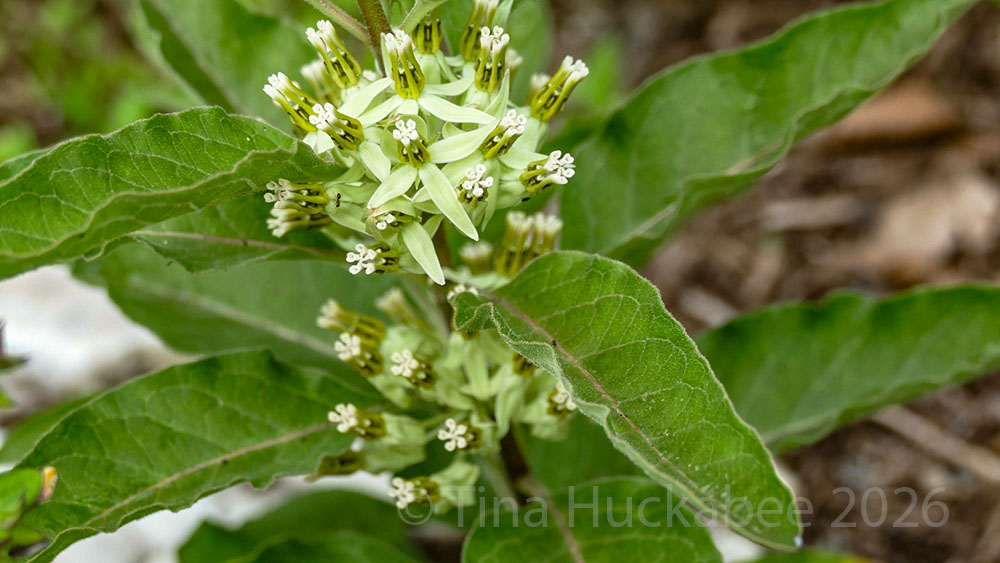
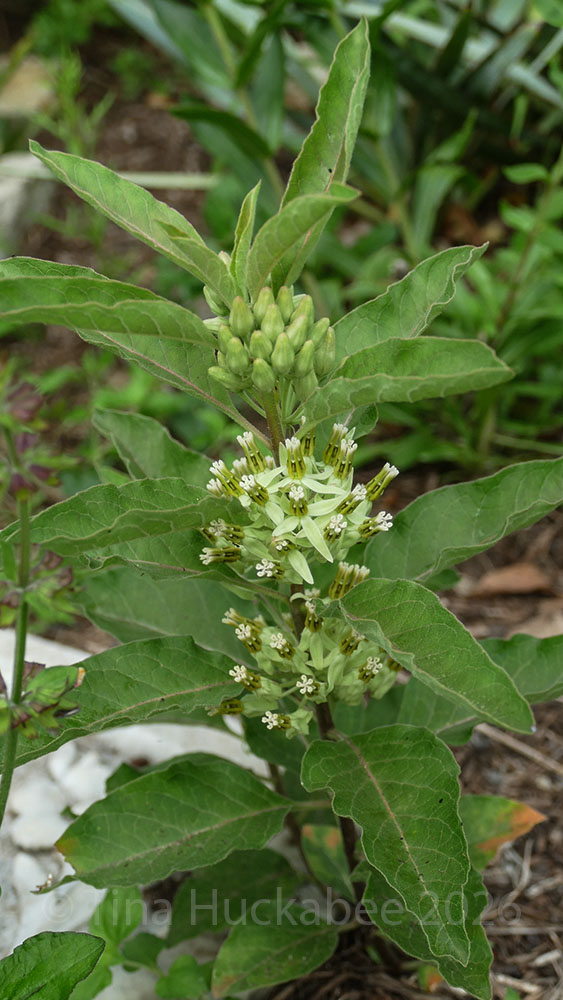
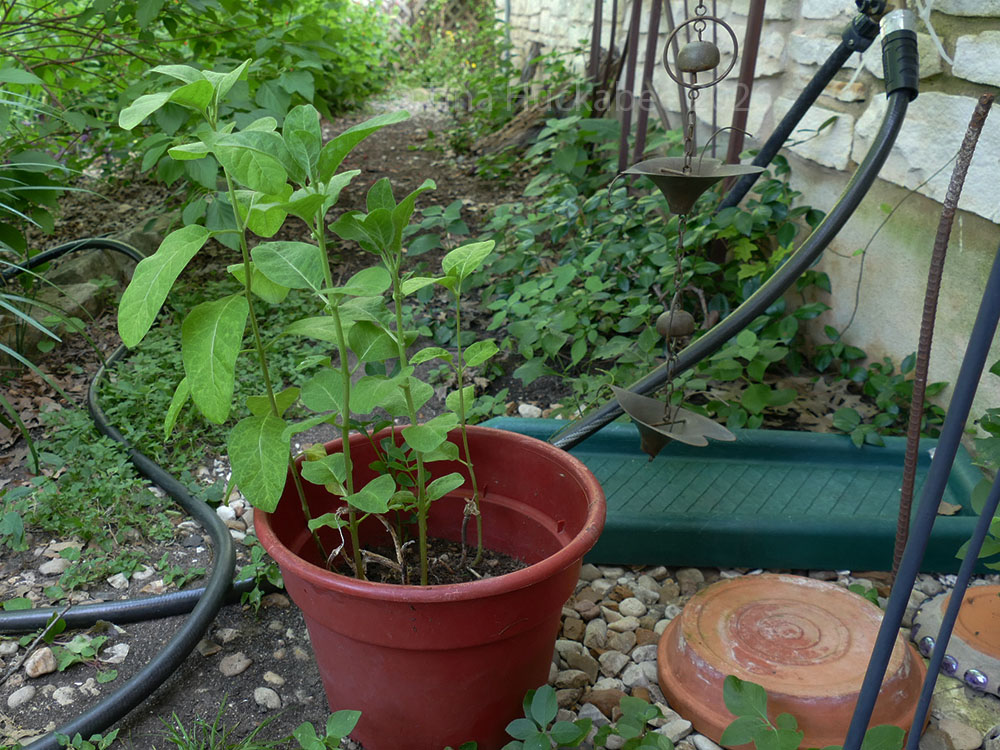
Since last summer’s milkweed discovery, I’ve found about eight other Zizotes Milkweed plants on the route I walk: five individual plants in a neighbor’s “hell strip” and one large one at the neighborhood school, alongside a walkway. The neighbors are refraining from mowing the milkweed, though it’d be nice if they weeded around the plants, but one can’t have everything, right? I asked for and received permission to dig up the school milkweed so that it wouldn’t continually be mowed throughout summer. The plant came out of the ground, bulb and roots intact, and as three individual plants! Woohoo! Within a couple of days, new leaf grow appeared. I love a tough plant!
I wish I’d taken a photo of the plants I removed from the school yard, as there was nothing left after the mowing but a few inches of shredded, raggedy stems. I rescued the milkweeds the day after the Austin Independent School District’s mowing crew did their worst. Now look at these three!
The name zizotes comes from Spanish, meaning “skin sores” because, like all milkweeds, the milky sap is toxic to humans and can cause skin irritation. According to the LBJWC (link in the first paragraph), Native Americans used the sap for as a poultice for skin rashes.
Very few Monarch butterflies came through my garden this past spring, adults wafting through the garden, nectaring on blooms. I noticed at one point that the zizotes disappeared. Did a monarch caterpillar eat it to the ground? I didn’t see that happen, but I certainly could have missed the action. The plant bounced back, up from roots and has grown and bloomed since. I’m hoping that my one plant will produce more Zizotes Milkweed plants, for my garden and to share with others.
 My Gardener Says...
Fabulous! I love a good rescue tale. 😉 I think it is very pretty in an understated way, like the shy beauty at the back of the ballroom (very Jane Austen)! They will no doubt produce many seeds for you to share. 👏🏼
LikeLiked by 1 person
I agree with you and ‘understated’ is a good word to use. I happen to love white/cream flowers and tiny ones too! Love the Jane Austin reference!
LikeLiked by 1 person
Why not rescue a plant from abandoned property? I am surprised to find out how many different kinds of milkweed exist. Is it on a rare plant list?
LikeLiked by 1 person
I don’t think it’s rare, as it has a wide area in which it thrives I’ve been perplexed about the ones I’ve found, wondering if someone tossed out some native seeds and they spread, or birds decided our ‘hood was a good spot for these plants. I’m certain there are more out there, in places that I haven’t walked by or in back yards.
LikeLiked by 1 person
Your good rescue work earns you a nomination for Austin’s HZQ (Hierba de Zizotes Queen). At our previous house in east Austin, where we lived until 2004, one of these milkweeds sprang up as a volunteer in the front lawn. I come across it in the wild maybe two or three times a year, the most recent being in April right outside Bastrop State Park. On that specimen one leaf had mostly turned a rich yellow orange. Have you seen a leaf change color like that on any of the zizotes milkweeds you’ve dealt with?
LikeLiked by 1 person
Do I get a crown with the title? I’d really like a crown!
I mention on your post that I recall color, I just don’t recall it being a particularly bright color, like the one in your photo.
I noticed this morning that the 3 school zizotes are developing some buds–I think those in the pot will bloom, too and before I hand them off to the school in the fall.
LikeLike
Pingback: Most recent hierba de zizotes milkweed encounter | Portraits of Wildflowers
Zizotes grows wild in my hay pasture in Montgomery County (northwest of Houston). I was worried about losing the plants when the hay is cut, so I tried to transplant some, but they did not do well. However the pasture is still full of them, so either they survive the mowing, or they self-seed enough to come back. I think they are so pretty; I am glad they do well here on their own because I am not a gardener. 🙂
LikeLike
Apparently, they do both–seed out and tolerate at least some mowing! I’ll bet they’re really pretty in a mass of plantings. My understanding is that they grow together in small clusters, not getting very tall. The one I have is only about 10 inches high.
LikeLike