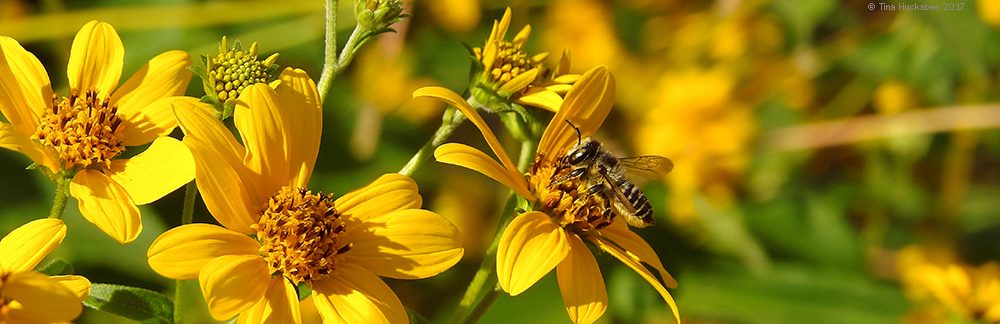
Spring migration is over, most of the neo-tropical birds now settled in their breeding areas for summer’s chick raising. I didn’t have quite the numbers of migrants through my gardens this year. I don’t know if it’s that I simply didn’t see as many or if there weren’t as many; I hope it’s the first and not the second. That being said, it’s a challenge to watch the many flitty birds that visit my front garden, as I don’t have a unobtrusive spot in which to hide and observe. Lincoln and Chipping Sparrows showed up, as they scattered when I came into the garden. I saw busy, chatty Eastern Phoebes, and Great Crested and Crested Flycatchers; I usually heard them before seeing them and identified those (and others) using my Merlin app to identify calls and songs.
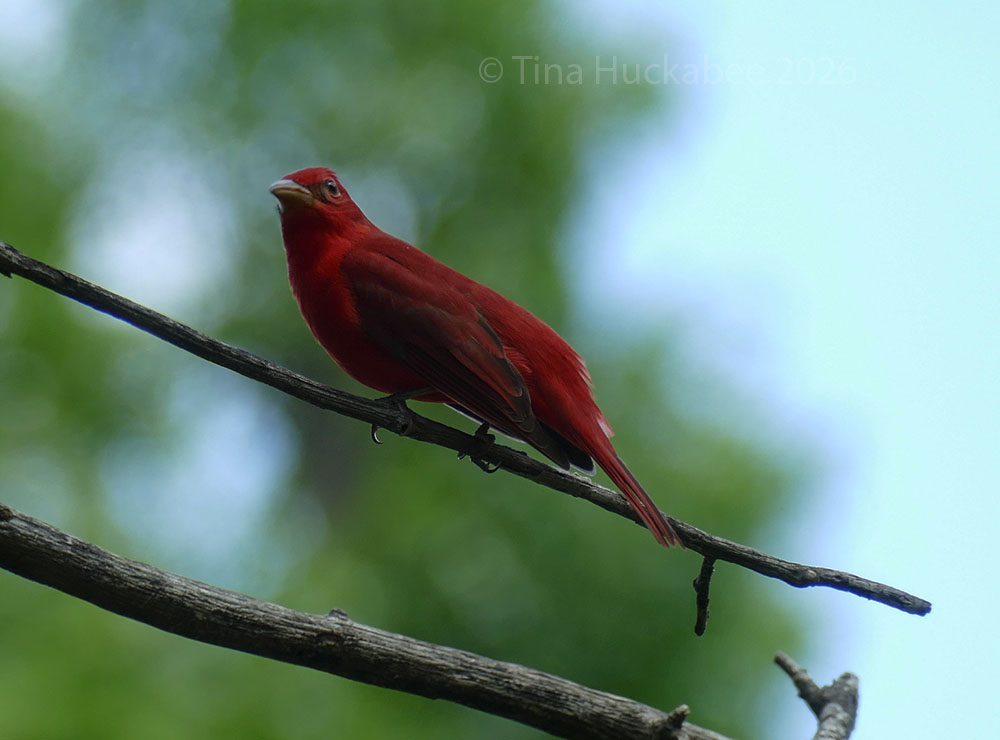
My back garden is still the best place to bird watch and it didn’t appoint. In an earlier post, I profiled a male Summer Tanager, Piranga rubra,
…and an Indigo Bunting, Passerina cyanea, who visited on the same day. I wonder if they coordinated, as red and blue go nicely together?
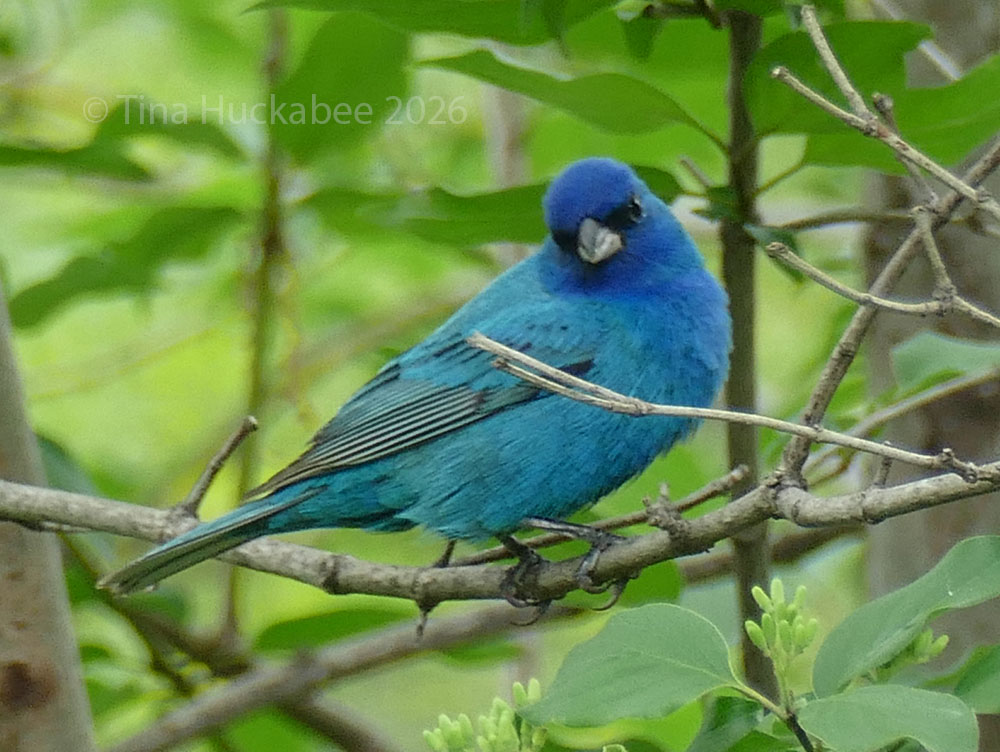
The tanagers usually show up in May and hang out near my beehive as they’re bee and wasp hunters. I’ve only seen an Indigo a couple of other times, so I was pleased with this pretty fella; he was obliging for the photo shoot. Both of these birds breed in the southern half of the US, the bunting with a wider range than the tanager. As a general rule, I only see these birds during spring or fall migration, though female Summer Tanagers have visited my gardens in summer months.
Painted Buntings also make an appearance in early May, usually for a couple of days. The only male Painted Bunting, Passerina ciris, that I saw this year was perched in my SIL’s Retama Tree, which sits outside one of our bedroom windows, offering close-ups of its lovely flowers and foliage at the window. I saw movement out the window, observed the handsome guy, ran for the camera, realized the battery was dead, said some bad words, replaced the battery, and by the time I returned for the shot, Mr. Gorgeous was semi-hiding in the pretty foliage and flowers of the Retama.
Harrumph!
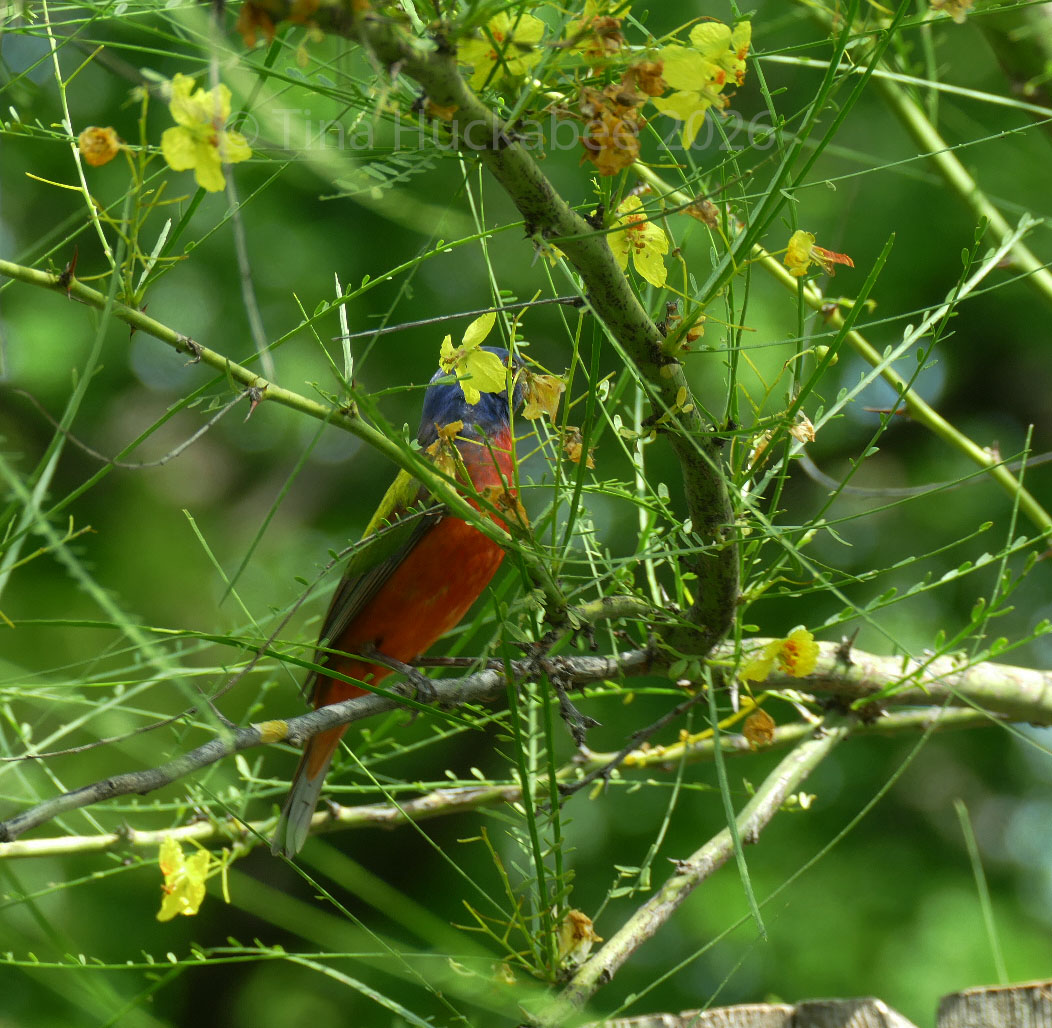
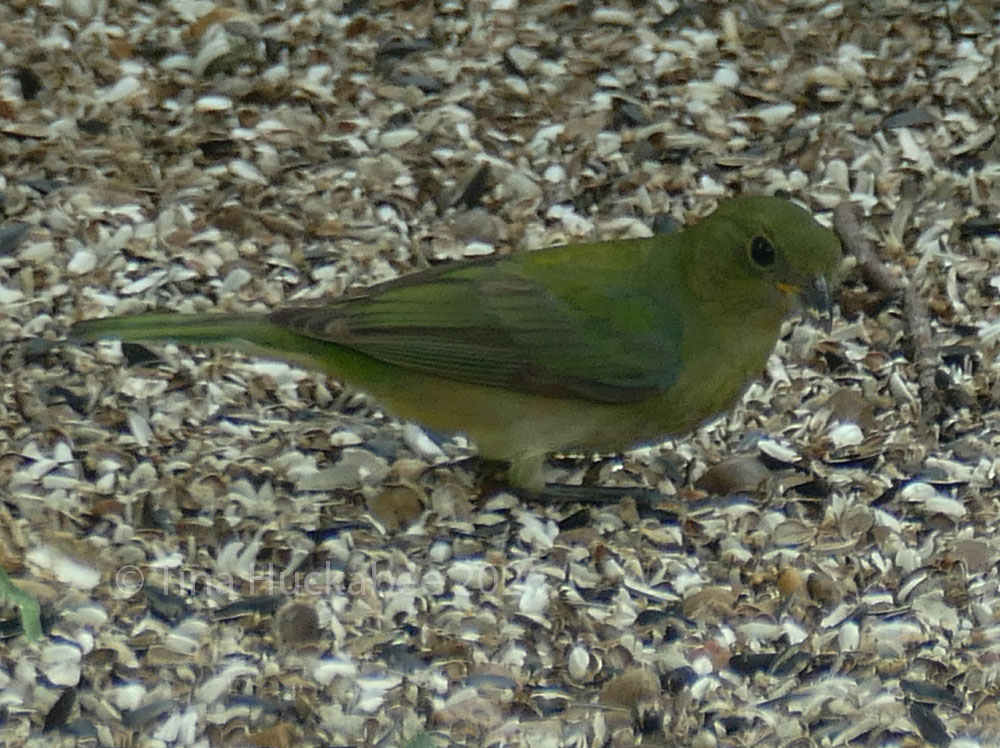
On the brighter feathered side, two female Painted Buntings spent an afternoon noshing on seed fallen from the the safflower and sunflower feeders. They never were close enough to one another to acheive both in a photo, but this pretty one was still long enough for me to capture her nibbling on a seed. Her sister bird is just as attractive.
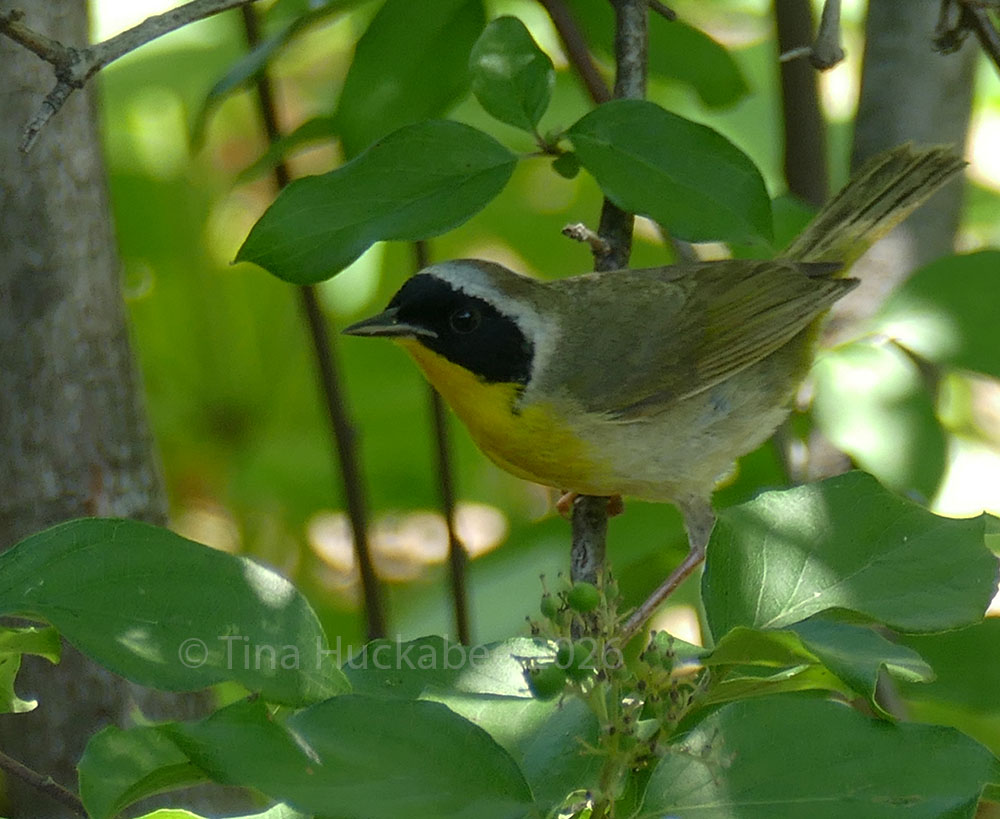
Two pairs of Common Yellowthroats, Geothlypis trichas, spent some time in my gardens over several weeks. This male, with his lemon yellow chest and jaunty black mask was all about bathing in the pond and fluttering dry in nearby shrubs. I never think these cuties the least bit common, despite their names.
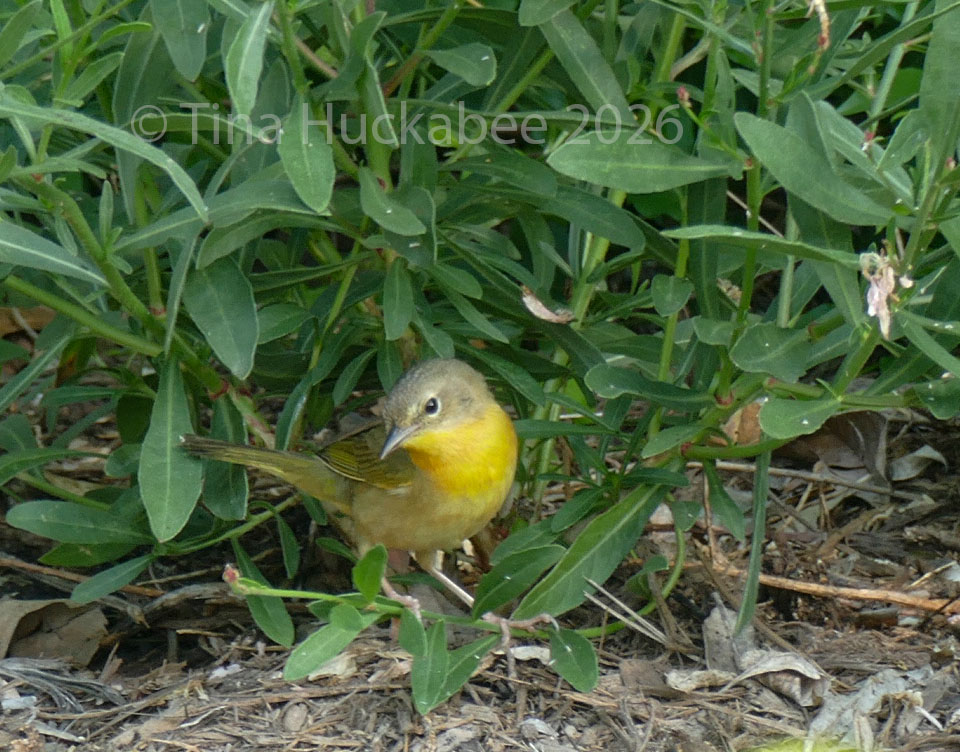
The females Common Yellowthroats were hard to see, only allowing the briefest of glimpses as they bopped for seeds and insects in, out, and through undergrowth. One of the females finally emerged from the greens of the garden long enough for me to capture her in a few photos. She’s less colorful than her mate, but darling nonetheless and her yellow is just as lemony as her male partner. These tiny birds fly far for their breeding, as they are mostly out of Texas to raise their families.
I like this bird-on-bird photo!
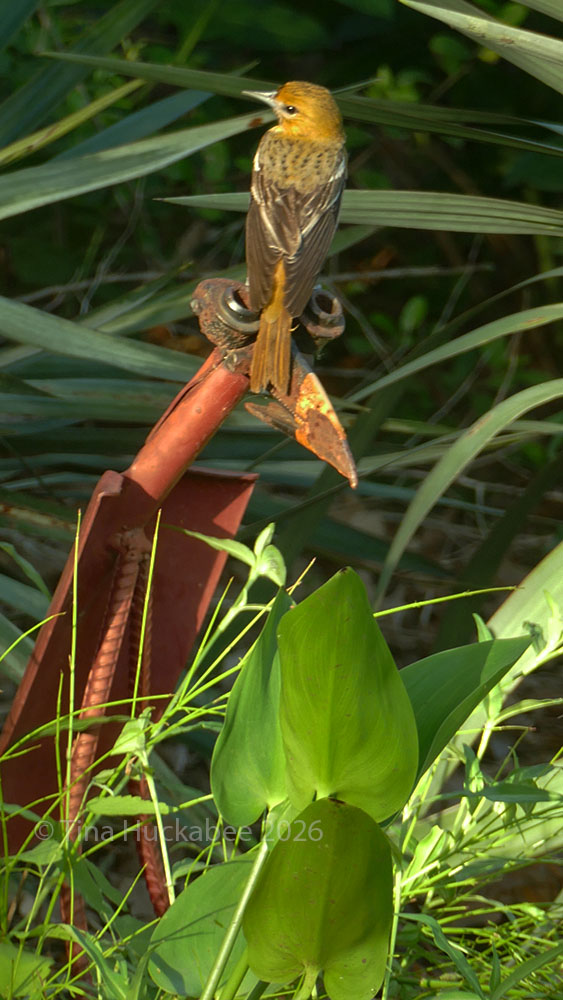
We were gone for the first week of May and that’s a prime time for migrants through my gardens, including Baltimore, Bullock’s, and Orchard Orioles. This female Bullock’s Oriole, Icterus bullockii, was a late arrival and perched amiably on a metal bird just so I could catch a shot of her. She was only around one evening and I saw no other orioles this spring unless they all came through when I was traveling. I’m a bit sad about that, either the lack or orioles or my having missed them. Orioles are easy to spot in a garden owing to their bright colors! I hope this one is north of Texas now, somewhere in the central or western part of the country, preparing for or tending to some healthy chicks.
Hummingbirds are here, too, though no photos yet. They’ll hang out through summer nectaring on a variety of my plants, most of the tiny terrors leaving by late October. Resident birds are tending to growing chicks, or have already competed the intense part of parenting, and breeding season will wrap up soon for most species around here. It’ll be mostly the usual suspects until sometime in August, when new calls are heard, and young birds hatched far north of here, together with their parents, make their way southward again for winter, continuing the timeless migratory patterns their genetics demand.


Migration is indeed a wonderful time of year, like a old friends reunion. The dawn chorus here seems less frantic, so I imagine there are many fledglings out learning the ropes now. The season literally flies by!
LikeLike
I like it when I travel in summer to places where “my” migratory birds are nesting. I get to hear their calls and songs, which I don’t when they pass through my place, looking for food and rest.
LikeLiked by 1 person
Your garden looks like a perfect rest stop along the northward and southward annual bird migration. Handsome photos!
LikeLike
Thanks, Sam–I feel good when a bird remains still for a few minutes, giving me time…:) I hope my garden is a respite for the birds, their lives are hard.
LikeLike
I think you have a wide variety of birds, more than I had down there. I always wanted to see a Painted Bunting.
LikeLike
Central Texas is the major flyway, though the coastal area also sees quite a few birds come through. Perhaps you were just a bit too far inland to benefit from that.
LikeLiked by 1 person
The last few years in Texas there have been very few visitors to my yard. High Island (which is not an island) was not too far from my location and has a huge spring migration. They say the birds drop from the sky as it is the first land they come to. I was about 60 miles from there, but the birds had other places to go.
LikeLiked by 1 person
My SIL has been to High Island, but I’ve never been. It is interesting that you were so close to such an intense migratory spot and yet, you didn’t see much. I guess those birdies have a different route northward.
LikeLike
The bird on the metallic bird got me wondering how lifelike a metal bird sculpture would have to get, in both form and size, for a bird to think it really is another bird.
LikeLike
Haha, I was tickled that the bird landed there and stayed a minute. I like that shot! I have a metal ant with its antennae that sits in a birdbath on the ground. The birds like to perch on that, too–I should get a photo sometime. Insect helping bird, I could call it. 🙂
LikeLike
Tina, wonderful captures of these beautiful birds. I love the buntings, especially the indigo bunting. We get the buntings here in coastal Georgia but I rarely see the indigo.
LikeLike
Thank you! I don’t see the Indigo buntings every year, though they do pass through here. I was happy that the tanager and bunting provided a bird photo duet!
LikeLiked by 1 person
Thank you for sharing your lovely photos, Tina. I would love to spend time in your garden watching your spring migrants. Some of them also stop by here, but many don’t. I would shout for joy if a Painted Bunting ever showed up on one of our feeders. This year was a first for a male Summer Tanager here at home, and I was overjoyed to observe him enjoying an orange.
LikeLike
You’re very welcome, Tanja! Come on down next April or May! It’s a bit of a trick sometimes, as I just happen to be out or looking out when some of them arrive, but it’s a treat when that happens, to be sure.
Summer Tanagers are so beautiful and I love their calls! Somehow, I just love it when birds like fruit! Currently, I’m putting slices of apples out for my Red-bellied Woodpeckers, who have to share with the squirrels for the treats. 🙂
LikeLiked by 1 person
Thanks for the invite, Tina. I will keep it in mind! 🙂
I also love the idea of providing fruit to (some) wildlife. Oranges seem to have the greatest draw; I haven’t had much response to apples or grapes.
LikeLike