It’s Spring, Y’all!

Poppies are poppin’ and honeybees are rockin’. Honeybees are all in the poppies’ innards, their pantaloons (corbiculae) laden with pollen as their work takes them from flower to flower. Most of my garden is abloom with native Texas plants, but this European poppy is the descendant of seeds given to me by a German neighbor decades ago. The poppies appear annually in January when delicate foliage rises upwards during the cool season, then buds reveal glorious red and purple in April.

It’s spring, y’all. Trees are leafing out, perennials and annuals are showing off their eye-catching wares. March was dry and warm, though rain and chilly temperatures have made a come back. Flowers are opening, pollinators are working, and birds entertain with song.

Two of my Soft Leaf yucca, Yucca recurvifolia, are in a blooming mood, guaranteeing they’re not outperformed by the red, red roses of Martha Gonzalez. I grow five of these yucca plants in my front garden. The plan was that each spring, upon maturity, the yuccas would all produce their dramatic flower spikes at the same time. This has never happened. This spring, three recalcitrant yucca individuals are refusing to send up spikes. Wishing the plants would bloom in concert with one another isn’t working. Alas, they will do their own thing.

Cool season, orangy Desert Mallow, Sphaeralcea ambigua pair nicely with pretty, purple Spiderwort. Tough plants both, they’re situated at the street side of the garden, full west sun. The mallow is a shrub, the spiderwort a cool season plant that will disappear in the heat, showing up again in late fall or winter.

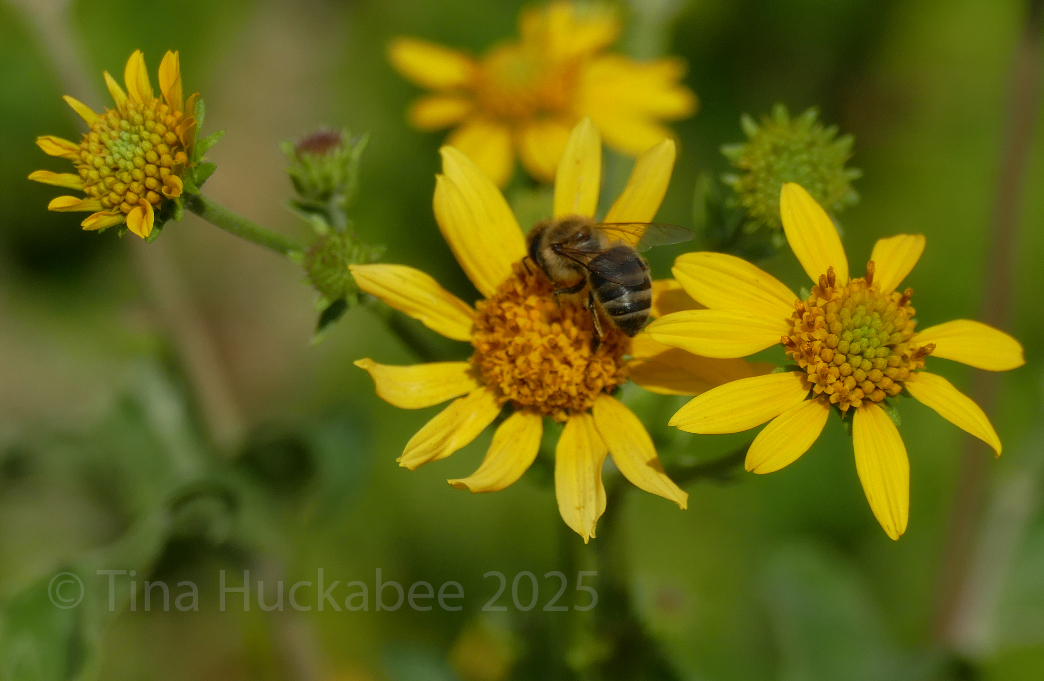
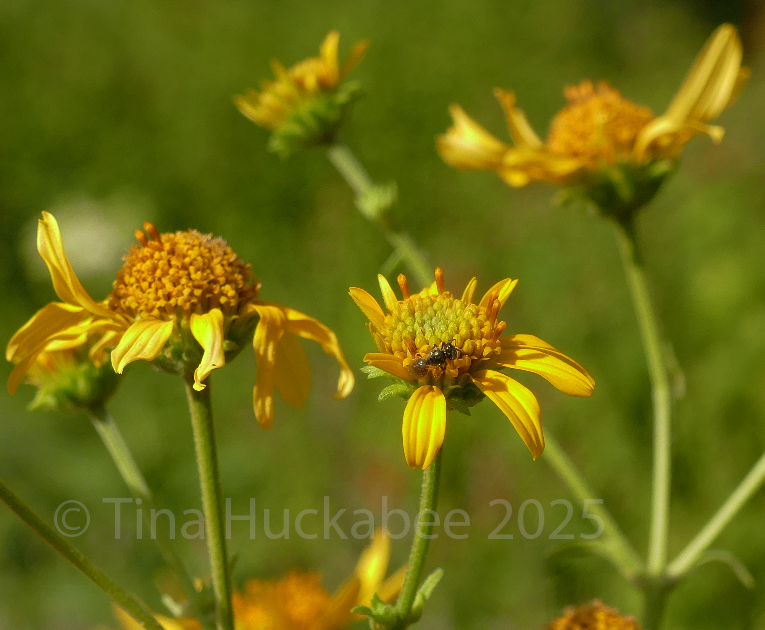
Four-nerve Daisy, Tetraneuris scaposa, dances in the breeze, their yellow faces turned to the warm sun. But are they missing something?

There it is! A native bee, maybe in the Melittidae (oil collecting bee) family. The bee landed in the pollen-plenty center of the sweet daisy flower, working the flower for the bee’s benefit and the plant’s future.

A side view of the bee highlights pollen stockings on its legs and cool abdomen racing stripes.

Hill Country Penstemon, Penstemon triflorus, is in full swing now, with mostly night moths as its main pollinators. If there are hummingbirds around, I’ve yet to spot them, but they won’t miss this pink beauty when they arrive in my garden. In my last post, I profiled the first one to flower, but now all five individuals have caught up and are playing their parts in the pink parade.

The greens are greening-up too, thank you very much. Foliage certainly has its own beauty and purpose, not outdone by flashier colors. In this photo, two evergreen Red Yucca, Hesperaloe parviflora, mix with spring-green Yarrow, Achillea millefolium, and the foliage of other Texas perennials: Plateau Goldeneye, Viguiera dentata and Zexmenia, Wedelia acapulcensis var. hispida. Just emerging from the soil is the scalloped foliage of Pam Puryear’s Pink Turk’s Cap, a cultivar of native Turks Cap, Malvaviscus. The trunk of a young Red Oak, probably planted by a Grey Squirrel, bisects the greening vignette .

Beautiful Mexican Feathergrass, Nassella tenuissima, pops up here and there, graceful in form and color.

The primacy of Blue Curls or Caterpillars, Phacelia congesta, is nigh. Lovely blue-purple florets unfurl along a spine, beckoning pollinators to visit and gardeners to admire. There’s a tiny native bee on this cluster set, do you see it?

If not, here’s another flower cluster hosting a similar busy bee, one more zooming in for some action.

Each day, more of these annual wildflowers are opening for business. Soon, I’ll watch as myriad pollinators, particularly small native bees, skippers, and true bugs, visit these blooms. Aside from the color, texture and form of the plants, the garden is alive with movement and life of those who rely on the plants for survival.

Spring has definitely sprung. The weave of form and color mark each morning-to-nightfall, and change is a constant. Pollinators are in fine form and migrating songbirds are passing through, resting from their travels and nibbling insects and seeds that drop.

Spring is the definition of beginnings, a confirmation of living.

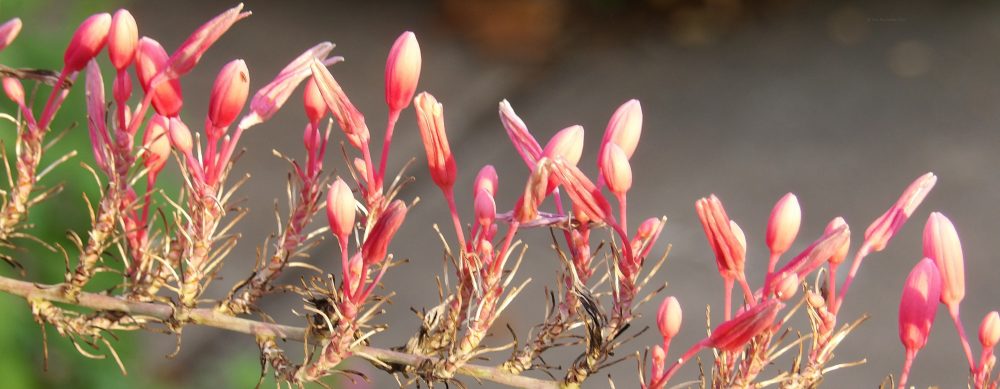
Red Yucca, Hesperaloe parviflora

Thinking Inside the Box

Sometimes, she’s thinking outside the box, too. This photo was taking in early January, before the oak lost its leaves. She wasn’t pleased with my cooing and taking her photo for all to admire.

An Eastern Screech Owl couple have been around the garden in recent weeks. I’ve spied them mating (once) and on a couple of videos, the pond wildlife camera featured one of of the owls, male or female this viewer has no clue, hunting rats. The female stays in the box some days, but not consistently, so I’m uncertain whether the box will be the nesting site or if it’s an occasional place to hang out for the day.

She’s in the box today, this freezing day. Blue Jays perch on the nearest branch and voice their disapproval with her presence. She sleeps, but sometimes stirs nervously when the jays are yelling at her.

I think this is a different couple than the pair that nested in here the previous three years. Their trills are different, the female is skittish, winging to her daytime sleeping spot before sunrise, rather than ‘Uptown Girl’ who enjoyed her time out of the box in the early mornings before sequestering in daylight hours.

I hope these two choose our box for their chicks and that the chicks fledge successfully.

I also hope the family eats some rats.

A Path Well Traveled

In viewing the videos and photos capturing the night antics of various critters who visit my garden I noticed that each of the species use the same pathway as they arrive at, and then exit, the pond area. The fox(es) always travel a certain path, through the back edge of a garden, as they leave the pond area for other fox adventures.

While most nights foxes are the main attraction, the raccoons also show up to enjoy the yummy, fishy pond water. When they leave to continue their rounds, they usually follow the fox route.

There are fewer visits from Opossums that are caught on the camera, but they too like traipsing through the winter touched plants, rather than taking a less leafy track.

It’s not entirely clear from the videos, but the back fence is at the far left of the frame. There is a gardener-made path, nothing formal, just a well-worn trail going from here to there, and I would have assumed the nocturnal beasties would use that path as it’s available and easy to travel. But they all prefer ambling through the herbage, sticks and branches and pokey plants their walking companions. My best guess for the walkabout choice is that the plants provide cover and protection and I suppose they feel safer than in an open area. For myself, I don’t like to bumble through the garden too much (unless I’m working). Inevitably, a branch I move aside will pop back to whack me. I guess the low-to-the-ground animals don’t have that problem!

Interestingly, I have seen each species take the start of the back trail and make their way to the open area at the pond, politely skirting the wooden beam.

And sometimes it’s just easier to crawl over the back side of the water fall.

Like humans, occasionally a varmint will shake things up and travel a different path. This fox seemed comfortable in the garden, no doubt having cut through it before.

It’s been a week since I’ve seen a fox and longer since the raccoons were spotted on the camera. The Opossums are still around, though the pond camera hasn’t captured them; I’ve observed them in the early mornings before sunrise, crunching through the fallen leaves and sometimes walking along the top of the wooden privacy fence. Mostly, the rats have been on the camera and I’m not thrilled with that, but they’re out-n-about at night too, so it’s not a surprise. I expect that as I’m pruning many freeze-damaged plants the night walkers prefer areas with more cover. They’re still attracted to water sources though, and my garden provides plenty. I’m hoping that the rats that are now at play will become an inducement for some wily hunters.