I watched this annoying cutie as he munched a treat of a whole pecan. Though he chose to dine in the small Red Oak tree standing in my front garden, he snatched the pecan from some other place, as only oaks with acorns live here. The oaks are stingy with acorns this year; there are fewer than normal, probably due to drought. However, it’s clear that a neighboring pecan tree is producing some yummy fruits.
Squirrel kept an eye on me, wary that I might be after his pecan.
Squirrel and I have in common a love of pecans. For me: fresh and raw, roasted in salads, added to cakes, pies, cookies, and ice cream. For squirrel, right out of the hard shell, balancing on a limb while nibbling.
Don’t fret Squirrel, I’m not after your snack, I have my own delectable pecan treat to enjoy in a few days.
Spring sprung many months ago, summer’s hardy floral gifts, amidst Texas heat and drought, delivered color and life with attending pollinator action throughout those toasty months. Summer is finally done and autumn is a robust flowering period, full of blooming goodness. A pollinator frenzy is in full swing in my Austin garden.
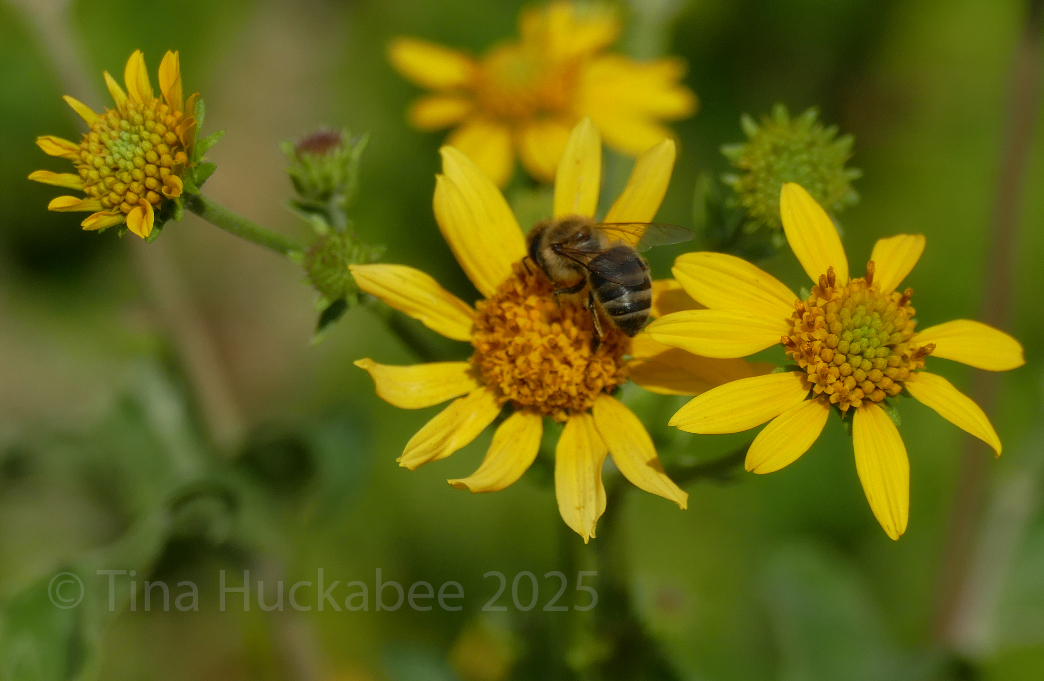
The yellows, especially Plateau Goldeneye, Viguiera dentata, are the pollinators’ delight. Monarchs have mostly drifted southward along gusts delivered by the last cold front. Other butterflies seem to be on vacation, but bees are still around and about–and pollinating. Most folks know about honeybees, but native or wild bees, are common and vital in any healthy ecosystem, whether in a natural green space or a planned and loved garden. In a recent stroll through my garden, I observed multiples of three kinds of bees that were all-in with their pollination business, sharing flower space they buzzed about a Plateau Goldeneye.
Here, a honeybee works the flower, her little leg splayed out, maybe for balance or perhaps preparing to scoot over to the next flower. A bee’s version of getting a leg up?
The same bee on the same flower, all hunched up and nectaring away!
This bee isn’t a honey, but a native, or wild, bee. My best guess, utilizing this website hosted by an entomologist at The University of Texas whose research focuses on native bees, is that this little gal belongs to the leafcutter bee family.
I like this bird’s-eye view of the leafcutter bee, pollen pantaloons (aka, corbiculae) full-to-bursting with a packed load of beautiful, golden pollen.
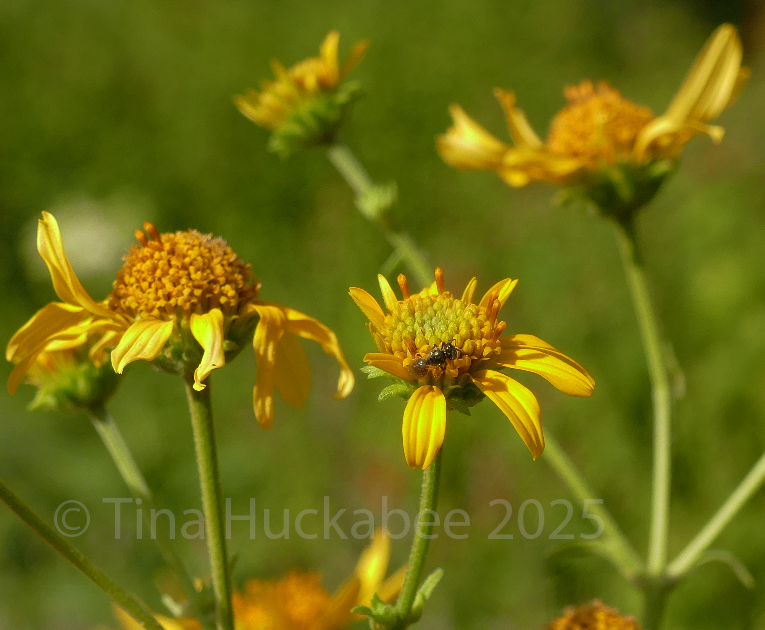
The third bee sort zipping around was this tiny thing, most likely a native sweat bee. All native bees are efficient pollinators, regardless of size, though size dictates how much nectar is consumed and the amount of pollen that is gathered. This little one won’t sip as much nectar or pack as much pollen as her bumble relatives, but she and her sisters are excellent in their important work.
This shot captures the difference in size between the sweat and the honey bee. Both are focused on their respective flowers.
Some bees are generalists, visiting a variety of flowers, others are more particular, arriving when certain flowers are in bloom, absent from the garden when that plant is in a resting stage. How the bee knows when its favored bloom is ready for pollination is a mystery, at least to me. Entomologists understand much about honeybees, but there’s comparatively little research on native bees. There are roughly 20,000 native bee species in the world, about 4000 reside in North America, and 350 in Texas. In fact, a new bee was recently discovered and named, existing only in Texas and Oklahoma: the Andrena androfovea–a blue bee, which you can read about here. This blue bee is one of those bees that sips from only one species of plant!
I’ve “identified” roughly 15-18 native in my garden over the years. I don’t necessarily know the name of each (though I know some), as there’s not much information available, so I look at photos and make guesses. Lots of guesses. But I have learned to recognize a bumble from a carpenter, a sweat from a leafcutter, a metallic from a bee mimic. I’ve become familiar with their habits: some are wood nesters, others nest in the ground, most (except for honeybees) are solitary and make small amounts of honey to feed their offspring. I recognize the leaf ‘damage’ that bees do to certain plants in my garden, as they pack their nesting sites with leaf matter, mud, and pollen. Some native bees forage for a brief time in early spring , lay their eggs in protected wood or plant stems, then die. Others are around throughout the growing season, procreating and nectaring all the while.
Native plants and native wildlife, insects included, evolved together and need each other to survive. A vibrant ecosystem will support this symbiotic relationship which defines the life cycles and relationships of flora and fauna. Go native and watch your garden and its inhabitants bloom with life and activity!
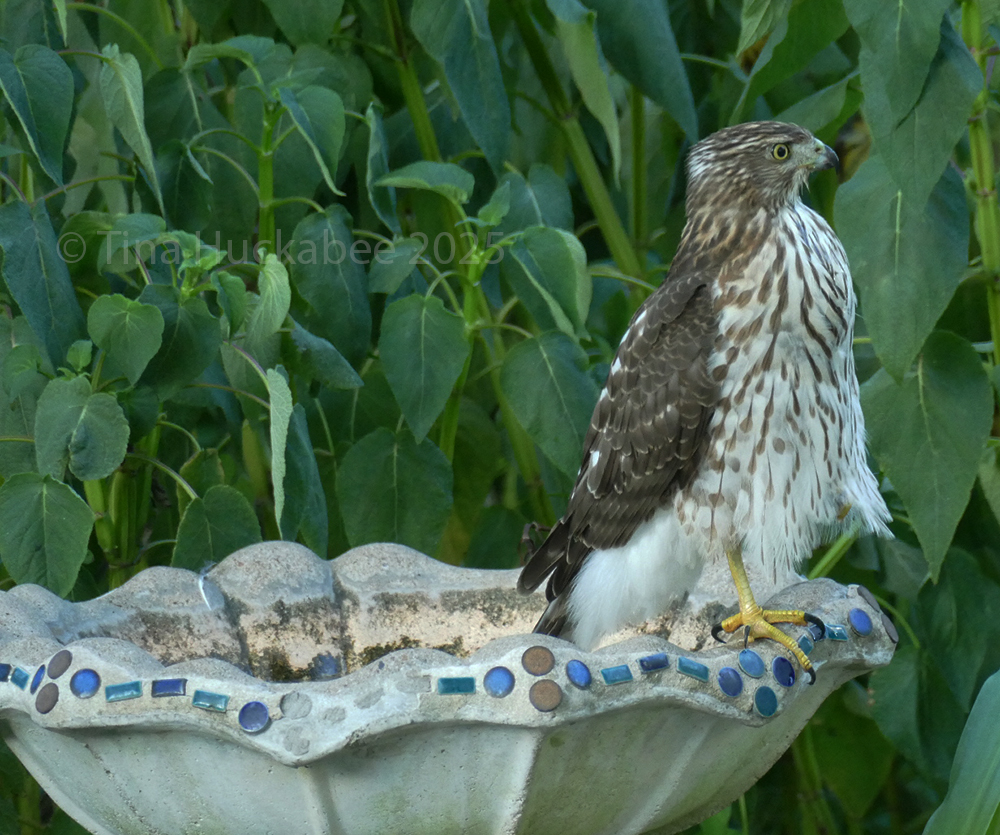
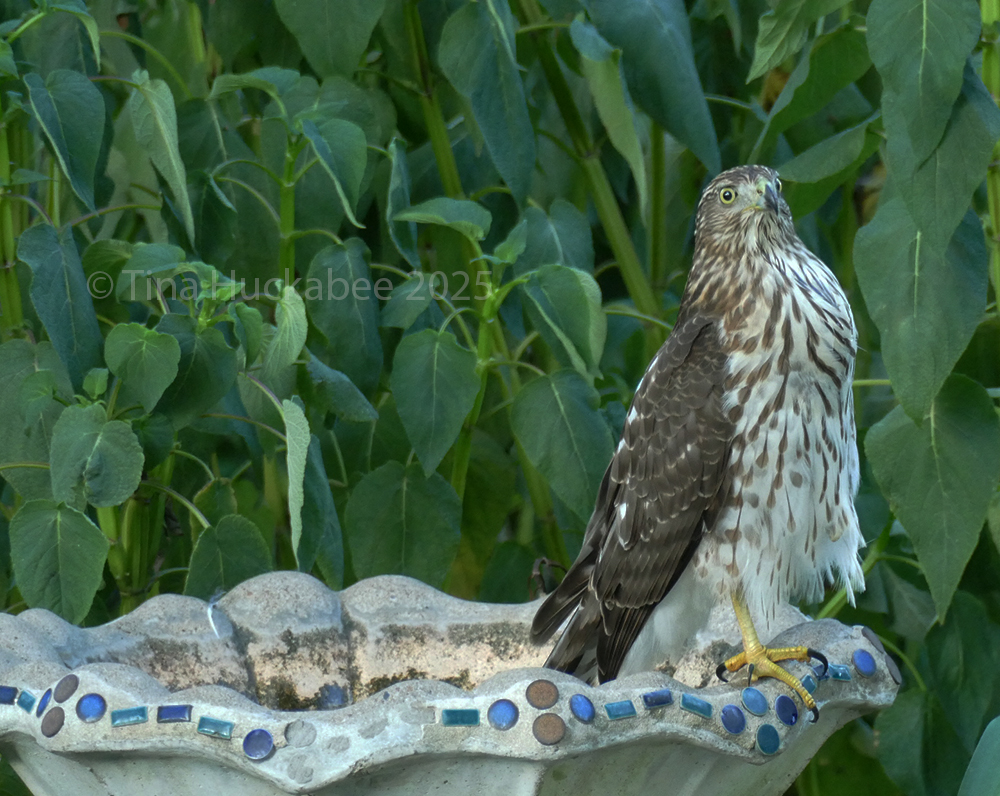
On a recent evening my back garden was honored with a visit from this immature Cooper’s Hawk, Astur cooperii, who spent time at one of my bird baths. The bird sat and surveyed its surroundings,
…took thirsty dives into the water,
…and with beak pointed to the sky, gulped, gulped, gulped, enjoying a cool water drink at the end of a day.
At first, I assumed he’d landed looking for dinner, but the squirrels were somewhat active (not directly under the hawk’s beak, but nearby) and birds were around, though giving this formidable predator its space. Cooper’s Hawks typically hunt birds, but I’ve witnessed one catch a squirrel. A successful predator will hunt whatever is available and catch-able.
I wouldn’t want to be on the catching end if these things–would you?
Given the hawk’s lack of interest in a meal and its focus on the water bowl, I wondered if this one had dined earlier, in some other venue, and was in my garden for its after dinner drink.
The hawk sat, sipped, looked around and eventually hopped to the opposite side of the water bowl. This young Cooper’s has a regal form: bright, intelligent eyes, glorious plumage, and a dignified figure.
My favorite photo of this half hour of hawk watching is this one.
The hawk has a I meant to do that! look on its face. Maybe it took a page out of the White-winged Dove book and pooped in the water? Or perhaps it belched a bit and was embarrassed? Do hawks belch? Do hawks get embarrassed?
Shortly afterwards, my hawk buddy winged to the overhead utility wires behind my property and then onward to its perch for the night.
I love to spy on the flitty birds in my garden, both migratory and resident. They’re quick, agile, easily hidden in the foliage and a triumph when I get a good look and photograph. That said, it’s rewarding and so much easier to watch and appreciate a bigger bird. It’s truly a gift when one lands and spends time resting in the garden.






 My Gardener Says...