I’d seen it (and others of its kind) in the neighborhood. “It” is a Gray Fox, Urocyon cinereoargenteus, most likely a female (vixen) native to Texas and common in Austin. A few days ago, she visited my back garden for about 20 minutes, clearly relaxed and in her element.
She knew we watched her, but didn’t flee, nor seemed nervous. Also, it was clear that she’d been here before; she knew her way along the garden’s paths. I suspect that it was a fox that predated our Eastern Screech Owl nest box back in February. If so, I imagine she had kits to feed. Gray Foxes are omnivores and eat what they find: eggs, seeds, insects, reptiles, bird fledglings, rodents; their diet is varied. They also climb like cats and can jump up to 6 feet. They’re well-suited as predators in an urban environment.
She looks healthy to me, her coat lush, her eyes bright. She spent a few minutes nibbling on the remains of safflower seeds, dropped from a feeder situated above her.
After a while, she jumped up on the fence, traipsing along the top, until she sat. Then she lay down on top of a trellis adjacent to one part of the fence, comfortably dangling one front leg off the trellis edge. After a bit of rest, she climbed over the fence, and with a swoosh of her bushy tail, she was gone into another’s fenced space.
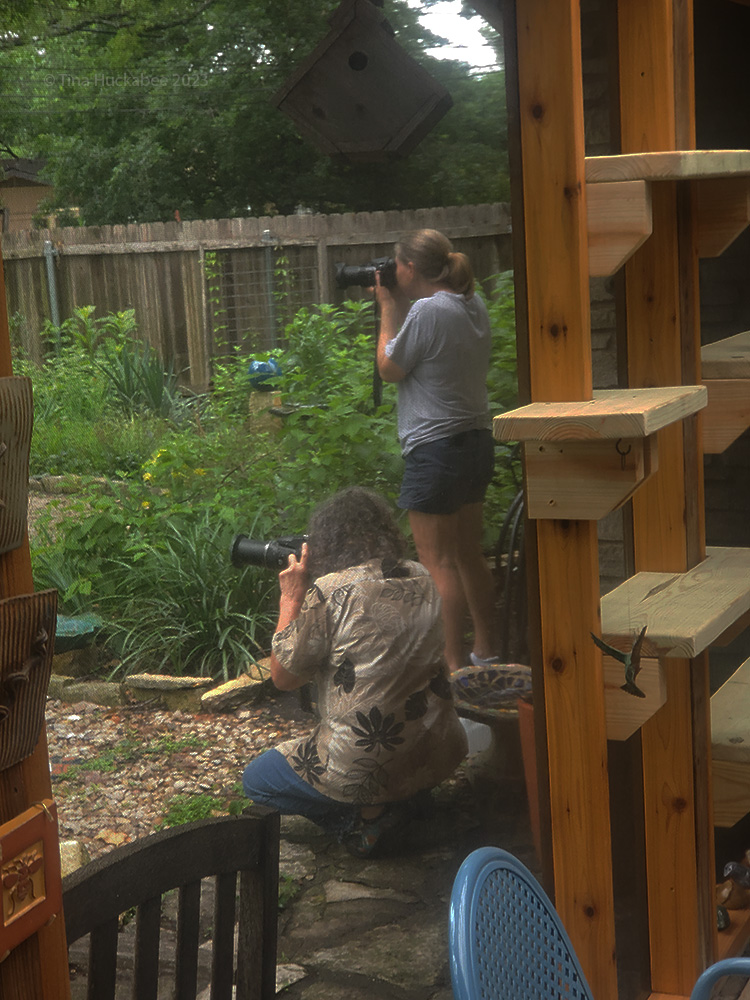
I’d called my SIL over to see our foxy visitor. Through the screen of the enclosed patio, the Hub caught this photo of us as fox paparazzi.
Spring bird migration is ongoing in my gardens, birds visiting as they wing their way north to their breeding grounds. I usually observe these far-flung-feathered-friends at or near my pond in the back garden; it’s a draw for these weary travelers and they love to splash. Near the pond are are several small trees/large shrubs where birds (both migratory and resident) take refuge when startled, or hop through, nibbling at whatever they find on foliage and limbs. The pond and garden beckons, so the migratory birds visit–sometimes for a couple of days, often only for a brief time.
The migratory birds don’t typically spend time at the feeders, but occasionally, that’s the main focus of their interest. This seems the year of the Red-winged Blackbirds, Agelaius phoeniceus. I’ve never seen so many in my gardens and they’ve never stayed around for so long. I observed a handful of males and lots of females. I usually hear these birds, their melodic, high-pitched call crystal clear, before I see them. They’re mostly gone now, but while they visited, they were interested in feeding.
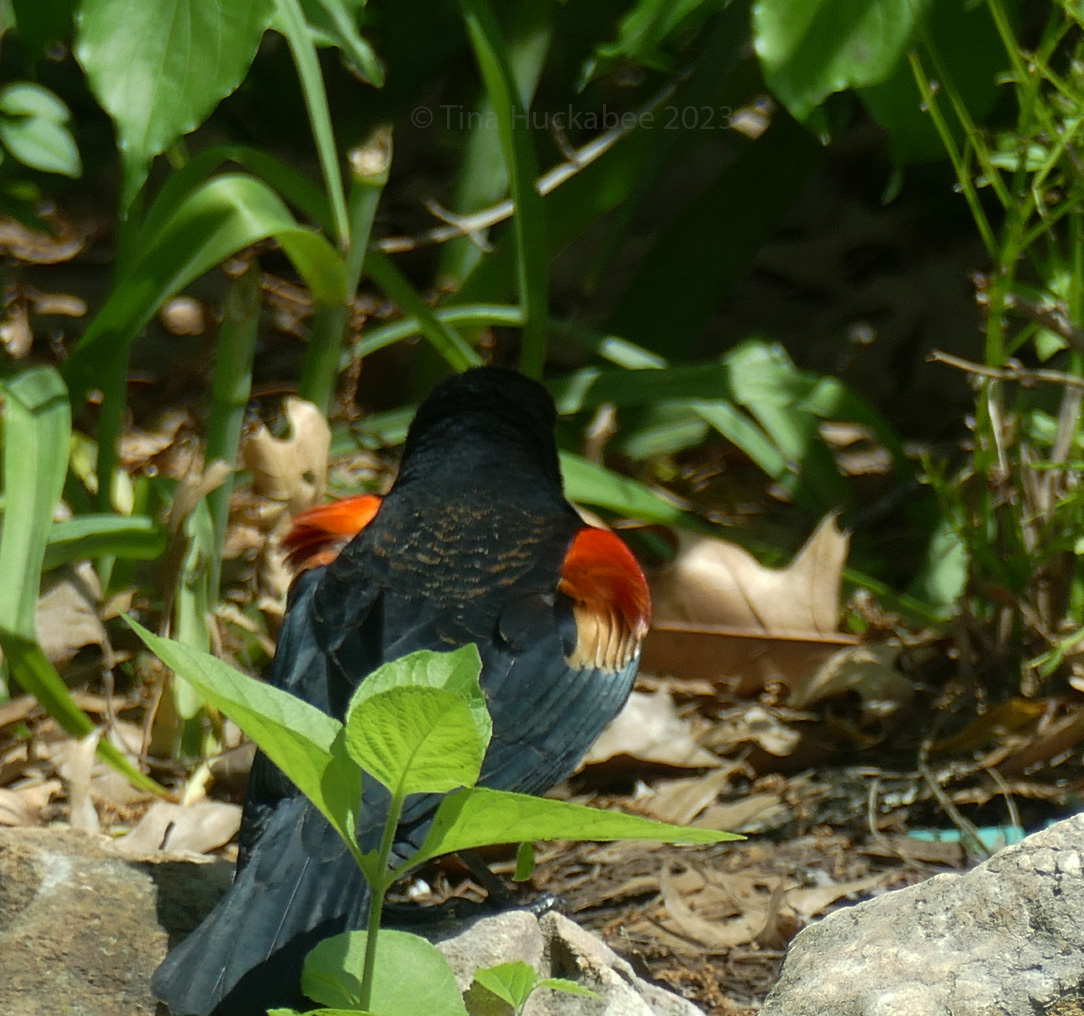
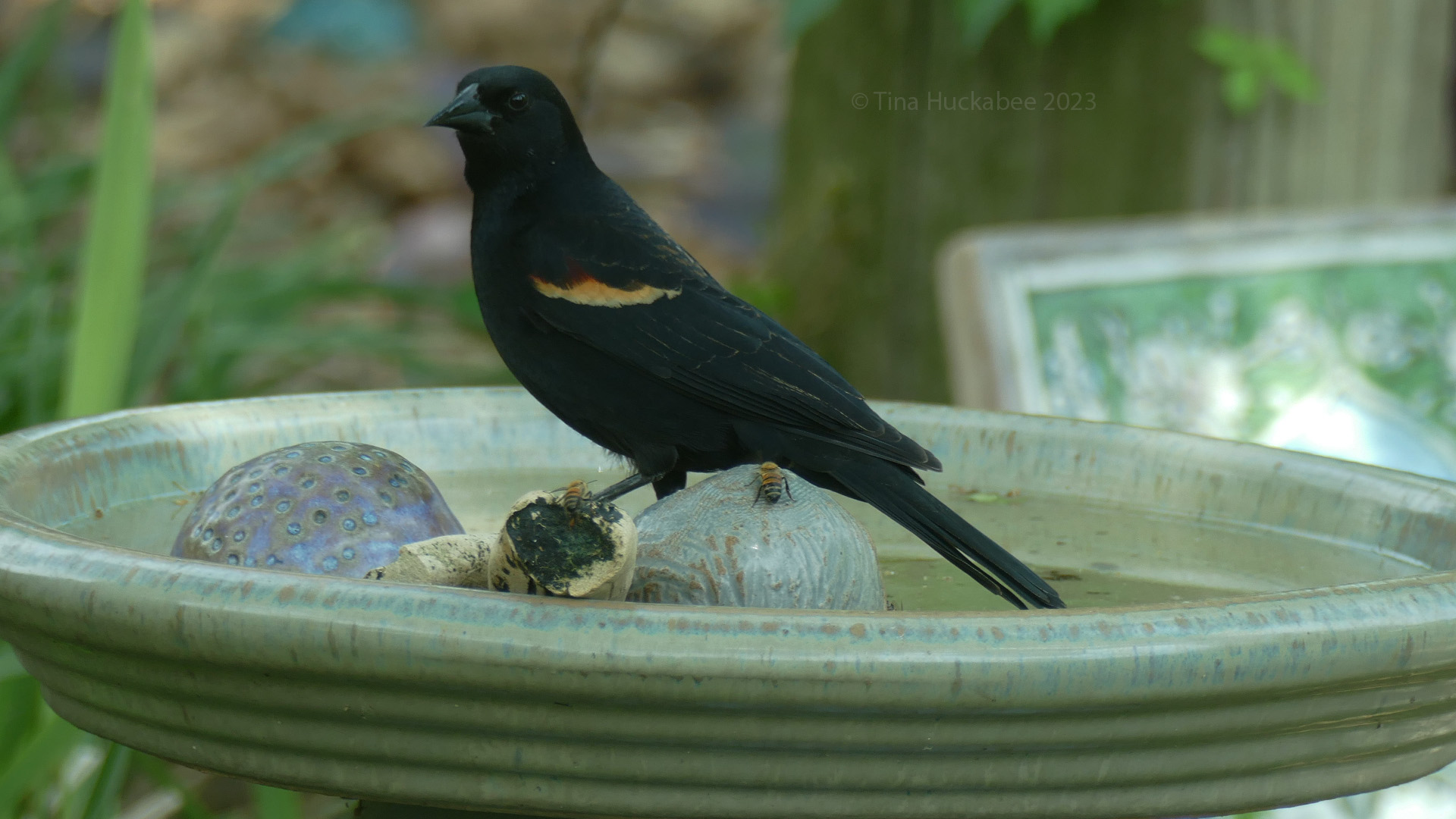
I’ve never been successful at capturing the stunning red and yellow markings under the wings of the males–until this spring. This guy was on the prowl, trying to impress a gal! He fluffed his feathers, the bright spots shone, the camera clicked!
That red against the rich, velvet black is swoon-worthy!
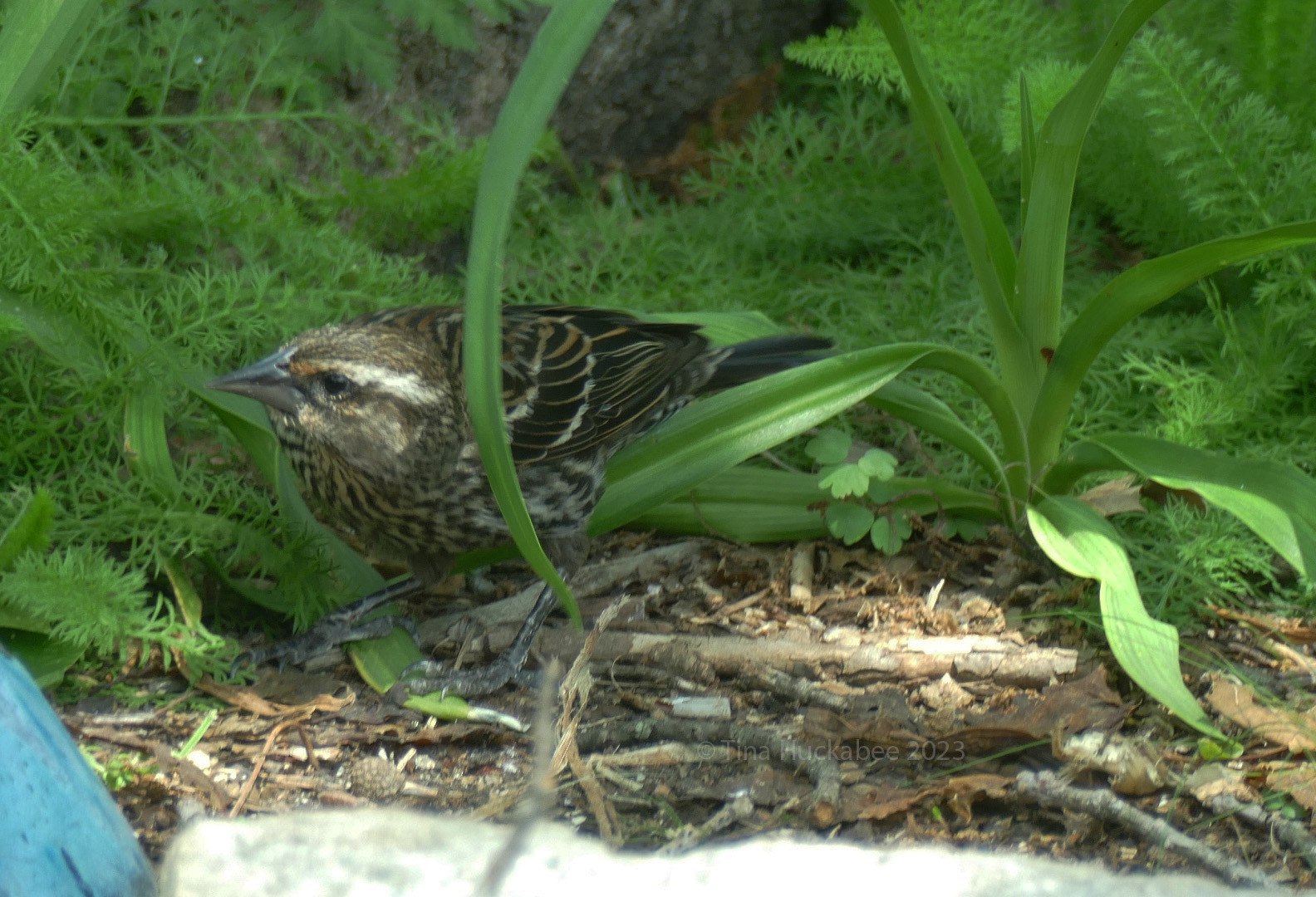
This was the object of the handsome male’s interest; she’s good-looking too, if less interested in him than he was in her. She ambled through the garden, seed-eating as she skillfully maneuvered away from the amorous male.
I think he finally gave up his courting attempt. A couple of honeybees kept him company on the water source, while the rejected male soothed his bruised ego with a cool drink and bath.
Probably my favorite of the migratory birds are the Lincoln’s Sparrows, Melospiza lincolnii. If not the flashiest of birds, they are nevertheless elegant in marking and form. Additionally, they have a line of feathers on their heads that stick up, suggesting birdie mohawks! They’re shy little things, zipping through the garden’s foliage, successful at not being seen. I have learned to recognize their call, and if I’m patient, sometimes catch them in a contemplative moment.
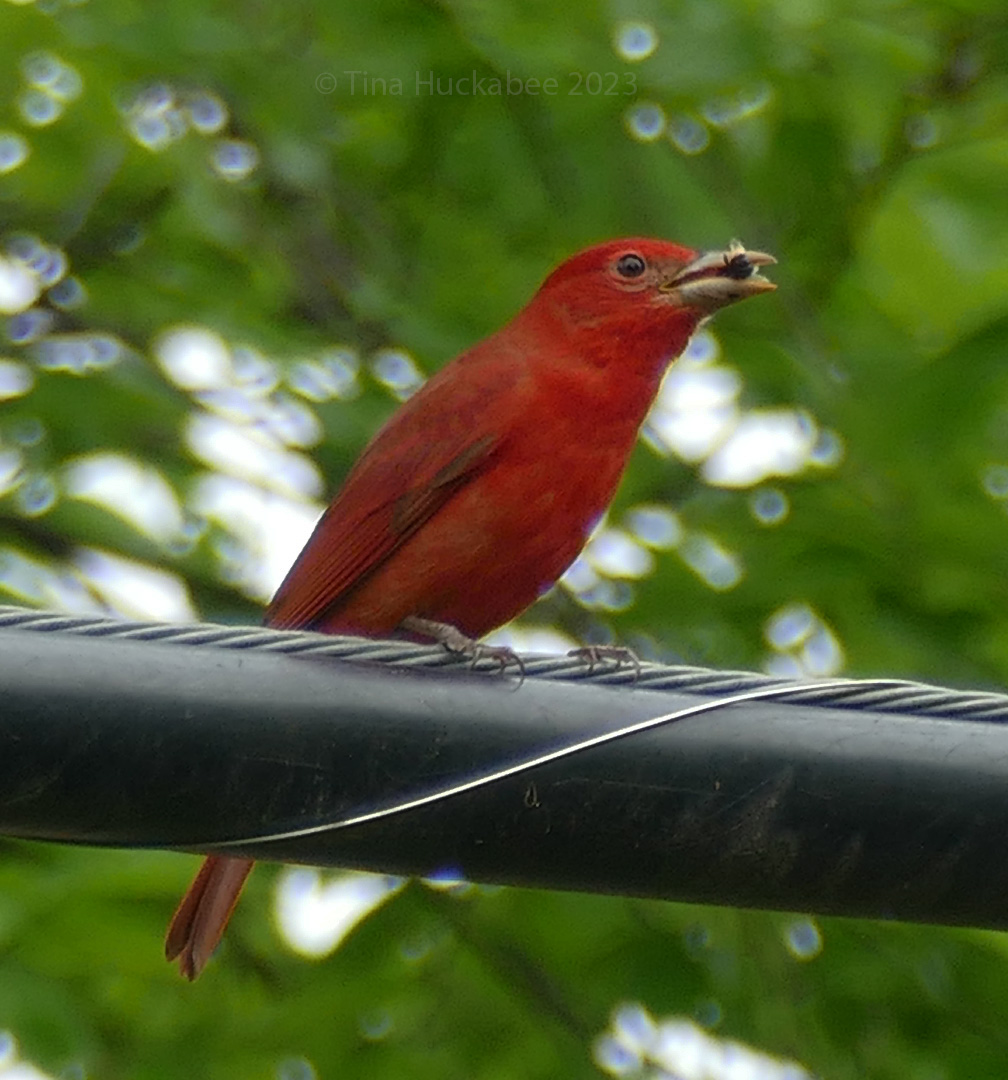
A truly flashy bird is the male Summer Tanager, Piranga rubra. Every spring, I see several in late April and early May. They hang out in the back garden where the beehives are located and hunt honeybees. Tanagers are known as bee and wasp hunters, catching the insects on the wing. This shot of an adult male with a honeybee snack was a dumb-luck photo. The tanager and I are thrilled with the capture, the poor bee probably less so!
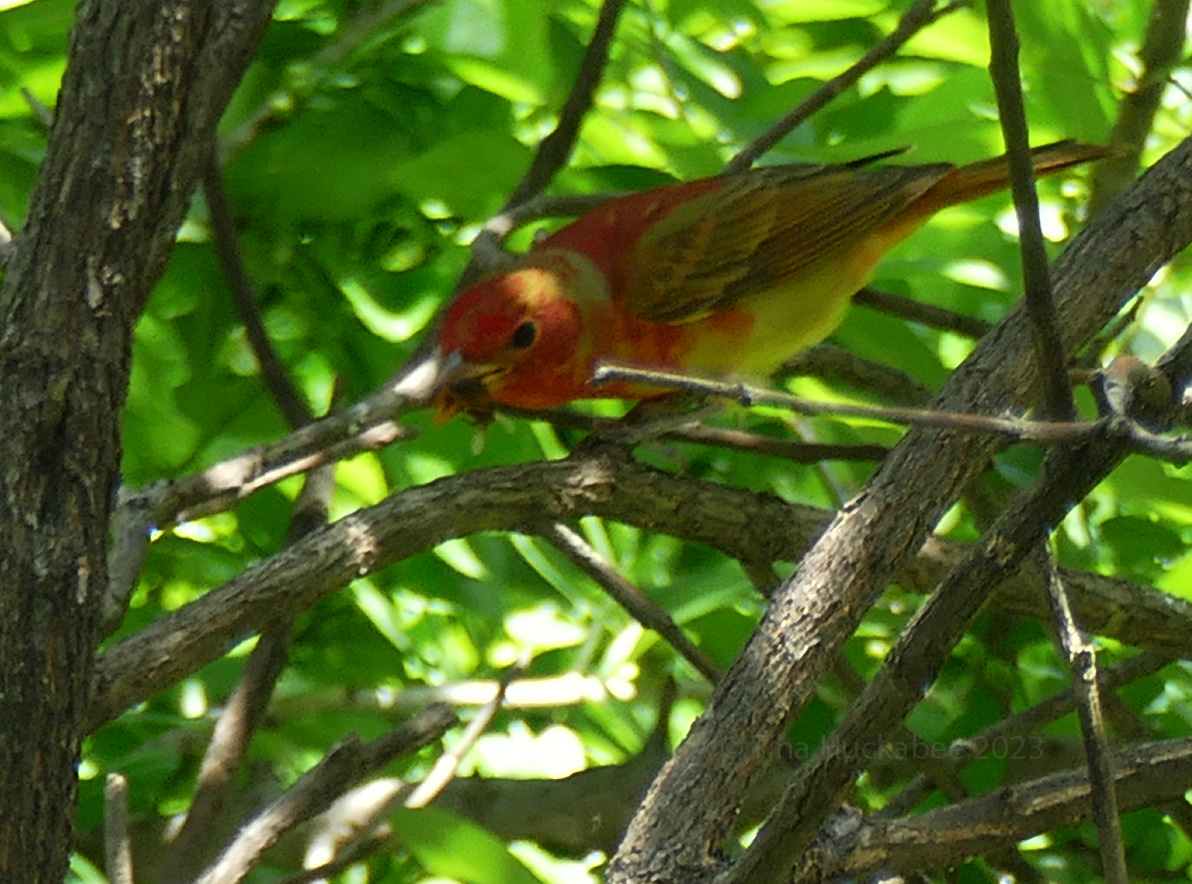
A week or so later, I heard another Tanager calling and saw this juvenile male, also hunting near the hives, his yellow and red coloring easy to spot in the leafy Mountain Laurel. He was also successful in honeybee snacking. During the tanagers visits, I saw only one adult female, but could never get a clear photo of her. The females are a rich, golden yellow and are just as fascinating to watch as their male counterparts.
A male Rose-breasted Grosbeak, Pheucticus ludovicianus, spent a couple of days going between my garden and my SIL’s garden. Cornell Lab of Ornithology shows their migration ranges from most of Texas (excepting far West Texas), through the eastern half of the U.S. They breed in the Great Lakes region, northeast, and Canada. Most years I see one or two, but I wouldn’t mind if more hung out for a while.
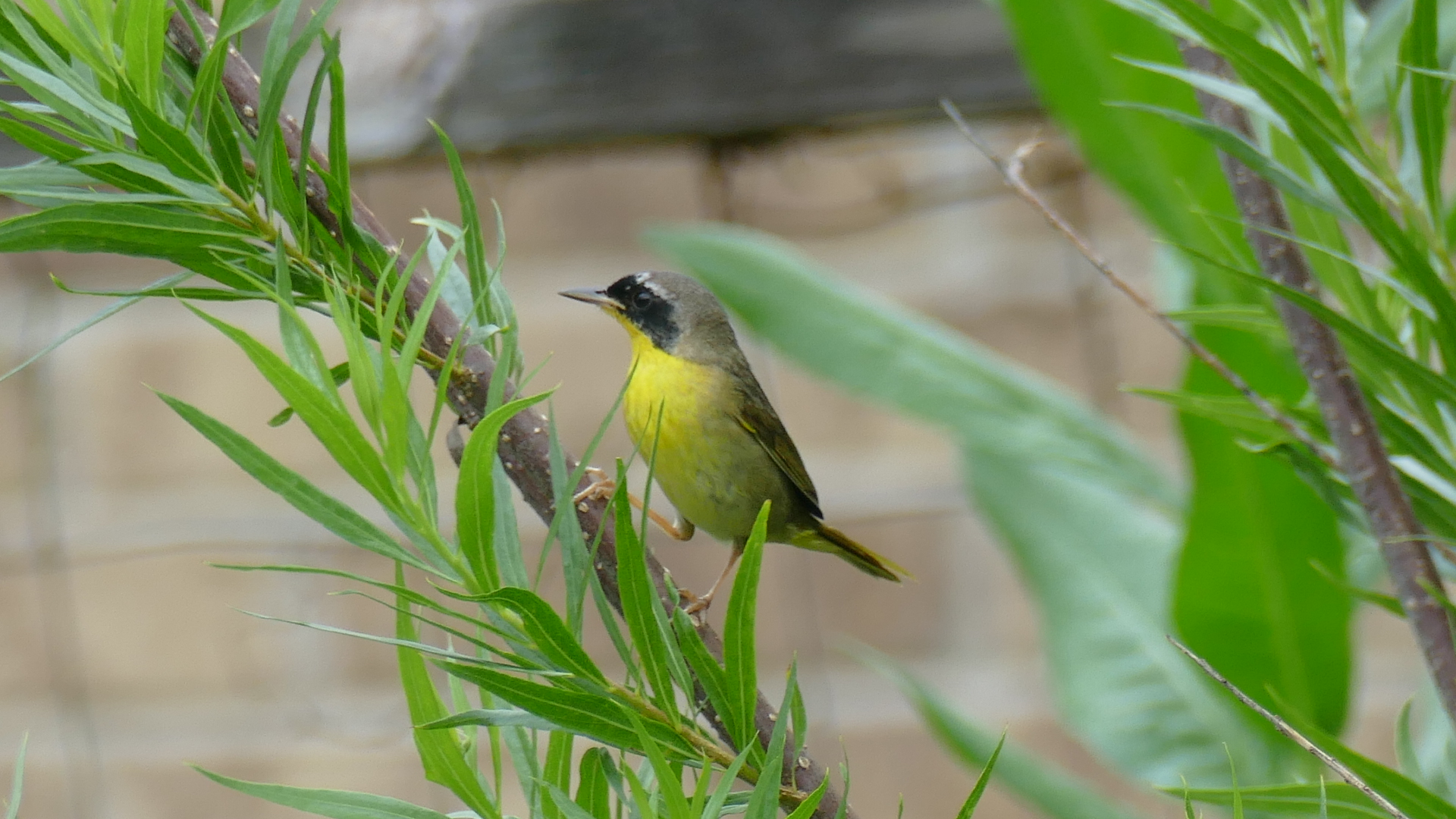
My new, full-sun front garden has proven to be another safe place for the migratory birds to spend time and eat. There isn’t a water source in this garden, but the native plant growth is welcoming for food and safety. Another bashful, super-flitty little warbler is the Common Yellowthroat, Geothlypis trichas, and they’re abundant in the front garden this spring. Hard to catch perching still, this male stayed long enough in my Desert Willow for me get a shot. I love the male’s rakish mask, he looks like a daredevil bird! As I write this post, there are two couples bopping around in my front garden, dashing through the plants, eating small insects as they go, sneakily avoiding the gardener and her camera.
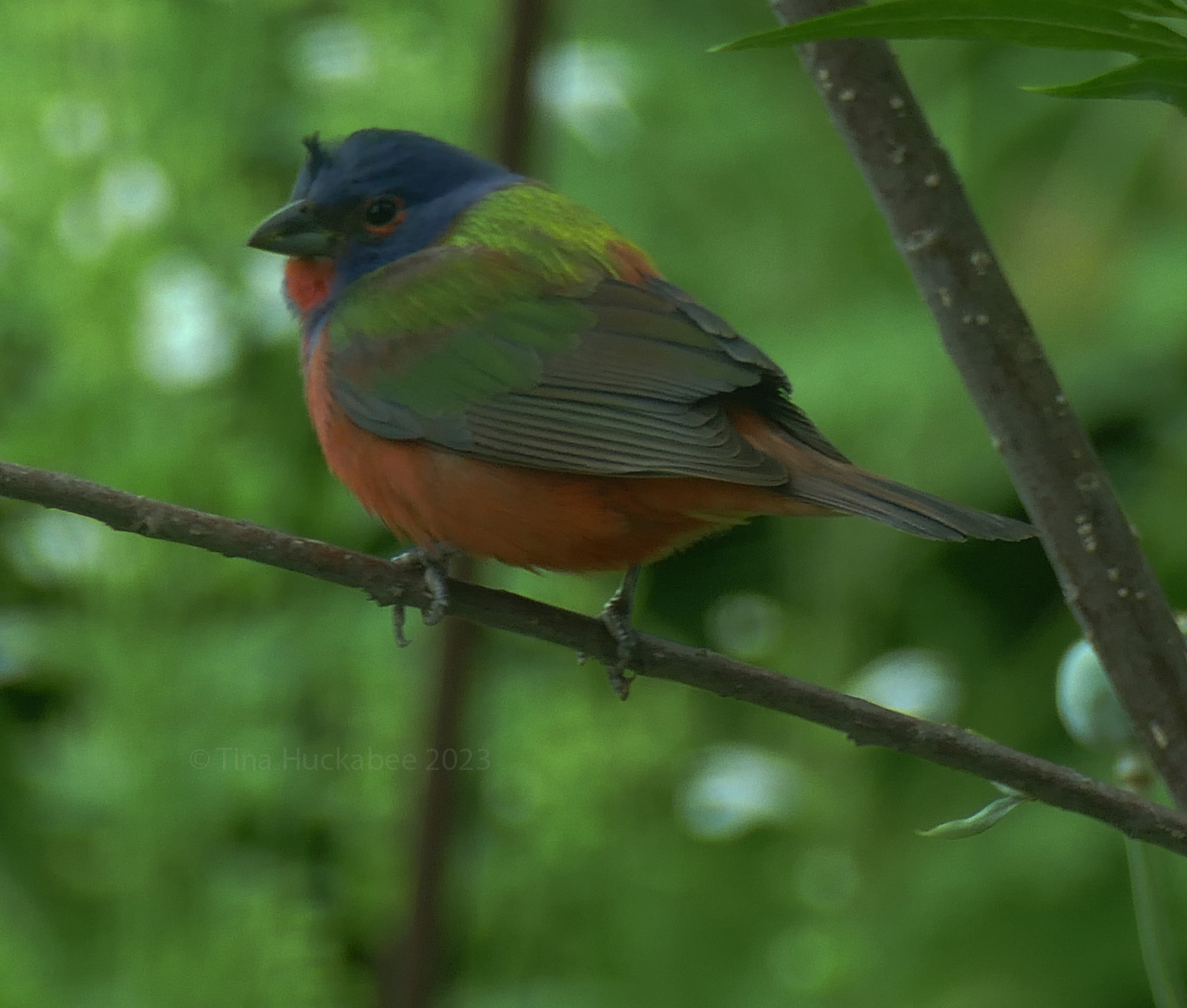
It’s been a good year to see Painted Buntings, Passerina ciris. Sightings over several weeks have allowed regular viewing of this most beautiful bird. This male wouldn’t cooperate and show me all of his colors, or the whole of his cute face, but I still like the shot of him resting in the tree after a bath.
His mate was more willing to be out in the open and spent time fluffing her feathers on the rocks bordering the pond after her bath, camera and human notwithstanding!
Another female Painted Bunting perched for a time while I was Yellowthroat watching. I couldn’t decide which photo I liked the best: her good side,
…or her other good side!
This shot is less clear, but demonstrates the magnificent colors of this gorgeous male. My cat, Lena, was watching him through our front window, no doubt wishing she could say a feline “hi” and maybe relieve him of his stunning plumage. That’s why she’s an indoor cat!
I’ve only seen one Nashville Warbler, Leiothlypis ruficapilla, this spring, which is unusual. I like these tiny, busy birds and they’re fond of the bog section of the pond. This fella is identified by his rusty cap a and white eye-ring. I hope more Nashvilles come through the garden to rest as they have a long way to travel. Their non-breeding area is in Central America and they nest in Canada.
One White-crowned Sparrow, Zonotrichia leucophrys, spent several days noshing on fallen safflower seeds. It hung out with the White-winged Doves, who didn’t object to its presence. According to the Cornell Lab of Ornithology map, White-crowns’ nonbreeding area encompasses Central Texas, but I’ve only seen them during spring migration. He definitely needed to fuel-up; his breeding grounds are in the northern most part of Canada and Alaska and it’s a long flight.
I was thrilled that a flock (gaggle? pack? gang? murder?) of Baltimore Orioles, Icterus galbula, spent a couple days between SIL’s and my gardens. Coincidentally, I happen to have some oranges, which is great because they love oranges. There were several males and females, adults and juveniles, each one gorgeous!
They adore oranges! They also enjoy grape jelly, though I don’t have any of that to offer. I don’t own an official orange feeder, but I stick the cut orange pieces on the cylinder feeder and on nails that I’ve hammered into our back fence. The birds seem satisfied with their treat.
Female Baltimores aren’t the orange-n-black-n-white show stoppers like the males, but are eye-catching birds nonetheless.
Orioles are adept at getting into the sweet spots of oranges with those pointed beaks.
Another of the sparrows tricky to identify is this Clay-colored Sparrow, Spizella pallida. This isn’t a great shot as these petite birds feed on seeds in the undergrowth, with lots of interfering plant material. They’re only in the clear as they wing swiftly upward to hide in trees or taller shrubs. I’ve seen several of these, usually feeding in pairs.
Like most sparrows, their colors are often considered drab, but I find the subtle colors and markings quite lovely.
I’ve had quick glimpses of other migratory birds, too, including one Black and White Warbler, a couple of Orchard Orioles, and an itsy-bitsy yellow thing that was too fast for me to identify. Birds are quick, bird watchers (at least this one) aren’t always so quick. It’s about halfway through migratory season, so there’s still plenty of time to observe the remarkable birds.
This weekend, Cornell Lab of Ornithology sponsors its annual Global Big Day of bird watching. Birders all over the world–serious and casual–will spend a few minutes (or a few hours) noting the birds they’ve seen. Participating doesn’t take much time, and it’s fun, educational, and it helps science and those who study birds. What’s not to love about that? Click on the above link to find out how to participate and become part of Team Bird!
I’d originally planned three posts profiling my gardens this spring, one each for early spring, mid-spring, and late spring. My garden changes a good bit between February and June. Life renews and it’s fascinating and affirming to witness the seasonal changes in flower, foliage, and fauna.
Well, early spring scooted right past me and late spring is knocking at the door, insistent to enter, but this is the first “spring garden” post I’ve managed to produce. It’s been a busy few months with plenty of distractions.
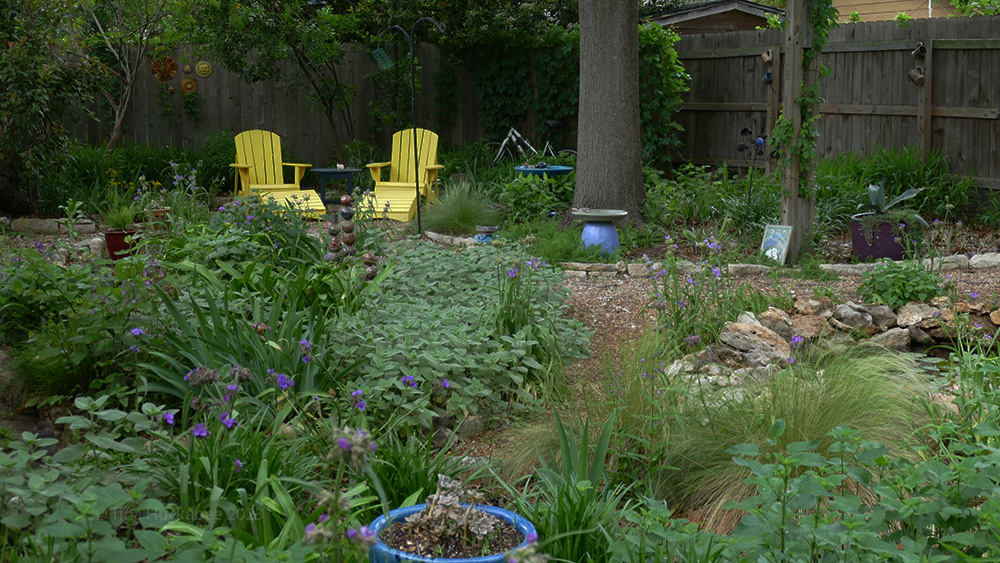
The back part-shade garden is filling in after winter’s freezes. Early bloomers are mostly done and beginning their seed processes, summer bloomers are arising from the Earth, growing in stature before their blooms begin.
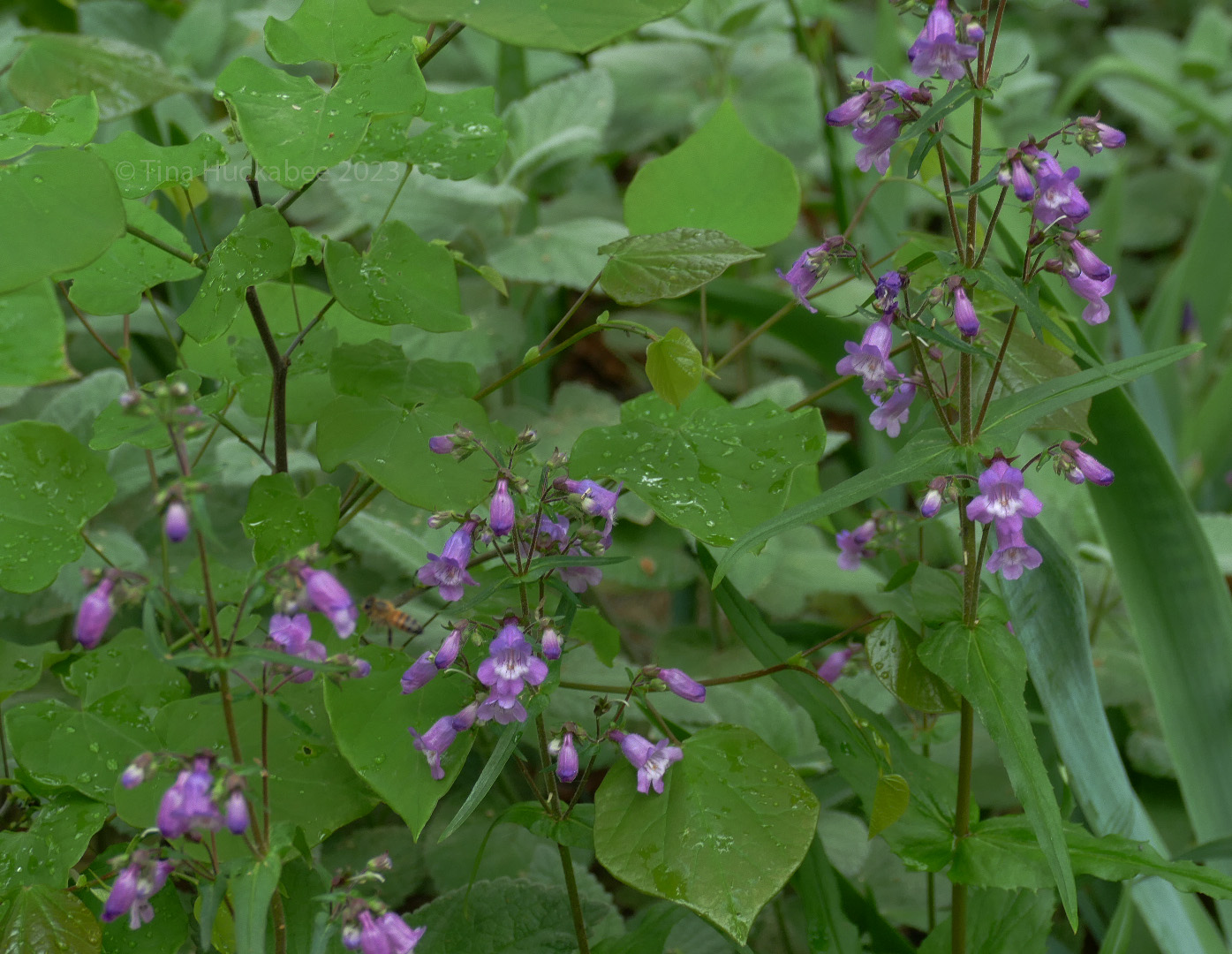
In March and April, there were sweet columbines and iris, scads of spiderwort, and sprinklings of native Gulf Coast Penstemons, Penstemon tenuis.
These pretty, bell-shaped blooms don’t last long, only about 3-4 weeks, but they make a nice impact in the garden and provide for pollinators. Their seeds will feed some birds, some squirrels, and ensure this plant’s future in my garden and probably elsewhere.
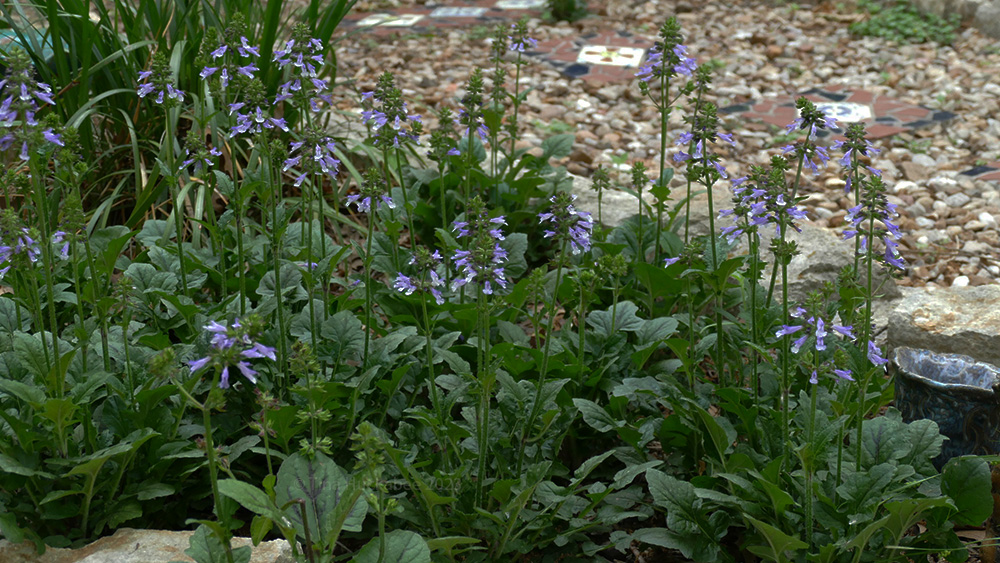
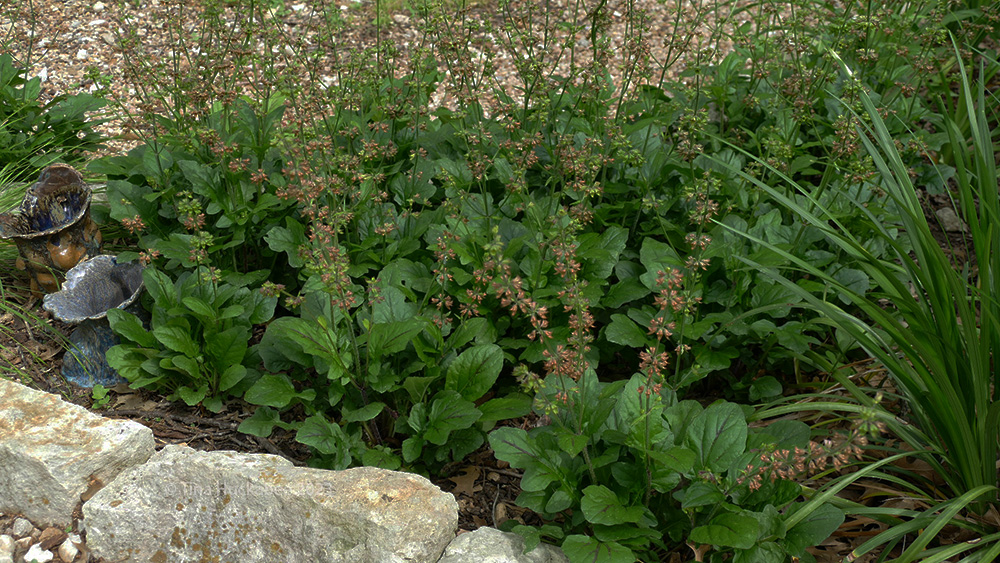
Another native perennial which flowers in mid-spring, more blue than purple, is the native Lyre-leaf Sage, Salvia lyrata; these bloom in concert with the penstemons.
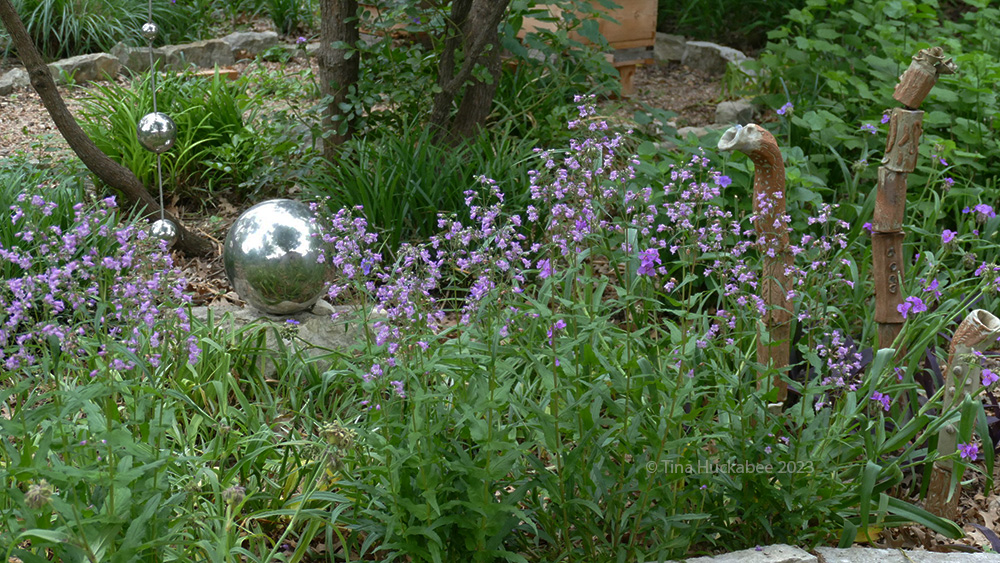
This photo, taken yesterday, shows the former flower stalks, now seed stalks. I’ve seen Painted Buntings, Lincoln’s Sparrows and Clay-colored Sparrows nibble at these seeds.
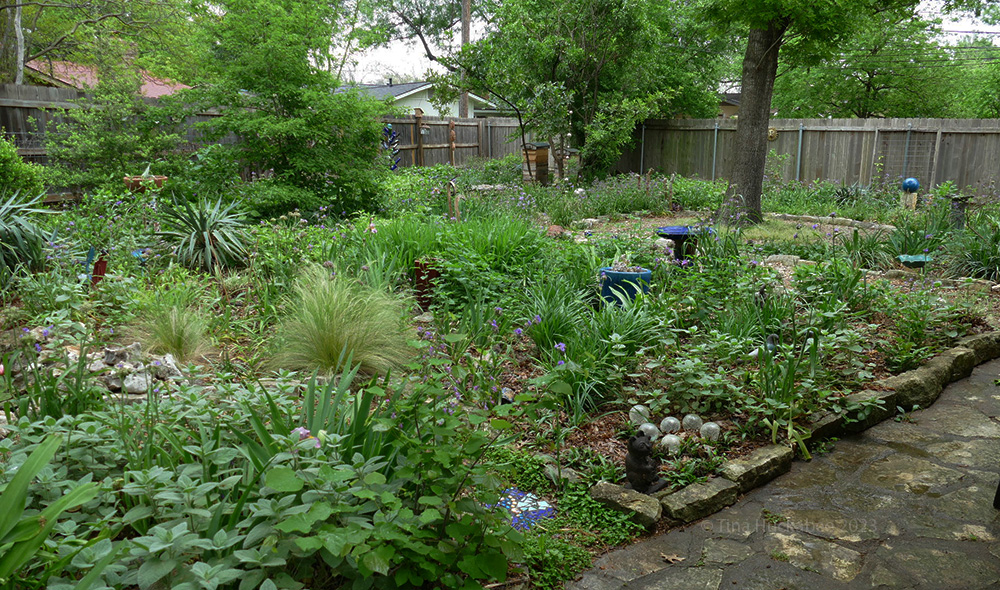
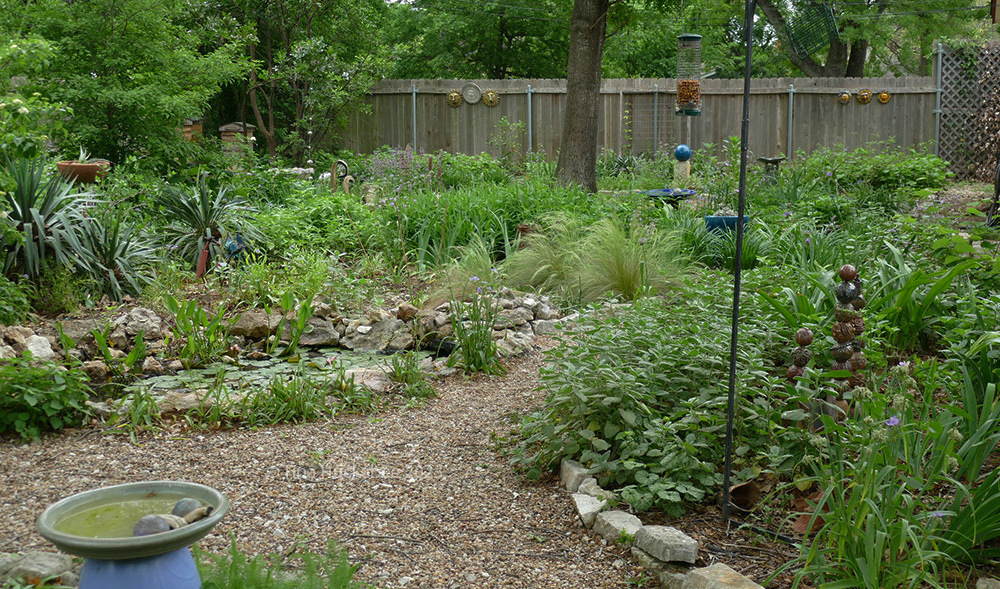
A wider look shows the garden in its “short” form. Come mid-June and going forward, many of the plants that you don’t notice or even see in this photo will be 4-5 feet tall. The early spring bloomers will be gone, or will have resigned themselves to green, ground-hugging rosettes, many offering seeds, at least for a time.
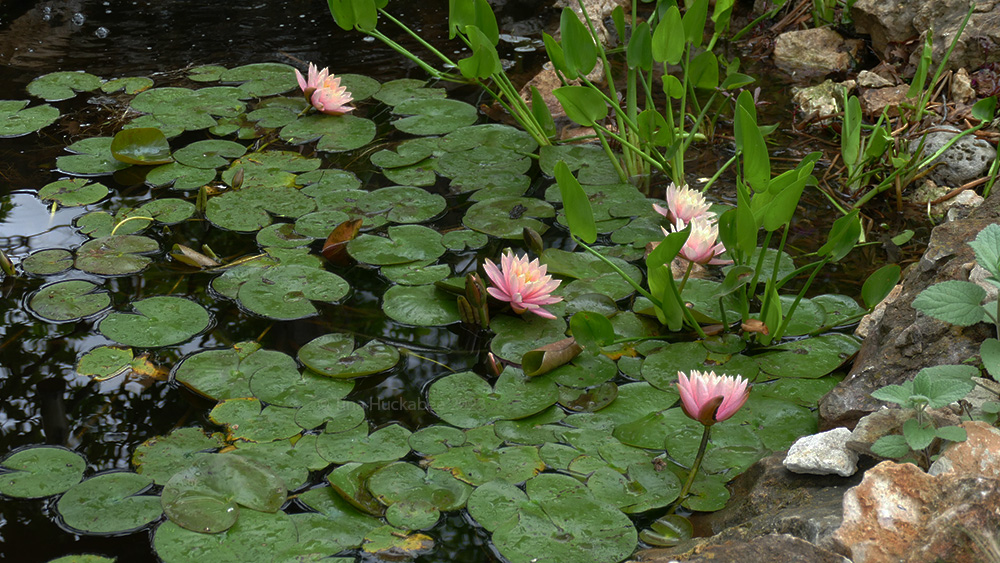
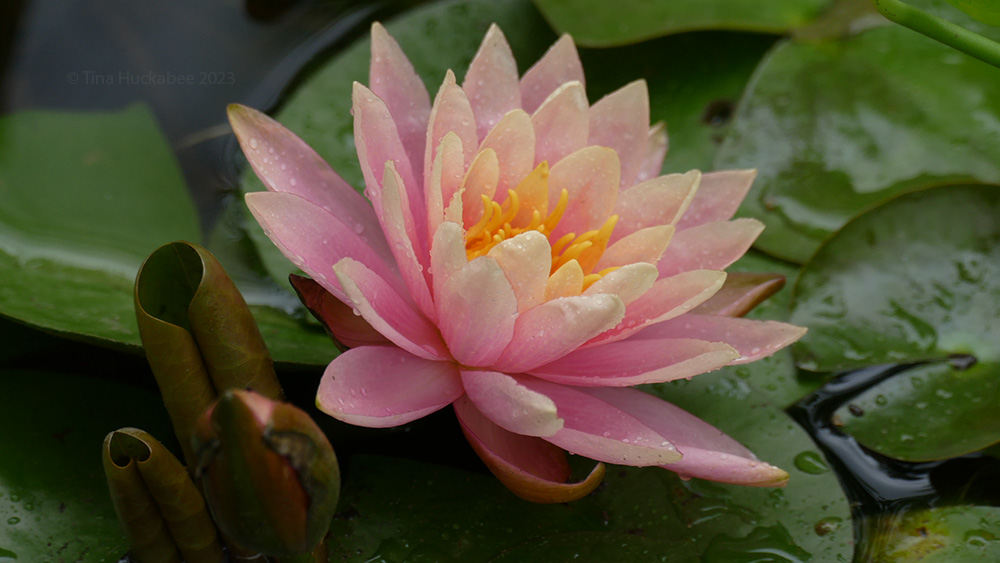
We never got around to cleaning the pond or separating the lilies and the Pickerel Rush.
It’ll be interesting watching these plants during summer. They tend to bloom well in spring, then mostly provide foliage protection for the fish during the heat of summer, with occasional blooms flowering up from the base. I wonder if my not having separated them this spring will make much difference in bloom production?
Once the heat sets in, this shady part of the garden provides respite from the relentless Texas sun. But so far, it’s been a cool spring–and wet! I’m not confident that our drought is over, but we’ve received some drenching storms and the plants (and gardener) are happy and appreciative.
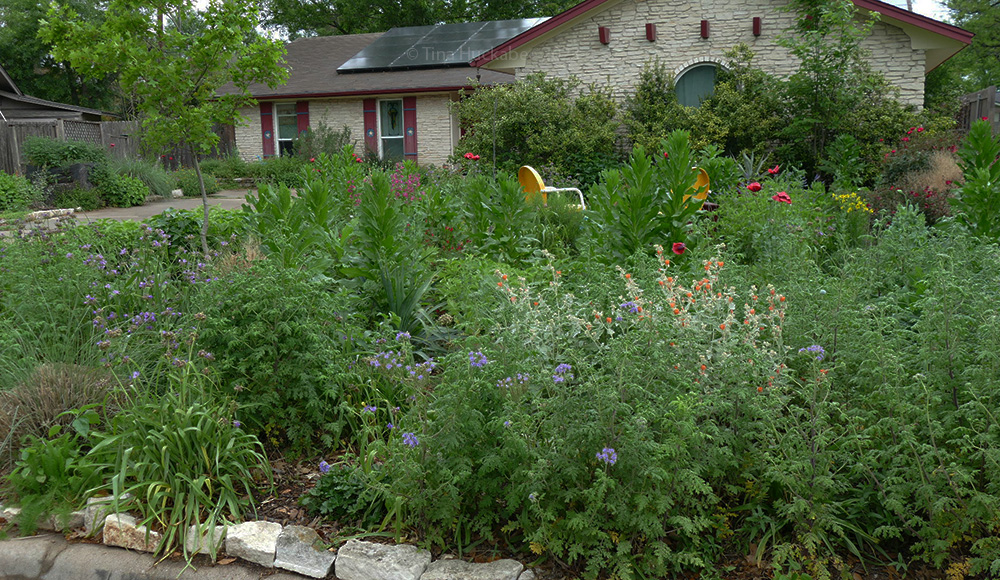
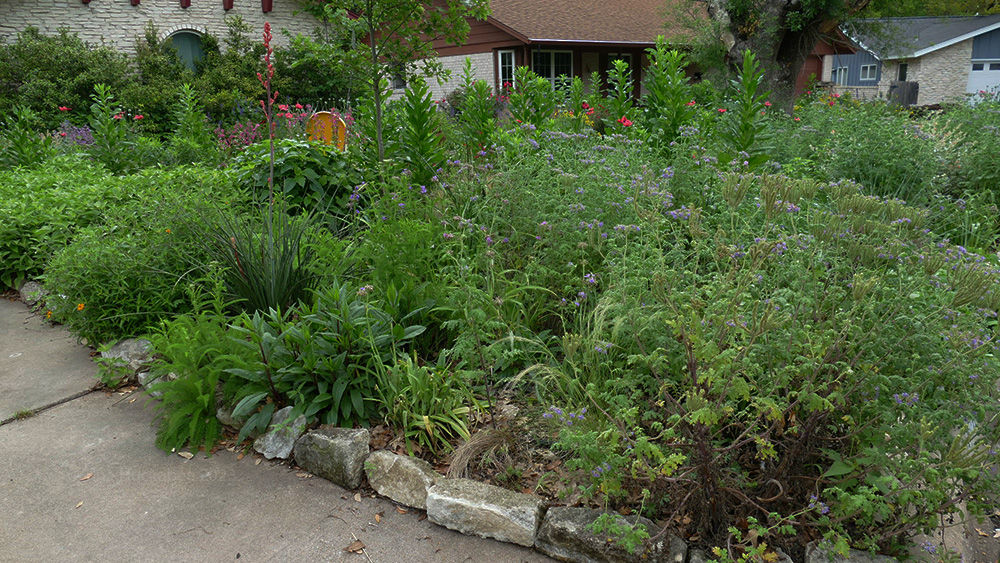
The front–all full sun of it–is bursting with color, form, and life. Migratory Lincoln’s Sparrows, Painted Buntings, Common Yellow-throats flit through the garden, nibbling whatever seeds and insects that come their way, filling up for their trip north to their breeding grounds. I occasionally chase a couple of neighborhood cats out of this wildlife haven.
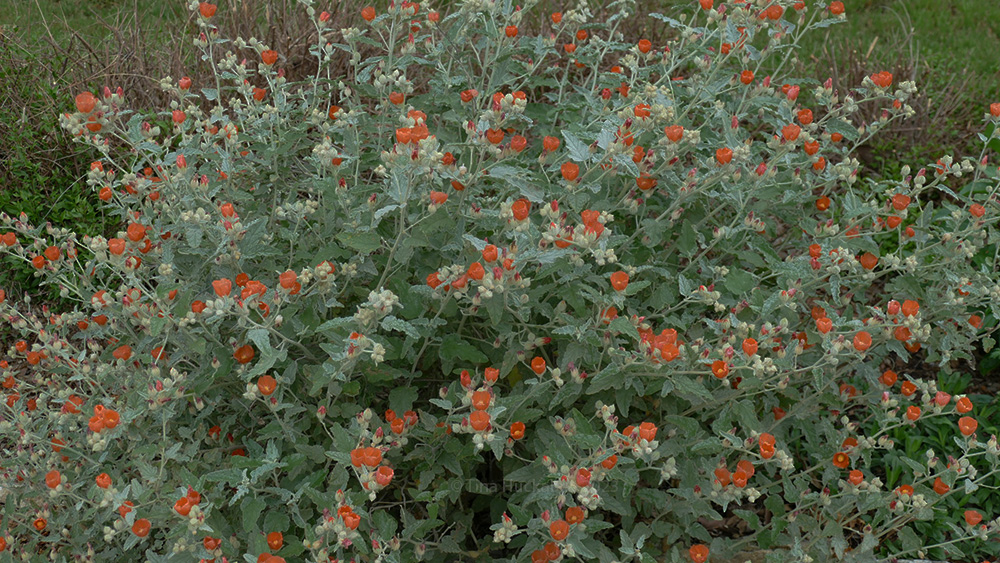
Early blooming perennial spiderworts and annual poppies provided pops of color and good things for the pollinators. They were accompanied by flowering shrubs that like cooler temperatures, like Globe Mallow, Spaeralcea ambigua,which is still in full bloom.
As is typical and planned for, the purples and blues are dominant in the garden in this middle part of the spring season. Red, yellow and orange will get their turn to show off in summer. White flowers also come into their own during summer and fall, and are restful for the eye.
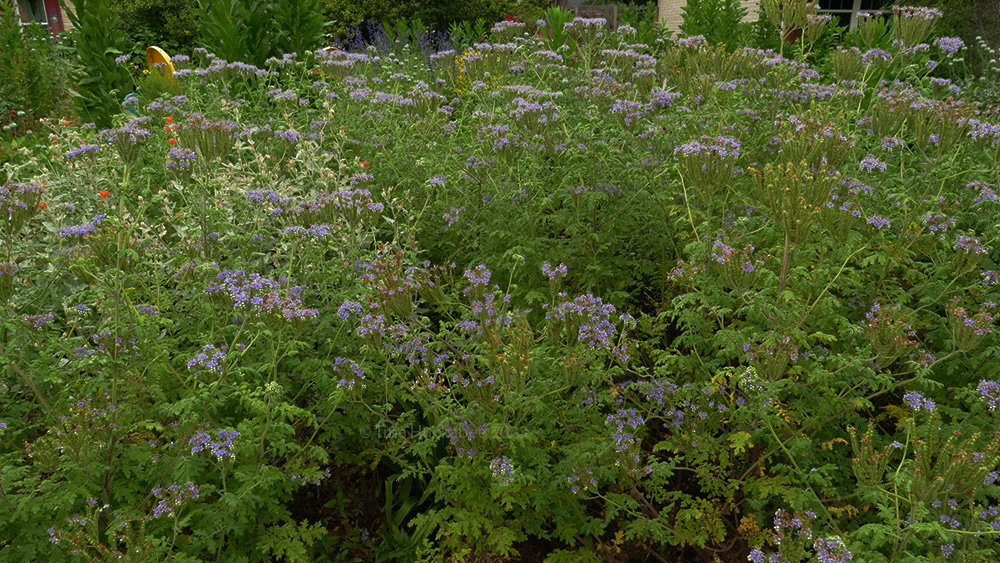
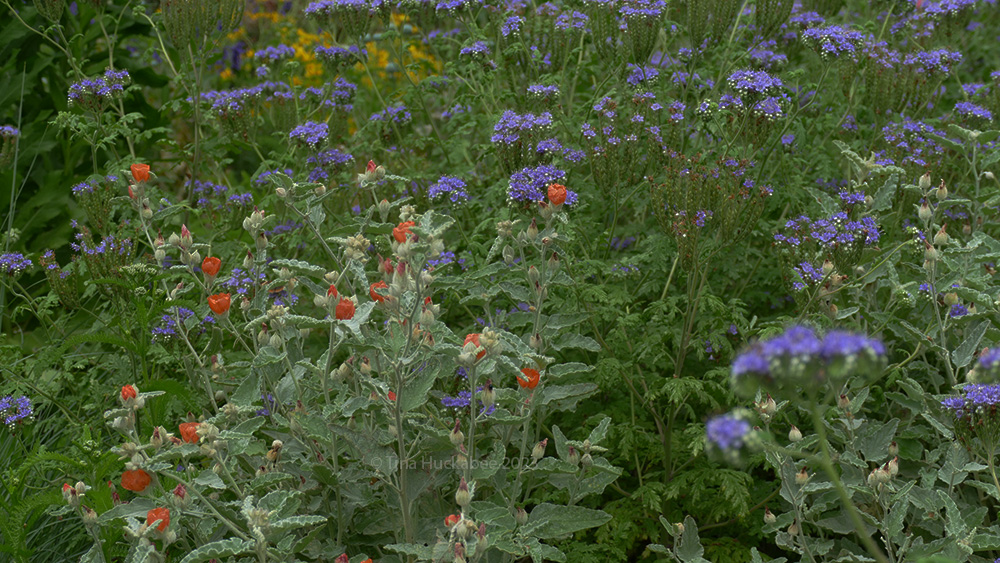
About five years ago, a friend gave me a couple of sprigs with roots of Blue Curls, Phacelia congesta, an annual Texas native spring wildflower. They’ve seeded out–and how! This year’s bumper crop of the unusual caterpillar-looking wildflowers has provided color and lots of movement in the form of visiting pollinators.
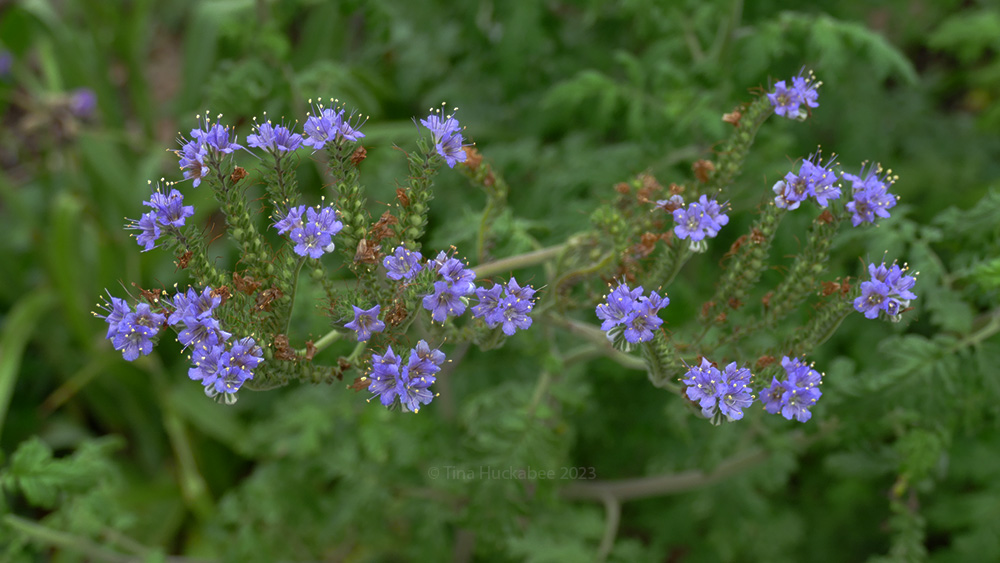
There aren’t any pollinators on this Blue Curls cluster, but that’s an anomaly; these diminutive blooms are pollinator powerhouse plants.
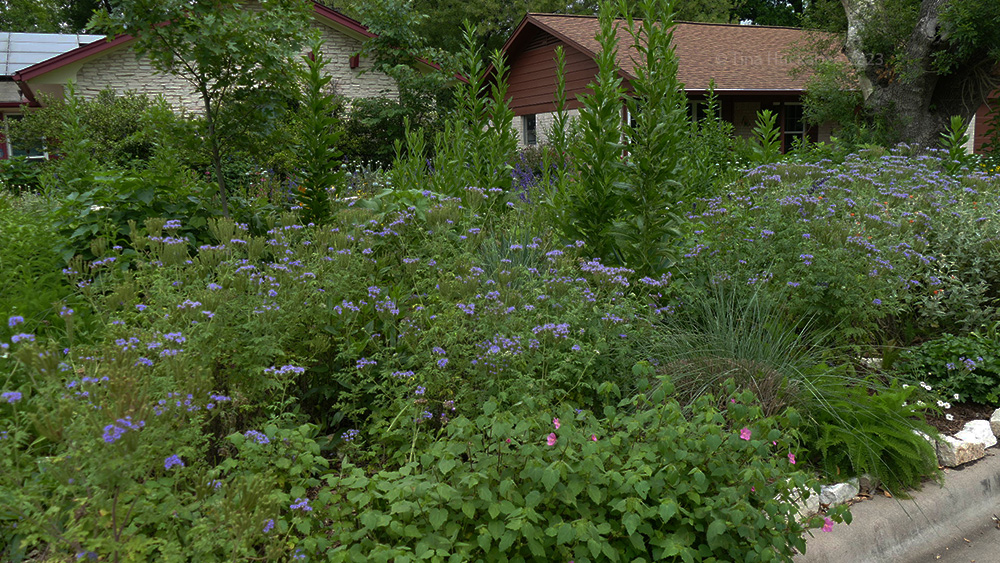
Blue Curls are bunched up at the edge of the garden. The slender, tower-like plants toward the center are the soon-to-bloom American Basket flower, Centaurea americana. This is another pollinator favorite and summer bloomer.
My Basket flowers have grown even taller since this photo, though I have pruned by half some of them. With pruning, the towers grow bushy, multi-branched and more shrub-like. Also, since they’re shorter, I can enjoy viewing the flowers! Those colossal towers are too high for me to see anything but the bottom of the blooms and the pollinators flying above them.
In another spot of the garden, I love the combination of Blue Curls, with their lacy green foliage, paired with the ruffly grey foliaged Globe Mallow.
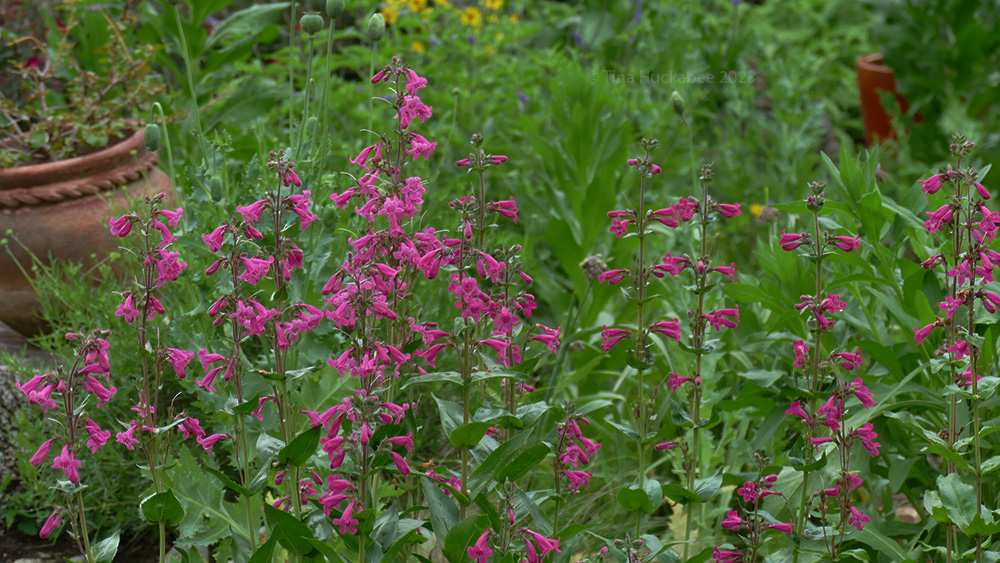
The stand of Hill Country Penstemon, Penstemon triflorus, has been stunning. I see carpenter bees nectar stealing, but the main pollinators of these flowers are the many Hummingbird, or Sphinx moths that visit at dawn and sunset, and sometimes during the day.
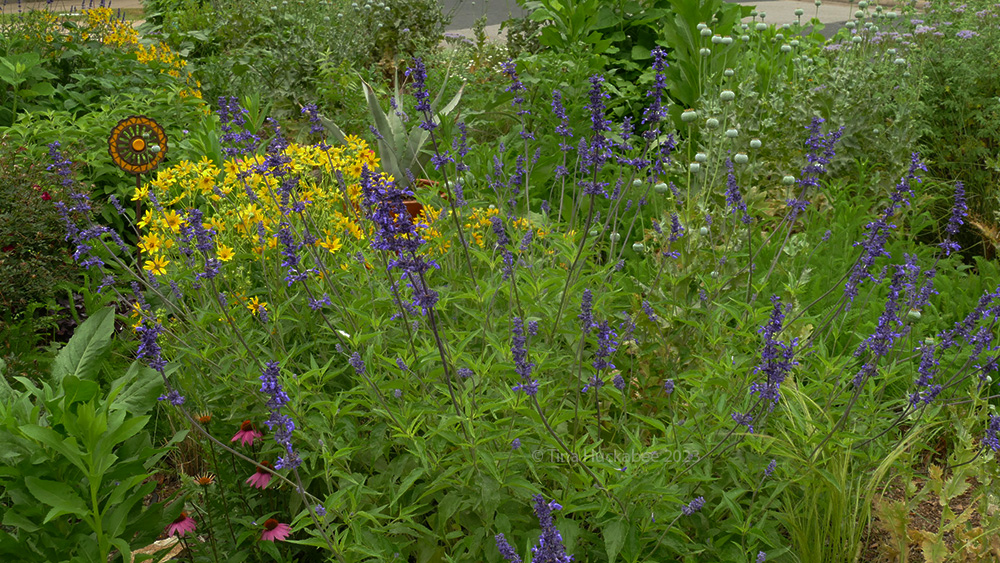
Deep blue Henry Duelberg sage, Salvia farinacea, complements cheery yellow Engelmann’s Daisy, Engelmannia peristenia. These two will bloom well into the summer months and potentially, through fall. Both are excellent wildlife plants: nectar and pollen for pollinators, seeds for birds-n-beasts. Oh, and the gardener really likes them too!
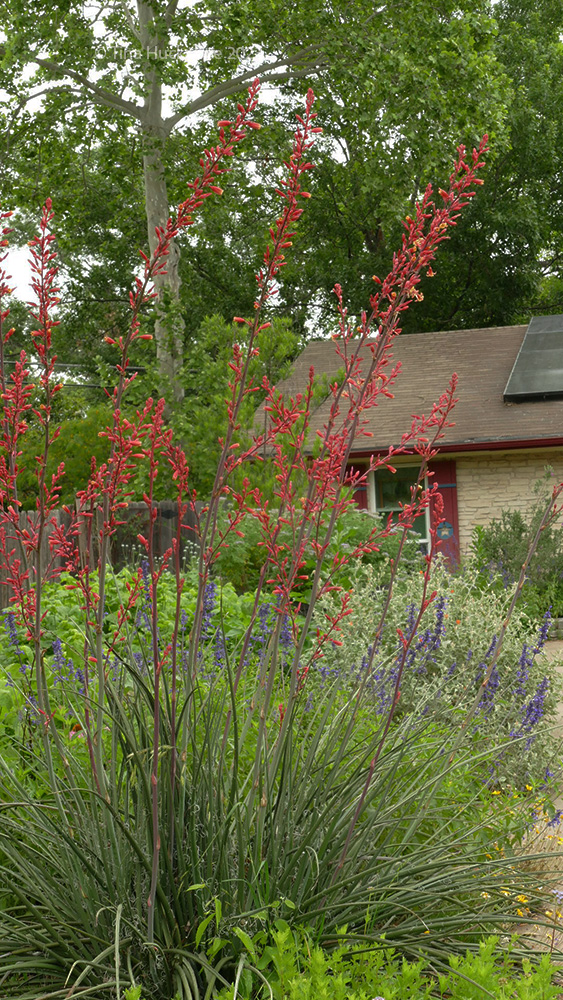
It’s a mixed-bag with the bloom stalks of my Red Yucca, Hesperaloe parviflora: This one produced 10 stalks; some others have none. Usually, my established yuccas each shoot up 3-5 stalks. I’m not sure why some didn’t produce any bloom stalks this spring, but the tough, evergreen foliage is still worthy and welcome in the garden.
Though fleeting, spring is a special time of year in any garden. Gardens are fresh, life is everywhere, and it’s not at all difficult to find color, texture, and wild things active.