As I wrapped up some necessary gardening chores early this morning, I saw a newly emerged Pipevine Swallowtail, Battus philenor, resting near its former home, the shell of its chrysalis.
I should have dropped the pruning shears, wiped the brow, and grabbed my camera, but I didn’t. By the time I remembered that there was a photo worth getting, the butterfly was off to its adult business: its wings dry, its proboscis unfurled for nectaring, and the search of a mate a keen objective.
Every day, I pass by this seedling where the caterpillar made its home for a few weeks; I never noticed it. The chrysalises are such small, unobtrusive things, it’s easy to miss them in the lush of the garden. I’m not a scorched earth pruner, but when it’s hot and humid and I’ve had just about enough for one morning, it’s sometimes easy to forget the garden’s purpose. I guess the chrysalis isn’t the only thing hanging by a thread.
I’ve seen a Pipevine flitting in the garden today; I’m glad it was up and out in the early morning, shedding its temporary home for the wider world.
Like peanut butter-n-jelly or mac-n-cheese, butterflies-n-wildflowers form a classic pair. My personal aphorism defining wildlife gardening is, if you plant them(wildflowers), they (pollinators) will come. This proves especially resonant in a spring season with ample rain followed by generous sunshine.
Blue Curls or Caterpillars, Phacelia congesta, bloom beautifully from March through May, attracting a huge variety of pollinators to the blue/purple flowers, which unfurl along a cluster as the diminutive flowers open. Pollinators, especially butterflies, are ga-ga for Blue Curls’ bounty. Sunny days bring fluttery life to the space above and around blooming Blue Curls, all manner of winged things in constant movement. Other pollinators, like beetles and true bugs, reach the pretty little flowers through multi-legged walk-a-bouts.
Here, two Grey Hairstreaks nectar on the flowers while another waits in the background. Maybe that one is full of rich nectar, and sits, resting and digesting.
This hairstreak feeds, but is it alone?
Looking directly down from the small butterfly, another pollinator (a walking stick type insect or a nymph of some sort?) seemingly sips from a flower. I didn’t see this insect when I snapped the shot, only noticing once I downloaded the photo to my laptop. I scrolled through pages of iNaturalist Austin, but there are a gazillion insects listed and I don’t have the time to suss out this guy’s identity. Any suggestions as to what this well-camouflaged critter might be?
Monarchs migrated through Austin, though few visited my gardens. A Blue Curls cluster beckons, a Monarch cousin–the Queen butterfly–alights, nectars and pollinates.
Smaller butterflies like hairstreaks, skippers, metalmarks, and sulphurs frequent Blue Curls, often alongside other pollinators, all sharing dining on a given cluster of flowers. In particular, Fiery Skippers, like Grey Hairstreaks, are abundant.
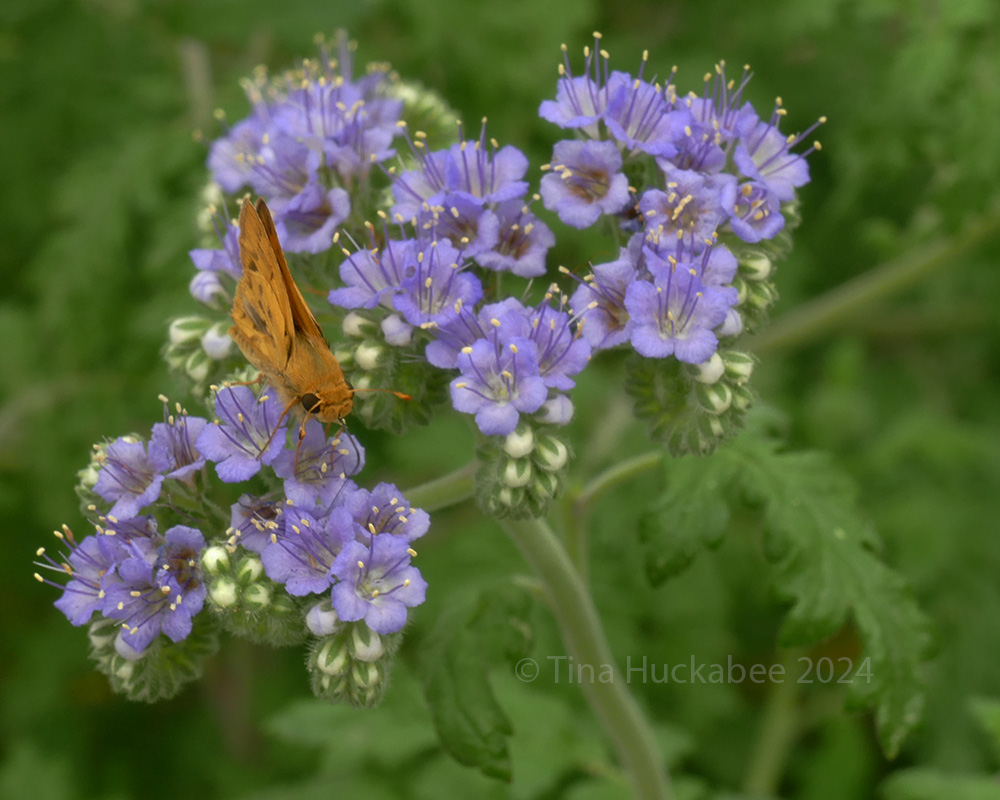
I think this Fiery Skipper’s coloring complements its Blue Curls meal.
Native bees, especially the tiny Lasioglossum, or sweat bees, also favor Blue Curls. Flies of various sorts cavort amongst the Curls.
This Horace’s Duskywing, a rare find in my garden, provides a dramatic contrast with its Blue Curl plant of choice.
Blue Curls are annuals, living their full life cycle in one year: seeds; germinated seedlings; mature plants with flowers; seeds, once again, after flowers are finished. My Curls are past their peak of blooming, beginning their seed production. I’ll leave the individual plants until the seed heads are brown, then I’ll prune the stalks to the ground and shake all available seeds into the garden for next year’s crop. The Blue Curl seeds (as well as other perennial and annual seeds) are currently providing meals for migratory birds. I’ve observed Lincoln Sparrows, Common Yellowthroats, Clay-colored Sparrows, Yellow Warblers, and Painted Buntings eating from these plants in the last few weeks. Seeds and insects on plants make up most of migratory birds’ meals.
Once the Blue Curls of 2024 are history (aside from their dormant seeds snoozing on the soil), the heat-loving summer perennials and annuals will step up to provide cover and sustenance for bees, birds, butterflies, and other garden critters.
The cycle continues, unbroken, in a native plants, wildlife-friendly garden.
The smallest Eastern Screech owlet is interested in what’s up.
These feathery bobble-heads are growing at a remarkable pace. At sundown, their parents visit, usually with moths, geckos, or worms (at least I think they’re worms…) as delectable nibbles for these cuties. While I don’t watch the camera overnight, I’m sure that feeding goes on throughout the dark hours. Often in the mornings, there is one, or more, deceased prey in the box, ready for a daytime meal when the chicks are peckish.
I haven’t taken daily photos to chart their growth, but they’re big and active now and it won’t be too long before they fledge. I’m fascinated with their daily activities, even when the three are lumped-up in a pile of fluffiness, breathing rhythmically.
Mom and Dad stay close by, coming into the box only to feed. Mom is always stationed just outside the entry hole.
Last year, the owls’ nest box was raided in late February, most likely by a Grey Fox or a Raccoon. This year, to prevent a predator from climbing up the tree and snatching the eggs or chicks, we wrapped the tree with linoleum flooring that comes from a roll, cut to size specification, at your neighborhood big box store. We nailed the width of the flooring to the trunk when mom owl had settled in the box to raise a family.
The tree isn’t near our roof or another large tree, so there’s no concern about a predator climbing up an adjoining structure, then lumbering over to this tree to gain access to the nest box. This makeshift collar has a thick linoleum coating which would be difficult-to-impossible for claws of a smaller mammal to penetrate for vertical traction, thus preventing successful climbing. Grey Foxes can jump up to 6 feet in height, so we placed the bottom edge of the collar at about 3.5 feet, the top edge reaches just over 7 feet high.
The collar looks a little goofy, and no doubt the tree is embarrassed by its attached swath of fake wood, but the fix is temporary and has provided some safety from predators for this owl family. It’s nearly 7 weeks since the the egg holding the oldest owlet (most likely the one on the left in the photo) was laid. Soon, these owlets will see their big, new world for the first time.




 My Gardener Says...