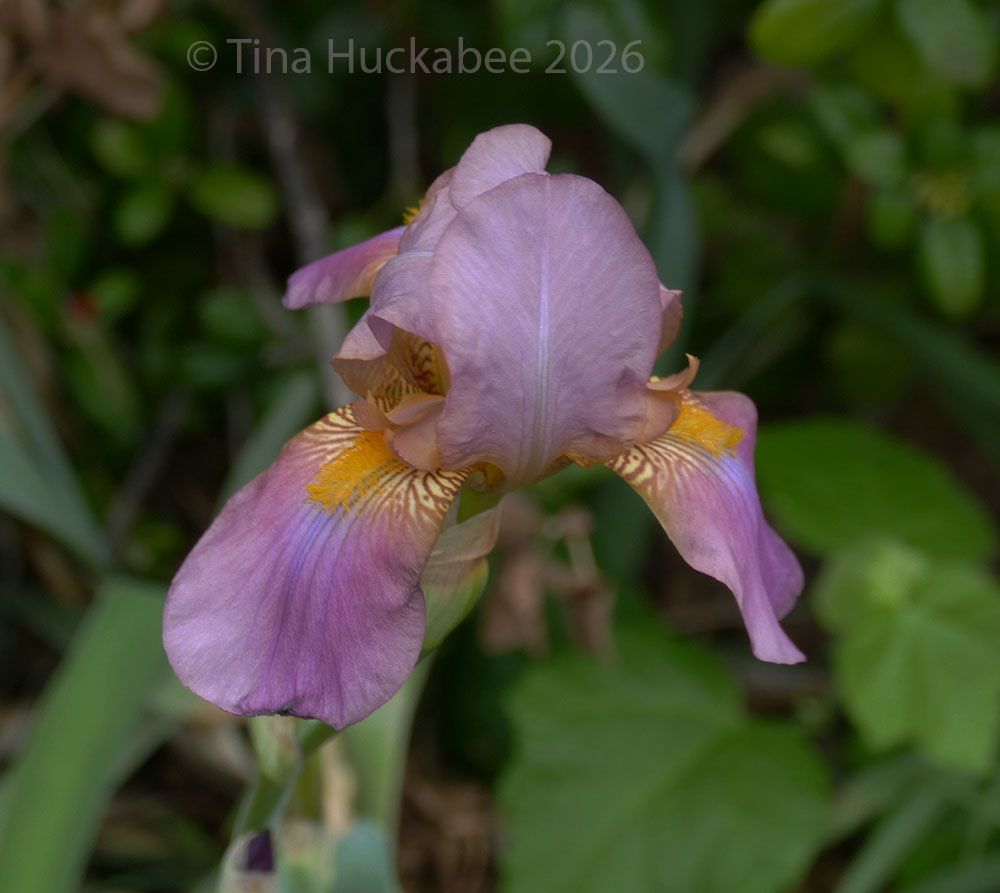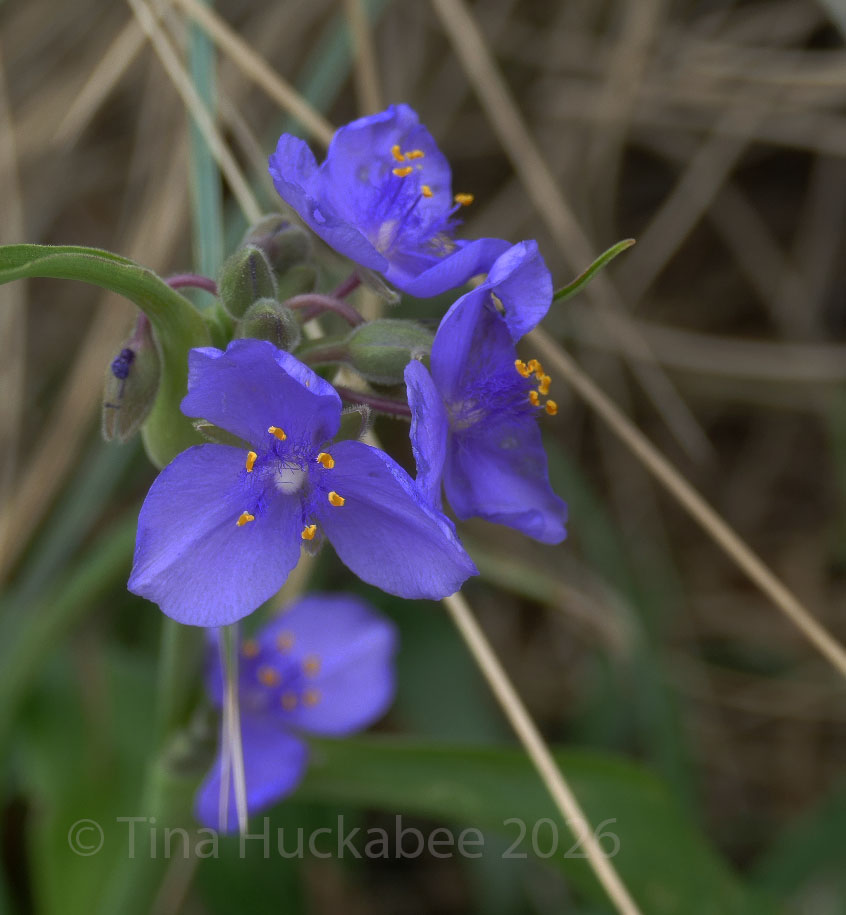
Riffing on first Texas wildflower blooms profiled at Portraits of Wildflowers, I noticed that my garden’s first wildflower is abloom. This wildflower is a common weed according to some, but I love the pretty, purple, pollinator magnet and so do the bees and butterflies. Insects were tucked in this morning, owing to the chill and clouds, but they’ll find this rich source of nectar and pollen when the sun returns and the temperatures warm.
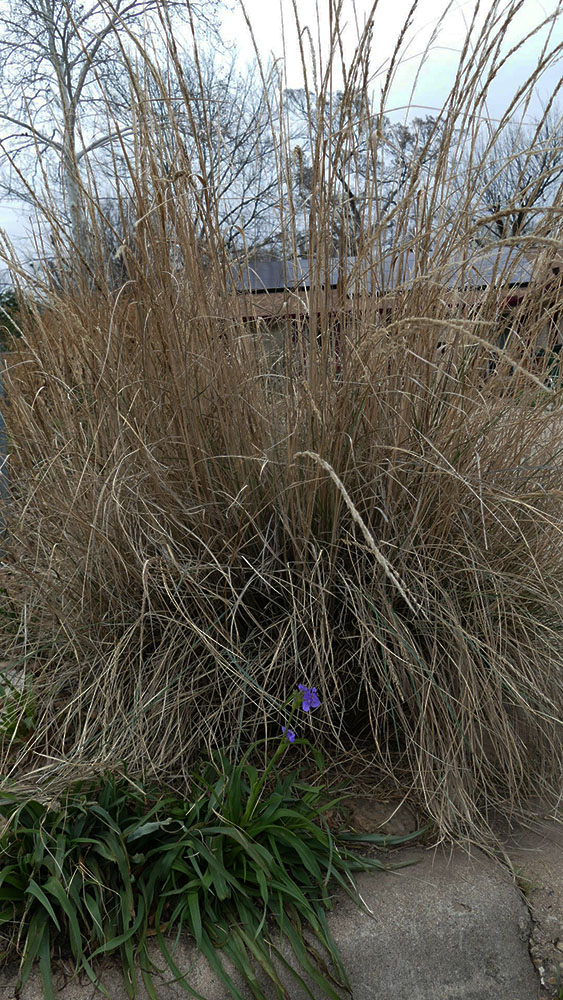
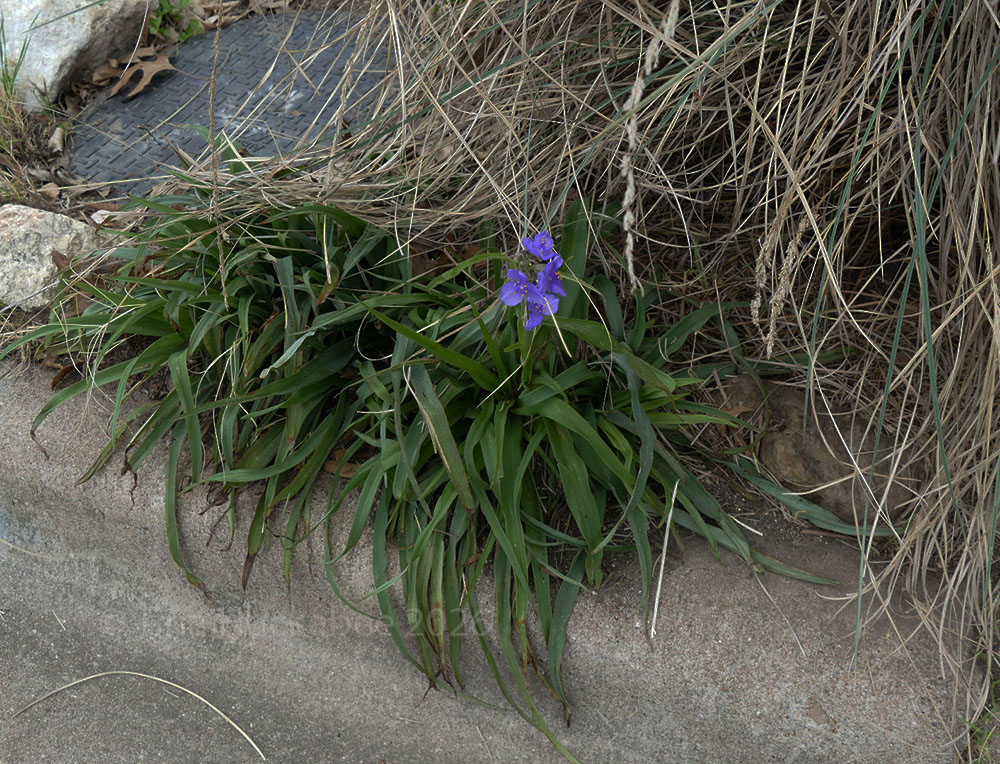
This Spiderwort, Tradescantia, sp., has popped up from last years’ roots at the base of a winter-tawny Big Muhly, Muhlenbergia lindheimeri. That splash of green has been a colorful companion to the muted grass since early December. Now, the green will be topped by rich purple to augment its beauty.
The spiderworts couldn’t have chosen a tougher place to plant themselves. Facing west, these two clusters sit at the curb, not even in the garden-proper. I never water this area, it only receives what bounty the sky delivers. There will be more spiderwort blooms in the coming months–from these two and many others throughout my garden–then the foliage will disappear, the roots in hiding from the long, hot summer. The muhly will provide some coverage, as new growth drapes over the curb and spiderworts’ spot, but this area is hot and dry most of the year.
It has begun, this renewal of life. Birds and squirrels chase their potential partners and rivals; flirtation as the rule of the first kind of chase, establishing territory the point of the second. The main winter clean-up work in my garden is finished, or nearly so, and change in the garden will be a daily, if not hourly, occurrence. Game-on, Spring!
Along with much of the continental United States, my garden has been stuck in freezer mode since Saturday morning. There hasn’t been snow, per se, but instead, the wintry mix weather folk like to talk about. The sleet started over night Saturday into Sunday, the thin blanket of ice covering everything, everywhere, all at once (with apologies to that worthy Academy Award winner of a few years ago).
Here in Austin, we’d experienced one light freeze before this deeper, longer one, prompting my check for the swirly ice sculptures which give native plant Frostweed, Verbesina virginica,its name. No ice capades appeared in my garden during that first freeze, but this deeper freeze delivered a dramatic frost show–but on only one of my Frostweed plants. Usually each plant produces its own icy artwork–ranging from bombastic to minimalist–but this winter, one of my largest and oldest specimens was the sole artist-in-residence.
The beauty of the ice, fragile and ephemeral, belies the rather violent nature of the super frozen moisture as it bursts through the plant’s stem structure, destroying limbs of the now-ended growing season. Frostweed is done; I will prune the remains to the ground soon. In a matter of weeks, spring will beckon, fresh growth will emerge, and the cycle for a new year of foliage, blooms, seeds, and ice flowers will commence.
The ice sculptures are called many names: ice flowers, ice ribbons, frost flowers, and more; my favorite of the nicknames is ice beards.
On less swirly–though still slippery–ice, this this Fox Squirrel, enjoyed some scattered seeds and peanuts for breakfast these past mornings.
Birds are also busy at the seeds, though this White-winged Dove, Zenaida asiatica, was content to chill in the chill.
One of the winter warblers hanging out in my garden, a darling Yellow-rumped Warbler, Setophaga coronata, is unfazed by the cold. He bopped around the garden, nibbling on this-n-that, dashing to shrubs and trees for protection.
Once this freeze is history, I’ll assess the damage to the garden. I don’t expect any permanent problems, as I choose tough plants to grow. But winter pruning must begin this week and the next 6 to 8 weeks are my busiest time in the garden. The goal of pruning completion is the first week of March; wish me good luck with that!
I grow a rare plant in my Austin garden. A cluster of Big Red Sage, Salvia pentstemonoides, resides at the corner where the street and my driveway intersect.
I first became familiar with this plant years ago, having read an article about a gorgeous, deep-red flowering plant that’s found only in a few counties of Central Texas. At one time, Big Red was thought to be extinct, but colonies of the plant where discovered, seeds collected, and some in the local nursery trade propagated the lovely plant for sale. When when I managed the Green Garden at Zilker Botanical Gardens, a previous gardener had planted several and those played a starring role in the front, full-sun garden, much to my. I’ve purchased several individual plants at two local nurseries over the years and my little cluster has thrived.
Big Red is pollinated by the Black-chinned Hummingbird, Archilochus alexandri, which hangs out in Texas during late spring and summer, migrating southward in September and October.
Other insects, like various carpenter bees and even honeybees, will visit the blooms, often nectar stealing from the flower, nosing deep into the calyx, puncturing the calyx-held flower for the sweet stuff.
Big Red Sage is a showy thing in the summer garden. Mine grow stalks about 3 feet high, though I’ve read that the stalks in natural areas reach to 5 feet tall.
Since 1975, this rare flower in decline has awaited its turn for protection by the US Fish and Wildlife Service. In January of 2025, the Service finally proposed that Big Red Sage be listed as an endangered species. Drought, floods, animal browsing (both native and introduced), and urban development are all adding stress to this rare plant; fewer wild colonies exist compared to when I first learned about the plant years ago. The official protection granted makes illegal the collection of Big Red Sage seeds from wild colonies. Check out this press release from the Center for Biological Diversity, the key organization which pressured, through a lawsuit, the US Fish and Wildlife Service to protect the Texas beauty.
I usually prune the stalks to the ground in November, leaving the dark leaves of the winter rosette as a reminder of summer’s glory. Though most stalks have ceased blooming, often there’s at least one hold-out bloomer, which you can see at the top left part of the photo. This plant just doesn’t want to quit!
The Lady Bird Johnson Wildflower Center is currently researching this plant, spending time collecting seeds in protected areas to learn about its biology, which you can read about here. The team of scientists and volunteers are seed-banking collected seeds from specific colonies to ensure the survival if wild specimens disappear. My understanding is that there are no plans to sell either seeds or the plants germinated from the collected seeds in order to protect the diversity and genetic strength of the remaining native colonies.
I sometimes feel a bit awkward as the guardian of this plant as it’s too precious for a common, urban garden! I purchased the plants that I have, as Big Red is a commercially available in some native plants nurseries. Mine have never germinated to create new plants and I don’t live in a neighborhood with many actual gardens (lawns, lawns, lawns!), so even if my sages produced offspring, it’s likely I could control where the plants grow. Still, as Texas and the wider world becomes less biologically diverse, I’m pleased that I have some of these rare and beautiful plants in my garden, for their looks, their pollinator draw, and for their uniquely Texan heritage.