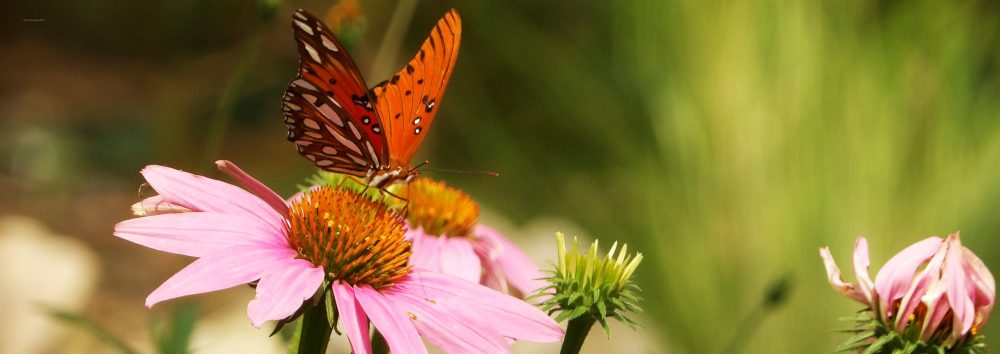
Purple Coneflower, Echinacea purpurea, is an excellent pollinator plant. But where pollinators feed, predators lurk.
This white crab spider, front legs outstretch for maximum grabbing ability, waits with supreme patience for a pollinator to appear, hoping for nectar and pollen, naive about what other dangers might lurk.
And so it goes in nature: food is provided for a variety of wildlife.
I first became acquainted with the Small Coastal Germander, Teucrium cubense, when one magically emerged underneath a Brazos blackberry vine in my garden about 10 years ago. Diminutive snowy blooms sparkled along the stems, the foliage suggesting a member of the mint family (it is a Lamiaceae). It took me a while to figure out who this stranger was, but I was delighted to learn that it’s native to Texas, other southern states, plus areas a bit westward. The germander grew and bloomed in that spot for a couple of years, then left my garden as mysteriously as it originally appeared.
Fast-forward a few years, add a devastating February freeze, followed by an old, severely damaged Arizona Ash tree removed, and the minty germander planted itself in my newly minted full-sun garden. This tidy little ground cover, evergreen in winter and decorated with delicate white pops throughout our long growing season, is not only cute, but a pollinator magnate as well.
One afternoon a few weeks back, I sat in the garden and observed the activity surrounding this rewarding plant. This germander has quite a following! There were dozens of flitty, crawly things, all honing in on the bounty offered by the blooms. The air surrounding the germander teemed with life, gentle buzzing the song of insect labor. Honeybees were the largest of the pollinators, sometimes muscling the smaller insects off of a bloom, stingy for their share of the flowers’ goods.
There were at least two species of wasps attending the pollinator party. A number of Mexican Honey Wasps, Brachygastra mellifica, Euodynerus, Potter wasps, dressed up in their yellow-n-brown stripes, added their particular beauty to the germander as they sipped and flit.
This one concentrates on its meal, wings closed.
A different wasp, Pitted Mason Wasps, Euodynerus foraminatus, also fed from the germander. Smaller and less stripey than the honey wasp, they made their presence known, gracefully moving from stem to stem, bloom to bloom.
Beetles are also in the pollination business, especially so with this germander. In looking through various sites and gobs of beetle photos, I’m still unsure what beetle this is, but several of its kind worked the blooms. Their shiny blue-black coloring contrasts with the pure white flowers.
Another kind of beetle, brown and nondescript and much smaller, is unfamiliar to me, but all-in with these blooms. This bit of brown that isn’t in a clear photo, worked blooms along with plenty of its buddies, all proboscis-focused on the flowers.
I didn’t manage any good captures of native bees who also liked the germander, but saw plenty tiny Lasioglossum, or Sweat bees flying, landing, and pollinating.
Coastal Germander holds its own in the hot-colored, full-sun garden, its cool white flowers and rich green foliage a balm in the mid-spring flower-power show. It visually pleases humans and softens the louder colors of the garden.
Coastal Germander’s most important role is as sustenance for many insects, the true calling of plants and their reason for existing. Plants and insects evolved together and are partners in the diverse quality of life for all ecosystems.
In February I wrote about the Red-shouldered Hawks who set up housekeeping in our Sycamore tree, adding their particular touches to an abandoned squirrel nest. Sadly, in March, after several days of high winds and the nest torn asunder, the hawks abandoned that tree. I didn’t see the hawks for a few days, but eventually found them busily building another nest in a huge, beautiful Red Oak, Quercus rubra, which grows just around the corner from my street. I guess the hawks chose well as that tree is taller and wider, with dense foliage for protection.
I’ve kept an eye on the hawk happenings, observing their new digs and parent hawk behavior. Typically, mom is on the nest, dad is nearby, serving as a protective sentry with his watchful hawk eyes.
I’ve only caught quick glimpses of fuzzy white chick heads, but never when I’m in possession of either my binoculars or my camera.
On this morning, dad was harassed by a vociferous Blue Jay, Cyanocitta cristata, off to his left.
Dad hawk looks rather disdainful of the intrusion; he flew to a different branch a minute later, jay in noisy pursuit.
Mom hawk is in the nest, caring for the wee ones, hunkered down in their solidly built oak-leafy nest.
My SIL has been luckier in getting great shots of the hawk family, including this one of the two chicks, fierce-n-fuzzy they are! Look at those darling, terrifying faces!
I’ve been watching the hawks since late March, but only two weeks ago discovered that across the street, situated in a large Live Oak, Quercus virginiana, a family of Yellow-crested Night Herons, Nyctanassa violacea, have also settled in for their chick-raising. Bird neighbors! I’m guessing these two feathery families don’t share meals or coordinate play dates for the kids! I find it fascinating that these two large predator birds are relatively close together and are raising successful families. That said, while both species hunt, they hunt different prey, so there’s probably not much competition for food, at least between the families.
There’s always one adult heron near the nest, and often I see both adults, perched on opposite branches that book-end the large nest of babies in between. In this photo, one adult faces away from my camera, tail feathers and skinny legs in view. The other adult preens, its yellow crown visible in the morning sun.
The oldest chick (presumably) is on the left, the two younger in the nest, cuddled side-by-side.
Here, one adult preens and the three chicks are being chicks. The one on the right is larger than the other two, a little heron head sits in the middle, and a blob of feathery fluff is barely visible on the left side of the nest.
Adult heron and baby heron, each stare in different directions.
Another stunning shot from my SIL! All beaks and eyes, these little critters rock their dinosaur past.
I expect these characters to fledge in the next week or two. They’ll be spotted on rooftops, residents’ cars, and on lawns, and hopefully not in the street. I also hope they’re too big for the hawks to predate, but I’m not so sure about that.
Puffy clouds act as a visual connection between the hawks’ home tree on the right and the herons’ home tree on the left. The street sits just below, bisecting the two properties.
There are at least four other nesting heron families in this part of our neighborhood and in the larger neighborhood area, a nesting family of Red-tailed Hawks, Buteo jamaicensis, and at least one family of Cooper’s Hawks, Astur cooperii, call this area home. Providing for these predatory birds, as well as for multitudes of song birds, wood peckers, finches, mammals, and countless insects is why trees exist. Large native trees are not only beautiful for people to enjoy, but provide life and protection for wild things.
Plant trees, especially native trees, and prune sparingly. Wildlife will cheer!
Sad addendum: we just experienced a strong thunderstorm with high winds, heavy rain, and hail. I walked over to the street where the nests are and I spoke with the young woman who is the owner of the house with the heron nest. The nest is completely gone, a major branch broke that was above the nest. The young woman said she found one nestling dead; she hasn’t seen the other herons. The hawk nest is undamaged. I didn’t see any chicks, but they aren’t always visible. I looked on the lawn and didn’t see any bodies or live birds. The young woman saw one of the adult hawks drying itself.