A Zizotes Find

Late last summer as I walked my dog, I would regularly pass by a house that is owned by a local family. With no one in residence for at least a decade, owners who don’t maintain the property nor answer queries about the property, the front lawn has become a repository for plants–many native. In my shambling ambles with my old dog, I kept an eye on a plant that had situated itself at the edge of the unkempt lawn and that seem to sport milkweed-like foliage. My curiosity piqued, one evening I whipped out my phone, tapped my handy Seek app, and learned that this milkweed-like foliage belongs to Zizotes Milkweed, Asclepias oenotheroides, one of the native milkweeds of Central Texas.

I hated the thought that this precious pollinator plant would be subjected to the occasional mowing and resulting temporary destruction. So one morning, shovel in hand and bucket at the ready, I dug up the plant and skittered home with my plant booty.

True confessions: I am a plant thief.

The purloined Zizotes transplanted beautifully. I dug it up, reaching well into the soil with the shovel, as I didn’t have a clue about the root system. It turns out the plant enjoys a large bulb, with some spindly roots that radiate from the bulb. After I removed the plant from its original home, I potted it and set it in a dappled light area of my back garden, near a water source so that I would remember to water the newly set milkweed. I watched it for the remainder of summer, watering as necessary, admiring the plant’s resilience. My plan was to donate the plant to our neighborhood elementary school, which has a set of gardens, including a pollinator garden. The caretakers of the school garden were happy with the offer, but I insisted that we wait until October to plant, an ideal time to plant perennials here in Austin.

In October, before I left for a trip to Europe, the thriving milkweed was ready to join other plants in the pollinator garden and I contacted one of the volunteer caretakers of the gardens. She was appreciative, but worried that she might “kill” the plant. I assured her that the Zizotes proved a remarkably hardy critter, but she suggested that I keep the plant.

Well, I wasn’t inclined to argue with that! The Zizotes Milkweed now grows in my front garden, kept company by two volunteer Lyreleaf Sage, Salvia lyrata, and a host of other native plants nearby.

I’ve never seen Zizotes Milkweed plants for purchase in a nursery, though it’s possible that they’re included in some native plant seed packets. Zizotes is not the most attractive (to humans!) of milkweed plants; I’d guess that most nurseries wouldn’t carry it as most nursery customers are looking for “pretty” plants. The flowers are small, greenish-white and cluster along the main stem. I like these plants and find the diminutive blooms charming.

Since last summer’s milkweed discovery, I’ve found about eight other Zizotes Milkweed plants on the route I walk: five individual plants in a neighbor’s “hell strip” and one large one at the neighborhood school, alongside a walkway. The neighbors are refraining from mowing the milkweed, though it’d be nice if they weeded around the plants, but one can’t have everything, right? I asked for and received permission to dig up the school milkweed so that it wouldn’t continually be mowed throughout summer. The plant came out of the ground, bulb and roots intact, and as three individual plants! Woohoo! Within a couple of days, new leaf grow appeared. I love a tough plant!

I wish I’d taken a photo of the plants I removed from the school yard, as there was nothing left after the mowing but a few inches of shredded, raggedy stems. I rescued the milkweeds the day after the Austin Independent School District’s mowing crew did their worst. Now look at these three!

The name zizotes comes from Spanish, meaning “skin sores” because, like all milkweeds, the milky sap is toxic to humans and can cause skin irritation. According to the LBJWC (link in the first paragraph), Native Americans used the sap for as a poultice for skin rashes.

Very few Monarch butterflies came through my garden this past spring, adults wafting through the garden, nectaring on blooms. I noticed at one point that the zizotes disappeared. Did a monarch caterpillar eat it to the ground? I didn’t see that happen, but I certainly could have missed the action. The plant bounced back, up from roots and has grown and bloomed since. I’m hoping that my one plant will produce more Zizotes Milkweed plants, for my garden and to share with others.

Pinks on Pinks

When deciding what to plant in a particular area, I take into account a number of factors: amount of light the plant will receive, how large the mature plant will become, whether I have a hose nearby for the mid-to-late summer watering, and what other vegetation occupies the area, so that there is a complementary blast of colors and textures year-round and that the community created all play nicely with one another.

However, plants tend to have will of their own and do as they please, growing where their seeds land, despite the gardener’s intentions.

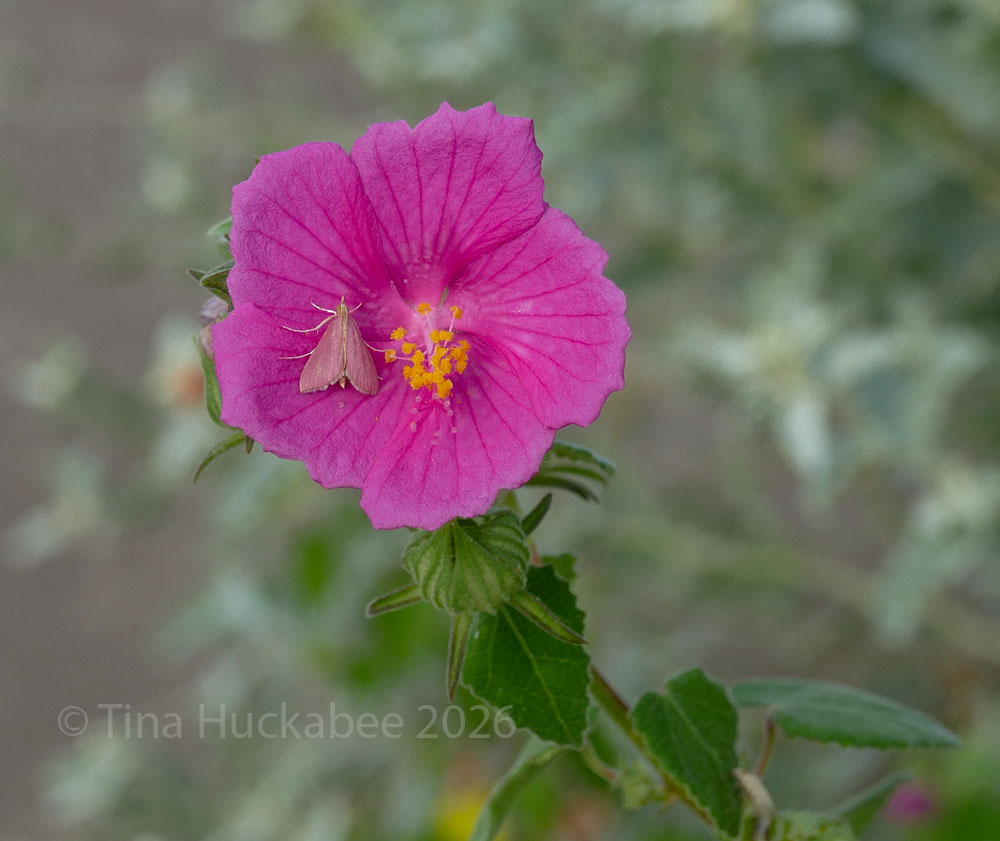
The Tina-planted plant is the Pink Skullcap, Scutellaria suffrutescens, a spreading, low-growing evergreen sprinkled with small pink flowers throughout the long growing season. The I’m-gonna-land-where-I-please plant is the mallow Rock Rose, Pavonia lasiopetala, hovered with arched branches and open-petaled flowers, over the Skullcap.

Pinks on pinks, I’m charmed by the Barbie-esque look!

Since the photo, I’ve cut back the Rock Rose as they respond well to pruning because they bloom on new wood. Trust me when I say that it’ll grow back quickly enough. The Skullcap has been in that spot for many years and had spread to about four feet in diameter. During late winter I pruned it to a two-foot diameter mound, making room for some other plants to settle in next door, out of the photo’s range.

Clearly, these two twin pinks get along and I’m sure in short order, there will be further pinks-on-pinks as summer moves forward and everything continues to grow apace.

May Garden

I was in New Mexico for the first week of May, a state that truly lives up to it’s motto: Land of Enchantment. As much as I love the high desert plants and beautiful hiking trails, this was not the first time home from a trip that I was surprised and pleasantly reminded about the lush garden that I’ve created on my own slice of the Earth.

The front garden faces west and receives full sun.

I don’t consider myself any sort of plant or design expert, but I’ve learned plants that work well in the Central Texas climate and the soil that my garden grows in. Along the way, mistakes were, and are, part of the process. I adore the plants in my garden, there are so many favorites, but also appreciate the wildlife that are integral to the health and beauty of my garden. There are periods of “mess” that I’ve come to understand are vital to a balanced ecosystem: allowing plants to seed out where they become unruly or tattered in the process. Those seeds provide for the native and migrating birds and all manner of mammals who pass through, insuring the future generations of those plants. The tattered leaves and stems become part of the mulch, eventually enriching the soil. The cycle continues.

I don’t typically photograph the wide swaths of my front garden, as I don’t want to get cars, trucks, street signs, or the neighbors’ AC unit in the shots. Alas, there’s no way for me to get a long shot of the narrow area between my driveway and the north-most neighbors’ property line without their AC unit or the slab of cement that is my driveway playing roles in the garden.

However, I can stroll along the driveway garden, capturing a couple of sets of shrubs, perennials and annuals.

Bloomers in this shot include the large shrub, Barbados Cherry, Malpighia glabra. Left to right grow Globe Mallow, Sphaeralcea ambigua, Blue Curls, Phacelia congesta, Blue Sage, Salvia farinacea, more Blue Curls, and not-quite-in-bloom Turk’s Cap, Malvaviscus arboreus.

Further along that same path and directly across from the front of the garage grows pink blooming Rock Rose, Pavonia lasiopetala, White Tropical Sage, Salvia coccinea, and yellow Zexmenia, Wedelia acapulcensis. Some taller shrubs, a floral vine and an old Desert Willow, Chilopsis linearis complete the rest of this small section.

Turning to my right, I face the front of my house. In this raised bed are a large Cenizo, Leucophyllum frutescens, a Red Yucca, Hesperaloe parviflora, and more Rock Rose, Blue Sage, and Zexmenia. Another smaller raised bed to the right of the photo echos some of the same plants.

As I stroll away from the front of the house, down the driveway and to my left is what was once the front ‘yard’ and is now an enclosed mulched sitting area, surrounded by a garden chock-full of native and well-adapted plants.

The pathway continues parallel along the front of the house, towards my SIL’s garden. A few feet in and with a right turn, the mulch sitting area welcomes a visitor to sit, or in my case, to stand and mull garden changes. The narrow span of garden between the mulched pathway and the mulched sitting area is full of spring flowers now, but summer’s plants are becoming impatient, already nosing to take over the blooming and seed production. I use many plants repeatedly, in similar or different combinations, throughout my garden. I hope there’s just enough variety of plant matter that the space isn’t boring or redundant.

In this shot, two Engelmann Daisies, Engelmannia peristenia bookend the photo in sunshiny yellow. The back of this section is bolstered by three heirloom roses: a Martha Gonzalez, an Old Gay Hill, and a Caldwell Pink. In front of the roses are two American Basket Flowers, Plectocephalus americanus; one columnar, its neighbor to the right, pruned for branching. These two (and others of their kind) will bloom most of summer. Two silvery-green Mexican Feathergrass, Nassella tenuissima, wave gently in the breeze.

Across the mulched path, along the front of the house (side of the garage) grow Feathergrass and American Agave in pots nestled in a bed of ground-cover Purple Heart, Tradescantia pallida, backed-up by evergreen Burford Holly, Ilex cornuta. An Eastern Redbud, Cercis canadensis, adds structure and light shade. A variety of small shrubs, ground-covers, and perennials also grow in this section.

Off to the side, a trio of salvia: Blue Anise Sage, Salvia guaranitica, and both White and Red Tropical Sage, Salvia coccinea keep the potted Mexican Feathergrass company.

Turning back to the main garden area, more Rock Rose, Mexican Feathergrass, and Engelmann Daisy are joined by a sprinkling of white Small Coastal Germander, Teucrium cubense, and the tail-end of my Whooping Crane garden attendant.

Pivoting to view the rest of the garden which is bordered by my SIL’s garden, the street, and the driveway, you’ll see small trees and dense, summer blooming shrubs. Flameleaf Sumac, Rhus lanceolata, Evergreen Sumac, Rhus virens, Mexican Honeysuckle, Justicia spicigera, Frostweed, Verbesina virginica, and Turk’s Cap, along with other shrubs, perennials, and annuals, act together as a natural privacy screen from the street.

I really like white in my gardens! These common White Tropical Sage are prolific bloomers and most visited pollinator plants in my gardens. As they’re not big plants, I transplant the many seedlings in groups of three or more. I also let them bloom where they grow, so pops of white sparkle throughout my garden.

For structural focus, native yuccas, Soft Leaf and Pale-leaf, plus another container of American Agave attempt to balance indulgent spring blooms. I find spiky plants interesting–in others’ gardens. I’m not a member of the Spiky Plant Fan Club; I don’t like plants that hurt me. My focus is the tumble of floral and foliage color, as well as seasonal change. That being said, yuccas and the like add beautiful and varied color and structure and gardens benefit from that added beauty.

There are many plants I didn’t show or discuss that fill this very full garden: smaller perennials hug the ground and others fill space and add color and foliage interest. In the 5 years since this garden became a full-sun situation, it’s evolved and changed more than I anticipated, though I have welcomed the challenges presented. Some plants were the perfect choice, other plants were…not so much. As the one Red Oak that a squirrel planted grows toward its eventual mature height, along with the understory trees that I’ve added, the garden will continue to change with each passing year. I look forward to watching my garden grow, to observing who lives here or visits, and to being nature’s humble assistant in this quest for a garden alive.