Spring Garden

I’d originally planned three posts profiling my gardens this spring, one each for early spring, mid-spring, and late spring. My garden changes a good bit between February and June. Life renews and it’s fascinating and affirming to witness the seasonal changes in flower, foliage, and fauna.

Well, early spring scooted right past me and late spring is knocking at the door, insistent to enter, but this is the first “spring garden” post I’ve managed to produce. It’s been a busy few months with plenty of distractions.

The back part-shade garden is filling in after winter’s freezes. Early bloomers are mostly done and beginning their seed processes, summer bloomers are arising from the Earth, growing in stature before their blooms begin.

In March and April, there were sweet columbines and iris, scads of spiderwort, and sprinklings of native Gulf Coast Penstemons, Penstemon tenuis.

These pretty, bell-shaped blooms don’t last long, only about 3-4 weeks, but they make a nice impact in the garden and provide for pollinators. Their seeds will feed some birds, some squirrels, and ensure this plant’s future in my garden and probably elsewhere.

Another native perennial which flowers in mid-spring, more blue than purple, is the native Lyre-leaf Sage, Salvia lyrata; these bloom in concert with the penstemons.

This photo, taken yesterday, shows the former flower stalks, now seed stalks. I’ve seen Painted Buntings, Lincoln’s Sparrows and Clay-colored Sparrows nibble at these seeds.

A wider look shows the garden in its “short” form. Come mid-June and going forward, many of the plants that you don’t notice or even see in this photo will be 4-5 feet tall. The early spring bloomers will be gone, or will have resigned themselves to green, ground-hugging rosettes, many offering seeds, at least for a time.

We never got around to cleaning the pond or separating the lilies and the Pickerel Rush.

It’ll be interesting watching these plants during summer. They tend to bloom well in spring, then mostly provide foliage protection for the fish during the heat of summer, with occasional blooms flowering up from the base. I wonder if my not having separated them this spring will make much difference in bloom production?

Once the heat sets in, this shady part of the garden provides respite from the relentless Texas sun. But so far, it’s been a cool spring–and wet! I’m not confident that our drought is over, but we’ve received some drenching storms and the plants (and gardener) are happy and appreciative.

The front–all full sun of it–is bursting with color, form, and life. Migratory Lincoln’s Sparrows, Painted Buntings, Common Yellow-throats flit through the garden, nibbling whatever seeds and insects that come their way, filling up for their trip north to their breeding grounds. I occasionally chase a couple of neighborhood cats out of this wildlife haven.

Early blooming perennial spiderworts and annual poppies provided pops of color and good things for the pollinators. They were accompanied by flowering shrubs that like cooler temperatures, like Globe Mallow, Spaeralcea ambigua,which is still in full bloom.

As is typical and planned for, the purples and blues are dominant in the garden in this middle part of the spring season. Red, yellow and orange will get their turn to show off in summer. White flowers also come into their own during summer and fall, and are restful for the eye.

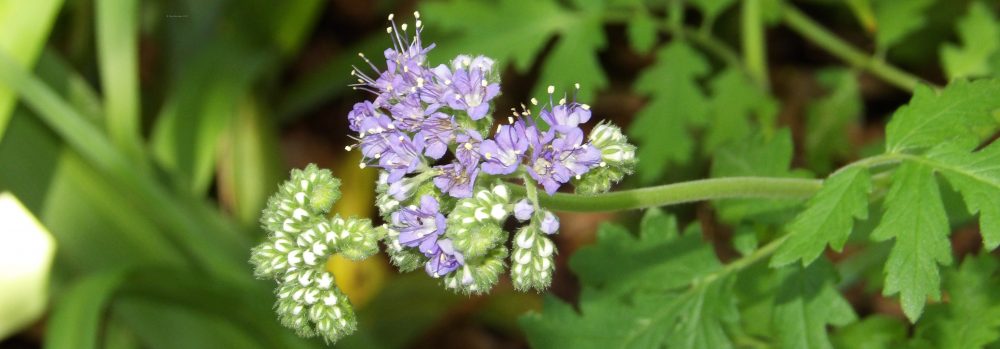
About five years ago, a friend gave me a couple of sprigs with roots of Blue Curls, Phacelia congesta, an annual Texas native spring wildflower. They’ve seeded out–and how! This year’s bumper crop of the unusual caterpillar-looking wildflowers has provided color and lots of movement in the form of visiting pollinators.

There aren’t any pollinators on this Blue Curls cluster, but that’s an anomaly; these diminutive blooms are pollinator powerhouse plants.

Blue Curls are bunched up at the edge of the garden. The slender, tower-like plants toward the center are the soon-to-bloom American Basket flower, Centaurea americana. This is another pollinator favorite and summer bloomer.

My Basket flowers have grown even taller since this photo, though I have pruned by half some of them. With pruning, the towers grow bushy, multi-branched and more shrub-like. Also, since they’re shorter, I can enjoy viewing the flowers! Those colossal towers are too high for me to see anything but the bottom of the blooms and the pollinators flying above them.

In another spot of the garden, I love the combination of Blue Curls, with their lacy green foliage, paired with the ruffly grey foliaged Globe Mallow.

The stand of Hill Country Penstemon, Penstemon triflorus, has been stunning. I see carpenter bees nectar stealing, but the main pollinators of these flowers are the many Hummingbird, or Sphinx moths that visit at dawn and sunset, and sometimes during the day.

Deep blue Henry Duelberg sage, Salvia farinacea, complements cheery yellow Engelmann’s Daisy, Engelmannia peristenia. These two will bloom well into the summer months and potentially, through fall. Both are excellent wildlife plants: nectar and pollen for pollinators, seeds for birds-n-beasts. Oh, and the gardener really likes them too!

It’s a mixed-bag with the bloom stalks of my Red Yucca, Hesperaloe parviflora: This one produced 10 stalks; some others have none. Usually, my established yuccas each shoot up 3-5 stalks. I’m not sure why some didn’t produce any bloom stalks this spring, but the tough, evergreen foliage is still worthy and welcome in the garden.

Though fleeting, spring is a special time of year in any garden. Gardens are fresh, life is everywhere, and it’s not at all difficult to find color, texture, and wild things active.

What’s growing in your spring garden?

Blue Eyes Smilin’

Each January, a sprig of “grass” emerges from a crack in my limestone patio. I look forward to its appearance, as I know that a sprinkling of cheery little blue blooms will decorate the diminutive stalks during March and April. I don’t know where this Blue-eyed Grass, Sisyrinchium angustifolium, came from and it’s never reproduced anywhere else in my garden. I have seen clusters of them scattered in the turf at the park adjacent to the local elementary school, but I don’t know of any closer to my garden.

Not actually a grass, this sweet patio gift is a member of the iris family. Each year, I promise that I’ll look for, and collect, seeds; each year I forget. This year is no exception on the promise end of things, but I have made a note of watching it carefully as the blooms fade, in hopes of gathering seeds to sow in fall somewhere else in my garden.

Such dainty, dancy things, they wave gently with spring breezes, happily blooming where there aren’t any other blooms to compete and over-shadow.

Look at that cute face!

Next year, seeds and seed-gathering willing, they’ll grace an additional area of the garden.

As I thought about the title of this post, “Blue Eyes Smilin’ ” popped into my head, obviously a riff on the song that made Willie famous, Blue Eyes Crying in the Rain, though it was written by Fred Rose. That song has been in my head all day, so I’m sharing.

Texas Dandy

In February, I posted about the non-native dandelion that is common in gardens and pathways pretty much everywhere. Though most people consider it a weed, I have no argument with that little flower, since it’s an early bloomer for pollinators.

Fast forward about six weeks with spring in full swing, and the native dandelion, Texas Dandelion, Pyrrhopappus pauciflorus, has made itself comfortable in my garden. Here it is, upfront and on stage, Four-nerve Daisy, Tetraneuris scaposa, waving in the background.

This little aster is a paler shade of yellow, more butter-yellow, than many other native yellow asters. The lower portion of its anthers are colored a deep maroon, which contrasts nicely with the soft yellow.

The flowers open in the mornings, though I’ve noticed that they are sleepy heads and it’s well after sunrise before they greet the day. The blooms close by mid-afternoon.

Like other flowers in the Asteraceae family, the seed heads are snowy white puff balls, just waiting for that perfect breeze to carry them off to land in another home.

In my garden, I haven’t seen any of the typical bee/butterfly/other pollinators nosing around the blooms. Instead, there’s often a cucumber beetle in the center, presumably doing the business of pollinating.

This individual planted itself just outside the bounds of the garden, which is typical; these usually grow in the pathways of my garden.

It’s a complementary plant alongside the planned garden, though it’s not the only one that invited itself to join the community.

The wide-leafed plant situated just behind and to the right of the Texas Dandelion is a volunteer American Basket Flower, which I wrote about last year. And next to that is a Coast Germander, Teucrium cubense, that appeared last year as well, uninvited, but not necessarily unwelcome. Not an aster, but instead in the mint, or Lamiaceae family, the dainty white flowers bloom non-stop and the foliage was evergreen all winter.

I think all three unplanned additions are dandy!