Small, Lavender and Mysterious

While I might fantasize about tall, dark and handsome, it’s this darling,P1070706.new

….small, lavender and mysterious, that has turned my head recently. This Branched foldwingDicliptera brachiata has planted itself in my garden, courtesy of I-don’t-know-who-what-or-how.

The pretty showed up late in spring, amid a cluster of Drummond’s Wild RuelliaRuellia drummondiana.

P1070700.new

 I grew the ruellia from seed and the group of four individual plants has been in the ground for a couple of years.  I noticed the different foliage and branching structure,

P1070463.new

…and wondered what bloom would appear.  In the past few weeks, small, simple  flowers have unfurled at leaf nodes along secondary shoots from the major branches.P1070747.newP1070744.new

The flowers are a soft lavender (as if lavender isn’t a soft enough color), which grows paler as the blooms age. P1070453_cropped_3161x3170..new

Not striking or boisterous as blooms go, but, they are graceful.P1070461.new

The plant itself is small, only about 1.5 feet in height and not wide; it forms  a loose growth habit.   Most of the leaves on the sub-branches are smallish, especially in comparison with the Ruellia foliage, P1070717.new

P1070464_cropped_4096x3258..new

…but the leaves from the main branches are larger.   The primary branch stalk is woody and all of the branches are somewhat square.

P1070708.new

P1070742.new

This plant is aptly named in both the Latin and common forms:  Dicliptera:  diklis, Greek meaning “double-folding” and pteron, Greek meaning “wing”; brachiata refers to “branch”.  The English is equally and elegantly straightforward:  Branched Foldwing.

P1070743.new

I couldn’t have named it better.  Until a couple of days ago, I had no idea what this happy garden surprise was.  I thought it was a native, though I can’t say why I thought it was native, except that it looks native-y.  I know, not very scientific.

I studied the plant, took photos, perused every plant detection search engine and book I connected to or own, but couldn’t find an exact match.   I dismissed it belonging to the native Texas plants in the Lamiaceae and Fabaceae families (thank you, Special Collections of the Lady Bird Johnson Wildflower website), though there are some physical characteristics of both plant families present in this plant.  Monday evening, as the temperatures cooled to a mere 100 degrees, I once again strolled into the garden and knelt beside the green and lavender gift.  I thought to myself: Do I have any plants that have similar blooms to this one? and realized, that yes, as a matter of fact, I do. The native to Mexico and hardy in Texas,  Mexican HoneysuckleJusticia spicigera, 

P1070745_cropped_4258x2973..newP1070746.new

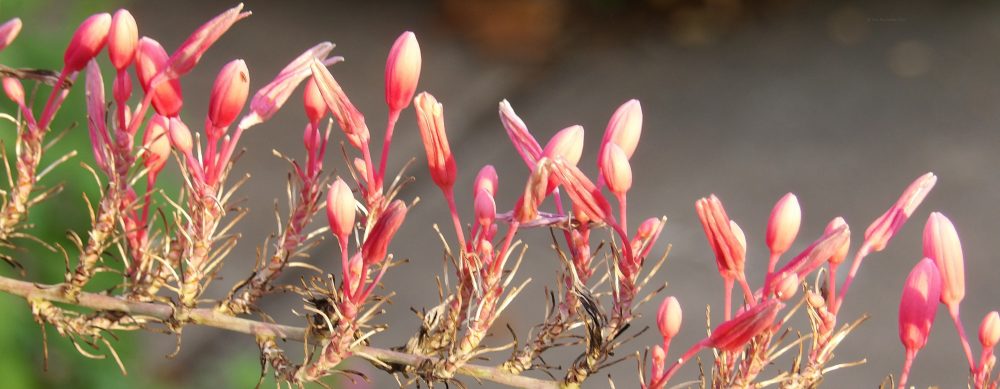
…which is in a gorgeous, showy mood right now, also demonstrates the charming petal curl similar to that of the Branched Foldwing.

P1070734.new

P1070763.new

Ah ha!!  So what family does Justicia belong in?  The Justicia spicigera is in the Acanthaceae family.  So I whip out my phone, log on the the Wildflower Center’s site and scroll through the Acanthus family plants. Fortunately, the Acanthus family is a smaller group than some of the others–that makes looking at the small print on the phone more acceptable–and easier. The Ruellia drummondiana plants, where the mystery plant is located, is also an Acanthus family member, so I roll the phone’s window through all of the Ruellia species, as well as others in this valuable family of plants, and then…there it is.

P1070702.new

Dicliptera brachiata.  Branched Foldwing.

A native to Texas and much of the southeastern United States, and stretching into the Midwest, D. brachiata is classified as a herb and an annual/perennial–I’m guessing that it will prove to grow as a herbaceous perennial in my garden.  The Branched Foldwing blooms July through October.  The WC literature mentions that it is a good moist woodland plant and can be “weedy” in a watered garden.   I only water two times/month, so “moist” is not something that my garden gets much of, except that there was a lot of rain in late spring and early summer, and the Branched Foldwing in question is near a bird bath. The areas around my bird baths tend to get more water than most of my gardens and several of them are in shady spots.  Lucky gardener, lucky plant.

Even better, this native is also the host plant to the Texas CrescentAnthanassa texana,  a common and pretty little butterfly that I see regularly and that flitted prolifically in my gardens earlier this summer.  Well, that explains the munched-upon leaves, doesn’t it?

IMGP9740_cropped_2364x2511..new

P1070740.new P1070739.new

The Texan Crescent caterpillars might be feeding on other plants, but there’s unquestionably  foliage damage on the Branched Foldwing. Considering that there were a fair number of the butterflies and this is a new plant in my garden, I think I’ve figured out at least one of the food bars that Texas Crescents are eating from!

Yay for native plants!  Yay for native insects which evolved along with those plants and add to the rich diversity of life in my garden!!  Yay that I finally figured out what the heck it is!!

So where did the Branched Foldwing come from?  Maybe a passing bird planted a seed?  Or a seed was carried by the wind and found its way into my garden?   It’s not a showy enough plant to be picked up by the horticultural industry, so I doubt that it came as a stowaway from some purchased plant. More than likely, there was a seed, or maybe several, nestled in with the seeds of the Drummond’s Wild Ruellia.  The flower is small and I have yet to identify a seed, but I will keep an eye on seed development.

P1070454.new

The story has a happy ending.  Small, lavender and mysterious isn’t so mysterious after all and is a welcomed addition in my garden.  It’s not a dramatically blooming find, but in hot August, arguably the toughest time of year for Texas gardens, its flowers freshen the hot and tired garden,

P1070460.new

And along with the Ruellia drummondiana,

P1070755.new

and a few others.

And that’s something to be grateful for.

Wildlife Wednesday, August 2015

As a general rule I’m not a conspiracy theorist.  However, this past month I’ve begun to think that they’re all out to get me.  Or rather, they’re conspiring against me, so that I don’t get them–in photograph form, that is.  The them I refer to is all the wild critters that inhabit and visit my gardens.  This past month, whenever I spied an interesting garden visitor nectaring, breeding, or otherwise creeping, crawling, or flitting,  I struggled to fetch or focus my camera quickly enough to snag a photo.  I’ve come to believe, cross-species, that there’s an understanding among the wildlife in my gardens:  Hey! Tina’s got her camera–let’s vamoose!!  And vamoose they did.  Even when strolling into the gardens, camera in hand and ready for a wild photo shoot, those in the garden, right there, busily slurping on a bloom or nipping at a seed suddenly, weren’t.

Is it my breath?

IMGP9710.new

I do have lots happening–bees a’buzzing, butterflies a’flying, birds a’twittering, but they don’t seem to want to mug for the camera.

IMGP9625.new

Maybe it’s just too darn hot.

IMGP9630_cropped_2898x3014..new

It is hot.  The dog days of summer have settled in Austin, but it’s also the first Wednesday of the month and time to celebrate wildlife in wildlife gardens.

There were a few things that didn’t scamper away from me like this nest that I discovered while pruning the blackberry bramble.

IMGP9214.new

I have no idea who this belonged to and I don’t know when it was built.  I didn’t see it during blackberry season (May), so I assume it was built afterwards.  I wonder what happened to the builders and/or the residents?

On the other side of the blackberry vine this beauty has built a lovely summer home.

P1070472.new

A deadly home though for anyone who bumbles into her webbing, but I welcome these common garden spiders, the Black and Yellow ArgiopeArgiope aurantia.  I saw that she caught some of the insects that were chewing on some of my veggies and milkweed plants which are nearby.   I definitely have mixed feelings about her hunting as I know she also caught at least two of my beloved Horsefly-like Carpenter Bees, Xylocopa tabaniformis,  like this one.

IMGP9637_cropped_2406x2779..new

Another Black and Yellow Garden spider set up shop in the back garden, as well.  If you’re a regular reader, maybe you’ll recognize the wooden structure in the background?

IMGP9387.new

Yup, she hunting honeybees and I know that she caught at least one.  No doubt, there were others ensnared in her web.

IMGP9674.new

It’s been a couple of years since I had these spiders in my gardens; some years they’re common, some years not.  I take a hands-off approach to spiders, insects and most critters in the garden.  Even with a very compromised local environment (lots of sterile lawns and few pollinator gardens), my garden space is healthier and relatively balanced if I let everyone do their thing, even if it means eating some of my favorite insects.

Sniff.

The male spider is much smaller and cruises around gardens,

IMGP9373.new

….looking for a female to mate with.  I guess these two are enjoying their summer fling.

IMGP9371_cropped_2591x3106..new

More spiders in my garden’s future….

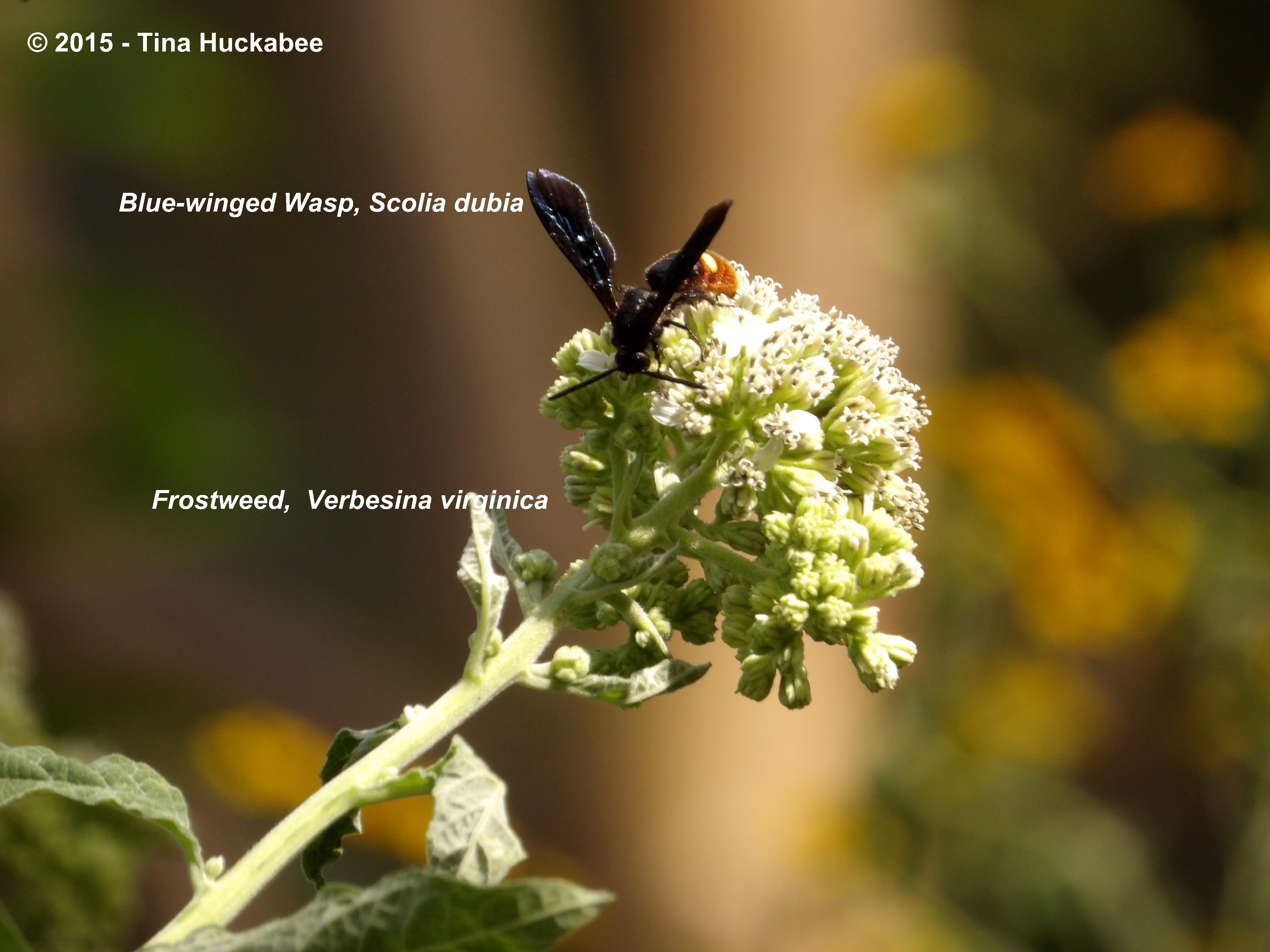
Other beneficial garden inhabitants are wasps, like this social Paper Wasp, Polistes exclamans.

IMGP9635_cropped_3365x3056..new

This insect is widespread in Texas and much of the South. I’ve seen a number of them this past month–resting on leaves, feeding at blooms, and sipping at bird baths.

IMGP9634_cropped_3374x2936..new

IMGP9633_cropped_2756x3051..new

Paper Wasps are  nectaring insects and categorized as social because they live in groups with a breeding queen and workers, though many wasps are solitary and are also common in Texas gardens.  These particular Paper wasps build nests that are made of cellulose, either out of wood or paper, with cells similar in design to honeybee combs; nests hang from a single stem attached to some object. I know I’ve seen the nests around my property, but of course couldn’t find one to photograph for this post. However, you can see one here.

The squirrels are not happy with me. I don’t always fill the bird feeders, but I am this summer. By default and population, I’m also feeding the squirrels.   Several of these enterprising rodents began climbing up and then hanging onto the solar screen while nibbling seeds at the ceramic feeder in front of the kitchen window. They were emptying this feeder in front of the kitchen window in less than a day.  NOT cool. I finally removed the screen, to their great frustration.  Since then, the screen-vanquished squirrels have tried, in vain, to figure out how to get to the feeder.

Glass is not so easy to hang onto.

IMGP9622.new

One morning, this little guy sat on the window ledge, looking quite despondent at his inability to reach the feeder.  I swear that he had his arms folded and was tapping his foot in annoyance.

It’s a good day when I can out-smart the squirrels.

These female Black-chinned Hummingbirds, Archilochus alexandri (or maybe it’s the same one) have visited on a regular basis.  In the first set of photos, the flower-of-choice is the Big Red SageSalvia penstemonoides,

IMGP9290.new

IMGP9288.new

IMGP9282.new

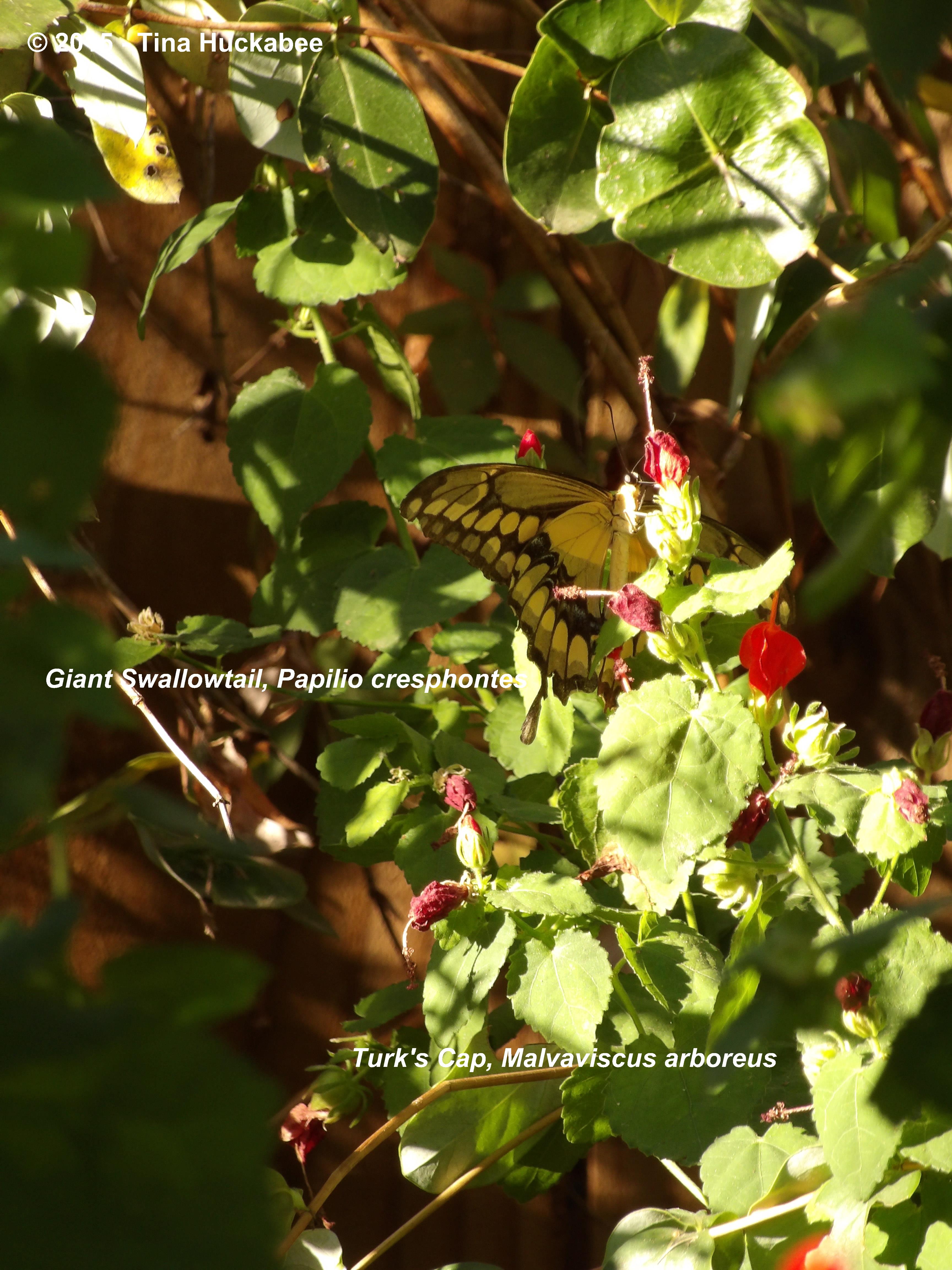
…and in this second set, the meal source are blooms of Turk’s Cap, Malvaviscus arboreus.

IMGP9774_cropped_2198x2958..new

IMGP9773_cropped_2875x2295..new

I’ve seen one or more Black-chinned males and male Ruby-throated Hummingbirds-alas, no photos other than those above though.    They’re hard to catch, these winged jewels, but I’m enjoying their visits, however fleetingly, as they feed at the plants they favor in my garden.

For several days in mid-July, I was  hearing an unfamiliar bird call.  I couldn’t find the singers for the first day or so, then finally spotted the jazz-like crooners.

IMGP9688_cropped_3521x3286..new

The Logger-head ShrikeLanius ludovicianus, is a year-round resident of much of the United States, though I’ve never seen one–ever.  I was surprised to see several of them, though all I could photograph was their lower halves, due to their perching high in neighbors’ trees around my gardens.  They have a varied diet, but also eat insects.  Were they after my honeybees?  Hmmm.  I heard them, finally saw a few, then I left town for a bit.  I’ve heard none since.  Too bad.

I loved watching this parent  Black-crested TitmouseBaeolophus atricristatus, feeding a young’n.

IMGP9259_cropped_2927x2710..new

IMGP9260_cropped_2976x2774..new

IMGP9268_cropped_3692x3286..new

Actually, I guess it was the young’n that I really watched, as he/she looked this way and that for this parent to show up with the seed.  Adorable, and gratifying that there’s enough to feed the next generation.

This lovely little Bordered Patch butterfly, Chlosyne lacinia, flitted in the garden for days before I could catch this mediocre shot.

IMGP9610.new

The host plant for this pretty are sunflowers, which are plentiful in my gardens this summer.

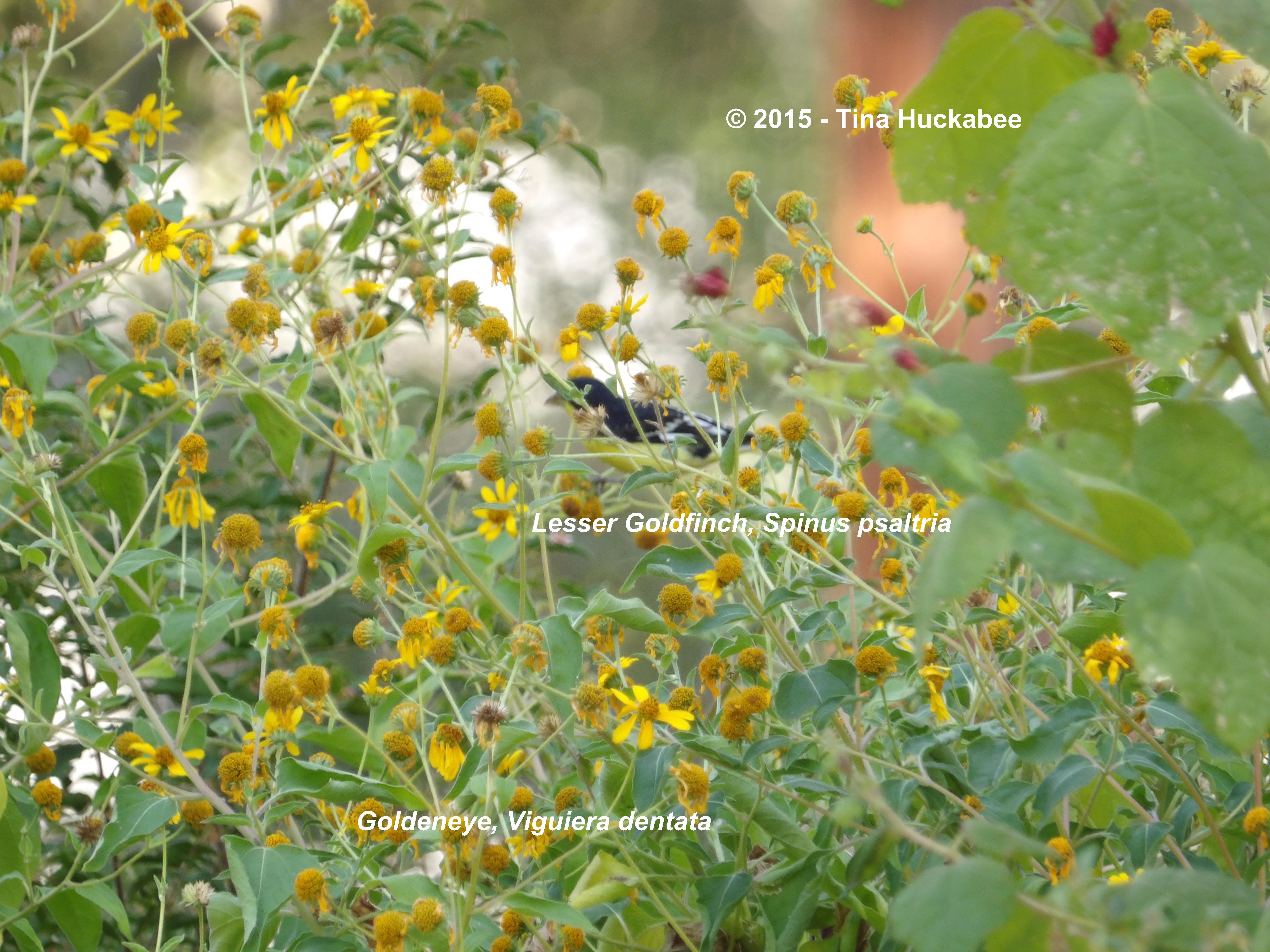
Feeding on the going-to-seed sunflowers are the Lesser GoldfinchSpinus psaltria, gang–boys and girls alike.

IMGP9715_cropped_3216x3216..new

IMGP9653_cropped_2700x2793..new

IMGP9659_cropped_3147x2755..new

Lessers love the seeds of Asteraceae plants, like sunflowers.  I chuckle as they hang upside-down for their food; it’s a neat trick, though I’ll take my meals at the table, thank you very much.

IMGP9658.new

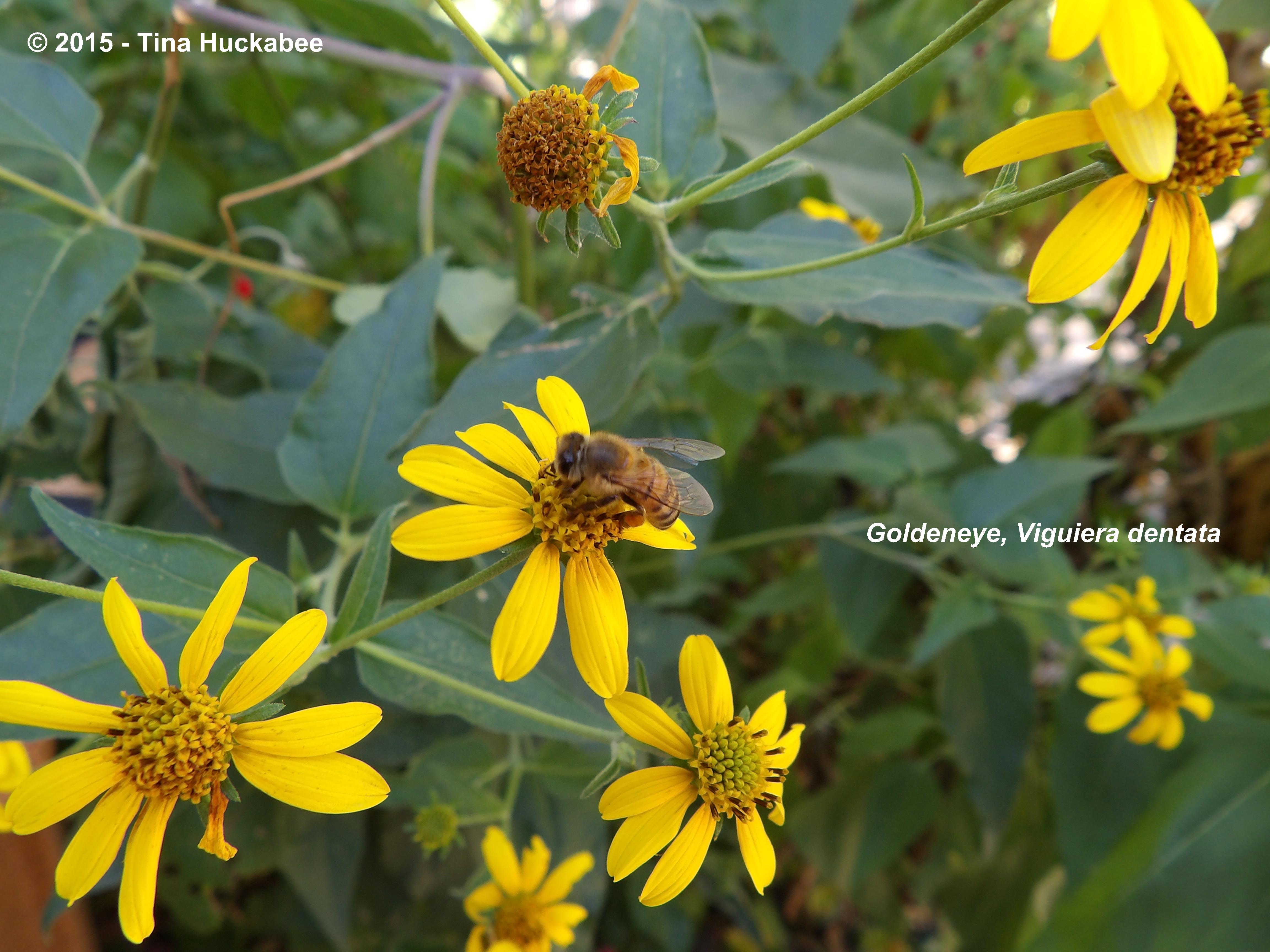
These guys-n-gals will soon finish up with the tall spring-germinating, summer-towering sunflowers.  I’ve already pruned a couple of stalks because there was little left on them, either in bloom or seed form.  But several sunflowers still have viable blooms, which the honeybees and butterflies are feeding on and seeds which the Lessers and also House Finches and Sparrows, are enjoying.

IMGP9215_cropped_3254x2595..new

To the “pretty plant” gardener–one who wants the sterile, pristine lawn or perfect, non-insect attracting bloom-n-foliage plants, I’m sure my sunflowers look hideous.  But to myriad wildlife–bees, butterflies, moths, syrphid flies, and a variety of birds, the stalks are beautiful for their life-giving  bounty.  And that is what wildlife gardening is all about.

I lamented that I didn’t have much to show and tell for this month, but I guess there was enough. Thank you critters–for your presence and for enlivening and completing my garden.

Kudos to all of you who garden for wildlife, no matter how much or little:  you’re part of the solution.  I hope your gardens received wildlife visitors this month and that you will join in posting for August Wildlife Wednesday. Share the rare or mundane, funny or fascinating, beneficial or harmful critters you encounter. When you comment on my post, please remember to leave a link to your Wildlife Wednesday post so readers can enjoy a variety of garden wildlife observations.

Happy wildlife gardening!

**Just a quick and timely addendum. This article is from the Washington Post via. Cornell Lab of Ornithology. A must read for anyone who understands the wastefulness and pointlessness of the American lawn.

Also, the original, beautifully written essay from Ohioan Sarah Baker about her experience in allowing her property to become a wildlife habitat.


Purple Martin Magic

Many people are familiar with the Mexican free-tailed bats who live in and around the Austin area, especially those inhabiting the world’s largest urban bat colony found under the Ann W. Richard Congress Avenue Bridge.  Austinites and tourists thrill at the site of the 1.5 million bats leaving their roost late each summer day for their nightly insect foraging, before migrating to Mexico for winter. Less well-known, but also a remarkable natural event, is the annual migration of the Purple MartinsProgne subis.

Photo courtesy of The Cornell Lab of Ornithology  All About Birds

The Purple Martin is North America’s largest swallow.  Like many other species of birds, they winter in South America, but breed in North America during spring and summer, migrating back and forth during the course of their lives.  Purple Martins are gregarious birds and it’s long  known that they’re comfortable around human habitation. According to the Audubon Society, Native Americans learned that the Martins were valuable assets to their crops and placed hollowed gourds to encourage the Martins to nest nearby.  The Martins chased crows away from crops and vultures away from drying meat.   In modern times, most Purple Martins nest in human provided housing during their breeding season throughout a large area of North America. From July to early August,  they leave their individual nesting sites and converge in enormous roosts preparing for their migration to South America for winter.

Here in Austin,  Purple Martins gather by the hundreds of thousands, roosting in trees along I-35.  Austin is located along one of three major flyways for this Neotropical bird. This year, the birds decided to change things up a bit and instead of roosting in oak trees at Highland Mall, as they have for a couple of years, they’re roosting in trees at the nearby Capital Plaza Shopping Center.

At about 8pm, you can witness a few birds in the air,

IMGP9391.new

…and a few Austinites on the parking lot, settling into their lawn chairs, getting ready for the show.

IMGP9388.new

Travis Audubon  hosts Purple Martin Parties on weekend evenings from mid-July to early August and have knowledgeable volunteers ready to answer questions about these cool birds and their life cycle. The evening we visited, one of the volunteers told us that there were an estimated 400,000 birds roosting for the night. It takes a while for the action to kick into gear, but by sundown, there are thousands of birds congregating above the parking lot.

IMGP9418.new

IMGP9432.new

Swirling in flocks, the Martins fly in unison, flitting into one tree, then another, seemingly indecisive about where to rest their weary beaks for the night.

IMGP9447.new

IMGP9452.new

The birds are chatty, beautiful and swift flyers, and downright doodee dangerous if you’re standing nearby and don’t hold an umbrella over, or sport a hat on your vulnerable head.

IMGP9484.new

If you know what I mean.

IMGP9421.new

IMGP9400.new

I always wear a hat when I watch the Martins.

IMGP9489.new

The Husband didn’t wear a hat this year and he had to wash his hair when we came home that evening.

IMGP9500.new

If you know what I mean.

IMGP9524.new

IMGP9544.new

As more birds gather, they swoop and sway in the air and by sundown, many are perched in the trees for the night.

IMGP9574.new

I ventured closer to get photos of the roosting birds.

IMGP9586.new

Yes, I was wearing my hat.

It was very windy that particular evening and I had a hard time getting clear shots of the birds in the swaying branches.

IMGP9589.new

Most of these birds are females and fledgling chicks, though there are males here too. The male Purple Martin is a deep, iridescent purple and the female is drab, with a light gray chest and white tummy.

IMGP9590.new

Martins are insectivores who fly fast and high, catching prey on the wing.  They feed during the day, resting at night.

I once placed a Purple Martin house on our property, but it was an abject failure at attracting these lovely birds.  Martins like open space in which to fly and hunt and there are too many large trees around my home to attract these birds.  Most Martins nest in human provided houses, though Martin lovers must contend with European Starlings and House Sparrows who will aggressively displace Purple Martins from their homes. Those wishing to attract Martins must be vigilant in removing the invasive birds if they want Martins to breed.  Older, male scout Purple Martins arrive as early as February to check out  nesting sites, followed a few weeks later by the females and the younger males.  They are fun and interesting to observe during their breeding period and fascinating as they prepare for their trip to South America.

Purple Martin magic.

IMGP9532.new

Ain’t nature grand?

Thanks to the enthusiastic Travis Audubon members who teach others about the importance of birds, to the businesses who encourage visitors to view the roosting Martins, and to the many Purple Martin lovers who host them during breeding season. You’re all part of the solution.

IMGP9432.new

Have a good migration, Purple Martins, and a safe trip back next February.  Swing by and say “Hi!”.