**This series of photos shows a predator eating prey.**
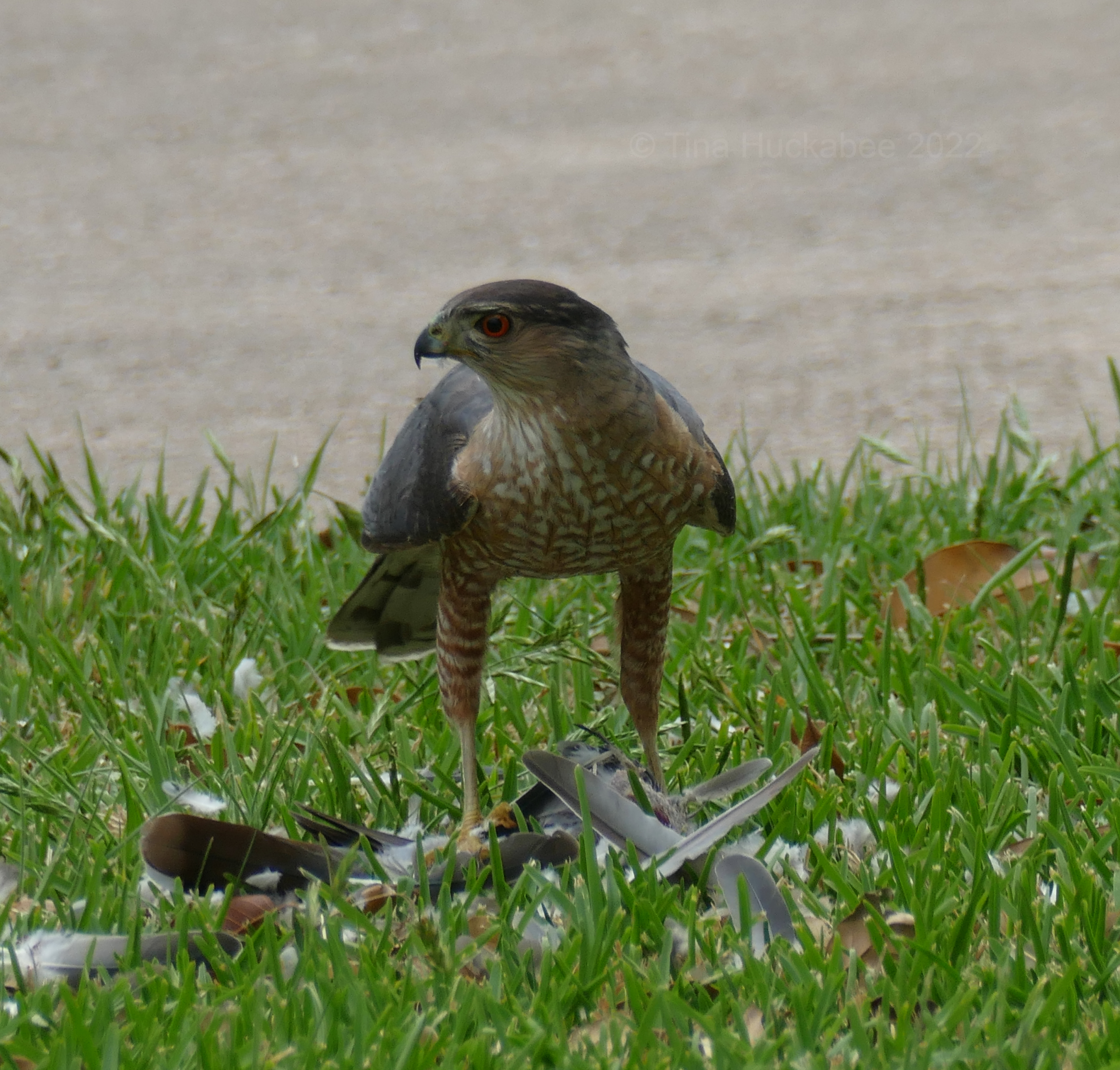
Towards the end of a day, I walked into my front garden, and glancing to my neighbor’s lawn, saw this Cooper’s Hawk, Accipiter cooperii, enjoying its Sunday dinner.
On the menu that evening was White-winged Dove, a favorite meal for the neighborhood hawks. I’ll admit to always feeling a bit sorry for those who are caught, but this scene demonstrates at least one part of a healthy ecosystem: that there are predators to hunt plentiful prey–and that is a good thing. There are more than enough fat, well-fed White-winged Doves in our area.
I imagine that this hawk is an adult from the mated pair of Cooper’s nesting behind my SIL’s house. As the trees leafed out, watching the hawks at their nesting site became nearly impossible, but they’re still around and hunting. Obviously.
The hawk ate for about an hour, eventually flying off with the last part of the meal, presumably as a snack for later–or to feed its babies. I’ll have a better idea of the Cooper’s parents’ success if I see a juvenile hunting in late summer and autumn.
The great spring movement of birds from Mexico, Central and South America to various parts of North America is well underway. In my own garden, I began noticing a few visiting birds as early as the latter part of March, just a few weeks after I realized that my two regular winter warblers had left. Texas is a main migration flyway between the two continents and even though visits are brief, it’s always exciting to see unusual, non-resident birds in my garden.
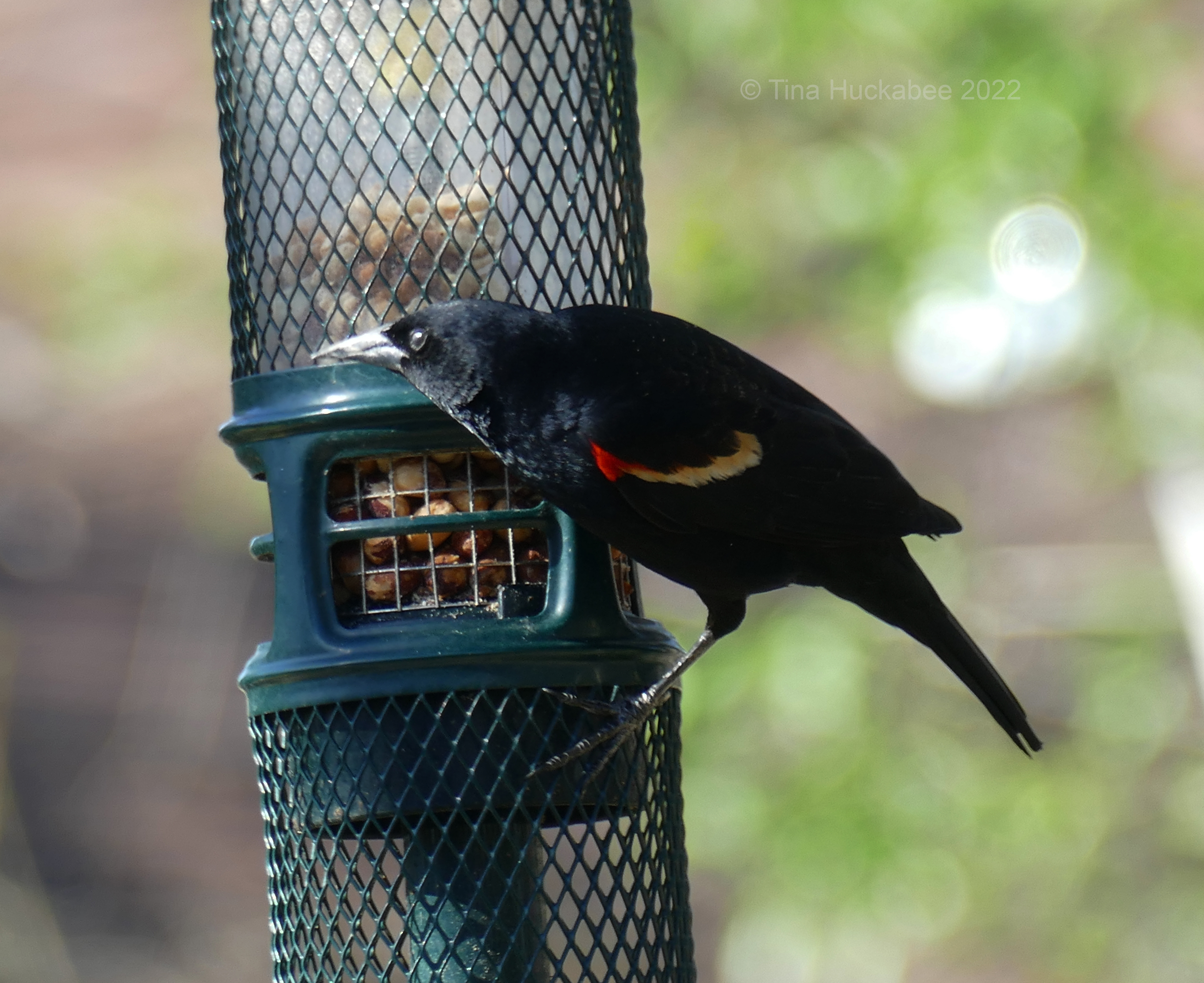
This Red-winged Blackbird, Agelaius phoeniceus,has been around the neighborhood for a few weeks. He has a lovely call and I hear him more often than I see him. Before he settled in to munch my peanut offerings, a group of female Red-wings worked the sunflower seeds that fell to the ground. They only stayed a day or two and I wish I’d snagged photos while they were here. In the past, I’ve enjoyed visits from other Red-winged Blackbirds well into June. I wonder if this guy will hang around that long?
I only see American Goldfinches, Spinus tristis, during late winter and spring. This year, it’s mostly males that I’ve observed, though few females have been in the mix. They visit sunflower seeds, but mostly they like to bathe and splash in the water features.
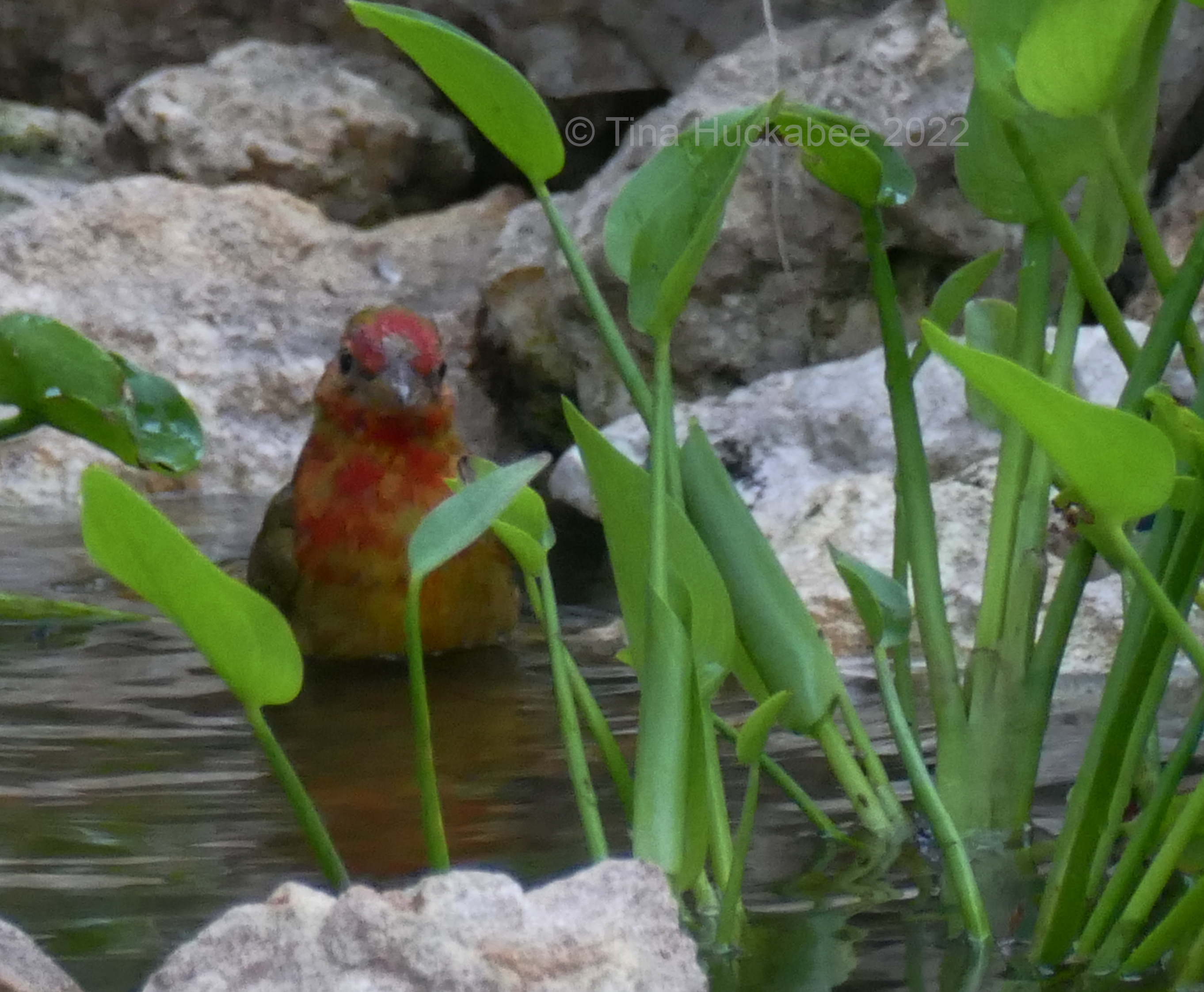
Migratory clockwork right on schedule, Summer Tanagers, Piranga rubra, show up every spring for a few days in late April. The gloriously golden females are adorable.
The scarlet males catch bird watchers’ eyes. How could you miss this head-turner of a bird?
He’s rocking his post bath fluff.
Along with a mature male and female, an immature male accompanied the adults.
Oh, those splotchy, awkward teenage months!
I’d like to think that they come for the peanuts I provide or the garden delights that I offer. But these bee and wasp eaters come to my garden for the baths and the bees–not necessarily in that order. Tanagers are great bee and wasp hunters, catching their prey as they swoop through the garden. According to the maps, Summer Tanagers breed in this area, but I’ve only ever seen these stunners in spring. They should hang around longer, there are always bees in my garden.
A common winter warbler in my garden are Yellow-rumped Warblers, Setophaga coronata. Typically, my winter yellow-rumps are females. Non-breeding males visit from time-to-time, but it’s a rare treat for me to observe a Yellow-rump in his breeding colors. Look at this guy! He knows he’s a pretty boy and that he won’t have any trouble finding a mate and raising a family of other darling yellow rumps!
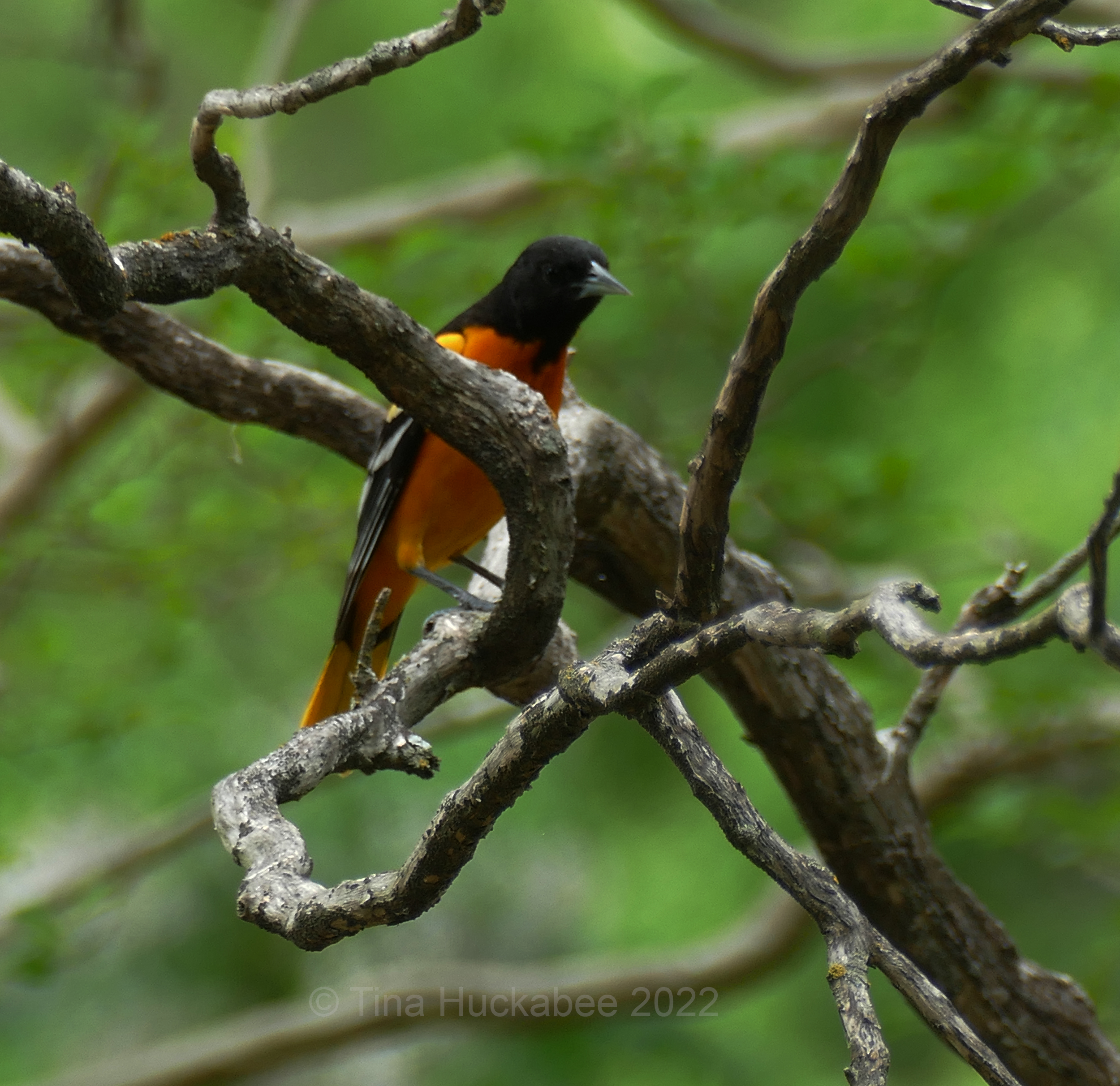
A flash of orange in the trees and I knew immediately what was flitting about. This Baltimore Oriole, Icterus galbula, was only in my garden for a few minutes (that I saw), but he was certainly a bright spot, even if was a spot hard to document with a photo. Clear shots were tricky because he was skittish and stayed mostly in a neighbor’s small tree and was always a branch between the camera and the bird.
This is probably the clearest of the photos, but, it is a bum.
I also had a brief glimpse of a female Orchard Oriole a few days later; I was too slow with the camera for that lovely bird. I don’t see the orioles every year, so I’m thrilled when they’re around.
I’ve observed several type of sparrows this spring. This male White-crowned Sparrow, Zonotrichia leucophrys, spent a Sunday afternoon in my garden and I’ve seen him, or another male, since.
Larger than some of other sparrows, that bright white-crown is a feature that allows for easy identification of this sparrows, or at the very least, the id of the male of the sparrows.
The same day I saw the White-crowned Sparrow, I observe another sparrow that I haven’t seen before. Lifer! This is a Clay-colored Sparrow, Spizella pallida. The name is rather drab and not descriptive of the bird at all; I think the sparrow is fetching. I especially like its almost-a-mohawk top!
It’s possible that I’ve seen this bird before and didn’t realize that it was something different from the ubiquitous House Sparrow. With sparrows, identification is sometimes difficult. They all wear the same family of colors–brown, beige, cream–but with seemingly infinite combos of those related colors. As well, there are lots of native sparrows in North America, so there’s plenty of room for confusion. Birders often refer to sparrows hard to id as ‘little brown jobs’. I think I like that name better than ‘Clay-colored’.
I’ve enjoyed the antics of a couple of small Song Sparrows, too, but their zoomies through the garden, chasing off other birds, made a photographic record impossible.
Another migrant who spent lots of time chasing birds around “his” pond was this Nashville Warbler, Leiothlypis ruficapilla. I finally caught a couple of shots of the cheeky cutey.
He dipped his head just so, showing his rusty smudge topping, demonstrating his masculinity. Considering how possessive he was about my garden and pond, I’d already figured out that he was male.
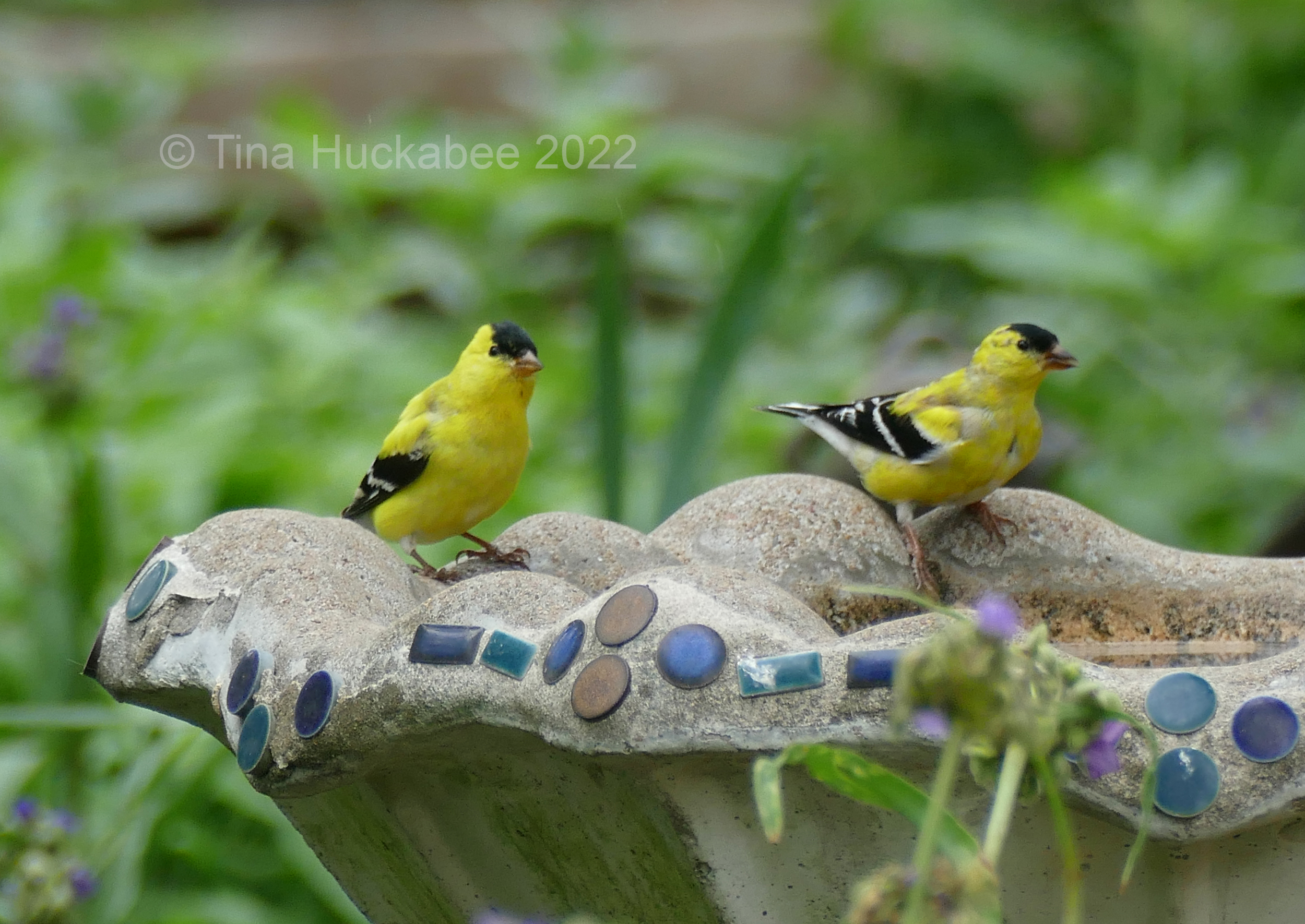
Lesser Goldfinches, Spinus psaltria, come and go in my garden, depending on what seeds are available to nosh. They are considered migratory and these two dabs of sunshine opted for the birdbath, rather than the pond. I’ve witnessed others feeding on the seeds of Four-nerve Daisies.
A new bird for me is this Kentucky Warbler, Geothlypis formosa, who made a quick visit near sundown one evening.
It took me a while to identify him. To identify birds, I typically use the Merlin app of the Cornell Lab of Ornithology, but I couldn’t find an exact match for this gorgeous fella. Eventually, the Hub and I grabbed our old copy of Peterson’s Guide to the Birds of Texas–an actual book–and after some perusal, we found our guy. Central Texas is barely in Kentucky Warblers’ migration path and I feel fortunate to have observed this beauty.
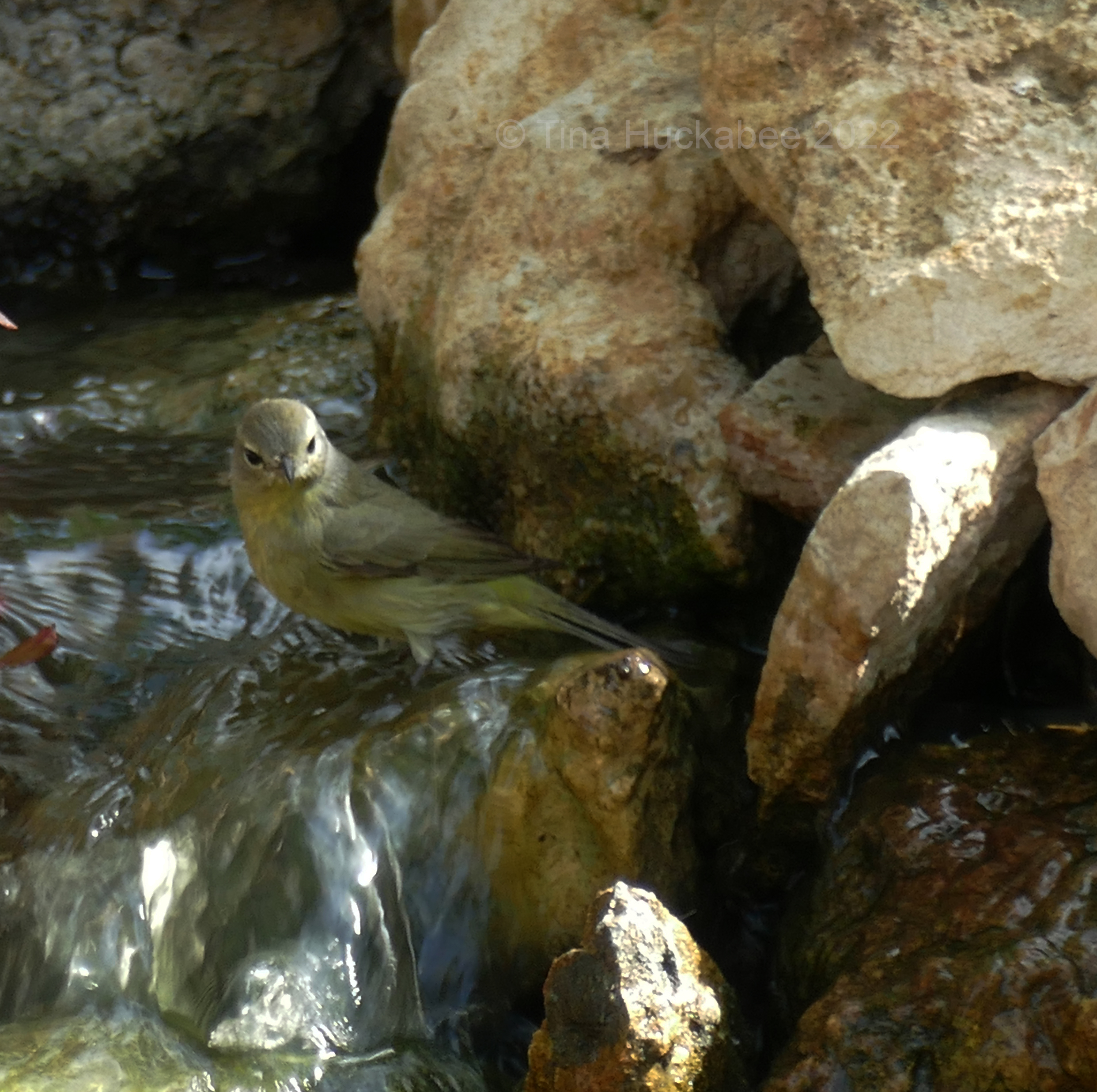
Like the Yellow-rumped Warblers, Orange-crowned Warblers spend the winter months here. But after my winter warblers leave, there are always a few Orange-crowns who come through to rest and bathe. I miss them when they’re gone.
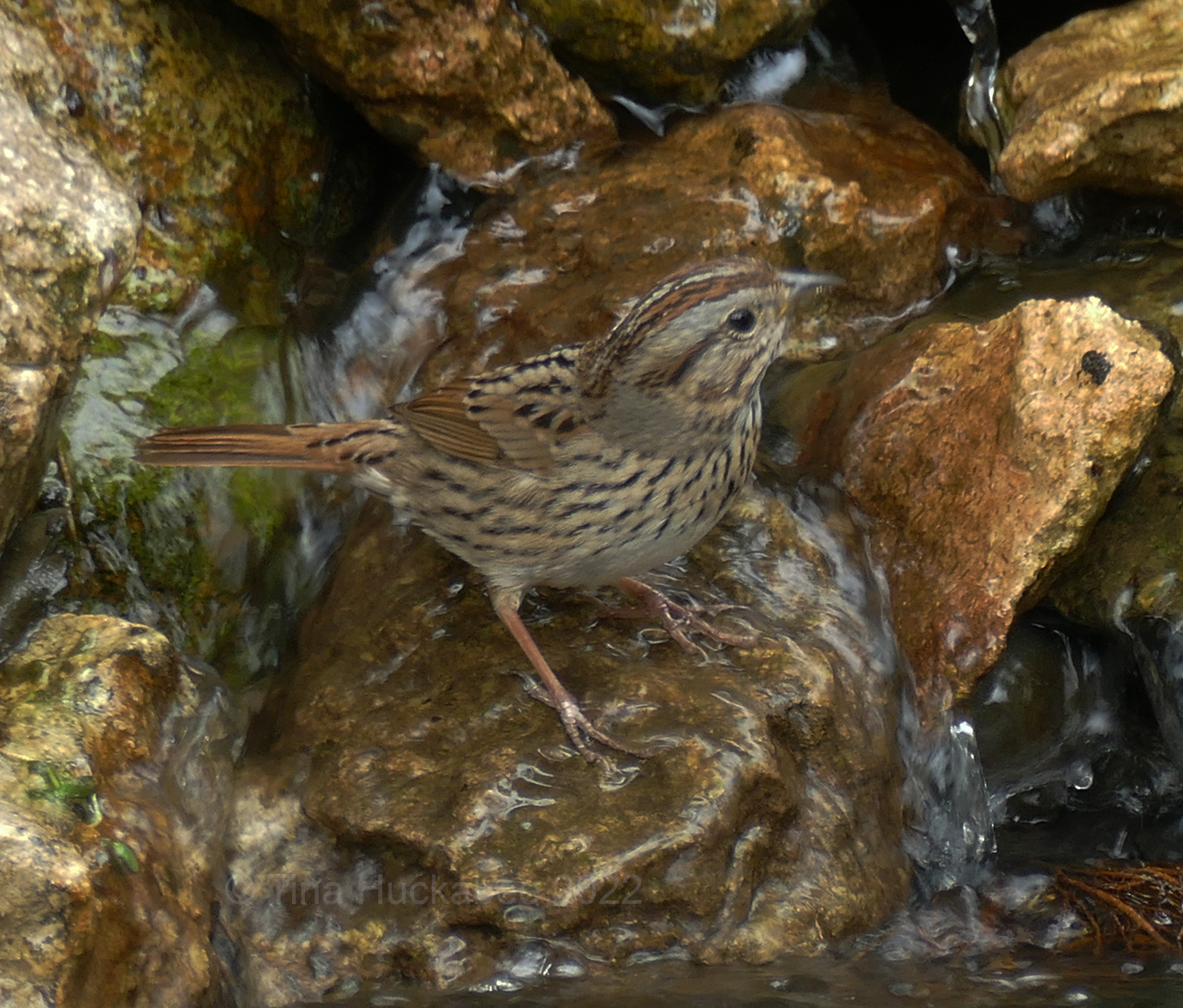
My favorite sparrow is the Lincoln’s Sparrow, Melospiza lincolnii. They’re shy, but fun to watch as they bop through the garden, looking for insects to eat. The ones who visit are big fans of the waterfall and bog sections of my pond.
Elegantly colored and marked, I think they’re such pretty little birds. Central Texas is in their non-breeding area, but I only see them in spring and fall. I’ve never had the pleasure of hosting them for winter, but here’s hoping for the future.
Migratory season is still in full swing and it’s likely I’ll see travelers coming through to rest and eat well into June. I hope you’re able to witness something of the remarkable process of the world’s birds as they make one of their two annual treks on ancient aerial pathways. Install some native plants and trees to provide cover and food, and add one–or more–water features to your garden space. Then, look out the window, they will be there, enriching your garden experience.
I spied a Fiery Skipper, Hylephila phyleus, resting and maybe (?) waiting for a receptive female to flit by for a bit spring fling. This handsome fella perched on a leaf of Zexmenia, Wedelia acapulcensis var. hispida which co-mingles with a competing stand of ferny Yarrow, Achillea millefolium.
He displayed his fiery, autumnal wings, turning on the leaf, which allowed a nice view of the beautiful colors and pattern. The host plants for this skipper are grasses like Saint Augustine and Bermuda and though I don’t have either in my garden, both grasses grow in abundance near my garden. As adults, these skippers nectar from many kinds of flowers; he and his kind have plenty of choices for their meals.
I don’t know if he found his skipper love, but I sure loved watching him.











 My Gardener Says...