It’s hard to say farewell to a species of plant whose end has come, especially one that produced such an abundance of flowers. Alas, my American Basket flowers, Centaurea americana, are done for the year. This is a sad sight:
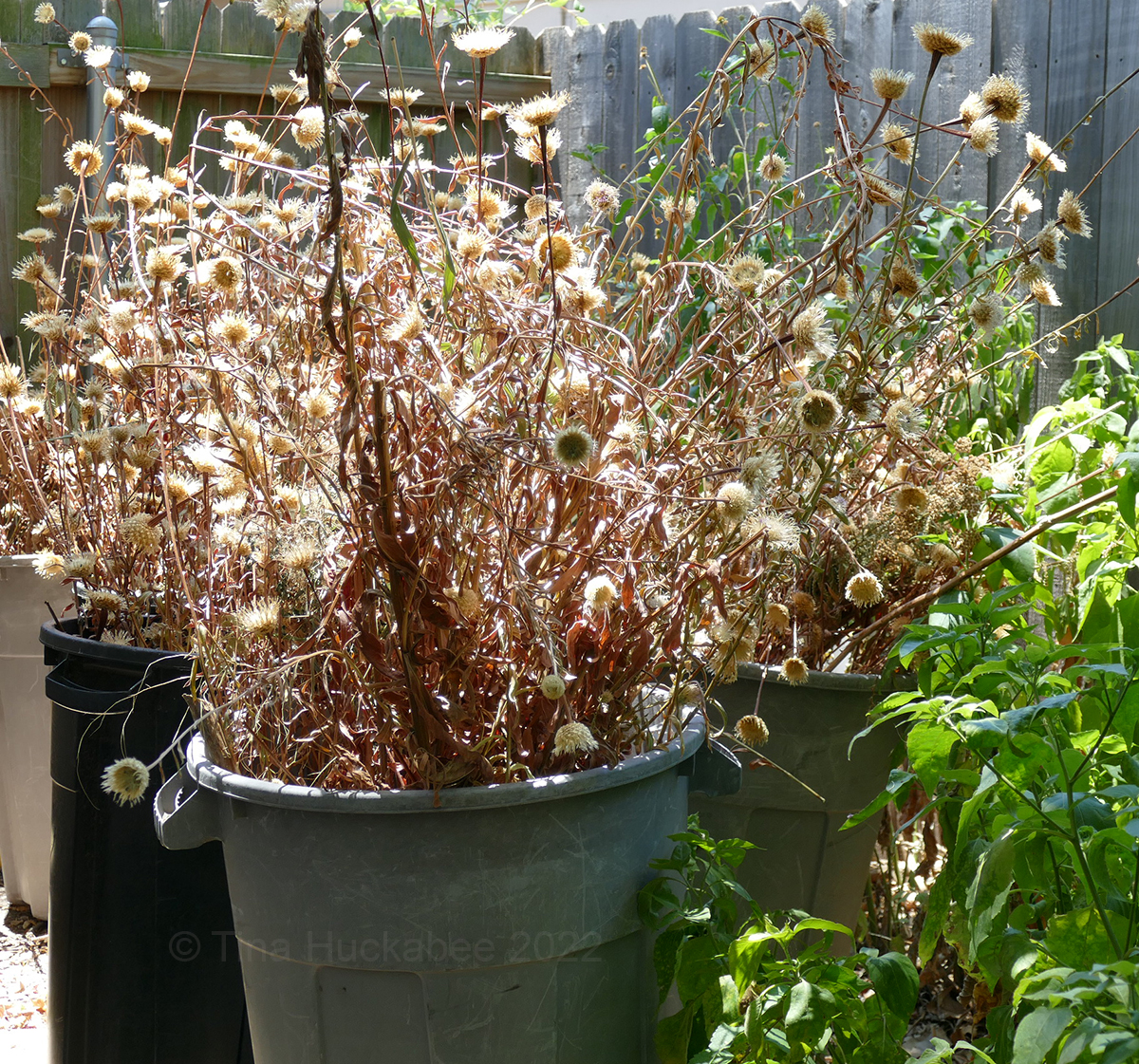
The stalks of these spent lanky lovelies, tidily tucked in to bins, are on the way to the city of Austin’s composting facility.
I grow these annual native wildflowers, with thanks to Linda of Lagniappe and The Task at Hand, who several years ago graciously mailed to me seeds she’d collected. It’s taken a couple of years, but these regal annuals are now an integral part of my garden family, offering stature and elegance to my summer garden. This year, the basket flower stalks grew especially tall, some reaching to 9 and 10 feet. Most stalks were so tall that I couldn’t enjoy observing many of the blooms that opened atop the stalks. Pollinators filled the air above the garden, zooming from bloom to bloom for pollen and nectar. The lofty flowers certainly earned their keep, even if I was out of the loop. That said, the stalks are multi-branched, so while many flowers were too high for me to observe, there were plenty at human eye level–and their presence was welcome by those wishing only to admire.

The common name, Basket flower, comes from the bracts below the flower head which is reminiscent of a woven basket.

As the flower develops, fringed bracts push upwards

…and outwards.

Once the flower fully opens, it’s about 4-5 inches across, a sweet purply-pink, and a pollinator magnet.

A wide variety of pollinators worked these flowers from May through early July. Pollinators like native bees, honeybees, small skippers, larger butterflies, hummingbirds, and flies were at the Basket flowers from sunrise to sunset. A couple of examples of these:


All things die of course, and once the Basket flowers ended their bloom time, seeds developed and the stalks turned from rich green to toasty brown.

During seed development, the pretty pinky blooms morphed to a warm beige; I think the spent flowers are quite attractive. Several of these beauties now reside in a dried flower arrangement in my house.

During winter and early spring, the Basket flower seedlings emerged and grew in the garden, I transplanted some and removed many. As they matured, the stalks grew taller than nearly every other plant in this garden. There was one group of about a dozen that I called ‘the grove’ that I left where they seeded out. I’m not sure why I didn’t take a specific photo of the grove in its prime, but this photo from my last post shows the grove in May at the top right of the garden.
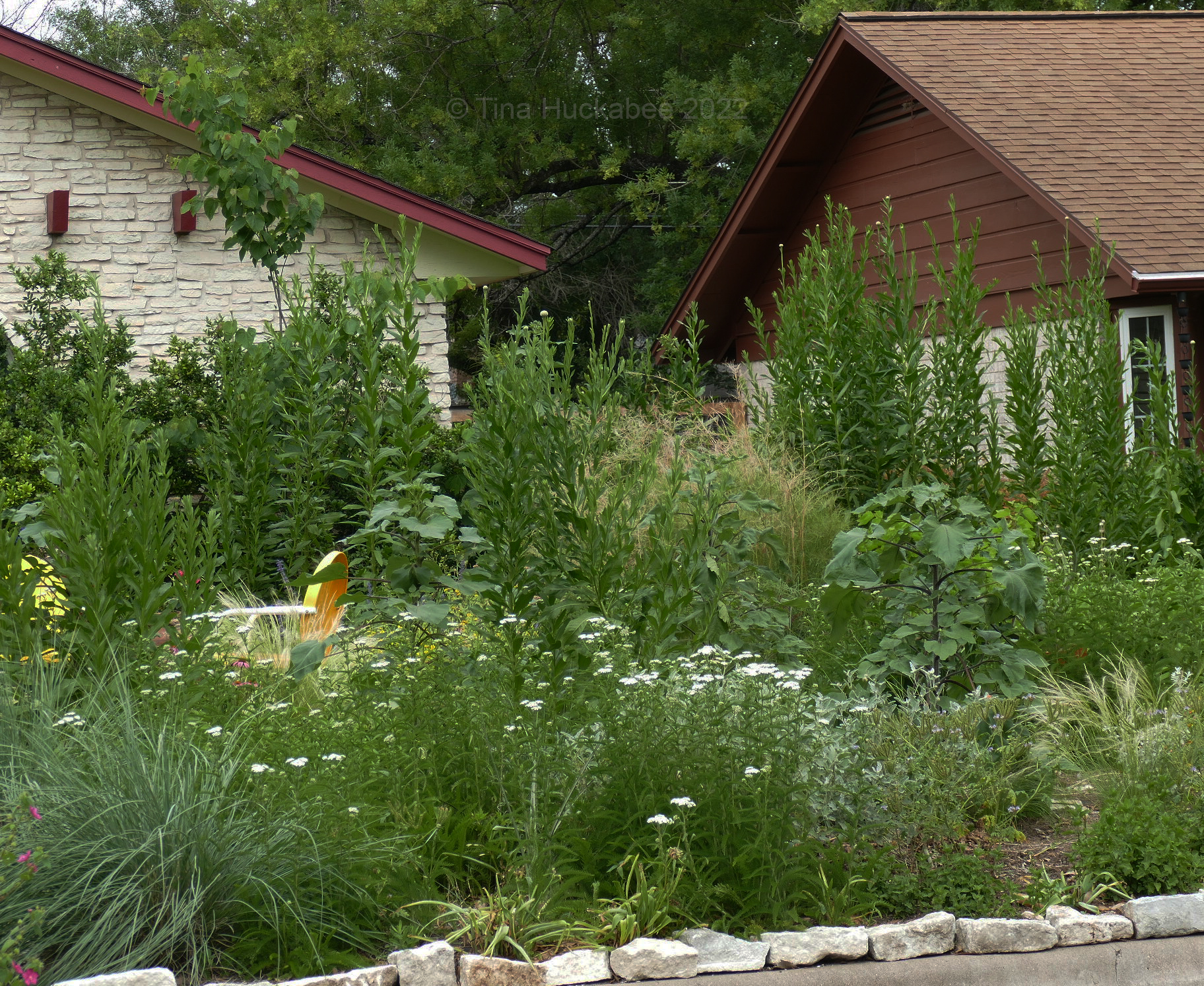
As the flowers of the grove ended their bloom cycle and began to spread their seeds, this is how the group looked.

Small, oval seeds are buried in the fuzzy center of the flower, released with a strong breeze or by working their way out of the center and falling to the ground. There were plenty of House Finches, Lesser Goldfinches, House Sparrows, and Carolina Wrens who enjoyed these seeds. The birds were skittish and I wasn’t particularly patient at getting photos, so I never managed a decent shot of any Basket seed-munching birds, but they will spread the Basket goodness. Besides in my own garden, I expect these seeds will produce plants throughout and beyond the neighborhood.
I’ve collected a few small bags of seeds that I’m donating to our local library for their seed bank.

I suspect if this summer wasn’t so hellishly hot and dry that the pollinators and I would still be enjoying the Basket flowers. Last year, many of my Basket flowers lasted well into fall and were done only after our first freeze of the year. Even though their bloom and seed cycle was shortened this season compared to last, I appreciate what these natives bring to my garden–and look forward to meeting them again next year.









 My Gardener Says...