As I wrapped up some necessary gardening chores early this morning, I saw a newly emerged Pipevine Swallowtail, Battus philenor, resting near its former home, the shell of its chrysalis.
I should have dropped the pruning shears, wiped the brow, and grabbed my camera, but I didn’t. By the time I remembered that there was a photo worth getting, the butterfly was off to its adult business: its wings dry, its proboscis unfurled for nectaring, and the search of a mate a keen objective.
Every day, I pass by this seedling where the caterpillar made its home for a few weeks; I never noticed it. The chrysalises are such small, unobtrusive things, it’s easy to miss them in the lush of the garden. I’m not a scorched earth pruner, but when it’s hot and humid and I’ve had just about enough for one morning, it’s sometimes easy to forget the garden’s purpose. I guess the chrysalis isn’t the only thing hanging by a thread.
I’ve seen a Pipevine flitting in the garden today; I’m glad it was up and out in the early morning, shedding its temporary home for the wider world.
We’ve hosted nesting Eastern Screech Owls, Megascops asio, in the back garden for about 14 years. For most of those years, the parents raised the chicks successfully and I’d observe them even after they fledged. In other years, and for a variety of reasons, the owls’ breeding season failed. For about 8 or 9 of the Screech Owl years we’ve also employed a working camera in the nestbox. Or rather, the camera would be working at the beginning of the process (mama spending time in the box) but would then go dark for some undiagnosed issue which proved fatal to a viewing a clear video, or, like last year, when a prolonged deep freeze snapped the cable.
This owl breeding season finally delivered a thriving owl family (the most important thing!) and a camera that caught it all–from eggs to owls.
Mama owl, named ‘Uptown Girl’ (by yours truly), sits on the the first egg, which she laid on March 15th.
The second egg appeared 3 days later on March 18th, the third entered the world on March 20th. I observed and kept track of the eggs, then chicks, with photos from the owl cam, the best viewing always at sundown, as mama took a break from the nestbox for a few minutes each evening.
All three chicks hatched about a month later; the two oldest hatched on the same day, the third arrived the following day.
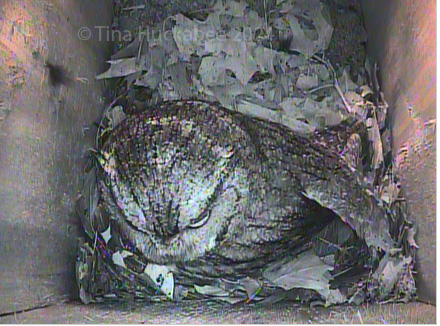
This photo was taken on April 16. Uptown Girl is at the nestbox window, no doubt ready for a break from the fuzzballs. Her tail feathers are visible at the top of the photo.
If you’re squeamish about the owls’ diet, you might scroll past this next photo, though it does require imagination to recognize what their meal was. This photo is from April 24th.
The older they are, the cuter they are! As they grew, they continued to excel in the fluff department and were so fun to watch. They’d nip and nuzzled one another, preen, and look around their limited real estate. This photo is from May 2nd.
Bright eyed and bushy tailed on May 4th! (Well, two of them, anyhow.)
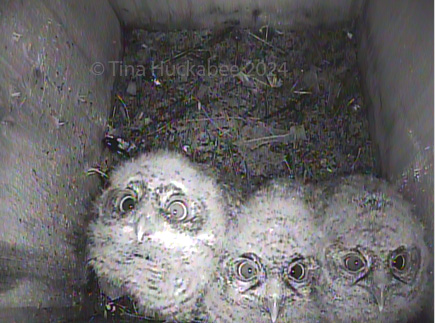
Finally! On May 5th all three are looking up with an owly cheese! for the camera. You’ll notice that they’re each slightly larger than in the previous photo.
On May 6th, they’re facing south, toward the nestbox hole that will soon be the portal to their lives as fledgling owlets.
Once the owlets filled the nestbox space with their size and regular wing flaps, mama spent little time in the box; watching the owlets was so much easier with mama out of the way! The owlets were active in the early mornings, sleeping during the afternoons, and then hungry, noisy, and wanting to feed in the evenings. The parents obliged by bringing food after sundown, each parent taking turns with an owl version of of door dash: pop in feed a baby, take off again. Next parent: pop in, feed a baby, take off again. And so on. Sometimes the door dash was a quick morsel of gecko or insect, sometimes there was a whole carcass of bird or rat delivered.
I never watched the nest box during the overnight hours. I imagine the parents delivered meals all night, given how fast these chicks grew. I could see that each day, especially in the last week or so, the owlets were bigger than the day before. They’d stretch themselves tall, their fuzzy heads almost reaching the camera, and wings were in regular flap mode, as they built strength and agility toward their flight training.
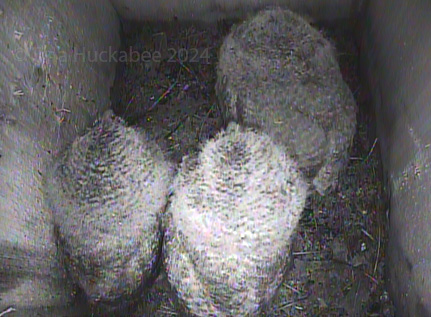
Notice how large they are on May 7th.
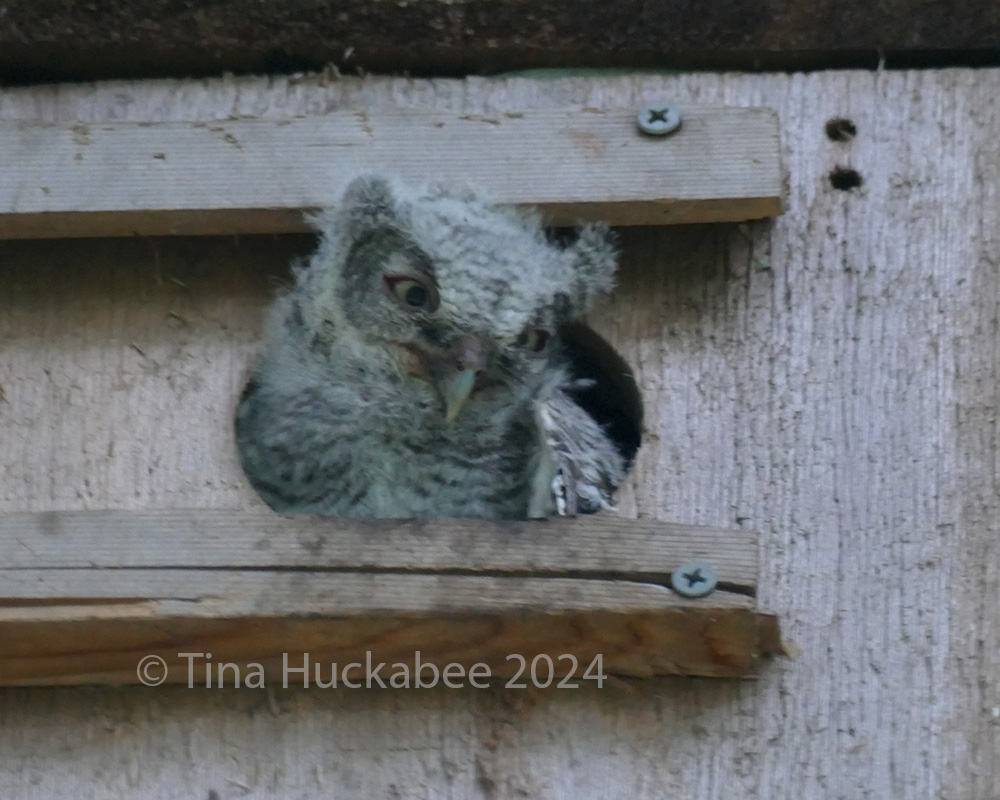
I had several opportunities to capture good photos as the owlets begin peeking out of nestbox hole to the outside world. This poor photo of a darling owlet is the only one I managed, mostly due to my own laziness. I should have been more vigilant; the time the owlets spend at the window just prior to their exiting the nestbox for good, is fleeting.
The two, presumably oldest, owlets fledged on the evening of May 10th; the third one was out of the box the following night. I heard two separate owlet begging calls that night in my neighbor’s tree, but also saw one of the parents in my tree, which indicated to me that while the third owlet was out of the box, it was still in our tree. By the next evening there was no sign of any owls. Typically, I’ve observed the owl families for a few weeks after they leave the nestbox, but this family is gone from the immediate vicinity–at least in the early part of the evening which is when I’m looking.
The parents will encourage their offspring to widen their territory and the next couple of months will be all about survival. By late summer, the young owls will be on their own. About 75% of Eastern Screech Owls don’t survive their first year, so these owlets have a treacherous few months ahead of them and it’s unlikely that all three will make to breeding age. I’ll never know which, if any, have survived, but I feel privileged and grateful for what I observed with this family and impressed with the dedication of their remarkable parents.
All the best to you, little owls–come say ‘hi’ sometime, okay?
Like peanut butter-n-jelly or mac-n-cheese, butterflies-n-wildflowers form a classic pair. My personal aphorism defining wildlife gardening is, if you plant them(wildflowers), they (pollinators) will come. This proves especially resonant in a spring season with ample rain followed by generous sunshine.
Blue Curls or Caterpillars, Phacelia congesta, bloom beautifully from March through May, attracting a huge variety of pollinators to the blue/purple flowers, which unfurl along a cluster as the diminutive flowers open. Pollinators, especially butterflies, are ga-ga for Blue Curls’ bounty. Sunny days bring fluttery life to the space above and around blooming Blue Curls, all manner of winged things in constant movement. Other pollinators, like beetles and true bugs, reach the pretty little flowers through multi-legged walk-a-bouts.
Here, two Grey Hairstreaks nectar on the flowers while another waits in the background. Maybe that one is full of rich nectar, and sits, resting and digesting.
This hairstreak feeds, but is it alone?
Looking directly down from the small butterfly, another pollinator (a walking stick type insect or a nymph of some sort?) seemingly sips from a flower. I didn’t see this insect when I snapped the shot, only noticing once I downloaded the photo to my laptop. I scrolled through pages of iNaturalist Austin, but there are a gazillion insects listed and I don’t have the time to suss out this guy’s identity. Any suggestions as to what this well-camouflaged critter might be?
Monarchs migrated through Austin, though few visited my gardens. A Blue Curls cluster beckons, a Monarch cousin–the Queen butterfly–alights, nectars and pollinates.
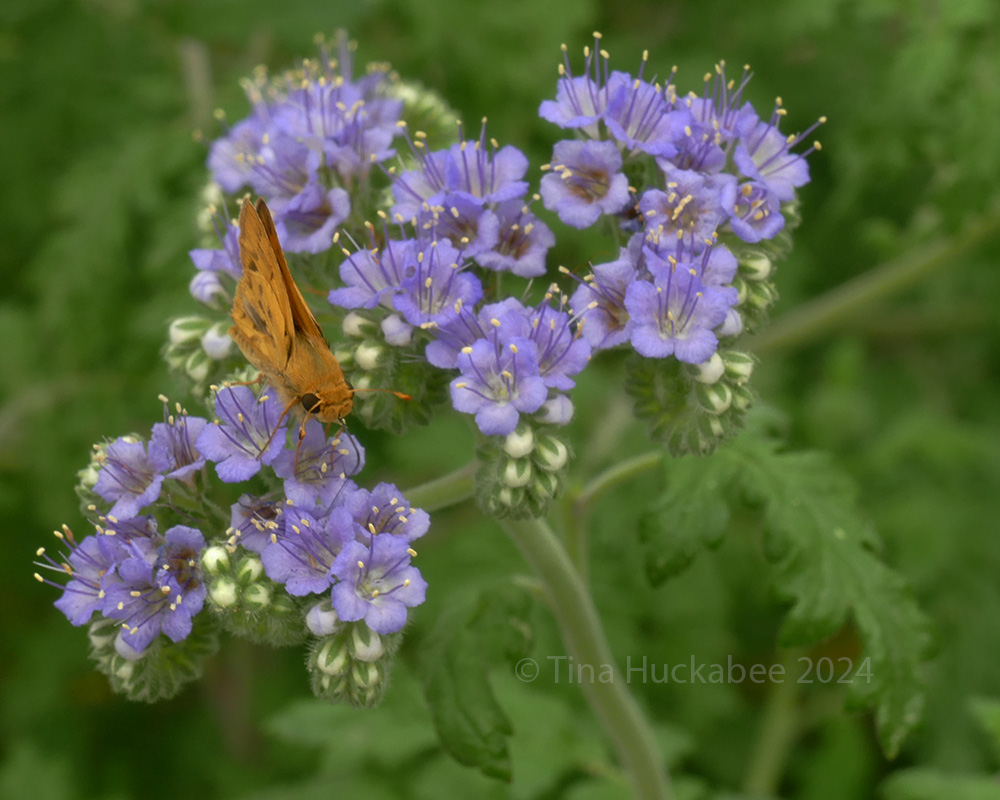
Smaller butterflies like hairstreaks, skippers, metalmarks, and sulphurs frequent Blue Curls, often alongside other pollinators, all sharing dining on a given cluster of flowers. In particular, Fiery Skippers, like Grey Hairstreaks, are abundant.
I think this Fiery Skipper’s coloring complements its Blue Curls meal.
Native bees, especially the tiny Lasioglossum, or sweat bees, also favor Blue Curls. Flies of various sorts cavort amongst the Curls.
This Horace’s Duskywing, a rare find in my garden, provides a dramatic contrast with its Blue Curl plant of choice.
Blue Curls are annuals, living their full life cycle in one year: seeds; germinated seedlings; mature plants with flowers; seeds, once again, after flowers are finished. My Curls are past their peak of blooming, beginning their seed production. I’ll leave the individual plants until the seed heads are brown, then I’ll prune the stalks to the ground and shake all available seeds into the garden for next year’s crop. The Blue Curl seeds (as well as other perennial and annual seeds) are currently providing meals for migratory birds. I’ve observed Lincoln Sparrows, Common Yellowthroats, Clay-colored Sparrows, Yellow Warblers, and Painted Buntings eating from these plants in the last few weeks. Seeds and insects on plants make up most of migratory birds’ meals.
Once the Blue Curls of 2024 are history (aside from their dormant seeds snoozing on the soil), the heat-loving summer perennials and annuals will step up to provide cover and sustenance for bees, birds, butterflies, and other garden critters.
The cycle continues, unbroken, in a native plants, wildlife-friendly garden.








 My Gardener Says...