Given any opportunity, nature will exploit holes in the system. Plants will always find ways to present themselves, whether or not the gardener was consulted.
This Heartleaf skullcap, Scuttelariaovata, is emerging from its warm season dormancy and in ground-cover fashion around the base of the ceramic tree guy. Additionally, a sprig of the skullcap greenery has grown up and out of the craggy pottery bark and now accompanies the grey ceramic bird who has been tree guy’s main buddy.
In another part of the garden, a strand of Purple heart, Setcrasea pallida, snaked its way up a whimsical ceramic sprout (for lack of a better term). A bouquet of pink and purple tops the sprout, adding a floral flourish which is lacking in its less adorned partners.
May your garden thrive and your breakthroughs be the fun and charming kind. Wishing all a happy and healthy 2022.
The birds in my garden are quiet now, as is typical for late autumn. The usual suspects show up early in the morning for their treats: Blue Jays are all-in for the unshelled peanuts; Black-crested Titmice, Carolina Chickadees, and Carolina Wrens favor sunflower seeds and shelled peanuts. The White-winged Doves flap around the pond and bobble in the garden, but at the moment, aren’t interested in what feeders offer. When spring approaches, that will change; doves are piggy birds. House Finches and House Sparrows are mostly about keeping clean in the birdbaths and at the waterfall feature of the pond.
Winter songbirds haven’t settled in yet as seasonal residents. These are the birds who migrate south from somewhere north and visit through winter and early spring, until the instinct to nest is paramount and they fly northward again–to mate and raise chicks, a timeless and universal cycle. These wintering birds are only here for a few months. I always look forward to their arrival and grieve when they leave.
I’ve had a couple of quick glimpses of a tiny, energetic Ruby-crowned Kinglet, Corthylio calendula, but it hasn’t stopped long enough for me to get a good photo. So far, no Yellow-rumped Warblers, Setophaga coronata, also known as Butter Butts, have appeared. It should be any day now that one–or several–come to my garden. The winter warblers see the garden as a safe haven for cover, water, and food.
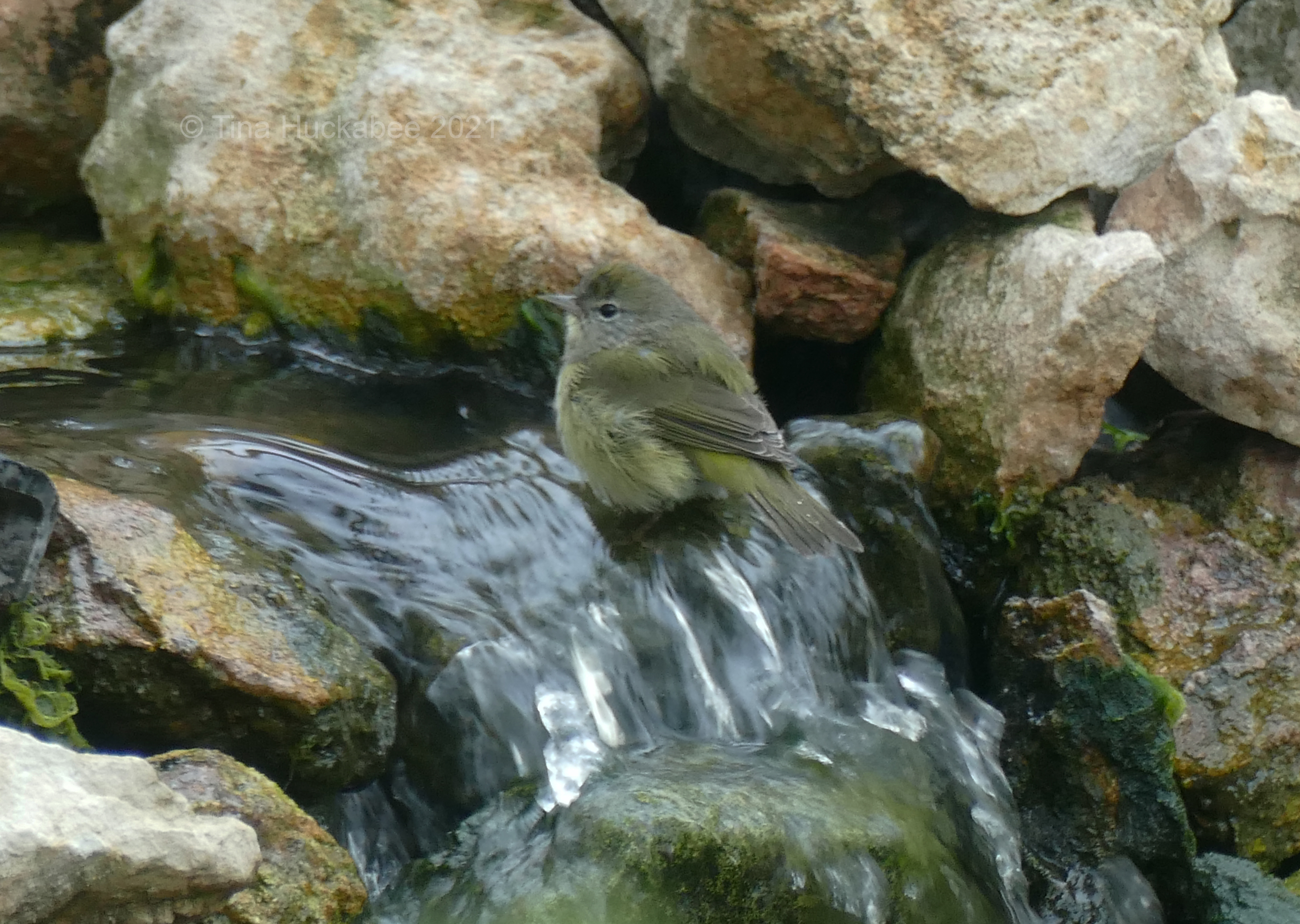
I have enjoyed a few visits from an Orange-crowned Warbler, Leiothlypis celata. It hops along the branches of the Shumard Oaks, often hidden behind foliage, but probably snacking on insects. The small warbler is too high and covered up for me to see it clearly. When it wants a refreshing bath, it’s out in the open, wary of all, careful and alert. Garden paparazzi takes advantage of the warbler’s bath time.
I think this one is a she-bird, though it could be a juvenile he-bird. There’s no sign of the orange crown that would indicate a male; the orange top is noticeable during bathing, as well as during the impressing-the-gals-time.
I haven’t seen the Orange-crown at any feeder, though they typically favor suet, which I haven’t bought yet. It’s on my to-do list.
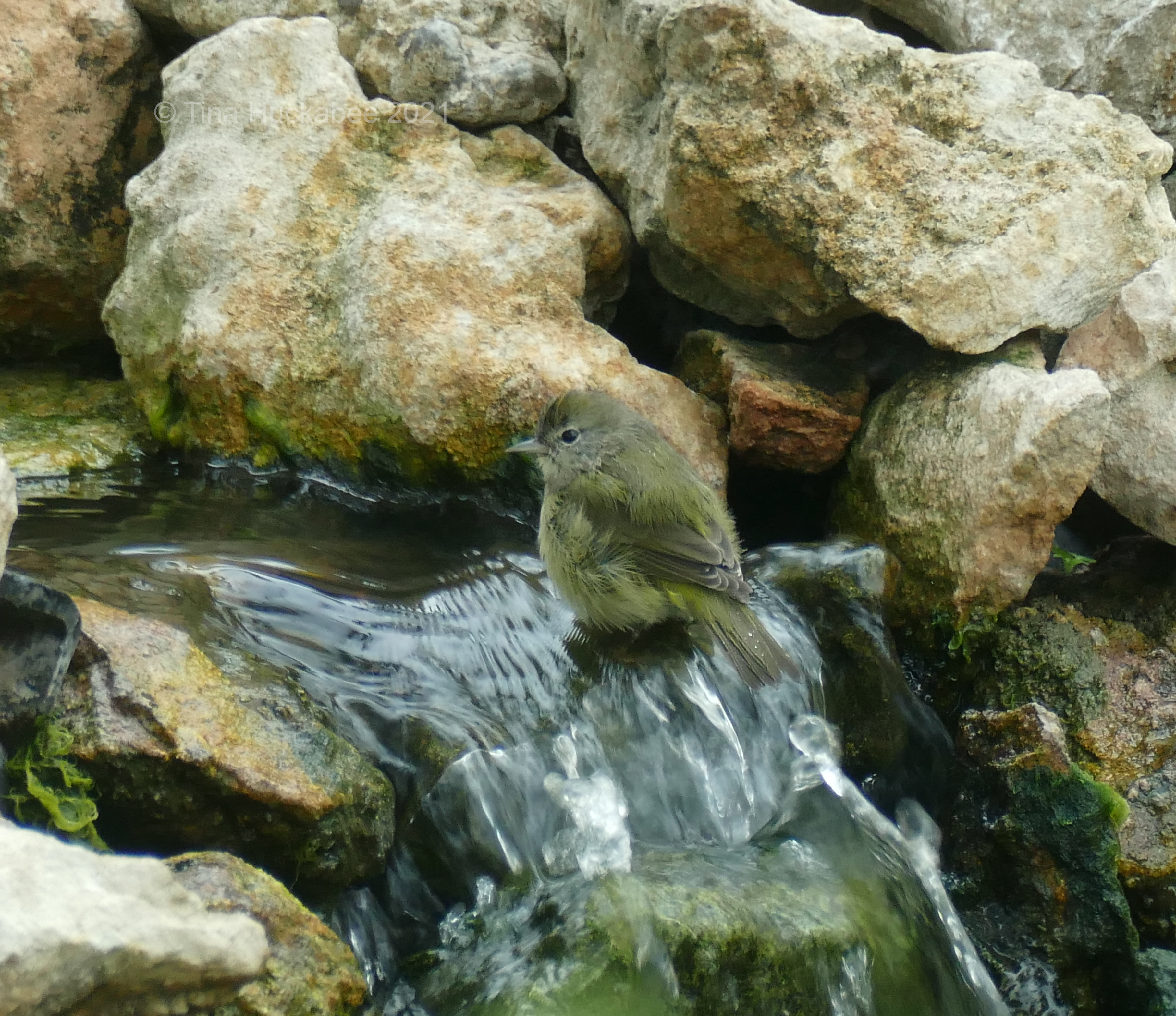
As it finished up its bath and fluff, the little beak is open; I wonder if it chirped its approval (I couldn’t hear from where I sat), appreciating the splash of the water.
This winter warbler was wet. Other winter warblers are on their way.
In past posts I’ve mentioned that the mature Arizona Ash tree in my front garden was permanently damaged by last February’s severe winter storm. After a June consultation with arborist Nevic Donnelly of They Might Be Monkeys (probably the best name ever for a tree company), we opted to have the tree taken down. This is dawn on the Ash’s last day.
Even though we made the decision in summer, I delayed the tree’s removal until fall migratory and blooming season were done–or mostly so–before scheduling a crew to take down this tree. They arrived before 9am on the appointed day of destruction, a week before Thanksgiving. There were three on the team, all ISA Certified Arborists: Zach, Judith, and Candace. They’d actually come by the week before with two other team members, Layla and Eddie (both ISA Certified Tree Workers) and removed much of the remaining foliage which was clustered along the lower limbs and trunk, as well as a couple of the larger limbs. What was left for the final take down day was bulk of the tree: the canopy, which was nothing but dead limbs and branches, and the other main limbs, and trunk.
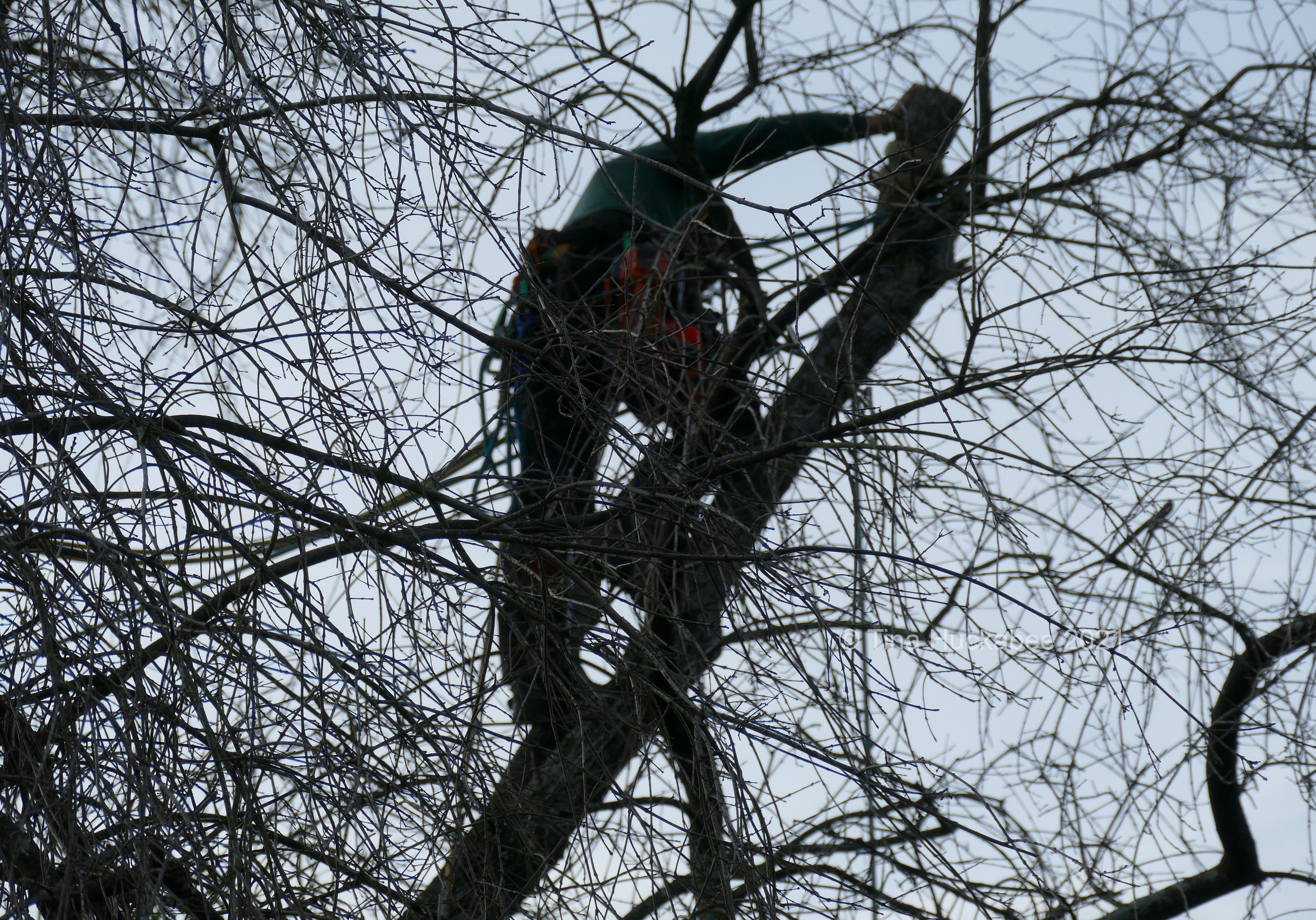
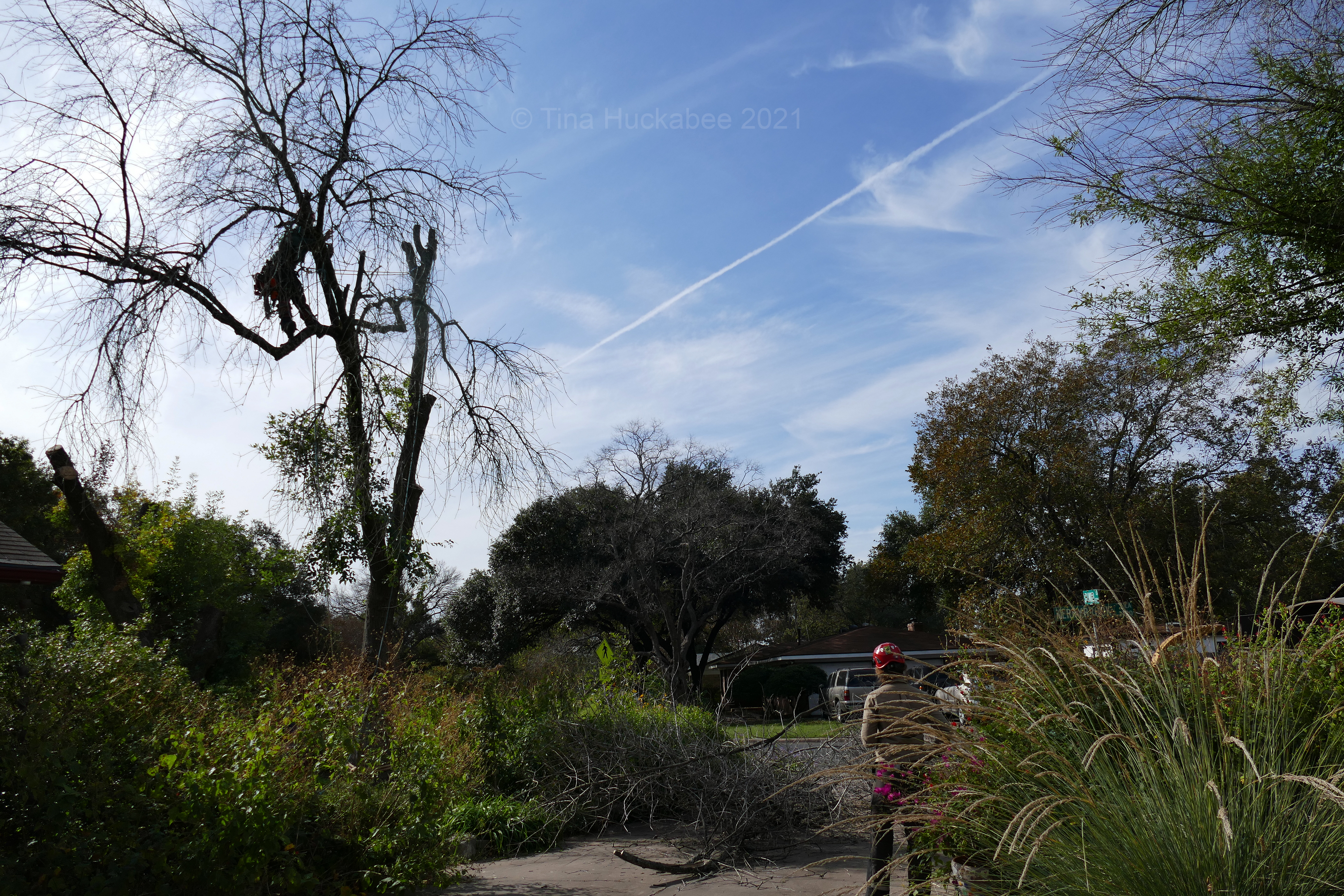
Only Zach worked up in the tree itself. I noticed that the crown of the tree, where all the dead twigs, branches, and limbs were located, took the longest time to assess and prune.
Candace and Judith manipulated ropes and, as bits and bobs of tree were sawed and pruned, guided those tree parts down safely.
As the crown of the tree was systematically removed, limb detritus ended up terra firma. The crew dragged branches and limbs, large and small, to the long driveway, which served as a staging area. All of the wood eventually ended up in their chipper.
I didn’t observe the entire process, only popping outside from time-to-time to watch and photograph, but it seemed that most of the four hour period was spent pruning the upper canopy. That work was slow. But with each of my viewings there was significantly less woody mass in the tree and more woody brambles clogging the driveway.
Just so it’s clear, I’m not right next to Zach while he works–my camera has a good zoom. Trust me, I would neither want to, nor was allowed to, get close to the work zone.
I was amazed and please at the limited damage to the surrounding garden. Considering that there were large limbs with lots of attached smaller branches and twigs lowered to the ground and then moved to the driveway through the garden, the perennials growing didn’t suffer breaks. My garden certainly didn’t make their work any easier.
Once the upper canopy branches were off, the larger structural limbs and eventually the trunk followed for removal. Zach assessed where to drop the limb/trunk piece and made cuts accordingly.
I think with most of these thicker cuts, he sawed directly, though not completely, through from one side, then swiveled to the opposite side and delivered a wedged cut to meet the straight cut. That allowed the section to be perched on a angle and lowered, ropes attached, carefully to the ground.
Zach used his ropes to move around the tree as each section was pruned, working different sides to get the right cuts. He would make the cut, attach the saw to a carabiner on his belt and assess the work. He’d then remove the saw from his carabiner and make his next cut. And repeat. And repeat. The work was precise, the process patient and deliberative.
Once closer to the ground, the mid-level main limbs and eventually, the trunk, were sawed through, then shoved off with a flourish. Judith and Candace handled the wood pieces as they were lowered and in preparation for the chipper.
All those big chunks fell to the sitting area (where no one was sitting!), landing with a robust thunk.
As I noted, the branches ended up on the driveway. I took a closer look at some and could easily identify the damage from the freeze. The outer bark split during the freeze, destroying the protective layer of the tree. The tree is an older tree, so no doubt there was other damage from other storms, too.
The poor tree had no functional life support in these canopy branches after the week-long deep freeze.
The grinding of the limbs and trunk was dusty, but didn’t take too long.
I dragged off a few branches to pop into my gardens. I leave dead limbs and branches for insect nurseries and natural wood is a nice way to segment a garden. In one part of my garden, I’ve developed a stumpery of sorts.
And the tree is no more.
I’m still adjusting to the open area and full sky. The front garden is brighter and certainly in the summer, will be much hotter. The garden feels exposed and bare.
This tree was never a great tree; it was a poor choice because Arizona Ash is a weak-wooded, disease-prone, non-native tree. It was planted when the neighborhood was built in the early-to-mid 70s and was the developer’s choice because Arizona Ash grow quickly. As well, it was always shaded by the huge Arizona Ash next door (where my SIL now lives). After the devastating winter storm, neither tree will ever be more than shrubs. In many ways, I’m not sorry to see the ash go: I can now grow some plants that I haven’t grown before because of the light and there’s already a replacement tree, a small oak with a nice shape and beautiful fall color which was planted by a squirrel or blue jay. I found the oak a couple of years ago and it’s grown well. With no competition from the ash, that oak will take off.
That being said, the end of a tree is a sad thing. When my children were babies and toddlers, we sat under the tree to read, play, and picnic as the oaks in our back garden didn’t provide enough afternoon shade in those years. The ash was the nursery for countless squirrels, as well as some Red-bellied Woodpeckers, Blue Jays, and Mockingbirds. Titmice, Carolina Wrens and Chickadees were always working the branches for the insects they enjoy, chittering their approval of the snacks provided. In the growing season, breezes ruffled leaves, a soft serenade; in winter, the the twigs performed a gentle percussion.
I’ll miss the shade in summer.
The tree is down though and it was a good decision to remove it. I’m glad I hired a responsible, well-regarded company to do this work and I’m already re-creating this garden space. The garden is on to its next adventure–a life in full sun!








 My Gardener Says...