Texas Mountain Laurel (Dermatophyllum secundiflorum): A Seasonal Look

What’s that fragrance wafting on the spring breeze? It reminds me of, hmmm, let me think…grape soda! Where could it be coming from??

Truly one of the most beautiful of Texas native plants, this is the gorgeously blooming Texas Mountain Laurel, Dermatophyllum secundiflorum. A slow-growing, small tree, the Mountain Laurel produces luscious purple, sweet-fragranced flower clusters for a few weeks in February/March and has rich, abundant foliage for the entire year. I’ve grown two in my small urban lot: one is about 28 years old, the other a few years younger. Neither are in full sun–where the laurels are at their best–but they’ve both flowered each spring, some years more than others, and both have provided dense foliage that birds appreciate and humans admire.

A drought tolerant, tough tree, Texas Mountain Laurels are native to the Texas Hill Country, west to New Mexico, and south to parts of Northern Mexico. They’re not picky about soil, but want good drainage. I’ve never experienced any insect damage on my trees and laurels are deer resistant plants.

Early bud development
Buds near bloom time

Texas Mountain Laurels grow and bloom best in full sun, but they are also great plants for shade and part shade, they grow slowly with fewer blooms. My older tree has grown up in the shadow of a good-sized Red Oak tree, but it always dresses up in its spring flowers and most years the purple-cluster blooming is excellent.

As the Texas Mountain Laurel is one of the early spring bloomers, it’s an especially important nectar source for pollinators. My honeybees always partake of the rich blooms, but butterflies, native bees, and a variety of flies buzz around the tree constantly during its flowering.

Blue Orchard Bee, Osmia lignaria
Eastern Black Swallowtail, Papilio polyxenes
Monarch Butterfly, Danaus plexippus

The migration of North American Monarch Butterflies doesn’t always coincide with the flowering of the laurels, but often the two events are sync-up and it’s wonderful to observe the fluttering Monarchs.

Texas Mountain Laurels are known for their intense, grape soda-like fragrance. Some people love it, others find it cloying. I like the fragrance, but interestingly, I can only detect it at night or when my nose is snug-up in a bloom cluster. I have a fairly good sense of smell, but this particular fragrance eludes me, with those couple of exceptions.

Unfortunately, the Texas Mountain Laurel doesn’t have a long bloom time. That’s the flaw in a nearly perfect plant! Blooming occurs over a 3-4 week period, faded blossom parts falling to the ground, creating lovely lavender sprinkles around the tree.

After the blooms, come green legume-like pods. Texas Mountain Laurels are in in the Pea or Fabaceae family and their pods and seeds are definitely bean-like.

In years when the blooms are prolific, the seed pods follow the same pattern.

By autumn, the pod clusters hang from limbs like dangling earrings, rattling like mini maracas when shaken. They are attractive in their own right.

Eventually, the pods break open and reveal hard, scarlet beans which fall to the ground, ready to usher in the next generation of tree.

Over time, tiny seedlings grow from the fallen seeds.

These seedlings are easily transplanted, or you can leave them where they landed. Mountain Laurels are tricky to transplant when the seedling is taller than about 12 inches because these laurels have deep tap roots, and unless you get the whole root, the transplant will die. Over the years, I moved a few baby laurels around in my garden and given away even more. Because of its slow growth, the gardener will require patience to see tiny seedlings to adulthood. The good news is that this plant is readily available in most nurseries. I personally wouldn’t by anything smaller than a one-gallon container; it will take a decade or more to reach shrub or small-tree size. The wait is worth it, though!

This post is part of a series I call A Seasonal Look. Most plants change their looks over the course of a year: they bloom, set seed, maybe change foliage color, drop foliage, and become bare-limb when dormant. Or perhaps they’re evergreen, blooming on-and-off throughout the year, according to seasonal variations. Certainly Texas Mountain Laurel is no different in that it demonstrates changes. In late winter the plant begins its ramp-up to flowering, bub spikes grow with spring blooms to follow; seedpod development occurs during late spring, continuing their maturity through summer. By fall, the toasty seedpods are ready to drop, allowing the tree to rest before spring flowering beckons.

After the purple flower power show, Texas Mountain Laurels are a steady presence in the landscape: the luxuriant, rich green foliage surrounds warm, textured bark, creating a lovely shaped tree. Some gardeners prune to a single trunk, but if you do that, you’ll always have to prune, because the plant wants to grow and sprout new limbs. I’m on team multi-trunk: I love the natural shape of these trees and see no need to prune to a formal shape. Nature has done a fine job of fashioning something exceptional–why mess with it?

From late spring, going forward, the Texas Mountain Laurels look like this:

And in summer and autumn:

During the the winter months, the laurels are a green oasis in the dormant garden. Even after ice encases the foliage,

…the verdure of the leaves prevail, a harbinger of new growth and life in the garden.

Texas Mountain Laurel is a stunning, hardy and resilient large shrub or small tree, beautiful during Spring:

Summer:

Fall:

Winter:

Eastern Screech, Settling In

When we returned during the first week of January from our European travels, our Eastern Screech Owl, Megascops asio, nest box was open and ready for residents.

It was surrounded by lovely autumn foliage, though shortly after this photo was taken, the leaves went brown and dropped. This is a new box, as the older one was no longer functional. The fancy slide for the door that The Hub engineered is so we can easily close the box after the chicks fledge and the owls vacate, or, at the beginning of owl nesting season, to prevent squirrels or opossums from squatting in the box. We also installed a new camera (some wiring is visible at the bottom, left of the box). With that new camera we saw that a squirrel had filled the box with leaves, prepping the box as her nest for some babies. I feel sorry for evicting the squirrel by pulling out the leaves, but we built the box for owls, not squirrels. I had observed an owl in the box before we left in mid-December, but that doesn’t always mean that she’ll settle in for nesting.

But settle in she did, within a day or two of removing the squirrel’s leaves. Shortly thereafter, this little egg appeared:

…and two days later, another,

…then another,

…finally, a fourth.

Note the swish of Mom’s tail feathers at the top of the photo.

Wow! This couple got busy, probably in late November; I had no idea that breeding action had commenced. This is the earliest that a Screech Owl couple has ever started their breeding season in my garden. In past years, I observed their courtships during January and February, watching them meet at sundown, woo and canoodle, then fly off together to hunt for the night.

And as I write that, it sounds voyeuristic and maybe even a little creepy.

The fact is that the best time to observe these elusive nighttime birds is during their courting and the raising of their chicks. This season, I missed the first part of that fascinating process. Typically after courting Mama resides in the box in February, laying her eggs during in March; chicks fledge between late April and mid-May. Dad will hunt and provide food for the whole family, until the chicks are nearly old enough to leave the nest box, when Mama joins him in the hunts. This couples’ early nesting is new in our Screech Owl experience, but is within the time frame of owl procreation here in Texas.

If I’m out at the right moment around sundown, I’ll see Mama swoop out of the box for a quick piddle-n-poo break. I imagine she takes a few breaks during the night, but she’s on the nest nearly full time now–those eggs need to stay warm and cozy. Dad has been harder to observe this year; I’m pretty sure he’s holed up in my back neighbors’ large elm tree, but it’s likely he moves around from place to place. I’ve only spied him once, at sundown, when he flew to the nest box, then to the nearby Mountain Laurel tree. Mama dashed out to met him, both perching briefly in the laurel; I lost sight of them after that.

Eastern Screech Owls are amazing hunters, but they’re also vulnerable to larger predators like Great Horned Owls (we have a pair in our neighborhood), accidents with automobiles, and poisons laid out for rodents which impact the food chain. All I can hope is that this couple remain safe and healthy, and are able to raise their chicks to adulthood.

While I Was Gone

Vacations are great, especially when parents meet up with an adult child living in a far-flung place. We connected with that character-of-a-child in Vienna, Austria, not quite mid-way between where he lives and where we live, adding a side jaunt to Salzburg (with him), and a week-long dash of Paris before Austria. I won’t get out the white sheet to hang on the wall and bore you with my vacation slides, but I will lament my freeze-damaged garden with readers who probably suffered the same, or something similar.

While I enjoyed balmy 40s F in Vienna, Austin dipped to 15 F overnight and remained below freezing for several days over the Christmas weekend. The garden is now a palette of brown, beige, and grey, bits of green suggesting that life exists.

This Purple Heart, Tradescantia pallida, reflects my feeling about the garden when I arrived home and got my first look!

Native plants and those from Mexico or Western U.S will be fine. In fact, all of the annual Texas wildflowers are green and gearing up for a nice show,

Blue Curls or Caterpillars, Phacelia congesta. I have scads of these throughout my front garden.

Evergreen native perennials, even if freezer-burned, are returning from their roots or flushing out new foliage. I’m also seeing a few blooms pop up. Yay!

Native to Arizona, Globe Mallow, Sphaeralcea ambigua, is typically a cool season bloomer.

Some evergreen plants are truly evergreen. This young Softleaf Yucca, Yucca recurvifolia (left) and mature native Basketgrass, Nolina texana (right) are green year-round no matter how hot or cold,

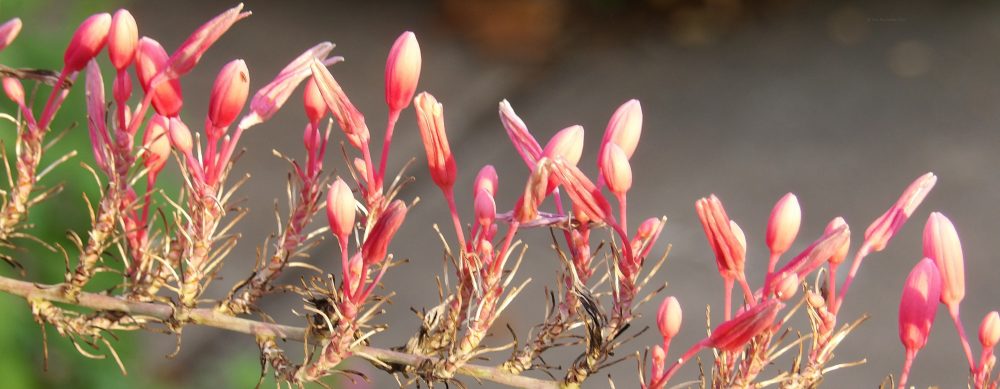
…as is this Red Yucca, Hesperaloe parviflora. Huzzah for the green stalwarts!

The plant that suffers most are the clumps of Flax lily, Dianella tasmanica, in my back garden. This summer drought-tough non-native is the only plant that I always cover before a hard freeze. My peach of a sister-in-law prepared my garden and pipes for the freeze, but some plants just had to weather the cold, come what may.

Sad as this and the other flax lilies look, I’m already seeing some of their striped foliage emerging from the frozen apocalypse. Going forward, I guess I don’t actually need to cover these, which is great news!

The garden is in a dull state, but there are birds (chirping), squirrels (chasing) and even a few butterflies (flitting). The honeybees forage on warmer days.

Bright spots in my garden are silvery grasses. They’re not green and lush of the growing season, but they’re still full and graceful, moving in the breeze, rustling with the wind.

Since those cold, cold few days, Austin’s weather has been mild and dry. I returned from my trip during the first week of January and have worn shorts and t-shirts often. I’ve also begun the pruning process which will require time and patience to help the garden prepare for the upcoming growing season.

I have my work cut out for me in the next 6-8 weeks. Virtually everything will need pruning to the ground. What fun! Would that I could be a resident of old Versailles, France gazing out at the gardens, concerned only with court intrigue and how much powder to put on my wig!