Hummingbird wars–that’s what I call the zooming, zipping, and general territory defending that the teensy winged wonders engage in, especially toward the end of their time here in Central Texas. Hummingbirds are now preparing for their fall migration (some have already left), and their wintering in Mexico and Central America. This summer, I’ve observed both a male and female Black-chinned Hummingbird, Archilochus alexandri, in my garden, though I was never able to get clear captures of either. Here,
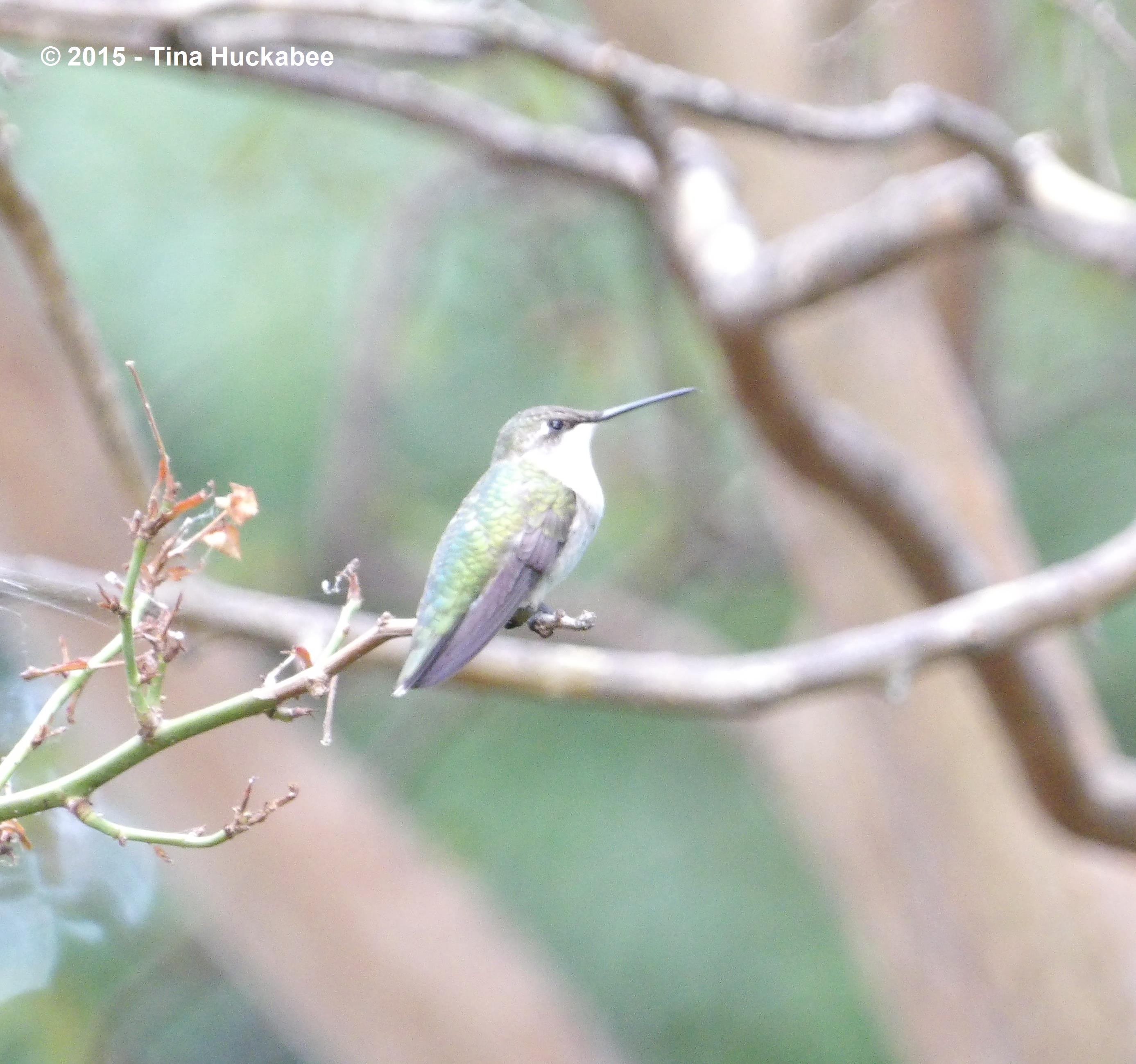

…a female Ruby-throated Hummingbird, Archilochus colubris, rests while surveying her territory, also known as my back garden. The literature about the Ruby-throated suggests that the male is the main aggressor, defending his territory and food sources with great vim and vigor, but I’ve noticed that both genders appear enthusiastically antagonistic to encroachments by critters, especially when those critters are other hummingbirds. Though it isn’t always other hummers that are chased; in July I witnessed a female chase a Carolina Chickadee around the garden–that was a hoot!
I employ in a bit of eye-rolling when I hear people exclaim how “mean” hummingbirds are, as if human beings can pass judgement on any other creature in the nastiness quotient. I usually respond to the hummingbirds-are-mean comments with a you’d be mean too, if you were tiny and vulnerable, traveled alone for hundreds to thousands of miles, back and forth, attempting to locate enough food to survive and thrive while doing so. The hummingbird’s migration is a feat that requires a certain level of courage and I’m certainly not going to pass judgement on any critter with that kind of chutzpah.
This is the same (?) or perhaps another, female Ruby-throated enjoying a quick junk-food snack of sugar syrup.

I haven’t hung a hummingbird feeder for quite a few years, but bought one this year in a weak moment. I grow lots of plants that hummers love: Turk’s Cap, Malvaviscus arboreus, is a huge favorite,

…but they also love Yellow Bells, Tecoma stans, as well as most plants in the salvia family. But when these adorable birds are feeding, they’re often far across the garden and not easily seen as they move about the shrubs and around the limbs of plants. For purely selfish reasons, I hung a feeder on the back patio cover to better observe and enjoy their visits. They chase one another from the feeder, buzzing past the astonished and thrilled gardener. Hummers also demonstrate possessiveness with their favorite plants, too. Throughout August and into September, one male Ruby-throat claimed three Turk’s Cap shrubs in my back garden as HIS! He spent lots of calories defending his particular nectar-loaded buffet.
To augment their liquid diet with protein, hummingbirds eat a variety of insects like mosquitoes (not nearly enough, if you ask me), flies and even aphids, which are plucked off of plants.
The Ruby-throated is so named for the brilliant red feathers adorning the throat of the male of the species. This male Ruby-throated Hummingbird, rested in my Desert Willow, Chilopsis linearis,

…but wasn’t situated quite right for the show of scarlet feathers. At off angles, the feathers appear rusty-brown to dull red. After this photo was taken the bird flew away from the tree and toward me in hot pursuit of another hummer which I didn’t see at first. That ruby-red throat came directly at me, in brilliant, flashing color. You’ll have to take my word for it because I wasn’t quick enough with the camera to capture a bird flying that fast.
Bummer.
As cool fronts move through Central Texas over the next few weeks, the remaining hummingbirds will wing their way south, surfing blustery winds. I’ve notice fewer hummingbird antics this past week; Mr.That-Turk’s-Cap-is-mine-Mine-MINE!! is no longer around and I think one or two of the female visitors are gone. There are the occasional hummers who overwinter here, but mostly they reside in sunny Mexico until spring migration northward. They’ll be back in my garden next spring for their courting, during summer for raising chicks, and in early autumn, careening around the garden, chasing each other and providing entertainment for this gardener and backyard birder.
And since I think the hummingbirds are looking good in my garden, I’m joining with Gillian at Country Garden UK and her new Looking Good in the Garden meme, which will be a regular Friday feature. Pop on over to read about what’s looking good in her garden, as well as other gardens.






 My Gardener Says...