BIG B, little b, what begins with B?
In my case, it’s not Barber baby bubbles and a bumblebee, but BIRDS, Birds, birds! With apologies to the Dr. Seuss children’s book which whimsically teaches the ABCs in classic Seussian-style, this month in my garden has seen a variety of both upper case (BIG) and lower case (little) birds. Welcome to Wildlife Wednesday, a monthly huzzah for wildlife and also for those who garden to protect and support that wildlife.
I’ve never witnessed as many up close and personal daytime raptor encounters in my own garden as has been the case for the past couple of months. During late autumn, winter, and spring, I regularly see raptors swooping through the neighborhood, scattering terrified birds, as well as soaring through the Austin sky as I make my way around town. But this past month, several have hunted directly in my back garden, with exciting, sometimes troubling, results.
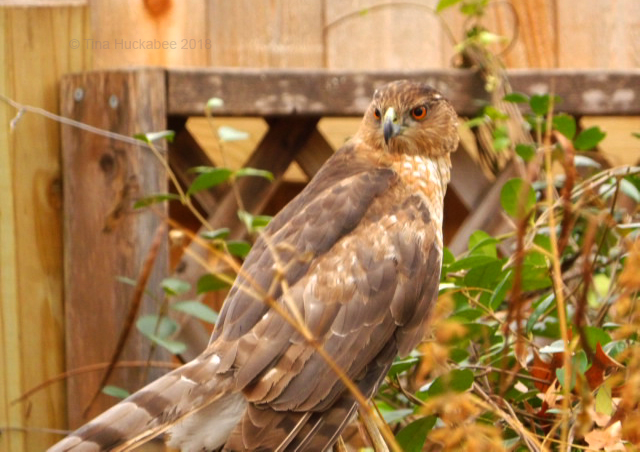
A gorgeous Cooper’s Hawk, Accipiter cooperii, flew into a sliding-glass door which serves as the door to my back garden. I happened to be out in the garden and it must have flown passed me on its way to the crash. I heard the thump against the glass door and whipped around, assuming that it was a Whitewinged dove, as those are the birds that typically hit the windows. I was shocked to see the hawk on the back patio floor, a bit unsteady on his talons. He fluttered to a bench adjacent to the door, and then flew to a back trellis.
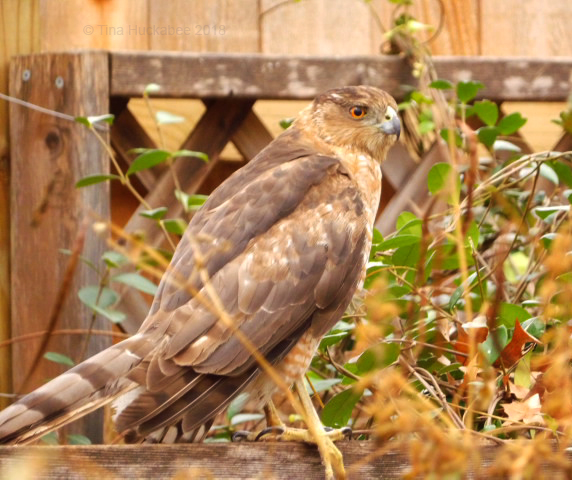
I thought the hawk might be a juvenile, but the deep orange eyes suggest an adult.
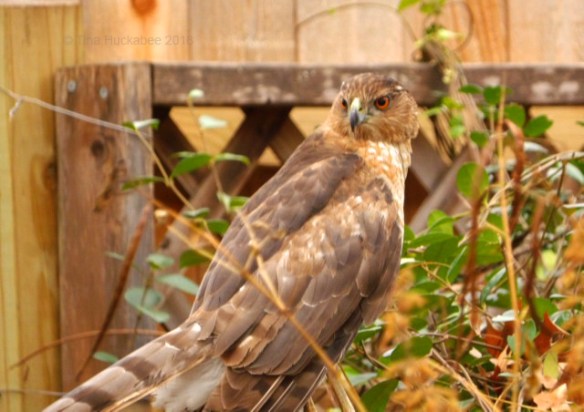
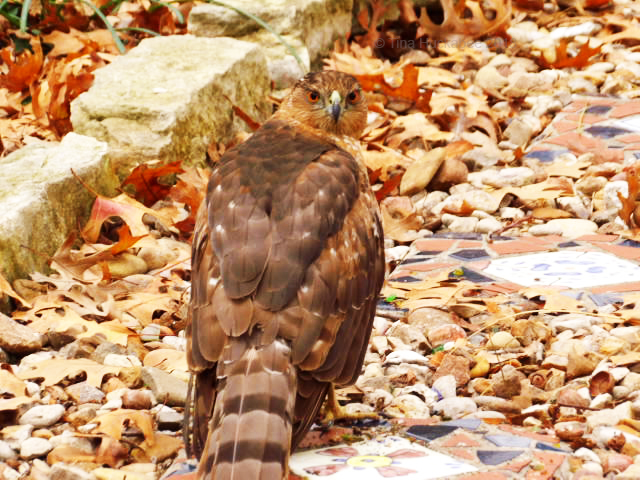
With one more addled act, he landed on a pathway about 10 feet in front of me. After minute of giving me the stink eye and allowing me the time to grab some photos,
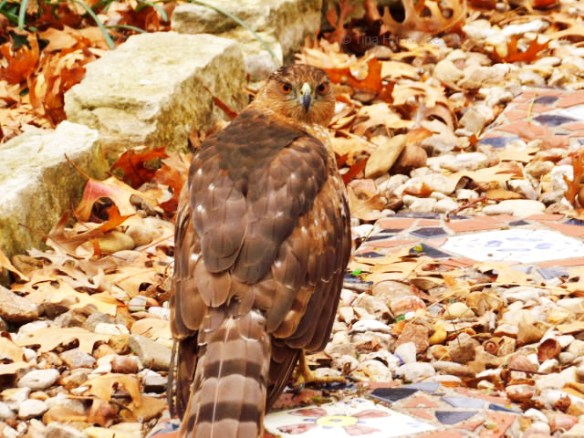
…this beauty flew to a neighbor’s tree and then was off again, flying well.
A few days later, I saw a Cooper’s Hawk in my Red oak tree; I assume it’s the same hawk, as it hangs around my house, clearly looking for bird meals.

The hawk’s eyes are focused on what I realized was a dove, its targeted meal.
A split second after this shot, the bird belted toward the back of the garden and with a rustle of leaves and kerfuffle of activity, a Whitewinged dove sprinted into the air and across the neighbor’s back garden with the hawk in fast pursuit. I lost sight of the two of them as they winged through trees in the ancient predator-prey dance, so I don’t know how the chase ended.
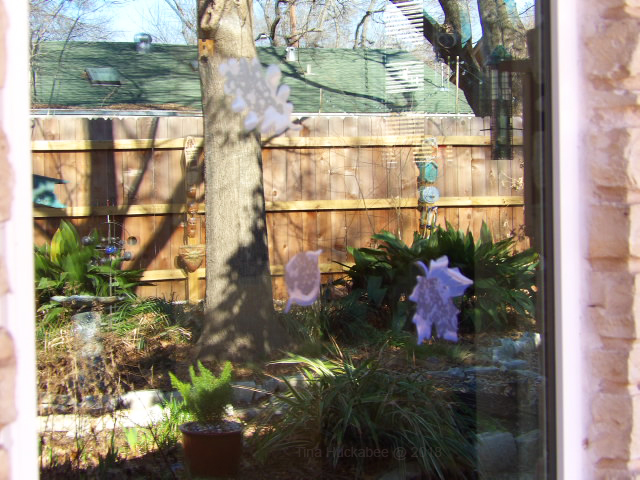
I’ve noticed a few more bird strikes on my windows since I had Pella windows installed about two years ago. While I love the windows, I’m sorry that it’s created a problem for the birds. The vast majority of hits are of Whitewinged doves, and only one proved immediately fatal, but I can’t help wonder how many hit when I’m not home? And, do any die later, from internal injuries? I‘ve placed “bird alert” window decals on many of my windows, though I’d never placed any on the sliding-glass door that the hawk hit; I’ve remedied that. (My back patio is covered and I mistakenly assumed a bird wouldn’t fly fast into such obviously human territory.) The reviews of these decals are mixed, but they apparently have some positive effect on the birds’ view of things. A quick look at one of my back windows gives you an idea of what the birds see.
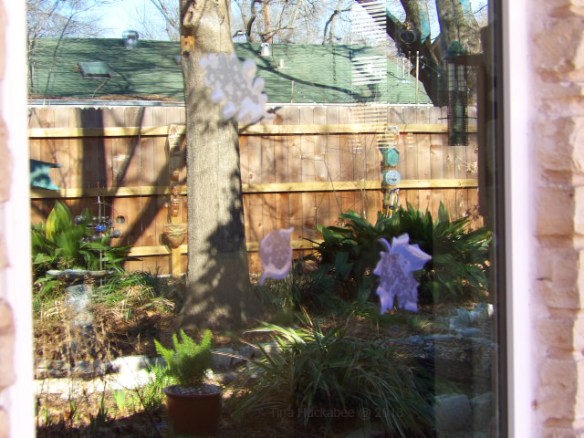
This window images part of my back garden and the back neighbor’s roof. You can also see the stickers, placed closely together.
As far as I’m aware, no bird has hit this particular window, but you can see why one might.
At about this time last year, I witnessed another Cooper’s Hawk chasing birds in my garden. It flew from the house to a Mountain Laurel tree (mid-garden), and then immediately whooshed back to the house, straight toward a bedroom window. The bird banked hard to its left about three feet from the window and flew off. I’d placed some decals on that particular window and have often wondered if the bird saw the decals and realized that it wasn’t open space.
I’m now lowering the blinds in my windows, especially when I’m not at home, as bird researchers think that the slats help the birds to see that the window, even if reflective, isn’t open space. Another recommendation is that if you have a window with an opposite window in the same line of sight (where you can see all the way through the house) which might give birds the illusion of open space, close or lower blinds on the second window. It will diminish the look of greenery, trees and sky that birds think they see. For more information about how to reduce bird strikes, check out this article from Cornell Lab of Ornithology.
Along with the active Cooper’s Hawk, there are two Red-tailed Hawks, Buteo jamaicensis, at least one of which I’ve seen a couple of times diving through my garden in search of bird à la feathers. As well, a Great Horned Owl, Bubo virginianus, prowls at night; I’ve heard and seen it several times. I can’t tell if it’s a single, or one of a pair, but it’s big. Really big. While the predator birds have been unusually active this winter, I haven’t seen or hear any evidence of Eastern Screech Owl, Megascops asio, activity. We’ve welcomed mated pairs for the past 8 years, enjoying their parenthood antics and darling offspring. Last year, we missed hosting a pair because of an oppossum in the owl box. This year, the owl house is clean, empty and ready for the little owls, but they’re a no-show. It might be fear of the hawks or the Great Horned Owl, but it’s unusual–and concerning–for there to be no Screech owl activity this time of year. I am also concerned about neighbors who place rat bait stations around their property. Do the bait traps contain rodenticide, or substances that repel, rather than kill rodent? Poisoned rodents lead to poisoned raptors.
As for the little birds, there are plenty and they are quick. I briefly witnessed this Blue-headed Vireo, Vireo solitarius, bathing in the bog and fluffing feathers in the winterized Yellow bells, Tacoma stans.
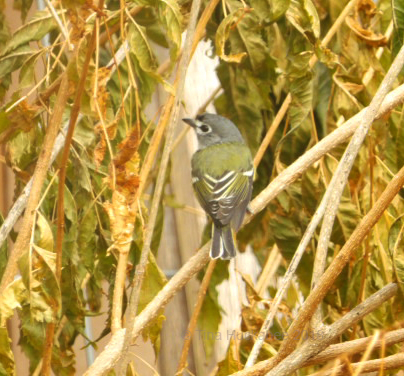
I’ve seen this species of bird before during spring migration and I wondered if this one was misplaced. In fact All About Birds shows that Central Texas is on the cusp of the vireo’s winter habitat. He made one brief visit, but he’s welcome anytime.
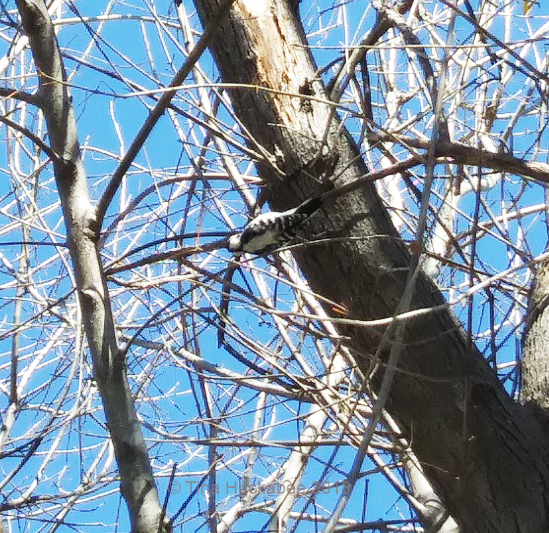
While on a walk in my neighborhood, I snagged a shot of a quick-moving female (?) Downy Woodpecker, Picoides pubescens. Darling little wood lovers, I’ve limited success with decent shots of these rapid-fire tree huggers; these are the best I’ve managed.

Up in a tree a few streets away from my house.
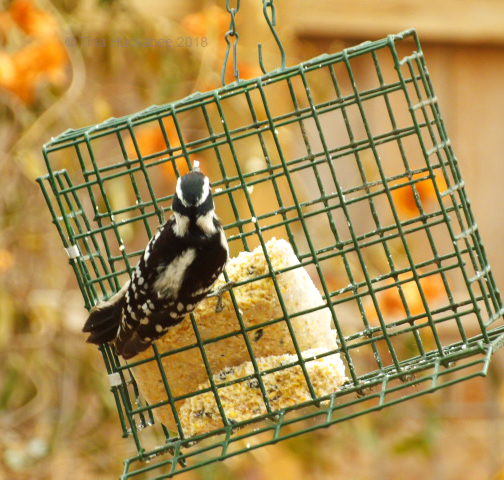
Nibbling at the suet feeder in my garden.
Downy woodpeckers sing a charming chirp and are common in my neighborhood, but apparently, shy with bird paparazzi.
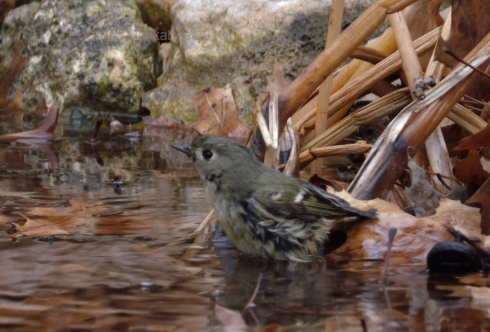
As for poor quality bird photos, I’m posting these of a Ruby-crowned Kinglet, Regulus calendula. My current camera, coupled with a bordering-on-a-character flaw lack of patience, removes any expectation of achieving clear shots of this tiny dynamo, topped by a flaming red cap, so I’m going for broke on photos of this bird and not fretting over the less than stellar quality!
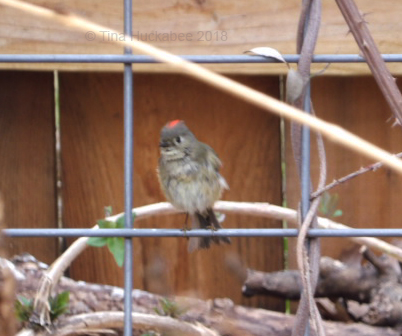
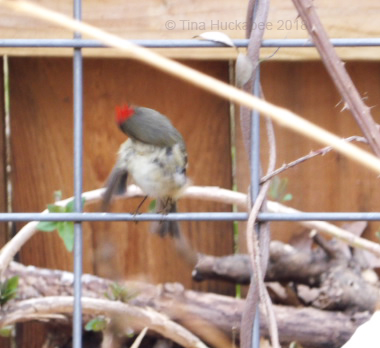
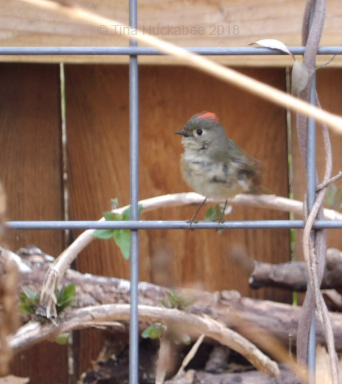
Look at that red, albeit smeared, head! Males like to flash their color when they’re defending territory, impressing ladies, or expressing annoyance. This one likes to bathe in the bog, then fluffs-n-dries in the adjacent Yellow bells shrub. When he’s fluffing and drying, he’s as still as he gets; otherwise, he’s constantly on the move for insects.
This shot of him in the bath is, well, at least clear! I assume there’s no red crown because he’s relaxed and enjoying his bath.

I’ve seen two of these itty-bitty birds simultaneously, but usually there is only one in the garden or at the pond at any point in time.
Other little birds regularly visiting are finches. Lots of finches. One American Goldfinch, Spinus tristis.
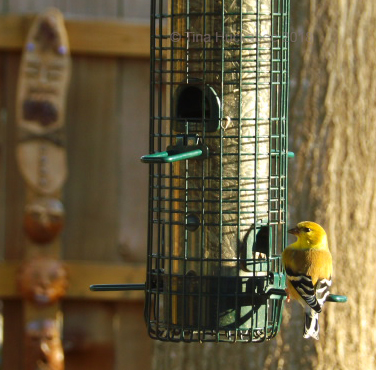
He has the food bar all to himself.
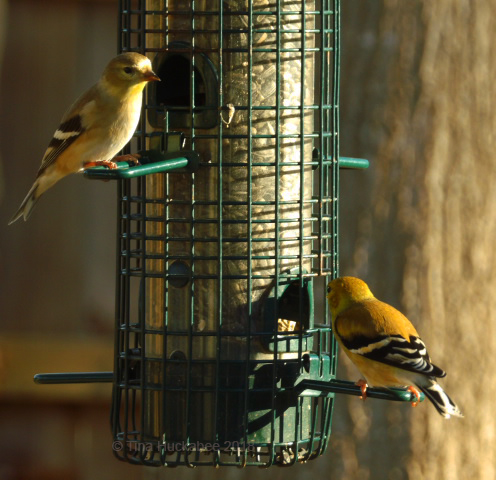
Two American Goldfinches.

Share nicely!
Two Americans, plus a House Finch, Haemorhous mexicanus.
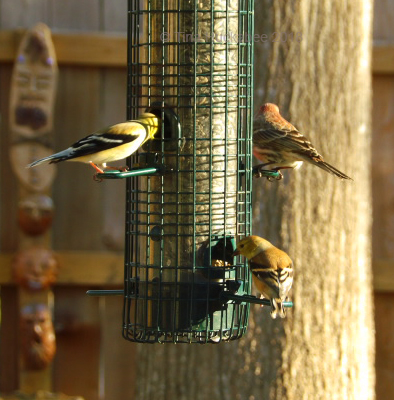
This food bar is becoming popular!
Three Americans, a House, and an upturned tail feather owner–probably another House Finch.
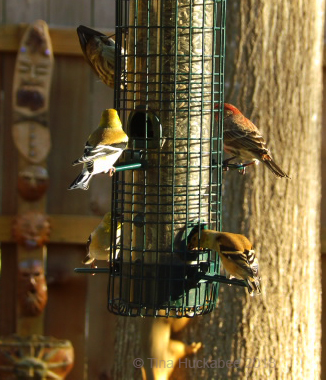
The sign of a successful eatery: long waits before seating!
I can’t help wondering what rhyming silliness Dr. Seuss would posit about these feeding finches.
The resident birds and winter visitors represent garden life in this dormant time of year, adding color, interest, and activity. Who’s visiting your garden? Please share your photos and stories of wild critters this past month. Remember to leave a your link when you comment.
Happy wildlife gardening!



















 My Gardener Says...