On Sunday I admired a neighbor’s iris stalks: tall and turgid, topped with a couple of just-about-to-open buds. I lamented that though my iris plants boasted full, lush, and healthy foliage, none had stems, much less any promise of luscious flowers.
Overnight Sunday into Monday, a stalk arose from the depths in my back garden; a second joined Monday night into Tuesday. Now there are a dozen iris stalks, ready for their part in spring’s play.
In the next days there will be iris flowers: purple, ruffly, and filling the air with a lovely fragrance. Maybe should stay awake all night and watch the iris stalks push towards the night sky, awaiting morning’s light. Or perhaps I’ll continue as I do each season: marvel at and appreciate nature’s timetable, and remain bedazzled with the turn of each season, the daily changes, the overnight sensations.
I was surprised to see this softball-sized swarm this chilly February 29th.
Bee Daddy and I checked our honeybees this past week for the first time since October and both were thriving. Bo-Peep and Woody (our hives) had brood frames that were packed with larvae and honey–which is exactly what we wanted to see. In fact, we took a brood frame from each (replacing with an empty brood frame) which will give them some space to re-comb and hoard more honey. I was particularly chuffed about the healthy state of both hives, as I’ve been concerned about our weaker hive, Woody.
I didn’t write much last year about the honeybees, but 2023 was a tricky bee keeping year for us. Both hives swarmed in late March–which is normal–but just afterward, Central Texas plunged back to “January” weather and it was wet and cold for a full week. For the next month or so, neither hive showed any larvae, which meant that there was no queen in either hive. We guessed that the virgin queens created by the hives perished during their respective mating flights during the inhospitable-to-honeybees weather of that first week in April.
We purchased two queens and re-queened in early May, hoping that would solve the issue. Bo-Peep responded well to her new queen and rallied. Woody continued to struggle; by late June, we realized that the “new” queen had probably died. We re-queened Woody again and the hive accepted the queen. She was a prolific egg producer; by October, Woody had mostly recovered and had honey and a decent, though small, population of bees. With the late start (mid-summer) of building a population of workers, Woody entered winter weakened and with minimal honey. During that last hive check, we added a couple of Bo-Peep’s honey frames to bolster Woody’s honey stores for the winter months.
This past week was quite warm and we popped in on the girls to say howdy and check their post-winter conditions. I was gobsmacked at how robust each hive was, both full of honey and larvae. Bo-Peep has so much honey that we added a second honey box and will take and process some frames in the near future.
Then, this weird little swarm shows up today. It’s located about 6 feet from the hives. In the photo, the swarm sits on a branch in the Texas Mountain Laurel, to the left and up from the taller hive (Bo-Peep).
Additionally, our very warm spell has ended and it’s back in the 40s and cloudy. This brush of winter won’t last; it’ll be mild again this weekend, but the swarm won’t move while it’s cold. This swarm is too small to survive on its own. Will it swoop back into the hive it most likely came from, or, will it set out for parts unknown and perish? I’ll keep an eye on this ball of bees, though it’s unlikely that I actually see the girls leave the limb.
Honeybees–they’re always doing something cheeky and unexpected, messing with our heads!
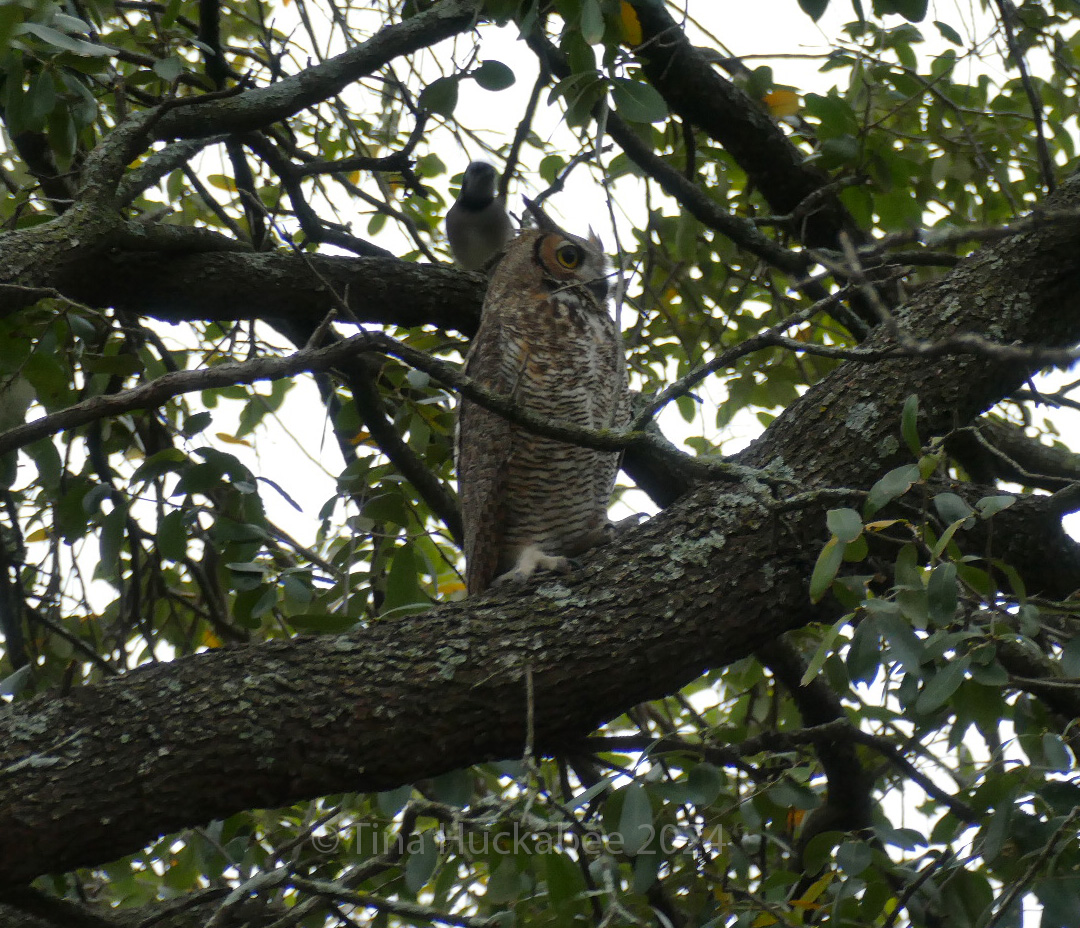
It wasn’t the signature hoot of a Great Horned Owl, Bubo virginianus, that alerted me to its presence in a neighbor’s big, beautiful Live Oak tree early this morning, but instead, the vociferous complaints of a mob of Blue Jays, Cyanocitta cristata.
I think this gorgeous bird is a juvenile Great Horned Owl, most likely last year’s hatch. It could be an adult, as our neighborhood has sustained at least one pair of nesting Great Horns for years.
Just after I returned from visiting stunning Costa Rica in November, for several weeks each day, I heard a call that I couldn’t identify, even with the Merlin app sound feature. In time, my neighbor (and sister-in-law) discovered that the call is the ‘begging call‘ that young owls use for catching the attention of their adults. Once they’ve left their parents’ tutelage, young owls use that call for a time to let their parents know where they are located in the wider world.
Handsome Bird stayed in the tree for at least an hour, with its Blue Jay back up screamers serving as annoying company.
Blue Jay nemesis perches on the branch just above the owl, cawing nonstop.
As I snapped photos, the big, beautiful bird turned southward, spread its magnificent wings, and flew to a quieter spot. Maybe it’ll get some rest today, before hunting commences at sundown.



 My Gardener Says...