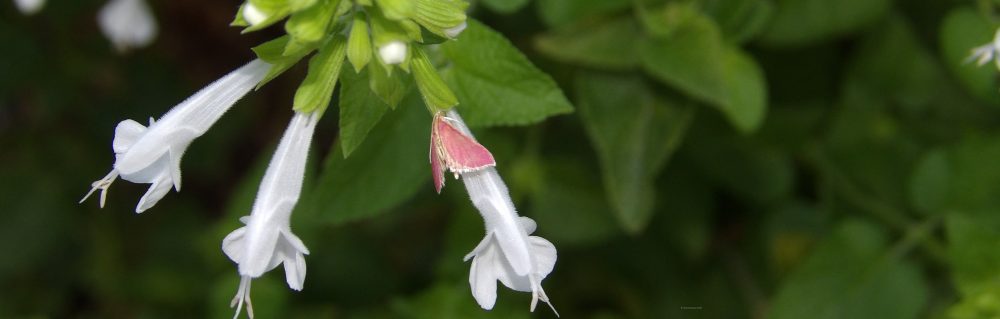
Bloom Day, November 2014–Dodged the Frozen Bullet

After a chilly week and our first real touch of winter, there are still blooms in my gardens. Lucky gardener!  Lucky pollinators!  I live in central Austin and those supposedly in the know predicted our temperature would fall to the high 20’s by early Friday morning.  Well there was no freeze for me and mine.  Outlying areas received their first freeze, but much of  Austin was spared–this time. To celebrate those lucky blooms, I’m joining with Carol at May Dreams Gardens for November Garden Blogger blooms.

The Coral Vine, Antigonon leptopus, bloomed its signature fuchsia necklace  rather late this year.

IMGP1604.new

Now with colder temperatures and shorter days, the blossoms are fading on the vine.IMGP2341.new

I think my honeybees will miss this favorite nectar source.

The native Texas CraglilyEcheandia texensis,  still blooms, IMGP1507.new

IMGP2343.new

IMGP2344.new

…though it’s going to seed. One patch blossoms in tandem with the blue Henry Duelberg SageSalvia farinacea,’Henry Duelberg’.

IMGP1978.new

A freeze would have quickly ended that pretty pairing.

Rock RosePavonia lasiopetala, sports flowers this November and that’s unusual–they normally stop production by late October.IMGP2383.new

IMGP2362.new

IMGP2360.new

Heavy with seed, I’ll expect more of these lovelies in seedling form next year.  Any takers?

And GoldeneyeViguiera dentata?  It just won’t quit.  This most photogenic of flowers, has bloomed since September.

IMGP2379.new IMGP2381.new

This is one of my two last blooming Goldeneye plants.

IMGP2531.new

The Goldeneye plants in the back garden bloomed first, then set seed and were followed by others throughout my gardens, each individual plant taking turn at adding cheeriness and wildlife goodness to the world.  I’m glad these hardy natives have planted themselves all over my gardens.  Bees, butterflies, birds, as well as this gardener, enjoy and appreciate a long season with these pretties.

IMGP2387.new

The last FrostweedVerbesina virginica, is in flowering mode.

IMGP2384.new

While most of that species are setting seed.

IMGP2469.new

A few Turk’s CapMalvaviscus arboreus, still bloom.

IMGP2394.new

Yellow BellsTecoma stans, ‘Esperanza’, are available for passing bees and butterflies.

IMGP2467.new IMGP2471.new

Blue MistflowerConoclinium coelestinum,

IMGP1475.new

and Gregg’s MistflowerConoclinium greggii, 

IMGP1555.new

IMGP1560.new

…are toward the end of their season.  A true freeze will force the blue blooms into a tawny fluff, ready for dormancy.

Red YuccaHesperaloe parviflora, blossoms on its long bloom spike until a hard freeze.

IMGP2364.new

This hasn’t been a banner year for my salvia species.  They’ve bloomed, but not regularly nor as fully as usual.  But they aren’t quite ready to close up shop, so bloom they will until it’s just too chilly and dark.  Salvia like this red Tropical SageSalvia coccinea,

IMGP2354.new

…and this Purple Sage, S. greggii x mycrophylla,

IMGP2560.new

…and this red Autumn SageS. greggii, 

IMGP2611.new

…and another,

IMGP2614.new

…and this coral Autumn Sage.

IMGP2612.new

They’re determined, if not prolific.

The remains of Fall AsterSymphyotrichum oblongifolium, are tired of blooming and ready for seeding themselves.

RICOH IMAGING

When I thought there would be freezing temperatures, I cut the last of the fall blooms of Purple ConeflowerEchinacea purpurea and Tropical Sage and did this:

IMGP2616.new

As well, I cut a few Goldeneye and basil and did this:

IMGP2590.new

I’m not much for cut flowers in the house (I much prefer a garden full of blooms), but they are nice when it’s gloomy outside. I guess November in my garden and my house is not so barren after all!

Pop on over to May Dreams Garden and enjoy a show of November blooms from all over


Bee Mama Missive: Honey Flow, Honey!

My honeybees have been busy bees this autumn. They’re all over the fall blooming perennials like Goldeneye, Viguiera dentata,

IMGP1530.new

IMGP1538.new

...and Frostweed, Verbesina virginica.

IMGP0972.new

And let’s not forget how much the honeybees (and everyone else, it seems) work the Blue Mistflower, Conoclinium coelestinum.

IMGP1615.new

As well, honeybees adore the blooms of Coral Vine, Antigonon leptopus.

IMGP1413.new

When I walk into the back garden, day or night,  the fragrance of honey drifts from my hives.  Mmmm.  Breathe deep. That honey-strong fragrance indicates that there is a honey flow happening and it’s been going on for a while.  Honey flow occurs when there are blooms galore and plenty of nectar to gather and honey is busily bee-ing made.

Recently, we checked both hives and Scar’s three boxes are full of comb and honey.P1060815.new

IMGP2325.new

IMGP2327.new

Mufasa has been the weaker of the two hives, but its two boxes were also full of comb and honey and ready for a third box.  So we prepared another set of top bars for Mufasa’s third box. We melted down some frozen comb from the July honey extraction,

IMGP2025.new IMGP2024.new

…to add to the bars. This little track of wax will help the girls start their comb-building.

IMGP2027.new

Before adding the third box to Mufasa, we sneaked a peek to assure that all is well. The comb in Mufasa’s second box is heavy with honey and larvae.

IMGP2334_cropped_2903x3322..new

However, If you look closely,IMGP2337.new

…you can see how the comb is undulated–sort of wavy-gravy kinda comb,IMGP2339.new

…not neat, tidy and vertical comb aligned with the bars as it’s supposed to be.

This, dear readers, is an example of poor beekeeping management.  In early September, while checking Mufasa, one of the combs broke off of the bar.  Unfortunately with the Warre type hives that we built, this easily happens.    I made the beekeeper’s executive decision to place the broken comb back into the box, as best I could, rather than removing the comb and the honey.  If it was earlier in the growing season, I would have removed the comb and extracted honey and the bees would simply rebuild–after all, that’s what they do. But the latest broken comb incident occurred late in our growing season and I didn’t want to take honey from the bees.  So, I dropped the comb in, knowing that they wouldn’t repair it as perfectly as it was originally built. Given that our beekeeping  goals are not so much about the production of honey for us, but for the bees themselves, it’s a reasonable decision to make.

Assuming our hives survive winter, my best amateur guess is that there will be honey left over and we’ll extract it then, along with the wonky comb. With our Warre hives, when we take honey, we have to take comb too, as there is no straightforward way to extract the honey without crushing the comb.  It’s simply how the design works. Next spring, the hive will have the whole growing season to rebuild and restock their honey stores.

We added the third floor to Mufasa a couple of weeks ago and when recently checked, the bees completed two bars with comb and honey.   That’s fine and expected; they’ll build more comb over time.

RICOH IMAGING

I’ve continued observing a few Small Hive beetles in both hives, which you can read about here, but not many and not every time I check.   When I opened Mufasa this past week, I saw and killed what looked like two Wax Moth larvae.  Well, I knew they would invade eventually.  I opened both hives and didn’t see any webbing that is indicative of a mass infestation of the Wax Comb moth. Whoop!  But I am popping Mufasa’s top off most days to check–just in case.  In one of the articles I read about the Wax Comb moth, the author suggested that if the beekeeper kills the moth larvae, then drops the dead larvae into the hive, it teaches the bees to kill the larvae as invaders.  I have my doubts about that particular management practice, but that’s what I did–not because I’d read to do that, but because I was grossed out and offended to see the two larvae crawling along Mufasa’s hive.

Bee Mama is protective of her little bees.

We’ll  thoroughly check both hives at least one more time before true winter sets in.   Both hives have plenty of honey stores (fingers crossed) for the winter and we’ll see how they fare.

The bees continue their work.  Foraging,IMGP1082.new

….pollinating,IMGP1620.new

…sipping at their local watering hole,IMGP2443.new

….and being bees.

IMGP1535_cropped_3562x3138..new

Wildlife Wednesday, November 2014

I should call this month’s post: what you notice when you bother to pay attention.  The reason I started Wildlife Wednesday was (unselfishly)  to promote planting and gardening for wildlife and (selfishly) to improve my own observation, identification, and photographic skills.  One thing I’ve learned is just how much wildlife actually resides in my gardens that I hadn’t fully appreciated.  I wasn’t oblivious to the myriad of creepy, crawly, flitty pollinator/seed distributor-types, but I didn’t notice them all that much.  Bees?  Oh sure, they’re in the garden, but don’t ask me to tell the difference between species.  The birds were easy to identify, as long as they were colorful or in some other way caught my eye. All those little brown/gray/tan things?  They were just “twitty birds” to me.  Butterflies, because of their obvious beauty, were much easier to discern, but I didn’t necessarily observe and identify moths or the many little skippers out there, which are important pollinators, along with the most beautiful butterfly. I’m still more likely to be aware of the conspicuous; sometimes, that’s all I have time or patience for.  But in these past few months, in focusing my observations on life-beyond-the-plants, I’m amazed at what I’ve seen that I wasn’t aware of.  I have grown to value, even more than before, the abundant diversity residing in my patch of the Earth.

I must have spent fifteen minutes attempting to get a decent photograph of this pollen-heavy leafcutting bee,

IMGP0964.new

..as it worked the blooms of a Henry Duelberg Sage.  At least I think it’s a leafcutting bee, which is categorized as a Megachile species.   I was more fascinated at how this little bee moved around, so laden  with pollen.  At one point she rested along the stem.

IMGP0954_cropped_3709x2742..new

Just afterwards, she lumbered away in flight, her corbiculae, which I like to call pollen pantaloons, loaded with valuable cargo.  Honestly, I wasn’t sure she could fly, she was carrying so much pollen.  But fly she did.

Throughout this blooming fall, I’ve seen many individuals of this species of Tachinid fly at blooming plants, like Frostweed.

IMGP1062.new

The first of these flies that I saw was at a distance and  I assumed it was some sort of black bumblebee.  Upon closer inspection,

IMGP1072.new

…it had that definite fly look about it. Those huge eyes!  And don’t you just love those hairs sticking out of its abdomen?

IMGP1065.new

Interestingly, I’ve observed these flies exclusively on the Frostweed and White Mistflower blooms–both white flowers, though I couldn’t find any information that suggests they prefer white blooms.

Of course, I must brag about my little honeybees,

IMGP1790_cropped_3806x3346..new IMGP1569.new

…as they work flowers for the benefit of the hive(s).

Throughout October, I’ve seen several types of hover fly species in the gardens.  The Common Oblique Syrphid, Allograpta obliqua, is remarkably photogenic.

IMGP1634.new

IMGP1639.new

This little “flower fly” is a beneficial garden resident as it sips nectar in its adult stage and controls aphids in its larval stage, as a little green worm.  Beautiful to look at and valuable for gardens,

IMGP1641.new

…they’re good garden partners.

And of course, no parade of October-in-Austin insect photos are complete without a bevy of butterfly images.  The Monarchs, Danaus plexippus,  have been daily visitors through most of October, nectaring on favorites like the Gregg’s Mistflower.

IMGP2001.new

A relative of the Monarchs,  the QueenDanaus gilippus, also prefers Gregg’s Mistflower,

IMGP2057.new

…as does the American Painted LadyVanessa virginiensis,

IMGP2060_cropped_3415x3078..new IMGP2086.new

IMGP2079.new

…as does the Mournful DuskywingErynnis tristis.  

IMGP2090_cropped_3433x3253..new IMGP2095_cropped_3783x3133..new

I guess the garden lesson demonstrated here is that Gregg’s Mistflower is a must-have wildlife attracting plant.  It’s pretty, too.

Common in Austin, the Pipevine SwallowtailBattus philenor,  is a high, strong flyer. Though this one,

IMGP2202.new

IMGP2205.new

…looks a little worse for wear.  It was nice to see him one sunny afternoon, because I haven’t enjoyed many of his kind visiting my gardens this year.

As we head into cooler temperatures, the various dragon and damselflies will be dormant. I spied this beauty, a Springwater Dancer,  Argia plana, sunning himself on the rocks which border my pond.

IMGP2101_cropped_3663x3225..new

He may be the last one I see this autumn, but I’m sure he and his Odonata brethren will return next spring to grace my gardens.

I think this little insect is a sweat bee of the Halictidae family.  He/she was busily working a Goldeneye bloom. Small bloom, smaller bee.  I thought that I would definitely find a photo and identifying information for this critter, but didn’t locate information which gives me total confidence on my identification. I’ll have to take a guess on this one.

IMGP2151.new

But it’s an example of what you notice when you pay attention.  Unobtrusive and small, I might not have seen this native bee (of whatever variety) if I wasn’t looking for wild visitors.

This Blue-gray GnatcatcherPolioptila caerulea, was hopping around in my Retama tree one Sunday afternoon as I attempted to photograph a Tufted titmouse.

IMGP1600_cropped_3327x2926..new

The Gnatcatcher is apparently a summer resident in Central Texas, before migrating south, but I don’t know that I’ve ever seen one before.

IMGP1601_cropped_3788x2940..new

More than likely I have seen a Gnatcatcher, but relegated it to the category of “generic neutral-colored bird,” which I’m afraid I sometimes do.   My bad.

IMGP1602_cropped_2829x3170..new

He’s another example of what you notice when you pay attention.  And I never did get a decent photo of a Tufted titmouse.

This American RedstartSetophaga ruticilla, visited and this is the best shot I could manage. IMGP1652_cropped_2695x3304..new

The photo is poor quality, in part because I was so excited to find a bird that I’d never seen (I need to work on that breathe deep and focus thing), but also because he was flitty and flighty in his movements.  Then my dog waddled near to where the bird was.  Then the cat decided to stroll in the general vicinity of Mr. Redstart.  Well, he’s no fool and he flew away. Migratory through Central Texas, on his way to Central and South America for winter, I saw him a little later in an oak tree, but it was late and he just wouldn’t cooperate for a photo.  After looking at photos of both the male and female Redstarts, I believe I observed a female mid-month working her way among my perennial shrubs.   Alas, no photo of her either.

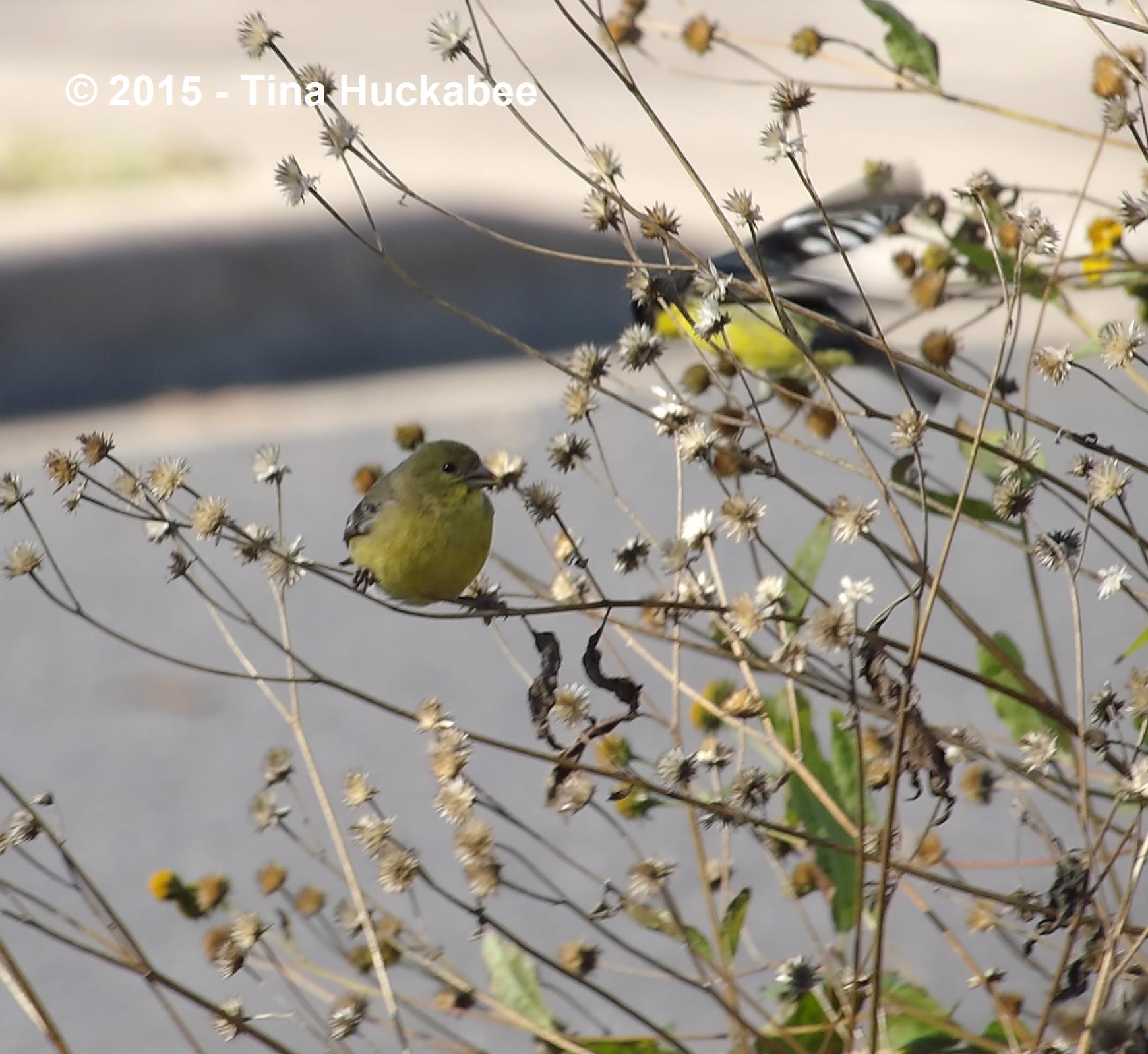
The Lesser Goldfinches, Spinus psaltria, descended on the Goldeneye as the flowers went to seed.

IMGP1968_cropped_2940x3332..new

IMGP2065_cropped_3290x3341..new

They were around for a week or two, making themselves at home.

IMGP2062_cropped_3046x3359..new

I haven’t seen them in about two weeks.  I live on the edge of their year round habitat, but it’s possible the visiting crew headed south.  I did read that they tend to move around quite a bit.  I still have Goldeneye seeding out;  I wish the Lessers would stop by for some meals.

And I’m always amaze at the noise the petite Carolina WrenThryothorus ludovicianus, makes.

IMGP2200.new

This little guy is a common bird in my gardens and packs a wallop of sound from that tiny body.  This fellow was singing away just after sunrise.

Lots happened in my garden during October and I’m sure yours also hosted plenty of wild action. Please join in posting about the wild garden visitors for November Wildlife Wednesday. Share the rare or mundane, funny or fascinating, beneficial or harmful critters you encounter. When you comment on my post, please remember to leave a link to your Wildlife Wednesday post so we can enjoy a variety of garden wildlife observations.

IMGP1808.new

IMGP2098.new

Good wildlife gardening to you!