Mob

No, there isn’t a mob in my garden; no large group of kangaroos have arrived for March in my garden. But there are lots of Cedar Waxwings.  Lots and lots and lots.

A migratory bird that winters in Central Texas, the Cedar Waxwing, Bombycilla cedrorum, is gregarious, always as a part of a group, rarely seen alone.  In the last few days, I’ve had more of these birds visit en masse than ever before.

I usually hear them before I see them as they’re rapid, high flyers, and they whistle while they work.

Typically, I see dozens at a time, flying from treetop to treetop in flocks of 10 to 30, vocalizing with their signature shrill calls, flitting in to settle along the branches of my trees,  and maybe, contemplating a dip in the pond. As a group, they’ll swoop down to take the bath and also grab a drink while they’re at it.

Recently, their numbers are in the hundreds and they’re certainly making their presence known:  garden feature-hopping, whistling as they go.
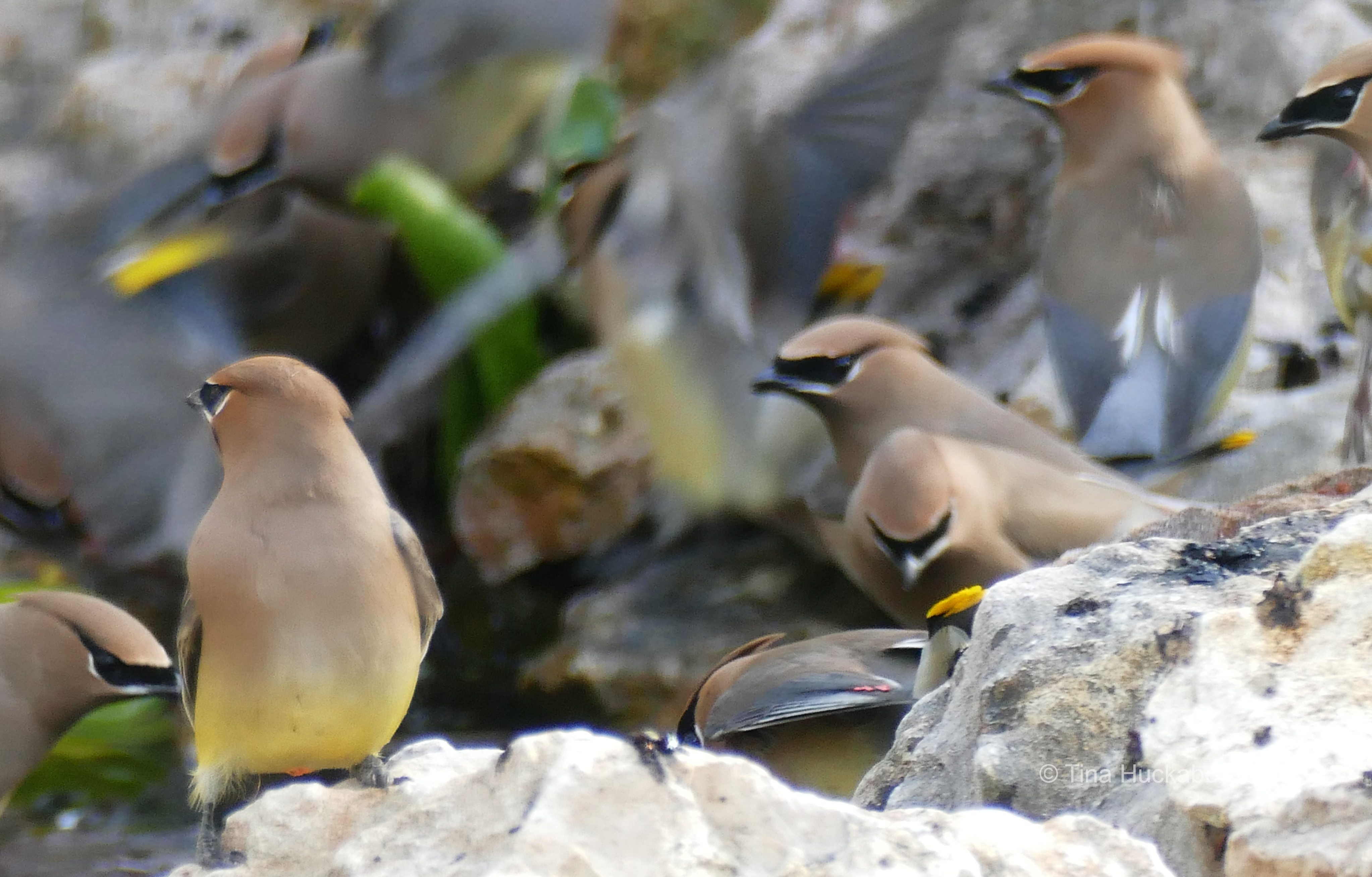
 

This little group (fella at the left notwithstanding–he’s telling the others how it’s done) are head-down, front-facing as they drink from the bog.

And this group, not wanting to follow along with the crowd, strike a similar, but different pose:  head-down and tail-facing.

I wonder if this waxwing is engaging its partners in conversation as to whether front-facing or back-facing is best.


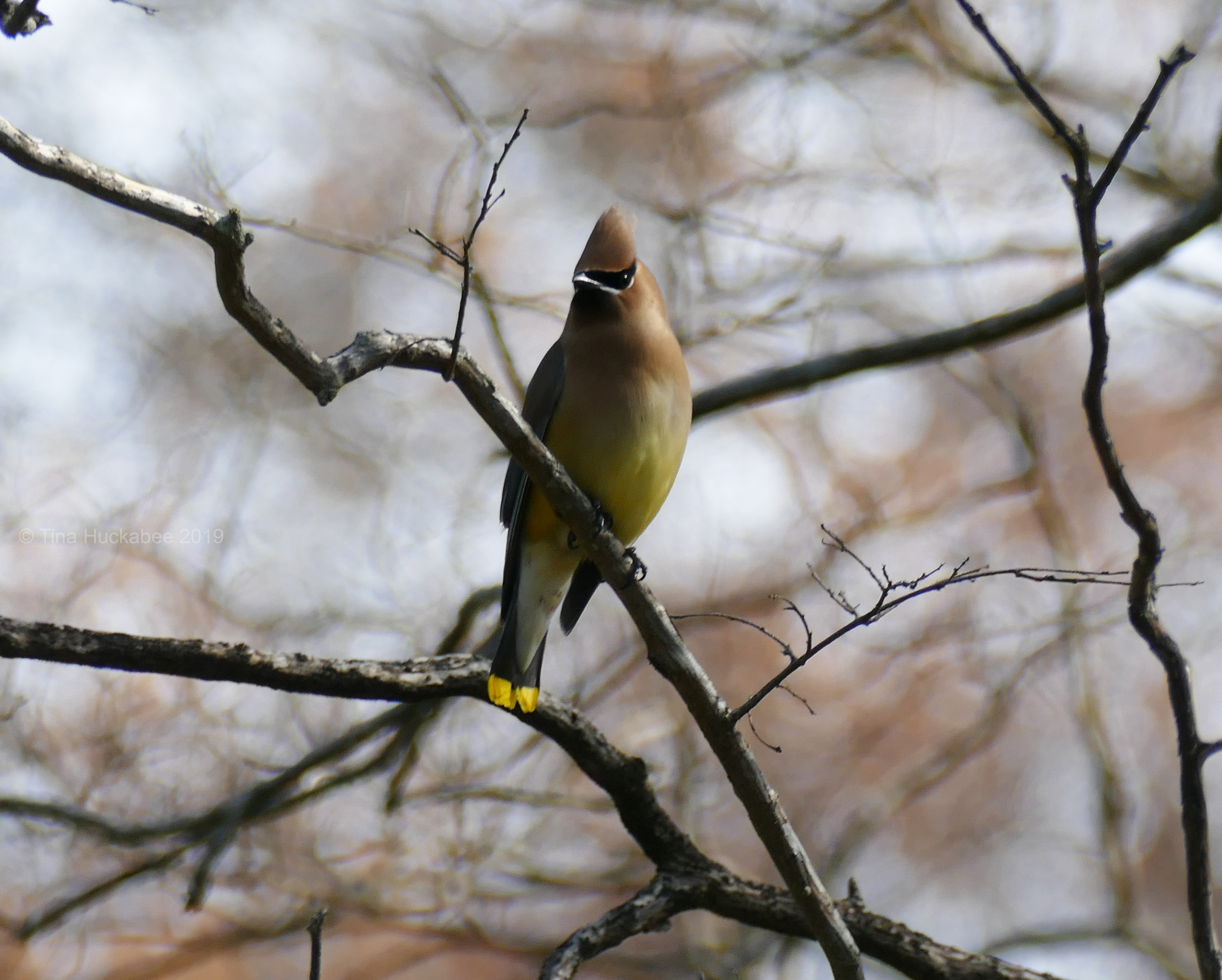
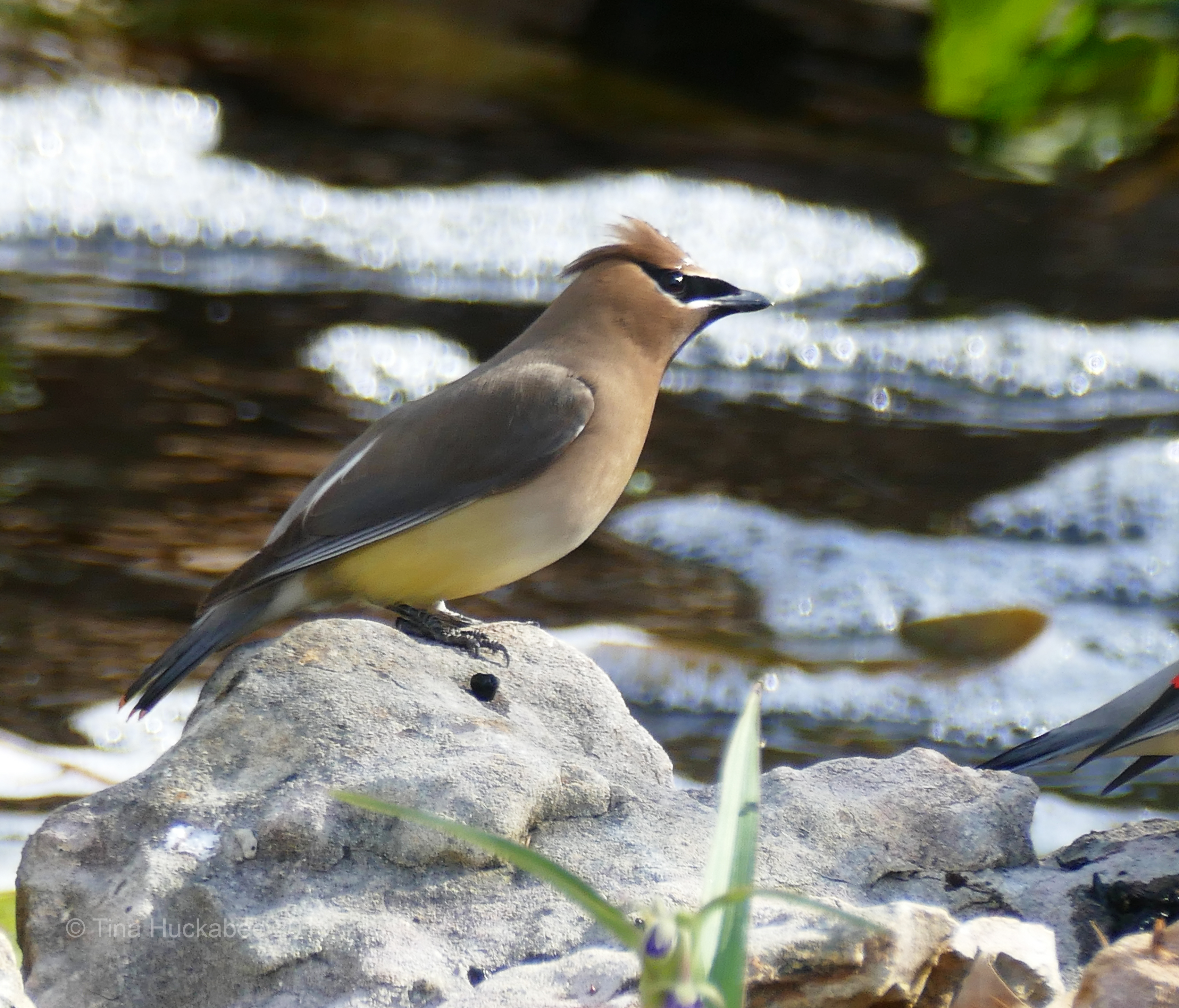
Cedar Waxwings are stunning birds.  Soft and elegant tan-to-grey colors their back and wing feathers, morphing to butter yellow bellies.  Dramatic black masks which are rimmed in white, accessorize their jaunty faces.   Atop their lovely heads is a crest, but often it lies flat.

The name ‘waxwing’ comes from the brilliant red tips at the ends the secondary flight feathers, which may be related to attracting mates.  Not all waxwings have these red tips.

The tips of the tail feathers are bright yellow, a well-appointed echo of the yellow belly.
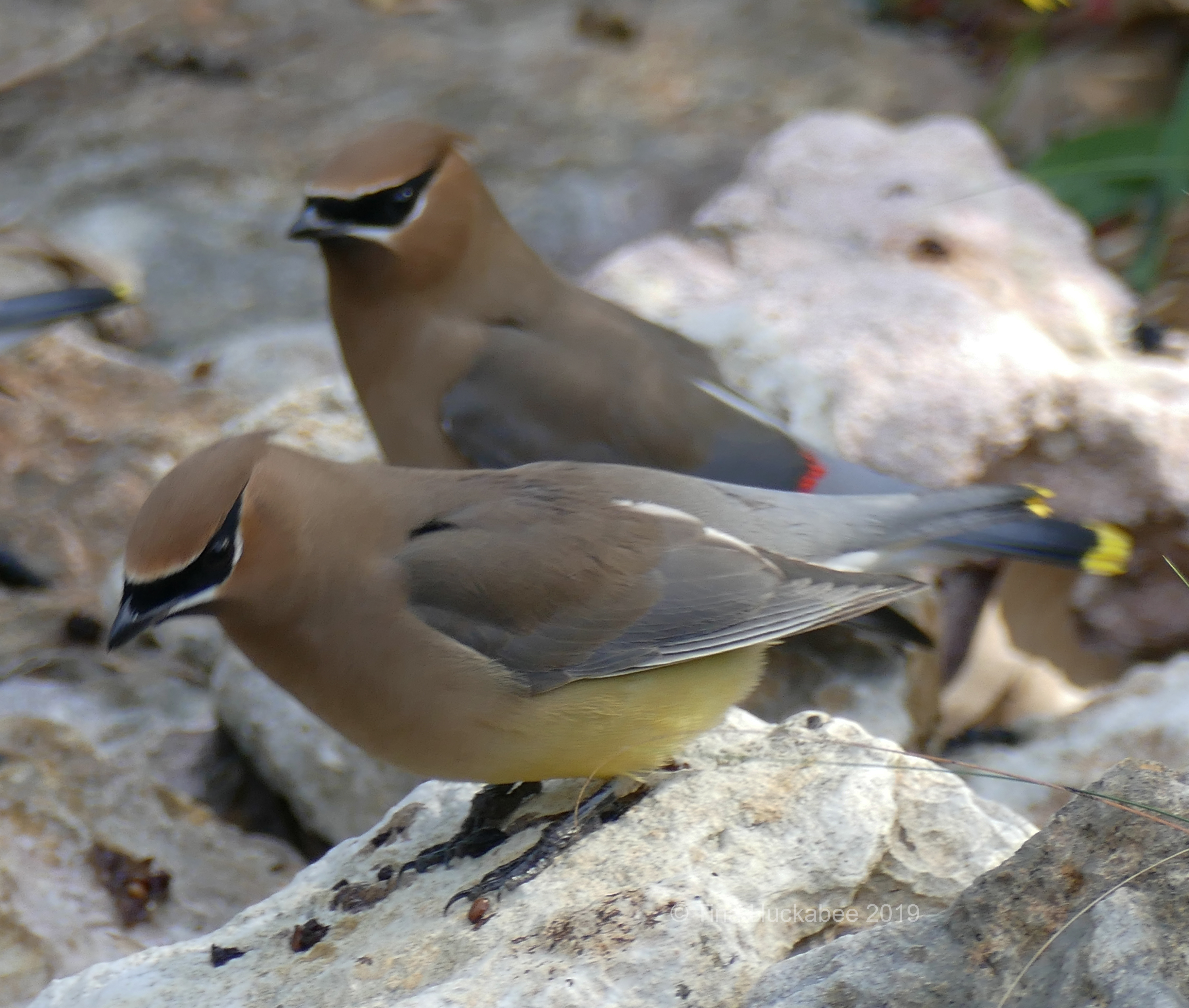
When I first downloaded the photos of these merry birds, I noticed that this individual,

…appears to have orange, rather than yellow, tail feather tips.  If you click on the Cornell Lab of Ornithology link at the beginning of the post, under “Cool Facts” there is a mention that starting during the 1960s, it’s been observed that some birds in Canada and the United States sport orange, rather than yellow, tips on the tails.  Apparently, if a waxwing eats berries from a certain non-native honeysuckle during growth of the tail feathers, the tip will be orange.  Cedar Waxwings winter here and southward, but they breed and raise chicks in the far north of the U.S. and well into Canada, so this orange-tipped Cedar Waxwing must have come across the honeysuckle berry at some point during its adolescence.

Photos don’t adequately capture the exuberance and energy of these flighty birds as they whoosh to the pond from the trees and flap in the water with verve.  Always on the move, they regularly change places and positions with one another, chatting all the while. 
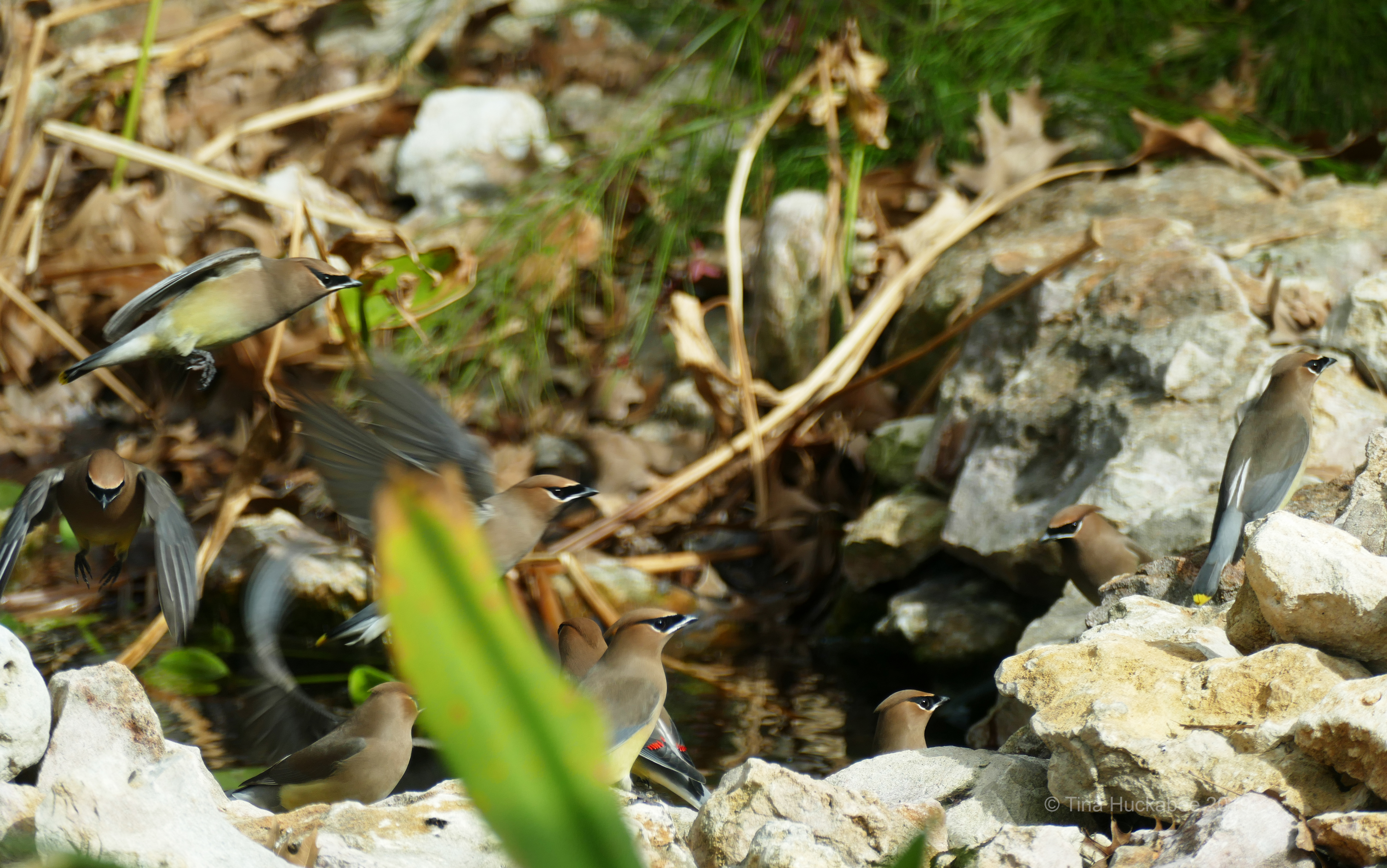
Back and forth they go–tree to pond, pond to tree–eventually settling together along limbs, sociably fluffing and drying with their comrades.  
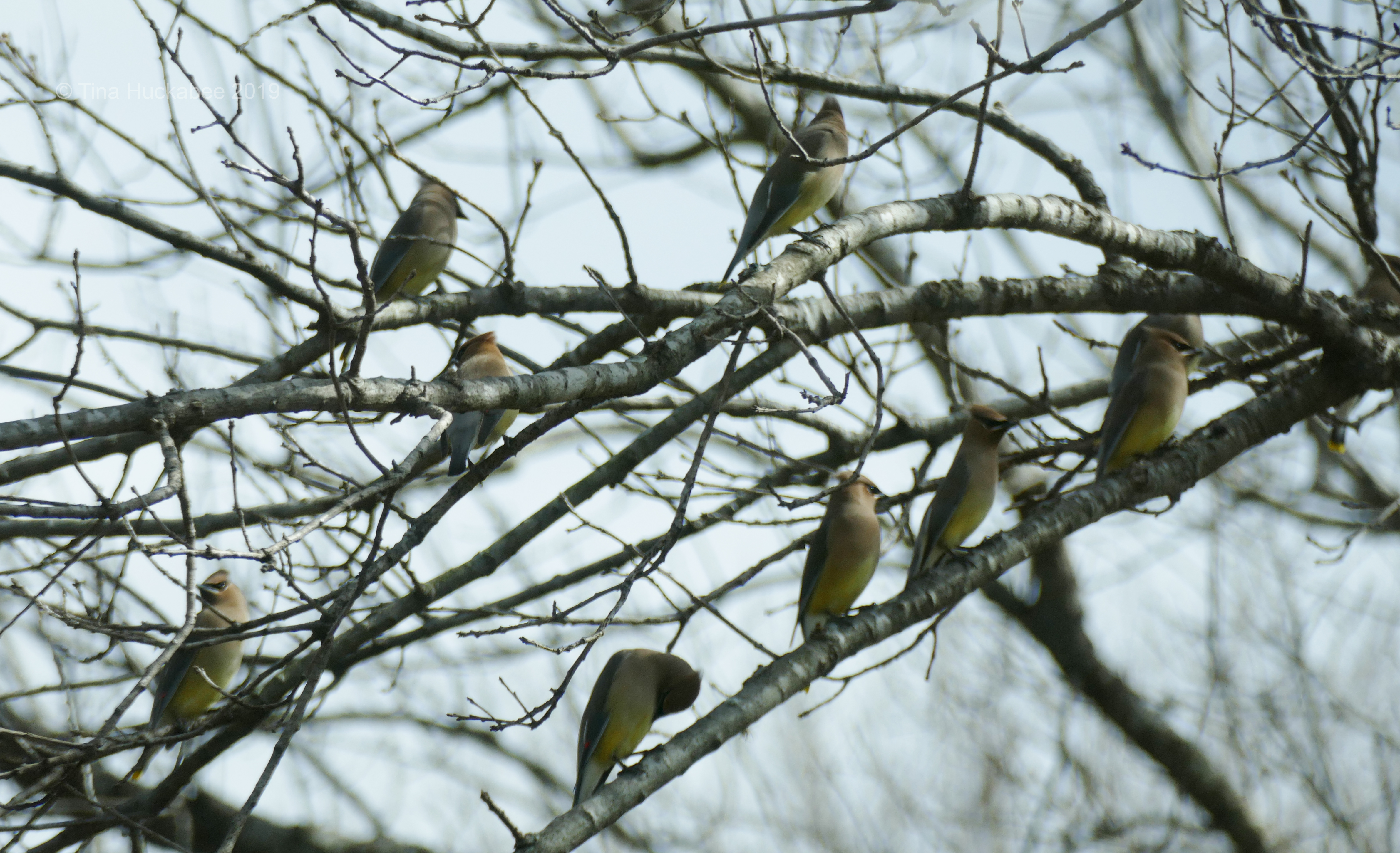
Then, at some signal I’m not privy to, they dart away with wings aflutter and calls sharp.  Sometimes they circle round again, not having had quite enough of my garden’s offerings, but often, they fly away–as a mob–to their next adventure.

Cedar Waxwings enjoy perching in the trees.  They like to preen and look pretty, and it’s a good time to get a quiet shot of these beauties.  Catching one alone?  That’s a real feat.
Eating fruit almost exclusively, when they decide that it’s time to for a meal, a group of Cedar Waxwings will strip a tree or shrub of berries in a matter of an hour or two.  In my own garden, they eat the berries of the native Possumhaw holly, Ilex decidua and the non-native Burford holly, Ilex cornuta.  I’ve never witnessed it, but many folks in Austin (and elsewhere, I’m told) report seeing drunk Cedar Waxwings after consuming overripe berries.  Tipsy birds might seem comedic, but in fact, waxwings can die because of fermented berries.

Here’s another, less dire, but still obnoxious, result of the berry diet.  Do you see it?

And in this photo.

And in this photo.

These rocks are not polka-dotted, they’re bird poop-dotted, as is a good portion of my back patio and several walkways in my neighborhood.

Perhaps when I’m out, I should don a hat.

Despite the less-than-appreciated output of these birds, I’m thrilled at their visits in winter and early spring. Their high-pitched calls from the sky, their penchant for companionship wherever they go, plus their gorgeous good looks, brings cheer my heart and a smile to my face.
Return of the Blues: Wildlife Wednesday, March 2019

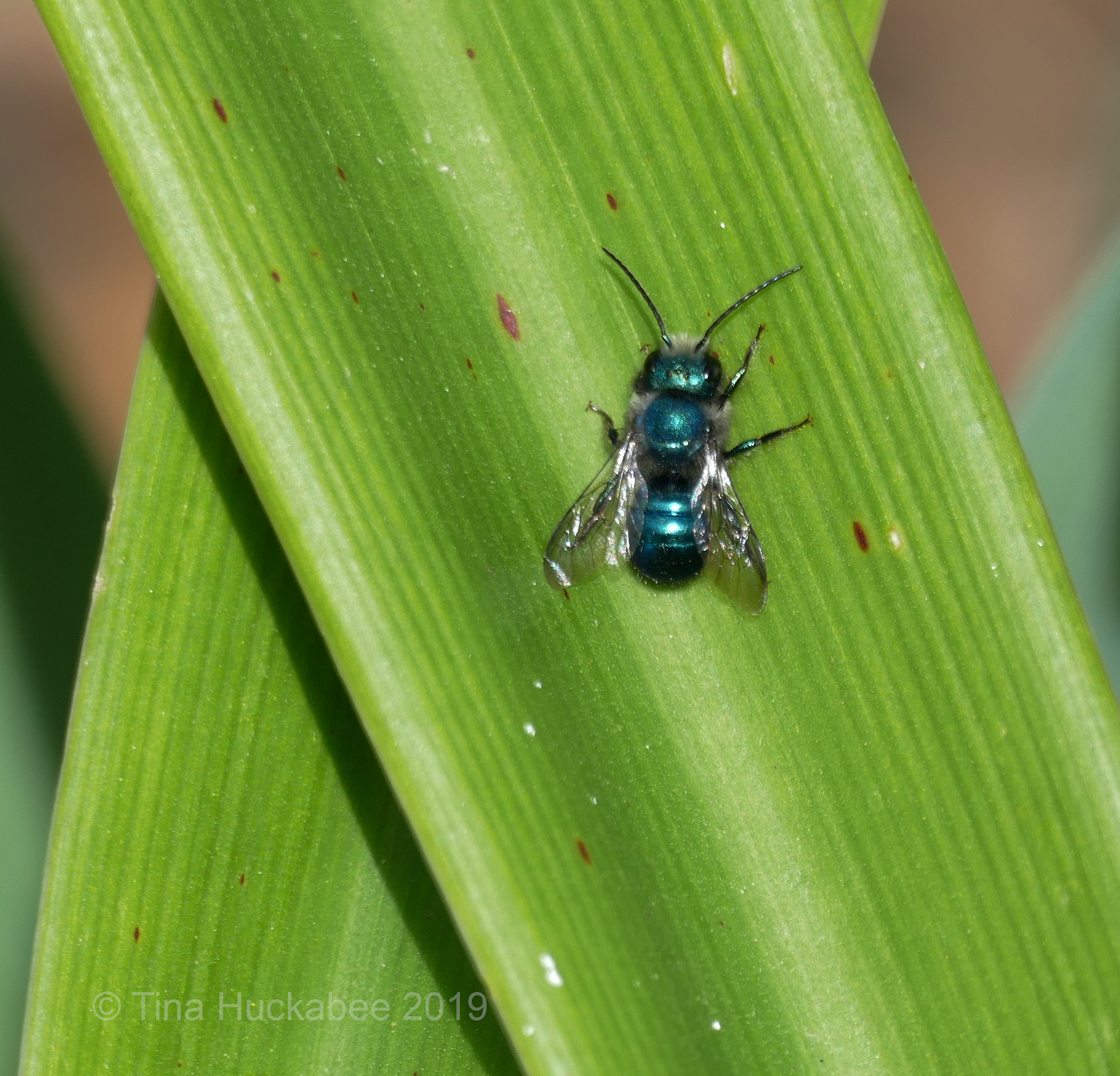
Ah, the winter blues.  More accurately, the late winter blues.  Blue Orchard Mason bees, Osmia lignaria, are exiting their year-long incubation chambers and buzzing my garden.

The goal for their short lives is to mate, rummage around flowers and foliage for nesting material, lay eggs, and pack the eggs safely to ensure the next generation of bees who will appear, on cue, next February.

The blue bee bonanza is an annual event in my garden.  These beautiful insects–an eye-popping, rich, iridescent blue–zoom from the native bee houses where they grow up, to the garden and beyond, and then back again, as they mate and then gather pollen and other material for the next generation’s nesting chambers.

These bees are important for commercial orchards, but thrive in welcoming home gardens, too.  In our garden, we’ve placed several boxes with drilled wood and lengths of cut bamboo.  These bee houses are utilized by a variety of native bees throughout the year.  Because the Blue Orchard bee adults emerge in February, they’re the first native bees to pack away their babies in the bee houses.

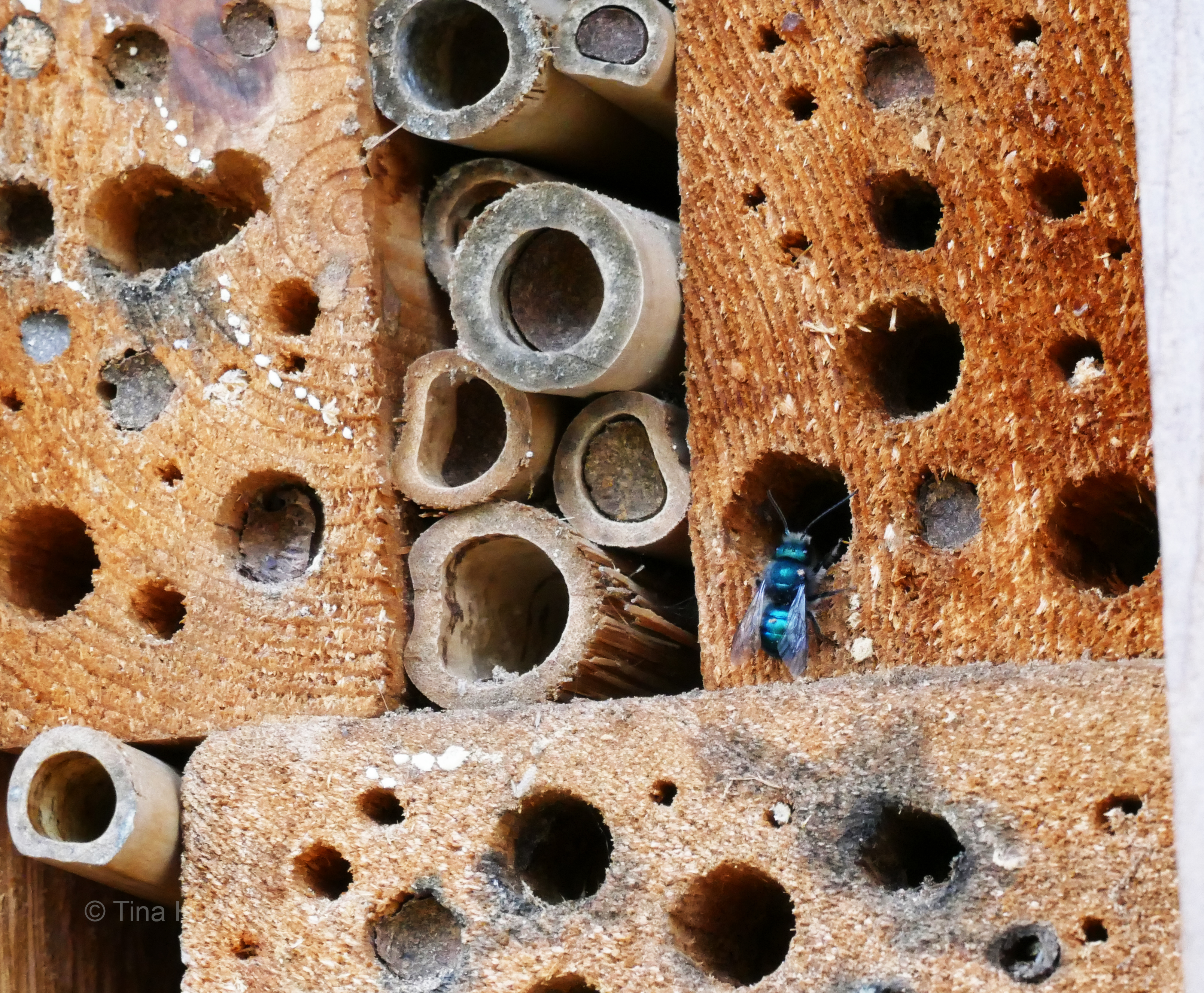
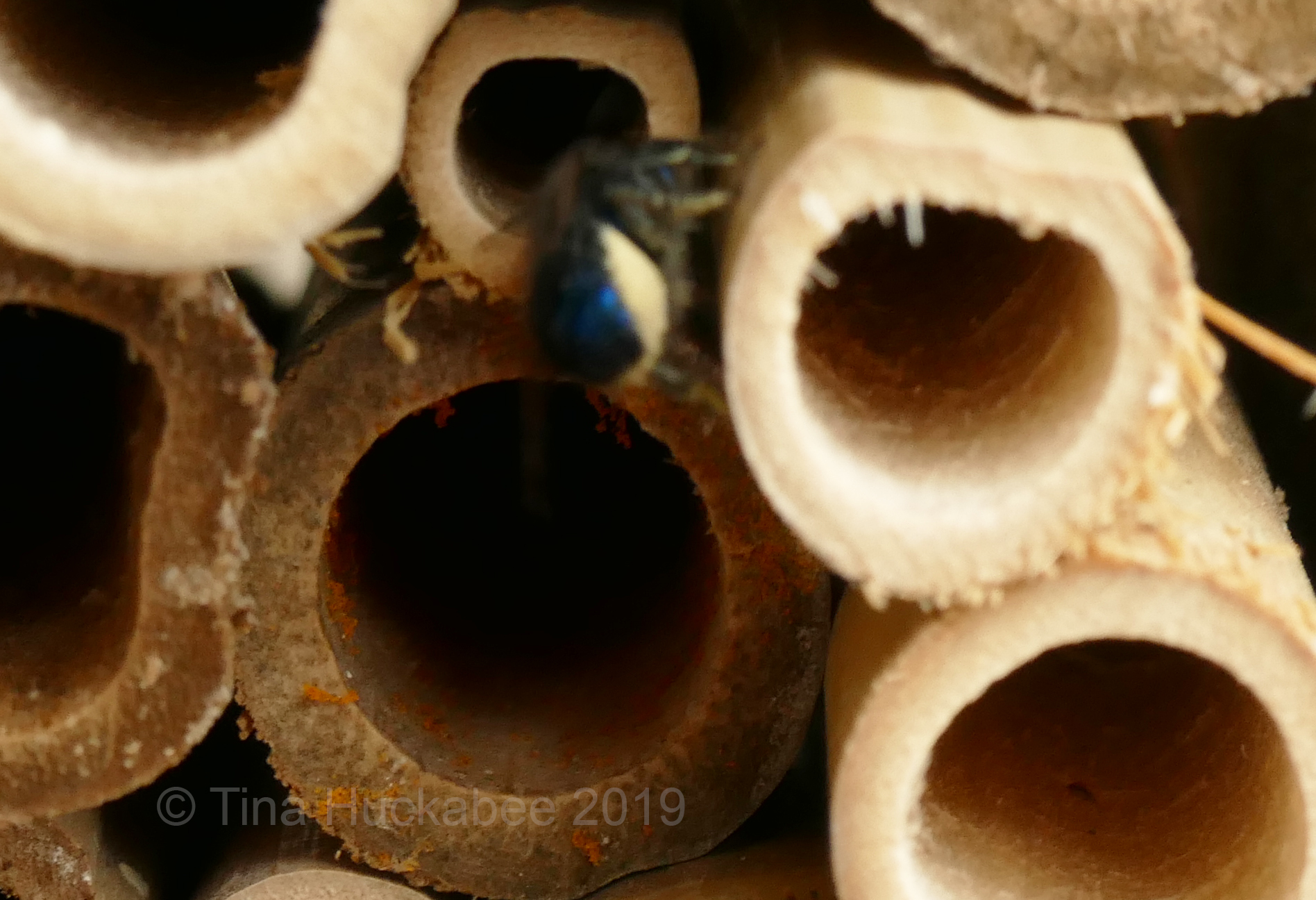
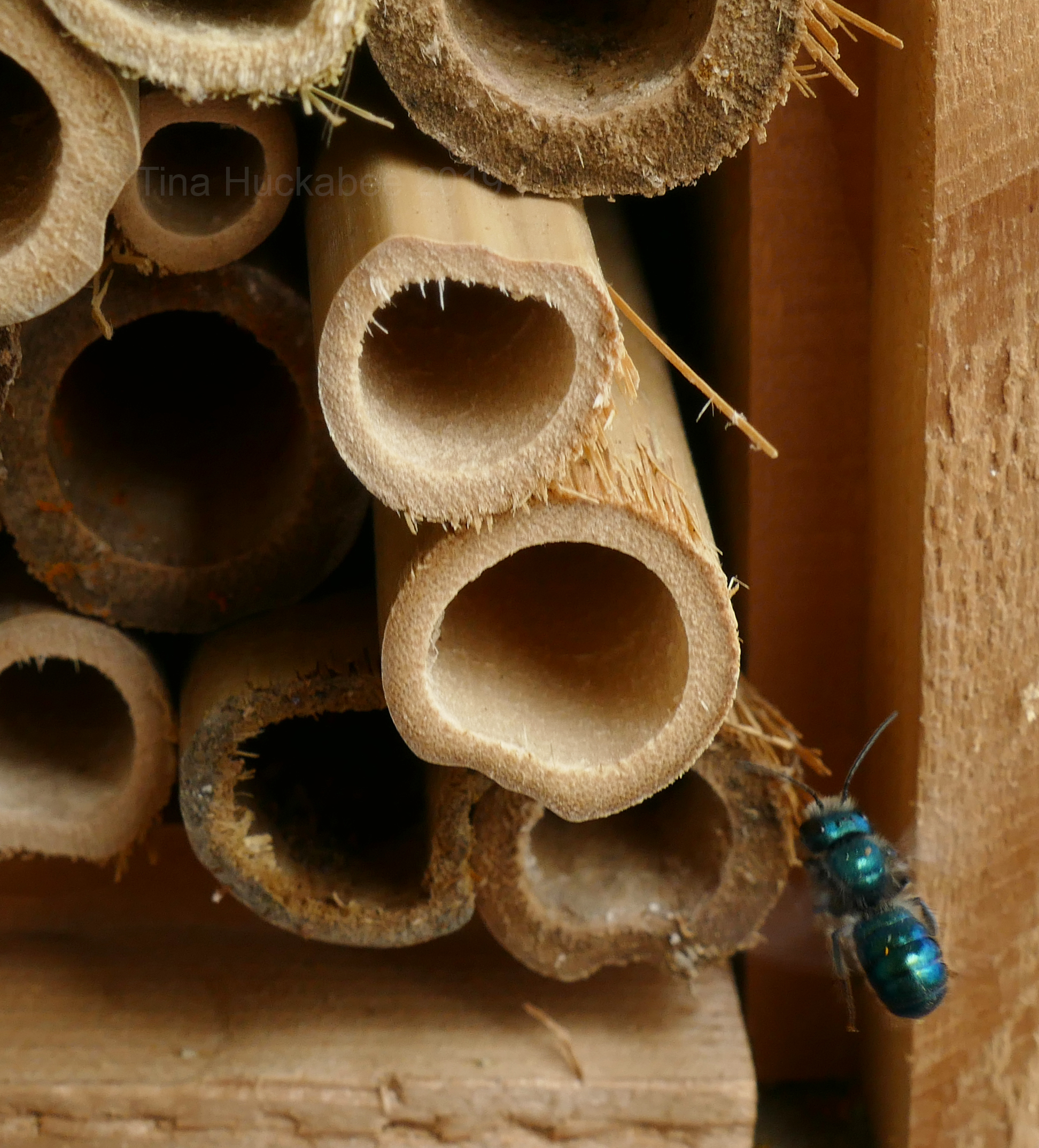
Packed nursery holes, as well as some where a bee (or bees) have exited, and a new adult.

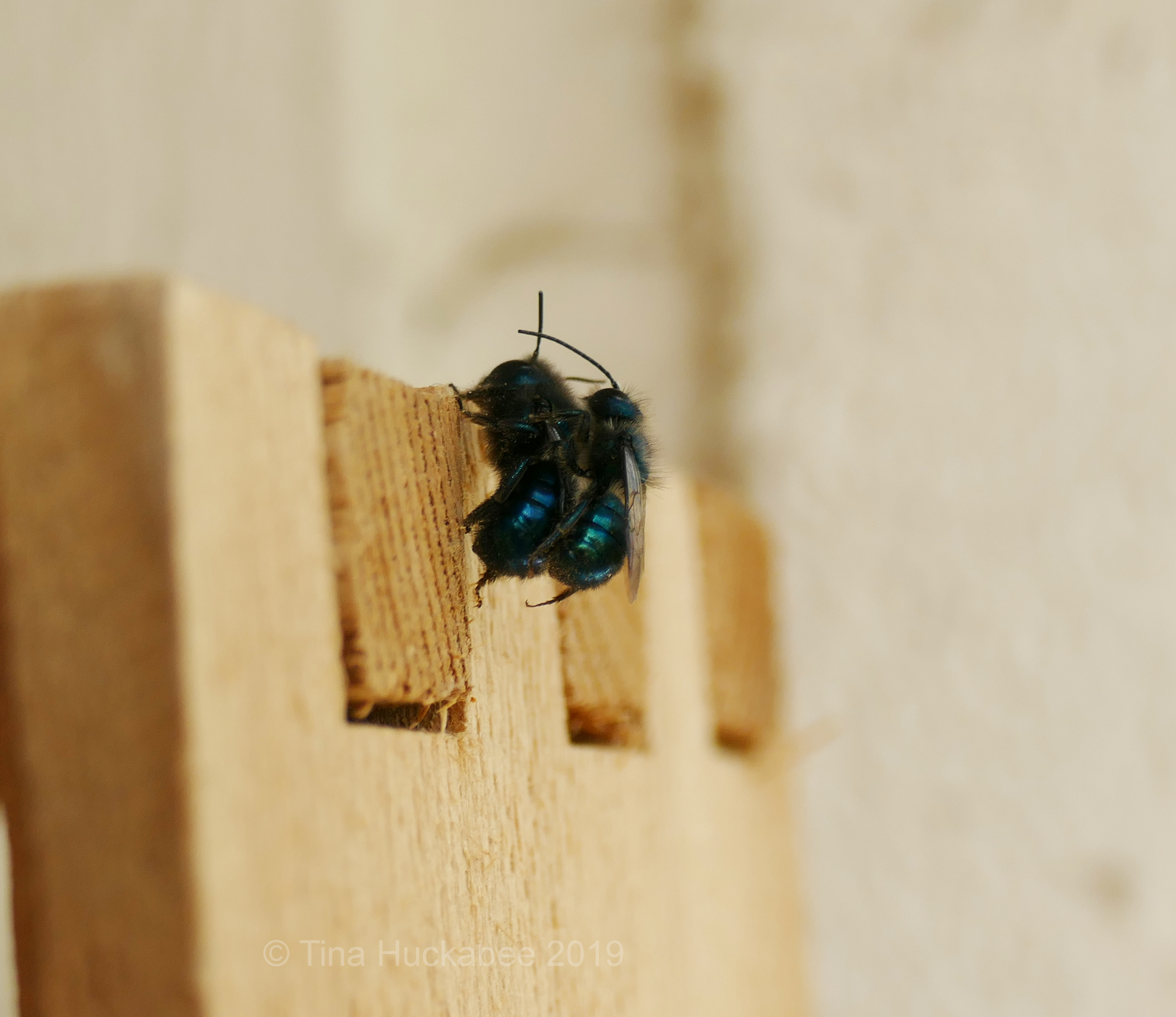
After mating,

…the females begin their egg-laying process in a hole in wood or masonry which is of a size and length that the adult female finds appealing.  The first eggs laid–those at the back-end of the cylinder–are female, and the eggs at the front–potentially the most exposed–are male. Between each egg laid, mom bee builds a wall of mud and pollen so that each is snuggled into its own room.  The entire nursery, all chambers therein, is then sealed firmly until the next year.

Do the girls get pink rooms and the boys, blue?  Nah, the rooms are gender-neutral, as far as color choice goes.  However, gender differentiation is present: the female eggs-larvae-adults are at the furthest end of the nursery cylinder so that those most responsible for successful procreation are best protected, or so suggest the entomologists who study these bees.  The male eggs-larvae-adults are situated at the front of the nursery cylinders, emerging as adults first, so that they’re ready, eager, and awaiting their potential mates.

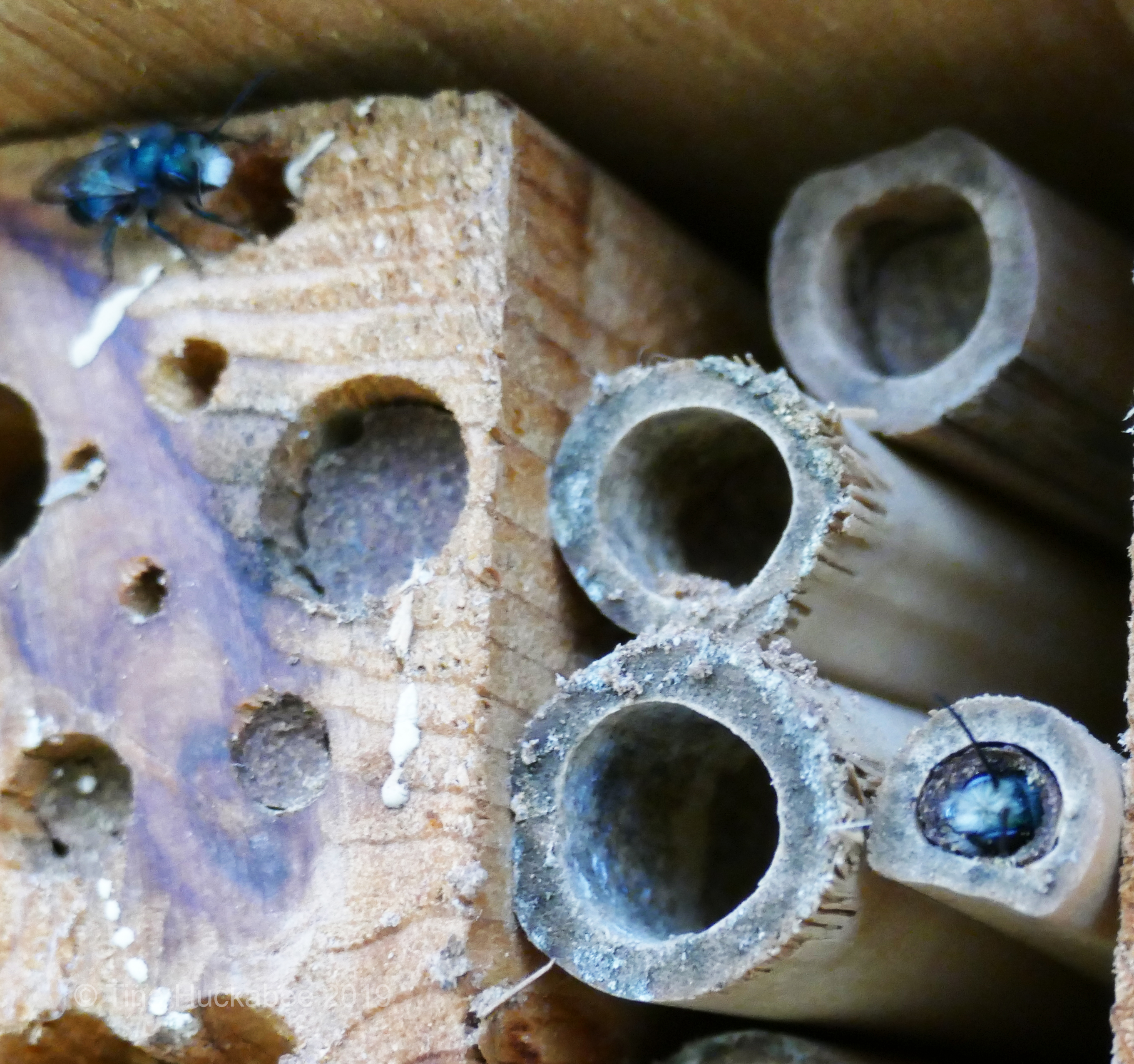
The two bees in this photo are males; one is fully emerged, the other peeking out, ready to take on his corner of the world.

Males have a white patch on their faces which is a mustache-like clump of white hairs.

Hairy dudes.

This fella rested on an upturned plastic bin under one of the bee houses.  He posed handsomely for me.  Or was he challenging me to a duel?  Or perhaps wondering what I am?  Who knows what a bee thinks?

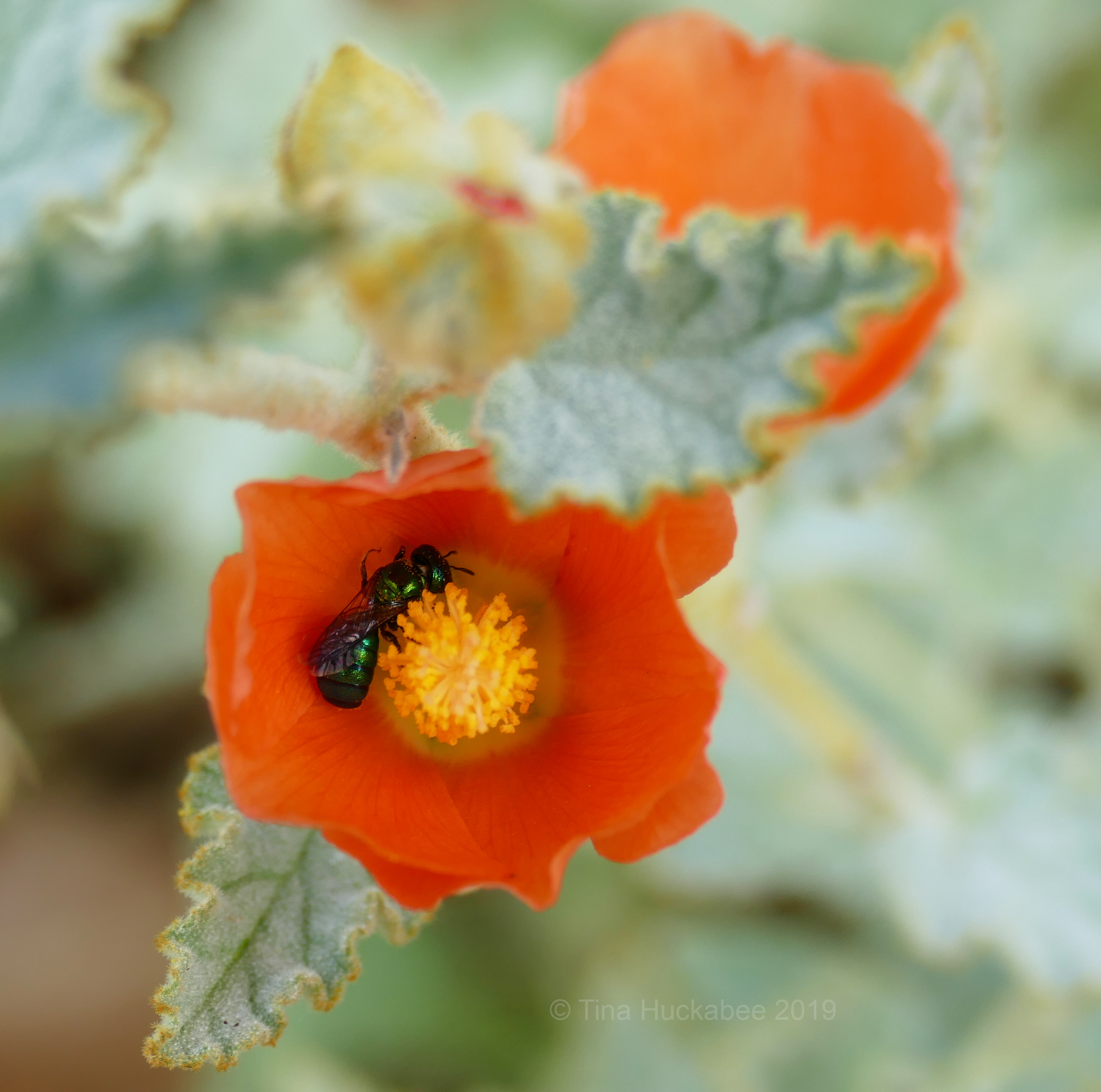
The females (with the males, of course) mate, then begin preparations for laying eggs and provisioning for their offspring.  This female wriggled and writhed around the pollen-laden center of a Desert mallow bloom. 

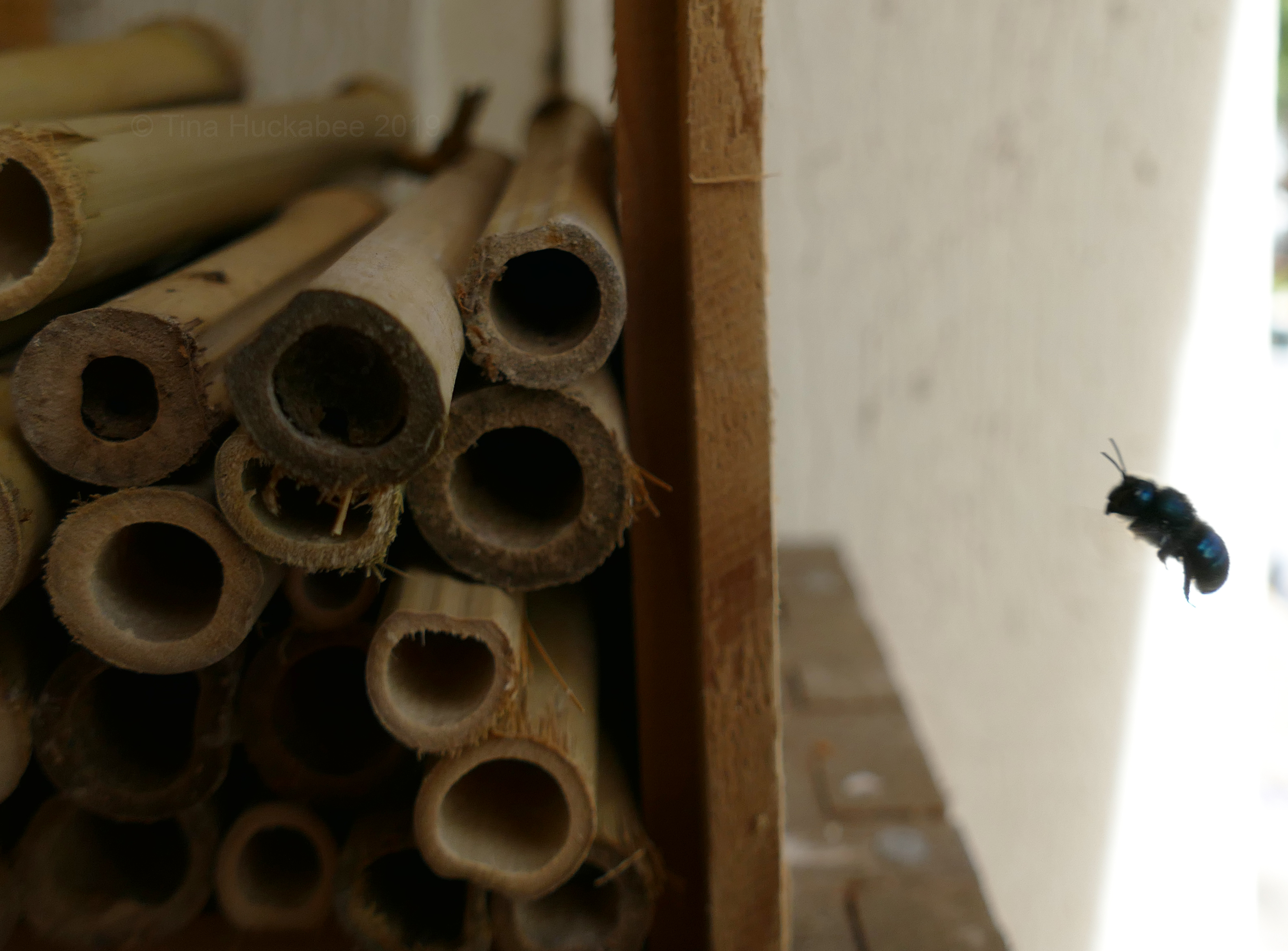
Unlike honeybees, who carry their pollen packs on their legs in what are formally known as corbiculae or pollen baskets; I call them pollen pantaloons, but that’s just me. Blue Orchard bees,  members of the Mason bee family, carry gathered pollen on their tummies.  This is the best shot I  managed of a female heading into a nesting chamber with pollen.  These gals are fast fliers!  I’ve observed creamy white pollen-coated tummies, as well as cheery yellow and orange, color depending upon what bloom, or blooms, the female worked.

The females fly into the holes head-first, making their way to the back of the cylinder, then working their way forward–one egg and egg prep–at a time.  Mom bee rolls the pollen into balls, adding nectar and microorganisms, to make pollen bread. Each egg is laid on its own ball of pollen bread, which will be the food source for the larvae.  A mud wall is built, sealing in the egg and its food source.  Then mama works on the the next egg and chamber, so it goes until she reaches the front of the hole, which she seals thickly with mud and pollen.

The female has chosen this bamboo cylinder for her nursery. To the left, see the two cylinders with holes; adult bees, plopped in last year, have exited their nursery chambers.

I don’t grow any fruit trees, though I have some early spring blooming trees in my garden  There are flowering fruit trees in my neighborhood–peach, apple, and pear–and I expect that the blue bees nesting my garden visit those flowers.

Building native bee houses, or hotels, is easy.  Using untreated wood and providing a variety of different sized holes for different sized bees, you’ll attract a wide array of native bees to your garden.  You can even leave cut logs from downed, or pruned, trees in your garden, and with some aging of that wood, the native (carpenter) bees will find them.  Check out these links for instructions and ideas about attracting these fascinating and beautiful pollinators to your garden.

https://www.nwf.org/en/Garden-for-Wildlife/Young/Build-a-Bee-House

http://www.foxleas.com/make-a-bee-hotel.asp

As much as the appearance of new buds on trees or the thickening of bloom stalks on spring perennials, the arrival of the adult Blue Orchard bees heralds the onset of Spring in my garden.  New life emerging and continuation of the alliances between flowering plants and their pollinators confirms a time-honored environmental zeitgeist of the natural world.

What indicates spring–or autumn–for your garden?  Please share your wildlife garden observations and insights, then leave a link to your post when you comment here–and happy wildlife gardening for March!

Winter(?) Blooms

While it flies in the face of garden normalcy, it’s been a good winter for many of the flowering perennials in my garden.  Few plants were sent deep into dormancy, so flowering florals have been a constant.

This cheery cool season bloomer has brightened the edge of a garden for months.  Four-nerve DaisyTetraneuris scaposa, is a tidy little thing.  Evergreen slender leaves serve as a base for sprightly yellow daisies.  Even after a hard freeze, this is a typical winter bloomer.


Owing to the mild winter, there are a couple of Purple coneflowerEchinacea purpurea, eager for spring to begin.  Interestingly, the established plants, some of which are years old, haven’t bloomed up yet.

This group volunteered themselves for a pathway decoration.   I’ll leave them be–who am I to yank them up when they’re so charming?


Another beneficiary of our lack of freezes this winter are the Tropical sageSalvia coccinea.  This particular one is red, but the white ones have bloomed all winter too.  They’re a little lanky now, but I’m still enjoying the accents of red, so they’ll remain until the new growth catches up with the old-growth blooms.


A cousin of the S. coccinea is this salmon-colored Autumn sageSalvia greggi.  It’s not a bountiful bloomer, but only because it grows in too much shade.  Still, the blooms are beginning and will grace the garden for the next couple of months, taking a break during our hot summer, resuming flowering in fall.


Another “victim” of the mild winter is the Mexican honeysuckleJusticia spicigera.  This is a funny plant as it doesn’t have a specific bloom time. In mild winters like the one this year, it blooms all winter, well into spring.  In a “normal” winter (whatever that is), it’ll be knocked to the ground, requiring several months to flush out before flowering ensues.

I’ve thoroughly enjoyed these winter-orange blooms and so have the honeybees.  Most of the native bees are dormant for now.

Mexican honeysuckle is also a great plant for part shade–yay for me as I have plenty of that!


My two red roses have produced luscious blooms all winter, non-stop.  This, the Martha Gonzales rose,

…and its botanical doppelgänger, the Old Gay Hill rose.  Easy to grow, disease-free, and gorgeous against the blue Texas sky, both roses are head-turners.  I’m not going to prune them just yet, against common gardening wisdom;  there will be time later for that.


In the last week or so, the Southern dewberry, Rubus trivialis has burst out in blooms.

The sweet, snowy flowers attract skippers and honeybees, and dot the back of the garden, clambering up a fence and creeping along the ground.

The buds are a pure pink, so provides a bit of a color two-fer.  Alas, it’s more than likely that the birds will pick off the berries before I get to them.


I finally found the one spot in my garden for Desert mallow, Sphaeralcea ambigua.  Native to regions west of Texas, this lovely requires full sun and excellent drainage.  It’s a high elevation shrub, but the best I could do was pop it into a raised bed.  I love it, blooms or not, and the tangerine flowers paired with that grey-green ruffle of foliage is a winning combination.

The native Blue Orchard bees, recently awakened from their own year-long dormancy, have enjoyed the pollen provided by this mallow.


A passalong plant,  Giant spiderwort, Tradescantia gigantea, delivers blasts of purple for this gardener and loads of nectar and pollen for the pollinators.  Honeybees are in a frenzy gathering the pollen as they gear up for spring.

I have quite a few clumps of this spiderwort and they seed out prolifically.  They’re easily pulled up and tossed into the compost, or even better, gifted to unsuspecting gardeners.

I like that the insect (a fly or native bee?) is also interested in the plant.  I wonder if he/she is responsible for the hole in the leaf?

Purple power rules the garden with these spring pretties.

Most of these perennials and shrubs bloom at least some during a colder winter, but this year, that floral show has been richer.  Of course, as we enter March, the month of spring, an overnight light freeze or two is predicted in the next few days.

Typical.

The native plants will be fine, the irises, reaching to the sky and starting their blooms, might be damaged.  Time–and actual temperature–will tell.  Regardless, spring is now knocking at the garden gate and winter is mostly done.

How has your winter garden fared?