Garden Blues

My garden has the blues and I couldn’t be happier about it.
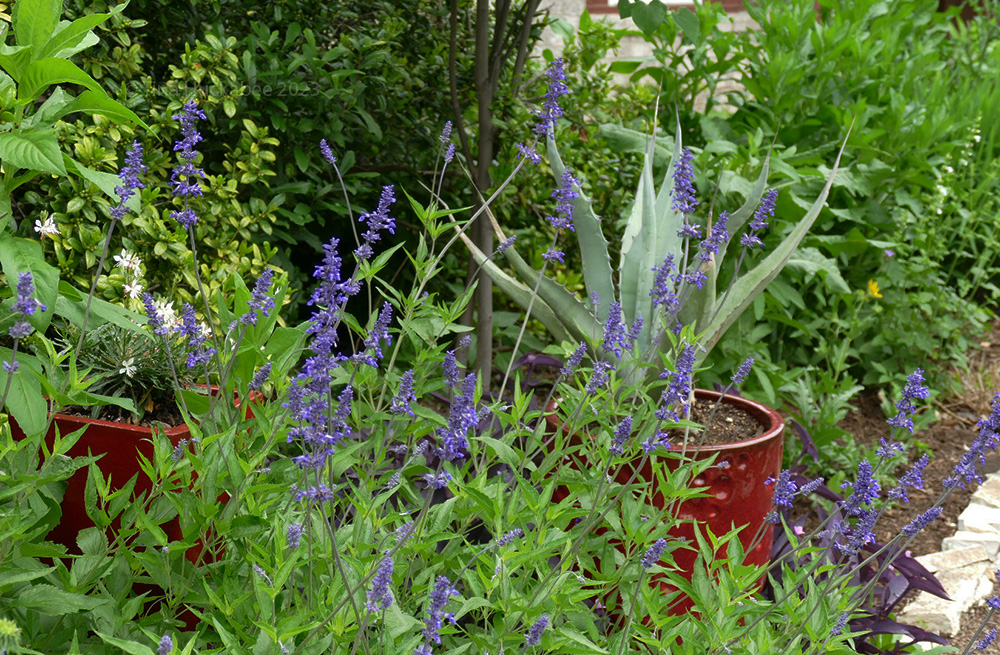
The full sun front garden is bursting with color in its second year of being, the blues not depressing either the garden or the gardener. I’m fond of blue flowers and grow several different species, most of which are native to Texas.
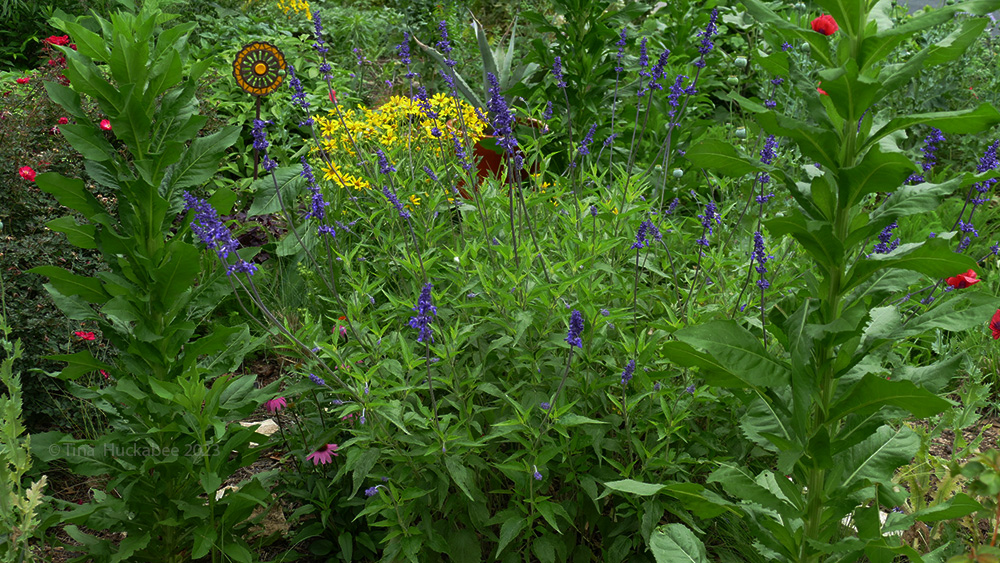
In this new garden I’ve planted five clumps of perennial Mealy Blue Sage ‘Henry Duelberg’, Salvia farinacea; all come from a plant I purchased years ago. This salvia is a late spring/summer/early fall bloomer and spreads by both seed and root. I should add that while it spreads, I don’t consider it aggressive; if a sprig pops up, it’s easy-peasy to yank out. It’s a dream to transplant: pull up a clump with roots, stick said clump in the ground, water a few times and it grows and blooms, beckoning the pollinators!

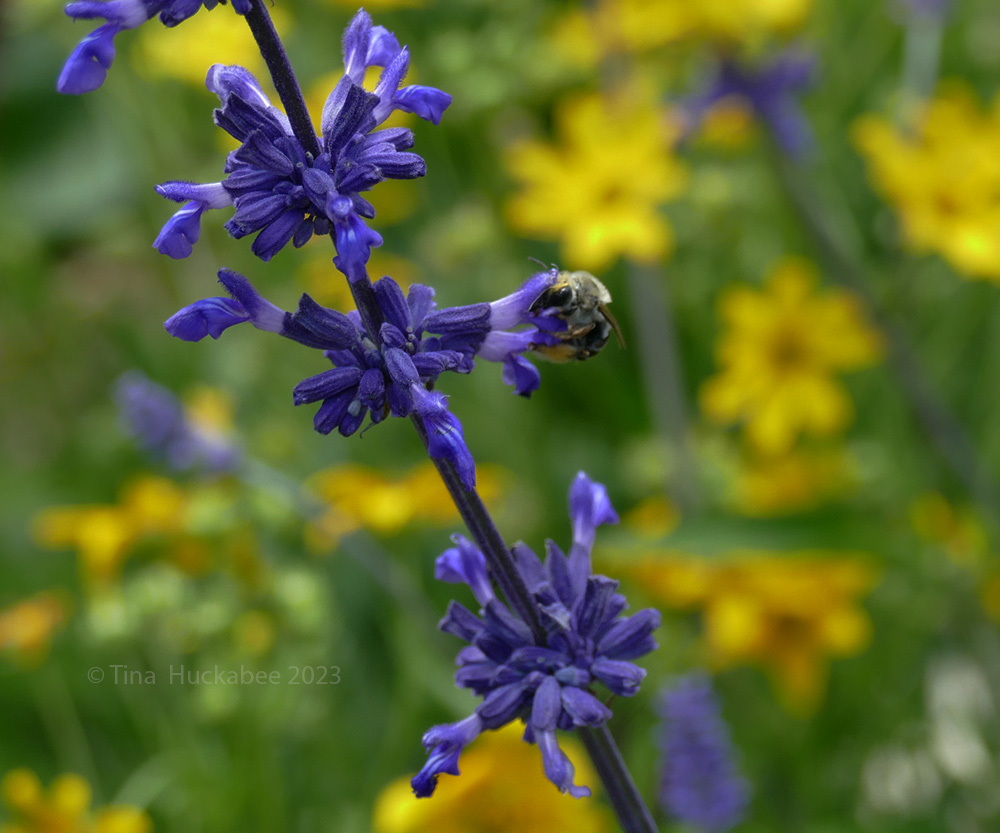
Mealy Blue Sage is favored by a wide variety of pollinators, like this honeybee. She is all-in for these small blooms.
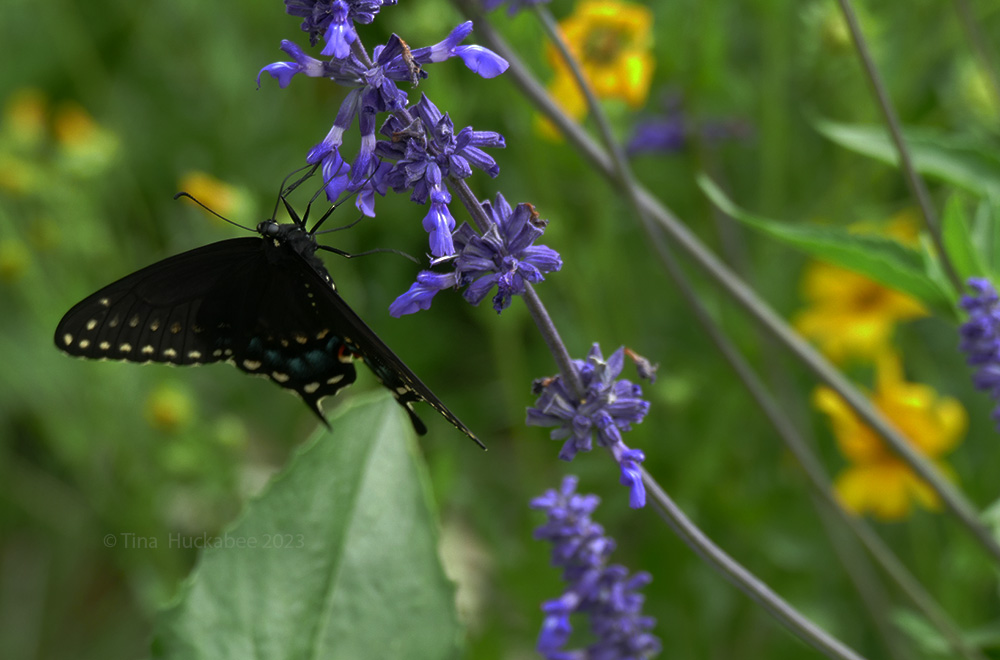
Bigger pollinators, like this Black Swallowtail, Papilio polyxenes, are fans of the mealy blues, too.
Another blue that makes me cheerful is Indigo Spires, Salvia x ‘Indigo Spires’. This perennial is a hybrid cross of the native Salvia farinacea and Salvia longispicata. I planted this specimen in my back garden a couple of years ago where it received some afternoon sun, but when the front garden morphed to full sun, I moved it there where it would get most-of-the-day sunshine, be a happier plant, and bring on the blues. Indigo is bigger than the ‘Henry Duelberg’, with longer bloom spikes and larger leaves.
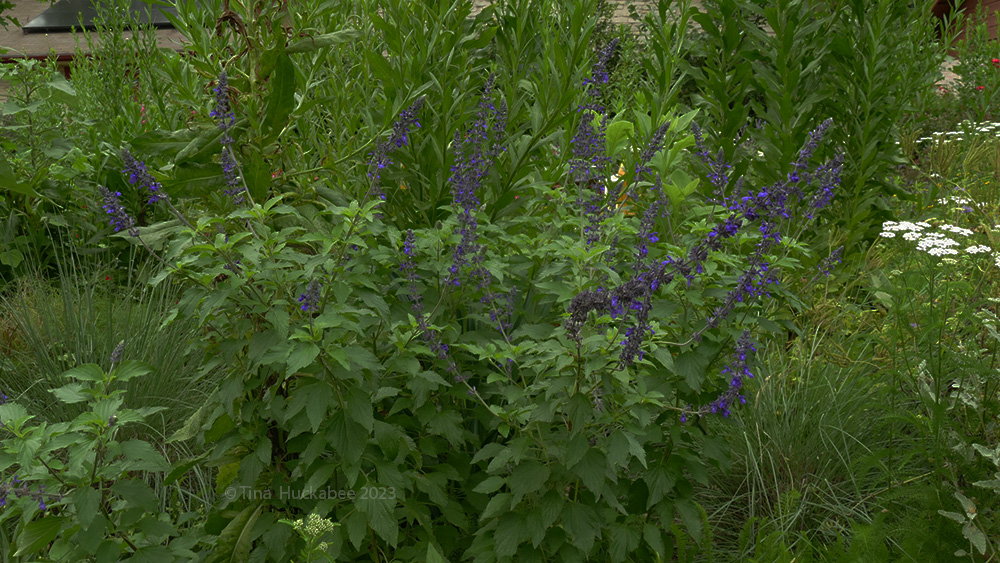
Many years ago when my back garden was full sun, I grew an Indigo Spires. In late summer and fall afternoons, there were often fifteen to twenty American Bumblebees working these blooms. Sadly, I haven’t seen that many bees on this plant, but the bees that are around definitely make a bee-line for these blues.

If there was an award for blues in the garden, I think it would go to the Blue Curls, Phacelia congesta. I didn’t mean to have so many this year and I should have culled some of the seedlings, but I am a softy. I have a hard time removing seedlings of desirable plants unless I have someone who will take them to another garden space. These are Texas annual wildflowers, so leaving them in place didn’t stress me too much as I knew that they’d be done with their show by mid-May when I could remove them, making room for the summer perennials.
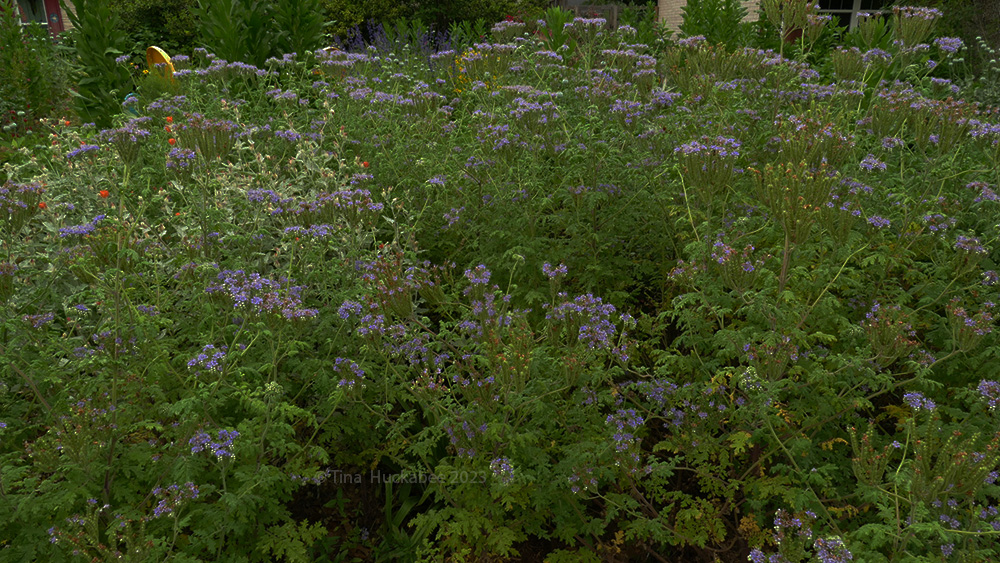
When the Curls reached the zenith of their flowering, there was a constant gentle buzzing in the garden and movement throughout the garden’s air. Honeybees, Carpenter bees, a myriad of tiny native bees, skippers and larger butterflies all flock to partake of these charming blue-violet flowers.
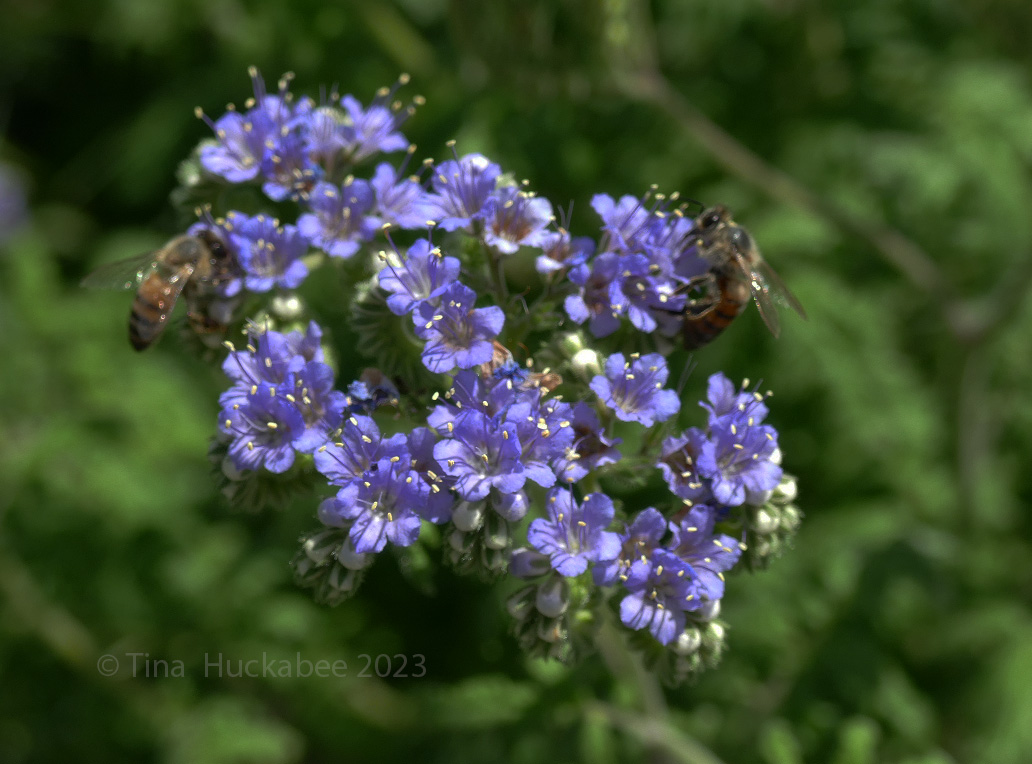
Honeybees sharing a meal of Blue Curl nectar and pollen.
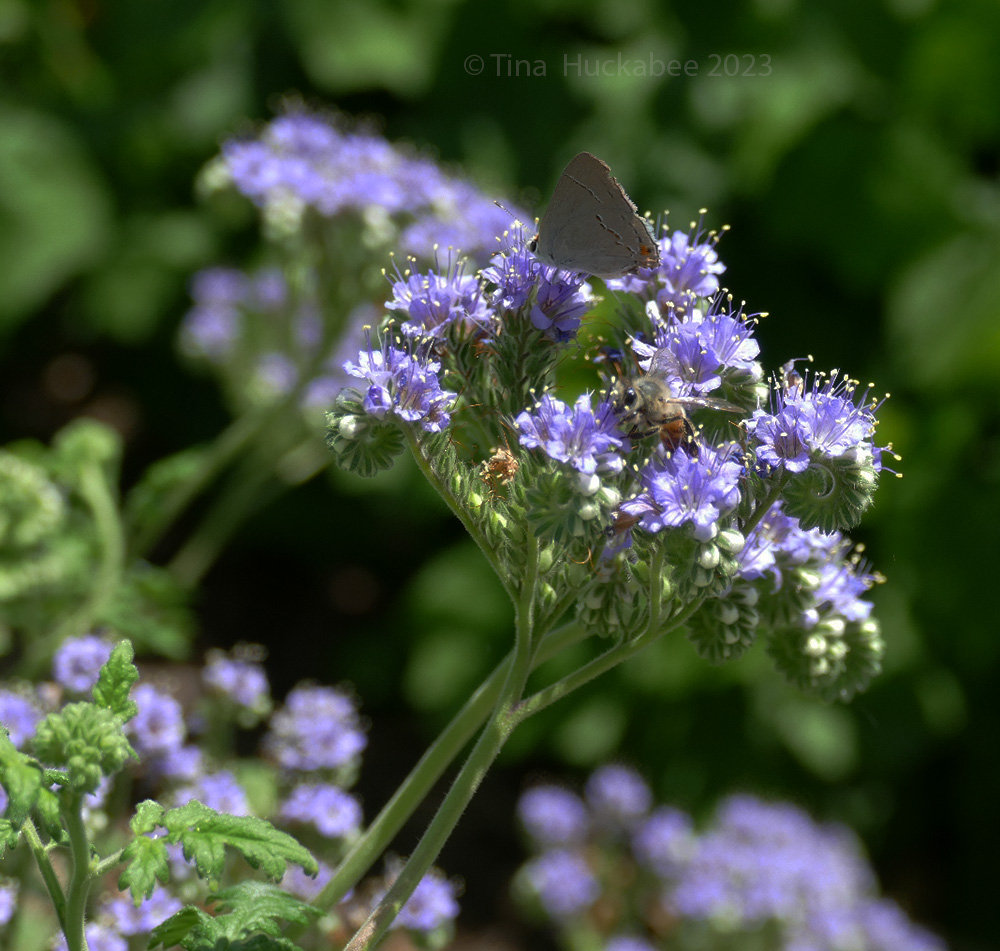
Honeybee and Grey Hairstreak each mind their own business as they sip the sweet stuff.
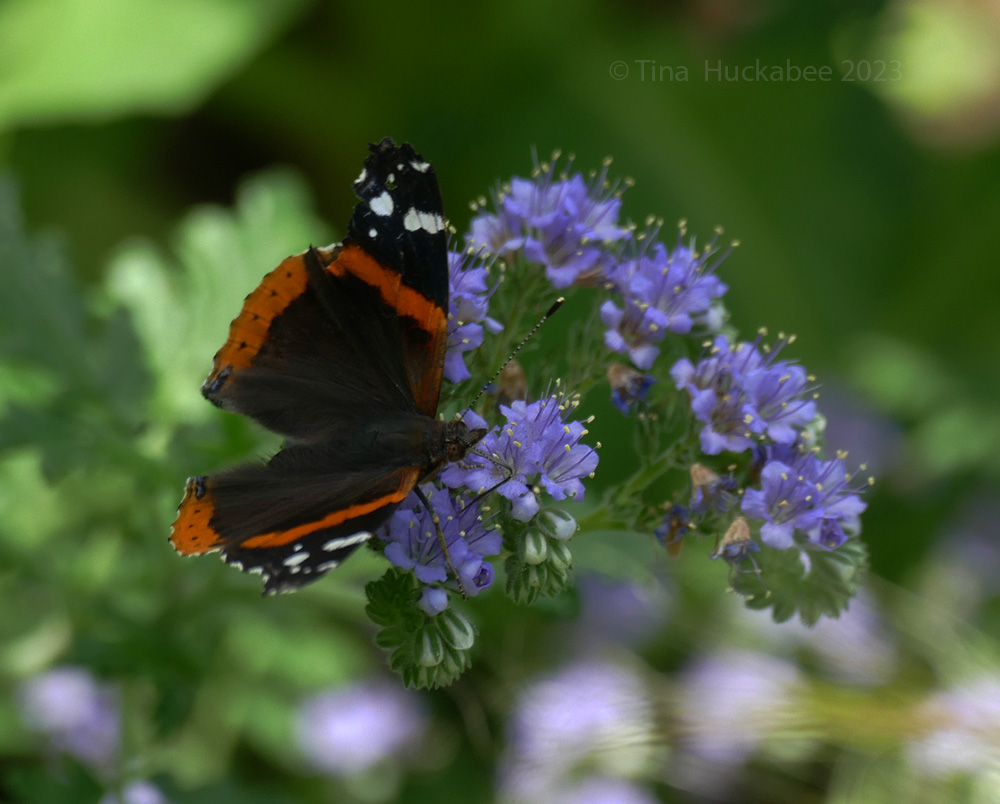
Red Admiral (Vanessa atalanta) on a Blue Curl.
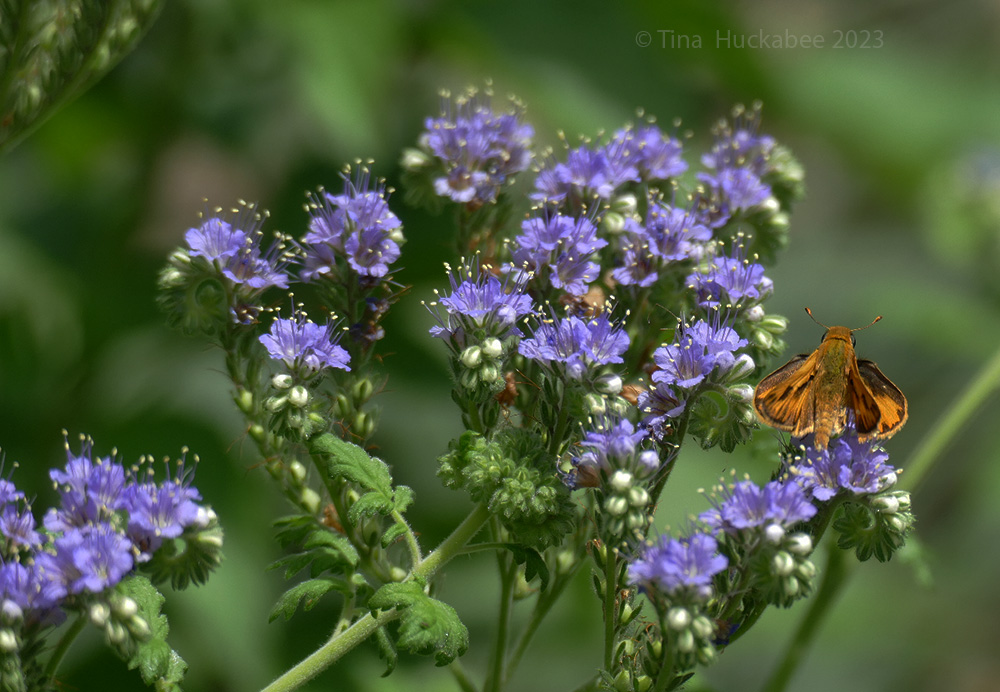
Fiery Skipper (Hylephila phyleus) lights up the blues!

A variety of beetles and leaf-footed bugs got into the act of working these sweet blue blooms! Everybody, it seems, loves Blue Curls.
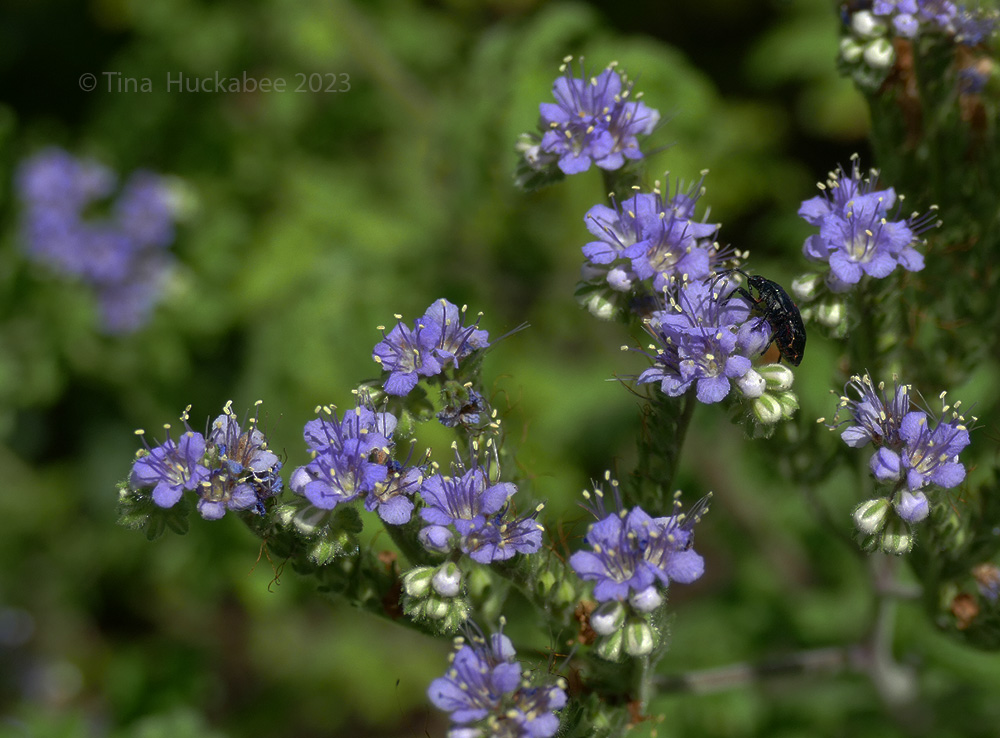
As the Curls’ blooms faded and the seeds developed, migrating songbirds were in the garden from dawn to dusk. I witnessed Common Yellowthroats, Lincoln’s Sparrows, Clay-colored Sparrows and Lesser and American Goldfinches noshing on the seeds and, no doubt, some of the tiny insects that were also on the plants. As these migratory birds fly northbound from my garden, they’ll pass along seeds to other places for next year’s wildlife.

Blue Curls are a cornucopia for wildlife. The insect and bird song, color, and life that these blue beauties brought to the garden during March and April eclipsed all other plants in the garden.

That’s why I didn’t remove them!

In the back garden, things are shadier, but the blues reign. Another violet-blue flowering plant is the perennial Heartleaf Skullcap, Scutellaria ovata and it thrives in part-shade.
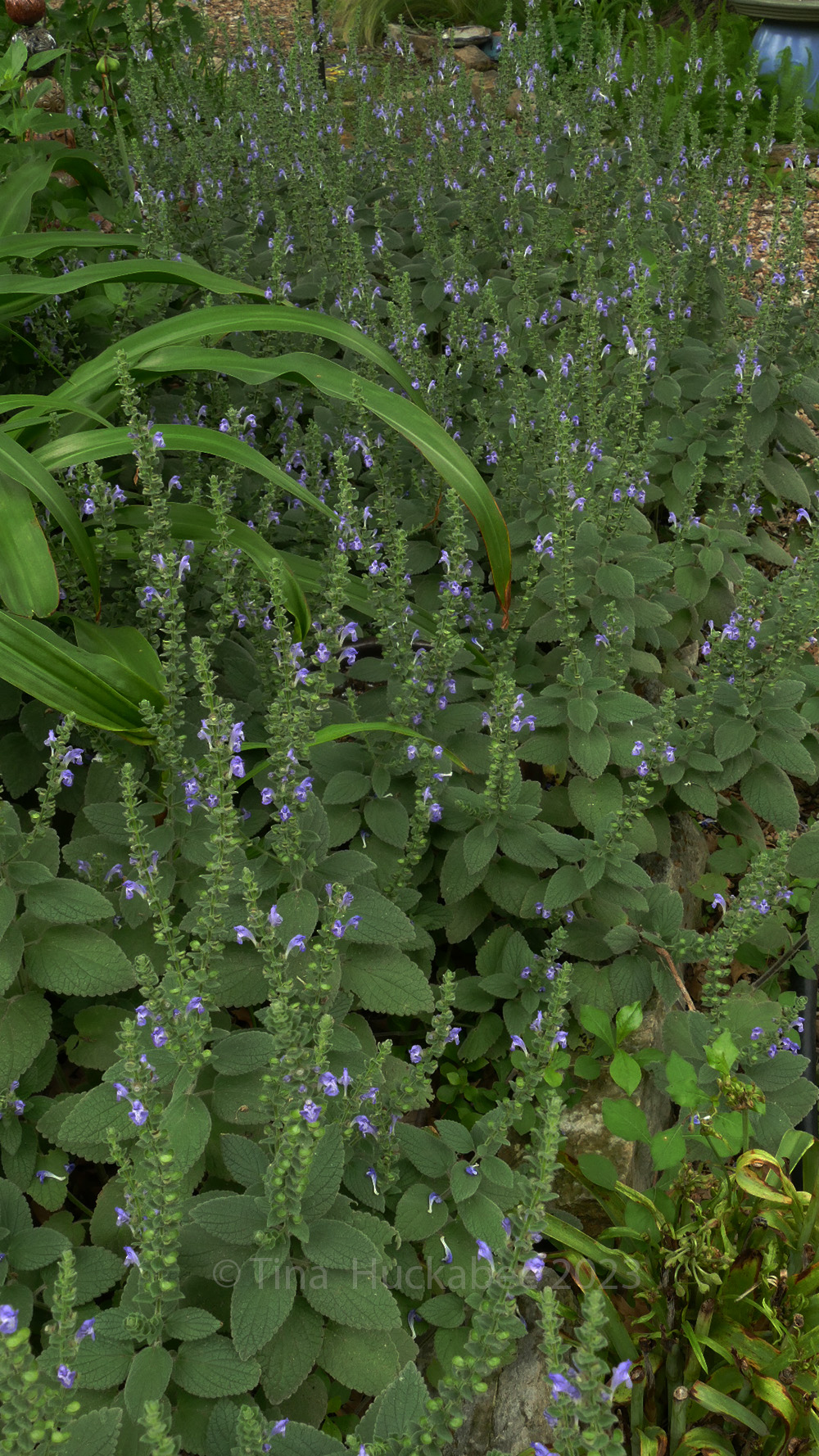
Velvety, grey-green foliage accompanies these diminutive blooms.
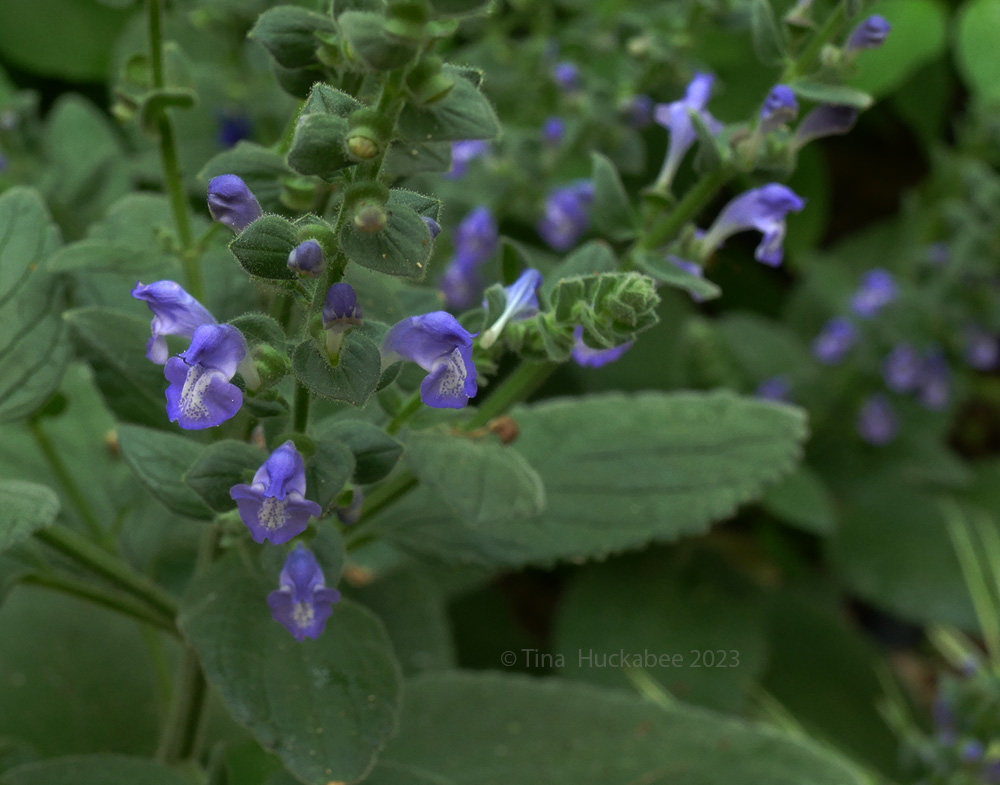
The grey-green stalks with fuzzy foliage appear in winter, fresh color against the freeze-rendered browns and tans. Heartleaf Skullcap spreads as a ground cover, adding blue bloom spikes atop the foliage from late spring through mid summer. Summer’s heat ends the blooms and fades the foliage; the plant eventually disappears. The gardener helps that process by shearing to the ground or pulling up the plant. Thick roots lie dormant in the soil, safe from the Texas heat, waiting patiently until cool winter, when it emerges with fresh stems and foliage, ready to grow and begin its cycle in the garden for a new season.

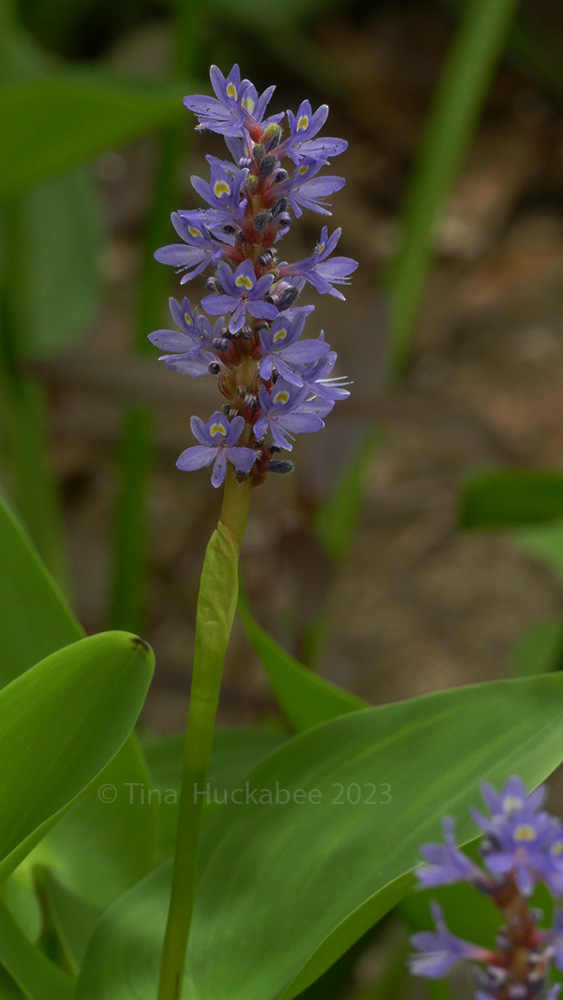
The pond’s water lilies are pink and yellow, but its bog plant, Pickerelweed, Pontederia cordata, rocks teeny violet-blue flowers borne on spiky stems. The plant sits in slow-moving water, blue spikes rise above luscious foliage.
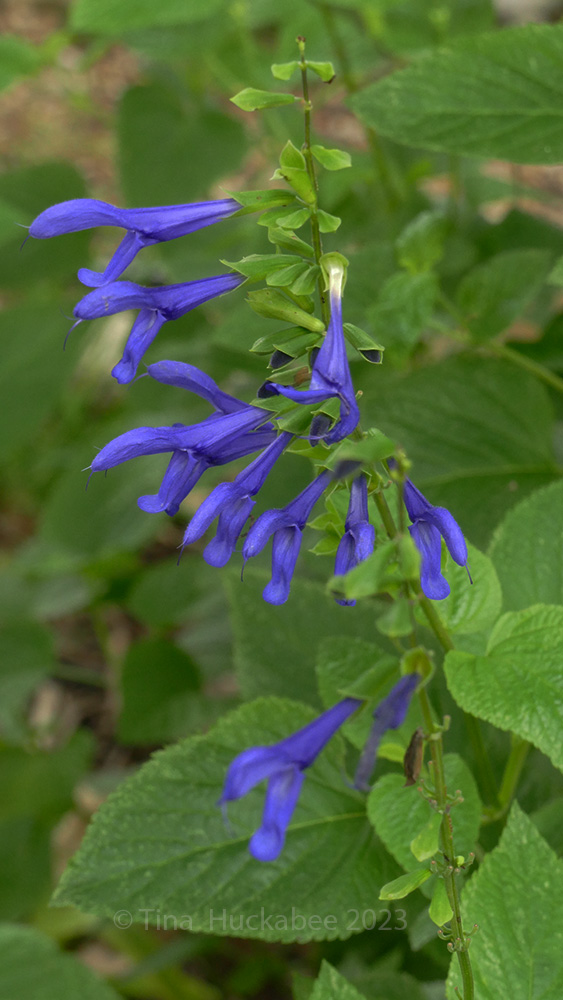
Many of my blues suggest a liaison with lavender or violet, but this final blue is a true blue: spring and autumn blooming Majestic Sage, Salvia guaranitica.
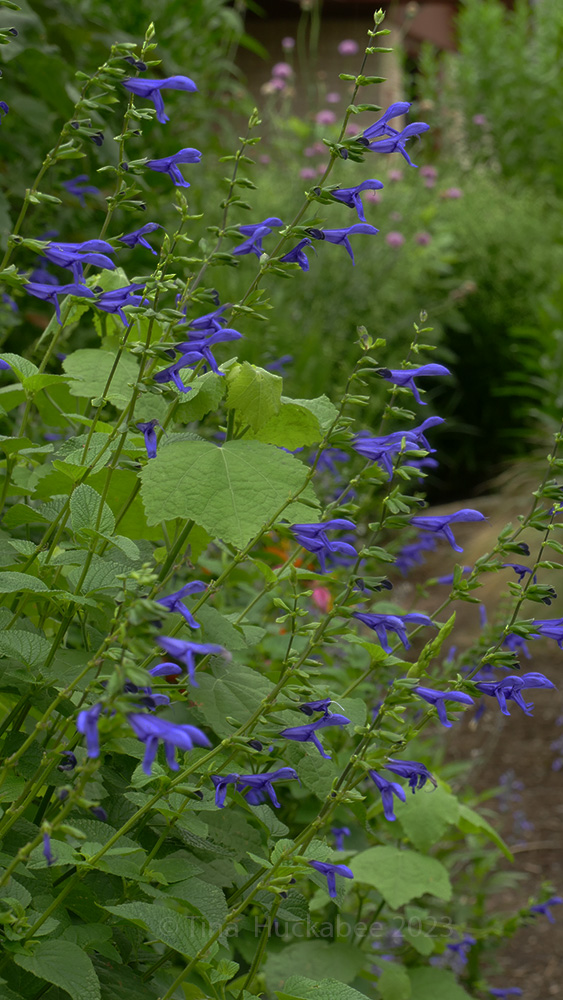
This is the only non-native blue that I grow; its home base is in Central and South America. A gorgeous, rich blue, the plant is colorful in spring and autumn, choosing to rest during the sweltering summer months. Most of the bees that visit nectar steal, though my honeybees and some of the tiny native bees crawl deep into the blooms for their sweet treat.
I grow a few other blues that will sing their songs in late summer and fall. The blues in a garden are the kind of blues we should welcome–for their beauty and for what they provide for the wild things we share space with. Add some blues to your garden, you’ll be happy you did!

It’s Purple Time

My garden is graced with purple:  purple blooms, foliage, and fruits continue with a seasonal tradition of a purple-to-lavender champion performances during the long Central Texas summer. Of course other colors dot the landscape, but plants which rock the purple hue thrive after months of heat, with (typically) little rain, and rule the month of August.  It’s purple time!

Foliage recovery is in full swing for this Branched foldwing, Dicliptera brachiata,            , which appeared unannounced, but welcomed, in my garden a couple of years ago.

Munched stems are recovering their green.

This restrained and unobtrusive little native perennial hosts the Texan Crescent butterfly.

Texan Crescent nectaring in spring on Golden groundsel.

My garden enjoys a nearly year-round population of these pollinators because I grow several of its host plants in the Acanthus family, including the Branched foldwing. The caterpillars do a nibbling number on the foldwing’s leaves, but the plant rebounds with aplomb, leafing out again and again, and setting blooms in late summer.

Dainty and unpretentious, the lavender–not really purple–flowers provide for tiny pollinators.


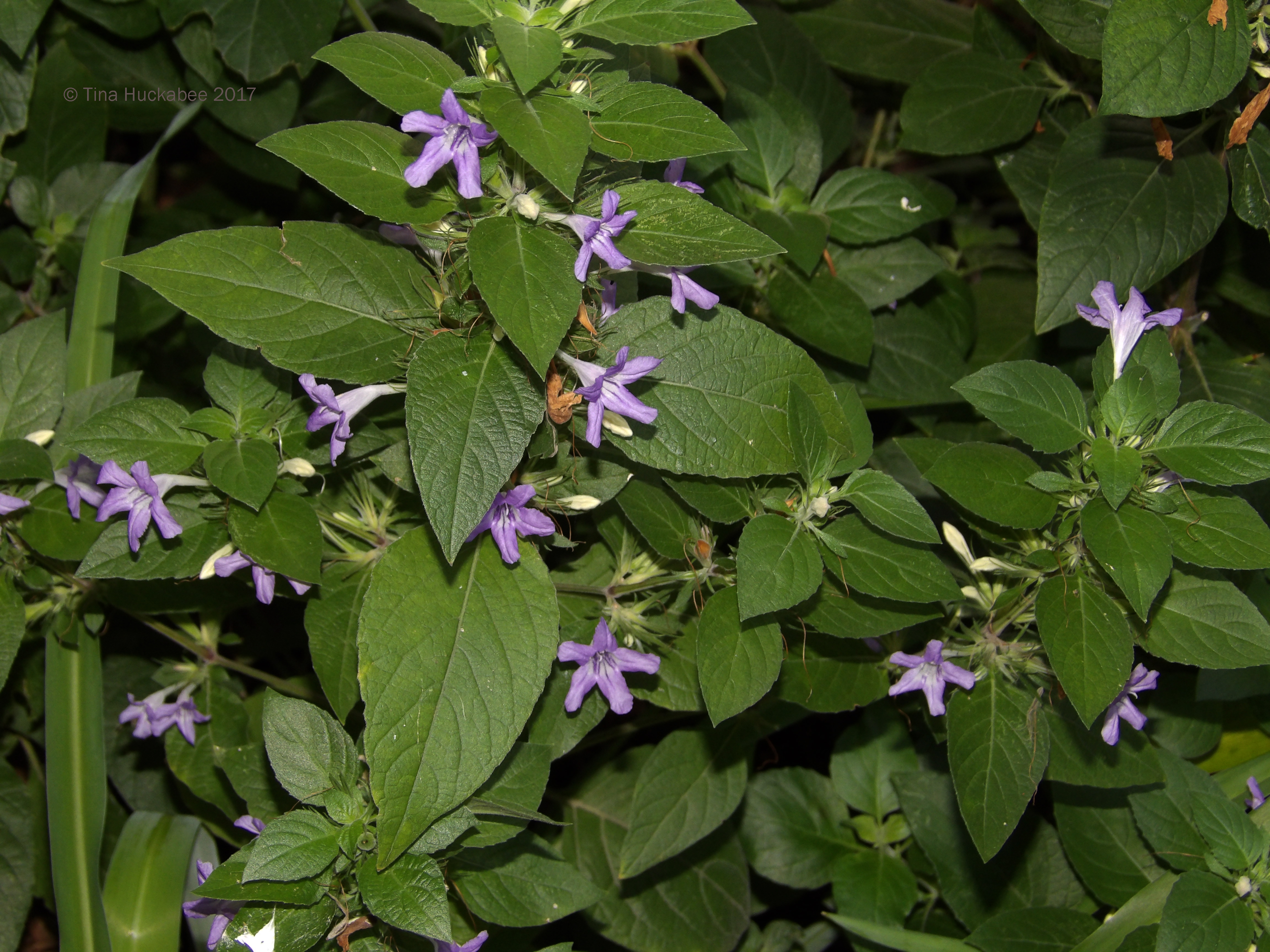
Drummond’s ruellia, Ruellia drummondiana, is another native Texan that loves the heat and demonstrates that affection with daily doses of purple goodness.

Opening early in the morning and closed by late afternoon, the blooms are loved by many-a-buzzing pollinator.  I’m rather fond of them myself!

I like the foliage, too. An attractive green-gray, it’s full and lush from spring until the first hard freeze–whenever that happens.  I like to mix it with some evergreen plants, so that there’s some winter action while the ruellia plants rest up for summer.

Cast Iron Plant, Iris, and Sparkler Sedge provide some winter green structure alongside the ruellia.


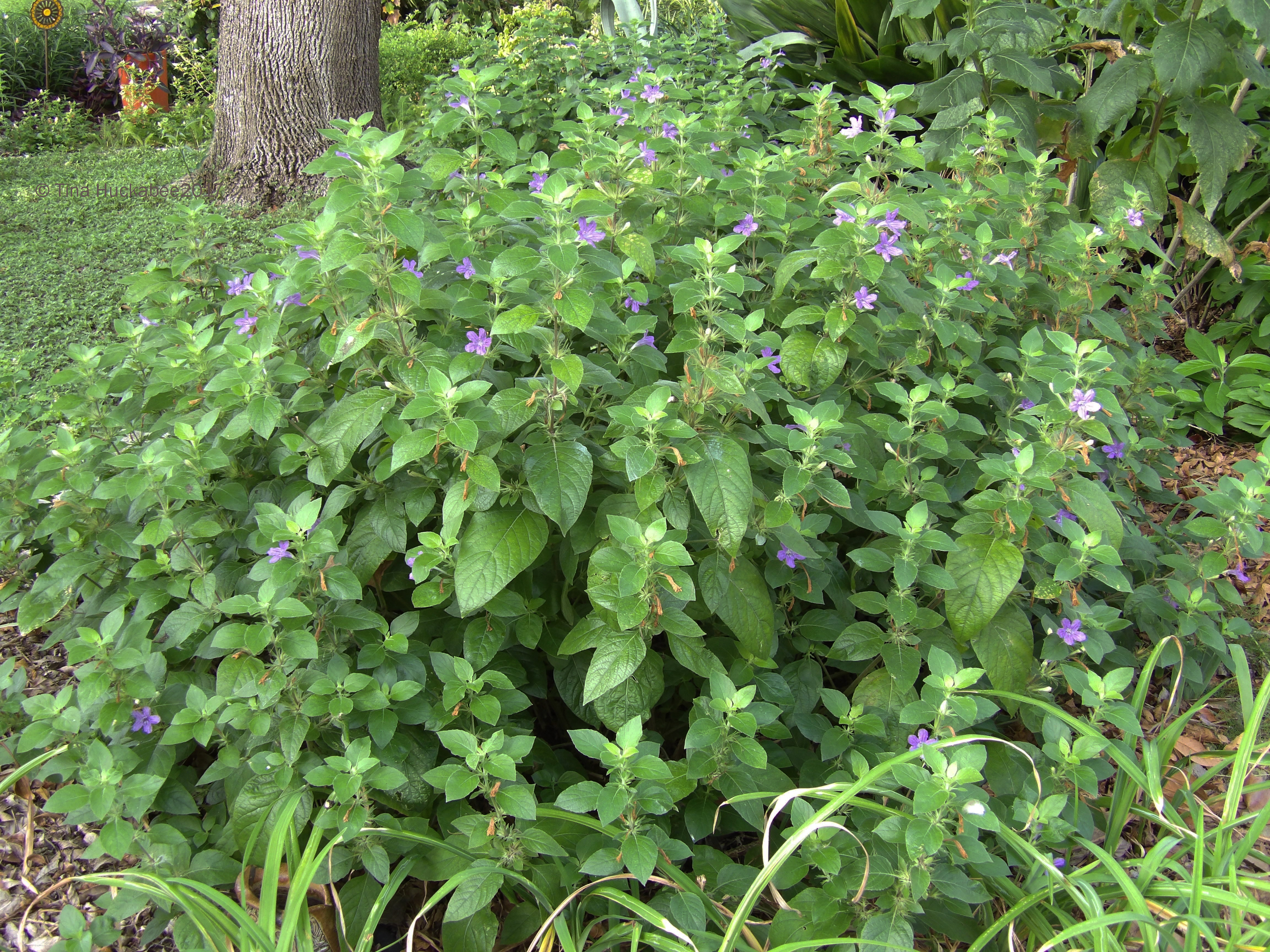
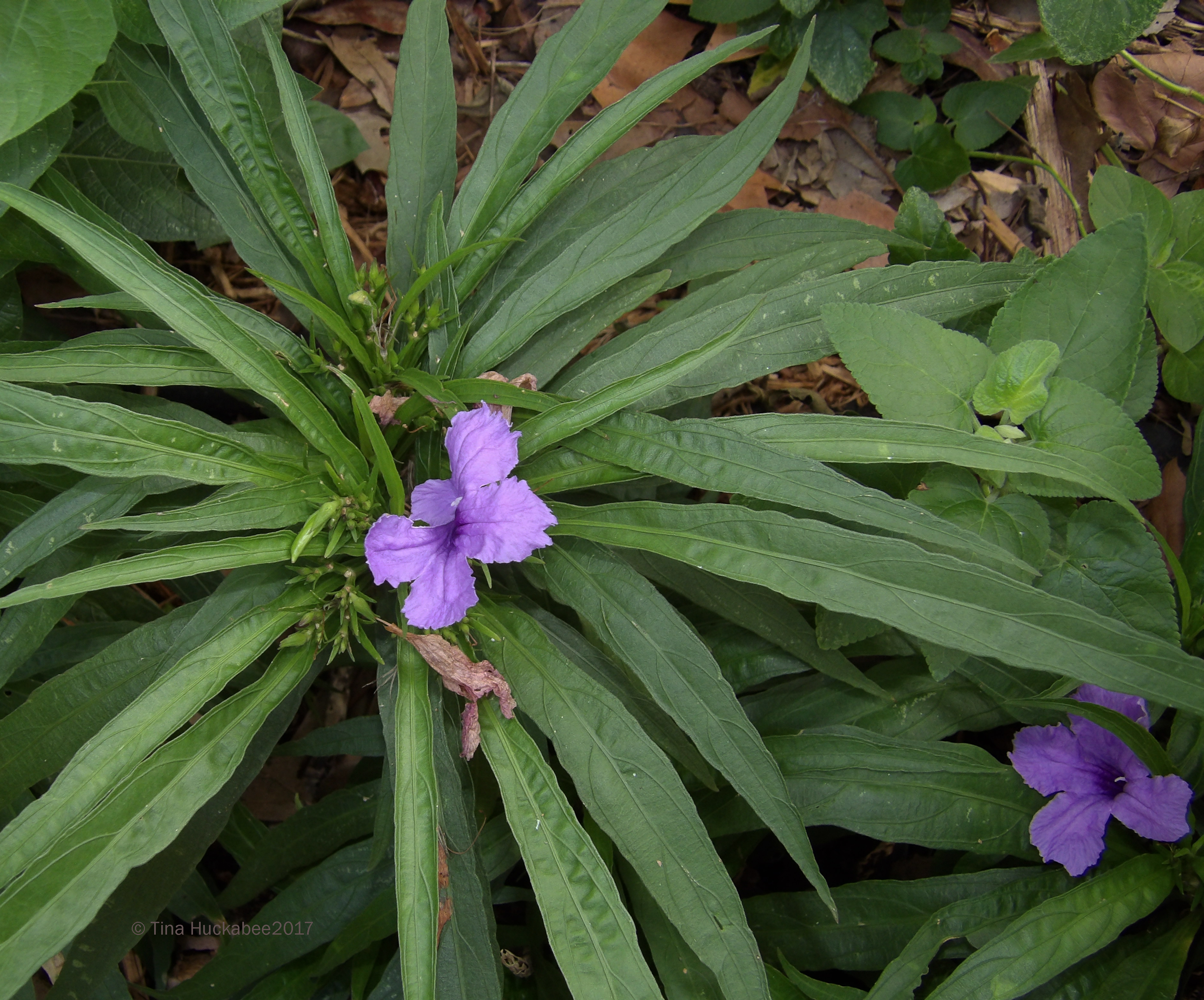
The cultivar, Katie’s Dwarf ruellia, also called Mexican petunia by Texas AgriLife, produces similar blooms as the native ruellias, though larger and more purpley colored. The lance-like foliage structure and ground-cover growth habit allows this plant to front large plants beautifully.  Katie’s Dwarfs also fits well into a narrow garden.

A water-wise wonder,  I’ve had a couple of these tough Katie’s grow out of rocks;  that’s a plant I can get behind!

With a  bouquet-like demeanor, the Katie’s Dwarf bloom spectacularly in shade, in full sun, and everything in between.


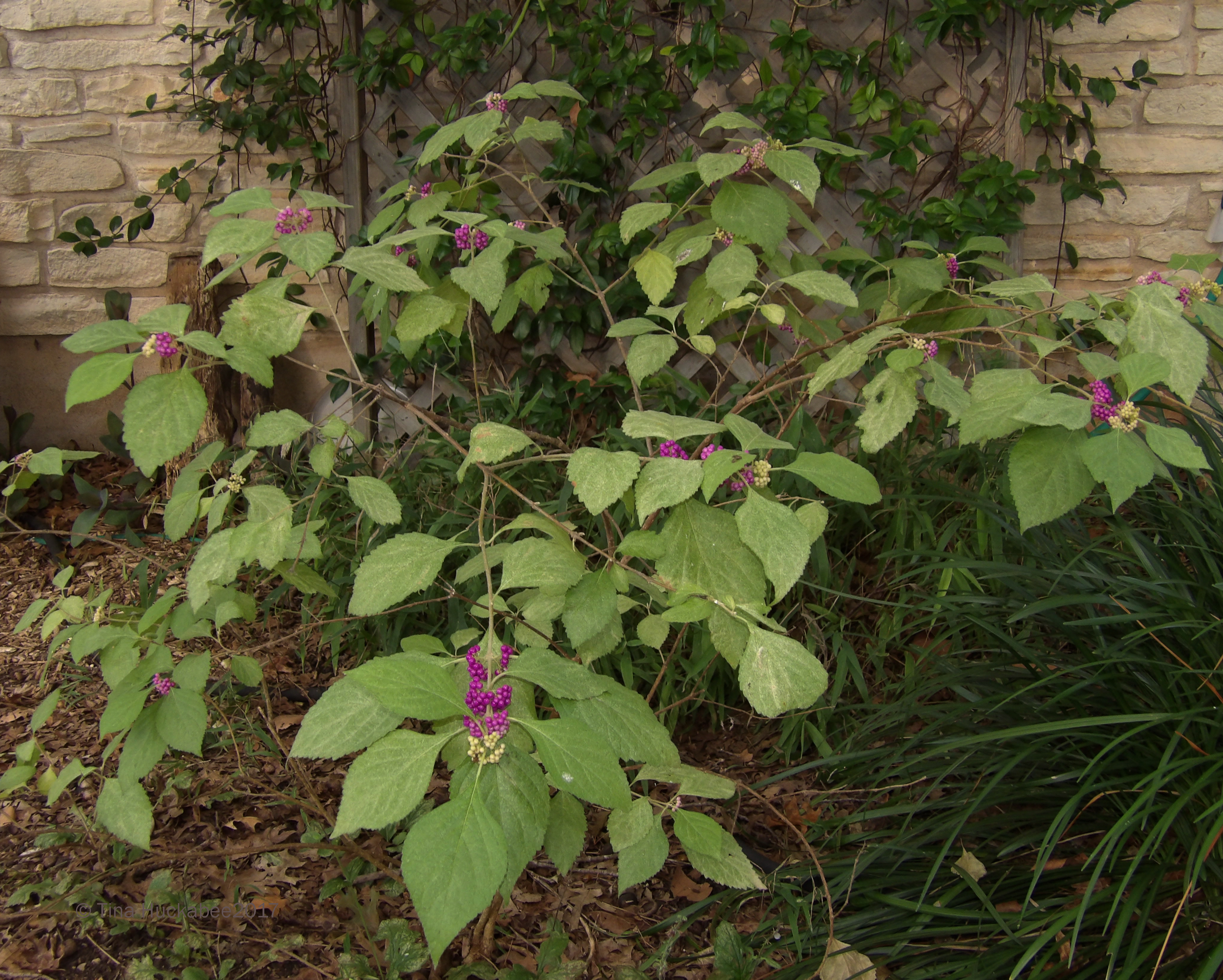
Purple-luscious fruits of the American beautyberry,  Callicarpa americana, are nearly ready for the appetites of hungry Mockingbirds and Blue Jays.

Gone are the petite pink blooms which decorate this deciduous shrub in early summer. Instead, the fruits are morphing from green to garish metallic purple, preparing for the birds’ meals.

Beautyberry also has a graceful growing habit, lovely in any garden.

Beautyberry is a win for gardeners and for wildlife–and adds some purple vibe to my August garden.

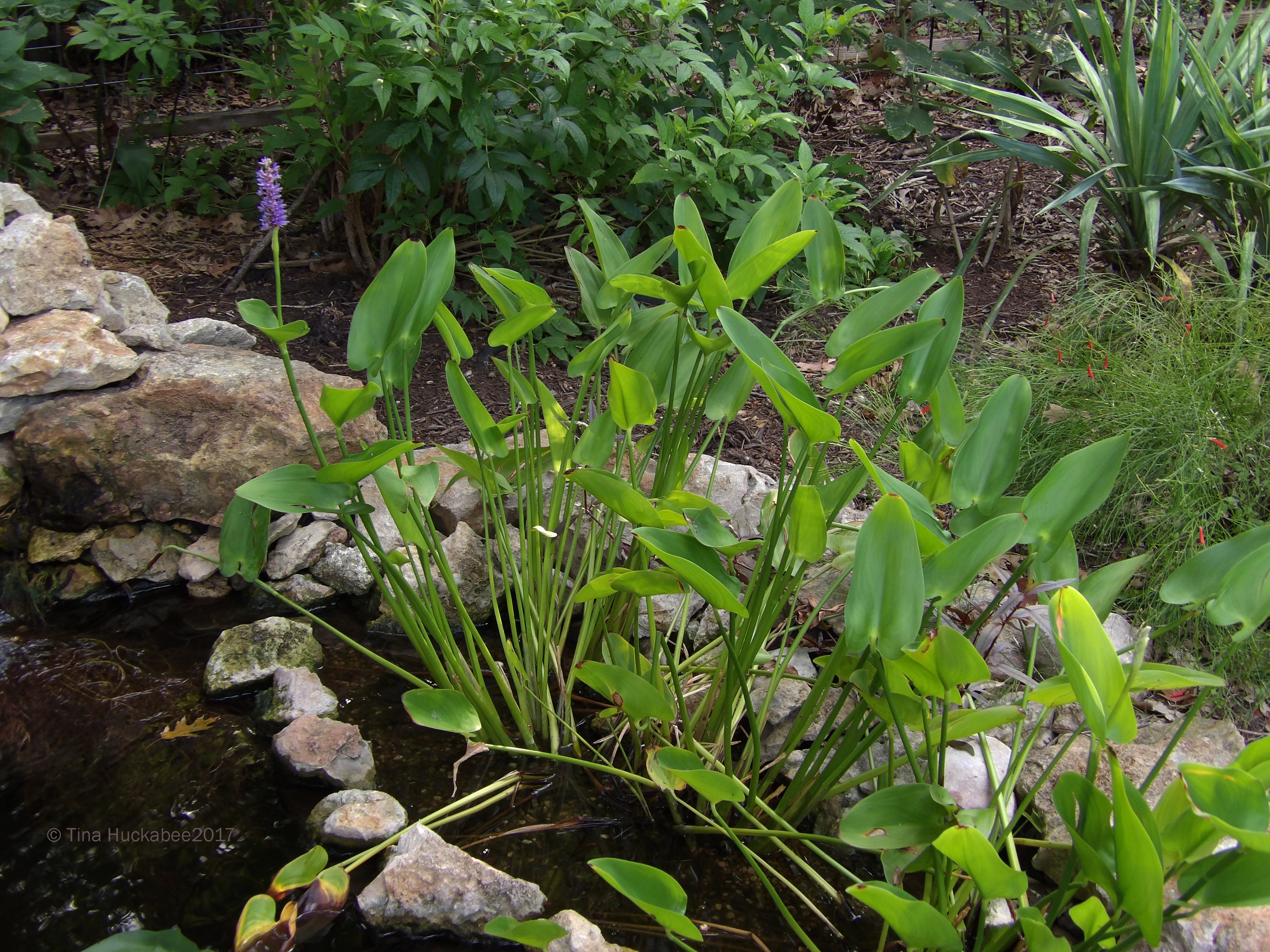
The refreshing pond isn’t without its purple contribution in the form of a cleansing bog plant, Pickerel rush, Pontederia cordata.

With the ever-increasing shade thrown on my garden, these pretty blooms are less active with each passing summer.  I appreciate the foliage, but I miss the massive blooming show that was common 8-10 years ago when we first built the pond.  These blooms benefit from plenty of shining summer sun.


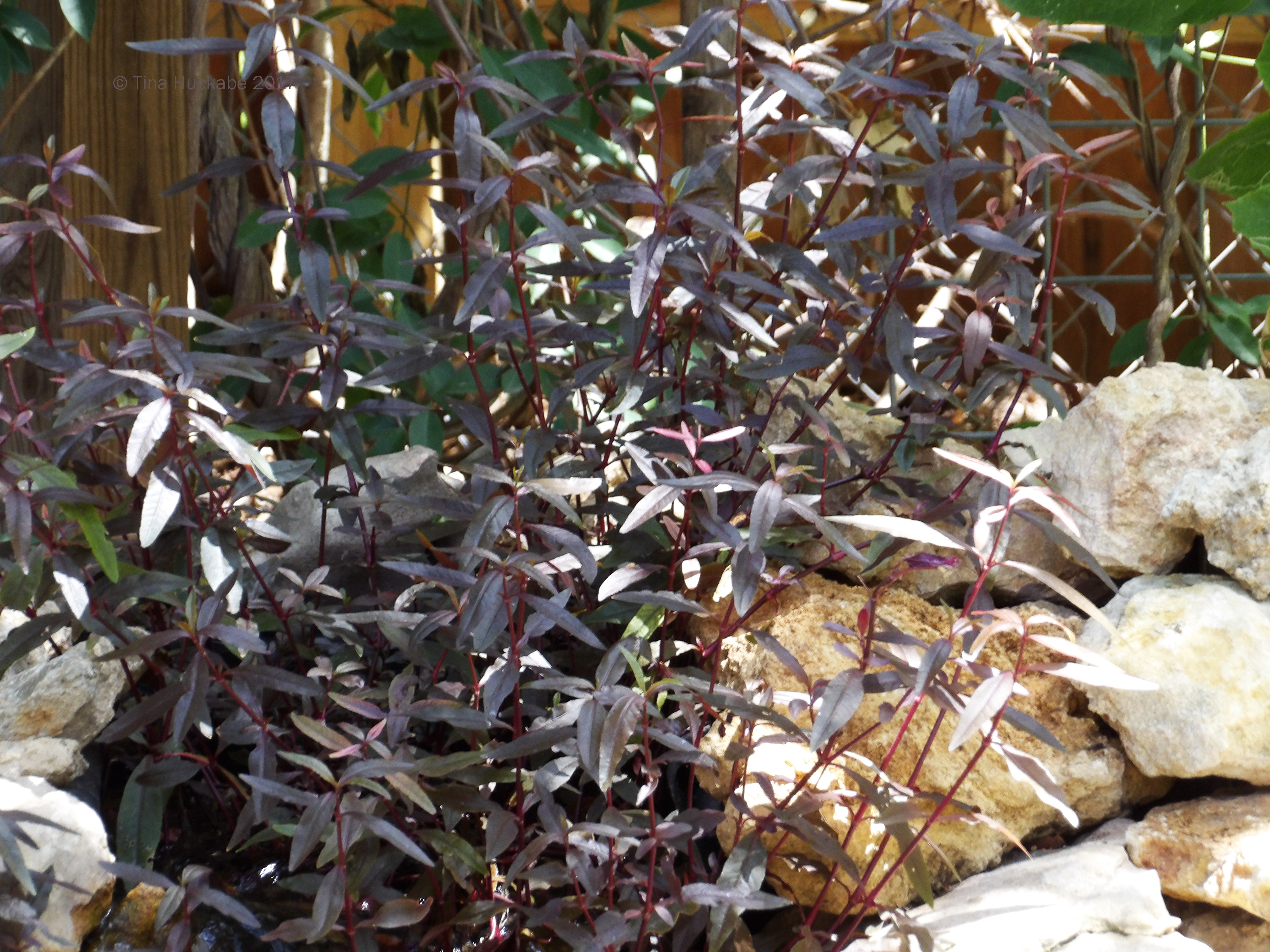
Another pond plant, this Ruby Red runner, an Alternanthera hybrid, adds a bit of purple-ish foliage fellowship to the waterfall.

I’m probably stretching the purple with this plant; I suppose it’s really more of a burgundy red, but I’ll lump Ruby Red into the purple camp.

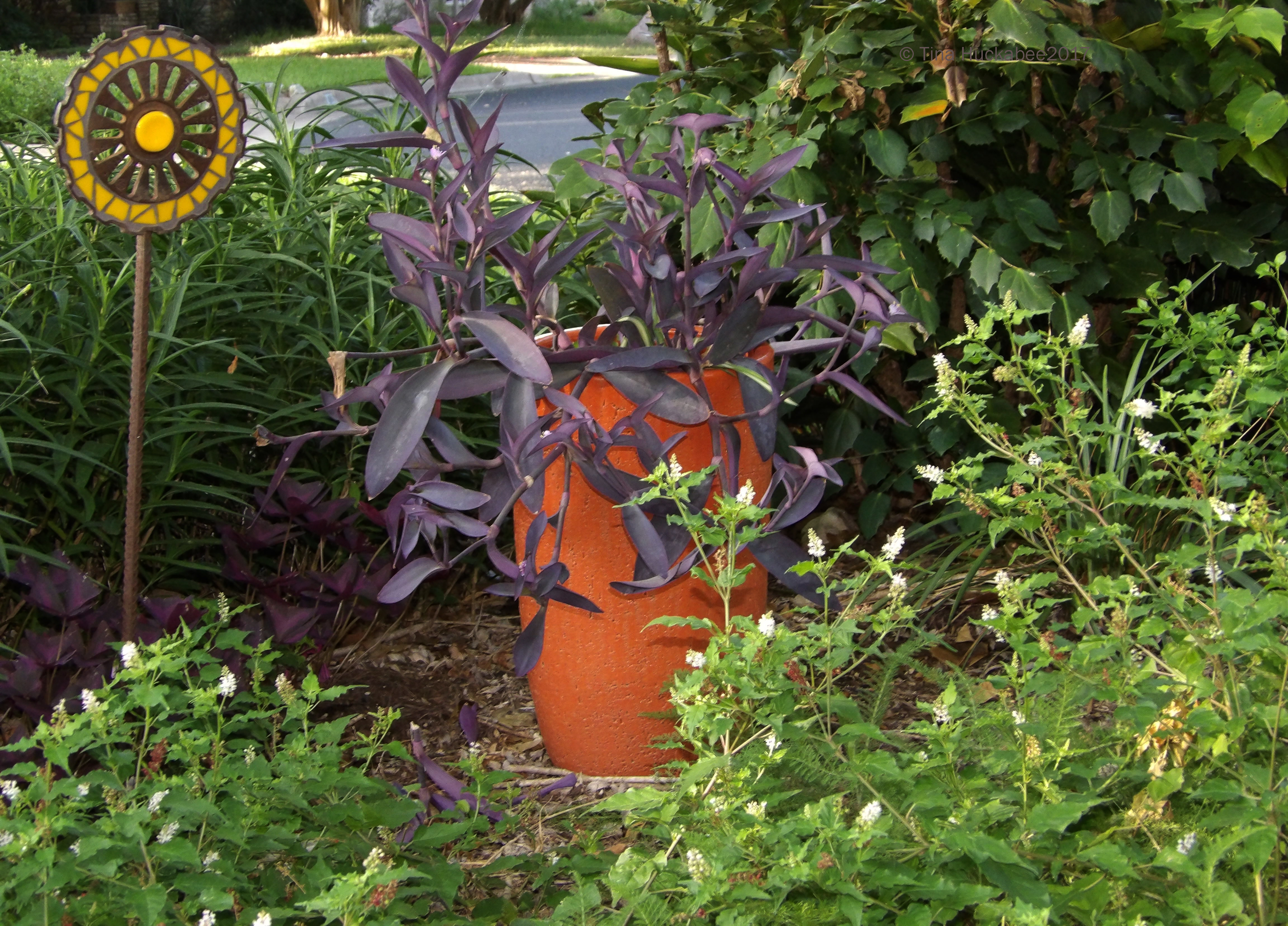
Purple HeartSetcreasea pallida, is native to Mexico, but naturalized in many parts of Texas.  I grew up with this common groundcover; my mother planted it along with her banana plants.  No banana plants in my garden, but Purple Heart works in shade or sun as a border groundcover.

As well, I like it cascading over containers.  It brings a spot of color to a dark corner of the garden.

Reds, pinks, whites and yellows are biding their time for now, hunkering down against the blast of August heat.  Once the days are shorter and the rains more regular, the garden wheel of color will burst forward with a vivid spin.  But for the rest of August, I’ll treasure the purples for their late summer donations to garden color.

Pretty purples!

Joining with Garden Bloggers’ Bloom Day to celebrate the blooms of August, please pop over to May Dreams Gardens to enjoy blooms from many gardens.

Foliage Follow-up, September 2014

As with our blooms, the Central Texas foliage perks up with September rains, shorter days, and the suggestion of cooler temperature ahead.  I join with Pam at Digging to celebrate the end of summer, new beginnings for autumn, and all things leafy.

The pond garden is a riot of fascinating foliage.  Just take a look! P1070046.new

Lots of foliage action in this shot!  Clockwise from the bottom, the actual water plants include the lily pads of the two lilies I grow (Colorado and Claude Ikins), the Ruby Red Runner, and the showy leaves of the Pickerel RushPontederia cordata.   All three pond plants contribute to the biological filtration of my pond, though I also have a mechanical filter.

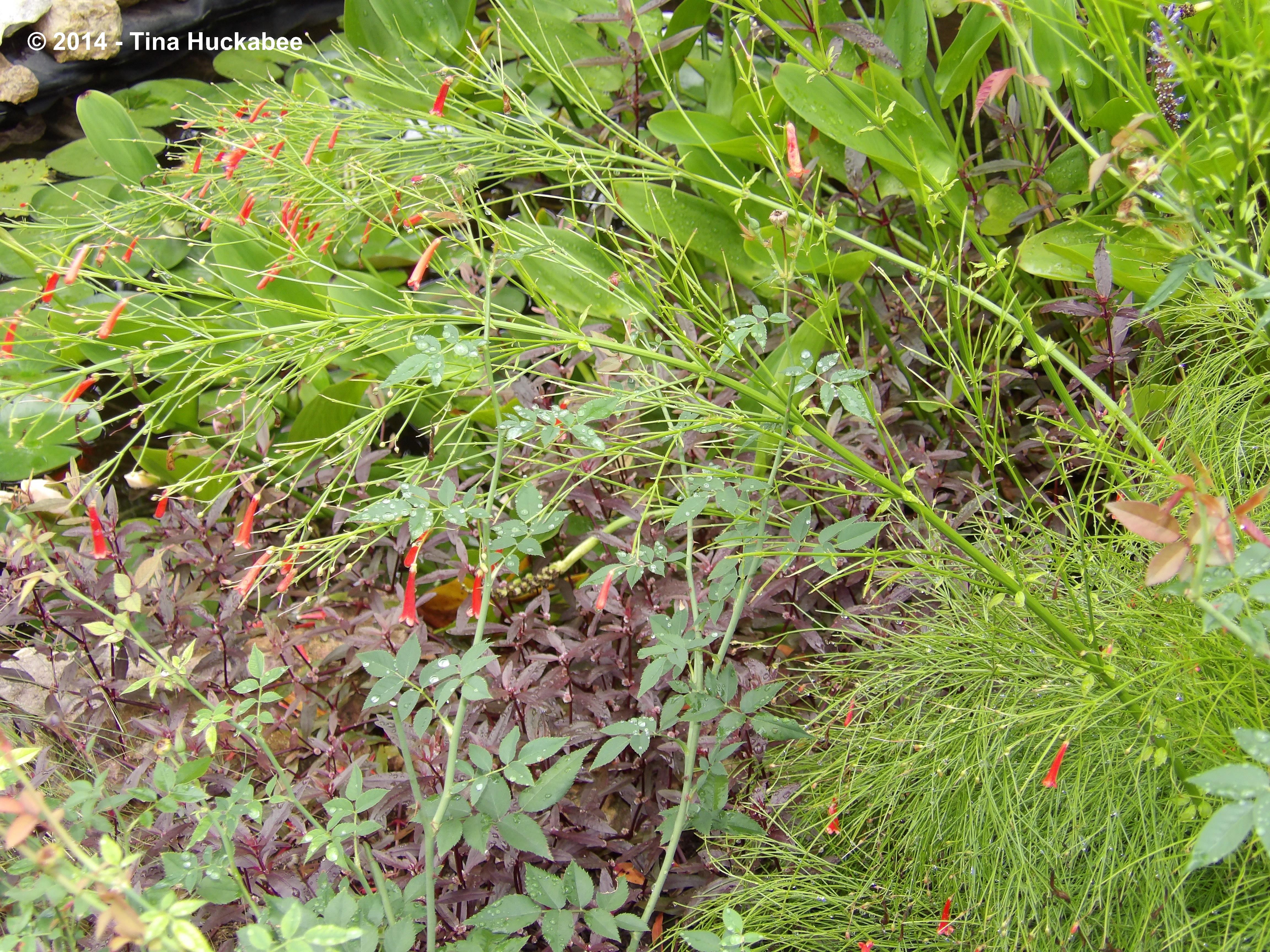
Continuing with the tour d’ foliage, the plants adjacent to the pond include tropical Yellow Bells, Tecoma stans, Soft-leaf Yucca, Yucca recurvifolia, Firecracker Plant, Russelia equisetiformis, Martha Gonzales Roses, Iris, Autumn Sage, Salvia greggii, and Mexican Feathergrass, Nassella tenuissima.  All of these perennials sport differing widths, textures, and colors of leaves.

P1070034.new

Ruby Red Runner dies back in the winter, but by late summer into fall it’s full-on lovely and spreading.

P1070042.new


P1070035.new

It’s seeded out in several places around the pond. This plant, usually used as a waterfall biological filter and prized for its attractive foliage, produces teensy puff-ball flowers,

IMGP0402_cropped_3073x3308..new

…which go to seed, thus, the spread.

Another view of the plants near the pond…

20140914_19.new

Not much blooming in those photos, but a variety of leaf beauty.

I particularly like these water shots with the creeping roots of the Ruby Red Runner, spreading its spidery fingers toward the lily pads,

P1070057.new

P1070056.new

…as if the roots are creeping outward to grab the pads.  Or maybe they’re just reaching out for a watery hug!

The soft, elegant foliage of Lindheimer’s Senna, Senna lindheimeriana,

20140914_11.new

lends structure to, but also softens the back of my garden.  Combined with the bright green leaves of the Yellow Bells and spiky, but matching-in-color American Century Plant, Agave americana,

P1070358.new

20140914_14.new

…the Senna fits well in this spot.

The morning after a recent rain,  the foliage of the Purple Heart, Setcreasea pallida, retained droplets along its edges.

20140914_54.new

With “traditional” autumn coloring, (which doesn’t happen for Central Texas on a large-scale until late November/December), the plumes of the Maiden Grass, Miscanthus sinensis ‘Adagio’, beautifully complement the flowers of Turk’s CapMalvaviscus arboreus, and the orange blossoms of Flame Acanthus, Anisacanthus quadrifidus var. wrightii.

P1070133.new

Here’s a closer look at the inflorescence of the Maiden Grass.IMGP0268.new

Along with the orange-y and autumn-y color theme, this new ceramic container is planted with the ‘Color Guard’ YuccaYucca filamentosa ‘Color Guard’, accompanied by Woolly Stemodia, Stemodia lanata.

P1070197.new

The container sits amidst a nest of blooming and berrying Pigeonberry, Rivina humilis.

What interesting foliage is gracing your garden space now?  Celebrate foliage in your gardens and learn about other foliage by visiting Digging for September Foliage Follow-up.