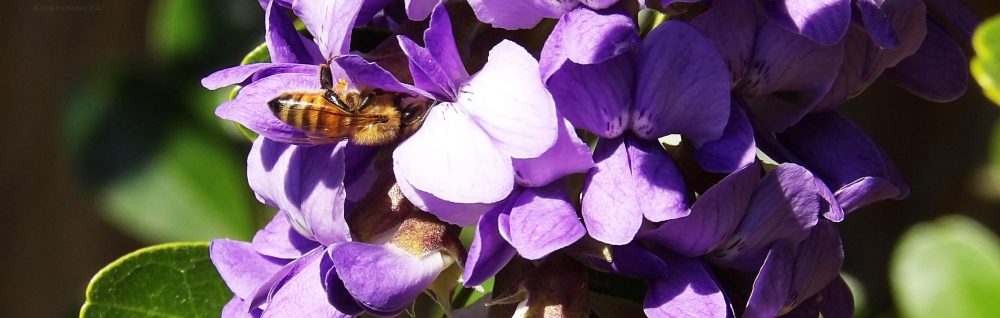
A few weeks ago the weather finally made its exit from the long, hot (seemingly) interminable Texas summer to a most welcome and agreeable autumn. As part of that climate morph, rain chances increase and native plants give thanks, opening their hearts with blooms galore. None do this with more flowery pizazz than Cenizo, Leucophyllum frutescens, also called Texas Barometer Bush. The purple blooms grace gardens throughout Texas and natural landscapes in West and Southwest Texas.
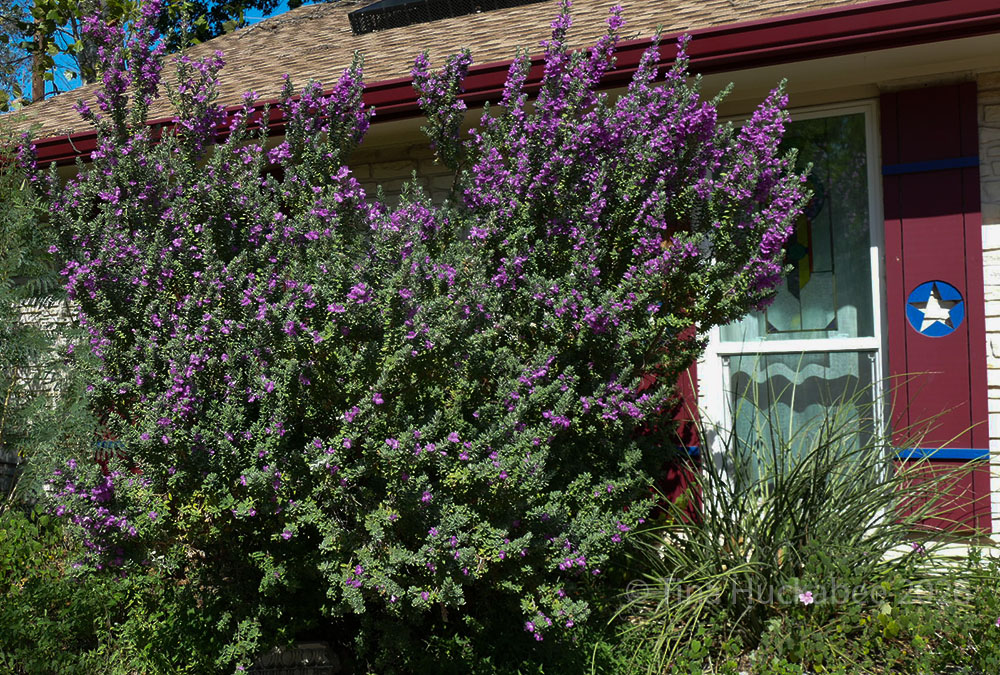
Some years ago, having always wanted this glorious shrub in my garden, I planted a Cenizo in the one spot that, in my otherwise too shady space, I thought would work for this sun lover. The shrub has done well, providing lush evergreen foliage where birds take cover and hunt for insects, and showy purple blooms–when weather conditions are amenable–for pollinators’ delights.
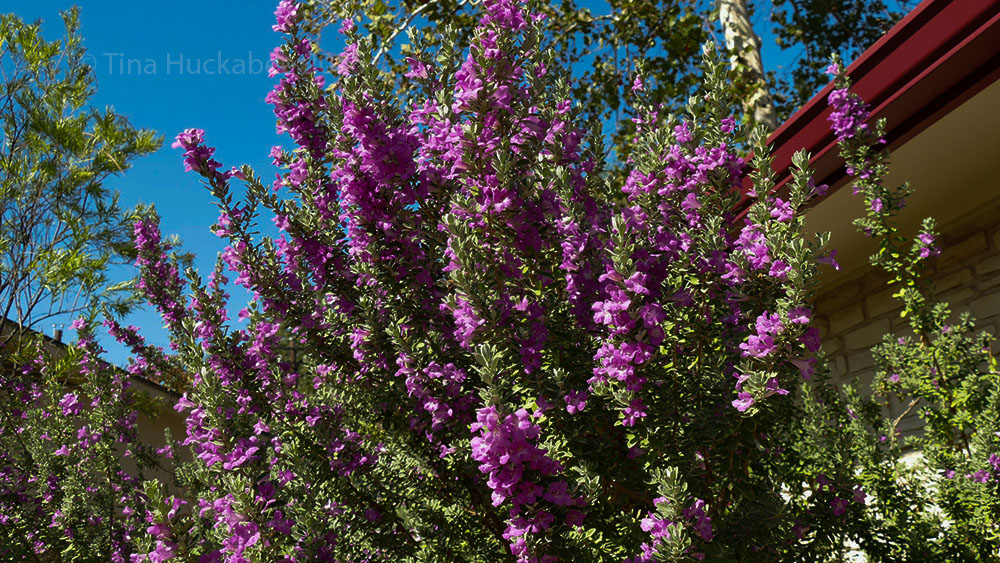
These outer limbs are covered with clusters of pinky-purply, bell-shaped goodness and appear to reach for the cool, blue sky!
For most of a week, my honeybees were all in for the nectar and pollen of the flowers.
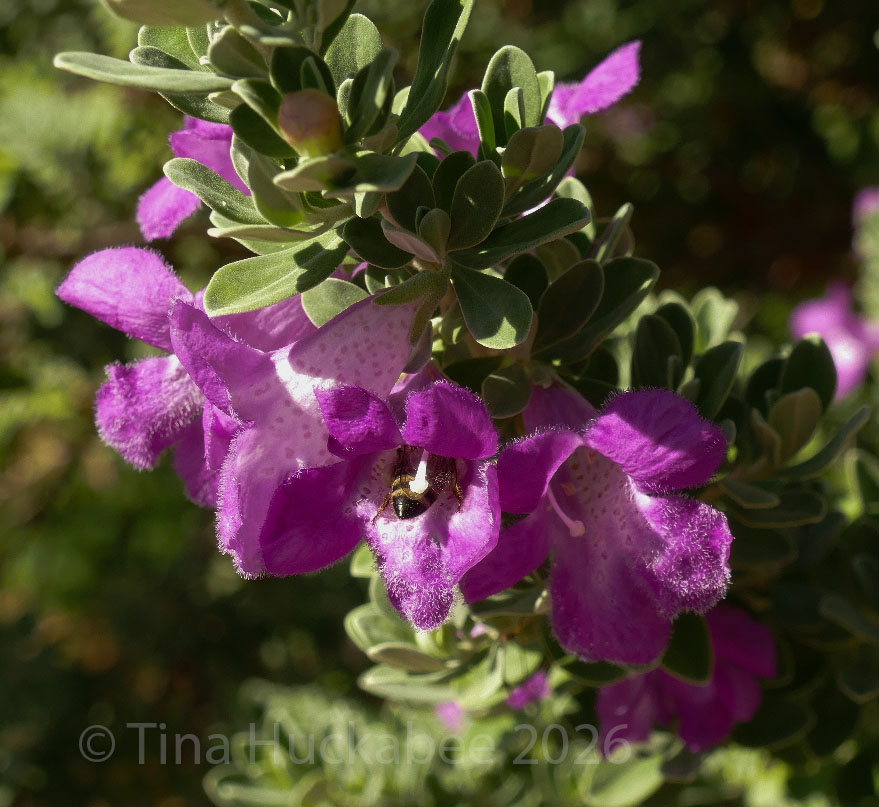
I watched this little gal hang on to the bloom for several minutes.
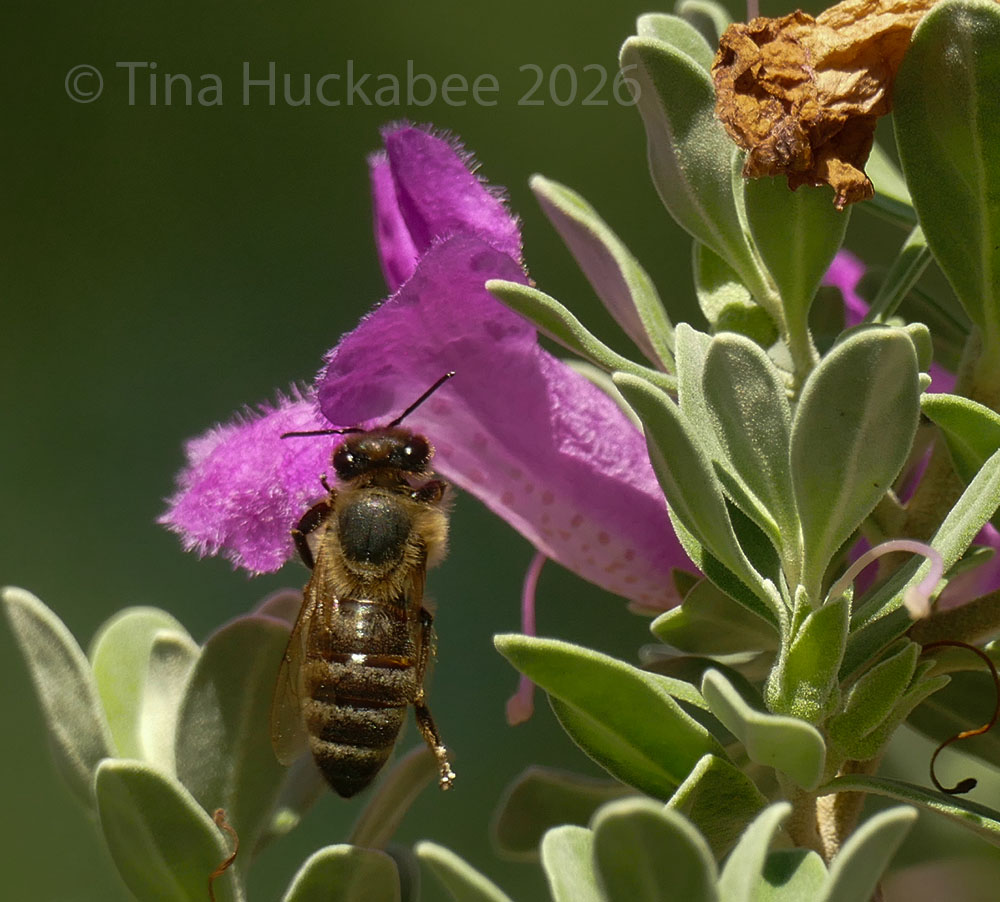
I’m guessing she was just starting her bee work, as there was no pollen packed in her corbiculae, or pollen baskets, or (as I like to call them) pollen pantaloons. I moved on with my day and I’m sure that day she filled her pantaloons.
My Cenizo is a cultivar and I don’t recall its name. The true native grows silver foliage, along with the signature purple flowers. This plant, true native and cultivar, is a hardy grower, needing little water and providing for wildlife. Of course I wanted it in my garden!


What a stunner! So glad it has taken to your garden and gets frequent insect visitors. I’m glad your weather has finally turned more agreeable and hope you will get to enjoy an extended pleasant fall.
LikeLike
Thanks, Tanja! It’ll be very nice here and hopefully, our first killing freeze will hold off until November.
LikeLike
Beautiful blossoms, I love the little pink polka dots!
LikeLike
Those little dots are darling!
LikeLiked by 1 person
That is a beautiful plant, for sure Tina! How fun to watch the bees love on it and fill their pollen pantaloons. LOL. The plant certainly seems happy in your garden!
LikeLike
Thanks, Beth–it is a real winner in the garden! The bees were just so fun to watch as they worked!
LikeLike
Happy bonanza. Ceniza is the Spanish word for ‘ash’ (sharing the same root as the first syllable in cinder), so the name cenizo refers to the ash-green leaves of the native plant. One reason cenizo has become so popular with gardeners and landscapers is the multiple rounds of flowering this shrub goes through in a year, even if the flowers don’t last long each time.
LikeLike
You’re good with words, Steve. I’d never looked that up, but it makes sense given the color of the true native. I really should call mine something else, like ‘Purple Sage’. I was thinking about the name of this cultivar and I think it was probably ‘Green Cloud’. When we bought our house, my mother (living in Corpus Christi) gave me two of the native Cenizo plants. I had them in my back garden for many years, until they declined in the increasing shade. They never bloomed much, but the foliage was very nice.
LikeLike
I don’t remember those in Houston; I would certainly have gotten one. It has an incredible number of flowers on it.
LikeLike
No, they probably don’t sell or grow well in East Texas, it would be too humid for them.
LikeLiked by 1 person
I don’t know — there are cenizos all over my area. In fact, several of my friends have them, both native and cultivars. It may be that their soil is sandier than the clay Judy had in her neighborhood. There are a lot of gas stations and such that plant them between their parking lots and the streets.
LikeLiked by 1 person
That’s what I thought. I would have gone crazy for it.
LikeLiked by 1 person
Almost ten years ago I posted about the political struggle that took place after the crape myrtle was named the state shrub. Many native plant enthusiasts took up arms, and went to battle for cenizo. Eventually, a compromise of sorts was reached, and now the cenizo is officially our state native shrub. The crape myrtle lobby was too strong to overcome, so that plant’s still the state shrub.
LikeLike
Crape Myrtle lobby is a tough one! 🙂 That’s kind of annoying, but not really surprising. I like Crape Myrtles just fine, but generally prefer our lovely native trees.
LikeLiked by 1 person