Spring sprung many months ago, summer’s hardy floral gifts, amidst Texas heat and drought, delivered color and life with attending pollinator action throughout those toasty months. Summer is finally done and autumn is a robust flowering period, full of blooming goodness. A pollinator frenzy is in full swing in my Austin garden.
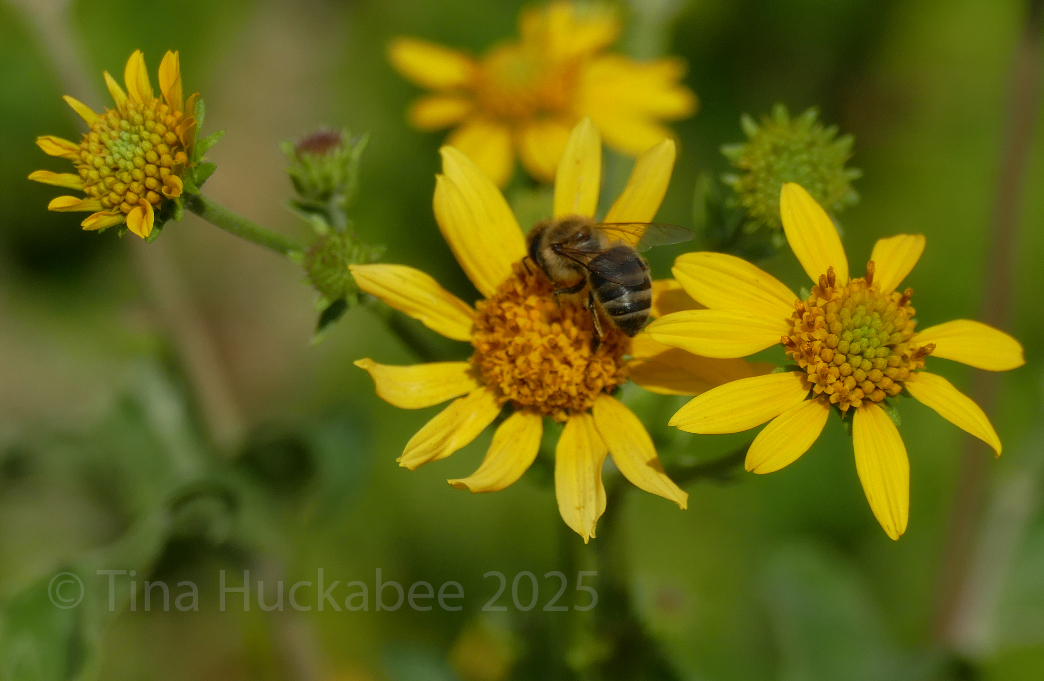
The yellows, especially Plateau Goldeneye, Viguiera dentata, are the pollinators’ delight. Monarchs have mostly drifted southward along gusts delivered by the last cold front. Other butterflies seem to be on vacation, but bees are still around and about–and pollinating. Most folks know about honeybees, but native or wild bees, are common and vital in any healthy ecosystem, whether in a natural green space or a planned and loved garden. In a recent stroll through my garden, I observed multiples of three kinds of bees that were all-in with their pollination business, sharing flower space they buzzed about a Plateau Goldeneye.
Here, a honeybee works the flower, her little leg splayed out, maybe for balance or perhaps preparing to scoot over to the next flower. A bee’s version of getting a leg up?

The same bee on the same flower, all hunched up and nectaring away!
This bee isn’t a honey, but a native, or wild, bee. My best guess, utilizing this website hosted by an entomologist at The University of Texas whose research focuses on native bees, is that this little gal belongs to the leafcutter bee family.

I like this bird’s-eye view of the leafcutter bee, pollen pantaloons (aka, corbiculae) full-to-bursting with a packed load of beautiful, golden pollen.

The third bee sort zipping around was this tiny thing, most likely a native sweat bee. All native bees are efficient pollinators, regardless of size, though size dictates how much nectar is consumed and the amount of pollen that is gathered. This little one won’t sip as much nectar or pack as much pollen as her bumble relatives, but she and her sisters are excellent in their important work.
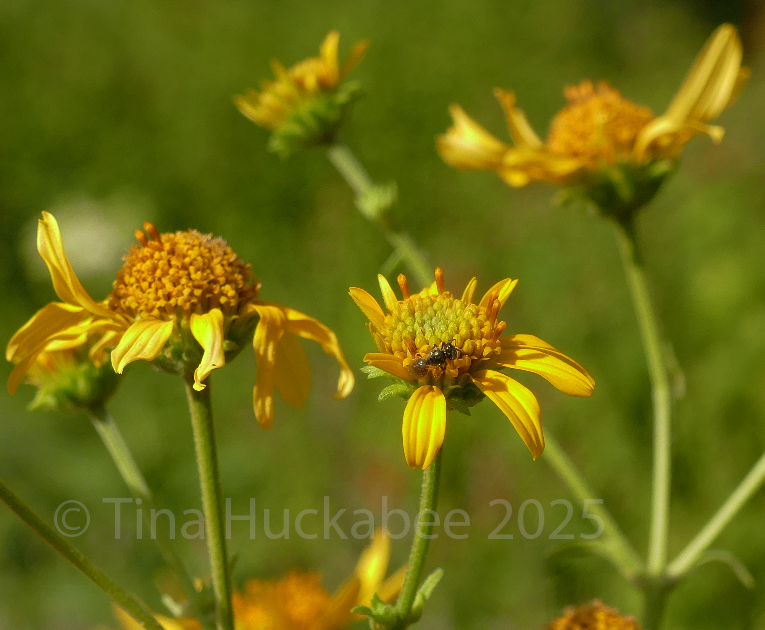
This shot captures the difference in size between the sweat and the honey bee. Both are focused on their respective flowers.

Some bees are generalists, visiting a variety of flowers, others are more particular, arriving when certain flowers are in bloom, absent from the garden when that plant is in a resting stage. How the bee knows when its favored bloom is ready for pollination is a mystery, at least to me. Entomologists understand much about honeybees, but there’s comparatively little research on native bees. There are roughly 20,000 native bee species in the world, about 4000 reside in North America, and 350 in Texas. In fact, a new bee was recently discovered and named, existing only in Texas and Oklahoma: the Andrena androfovea–a blue bee, which you can read about here. This blue bee is one of those bees that sips from only one species of plant!
I’ve “identified” roughly 15-18 native in my garden over the years. I don’t necessarily know the name of each (though I know some), as there’s not much information available, so I look at photos and make guesses. Lots of guesses. But I have learned to recognize a bumble from a carpenter, a sweat from a leafcutter, a metallic from a bee mimic. I’ve become familiar with their habits: some are wood nesters, others nest in the ground, most (except for honeybees) are solitary and make small amounts of honey to feed their offspring. I recognize the leaf ‘damage’ that bees do to certain plants in my garden, as they pack their nesting sites with leaf matter, mud, and pollen. Some native bees forage for a brief time in early spring , lay their eggs in protected wood or plant stems, then die. Others are around throughout the growing season, procreating and nectaring all the while.
Native plants and native wildlife, insects included, evolved together and need each other to survive. A vibrant ecosystem will support this symbiotic relationship which defines the life cycles and relationships of flora and fauna. Go native and watch your garden and its inhabitants bloom with life and activity!
 My Gardener Says...
I had previously read an article about native bees and was surprised by how many there are in the US. I thought of you when I recently saw a story about a 4-H boy who kept bees. His town cited him for having them, but enough people got on board to find a solution, and he was able to keep them.
LikeLike
That’s a great story about the boy and his bees. Glad there was community support and he was able to keep them!
LikeLiked by 1 person
Interesting and informative!
LikeLike
Thanks, Amy. I’m sure some came to visit you. 🙂
LikeLike
Good post, Tina. I love watching bees working my flowers, too. Like you, I have vague ID skills, but I enjoy them no matter the name. 😉 Cool to read about the blue bee!
LikeLike
Thank you, Eliza. It’s fun to watch them, each with their own ‘style’ of flight and pollination.
I thought it was a great story about the new blue bee!
LikeLiked by 1 person
One plateau goldeneye bush is currently flowering in a “wild” area in our neighborhood. I’ve occasionally seen them blooming as late as January in a warm winter. With your own garden, you’re in a good position to observe the insects that favor the goldeneye and of course your many other kinds of flowers.
LikeLike
I have quite a few in my front garden and along both sides of my house. I like them as they’re incredible while in bloom and they have a long bloom time, as not all bloom at once, but rather over a period of time. Once the blooms are done, a variety of birds love the seeds. It’s a great wildlife plant!
LikeLike
Wonderful images of bees and their favorite native plants! This is a beautiful, and beautifully written, post. 🙂
LikeLike
Thank you, Beth. I know you enjoy these observations just as much as I do!
LikeLike
There has to be a parody! “Three bees a-pollinating, two dragons flying, and a bright Monarch sipping away…” It’s the Twelve Days of Garden Life! I’ve come to really enjoy the native bees, and now can identify perhaps a half-dozen. Sometimes I recognize them as natives, but then have to go looking for their identity. At least I’ve moved beyond honey bees and bumble bees!
I’ve been constrained by work, even on the weekends, for the past little while — I’m more than eager to meet two looming deadlines so I can get out and about again. The deadlines are real — my boats are leaving for Florida and south Texas, so freedom arrives on December 12!
LikeLike
I wish there were more sources for identifying these bees. I’ve seen quite a number that don’t look like any pics that I can manage to find. I have sent photos off the BugGuide.net, though I can’t always get a good shot. Still, it’s fun to watch the bees!
Good luck with your deadlines and I’m sure there will be plenty to write about after that!
LikeLike
Great article!
Janet Fitzsimon Barr, Texas
LikeLike
Thanks, Janet!
LikeLike