I first became acquainted with the Small Coastal Germander, Teucrium cubense, when one magically emerged underneath a Brazos blackberry vine in my garden about 10 years ago. Diminutive snowy blooms sparkled along the stems, the foliage suggesting a member of the mint family (it is a Lamiaceae). It took me a while to figure out who this stranger was, but I was delighted to learn that it’s native to Texas, other southern states, plus areas a bit westward. The germander grew and bloomed in that spot for a couple of years, then left my garden as mysteriously as it originally appeared.

Fast-forward a few years, add a devastating February freeze, followed by an old, severely damaged Arizona Ash tree removed, and the minty germander planted itself in my newly minted full-sun garden. This tidy little ground cover, evergreen in winter and decorated with delicate white pops throughout our long growing season, is not only cute, but a pollinator magnate as well.

One afternoon a few weeks back, I sat in the garden and observed the activity surrounding this rewarding plant. This germander has quite a following! There were dozens of flitty, crawly things, all honing in on the bounty offered by the blooms. The air surrounding the germander teemed with life, gentle buzzing the song of insect labor. Honeybees were the largest of the pollinators, sometimes muscling the smaller insects off of a bloom, stingy for their share of the flowers’ goods.
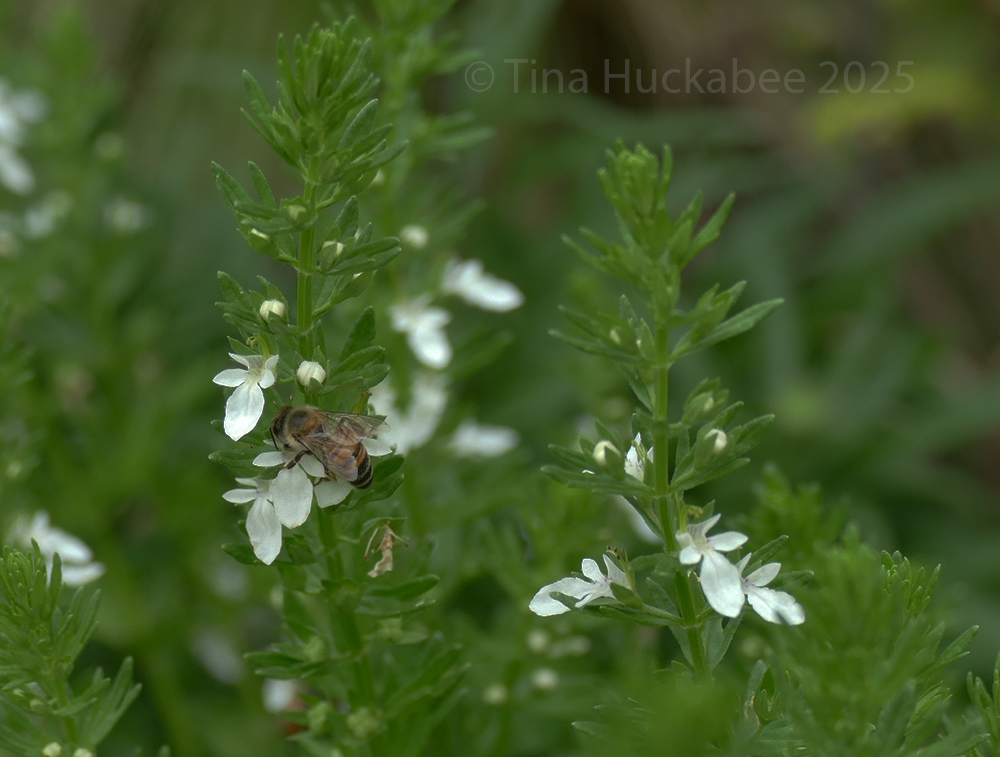
There were at least two species of wasps attending the pollinator party. A number of Mexican Honey Wasps, Brachygastra mellifica, Euodynerus, Potter wasps, dressed up in their yellow-n-brown stripes, added their particular beauty to the germander as they sipped and flit.

This one concentrates on its meal, wings closed.

A different wasp, Pitted Mason Wasps, Euodynerus foraminatus, also fed from the germander. Smaller and less stripey than the honey wasp, they made their presence known, gracefully moving from stem to stem, bloom to bloom.

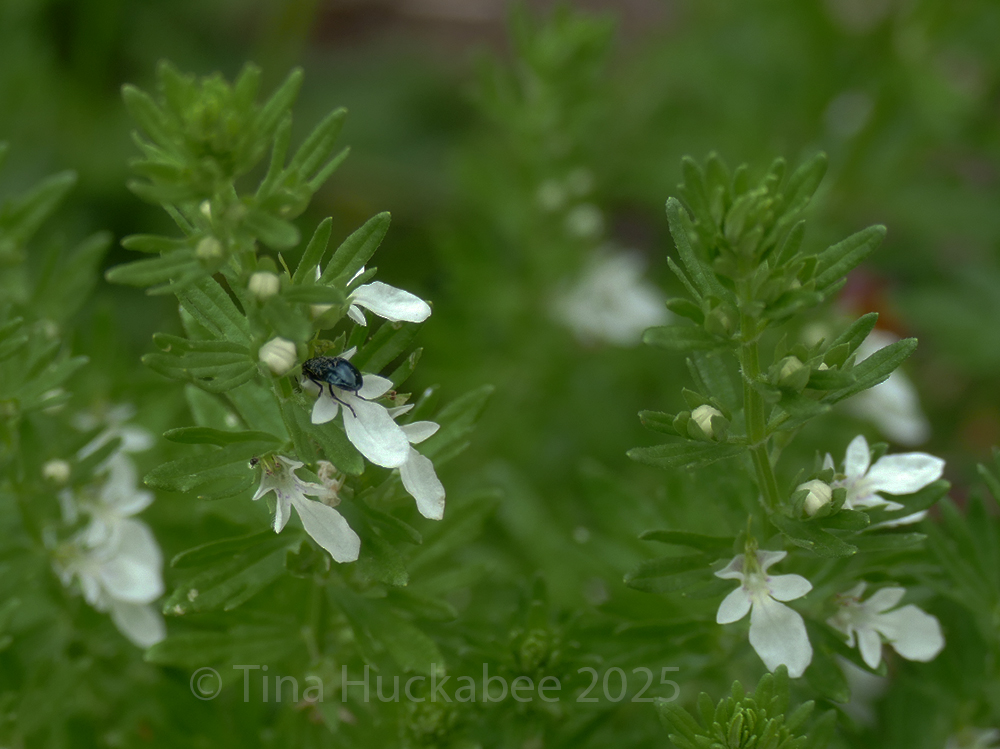
Beetles are also in the pollination business, especially so with this germander. In looking through various sites and gobs of beetle photos, I’m still unsure what beetle this is, but several of its kind worked the blooms. Their shiny blue-black coloring contrasts with the pure white flowers.
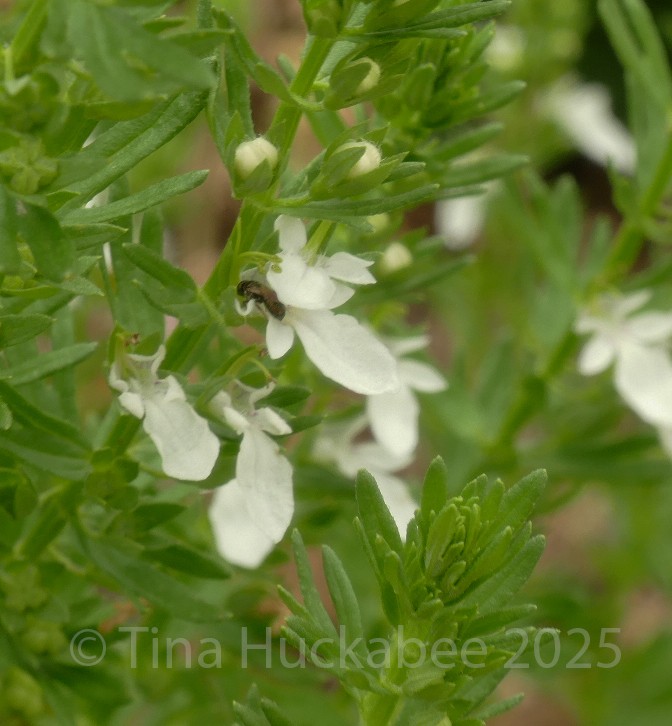
Another kind of beetle, brown and nondescript and much smaller, is unfamiliar to me, but all-in with these blooms. This bit of brown that isn’t in a clear photo, worked blooms along with plenty of its buddies, all proboscis-focused on the flowers.
I didn’t manage any good captures of native bees who also liked the germander, but saw plenty tiny Lasioglossum, or Sweat bees flying, landing, and pollinating.
Coastal Germander holds its own in the hot-colored, full-sun garden, its cool white flowers and rich green foliage a balm in the mid-spring flower-power show. It visually pleases humans and softens the louder colors of the garden.

Coastal Germander’s most important role is as sustenance for many insects, the true calling of plants and their reason for existing. Plants and insects evolved together and are partners in the diverse quality of life for all ecosystems.

 My Gardener Says...
A pretty native, Tina, thanks for the intro!
LikeLike
You’re welcome, Eliza!
LikeLike
Sounds like a great plant for pollinators. I have had a few natives move in and enjoy garden beds. As long as they aren’t too weedy, it is a nice surprise.
LikeLike
Yep and sometimes they’re not all that much of a gift, more of a curse! 🙂
LikeLiked by 1 person
How remarkable that this pretty and beneficial native plant decided to settle in your garden not once, but twice! It looks good amidst your other flowers. Let’s hope it is here to stay!
LikeLike
I’ve no idea where the first one came from, but I’m sure there have been seeds lurking for just the right time!
LikeLiked by 1 person
Hi, Tina,
I love your blog and seeing all the incredible wildlife that visits your beautiful wildscape. I enjoyed this entry on the pollinator friendly coastal germander which grows plentifully in my San Antonio neighborhood. You seem to have misidentified the wasps, though. The first two wasp photos are not Mexican Honey Wasps (Brachygastra mellifica) but rather one of the Euodynerus potter wasps (I’m not precisely sure which one.)
I’ve attached a photo of one of the Mexican Honey Wasps that have visited my garden. This was taken last summer when every pollinator imaginable visited the frostweed. They are one of my favorite wasps — so plump and adorable!
Thanks for your wonderful sharing and all you do for our wildlife kin.
kind thoughts, Mobi
LikeLike
Hi Mobi!–and I think you’re correct! The honey wasps always have a more pointy bottom-of-abdomen than most (has that for scientific id method!) and ‘my’ wasp clearly doesn’t have that when I look at photos of honey wasps. (Your photo didn’t download, but there are plenty when googling.) So I’m guessing that both wasps are in the Euodynerus family. Thanks for setting me strait! Regardless, I’m glad that they are in my garden, courtesy of this wonderful little plant. I’ll bet it does very well for you in SA.
LikeLike
Familiar as I am with American germander, Teucrium canadense, which is common in various places in northwest Austin, I’m not familiar with the Teucrium cubense that has twice graced your yard. According to botanist Bill Carr, it’s “a species of subtropical distribution, ranging north into the southern half of Texas. Rare in our area, known from a single collection,” whose location he goes on to identify as “E bank of Shoal Creek ca. 500 ft. S of W. 34th St. bridge” on “11 Nov 1995.” Sounds like your visitor is more special than you knew.
LikeLike
Oh, that’s really interesting. When I learned the name of the plant, it indicated native to the ‘coastal’ region, though common names aren’t exactly the thing to go by, I guess. I always assumed that the plant seeded out from someone else’s garden and that that person(s) bought it from a nursery. It does propagate easily, though isn’t particularly weedy. Regardless, I’m happy it’s in my garden.
LikeLike
Do you also have, or have you had, the more-common American germander in your garden? I wonder if they’re genetically similar enough to hybridize.
LikeLike
No, I’ve never grown the American. My dad had some in his garden in Corpus and I always meant to grab a sprig, but never did.
LikeLike
Special as it may be in your area, it’s common as can be down here. See my response to Tina.
LikeLiked by 1 person
And mobiwarren (above) notes that it “grows plentifully in my San Antonio neighborhood.” That’s the difference 90 miles makes—in the right direction, of course.
LikeLiked by 1 person
As the realtors say, it’s location, location, location. This plant is so common down here, especially in the Brazoria and San Bernard refuges as well as in watery ditches, that I usually pass it right by without even taking photos. It’s as common as pink evening primrose or our native Texas dandelions can be. When I say ‘common,’ I don’t mean you can find it every day; I mean thick as a carpet in many places. It sure is a pollinator magnet, and it apparently is very tasty for many insects, since the plants often show damage from nibblers.
The next time I find some nice examples, I’ll stop ignoring it and take some photos!
LikeLiked by 1 person
Please do.
LikeLike
One person’s rarity is another person’s rare gift! The first time I ever visited Kew in GB, I saw lantana–a veritable weed! But it was special enough to include in their collection.
I think it’s interesting that in your area, you see it in areas that are wet, or at least damp. I don’t water that garden much and (I’ll have to check) I don’t think my soaker hose even goes by this plant. And yet, it blooms-n-rests-blooms throughout the growing season.
LikeLiked by 1 person
I used one wrong word in my reply. The plant doesn’t grow ‘in’ watery ditches, but ‘near’ water: ponds, sloughs, and ditches. For example, on the loop round around some of the biggest ponds, the water and waterfowl may be only ten feet away, but the plants are on top of the berm, on the same level as the road. The combination of sandy soil and good drainage probably mimics the conditions at your place.
In another spot at Brazoria, it’s often growing in an area well removed from the big slough. It sure doesn’t show up around any of the mud flats or marshes! There are so many different environments in these refuges that I need to remember to specify where a given plant is growing!
LikeLike