Spotting the birds that migrate through Texas in spring (and autumn!) is always a thrill. I live in Central Texas, a major flyway in North America, and enjoy a front row seat to bird migration because my garden is packed with blooming and seed-setting native plants, large native trees, and plentiful water sources. Weary, feathery travelers who seek rest and refueling will visit–briefly–from March through June as they head northward to breed.
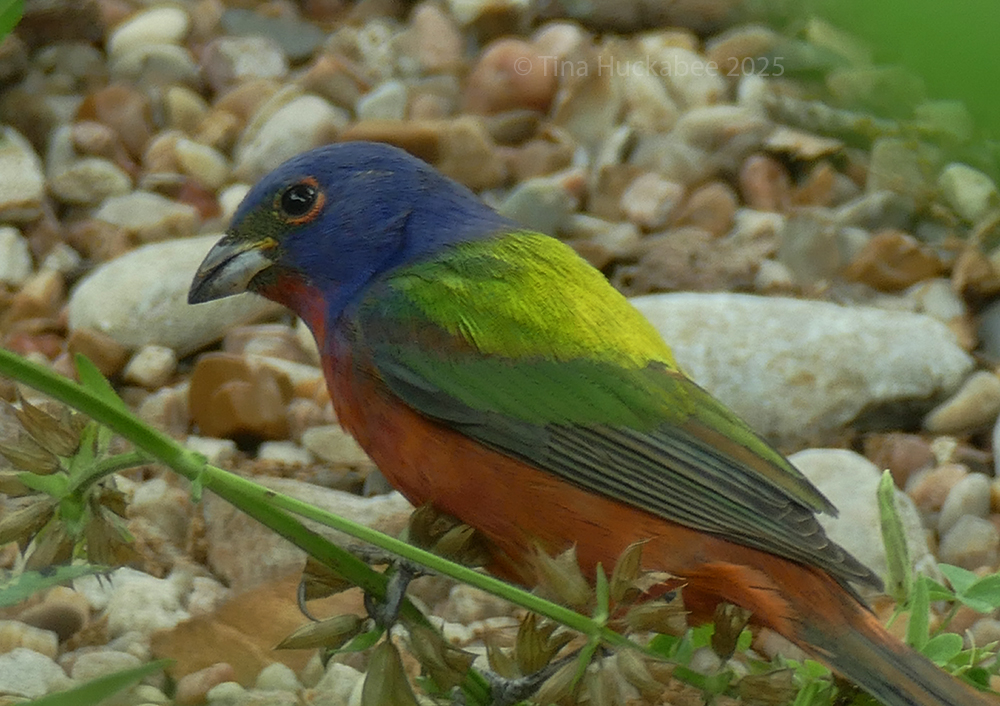
Each late April/early May, a handful of Painted Buntings, Passerina ciris, swoop in to nosh on the seeds of Lyre-leaf Sage, Salvia lyrata, and Mexican Feathergrass, Nassella tenuissima. The crew this spring were particularly skittish, resulting in this being the only reasonably clear shot I managed. That’s okay, though: sometimes it’s instructive and enjoyable to put the camera down and simply watch these vibrant birds.
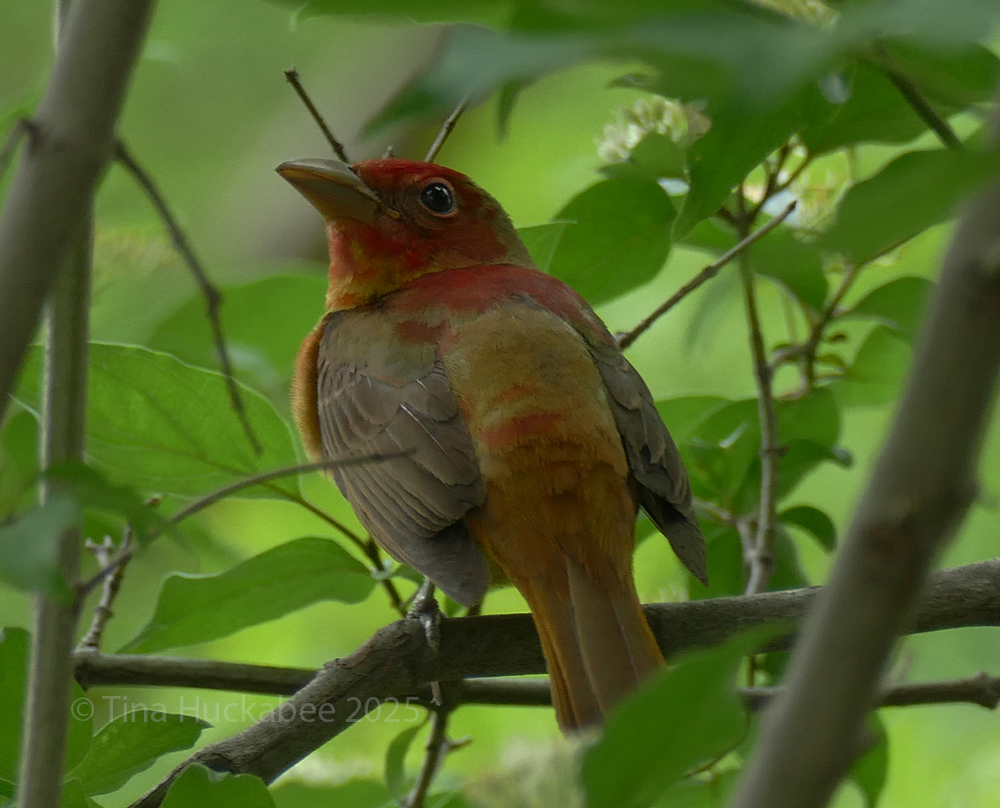
The first few days of May always brings in a trio of Summer Tanagers, Piranga rubra. Typically the visitors include an adult male and female, plus one juvenile male; I’ve speculated that they migrate as a family unit. No scarlet male showed up this year and I missed seeing him. But the juvenile male, all splotchy gold-n-red, zipped around the garden and hung out in trees. More importantly, from the tanager’s perspective, he spent his time around the bee hive where he snatched honeybees. Summer Tanagers hunt bees and wasps and my garden has plenty of both to offer.
The adult female also nibbled unfortunate bees, but was entranced with the tangerine slices that I offered for migrating orioles.
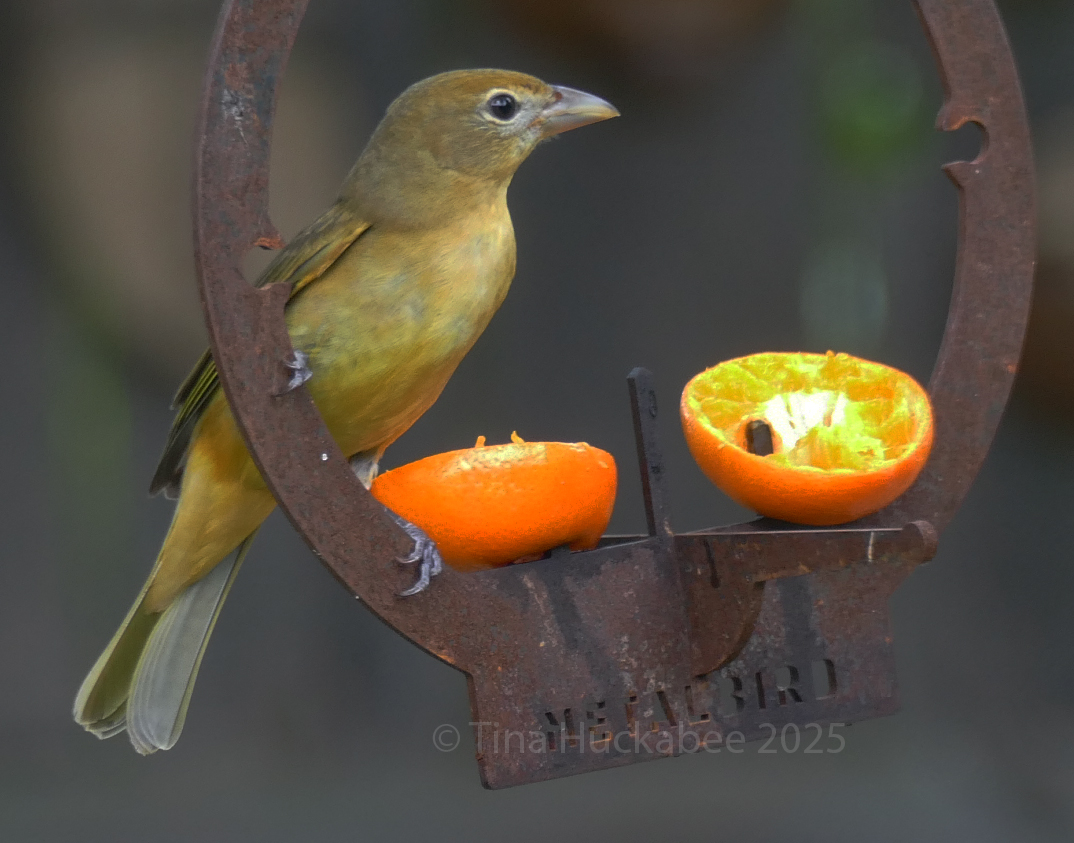
I didn’t notice the dark thing in the orange until I downloaded this photo, but I observed bees enjoying the oranges. Maybe the tanager came for the bee, then discovered the juicy joy of orange juice!
Various oriole species migrate through Central Texas. Some years there are quite a few, other years I observe only one or two, or none. This was a good spring for Baltimore Oriole, Icterus galbula, observation! A band of showy orange-n-black birds made their avian selves at home in the garden for a few days, mostly due to the offering of oranges and tangerines, which orioles love. My neighbor (and sister-in-law) also offered orange slices, so the migrants dined at two sets of gardens during their lay-over in Austin.
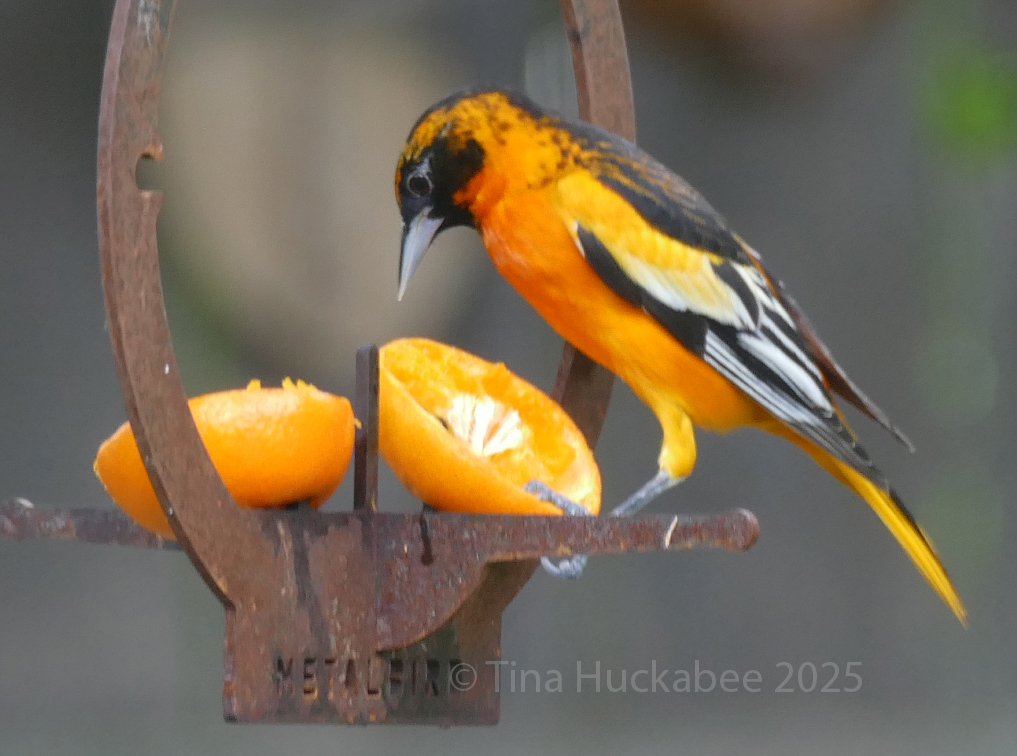
This oriole feeder, gifted to me by my SIL, proved a good spot for the orioles to perch-n-eat and the oriole-watcher to watch-n-photograph. I recall that these are two different (probably) juvenile male Baltimore Orioles, the photos taken on different days.

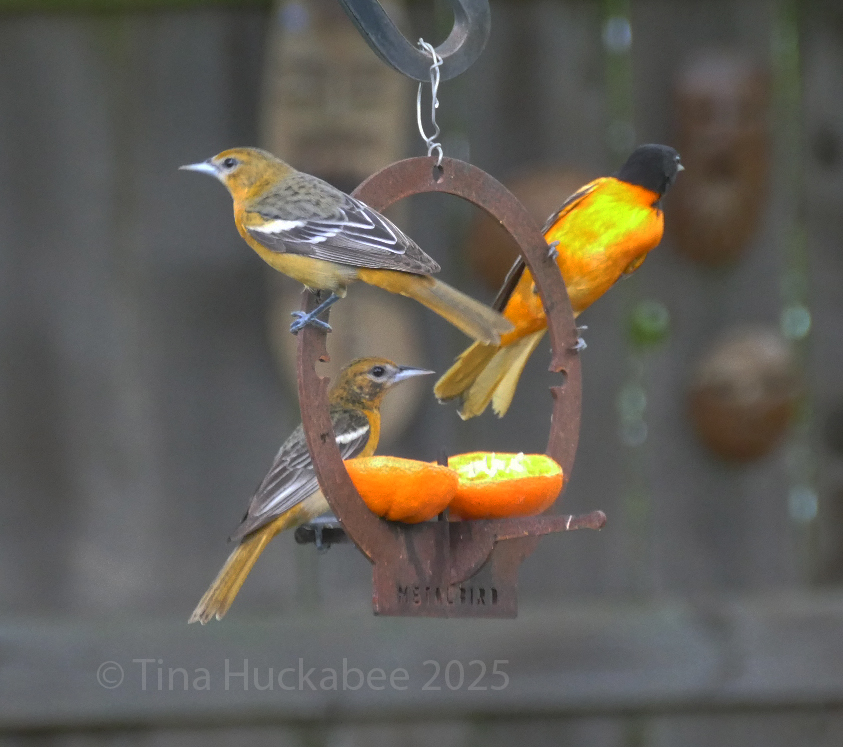
This threesome includes an immature female (left), an adult female (bottom/back), and an adult male. With only two slices, I wonder how they divvied up taking turns at the oranges? There was another photo that I didn’t download to this post that showed a female clearly chastising the male, no doubt for his rude behavior at the orange bar.
Along with the formal orange feeder, I stuck orange slices on a potted American Agave and these two handsome adult males didn’t mind the prickly posts at all. Yes, I was poked a couple of times, but also didn’t mind the extra feeding station for the orioles.

Both my SIL and I caught a shot at one female Bullock’s Oriole, Icterus bullockii. As I downloaded photos, I recognized that this bird has a white tummy, which is not a characteristic of the other orioles. Neither of us saw a male, but it’s likely one was around, we just missed him.

In addition to the birds that I saw and photographed, scads of smaller warblers and sparrows, too quick and too hidden in the plants to observe, are in the garden. Interestingly, the little birds–warblers, sparrows, and finches–are more likely found in my front garden which provides plenty of food (seeds and insects), as well as cover. Unfortunately, as a bird watcher, I don’t have an unobtrusive spot where I can spy on birds and remain unseen. Every time I amble outside, there’s a whoosh of wings and a chitter of alarm calls; they’re not thrilled with my presence. Lincoln and Vesper Sparrows, Lesser Goldfinches, and Common Yellow-throats have all been in the mix of the front garden bird fest. I’m certain there are lots of others when I’m not watching.
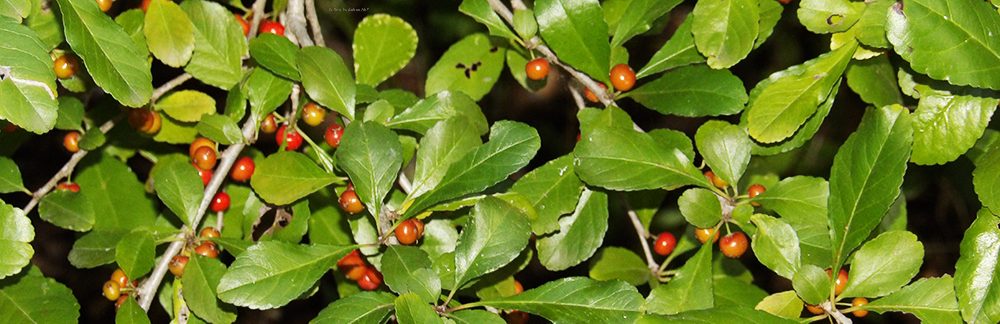
Additionally, a couple of Indigo Buntings, Passerina cyanea, hung out in my Possumhaw Tree and that was a treat. I saw them through my binoculars, but catching a photo with all that foliage as a distraction was a no-go. I was thrilled to see the Indigo Buntings, they’re stunningly beautiful birds.
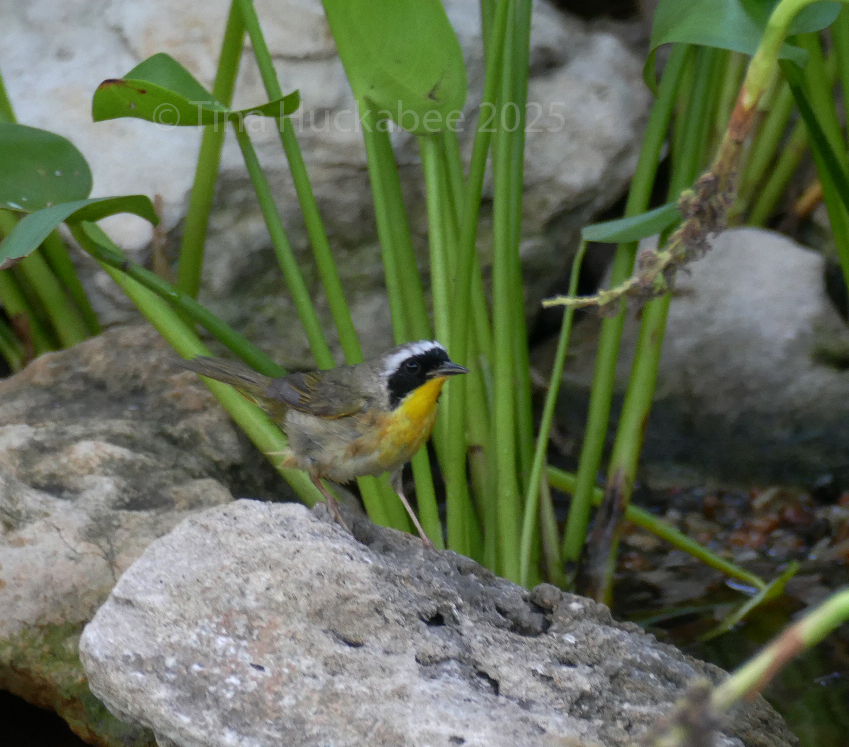
I finally snagged some shots of a darling male Common Yellowthroat, Geothlypis trichas, late one evening at the pond in the back garden. He was certainly flitty, but I could hide at the catio while he bathed in the bog section of my pond.
He danced along the rocks,
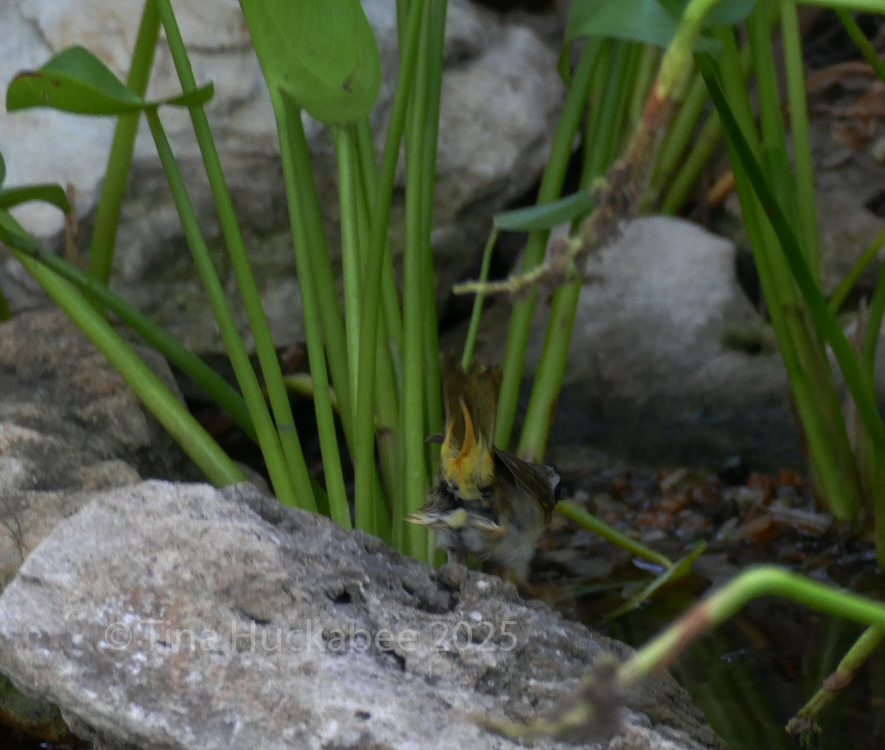
…and then it was a bums-up before another splash in the shallow bog water.
Several Yellow Warblers, Setophaga petechia, at least one Magnolia Warbler, Setophaga magnolia, and who knows how many other migratory birds, have stopped in my garden to rest and eat. Migratory season is winding down, but not yet done. These birds are all headed to northern places to breed. They’ll raise their families up north, then sometime in August, they and their offspring will make their way southward, completing the migration cycle once again. I’ll wait and watch for them.
If you plant them (native plants), they (wildlife) will come!
 My Gardener Says...
What outrageous colours your visitors have! I certainly envy your garden’s attraction powers.
LikeLike
Outrageous is a good description of these colorful beauties! Thanks, Brian
LikeLiked by 1 person
Wonderful collection of photos – and all right around your house! You’ve done a wonderful job of creating a migration haven for them!
LikeLike
Thanks, Sam. I’m glad that my garden and now, my SIL’s garden, provide for these remarkable birds. It’s a joy to host them, even if only for a brief time.
LikeLiked by 1 person
This seems a more colorful than usual assortment of birds. Is it happenstance, or do the colorful birds you show here tend to pass through together each year?
LikeLike
Except for the Indigo Buntings, these species all visit and they’re pretty much on schedule this year.
I was sorry that I couldn’t get a good look at the Indigo Buntings. My SIL took some excellent photos when they were at her feeding station.
LikeLike
I would love to see a Painted Bunting. You are really in the right spot for migration. I don’t seem to have as many stopping by.
LikeLike
They are spectacular birds! Those vibrant colors, they just don’t seem like a ‘real’ bird. 🙂
LikeLiked by 1 person
Glad you provide a welcoming way station for migrants. A lot of these species have been arriving in the past couple weeks. Every morning I’m hearing new calls, such a thrill. I’ve been hearing warblers galore, Baltimore orioles and I even saw two separate indigo buntings, tra-la-la! Unfortunately, they keep moving on.
LikeLike
It’s exciting when I first hear or see these migrants in the garden. Somehow it’s comforting to know that the cycle is still intact, even if threatened.
I guess I assumed you probably hosted many of these for summer. It’s disappointing that they visit only briefly, isn’t it?
LikeLiked by 1 person
Dear Tina,
You and your garden are a testament of what each of us can do to help our feathered friends–and get blessed with the presence of beautiful beings.
Thank you for sharing this colorful collection of your avian visitors. As I have said before: If I were a migratory bird, I would stop over in your garden. And leave you a 5-star review on “recommended migratory stopovers by and for birds.”
Happy birding,
Tanja
LikeLike
Thank you, Tanja. It’s been a real joy to create this garden and see who benefits from its bounty–like these beautiful birds.
Lol–I wonder how many ‘stars’ or ‘thumbs-up’ the birds give my garden? 🙂
LikeLiked by 1 person
I have no doubt in my mind that they leave only 5-star ratings! 🐦🐦🐦🐦🐦
LikeLike
I think I reported last year on my sightings of these beauties, and things haven’t changed. I’ve seen one Oriole on Galveston Island, and a lone Indigo Bunting appeared at my feeders two years in a row, for two or three days per visit. Sigh. Given the number of birders who show up here during the spring migration, they must be around, but they’re probably in areas that are either designed for them or that naturally suit them more than my neighborhood.
The one I’d love to see is the Painted Bunting. I have a friend in the hill country who sees them every year; I tease her about her tendency to call everyone she knows to repeatedly brag about it. You sure have created a magnet for these wonderful creatures; it’s a thrill to see them, even if only in photos.
LikeLike
You’ll have to wrangle an invite to your friend’s house during their migration through her area. Honestly, when Painted Buntings are around, you can’t miss them!
LikeLiked by 1 person