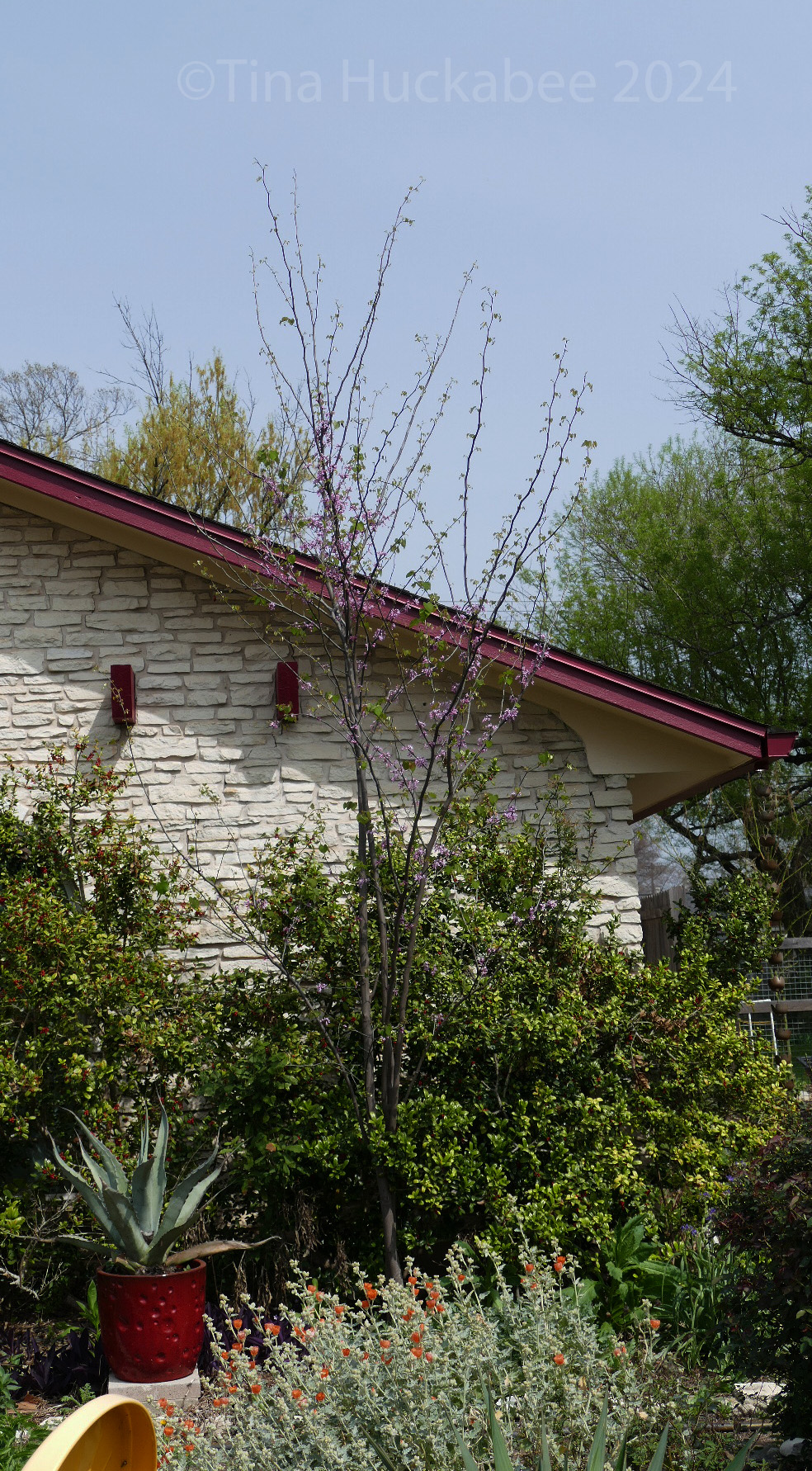
Riffing on a recent post from Steve at Portraits of Wildflowers, I’m enjoying my own celebration of the annual pink-n-blue spring happening. It was Steve’s post that reminded me that I do have a redbud tree and that maybe, just maybe, it might be loaded with blooms this year. This little tree has grown apace since the front garden shed its shady ways and began thriving in full sun after the removal of a large, ice-storm damaged Arizona Ash tree.
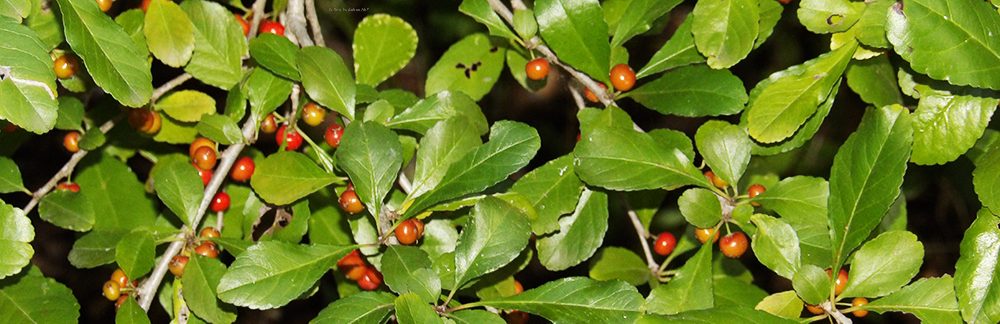
The plant seeded itself in this spot 10-plus years ago. It didn’t grow much and never bloomed, though the foliage certainly looked to me like redbud foliage.

Absent other clues, I just wasn’t 100% certain what it was–until last spring. Last March a few of the signature dainty pink flowers, hugging close to the limbs, appeared. Yes! A redbud tree! I was tickled pink!
Once the tree was exposed to full sun, it took off in height and width, and this spring for the first time, it is in full flower production. Blooms have appeared throughout the limbs, in concert with the unfolding heart-shaped leaves.


There are several kinds of redbud trees which grow here in Texas. I believe that this one is an Eastern Redbud, Cercis canadensis var. canadensis, mostly due to its glossy leaves. There are a number of these trees in my neighborhood and there are several small seedlings in other spots in my garden.
As I’ve observed the blooms, tiny native bees seem to be the primary pollinators. On a breezy day, they’re hard at work, but difficult for me to capture in a photo.

The common name for this tree describes the red buds, before blooms open. But it’s the lovely shape, lush foliage, and sweet pink flowers that most people remember about this tree and its relatives.
Pink blooms and blue skies–spring has sprung!
 My Gardener Says...
The red buds in my area are having a great year.
LikeLike
They’re really pretty here, too.
LikeLiked by 1 person
One of my favorite natives, though there aren’t as many in the northeast as the southeast where they light up the woods.
LikeLike
They do ‘light up’, don’t they? A favorite of mine, as well. So pleased that some bird or squirrel or puff of wind brought one (more, actually) to my garden!
LikeLiked by 1 person
I’m glad you’ve gotten to enjoy the pretty pink display this spring without even having to leave your yard. As you noted, access to sunlight seems to have been the decisive factor.
The common name redbud has puzzled me, given that the pink flowers rather than the red buds are the main reason people appreciate this tree.
LikeLike
I’m with you about the common name–why red bud when it’s the pink blooms that are the show. Maybe we should start a petition drive to change the name!
LikeLiked by 1 person
Last week, all the redbuds in the area began to bloom at the same time: at least, within 48 hours of each other. It was amazing to see, and so pretty. I’ve seen a very few in the hill country woods, and they’re such gorgeous accents to all of the live oaks and vines and whatnot. It’s going to be interesting to see what other changes come to your garden, now that you have that additional sunlight. This is a great start!
LikeLike
When they start blooming, they ALL start blooming. Then again, it’s the same with Texas Mountain Laurel, Rock Rose, and so many others.
I’ve found in these last 2+ years that the plants getting full sun really seed out more–lots more. That’s now a major chore, weeding up the seedlings that I don’t want or need. I’ve also been surprised at some plants that I’ve always thought of as “shade or part-shade” growing and blooming beautifully in the full sun. The main one that comes to mind is Pigeonberry, Rivina humilis. I always grew it as a shade lover, but the ones I left in the now full son garden have really thrived–and produced lots of seedlings!
LikeLiked by 1 person
How nice that your ten-year wait-and-see attitude finally paid off last year and even better this spring. Keep enjoying this handsome and useful tree.
LikeLike
I’m happy, especially because I wanted a redbud in the garden. I thought I’d wait to see whether this was, indeed, a redbud. Score!
LikeLiked by 1 person
Love, love this tree! We had to cut ours down because it was growing into the house roofline/gutters. 😦 But we bought a new one, and it’s currently growing happily in a pot. They are beautiful trees in full bloom, aren’t they? And native to a large portion of the Eastern, Southern, and MIdwestern U.S. 🙂
LikeLike
It’s a garden winner, that’s for sure! Glad you purchased another–it’s always great to have a redbud in the garden!
LikeLike