Awakenings: Wildlife Wednesday, March

Wild things are throwing off the covers of winter and so are their garden partners!  Welcome to Wildlife Wednesday, celebrating all things wild in our gardens. Here in Austin, Texas, it’s not meteorolgically  spring, but it’s also definitely no longer winter.  Sure, it’s likely there will more cold days, but spring is busting out everywhere and wildlife are gearing up with life-affirming activity.

Birds–residents and winter visitors–have taken front stage in wildlife action for the last couple of months and they still are the leading characters of the garden.  There are other garden-dwellers who are angling to slough-off their winter wears and gear-up for a new life and the promise of a mate (or mates!) and family.

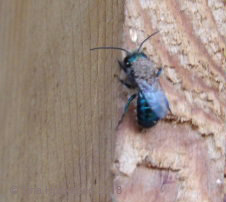
Bees are back!  The honeybees have been around all winter, though on the coldest days, they remained well-tucked in their cozy hives to keep warm.  But the season is nigh for the emergence of the native bees and first in line are the Blue Orchard beesOsmia lignaria.   The highlighted link takes you to my March 2017 Wildlife Wednesday post, where I wrote about these stunning bees as they emerged at exactly the same time last year.
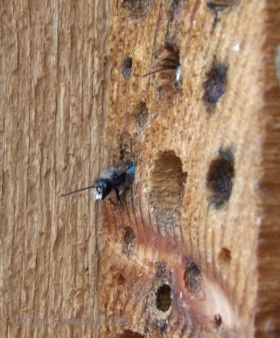
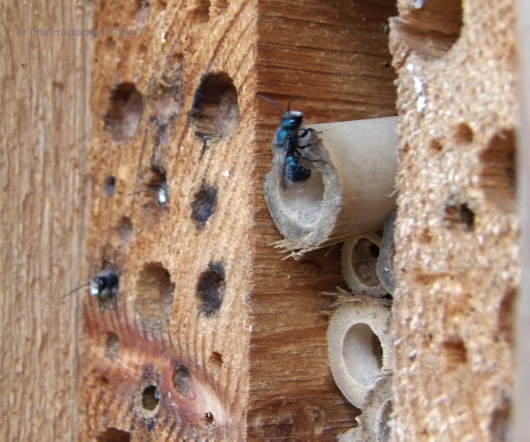
Two adult bees emerging after a year of development in the holes of an insect hotel.

The Blue Orchid adult bees live for about a month and during that time, they mate, and then gather pollen, leaf material, and mud for their offsprings’ incubation chambers.

I found this Blue Orchard bee chewing away at the leaf of my Old Gay Hill rose. It’s the leaf material that they gather which gives the packed holes a green tint.

Females lay their eggs in the holes of wood,
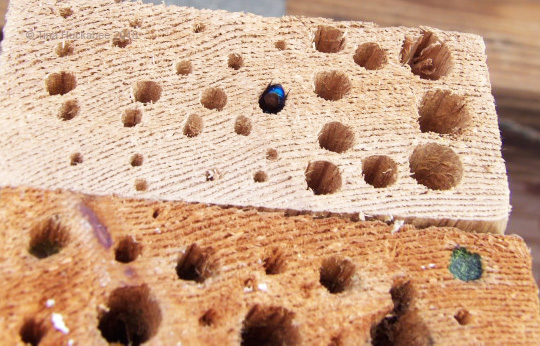
This female is regurgitating her gathered material, so she’s head-first in the baby-bee incubation chamber. Check out the packed green tinged hole; is that green from my rose-leaf??

…or masonry,

…and then pack the holes to protect the developing bees for the next year.

A just-emerged adult Blue Orchard bee. You can see the holes that the adults emerge from in the packed nesting material created last February/March.

It takes a full year for these blue beauties to “cook till done” but it’s time well-spent.  Currently, every time I walk by either of my two insect hotels, there is a flurry of shiny blue activity as the buzzers have mated and are bringing in material to secure their babies’ future.

With as long a screw that I could find in our garage, I cleaned out those drilled holes where it was obvious that a bee had emerged, so that it’s available for the next generation. I couldn’t quite reach the end of the drilled holes in some nesting spaces, but cleared many spots.  I also added a few more cut bamboo pieces and drilled wood blocks to the boxes.
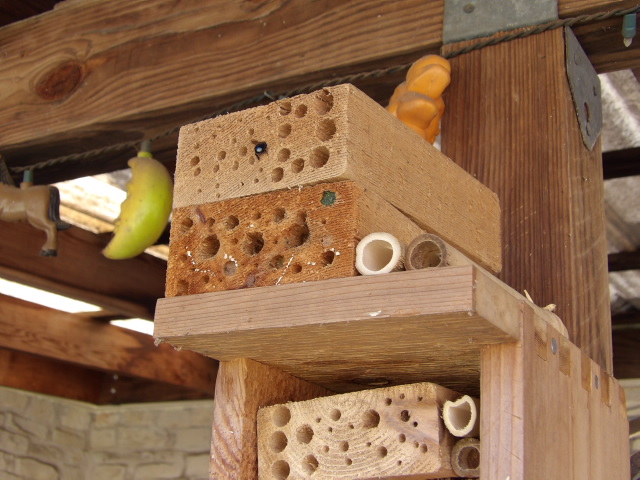
I like blue bees in the garden and will happily welcome more next year!
 

Squirrels are ever-active and always cute.  And annoying.

Eastern fox squirrel (Sciurus niger)


Winter and spring are the best times to see woodpeckers in my garden and this year, they haven’t disappointed.  I hear and see Red-bellied Woodpeckers, Melanerpes carolinus,  nearly daily.  A male and female are regular visitors (mates?), enjoying the commercial suet I provide in the cool seasons.

A handsome male.

This male sat for quite a time in my Red oak tree, enjoying the rest.  Maybe his tummy was full.

At another time, he (or a buddy) worked the bark of a neighbor’s tree.  Check out the holes to his left!

I don’t see the female as often, but snatched a quick shot of her one day as she nibbled at the suet.

Suet is a bit gross (all that fat!), but birds need fat during winter and so I oblige. Personally, I’d choose cheesecake.  Or ice cream.  Ahem.

I only provide suet in winter and spring; once it’s hot, the suet spoils quickly.  During the warm months, I’ve tried a recipe of non-animal fat suet (peanut butter with seeds and cornmeal), but there were no takers.


A few mornings each week, I take a handful of peanuts out for the Blue JaysCyanocitta cristata.  They love their peanut treats!
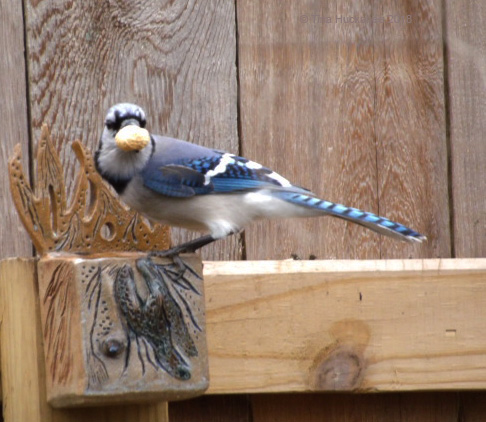
Sometimes they line up along the fence line like planes on a runway, awaiting departure.  Each bird waits its turn for a peanut-grab and take-off.


A pretty-boy House FinchHaemorhous mexicanus.

Perched at a bird bath.

The males are in full-mating color form, accompanied by lots of singing!


White-winged Doves are common here in Austin, but in my garden I rarely see Inca Doves or specimens of like this pretty Mourning DoveZenaida macroura.

The bird’s blue eyeliner echos the blue of the bowl it waddled past.

Its been hanging around for a week or so, nibbling seeds and resting in the sun, and walking that weird walk that doves are known for.


Another common bird, replete in his stunning spring plumage, is the Great-tailed GrackleQuiscalus mexicanus.

This photo doesn’t catch the luminous colors that his feathers display when the sun shines.  Instead, on this cloudy morning, the feathers showcase the velvety black that complements his striking eyes.


Not my favorite bird and an invasive pest,  I rather admire the plumage and coloring of the European StarlingSturnus vulgaris.

Starlings show up in late February and are bullies at the suet feeder.  I  usually stash away the suet when I see them congregating and chasing off the local songbirds, because a group of Starlings can finish a suet block in an hour, if allowed the opportunity.  I have noticed that they only appear in the mornings, so I hang out the suet in the afternoons once they’re gone.  This year, there haven’t been as many Starlings, for which I’m grateful.  They are joyous bathers and make great use of my birdbaths and the bog area of the pond.

The seasons are changing:  winter to spring and summer to autumn.

Who’s visiting your garden in this time of change?  Please share your photos and stories of wild critters this past month.  Remember to leave a your link when you comment.

Happy wildlife gardening!

Coral honeysuckle (Lonicera sempervirens): A Seasonal Look

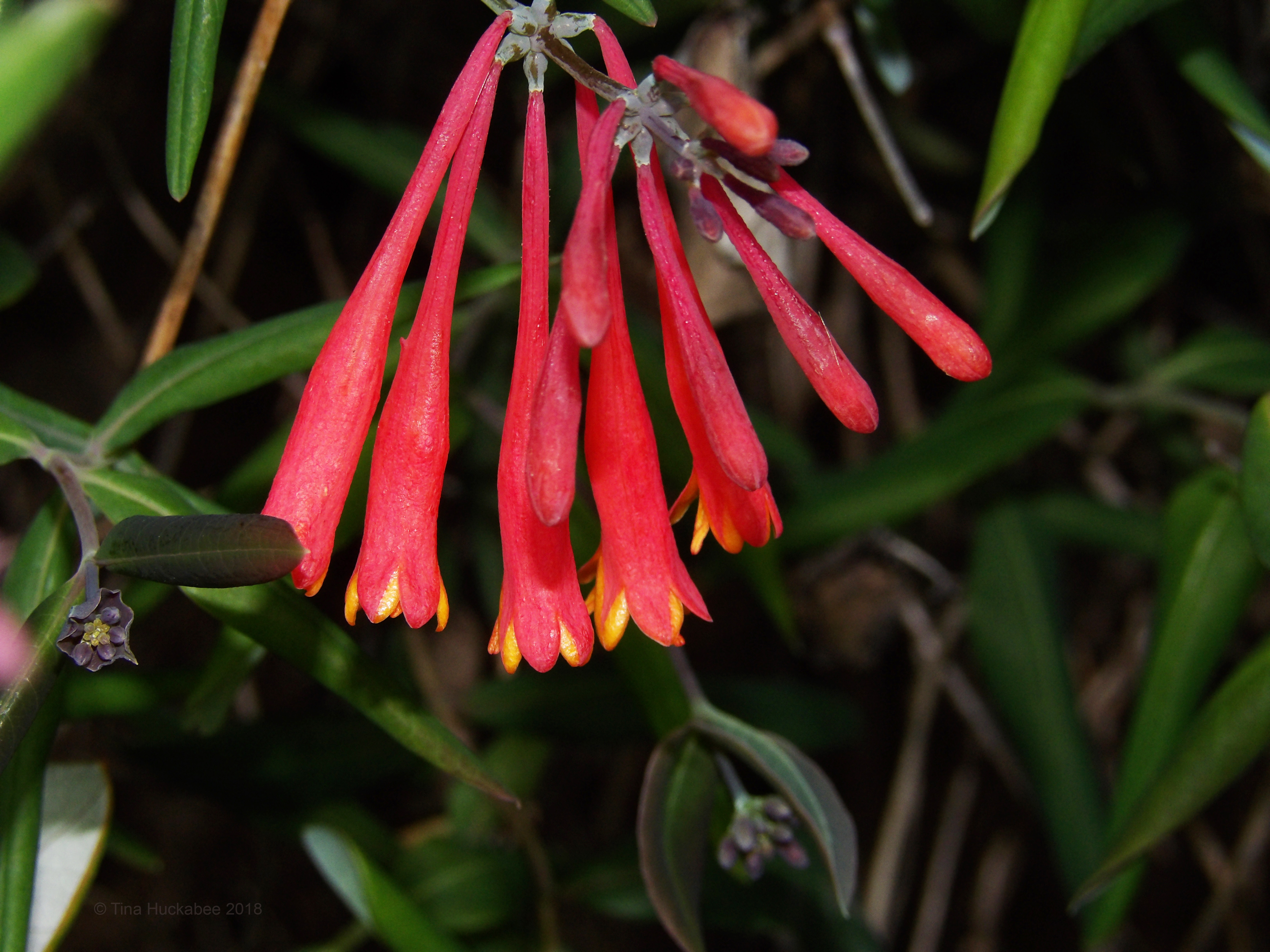
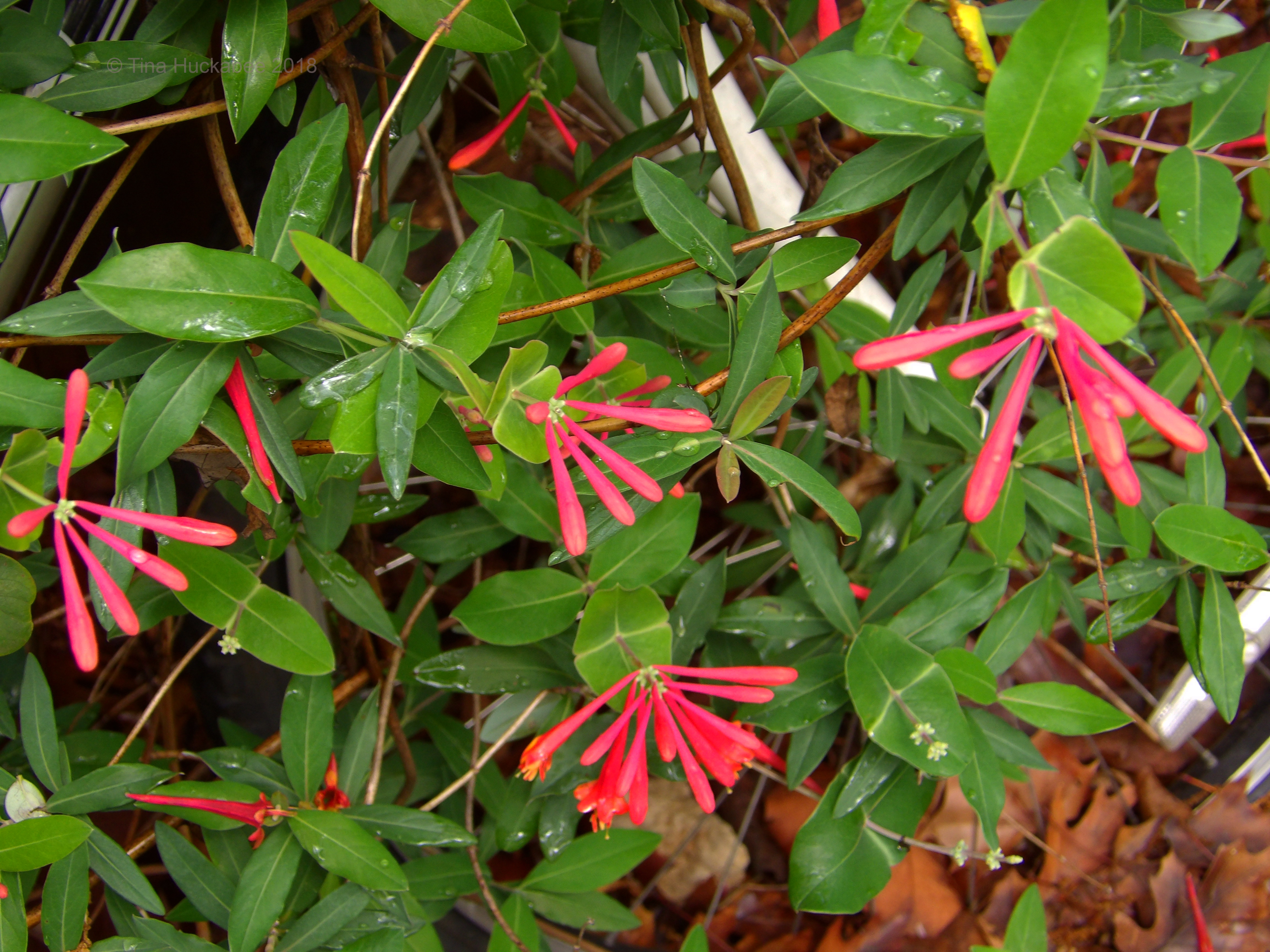
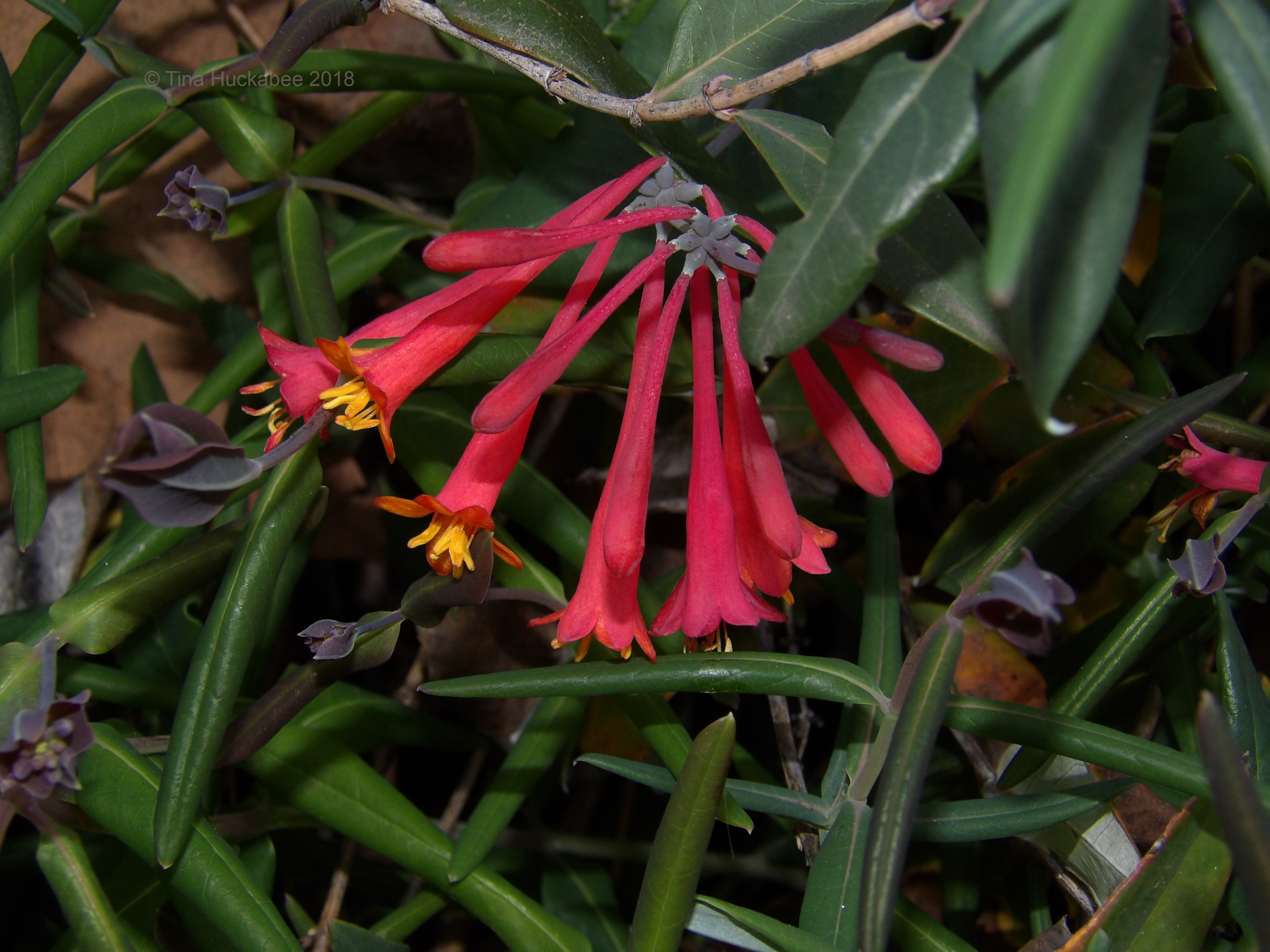
Coral honeysuckleLonicera sempervirens), loved for its eye-popping clusters of pollinator-delighting blooms and its robust  demeanor in the garden, is a favorite perennial vine for many Texas gardeners.

This vertical loveliness is native to East Texas, Florida, with a northward range up the east coast of the United States, but is also found in many other parts of the continental United States.   Here in Central Texas (Austin, Zone 8b), Coral honeysuckle provides semi-evergreen color, punctuated by spring outbursts of gorgeous red blooms, with yellow interiors.

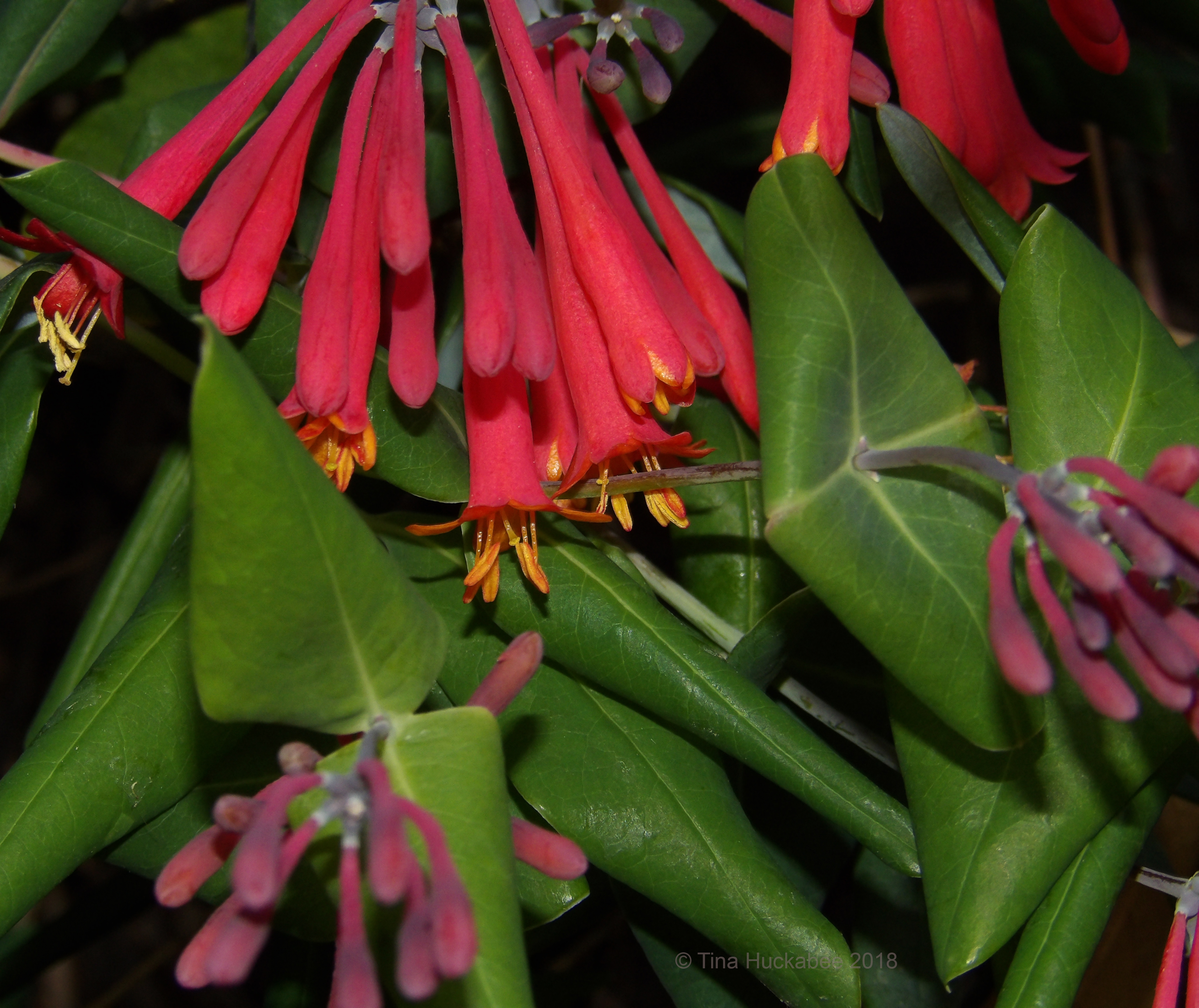
The bloom clusters remind me of a group of debutants, all in elegant, clingy red evening gowns, with an underneath peek-a-boo of yellow petticoats.


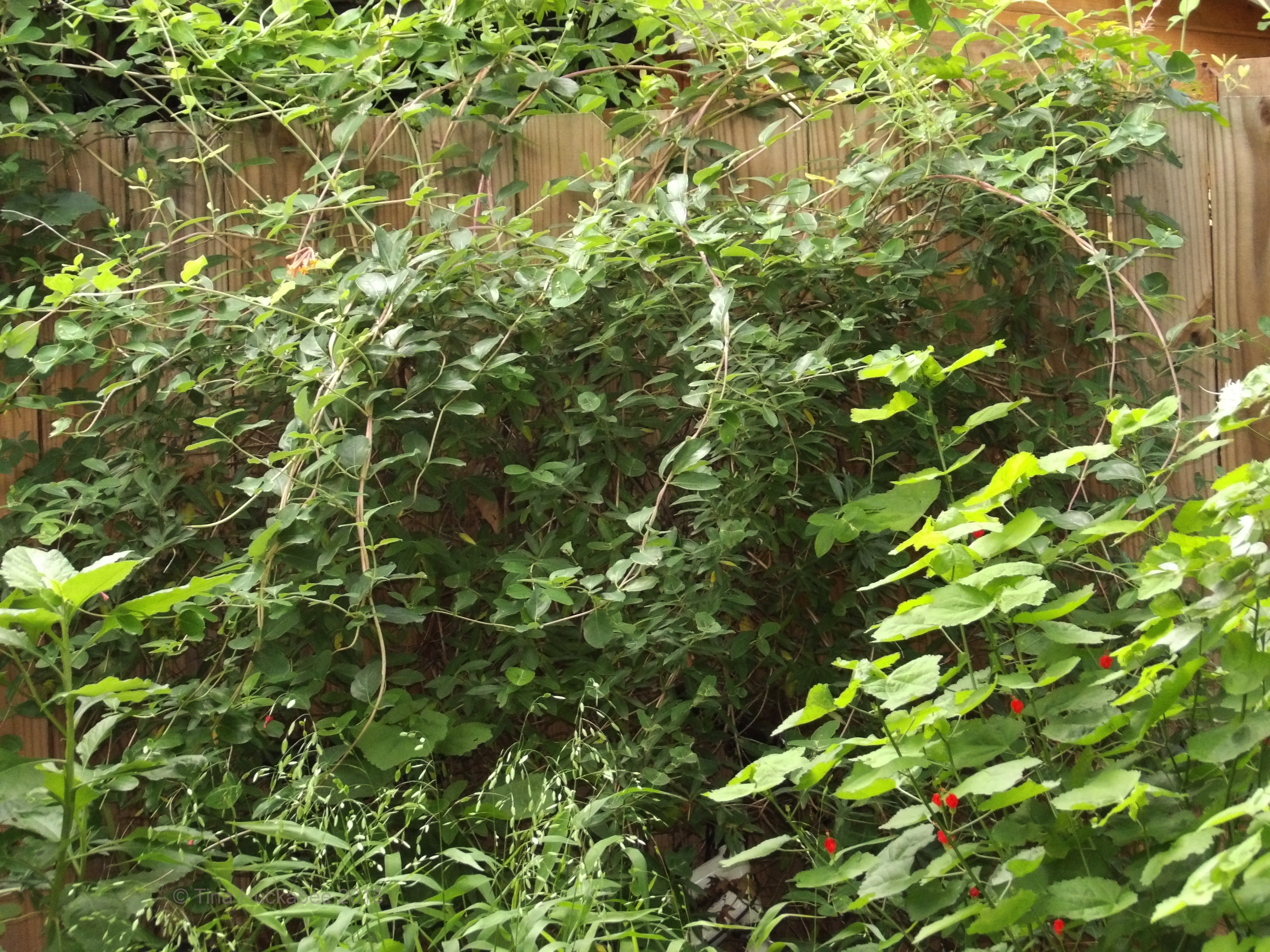
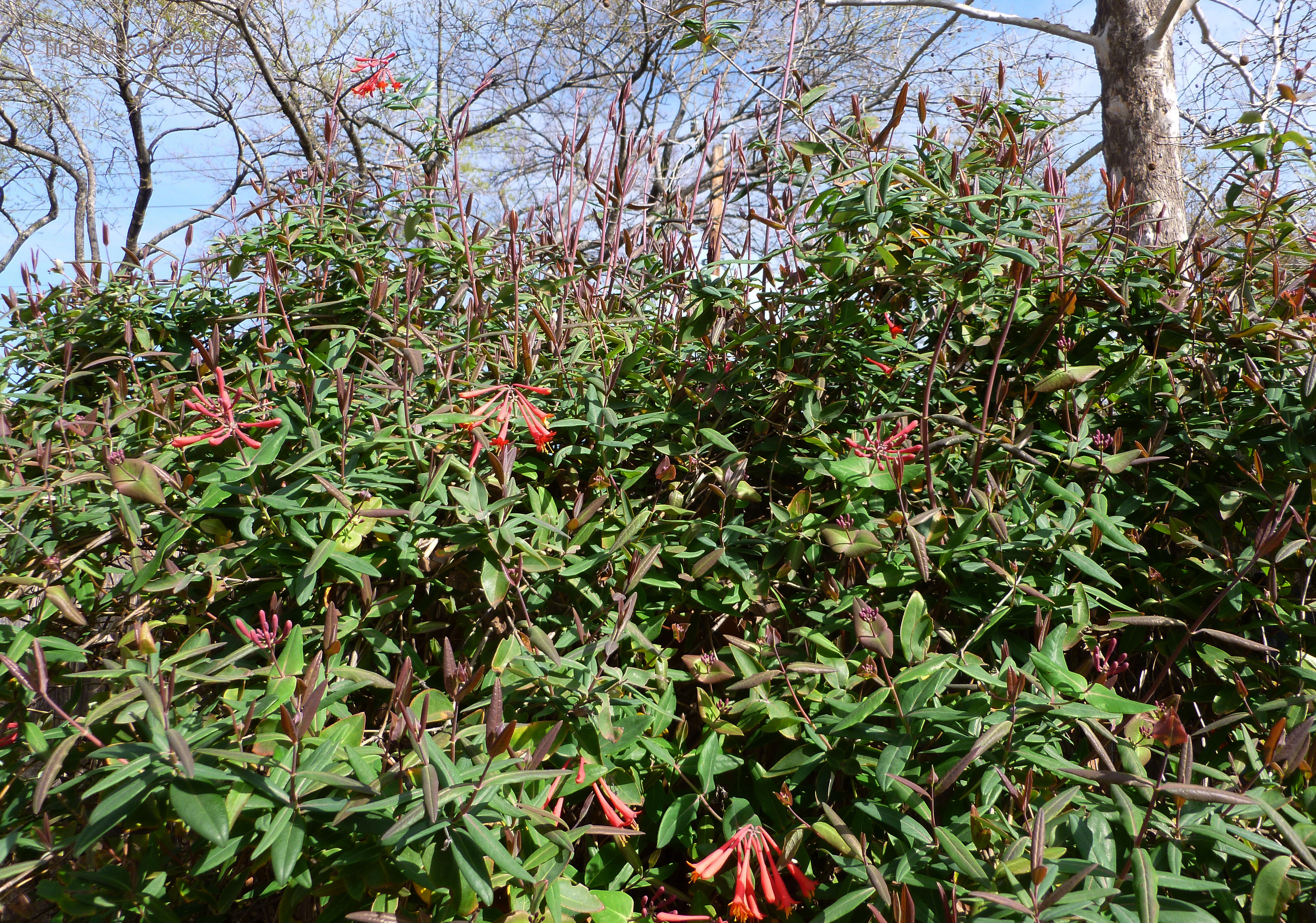
I’ve grown two of these vines in my garden.  This one in full sun,

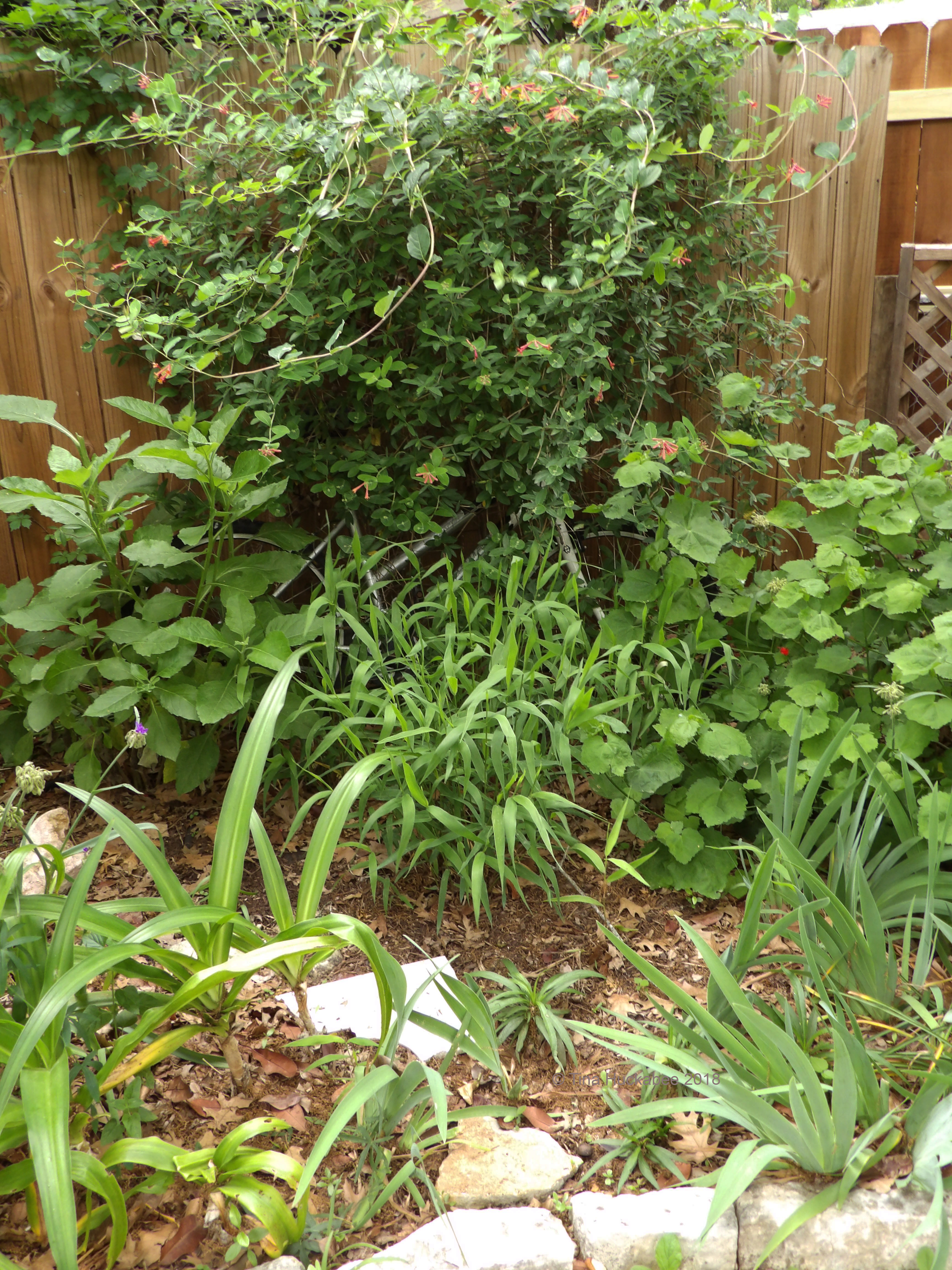
…and this one in a mostly shade spot.

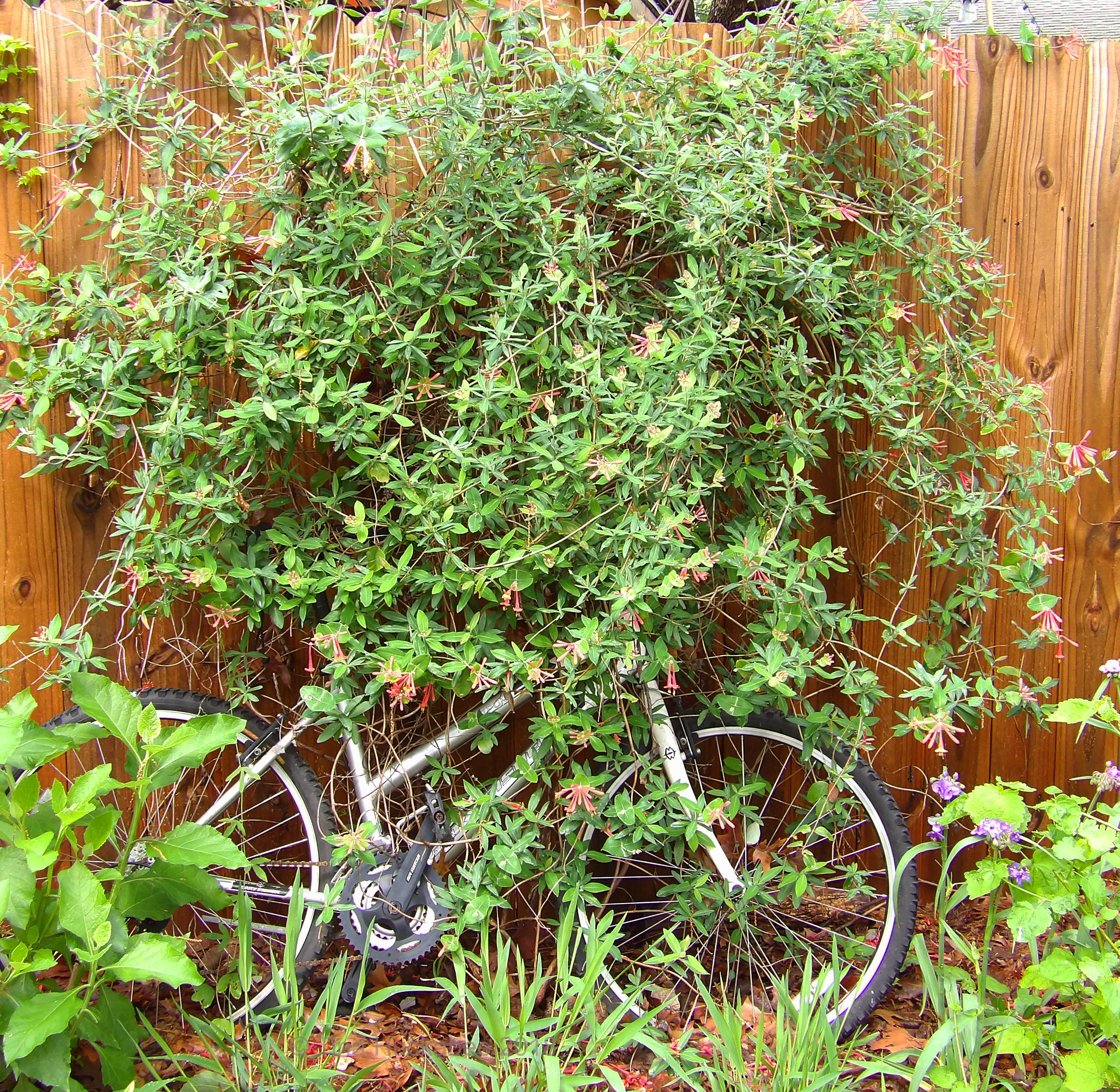
A May shot of a shady spot with blooming Coral honeysuckle anchoring the garden.  Aside from the bicycle, and (from left to right), grows Frostweed, Inland sea oats, and Turkscap.  Some Spiderwort are still popping with purple blooms.

The bulk of blooming occurs mid-to-late spring.   The flowers on my vines have bloomed as early as February, sometimes with continuous blooming into May.  Peak bloom time occurs during March and April, with a sprinkling of blooms in early summer.

An excellent climber–perfect for a trellis, arbor, or fence–Coral honeysuckle flowers more in full sun.

In woodland areas, it clamors over the ground as well as up trees and rocks.

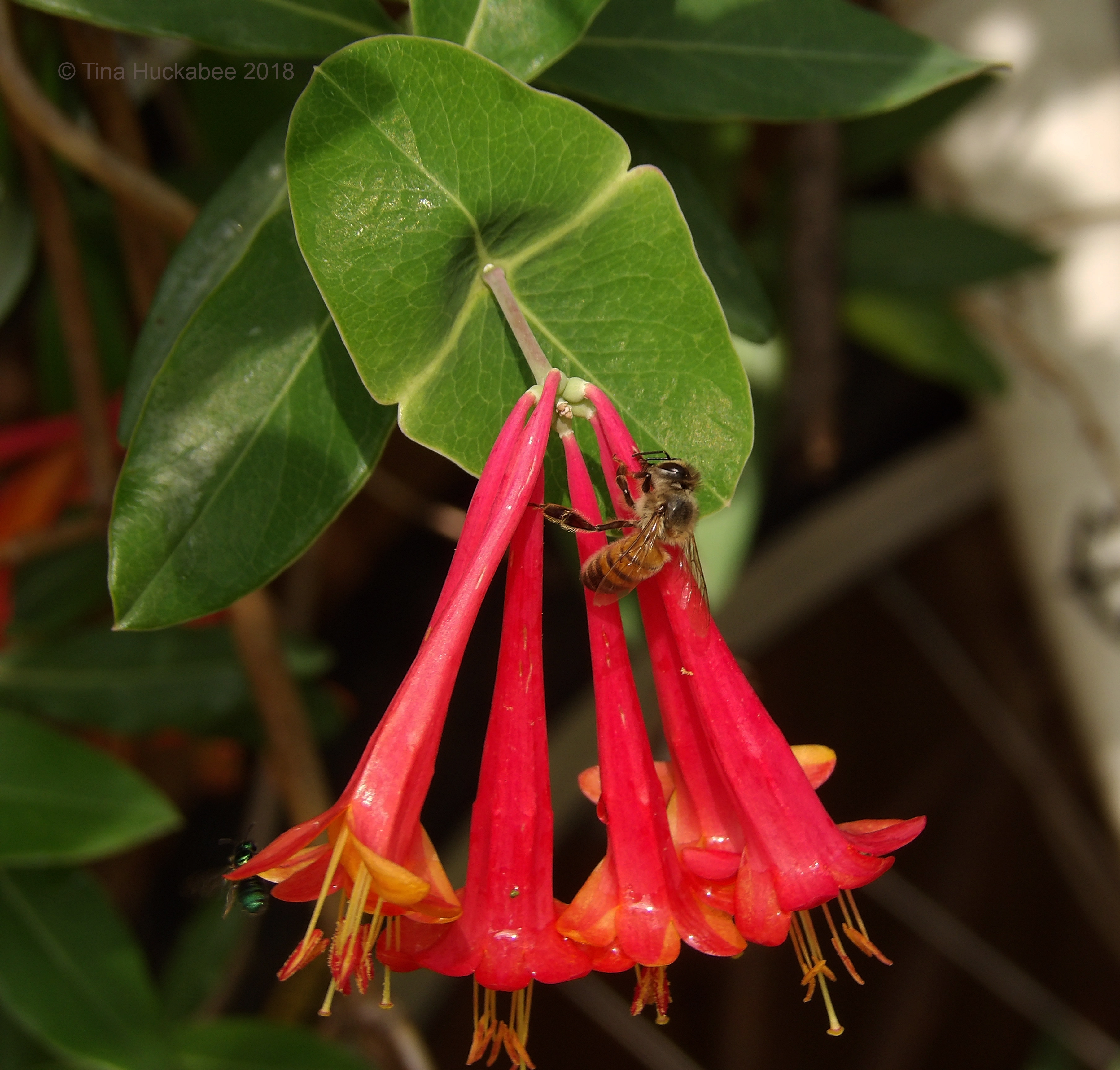
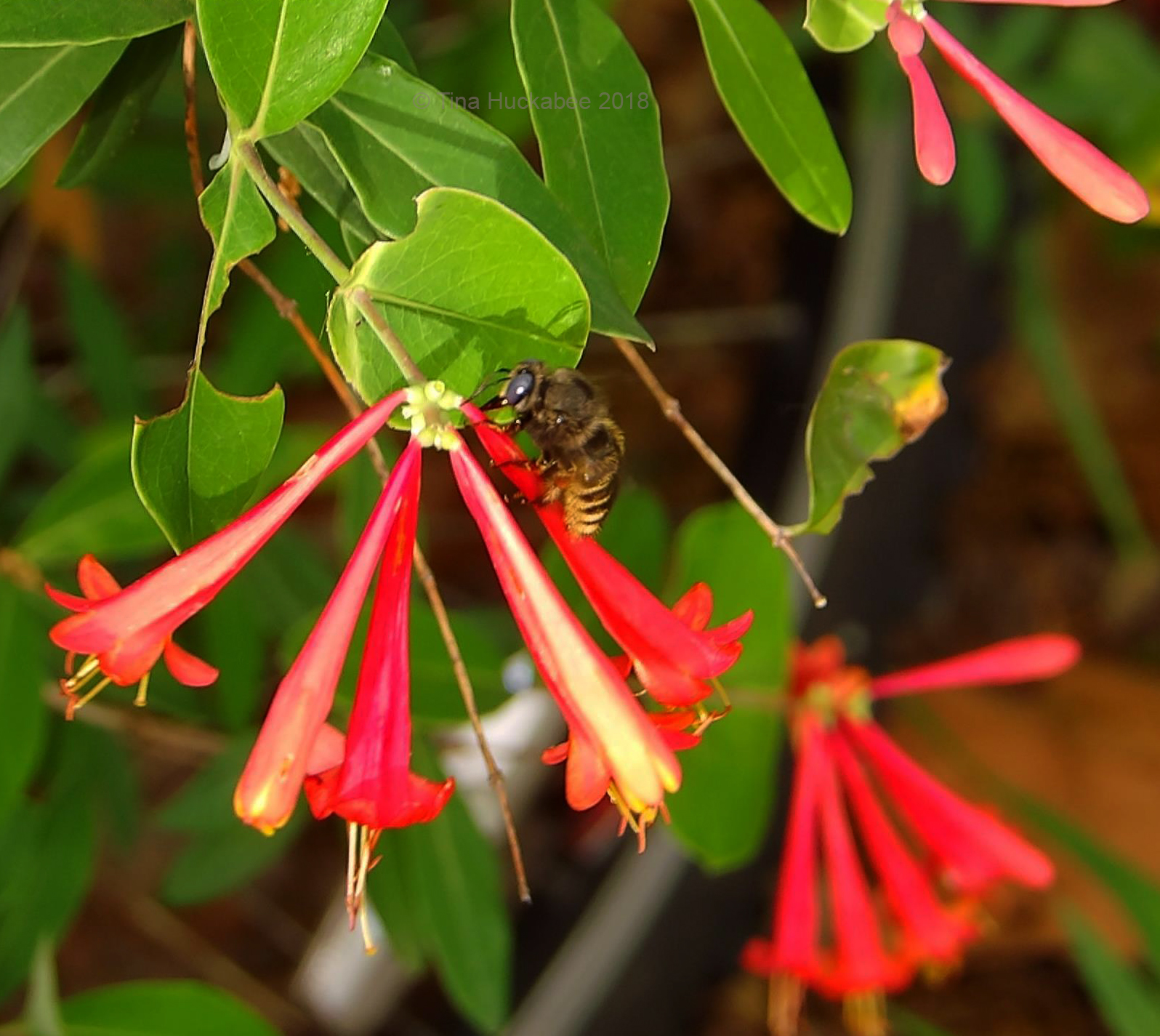
Pollinators of all stripes, sizes, and colors flock to the tubular founts of pollen and nectar:

Nectar stealing Honeybee at top of bloom, with native Green Metallic bee (Halictidae) on left, toward back of bloom cluster.

Nectaring Metallic Green bee.

Horsefly-like Carpenter bee (Xylocopa tabaniformis).

Honeybee coming in for a meal.

Hummingbirds are attracted to the blooms, though I’ve never seen any at my blooms.   I suspect that there simply aren’t many (if any) hummers around during the peak bloom period in my garden as they don’t typically arrived back in Austin from Mexico and Central/South America.  That said, the tubular red blooms certainly fit the profile of hummingbird attracting flowers.

Additionally, this honeysuckle is the host plant for a butterfly, Spring Azure, (Celastrina ladon), and a moth, Snowberry clearwingHemaris diffinis.

Springtime sees the biggest burst of blooming, but sporadic clusters occur in summer as well, usually after a tropical rain event.

The vine maintains a lush, green presence throughout the summer months, requiring minimal water during the dry and hot of summer.  I irrigate in the hottest of the hot, during those months with nary a drop from the sky.

Coral honeysuckle is a water-wise addition to any garden.


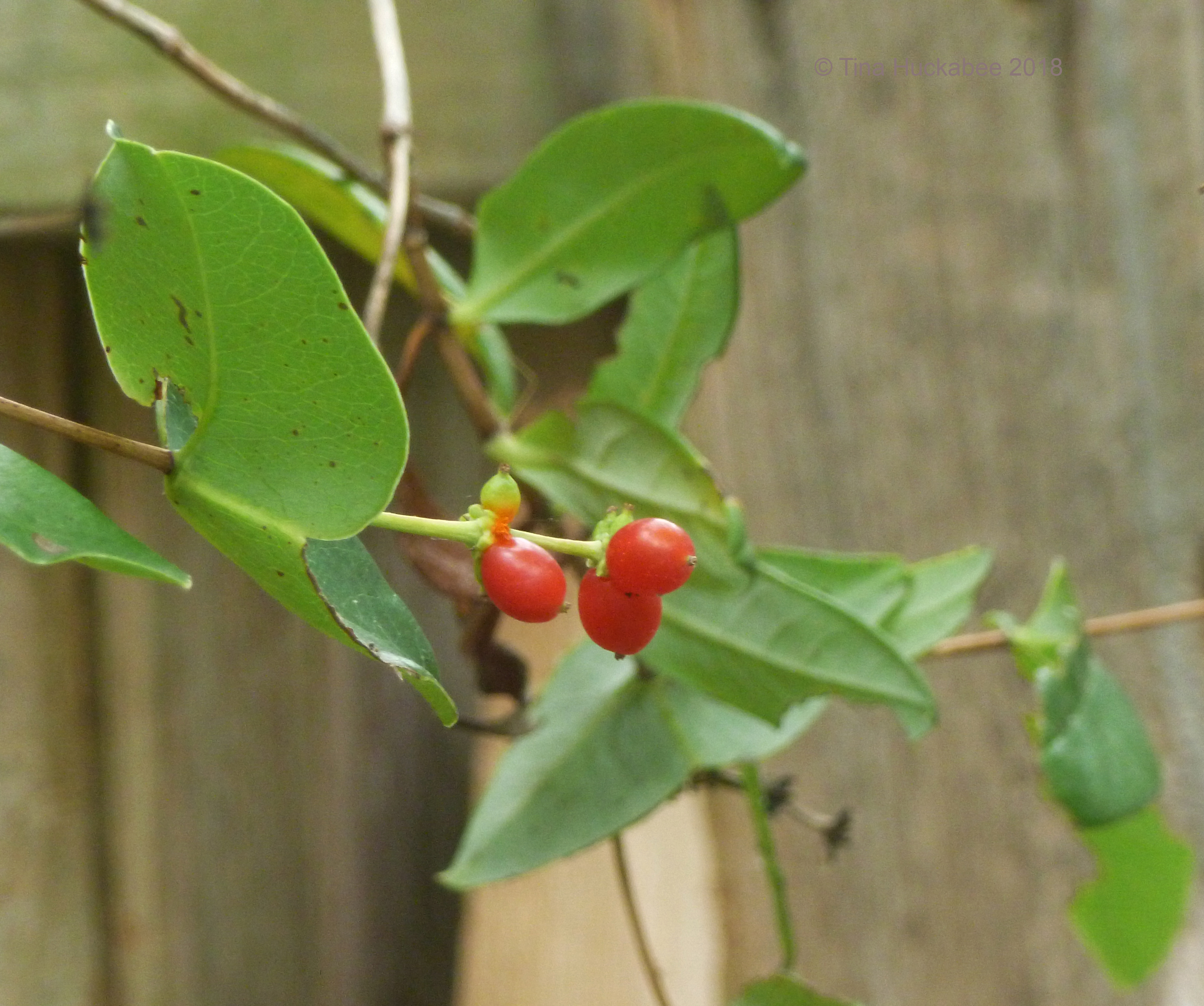
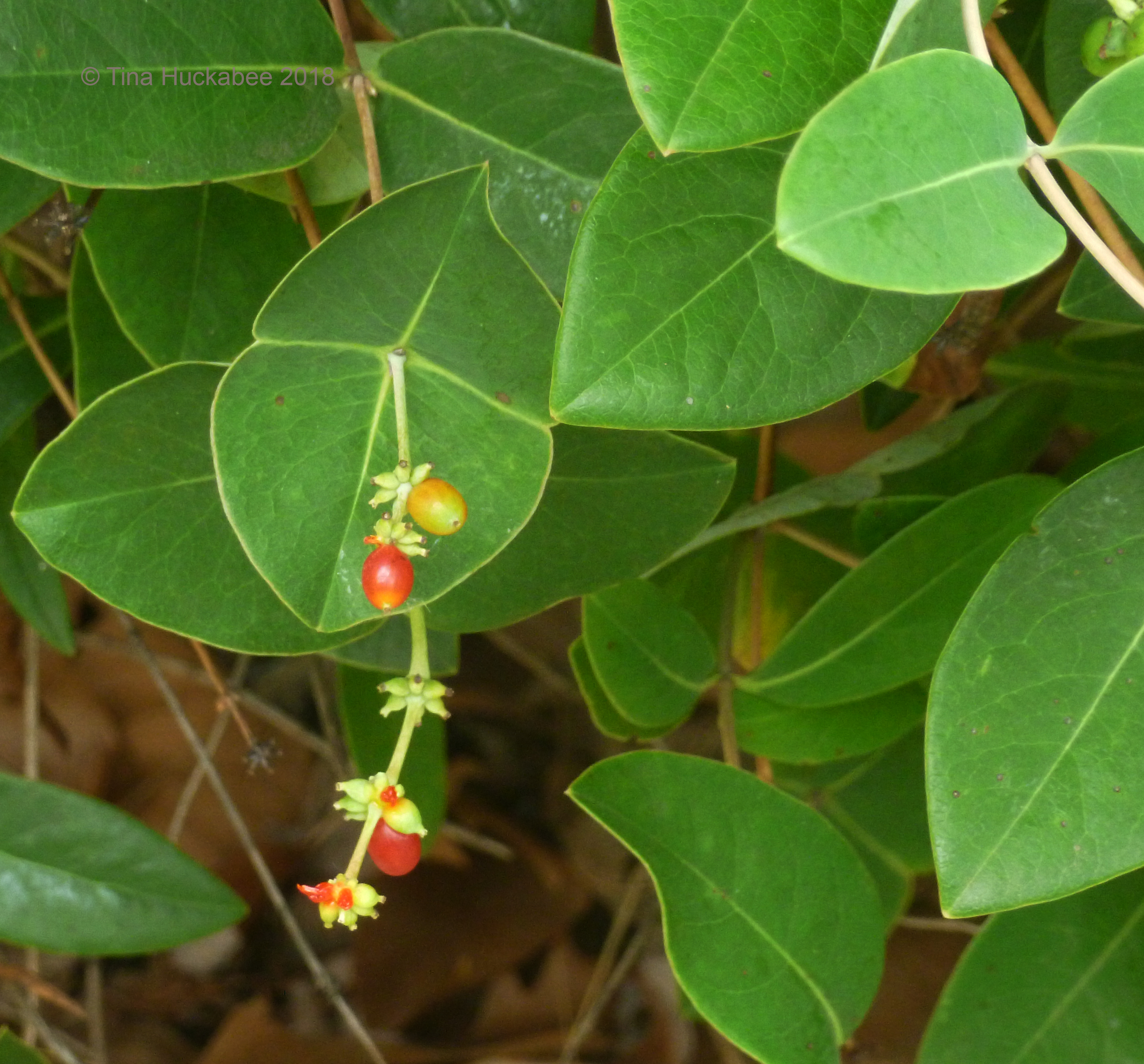
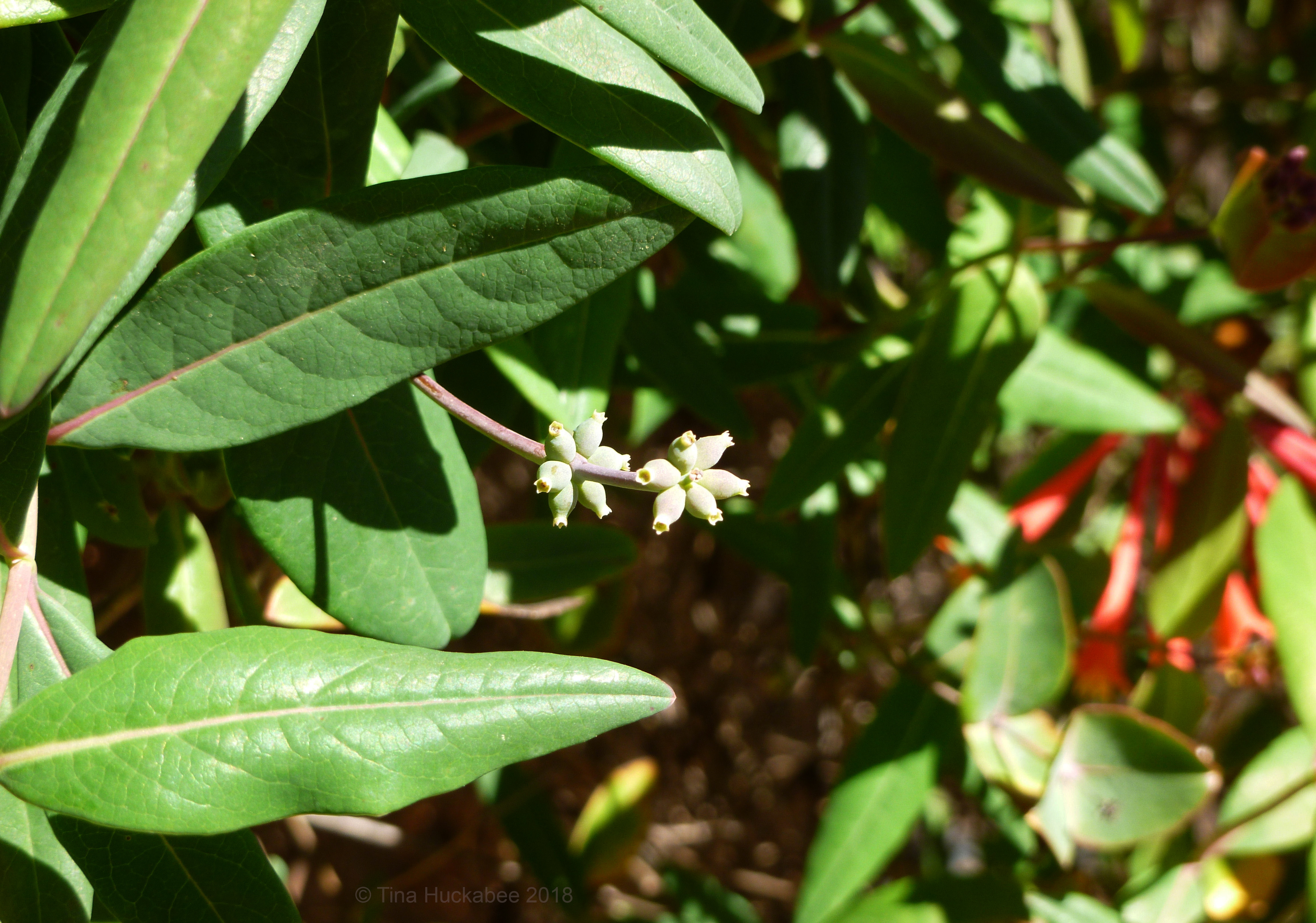
I usually see the fruits of the Coral honeysuckle in summer and early autumn.

They must be yummy, because the fruits don’t last long on the vine.  Various birds enjoy the fruits and foliage protection from honeysuckle; I’ve seen Mockingbirds, Carolina Wrens, and other birds seek refuge–and probably snacks–in both of my vines.

Nascent coral honeysuckle fruits.


As summer segues into autumn, Coral honeysuckle continues its solid green contribution to the garden.


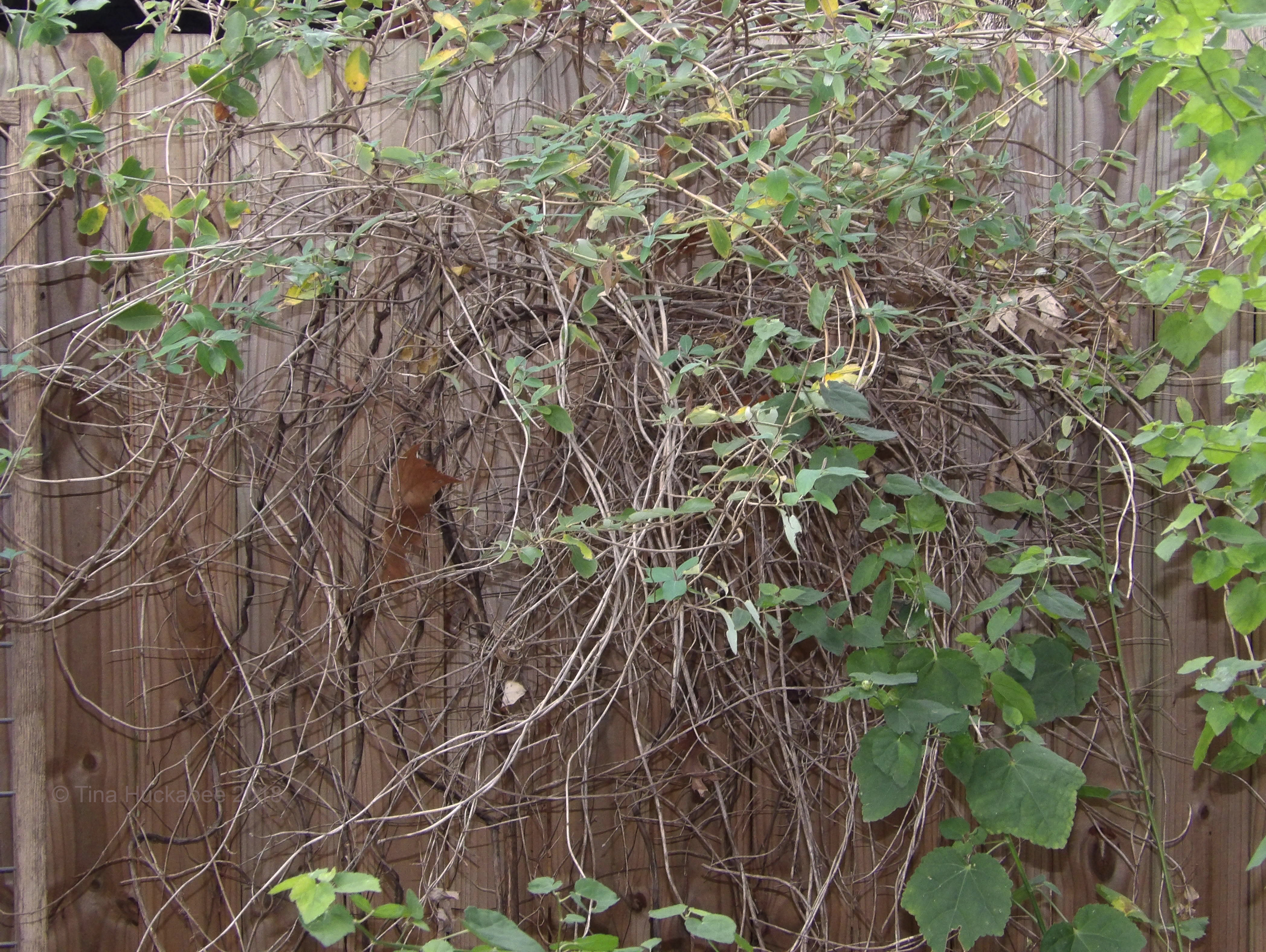
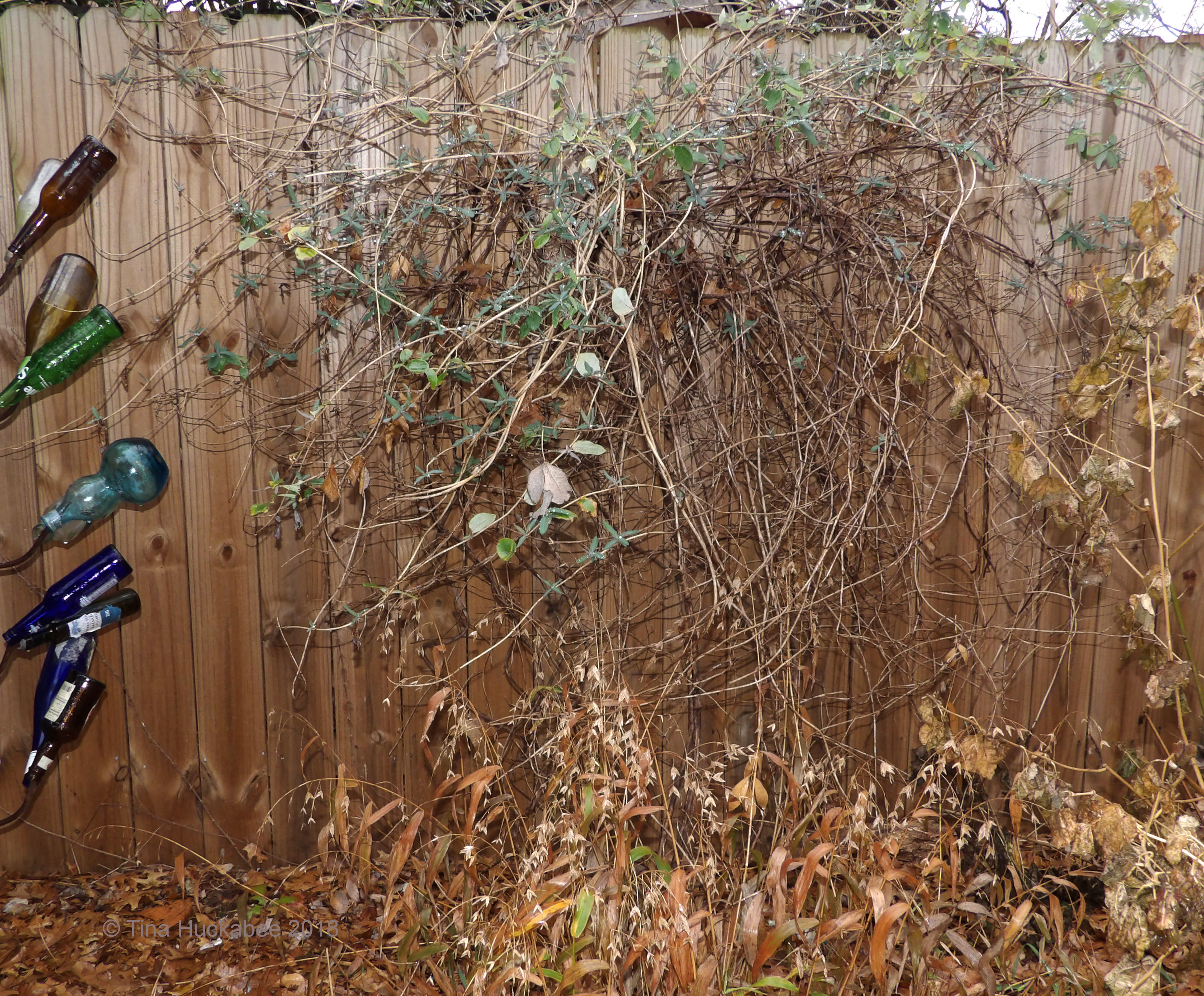
During winter the vine can freeze completely if the freeze is hard and long enough.

There are usually a few token leaves remaining.

More often than not, the foliage simply thins a bit, with some strands lacking foliage and the vine maintaining the majority of its leaves.

As the days grow longer and the temperatures warm, whatever foliage which quit the vine during winter’s freezes, return–lush and full and ready for the new growing season.

New Coral honeysuckle growth is exuberant–to the point that the fresh limbs reach to the sky in unwieldy growth spurts, requiring occaisional tucking in and twining around so as not to clamor over other things in their paths.

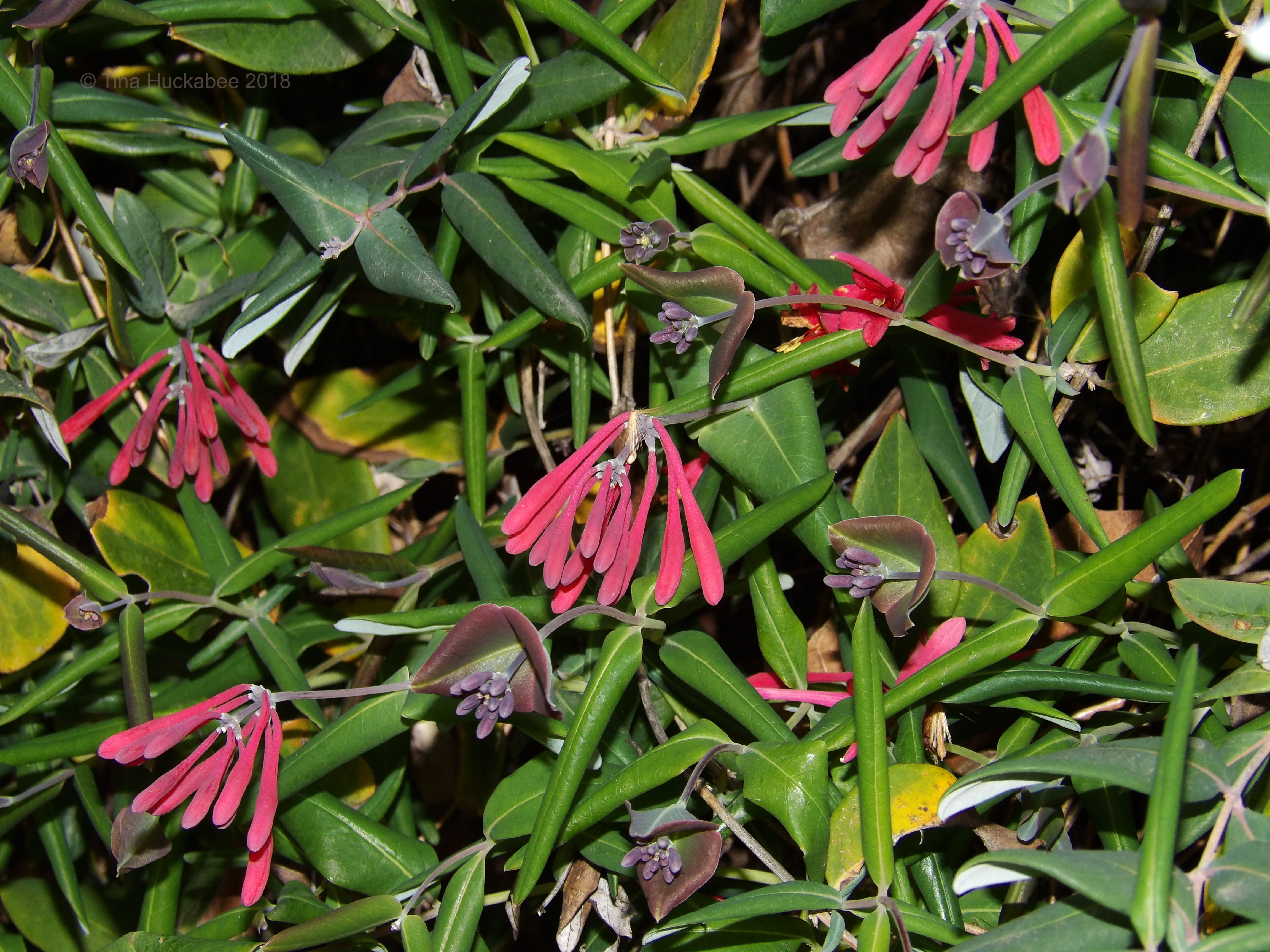
Additionally, emerging foliage and stems blush burgundy, augmenting the brilliancy of the blooms.

The crowning glory of this honeysuckle vine are the masses of bloom clusters which follow new spring growth.

Coral honeysuckle prefers well-draining soil and can develop powdery mildew if its feet are damp and the arms and legs of the vine congested.  That said, even in my clay soil and during the heaviest of flooding, I’ve never seen mildew on my leaves.  I mulch new plants, with a refresher of either commercial mulch or shredded leaves, as needed.  I water my vines, along with the gardens they’re a part of, during the dry of summer and prune bare strands when/if necessary.

I leave my vine as it is–a bit wild and wooly–so that birds can perch and hide, if someone scary (hawk, cat, gardener) comes near.  Coral honeysuckle isn’t invasive, it just requires a ‘haircut’ from time-to-time.  The oldest strands of vine are easily snapped off, making the work of pruning an easy task.  If you prefer a very tidy garden vine, Coral honeysuckle might prove a little feral for your taste.  But give it a chance: Coral honeysuckle’s beauty and hardiness make its mild rowdiness well worth the minimal shagginess.

My biggest complaint about Coral honeysuckle (and it’s not a complaint about the plant at all!) is that I don’t have enough room for more of these tough, pretty vines.  Gardeners appreciate the stalwart nature and beautiful blooms and foliage of this vine, wildlife appreciate its contributions to their safety and diet.

Coral honeysuckle:

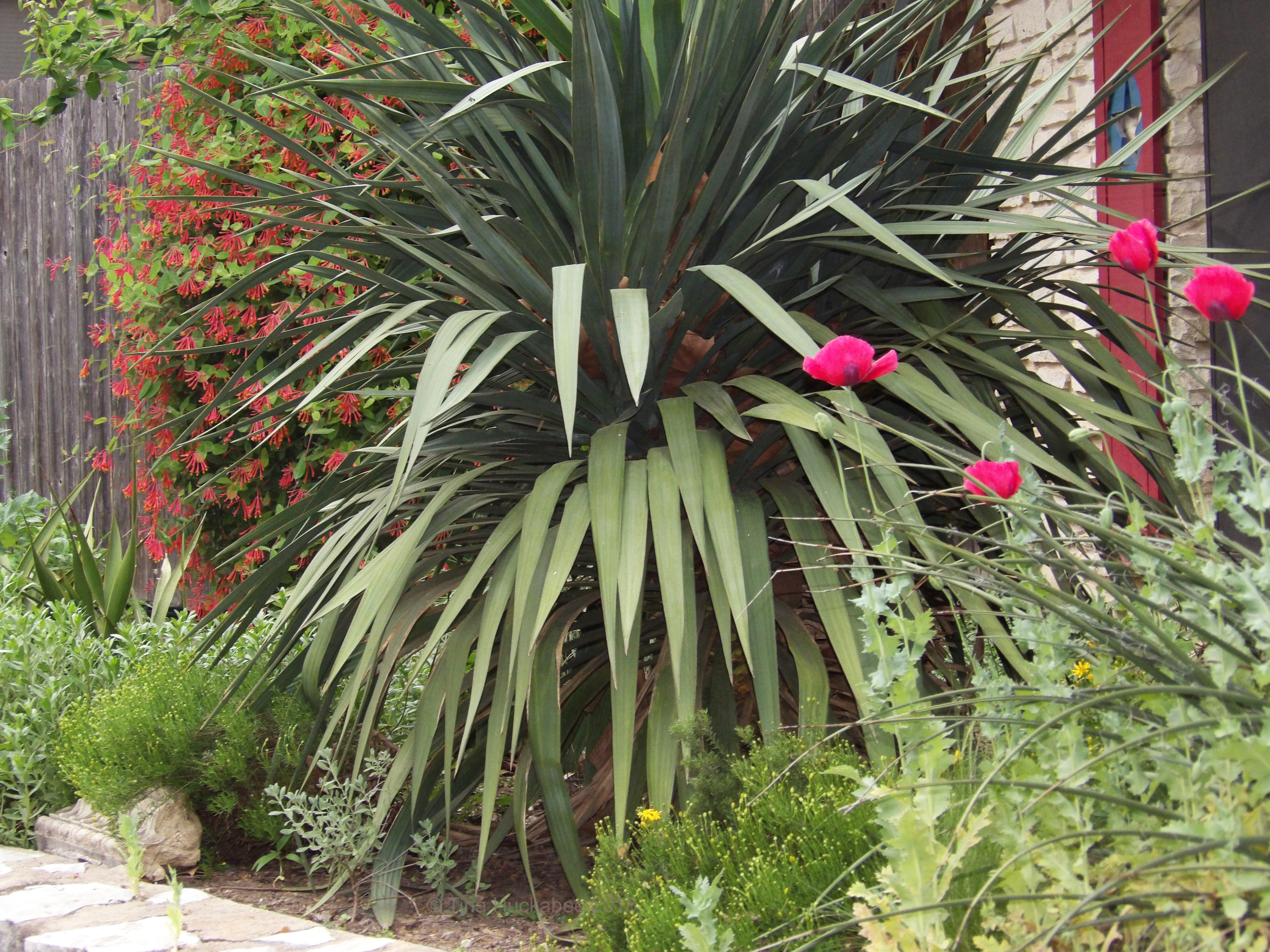
The vine grows to the left of the Softleaf yucca.


Spring:


Summer and Autumn:


Winter:

Coral honeysuckle flanked by dormant Turkscap (right), Inland Sea Oats (bottom) and in-bloom bottle tree (left).

A water-wise, wildlife-friendly, and gardener-pleasing vine–you’ll be glad it grows in your garden!

Sometimes They Land in Trees: Wildlife Wednesday, January 2018

Happy 2018 and welcome  to the first Wildlife Wednesday celebration of this new year.  Winter arrived in Austin in the last several days with an ice-numbing grip of below freezing temperatures.

I heard that snort and saw those eyes a’rolling!  I understand that compared to much of continental North America, my goose-bump inspired whining won’t win much sympathy, but darn it, it’s cold!  Truthfully, I’m just fine-n-dandy with the hard freeze, in great hopes that every mosquito in Texas is dead, dead, dead (not likely, though).  Also, with the frigid temps, my autumnally hued and interminably foliaged trees have finally let loose their leaves.
In the last couple of days, Red oak leaves blanketed the entirety of my back garden.

Maybe now I’ll be better able to observe the variety of birds who visit my garden, as the winter avian Texans (especially the tiny ones) prefer to flit among the bare limbs, in search of whatever they search for.  With the leaves as camouflage, that’s been hard to do.

This shot was taken on Sunday, just before the temperatures plummeted and the tree dumped most (but not all!) its leaves.

That said, for most of this past month, critter watching has mostly involved the birds at the feeders, with the random pitter-patting of maddening mammals and the skulking about of bothersome marsupials.

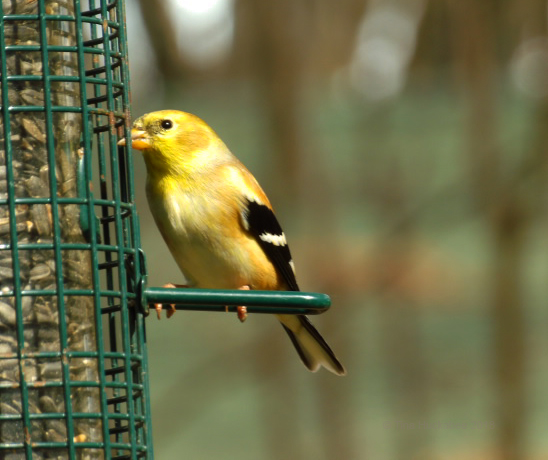
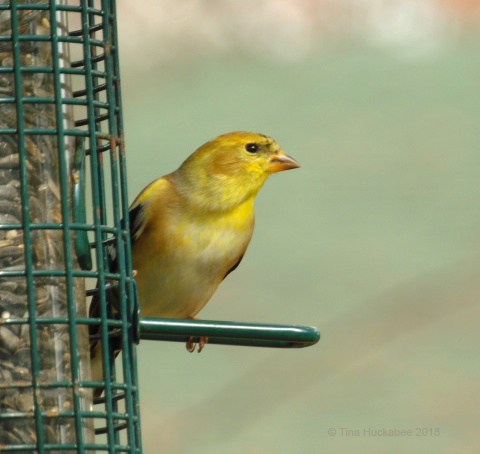
I’m tickled at the early appearance of two examples of the stunning American GoldfinchSpinus tristis.  American Goldfinches usually show up later in winter, so it’s a treat to see them now.

This handsome fella is wearing his non-breeding colors.

Do you need something?

Pretty boy!

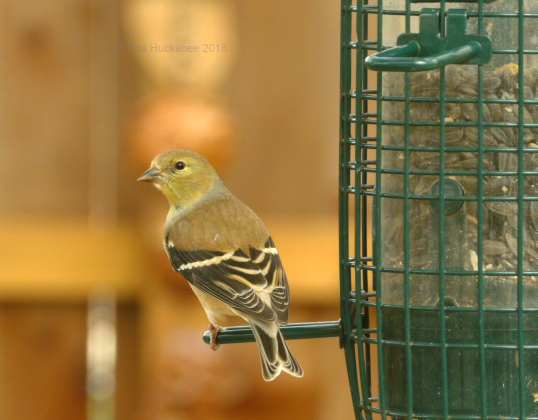
In addition to that obvious and gorgeous adult male, is this female or juvenile male.

The coloring–both dark and light–are muted in this bird.

Wonderful wing bars!

Sweet face!

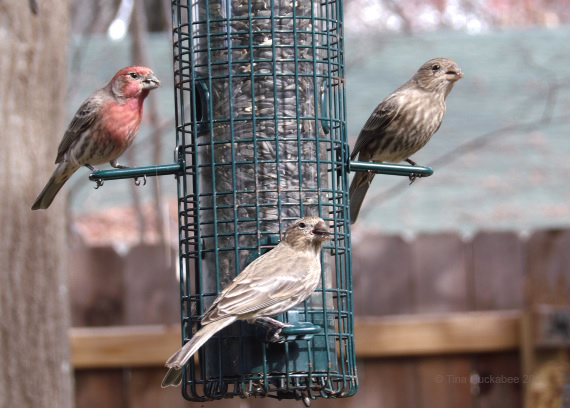
American Goldfinches belong to the same Family and Order as the House Finch, and House Finch eye disease, Mycoplasmal conjunctivitis, which I wrote about here, also affects American Goldfinch populations.  Fortunately, the two Americans who noshed at my feeder appeared free of the disease, the good news of which I reported on Project FeederWatch.  I still see a female House Finch with one infected eye which is completely closed due to the infection.  She feeds by searching for seeds on the ground, but she struggles to land when she flies and is vulnerable to predators with only one good eye.  All other House Finches who are in my garden–and there are quite a few– appear healthy.   The House FinchHaemorhous mexicanus, is a year-round resident, becoming more active as winter settles in.  Most bird feeders are designed with multiple perching stations, and birds share the stations with varying degrees of camaraderie.  Here, the House Finch clan dominates, with a red-accented male perching at the left and the more drab females completing the feeder trio.

Hey birds, over here!

Another duo feeding a the food bar is a second male House Finch sharing a meal with a Black-crested TitmouseBaeolophus atricristatus.

I’m not sure if the Black-crested is a male or female, but I’m confident that the House Finch is a young male.

The House Finch  poses nicely, the Black-crested snarfs seeds.

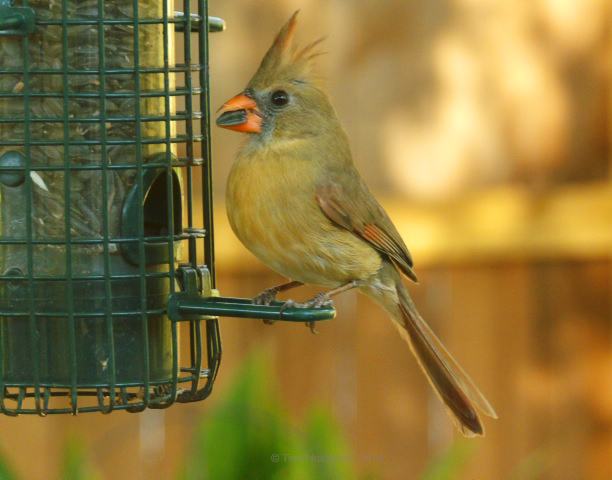
A Northern CardinalCardinalis cardinalis,  couple nests each year in a neighbor’s shrubbery,  but make daily forays into my garden to feed and bathe.    No photo this month of the scarlet feathered male, but the female is a head-turner in her own right!

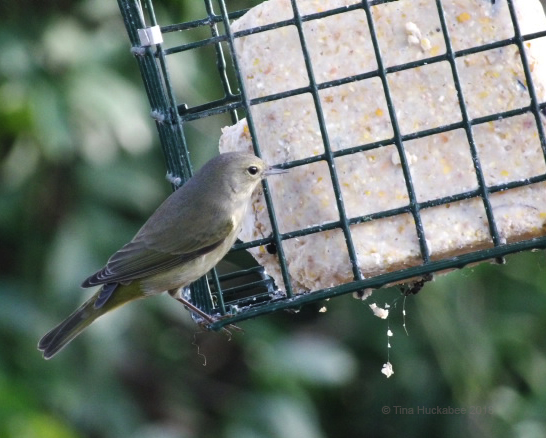
A common Texas wintering songbird is the Orange-crowned WarblerOreothlypis celata, and I’m fortunate to have at least one who is regularly visiting.

Song birds love suet and it’s a good thing to feed them in winter.  I can’t provide suet for 7 or 8 months because Austin’s warm climate causes the suet to turn rancid quickly.  It’s a perfect winter/early spring food though and provides fat, which birds need.

This little Orange-crowned also enjoys the occaisional bath in the pond bog.

About to take the plunge!

I provide a commercial suet for my avian friends, but there are many recipes for homemade suet.  Check out these recipes if you’re so inclined

Facing the camera!

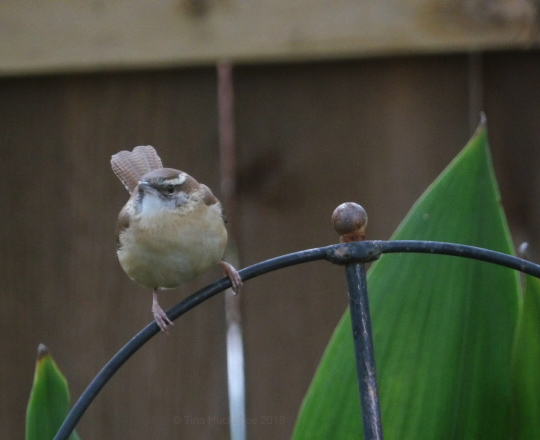
The pair of  Carolina WrensThryothorus ludovicianus, also visit more than just the feeders.   A favorite perch is a metal sculpture where each of the pair takes turns surveying the landscape.

Check out my profile!

The 360 degree view requires a look-see at the backside!

This favorite perching place is just below a little house built for the wrens, which they’ve inspected, but haven’t yet used for chick rearing.  Fingers-crossed that this spring, they’ll decide the neighborhood is worthy of their chicks.

Wrens forage on the ground, scavenging for insects and small seeds; they also enjoy the suet.

Eyeing something in the fallen leaves!


Finally, a bird who lands in a tree!  

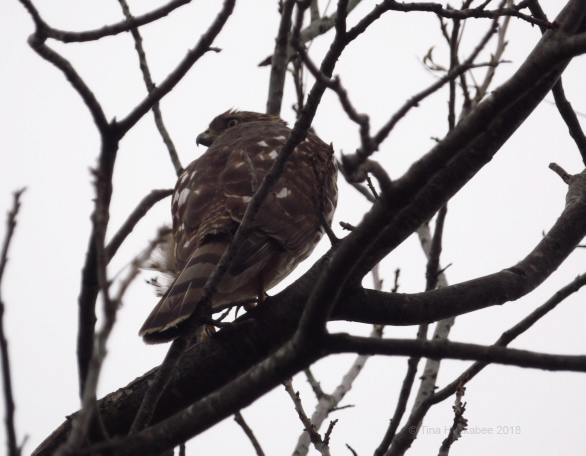
Giving me the stink-eye is this immature Cooper’s HawkAccipiter cooperii. He/she had scattered the neighborhood doves, with no meal as a reward, and was resting in a neighbor’s tree, no doubt annoyed with missing lunch.  The beauty loped off just after this shot.  Cooper’s Hawks are year-round residents here, but easier to observe once winter’s  chill render some trees bare.

There are always plenty of squirrels (stealing birdseed and digging in plant containers) who become meals for neighborhood raptors, though perhaps not as often as some might wish.  This squirrel was safe on the ground and near the house, munching away at fallen sunflower seeds and generally behaving well.

Eastern Fox Squirrel (Sciurus niger)

The Virginia OpossumDidelphis virginiana, is still around too, sometimes mosying through the garden during daylight, but not sleeping in the owl house–for now.

There are no Eastern Screech Owls in the owl house either, nor have I heard the adults’ signature trill at night.  I’m concerned that no couple is interested in the owl real estate in my garden and if there are no takers, that will be disappointing.  There’s still time for some owl action and owls are remarkably elusive; I won’t begin the no-owls-in-my-garden lamentation just yet.

So begins another year of garden wildlife drama.  Let’s celebrate lots of life in the garden during 2018. Please share your wildlife stories and remember to leave your link when you comment.

Good wildlife gardening to you!