The annual autumn bird migration through Central Texas is mostly completed. I typically observe fewer birds coming through my garden in fall than in spring, but there are always a few who spend time in the trees and shrubs and splish-splash in the pond.
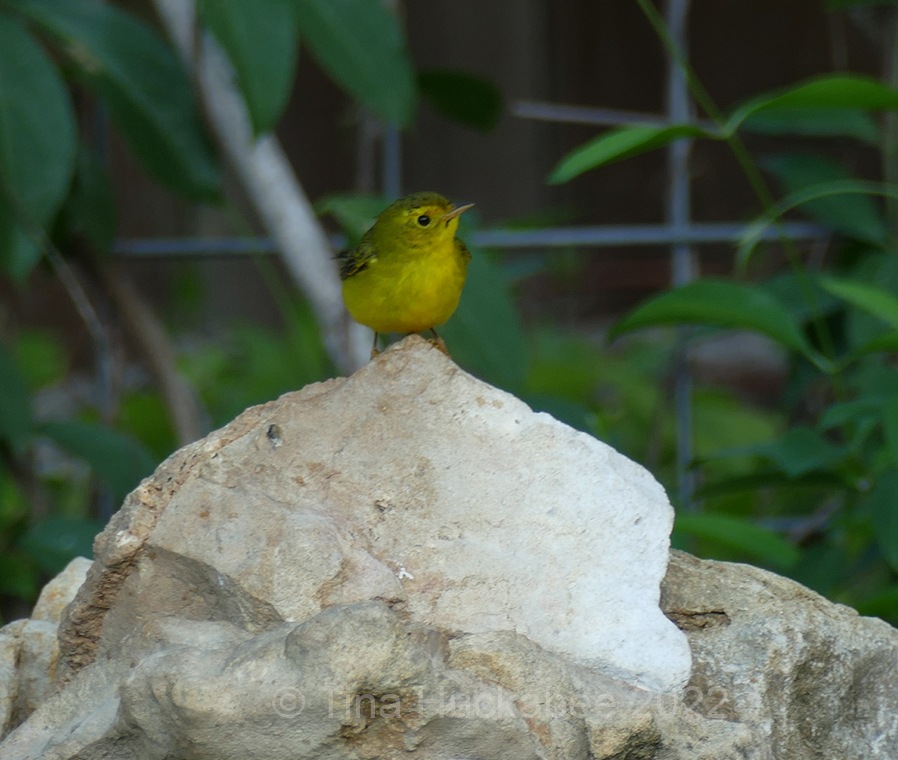
This fall several male adults and at least one female adult Yellow Warbler, Setophaga petechia, popped by for visits. These sunny critters are hard to miss: dashes of yellow through the air, pops of yellow in trees and shrubs, flashes of yellow in the shallows of the pond. These bright streaks-n-spots in the garden are busy, busy birds–they don’t stay still for long! I’m glad this one wanted some warmth from the sun after his bath; he perched long enough for a quick photo.
Male Yellow Warblers are brilliantly yellow, with lovely burnished breast streaks. Females and juvenile males are yellow in a softer hue, but lack the markings on the breast. These beauties winter in Central America and northern parts of South America.
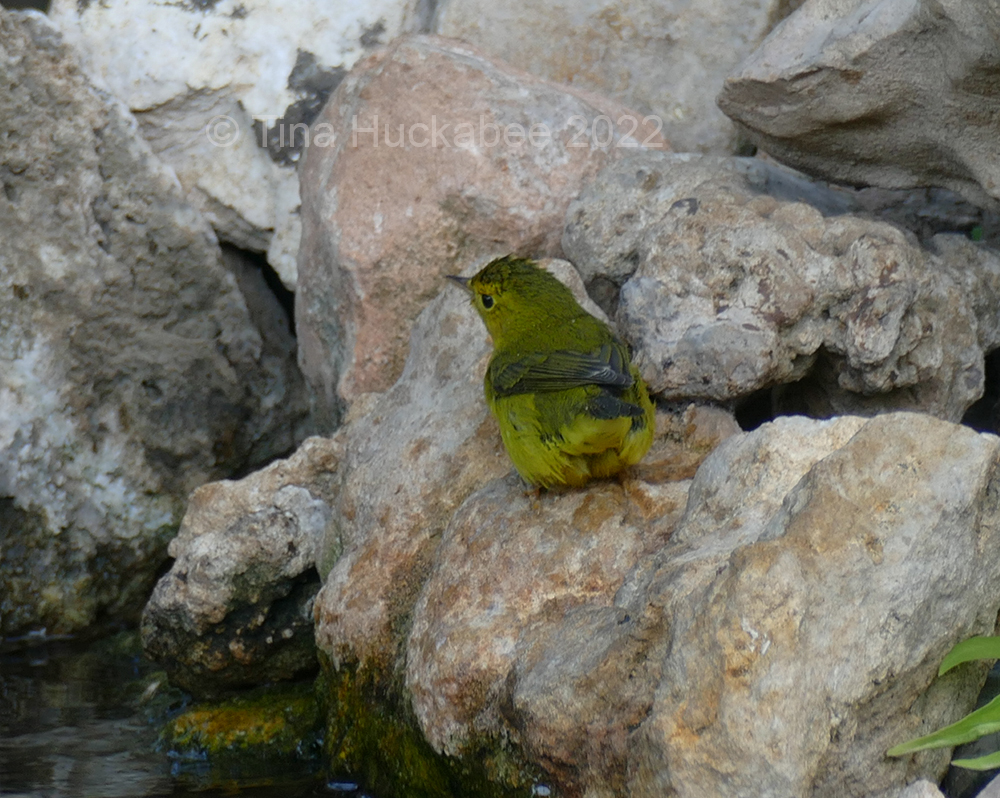
I took plenty of photos of “Yellow Warblers” but as I downloaded the shots, it happened that some birds were Yellow and some were just yellow. The two just yellows are female or immature Wilson’s Warblers, Cardellina pusilla.
Several years ago, I enjoyed the visit of a male Wilson’s Warbler, his little black cap a signature accessory. This fall, the two who bathed in the pond and bopped through my garden didn’t rock black hats, but instead, attractive arches of yellow over their eyes–the clue to their identities. These birds are heading for Central America, to rest, eat well, and prepare for next year’s breeding season.
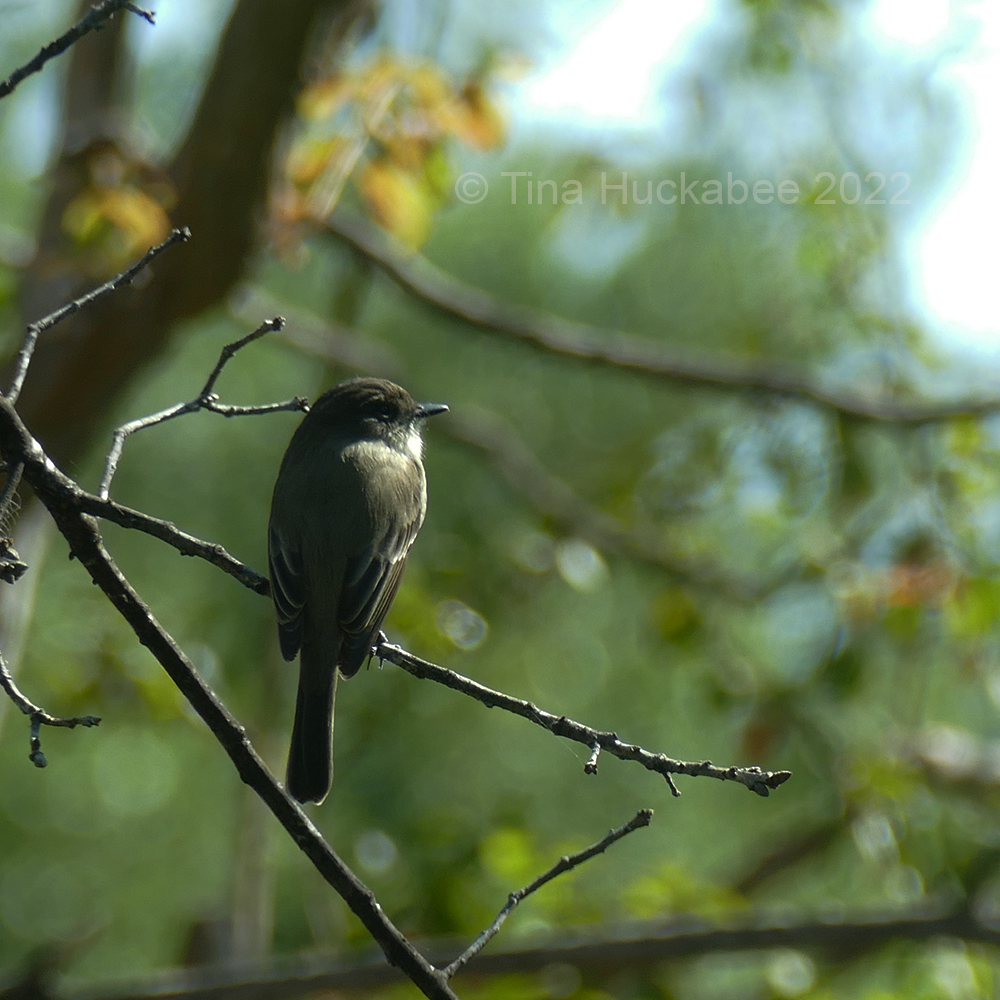
An Eastern Phoebe, Sayornis phoebe, graced my garden for several days, dipping in the pond, fluffing in the trees, catching insects on the wing. This bird is a flycatcher and some of its winter non-breeding range is located in Texas, though south of where I live in Austin. I see one or two almost every spring during migration, though I don’t recall ever spotting one in fall.
The Phoebe has a charming way of tilting its head back and forth, as if listening for important news. As insects are its main food source, the Phoebe is a fast and agile flyer, and an excellent hunter of many kinds of insects.
From November to April, I’m fortunate to host several kinds of warblers and I’m eagerly awaiting their settling in the garden. It’s always a thrill to observe them for the first time, but I never grow tired of their presence; their beauty and calls are a joy in the winter garden. I’ve already seen a couple of Orange-Crowned Warblers, but both moved on to other places, other spaces. Neither were my warblers.
C’mon little warblers: there’s plenty of food and water, trees and cover, and the cats are in the house. What are you waiting for??
There’s an old saying that one should never wear white after Labor Day. My garden is gleefully bucking that tradition; Labor Day has come and gone, but snowy blooms abound! Autumn is a rich time in Central Texas gardens: a little rain (very little) and gentler temperatures, (somewhat…), are just the ingredients for September and October floral madness. All the flowers are lovely, but cool white flowers are radiant in the autumn sun.
Once my front garden became a full sun space, Gaura, also known as Butterfly Gaura, Oenothera lindheimeri, was a plant on my must-have list.
The flowers look delicate and sweet, but this long-blooming perennial is tough and a sunshine-n-heat lover. It’s also proved a great pollinator plant. I’m hoping for a seedling (or several) for more gaura goodness in my garden.
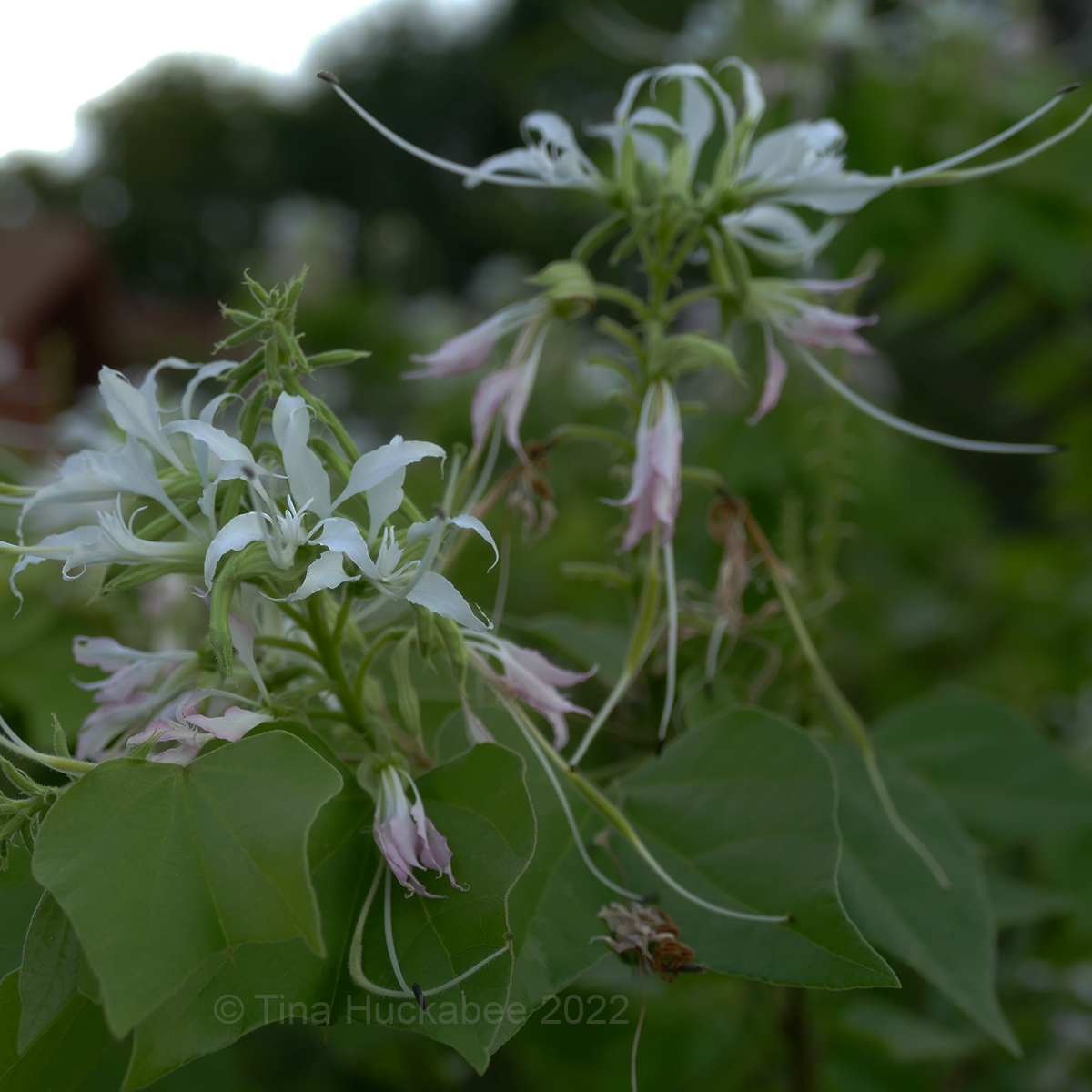
Mexican Orchid tree, Bauhinia mexicana, is also in full-bloom mode, though like the Gaura, it’s bloomed throughout this long, hellish summer.
While I’m touting the virtues of white blooms, you’ll notice that both the Gaura and the Orchid tree sport blooms with a slight blush of pink.
The front garden Orchid tree sits among some Martha Gonzales roses and Mexican Honeysuckle, Justicia spicigera. A couple of volunteer White Tropical sage plants, Salvia coccinea, have joined the crew, adding more dollops of cream in the garden.
Garlic Chives, Allium tuberosum are reliable bloomers in late summer and early fall. Typically, it’s a challenge to find a cluster without an attending honeybee–they love this plant! I’ve always wondered what honey produced exclusively from chives would taste like. Amazing, I imagine. In addition to attractive foliage and sweet, snowy blooms, the chives are also edible: bulbs, leaves, and flowers!
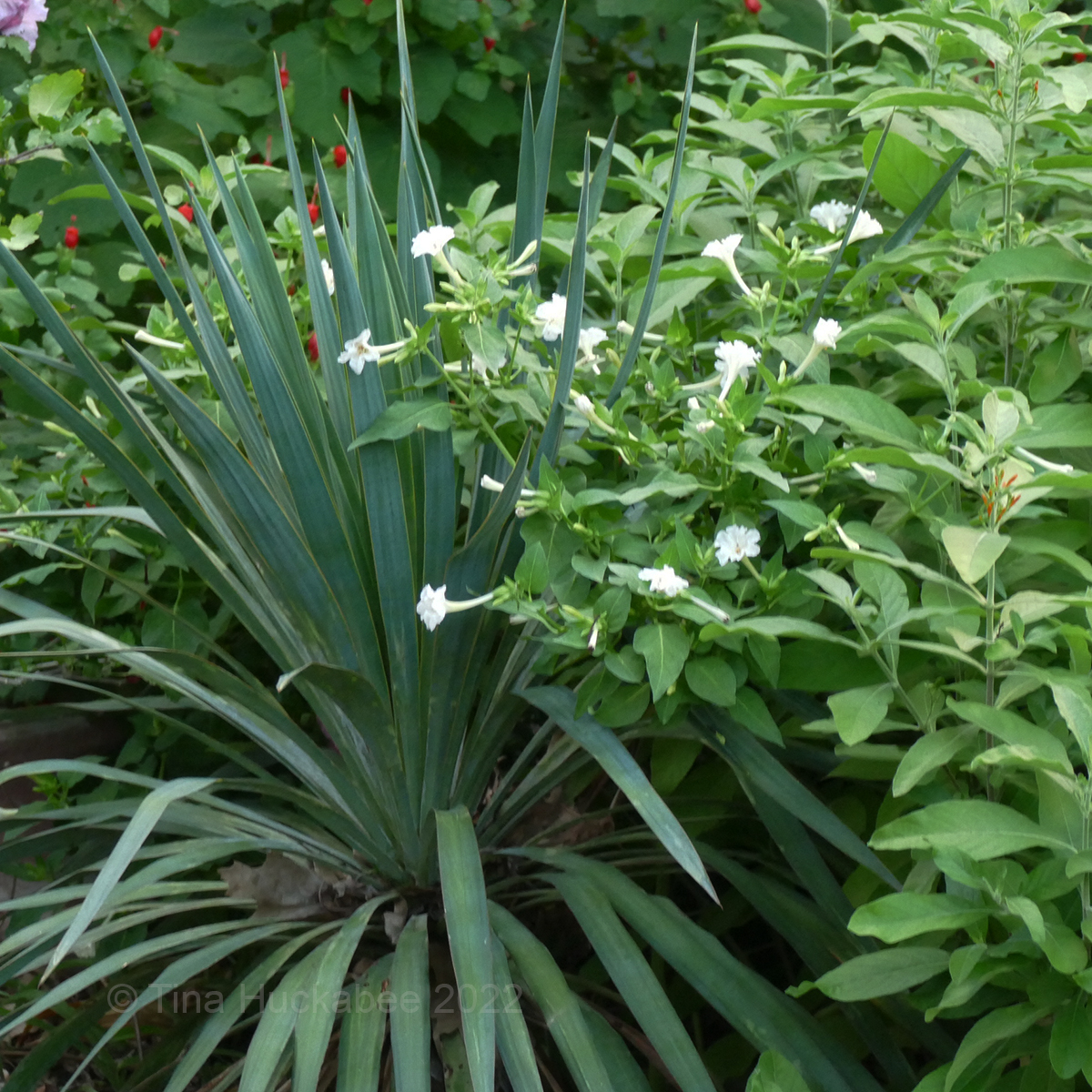
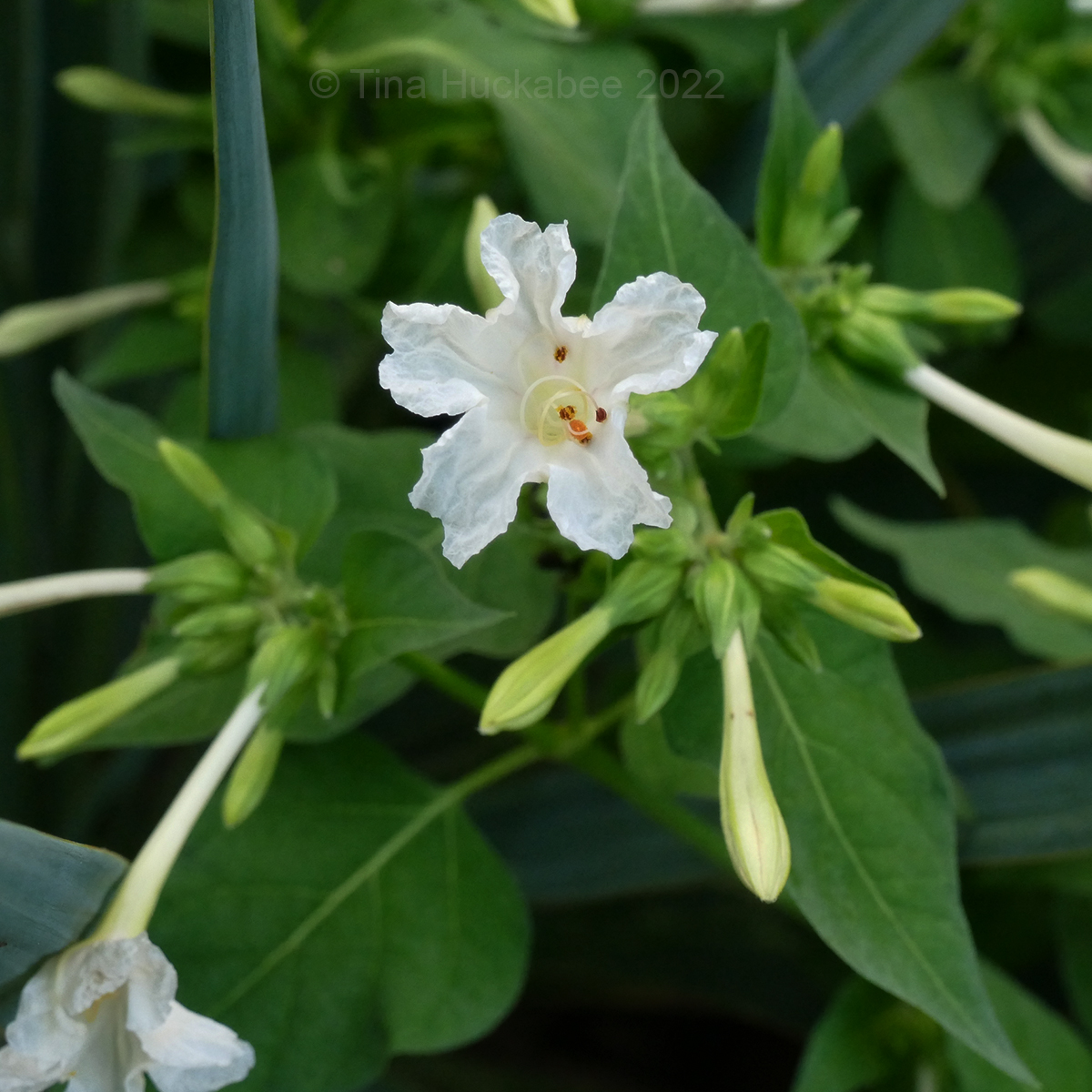
An old-fashioned pass-along plant, Four-o-clock, Mirabilis jalapa, is happily blooming white, dainty flowers while invading the space of a Soft-leaf Yucca.
Red flowering Turk’s Cap, Malvaviscus arboreus, joins the scene, top left.
The Four-o-clocks open in late afternoon, providing for nighttime pollinators, specifically Sphinx moths. By mid-morning they’ve closed up shop and new blooms will open later in the day.
I also grow a deep pink four-o-clock–a stunning color–but it’s the white flowers that are blooming beasts.
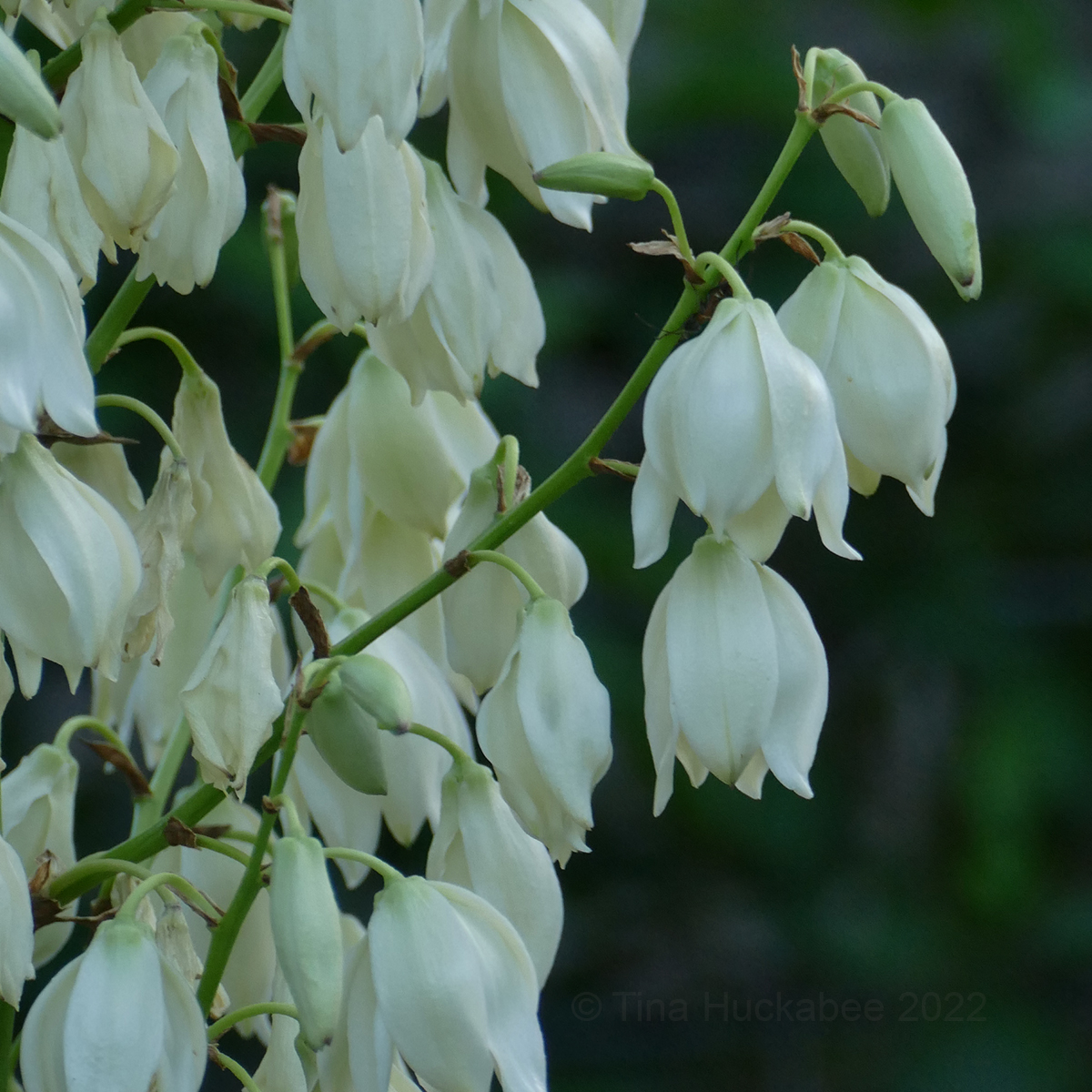
Softleaf Yucca, Yucca recurvifolia, are favorite evergreen ‘staple’ plants in my gardens. Most of mine have resided in areas too shady for bloom development, but I like their size, their pretty blue-green foliage, and their ability to withstand heat, drought, and cold. I also appreciate that they’re not too spiky in the garden–I don’t like plants that hurt! I was content with them as an evergreen, architectural presence, only occasionally lamenting a lack of yucca flowers.
This one, near the pond in my back garden, has never bloomed, so when I spotted its bloom stalk, I was thrilled.
I’ve long accepted that the back garden yuccas would never produce any beautiful, bell-shaped blooms. But after the February 2021 deep freeze, one of my oak trees was damaged and now doesn’t provide the shade it once did. I’m guessing that maturity, plus a tad more sunlight, allowed the yucca confidence to send up its bloom stalk and flower.
Nearly a year ago, I transplanted five small Softleaf Yuccas from my back garden to my front, newly full-sun garden, and look forward to their growth and future flower production. They’ll be quite happy in their new home: foliage and blooms–a win!
No Central Texas fall flower fawning is complete without mentioning Frostweed, Verbesina virginica. This stately perennial sometimes begins its blooming in summer (mine did) but the zenith of flowering usually occurs in October, well-timed with Monarch butterfly migration. Clusters of milky flowerets are magnets for a huge variety of pollinators.
My honeybee gals are all over the Frostweed flowers, slurping the sweet stuff and gathering rich, creamy pollen.
I like a garden with plenty of color and textural diversity. But in a colorful garden, white blooms have a place: cooling and calming, they temper brighter colors and are restful to the eye. Even in full sun, white blooms are luminous and beautiful.
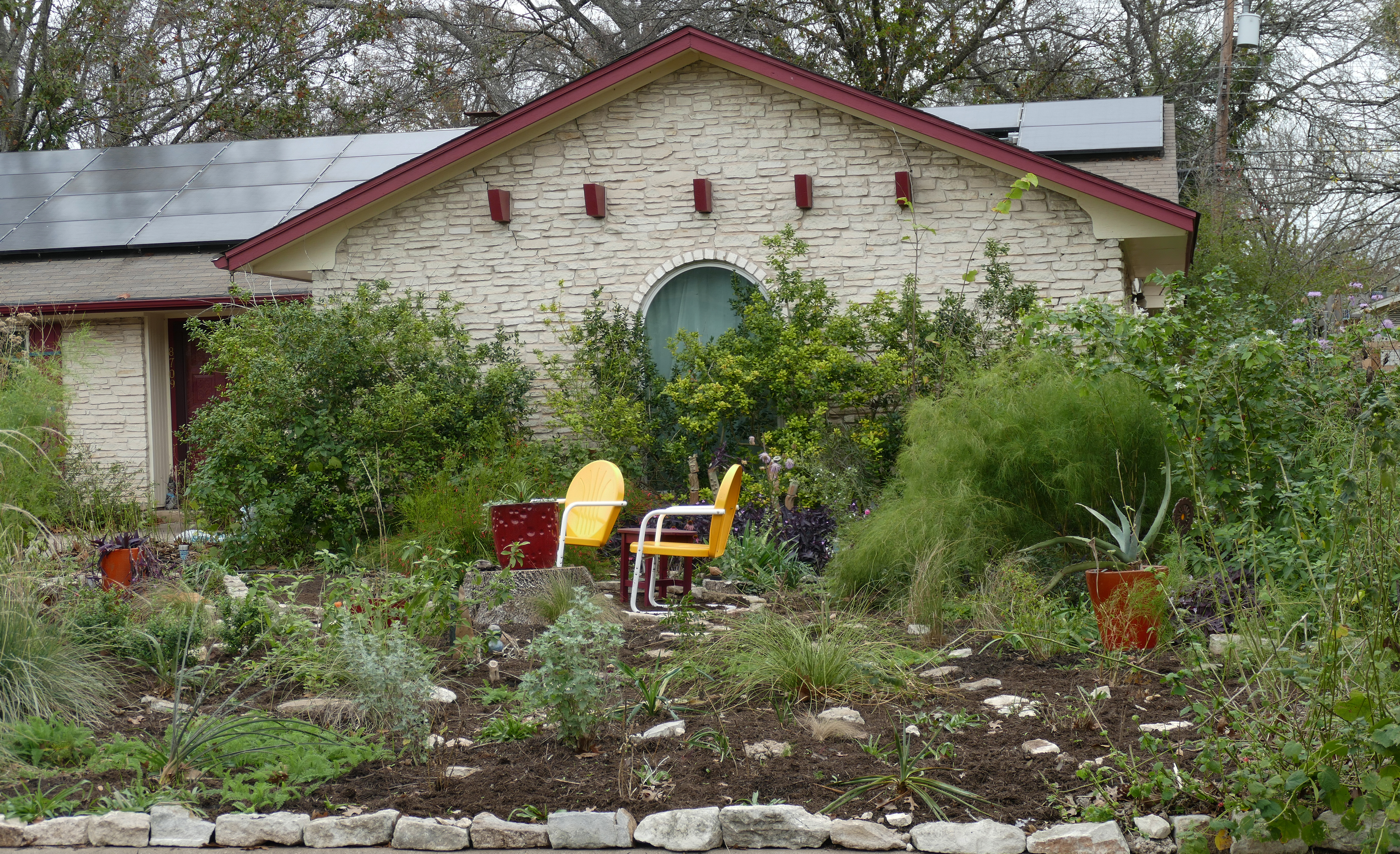
Last autumn we removed an old, freeze-damaged Arizona Ash from our front garden. Within a few hours, the west-facing garden morphed from mostly shade to full sun. With no tree canopy protecting the garden, it now faces all day, blistering Texas summer sun and that’s a thing that demands respect as well as tough-as-nails plants. I recognized early on that some established plants would welcome the challenge, but others would need immediate removal, and a few would require observation throughout the growing season to assess their viability in the changed conditions.
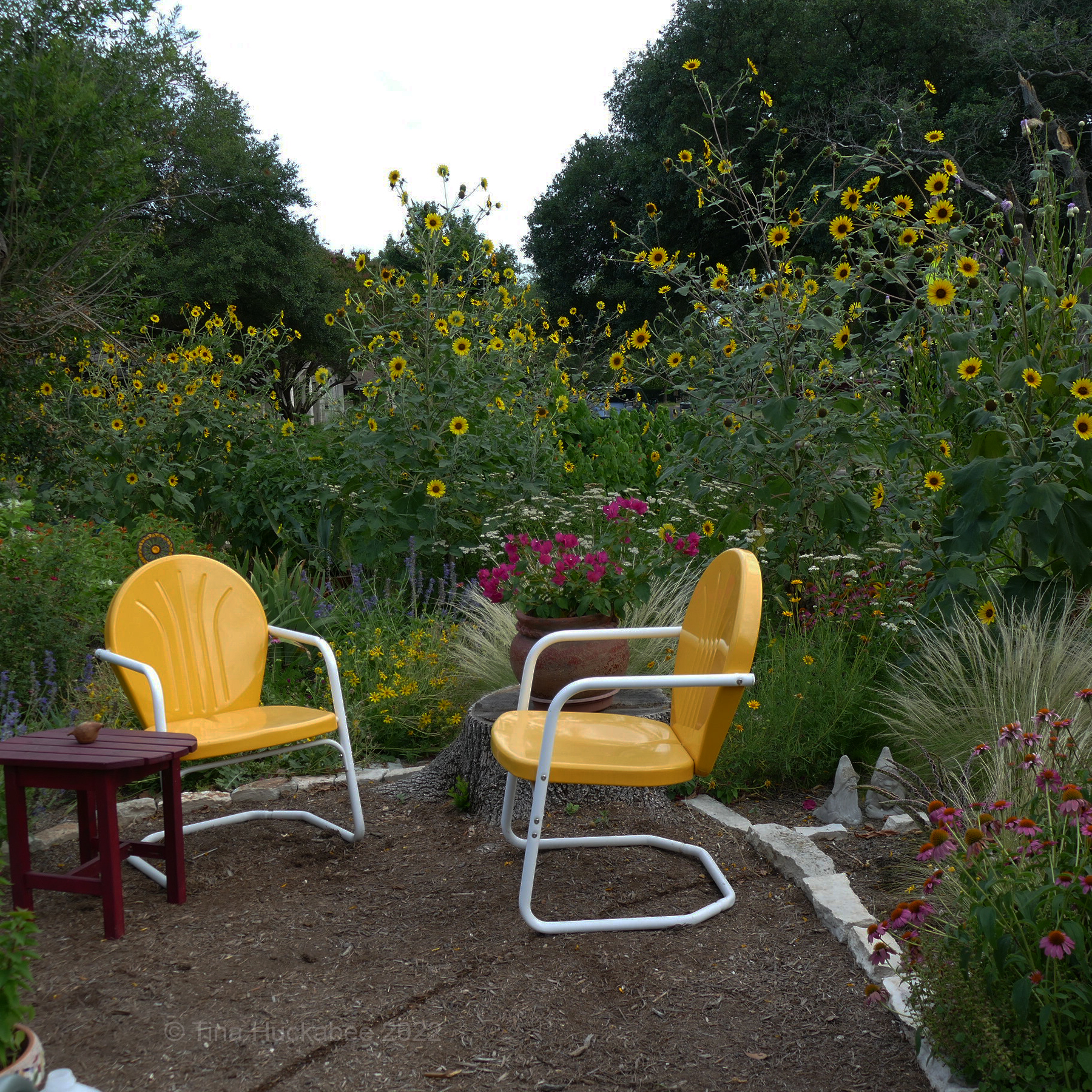
This is a view of my front garden in early December from the corner where the driveway and street intersect, using the zoom feature to capture the innards of the garden where the yellow chairs sit.
All that remains of the poor tree is a stump, now happily hosting a large potted bougainvillea, thriving in the searing summer sun.
A front-on photo in December demonstrates a completely new landscape in the center part of the garden. I transplanted appropriate plants from other parts of my garden, as well as newly purchased shrubs, perennials, and some small trees to this open garden. The southeast quadrant of the garden (behind the orange pot, along the right side of the photo) and the northwest quadrant (outside of this photo, to the left) are the two sections of establish plants that I left in place.
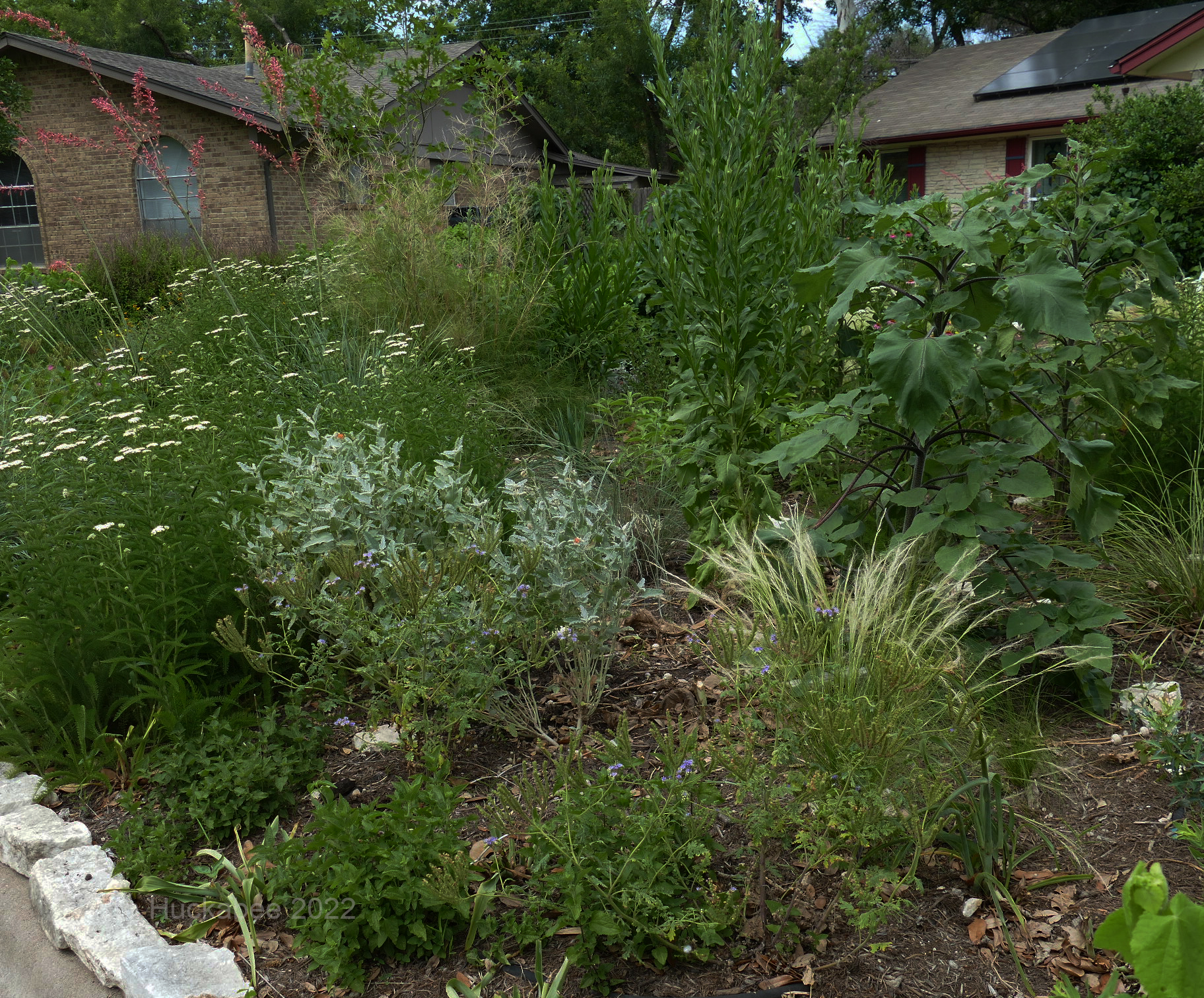
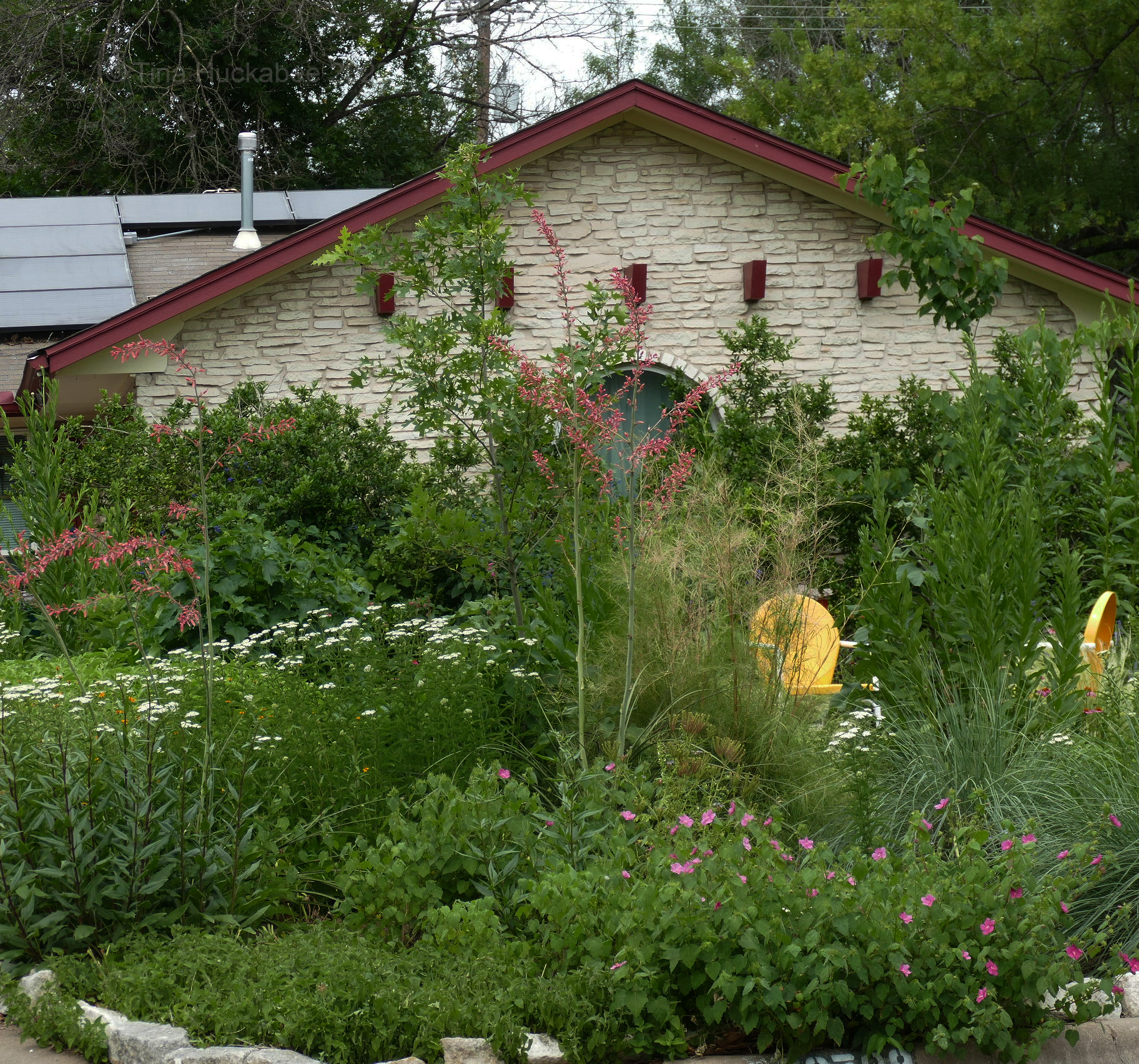
This shot was taken in June, roughly at the same angle. Stuff grew in! Who knew that would happen? Full disclosure: the following photos were taken in late May and June. (I’ve been meaning to write this post for a while.)
The tall 5-7 foot spikes in the background, right side of the photo, are American Basket flowers, Centaurea americana, and in the middle of the garden, you can see the large leaves of a couple of common sunflowers, which have grown to 6-8 feet. Both of these annuals have bloomed since late May, providing for pollinators, and now, as they complete their blooming cycle, for birds who are feasting on seeds. The tall plants have also allowed privacy for the seating area of the garden. I have planted several small trees and large shrubs for the long-term, but it will be a few years before they will be large enough to act as privacy screens.
I left bits and bobs of Common Yarrow, Achillea millefolium, and they’ve proved pretty and hardy, rocking their rich green foliage and fresh, creamy flowers.
To this bright landscape, I added Globe Mallow, Sphaeralcea ambigua, its grey foliage and creamsicle-orange blooms a fetching combination, several pink-to-red flowering evergreen Autumn Sage, Salvia greggii shrubs, and silvery Wooly Butterfly bush, Buddleja marrubiifolia. These new plants have flourished in the heat and with the abundant sunshine. Graceful Mexican Feathergrass, Nassella tenuissima (bottom right in photo), Gulf Muhly, Muhlenbergia capillaris, and rusty Little Bluestem, Schizachyrium scoparium, are new native grass additions. All are well-adapted to harsh conditions.
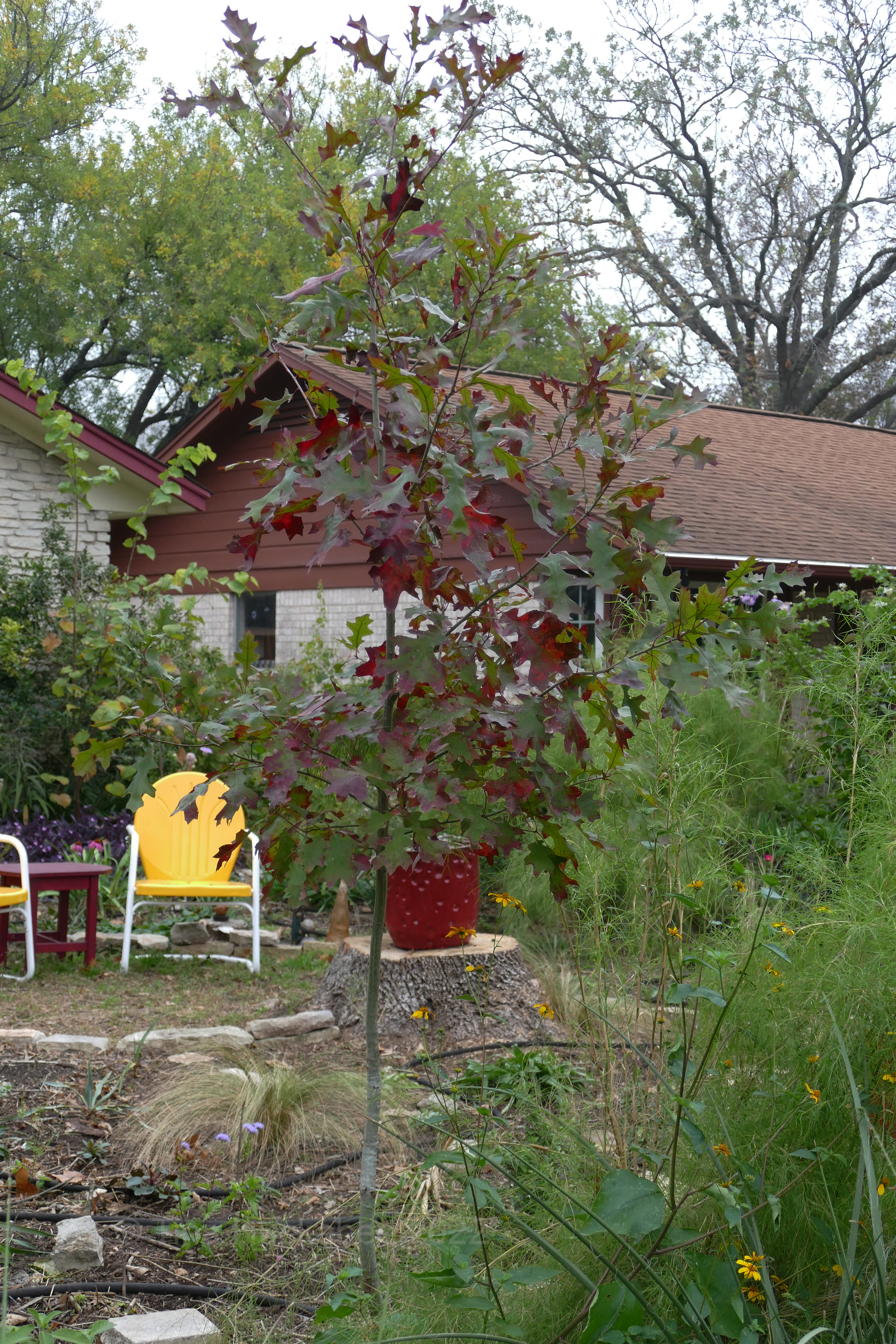
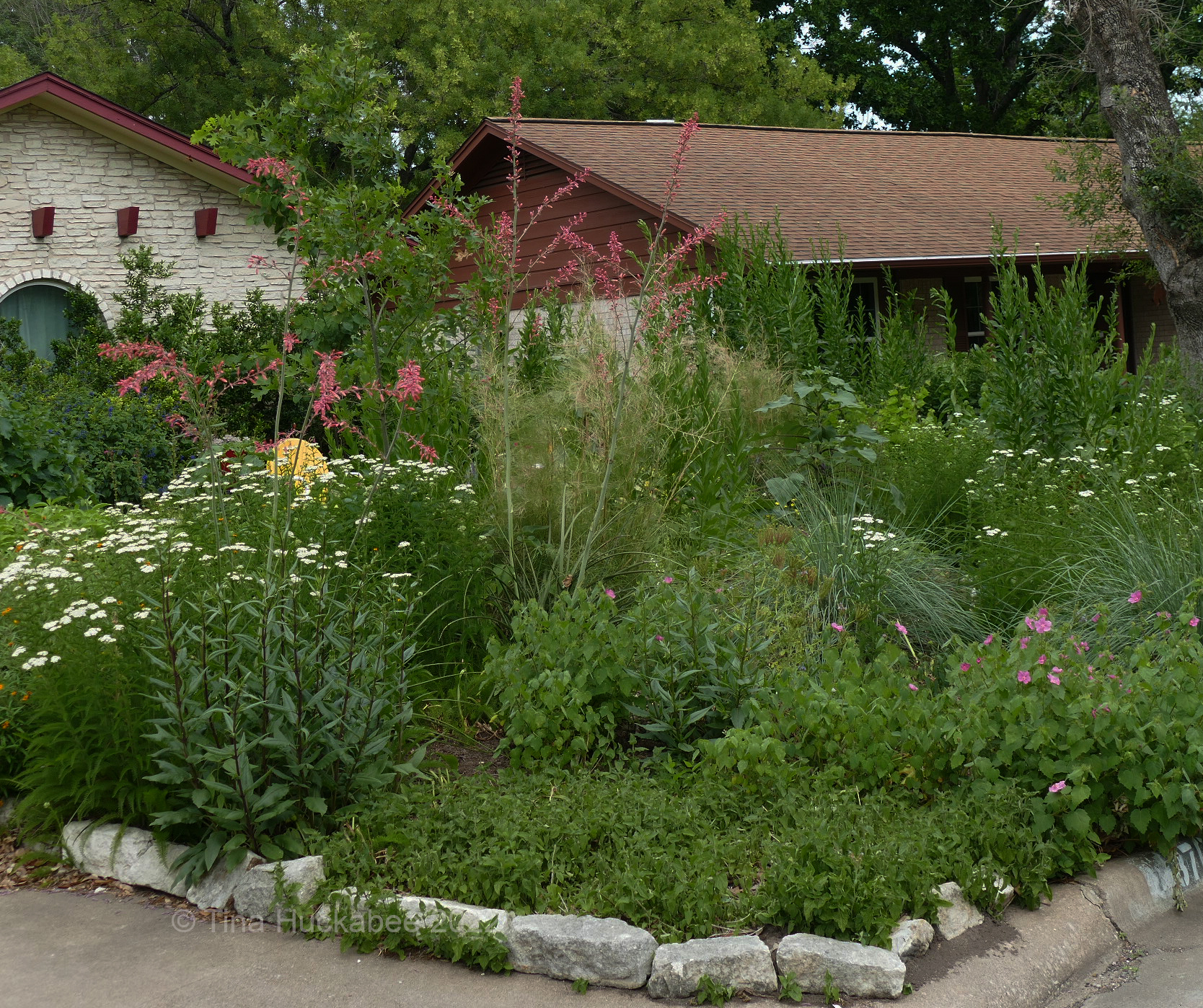
Red Yucca, Hesperaloe parviflora,adds lofty salmon flowers and keeps the little Red Oak tree company.
In June and July the sunflowers and basket flowers have towered over the garden. Pollinators are busy from sunrise to sunset: bees buzzing, butterflies flitting, and hummingbirds chasing one another, vying for dominance over disputed territory. Pretty pink- blossomed Rock Rose, Pavonia lasiopetala and the crimson blooms of Big Red sage, Salvia pentstemonoides, rest below the taller plants at the corner of the garden.
As this very hot summer drags on, some plants are showing heat damage. At the corner of the garden grows a ground-cover, Blue Mistflower, Conoclinium coelestinum. It has struggled with the heat and morning-to-evening sun, plus it’s situated at the intersect of the street and driveway, enduring reflective heat from the asphalt and cement.
Crispy critter! Last summer, which was a more ‘normal’ summer, the ground-cover grew well, lush and green, blooming beautifully in autumn. But this summer has been particularly hot; Austin just recorded its hottest 7 day streak ever and we’re breaking heat records regularly. The mistflower isn’t up to that kind of grilling. There’s also no water at this corner; the soaker hose is situated about three feet away. So what to plant there? I’ll probably go with one of the smaller native grasses or something like a Blackfoot Daisy, Melanpodium leucanthum or a small native yucca–all sun and heat lovers needing minimal water and care.
The sunflowers and basket flowers are colorful protectors of the center part of the garden, which I enjoy in the early mornings and late evenings. Their growth is a little wild and rangy, but I like that and more importantly, wildlife is pleased with the choice of meals.
Native perennials, like cheery Engelmann’s Daisy, Engelmannia peristenia, and the blue-blooming Henry Duelberg sage, Salvia farinacea, are rock stars, happy during long weeks of heat, though even they are growing weary with the oven-like temperatures.
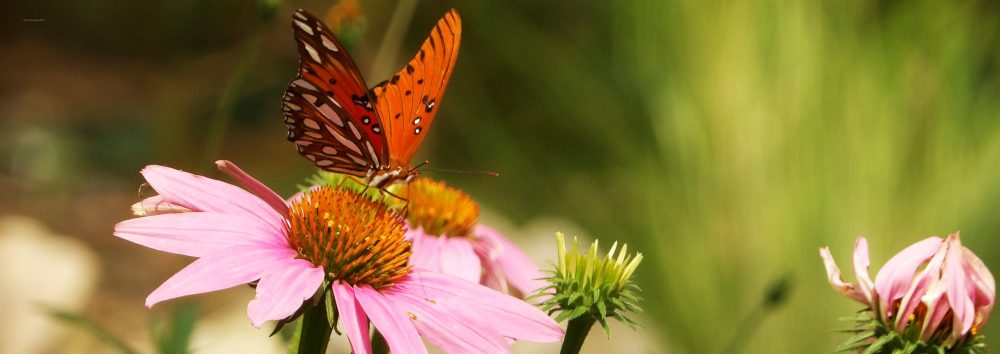
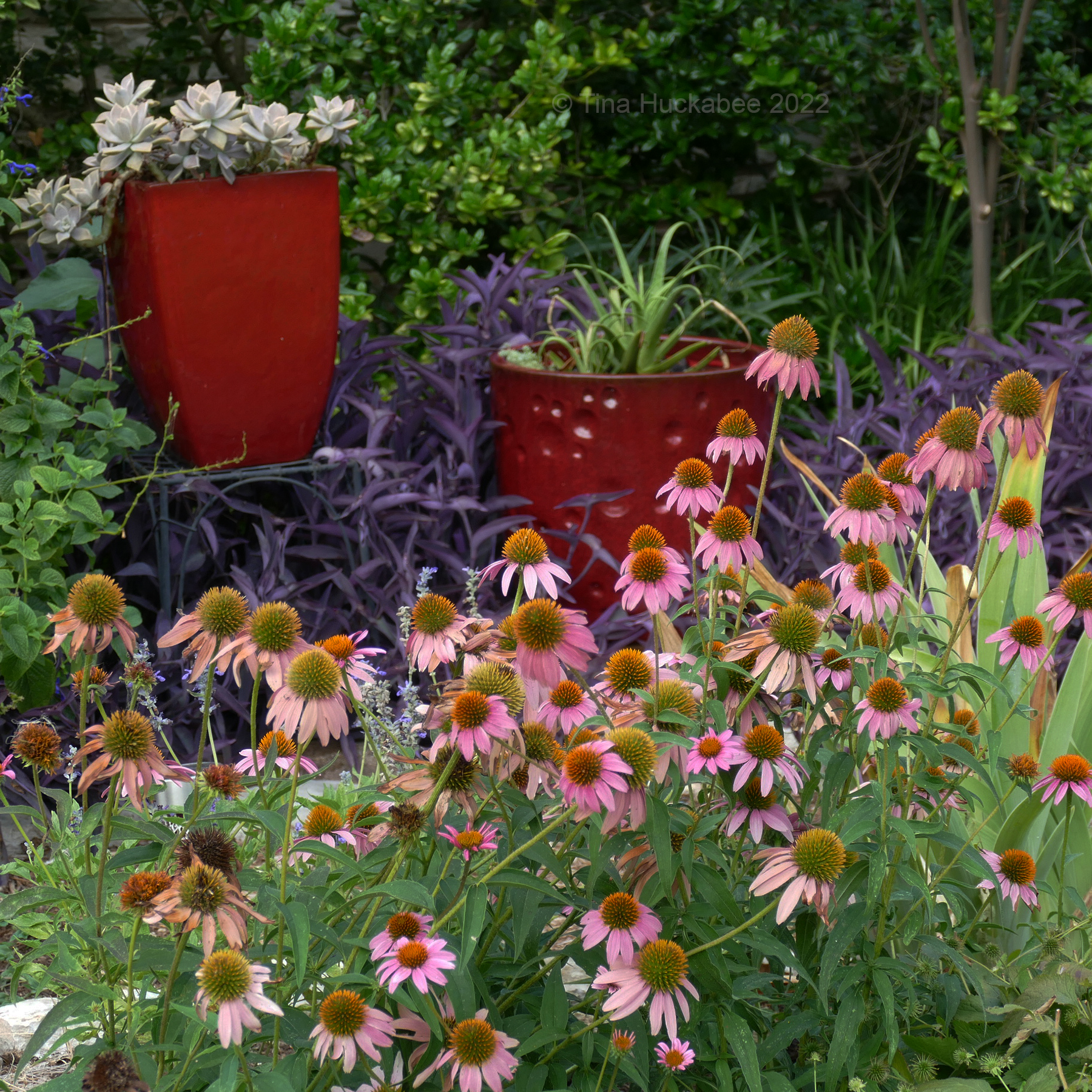
Purple Coneflower, Echinacea purpurea, always puts on a good show, though the blooms are mostly done and seeds are spent; I’m currently pruning them to the ground, their rosette set to weather the remainder of summer. Coneflowers generally return in autumn with rain and cooler temperatures, not as tall or prolifically, but flowering nonetheless. While that’s something to look forward to, temperate weather seems almost an impossible dream right now.
While I’m pleased with most of my established and new plants, I’ll need to remove many irises and all of the day-lilies and crinum lilies. The full-day summer sun is too much for these bulbs. I’ve also grown a couple of shade-loving spring ephemerals and they’re now frying in this sunny, hot garden. If they survive until fall, I’ll need to move them elsewhere.
As I observe the good, the meh, and the ugly of this new garden, I realize that changes are required and I look forward to the time when I can tweak the problem areas. It’s way too hot to contemplate the particulars of that work for now, so I’ll have to be content with mulling, fretting, and flip-flopping about what I want to plant.
A garden is ever-changing, never completed, and full of challenges .















 My Gardener Says...