According to the calendar, autumn is in place, with winter just around the bend. Maybe someone should remind one of my Columbine plants and some eager Spiderworts that they’re supposed to be resting right now.
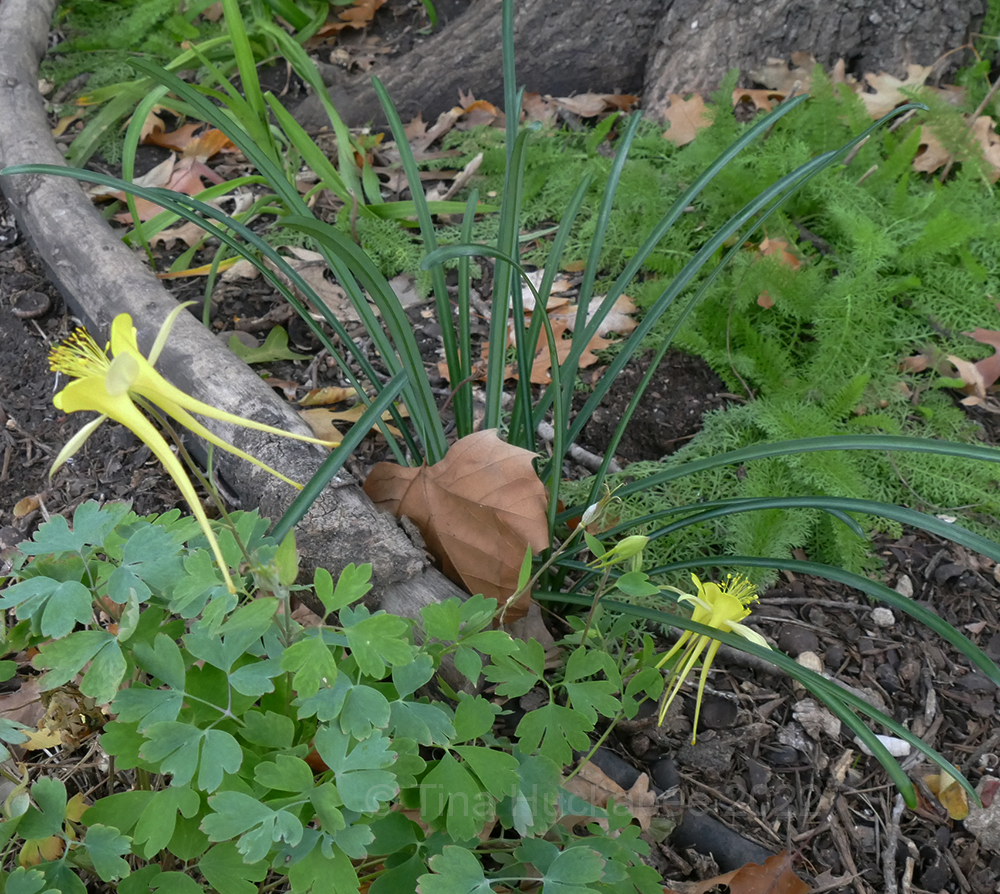
This Yellow Columbine, Aquilegia chrysantha, has blossomed over the last few weeks.
These are spring flowers which usually bloom from March through May. On occasion, this particular specimen has gifted some pretties in early fall, but I don’t recall it ever flowering this late in the season.
The yellow plays peek-a-boo with foliage of Red Spider Lily, Lycoris radiata.
The two fairy-like blooms complement ground-cover greens with yellow cheer. The spring-like foliage, which will remain evergreen throughout winter, is that of Yellow Columbine, Spider Lily and Common Yarrow. A crisp of autumn is in place with the golden-tan leaf of an American Sycamore.
The spiderwort that I grow are all pass-a-long plants, so I don’t know their exact heritage. Because they tend to be tall, I’ve always assumed they’re some hybrid of Giant Spiderwort, Tradescantia gigantea. I’ve seen the occasional bloom in December and January, but those are usually short, the stems and flowers low to the ground. In my front garden, a couple of clumps of Spiderwort have grown tall and are blooming, as if time skipped the gloom of winter and joyfully leaped to March and April.
This one is a lavender hue.This group suggests blue in its color
I certainly don’t mind seeing the Spiderwort. As weedy as they can become, I always welcome them in my garden. On warmer, sunny days, honeybees are busy nosing around in the blooms.
As well, a remnant of summer is hanging on in the form of a group of common sunflowers. This stalk is broken, but the bent piece maintains enough life in that section that it has bloomed prolifically since August, offering dabs of sunshine on dreary days.
This gardener firmly believes that gardens don’t always operate according to calendars and that plants have minds of their own.
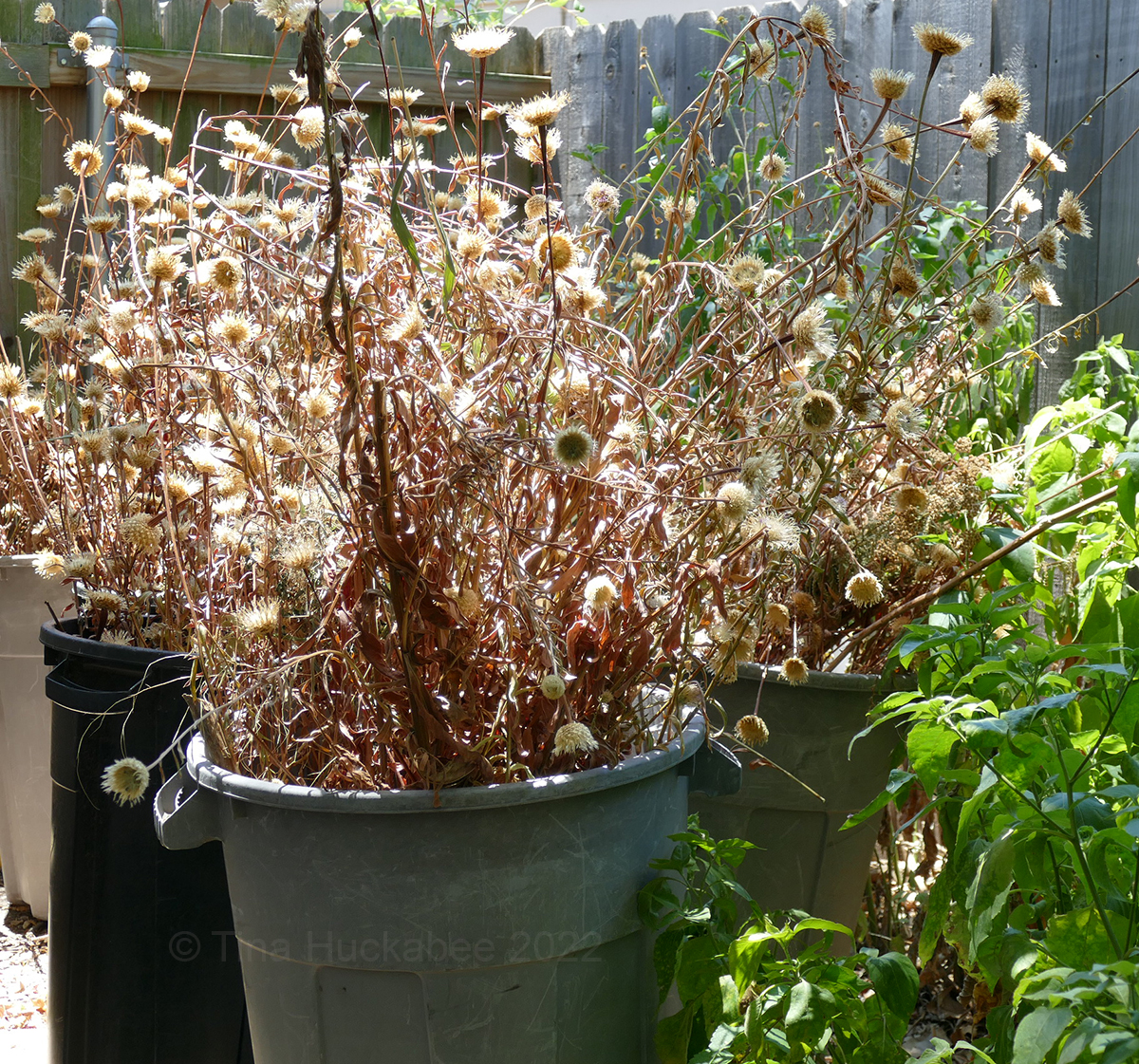
It’s hard to say farewell to a species of plant whose end has come, especially one that produced such an abundance of flowers. Alas, my American Basket flowers, Centaurea americana, are done for the year. This is a sad sight:
The stalks of these spent lanky lovelies, tidily tucked in to bins, are on the way to the city of Austin’s composting facility.
I grow these annual native wildflowers, with thanks to Linda of Lagniappe and The Task at Hand, who several years ago graciously mailed to me seeds she’d collected. It’s taken a couple of years, but these regal annuals are now an integral part of my garden family, offering stature and elegance to my summer garden. This year, the basket flower stalks grew especially tall, some reaching to 9 and 10 feet. Most stalks were so tall that I couldn’t enjoy observing many of the blooms that opened atop the stalks. Pollinators filled the air above the garden, zooming from bloom to bloom for pollen and nectar. The lofty flowers certainly earned their keep, even if I was out of the loop. That said, the stalks are multi-branched, so while many flowers were too high for me to observe, there were plenty at human eye level–and their presence was welcome by those wishing only to admire.
A basket bud tops a tall stalk. It waits for maturity, to open, and for multitudes of pollinators to visit.
The common name, Basket flower, comes from the bracts below the flower head which is reminiscent of a woven basket.
As the flower develops, fringed bracts push upwards
…and outwards.
The beginnings of a bloom.
Once the flower fully opens, it’s about 4-5 inches across, a sweet purply-pink, and a pollinator magnet.
A wide variety of pollinators worked these flowers from May through early July. Pollinators like native bees, honeybees, small skippers, larger butterflies, hummingbirds, and flies were at the Basket flowers from sunrise to sunset. A couple of examples of these:
All things die of course, and once the Basket flowers ended their bloom time, seeds developed and the stalks turned from rich green to toasty brown.
During seed development, the pretty pinky blooms morphed to a warm beige; I think the spent flowers are quite attractive. Several of these beauties now reside in a dried flower arrangement in my house.
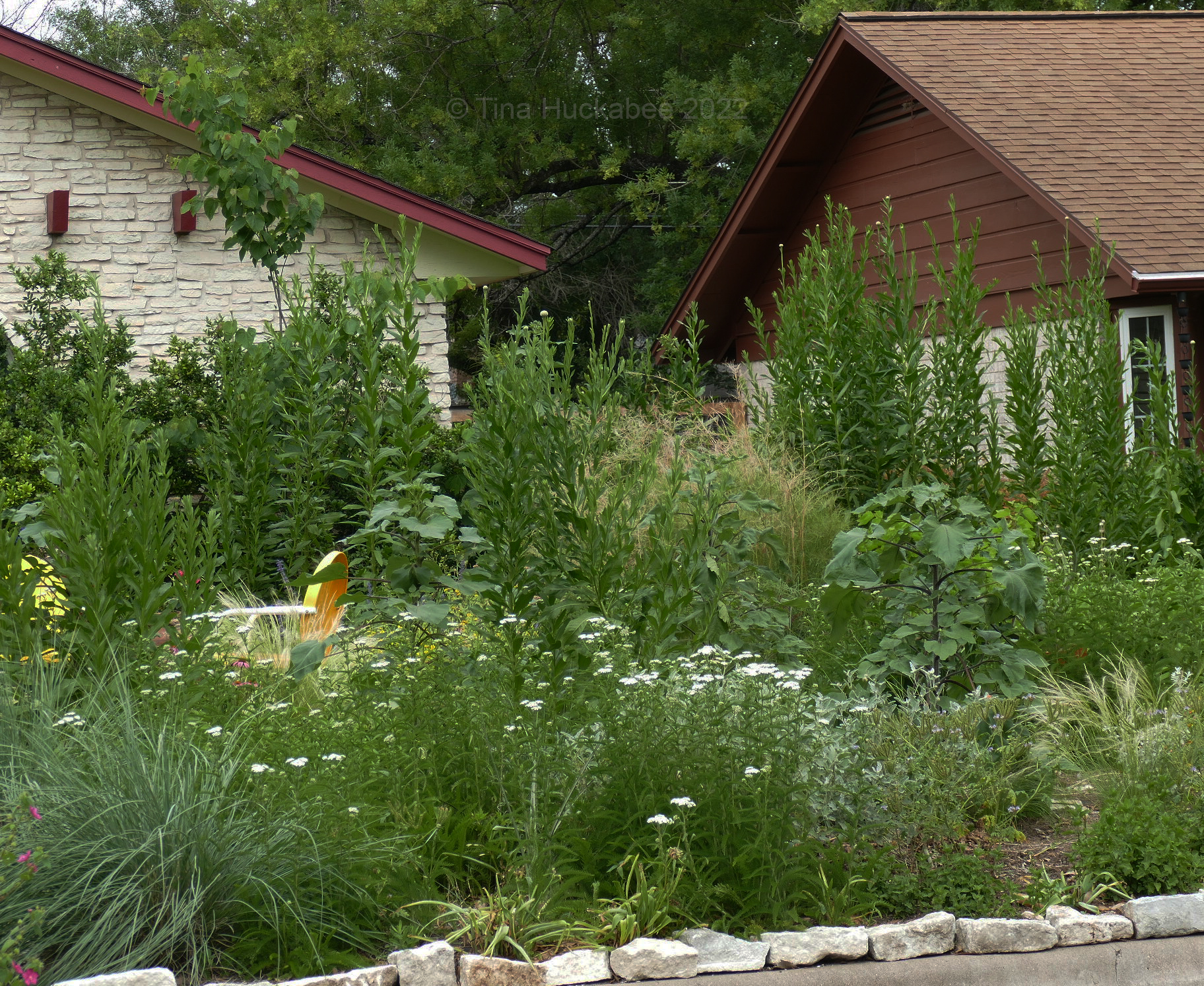
During winter and early spring, the Basket flower seedlings emerged and grew in the garden, I transplanted some and removed many. As they matured, the stalks grew taller than nearly every other plant in this garden. There was one group of about a dozen that I called ‘the grove’ that I left where they seeded out. I’m not sure why I didn’t take a specific photo of the grove in its prime, but this photo from my last post shows the grove in May at the top right of the garden.
As the flowers of the grove ended their bloom cycle and began to spread their seeds, this is how the group looked.
Small, oval seeds are buried in the fuzzy center of the flower, released with a strong breeze or by working their way out of the center and falling to the ground. There were plenty of House Finches, Lesser Goldfinches, House Sparrows, and Carolina Wrens who enjoyed these seeds. The birds were skittish and I wasn’t particularly patient at getting photos, so I never managed a decent shot of any Basket seed-munching birds, but they will spread the Basket goodness. Besides in my own garden, I expect these seeds will produce plants throughout and beyond the neighborhood.
I’ve collected a few small bags of seeds that I’m donating to our local library for their seed bank.
I suspect if this summer wasn’t so hellishly hot and dry that the pollinators and I would still be enjoying the Basket flowers. Last year, many of my Basket flowers lasted well into fall and were done only after our first freeze of the year. Even though their bloom and seed cycle was shortened this season compared to last, I appreciate what these natives bring to my garden–and look forward to meeting them again next year.
Bees are busy pollinating the summer garden, but like the rest of us, they need rest. Foraging is hard work! This Horsefly-like Carpenter bee, Xylocopa tabaniformis, chose a pretty pink bougainvillea bract as its preferred napping spot.
I watched it for some time as I puttered in the garden and it didn’t move. I’ve seen bees “sleep” on flowers in the past, usually on petals or atop leaves. I’m sure they rest in other places too, but it’s likely that those spots are more private, less noticed by the perspiring gardener. I checked the plant after puttering and the bee had moved on.
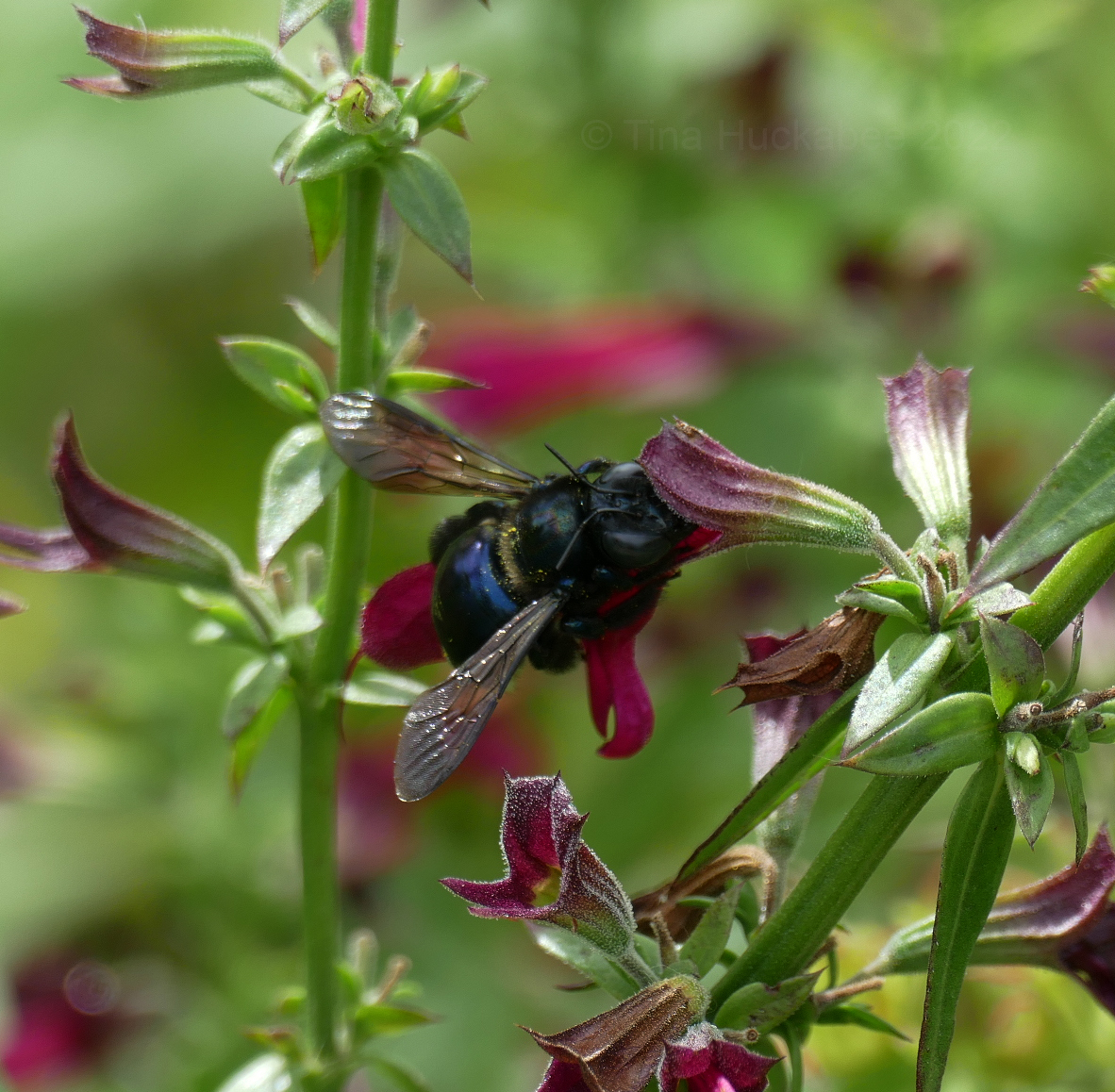
This Southern Carpenter bee, Xylocopa micans, participating in nectar robbing, is poised to poke its proboscis into the bloom of a Big Red Sage, Salvia penstemonoides.
Nectar robbing or nectar stealing is a way that various insects, bats, birds, and mammals consume nectar without the benefit to the plant of pollination. In the case of bees, they typically bite or poke a hole in the petal tissue, then sip the nectar, bypassing the parts of the flower where pollination happens. Flowers can be damaged by the robbing, thus preventing further visits from pollinators. As well, some pollinators also recognize when a bloom has been robbed of its nectar, so they move on to other nectar-filled flowers, the robbed flower missing out on pollination. For for various reasons, nectar robbing isn’t generally considered harmful for plants or an ecosystem as a whole, but is simply part of the functional tapestry of a diverse natural space.
Carpenter bees nectar rob because they’re such big bees they can’t fit into certain blooms. Generally, the blooms that bigger bees rob have slender, tubular corollas. This same Southern Carpenter bee is head-and-proboscis-deep into the base of the Big Red sage bloom, sipping the sweet stuff available. There’s no way that big body could nestle in the bloom.
Sometimes, a robber is sprinkled with pollen, perhaps due to buzz pollination. Buzz pollination happens when certain bees vibrate their strong thoracic muscles, vibrating, or sonicating, the pollen grains from flowers’ anthers. During foraging, this Horsefly-like Carpenter beemight have buzzed pollinated on a different flower, its back carrying sprinkles from the loosened pollen onward through the garden. The bee is too big to crawl into this bloom, a Henry Duelberg sage, Salvia farinacea, so stealing is the way to go.
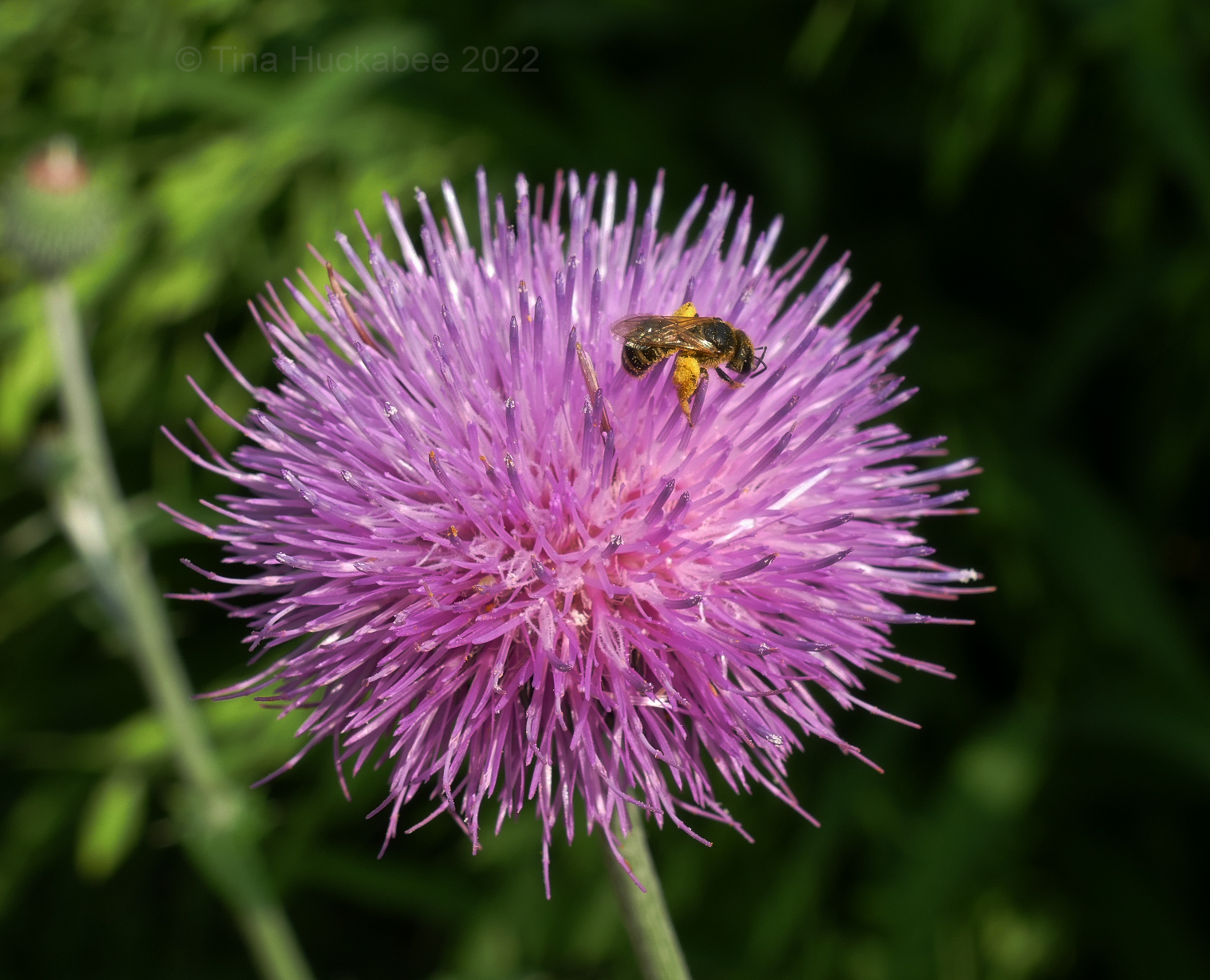
Of course, there are those who pollinate the old-fashioned way, crawling all over a bloom, collecting pollen as they go! This native bee, perhaps a Mining bee, Andrenidae, or a Plasterer bee, Colletidae, enthusiastically worked the flower of a Texas thistle, Cirsium texanum.
Pollinating or robbing, it’s a busy time in the summer garden, especially for those who live in and rely on its bounty. After a hard day in the garden, sleep is bliss.









 My Gardener Says...