A Yellow-rumped Warbler, Setophaga coronata, has finally arrived in my winter garden!
Most years I begin observing winter warblers in November. This migratory season, I’ve spied a zippy, hard-to-photograph Ruby-crowned Kinglet (a few times) and a female Orange-crowned Warbler, who is now making daily visits to the the peanut and suet feeders. But the Yellow-rumps have been tardy, or maybe just elusive.
This Yellow-rumped is a Myrtle Warbler, easily identified because of its white throat. During breeding and nesting season, Myrtle Warblers tend to spend time East and North, the Audubon species hangs out in the West. In winter, I’ve seen both species in my garden, but usually, it’s the Myrtle that is more common. I also think this one is a fella bird, given the little dab of yellow on his head. He isn’t yet in breeding colors, so perhaps he’s a hatch year dude, not quite out of his juvenile stage?
But he does rock that yellow rump. What a cute bum!
I’m glad to see the yellow rump flashing in the trees and hope that, instead of being a flash-in-the trees, he’s a daily visitor and that some of his butter-butt buddies will join him.
The birds in my garden are quiet now, as is typical for late autumn. The usual suspects show up early in the morning for their treats: Blue Jays are all-in for the unshelled peanuts; Black-crested Titmice, Carolina Chickadees, and Carolina Wrens favor sunflower seeds and shelled peanuts. The White-winged Doves flap around the pond and bobble in the garden, but at the moment, aren’t interested in what feeders offer. When spring approaches, that will change; doves are piggy birds. House Finches and House Sparrows are mostly about keeping clean in the birdbaths and at the waterfall feature of the pond.
Winter songbirds haven’t settled in yet as seasonal residents. These are the birds who migrate south from somewhere north and visit through winter and early spring, until the instinct to nest is paramount and they fly northward again–to mate and raise chicks, a timeless and universal cycle. These wintering birds are only here for a few months. I always look forward to their arrival and grieve when they leave.
I’ve had a couple of quick glimpses of a tiny, energetic Ruby-crowned Kinglet, Corthylio calendula, but it hasn’t stopped long enough for me to get a good photo. So far, no Yellow-rumped Warblers, Setophaga coronata, also known as Butter Butts, have appeared. It should be any day now that one–or several–come to my garden. The winter warblers see the garden as a safe haven for cover, water, and food.
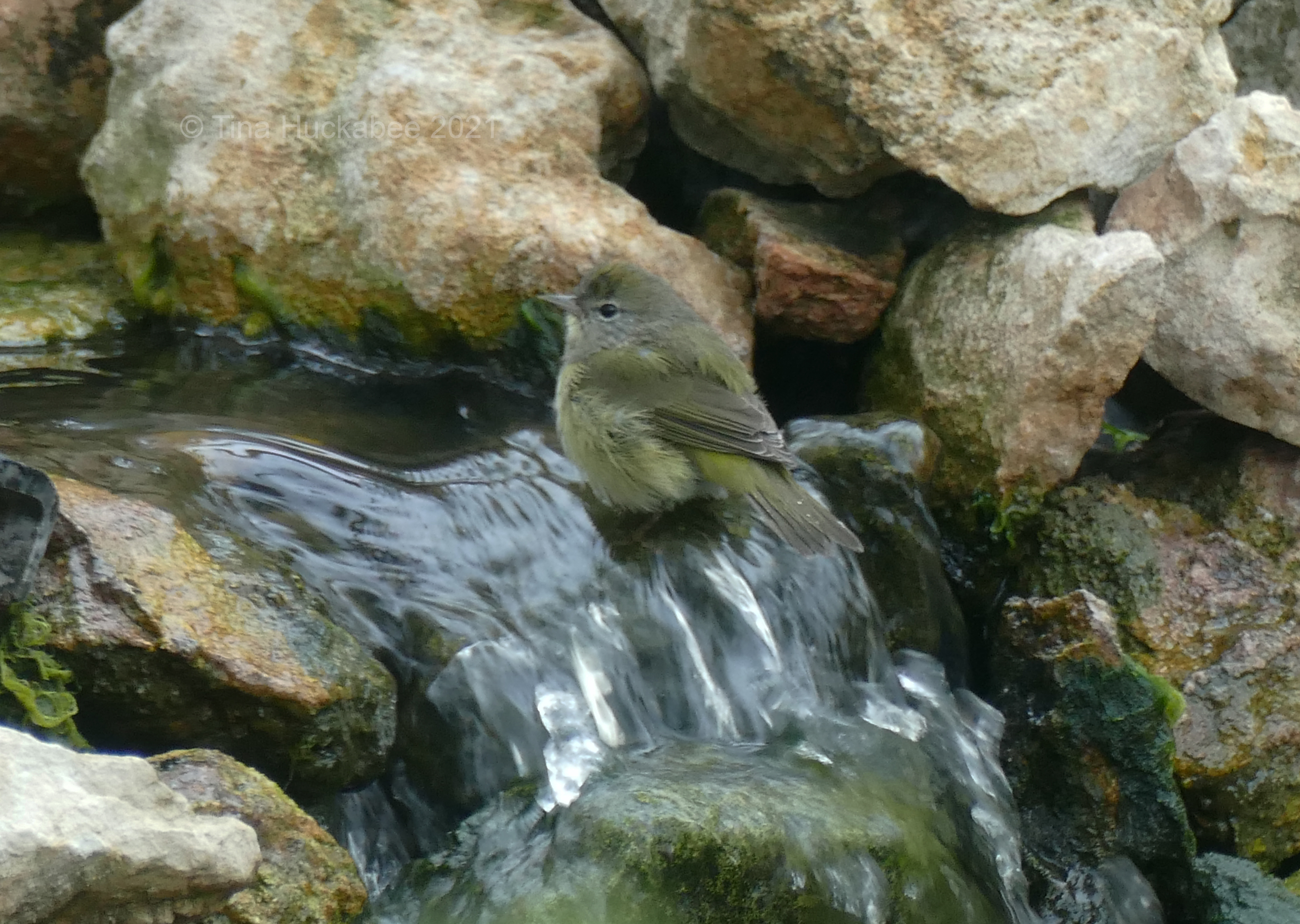
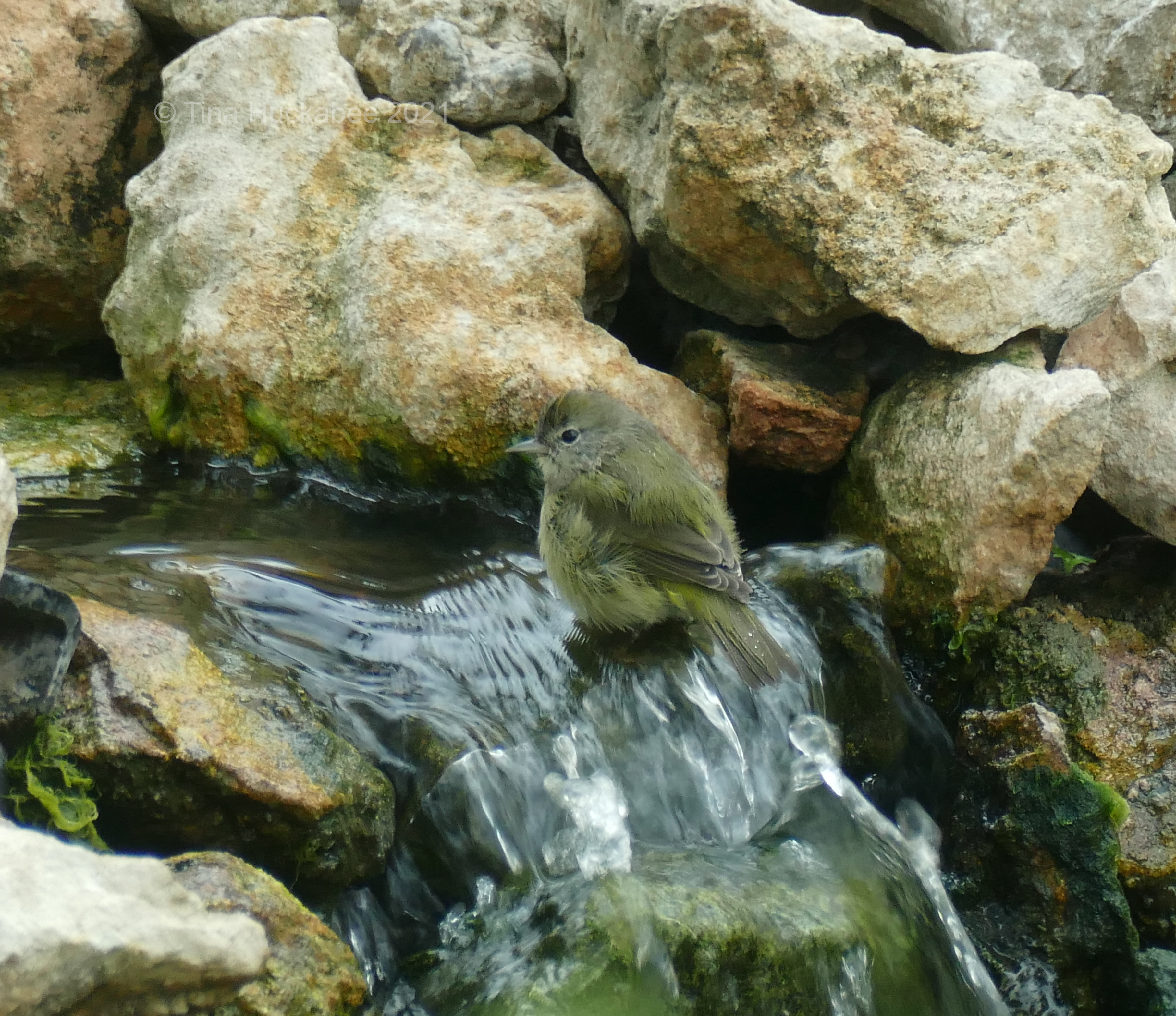
I have enjoyed a few visits from an Orange-crowned Warbler, Leiothlypis celata. It hops along the branches of the Shumard Oaks, often hidden behind foliage, but probably snacking on insects. The small warbler is too high and covered up for me to see it clearly. When it wants a refreshing bath, it’s out in the open, wary of all, careful and alert. Garden paparazzi takes advantage of the warbler’s bath time.
I think this one is a she-bird, though it could be a juvenile he-bird. There’s no sign of the orange crown that would indicate a male; the orange top is noticeable during bathing, as well as during the impressing-the-gals-time.
I haven’t seen the Orange-crown at any feeder, though they typically favor suet, which I haven’t bought yet. It’s on my to-do list.
As it finished up its bath and fluff, the little beak is open; I wonder if it chirped its approval (I couldn’t hear from where I sat), appreciating the splash of the water.
This winter warbler was wet. Other winter warblers are on their way.
I often bumble. I bumble out of bed early mornings, bumbling down the hallway to feed cats as they mew their kibble requests around my feet. Then, bumbling to the kitchen, I grind coffee beans, though to add to the morning bumbling is the sad reminder that the freshly ground coffee is no longer of the caffeinated kind, a reluctant nod to caffeine intolerance developed and morning wake-up routine compromised. At some point, I bumble out of doors, greeting the sunrise in the garden, sometimes with camera in hand (if I don’t bumble and forget to grab it).
What don’t bumble are American Bumble Bees. They move about their chosen nectar plants buzzing gracefully and intentionally from bloom-to-bloom, gentle in movement, determined in task, beautiful to observe.
In late summer and through autumn cooler, I’ll see Bumble bees in my garden. They feed from many flowers, but in my garden, their proboscis-down favorite is the blue-blooming Henry Duelberg sage, Salvia farinacea ‘Henry Duelberg’. Each morning, there are 3 or 4 at this lovely native hybrid, the Bumbles often sharing the blooms’ bounty with other pollinators who enamored with this plant.
Two decades ago I grew a related perennial, a large Salvia x. ‘Indigo Spires’, which is a hybrid of S. farinacea and S. longispicata. It was taller than the ‘Henry Duelberg’ and had longer bloom spikes; the blooms were also a rich purple-blue. In those years, the late summers and autumns saw the plant hosting15 or 20 gentle, giant bumbles each day, all working the blooms, minding their own business, adding life and movement to the garden. At some point, the bees disappeared, I suspected (though don’t know for certain) that their disappearance was related to the conversion of a nearby untouched field to a development of neighborhood housing. While that new housing addition has been positive for the neighborhood in many ways, the missing bees were, and are, missed. Bumble bees nest in the ground and require undisturbed ground. Urbanization (cement walkways, asphalt streets, swaths of non-native turf) isn’t kind to ground nesting bees, as well as other beneficial insects. In my garden, I have several uncultivated areas–no garden plants, no turf, no mulch–and have seen insect ground nests in those areas. I’m betting that the bees that visit my garden also have other places where they’ve set up their homes and nurseries, and with some good luck and knowledgeable human hosts, those areas will remain protected.
I don’t know if the numbers of bumble bees that my garden once hosted will ever return to their former glory, but I’ll certainly continue to leave open space and plant food sources for them, supporting their full life cycle.