As I looked out my windows on Snowy Sunday several weeks ago, I spied a visitor at the peanut feeder who wasn’t the usual yellow of an Orange-crowned Warbler, Leiothlypis celata. The new-to-me bird sported a brighter shade of yellow and belly streaking, reminiscent of the Orange-crown. The Pine Warbler is a lifer bird for me! Meet Mr. Pine Warbler, Setophaga pinus.
Pine Warblers spend their winters mostly in east and north Texas (as well as along the southeastern part of the US), but are rare birds here in Central Texas. Throughout their range, Pine Warblers prefer to hang out in pine trees which are found readily East Texas. While I haven’t seen the Pine Warbler at all this past week, for about ten days, he frequented the peanut, suet, and sunflower seed feeders.
According to Cornell’s site, Pine Warblers exhibit different digestive traits, depending upon their usual food sources. Those who eat mostly seeds have larger gizzards (where the hard-coated food is crushed) and require a longer time for digestion and those who primarily feed on fruit tend to develop longer intestines and digest more quickly. I’m guessing this handsome male is of the first variety, rather than second, because of his interest in what my feeders supply.
Until recently, I’d never seen a Pine Warbler in flesh and feathers, but I recognized him immediately. I’ve seen plenty of Pine Warbler photos posted on social media by bird-crazy Texans who live north and east of where I live. Reading birders’ posts and studying their often stunning photos has been a great learning tool for my backyard birding interest.
Are you charmed by this stare-n-glare face ? I am, even if he doesn’t look too pleased with the photographer.
What a good-lookin’ guy! Cheery plumage, streaked with grey on the belly, echoes grey coloring on the back and wings, and is highlighted by winsome white wing bars. He’s a well-dressed bird.
Pine Warblers are related to Yellow-rumped Warblers (‘Butter butts’) and, like previously mentioned, at a quick glance, look similar to Orange-crowned Warblers; both species winter in my garden every year. Maybe in the future, the Butter Butts and Orange-crowns will put out a good word to wintering Pines and encourage more of these sweet warblers to wing their way to my garden.
There’s a term for northern folks who come to Texas to enjoy a milder winter: winter Texans, also known as Snowbirds.
Some actual birds are winter Texans too, and in my Austin garden they’re unlikely to see snow (not impossible, but less common in these past few decades). Nonetheless, these winter birds are here for rest and good food sources, and to gear up for spring/summer breeding season. In my garden, they enjoy the pond and its surrounding trees and shrubs.
No snowbirds here, but the warblers are warbling and the phoebes are phlying.
Groan. That was bad. Really bad. Apologies.
As these winter Texans settle in for the next months, joining local, year-round birds, they’ve been active in their everyday lives, which thankfully provides nice a distraction for my everyday life.
I’ve seen a Ruby-crowned Kinglet, Regulus calendula, and have observed one–or more–Orange-crowned Warblers, Leiothlypis celata. But the stars of my wildlife garden show recently have been a crew of Yellow-rumped Warblers, Setophaga coronata. I’ve counted as many as 8 at a time, all fluttery and flighty in the trees and zippy around the pond. They come, hang out, and eventually make their way to the public bath–a favorite spot for birds of all kinds. It’s hard to count the Yellow-rumps as they’re in nearly constant motion, but I have been lucky with the camera a few times, capturing some brief, quite moments in between the winged energy that defines these busy birds.
I was excited when I downloaded this photo. It’s a nice capture of an adorable little Yellow-rumped Warbler face, avian colors complementing arboreal hues. But what interested me is the shading of the throat.
There are two subspecies of Yellow-rumped Warblers: Audubon’s and Myrtles. Audubon’s have a yellow throat, Myrtles’ throats are white. I’ve seen both kinds of Yellow-rumps in the past, but in winter and spring, it’s the Myrtles I see around here. I thought that the shading might indicate that this one is a juvenile Audubon’s, the yellow coloring just beginning. Yellow-rumps here during winter and lack their breeding plumage, so they’re softer in coloring, less showy than during the spring and summer when they’re attracting a mate. After looking at photos on Cornell’s site, I’ve decided that this one is a Myrtle and probably a juvenile, its adult white throat not quite established.
It’s a cute face, though–and Myrtle or Audubon’s–nothing changes that! Until my Red Oak tree loses its leaves (soon!), the little warblers are hard to see. It’s movement I look for, and I was pleased to follow this one as it darted, hither and thither, in the tree. Once it landed, I trained the camera to its perch.
This one waited in the wings for a dip in the pond, but landed closer to its target as it checked out the surroundings for crafty cats or other dangers. Two years ago I planted a Rough-leaf Dogwood, Cornus drummondii, by my pond and, while still only shrub sized, it’s proven itself as a good stopping-off point for birds going to and from the pond.
Here we are–arrived at the pond and rocking the yellow rump! The yellow dab of feathers, noticeable at a quick glimpse when the birds are in flight, are more challenging to see once the bird lands. Unless they turn just so, I don’t always see their namesake.
I like these three bathing beauties, each with their yellow highlights, under the wings and at the rump.
I think the one at the left is a mature female, mostly because of white streak along her eye and patch of beige across its cheek. The one at the bottom/middle is probably a juvenile female. She looks similar to the first one, but lacks the eye streak and defined beige ear patch. All I know about the one on the right is that she has a yellow butt.
Butter butts. That’s what wacky birders call Yellow-rumped Warblers.
Not that I’m a wacky birder.
Here’s a couple with differing views. The female, looks left and the male, looks right.
The male is definitely not in its breeding colors; his dark eye patch would be more obvious and dramatic. He’s probably another juvenile, spending his winter here as he matures. As much as I like to see the yellow side patches and yellow rumps, I like this shot because none of those spots of butter yellow are visible on either bird. One may appreciate their pretty faces, graceful forms, and dark/light markings.
This adult male Myrtle Yellow-rump Warbler splashed with vigor and fluffed his feathers with fanfare.
While he’s not in full breeding regalia, you can see that his plumage is richer in color than the other birds of these photos, females and juveniles all.
The Yellow-rumped Warblers enjoy the pond, but they also bop along the branches of trees and shrubs, nibbling insects as they go. They’re known as birds who catch insects as they fly (both the birds and the insects). Impressive as their aerial antics are, they’re outmatched by the flycatcher acrobatics of the Eastern Phoebe, Sayornis phoebe. One of these has been looping about my garden, diving here, perching there, for several days.
I often see one or two during spring migration, but have never had one in my garden at any other time of year. The maps suggest that Central Texas is in the ‘nonbreeding’ area, bordering the ‘year-round’ region, so I suppose I shouldn’t be surprised. I’m thrilled to see this swooping charmer and even happier when he rests. Then, aside from admiring his flying skills, I can appreciate his good looks.
I hope you find time to go outside, weather permitting, or just look out the window. Even in this dark time of year, as plants go dormant, days grow shorter, and we all hunker down, it’s remarkable how much wildlife activity there is in the garden. That activity wants only observation.
This post ends my garden blogging meme, ‘Wildlife Wednesday’. I’ll still post-n-photograph wildlife in the garden, but not necessarily on a first-Wednesday-of-the-month schedule or as a formalized garden meme, but rather, as I’m inspired.
I hope that hosting this meme was enjoyable and educational for participants and readers alike. I hope that learning how easy and gratifying bringing nature to your own garden inspired some gardeners to abandon dependence on chemicals and limit turf in favor of a healthier ecosystem. How, by gardening with native plants and plants which increase and sustain diversity of life, the novice and experienced gardener helps heal the world.
My garden enjoyed an extended fall bird migration as the the feathered travelers made their way southward for winter. I didn’t catch photos of most of the migrants I saw, either choosing to simply observe or (more often) lacking quickness in the utilizing of my camera. It’s gratifying to see so many birds resting–if only for a day–and that my garden serves as a respite along their long and dangerous journeys.
Typically, bird watching is more fulfilling during spring migration, as there are not only a reasonable number, but also a greater diversity of birds who temporarily visit my garden from early April, stretching to early June. Historically, fewer migratory birds have come through my garden during fall, though this year, that wasn’t the case. It’s hard to say why there were more migratory birds in September and October: perhaps it’s the drought we’re experiencing, making the urban garden scene a better bet for food and water sources than the open areas of rural Texas. Or maybe it was just the right weather or wind stream pattern that allowed for sufficient numbers on a path that brought them to my garden.
Like most migratory birds (as well as the native birds), it’s the promise of a refreshing bath and cooling drink that lured this cutie in and allowed me to appreciate her beauty.
The first time I saw one of these birds I thought it was the endangered Golden-cheeked Warbler, Setophaga chrysoparia, who nests no where else in the world except here in Central Texas. If you click on that link, you’ll see that, at a quick glance and if you’re a novice bird watcher, the mistake is an easy one to make. I’ve never seen a Golden-cheeked, but I’m oh-so glad that the Black-throated greens have seen fit to visit my garden space, even if those visits are ever-so-brief.
I like this cheeky am I not adorable? pose!
I hope she has safely made her way to southern Mexico/Central America and that her winter is spent eating well and resting.
For the last few springs, I’ve seen Nashville Warblers, Leiothlypis ruficapilla, in my garden. They always come as a troop of 4 or 5, never as a single bird, like so many migratory bird species. Nashvilles are feathered friends who enjoy another’s company!
In mid October, I was entertained for most of a week by a group of 5, both males and females, until a strong cold front sent them on their way south.
They’re shy and skittish at first, perching in the trees above and alighting on the plants below and beside the pond before they’re comfortable getting into the pond.
This Firecracker plant, Russelia equisetiformis, well-placed by the pond, serves as both perch and protection, before and after a bath.
Usually, there’s some time sitting on top of the pond rocks, nervously surveying the surrounding area for safety’s sake.
This one is a female,
…and this one is male. How can I tell? Check out the dab of rust-colored feathers topping his little head–it’s guaranteed to charm the ladies, or at the very least, one special lady.
In time, relaxed and ready, they take the plunge! I like these two, canoodling in the bog area.
Isn’t that sweet? Bird love in the bog! Most of my bird visitors favor the bog: the water is shallow, perfect for fluffy, flitty bathing and plants grow for cover from predators.
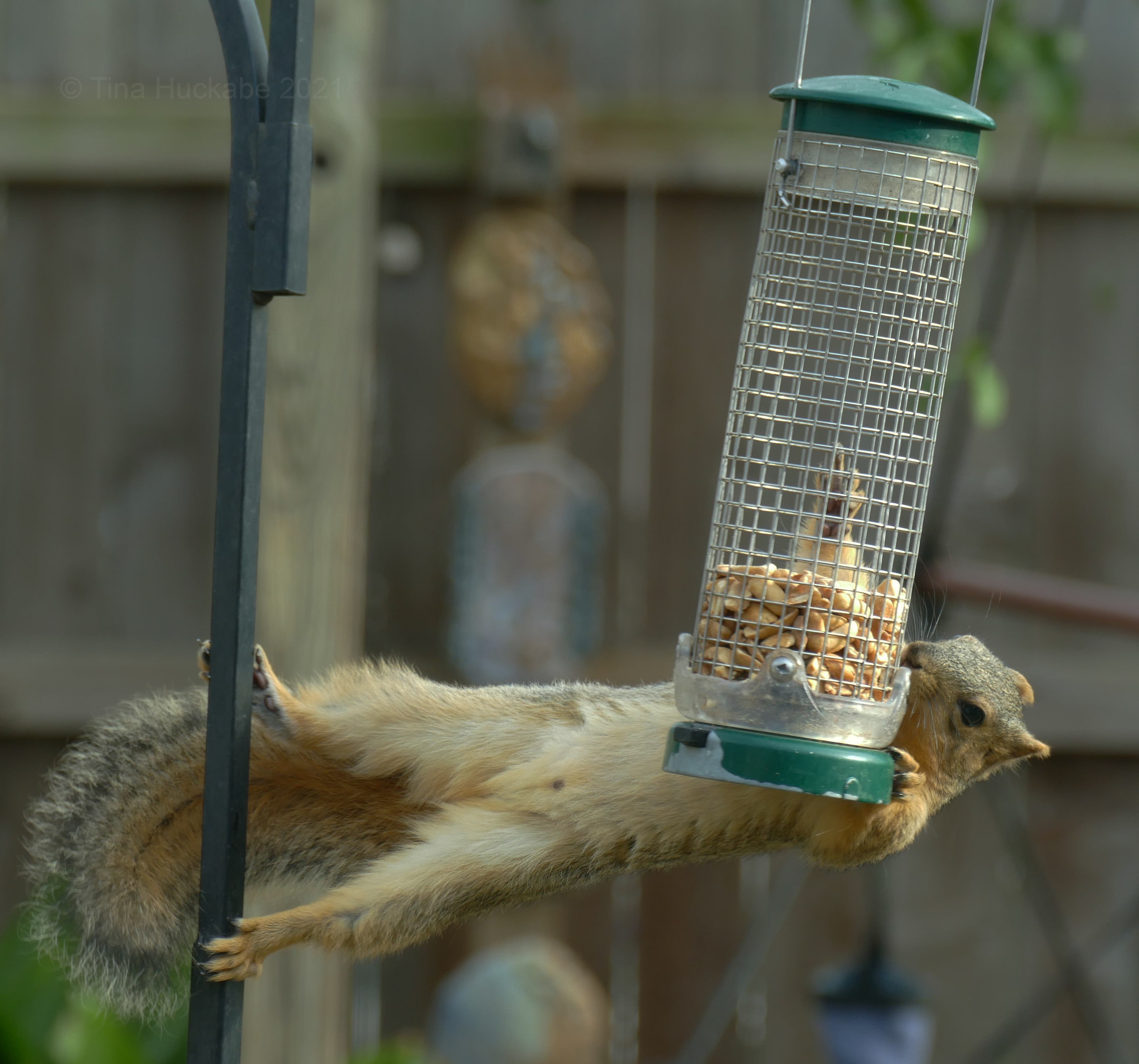
That said, there’s always a character lurking around, ready to disturb the peace, like this not-a-bird!
This Eastern Fox Squirrel, Sciurus niger, skittered up the rocks and scattered the birds, taking its turn for a drink at the waterfall. When disturbed, the birds disappear for a time, but they come back when all is quiet and they can bathe and drink in comfort.
Migratory season is mostly over. I did see a Nashville Warbler at the pond twice in this past week. Was it a tardy migrant, winging as fast as possible toward its warm winter digs? Or will it stay here until spring fever hits, joining several Yellow-rumped Warblers, Orange-crowned Warblers, and at least one Ruby-crowned Kinglet for bog baths, pond parties, and insect/suet munchies? Whatever they decide to do, they’re all welcome, temporary or permanent: these seasonal birds, along with the year-round resident birds, add their particular beauty to the diversity that is a wildlife garden.