Last week a cold front barreled into Austin, dropping temperatures 56 degrees, from 88F to 32F within a 24 hour span. As the wind picked up in late afternoon and I was covering a few of my container plants, I ambled to our lone beehive, Bo-Peep, noticing that the ladies were heading inside, having finished foraging on that warm day, soon to be cold night. I don’t know if they knew that it would be freezing for the next few days, but it would make some sense that they were snuggling in for the duration of the chill.
On the entry board of the hive, this stunning moth was also ambling about; the bees ignored the moth, the moth ignored the bees.
I’ve seen this species of moth before, mostly in flight, but it was always too quick for me to identify. A Grapevine Epimenis, Psychomorpha epimenis, this moth species uses grape plants as its host plant, meaning that it lays eggs on the plants, the larvae eat the plant as they mature to adulthood. In one local source that I found, the author mentions that the adults typically fly in February, laying their eggs on the still dormant vine. My Mustang Grape vine, Vitis mustangensis, has grown along a trellis for a number of years and is courtesy of a passing bird, raccoon–or something. I’ve never noticed caterpillars on the vine, but will keep a keen eye out for them in the next couple of months.
This moth sports red spots on its wings, indicating that it’s a male; females’ spots are orange. I was able to catch a glimpse of the underside of the wing, too. I like the mottled grey/black pattern, black dots on charcoal grey background. What a handsome fella!
During my winter pruning frenzy, I recently pulled some of the grape vine, which I’m now regretting. Though there’s still plenty of vine left and probably eggs on the vine, I wish I’d been aware that the vine is a host plant. Next year, I’ll leave the vine alone until later in spring, giving the larvae time to hatch, eat, grow, and become lovely little moths to grace my garden.
As it became colder, I wondered if the moth found refuge inside the hive, or if the bees would have tolerated a cold weather interloper. Maybe they became sisters and brother during inclement weather. Or did the moth fly off, finding warmth and protection under leaf or branch elsewhere in the garden?
The late winter garden is a palette of muted colors marked with skeletal trees and shrubs. The evergreens, big and small, contribute welcomed dots of green, plus there are others who offer various reds to the garden environment. The tidiness of a pruned, simplified landscape has a certain appeal, but it’s also easier to bird watch in this season of leafless trees and mostly dormant plant life.
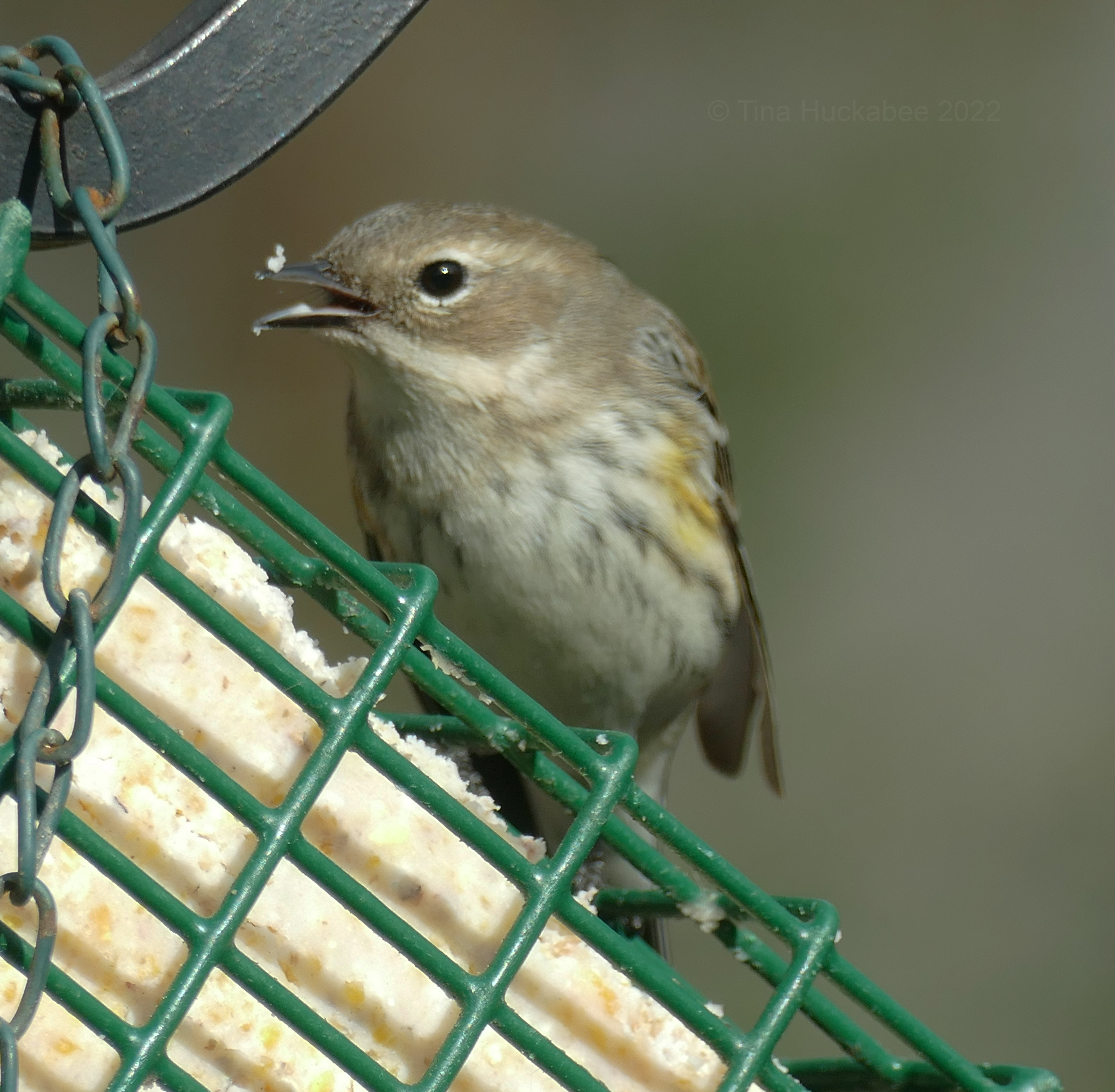
Here in Central Texas, bird colors span the rainbow: Blue Jays, Cardinals, Red-winged Black birds, Gold finches and other color-tagged critters. Along with the showy birds, there are birds whose understated plumage blends well with the winter environment, like this winter visitor, a Yellow-rumped Warbler, Setophaga coronata. Her dabs of sunny yellow are surely highlights in her feathers, but most of her colors and markings are warm and subtle, making her sometimes hard to spot in a tree. But at the suet feeder–which she loves–she is more easily observed and admired.
A beakful of suet is a yummy thing!
As she digs into the suet cake, she doesn’t realize that the sticky stuff…sticks—and stays!
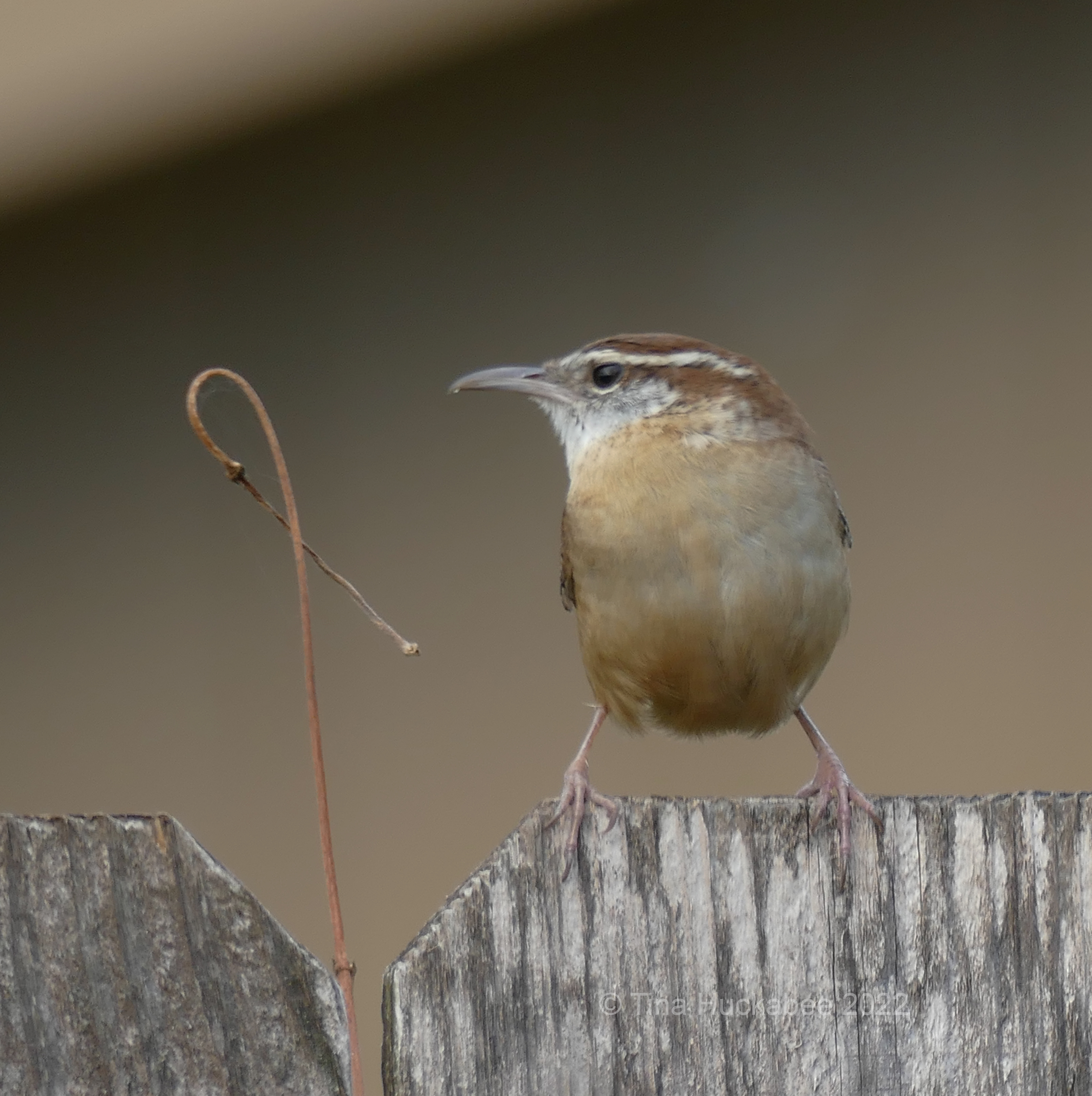
A year-round native resident, this Carolina Wren, Thryothorus ludovicianus, echoes winter browns and tans in his patterned plumage. He may not wear loud colors, but he sings with volume and gloriously for his territory and family; wrens are tiny birds with mighty voices. Wren song is the first birdsong I hear each morning throughout the year.
He posed with a strand of freezer-burned tendril of Star Jasmine vine, appearing as a weird appendage attached to the wren.
As he sung at the end of a day, he hopped along the fence, eventually creating distance from the plant part.
Wrens bop right and left in time with their chirps, tails flicked, eyes watchful.
A significantly less pretty bird and certainly a much larger bird than the two above, this Turkey Vulture, Cathartes aura, perched for a while in my SIL’s backyard tree. Turkey Vultures are common in the southern U.S. and throughout Central and South America. They soar majestically with the breeze and low to the ground looking for carrion. Though I see them all the time in the air, I’ve never seen one perched in nearby trees. It sat for a time and I wondered if there was something dead in my SIL’s back garden.
Dead squirrel? Opossum? Rat? Who knows what lunch was for this huge bird.
Turkey Vultures are scavengers and important links in a healthy ecosystem as they clean up the dead. Gentle creatures, they’re only interested in a nice meal of carcass; they are not predators. I was tickled to observe this one so close, but it eventually took flight, spreading impressive wings wide, circling over my garden as it gained altitude, moving along to find its next meal.
I appreciate the quiet of winter. I look forward to pruning last year’s growth and its revelation of the “bones” of the garden. I am witness to both successes and failures in the garden and of plants that I’ve chosen to create it. As with a muted landscape, even in a plainly colored bird, there is still much beauty in a darling face or in the pattern of the plumage, when hues are neutral and soft. That said, after many freezes this year and as March approaches, I’m eager for spring and daily observe signs of its arrival.
Recently, I walked along to path to my beehive, Bo-Peep, to check on the consumption of sugar water after a cold spell. As I was walking back along the same path, realized that I’d stepped in dog poop.
Wait,I don’t have a dog! What I’d stepped in was not the poop of a dog but scat from a fox! I know there are foxes in our neighborhood because I saw a pair not long ago, early in the morning. I’m also fairly sure I know where they live and it’s not far. These neighborhood foxes are most likely Gray Foxes, Urocyon cinereoargenteus. I love the fact that there are foxes in our midst, shy and elusive, but very much a part of the wildlife tapestry and great hunters of rodents. That being said, foxes are omnivores and along with rodents, will eat bird eggs and baby birds, as well as many other things. But in an urban environment, they have a place and are adaptable and comfortable even if we rarely encounter them.
Last year, a pair of mated Eastern Screech Owls, Megascops asio, wooed one another and settled into our nest box, the female laying four eggs. At that time, our owl nest box camera was functional (it has since given up the ghost), but I loved watching mama in the box, shifting and snuggling over the eggs, and dad bringing her treats of rats in the evening. One morning in early March, I logged on, got the inside view and there was nothing in the box–no eggs, no mama owl. I found broken egg shells at the base of the tree and realized that the nest had been raided, I assumed by a raccoon, as they’re very common in our neighborhood. Like foxes, they’re omnivores consume a wide variety food.
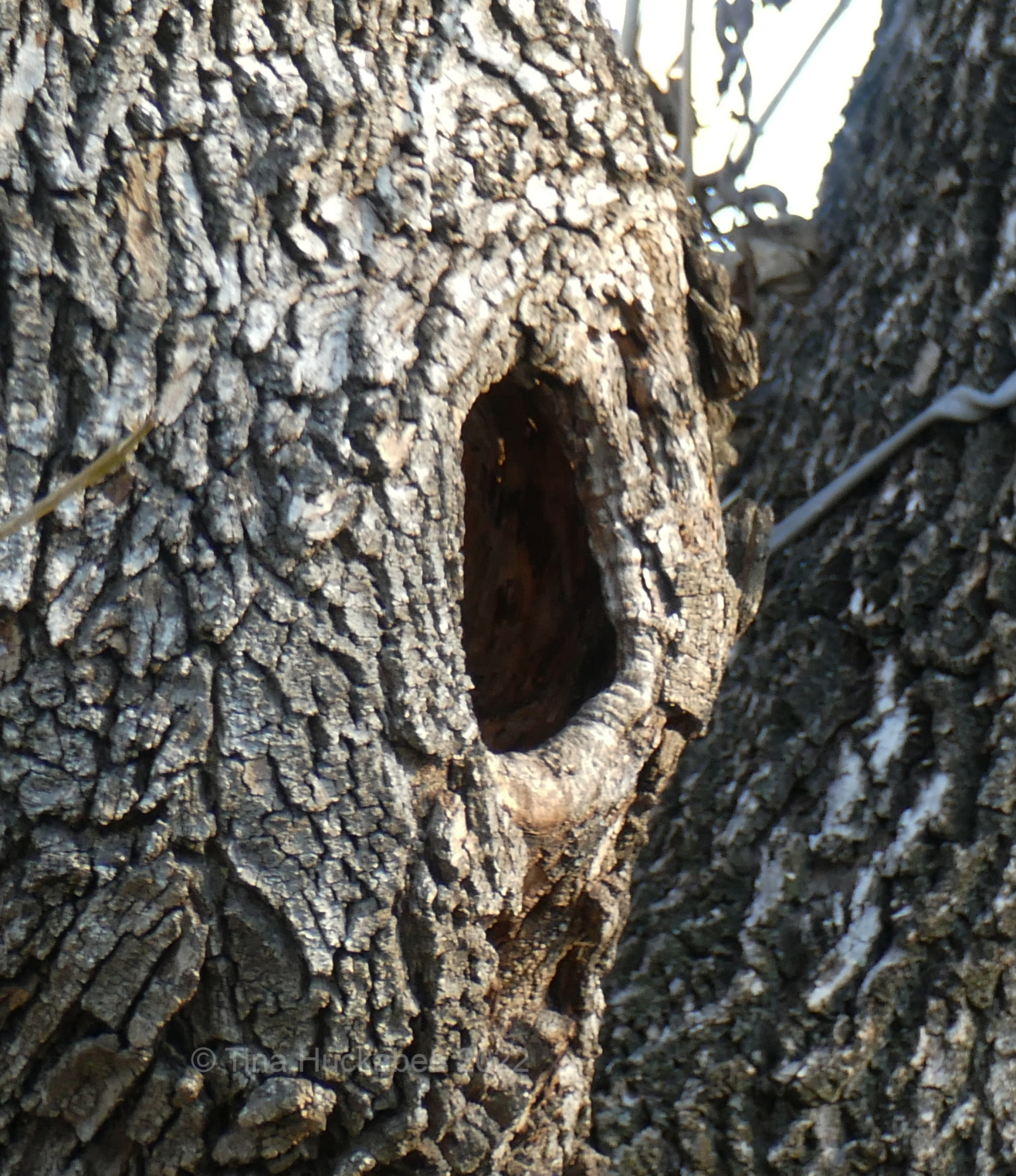
During that nesting time last year, dad would rest in the hole of my back neighbor’s dead Arizona Ash tree. The hole has a clear view of the nest box and isn’t far away. In the last two weeks, I’ve spied an owl (the same male?) in that hole almost every day. The Blue Jays know he’s there–that’s how I found him–following their warning calls as they harass him from time-to-time. Without the help of the caterwauling jays, I would have never known he was there, he’s so well camouflaged.
I know when he’s sleeping inside the hole or perhaps not there at all, when I can see the deep, dark of the hole. These two photos of the same hole were taken on different days.
This morning, at about 7am, I was hanging up the bird feeders and setting out unshelled peanuts along my back fence, when I saw an owl perched in a different, smaller tree–a Crape Myrtle–belonging to the same back neighbor. It was light, just barely, and it’s not typical to see owls out in the open after daybreak. The owl was still and facing my sister-in-law’s back garden. Just then, I heard the call of a Cooper’s Hawk, Accipiter cooperii, and observed two in her large backyard tree One of the hawks was enjoying an early breakfast.
The smaller male perched nearby while the female ate. They were closer together when I initially saw them and the dining hawk definitely bigger, which indicates that she’s the female.
It’s not a great photo, but shows both of these beauties. Did the male bring its prey to the female as a love offering? I mean, it is almost Valentine’s Day!
I was surprised at the early morning catch by the hawks, I usually see them hunting later. I now suspect that the little owl in the myrtle was caught in the open and was remaining still, as the hawks are a clear threat to her.
The Blue Jays arrived for their morning peanuts, discovered the owl in the myrtle and in a flash (that I missed, as I was glancing at the hawks) the owl flew to the nest box, trailing yelling jays after her. Just after that bit of bird drama, I glanced at the tree hole, saw an owl face there and snapped the photo shown the beginning of this post. I now know that there is a pair of nesting Eastern Screech owls in my back garden: dad is in the tree hole, mom is in the box. This pair is quiet and shy–just like last year’s owls. Are the the same pair? Probably, but only they know for sure. And really, isn’t that all that matters?
So why did I start this story with the fox scat? Last March, when the screech owl nest was destroyed, I assumed it was a raccoon that did the deed. For some time now I’ve wondered if, instead of a raccoon being the predator, that it was a fox that snatched the eggs. Foxes climb well, I know they’re around and that they’ve been in the back garden. I didn’t see any raccoons in or around my garden in this past year (though I’m sure there were visits from some) and I’ve spied the foxes several times. Additionally, in the past, but mostly during summer, I’ve seen snakes in the garden and it’s possible it was a snake which raided the box. The truth is that I’ll never know for sure who ended the owl couple’s chance at a family that time and whatever the predator, it has to eat too and likely had offspring to feed. After all, owls are predators and eat plenty of smaller birds.
Now that I’m aware that there are two owls, probably a mated pair and likely the same couple as last year, I hope to be proactive in helping them protect their nest box. There are guards that can make it difficult for predators to reach the nest and I’ll figure out something along that line. If past experience holds true, the owls will have eggs by the end of this month, definitely by March.
As for the Cooper’s Hawks, I will keep an eye out for their nesting digs. They’re big birds and a nest is likely placed in a large, evergreen oak tree.
Nesting season 2022 is underway!
Rest up, Dad. You’ll soon (hopefully!) have other beaks to feed!








 My Gardener Says...