You know what they say: The early bird gets the worm.
In this case, the early bird wasn’t the least bit interested in a worm, but instead chose dove or mockingbird as its breakfast of choice.
Just as it was light this morning, I spotted this juvenile male Cooper’s Hawk, Accipiter cooperii, enjoying a meal atop the remains of my neighbor’s Arizona Ash tree. The tree was damaged during the February 2021 freeze, but retained some of its lower branches. The upper branches all died and were removed last summer. What remains are some well-utilized perches for a variety of birds, including this beauty.
It’s possible that the hawk caught its prey yesterday evening, ate some of it, and saved the rest to finish for breakfast. I know I like left over pizza for breakfast, though I’d probably pass on dove. To each their own.
As I watched the hawk, it fluttered from the highest perch, to the one just below. I’m not certain what the advantage of the lower perch presented, but the hawk stayed for a bit, flying off later to spend the day hunting.
Observe that the outer bark of the tree is pulling away from the main wood. All of the trees damaged in that devastating freeze have similar shedding of of bark, some are larger pieces like this, some smaller. The birds don’t mind, though; it’s been fun to see the variety of birds making use of these large limbs. Everything from this big hawk to tiny hummingbirds perch on various parts of these limbs. I just have to remember to notice.
Every year for most of the past decade, I find a wildflower in my garden that I didn’t plant. Each year it’s a different wildflower and typically not repeated by either seed or root during the next growing cycle. The wildflowers have all been Texas natives, usually spring or spring/summer bloomers. Each plant has appeared in a different spot: some in the back garden, some in the front; a few popped up in containers where other things were housed, and several have grown along the southern side of my house, where there isn’t much of a garden, only a utilitarian pathway.
Where do these garden gifts come from? Maybe birds have dropped seed by way of their excrement, maybe seeds wafted into my garden space from the wind. Perhaps, wildflower nymphs, being such quirky critters, choose to leave me something new and unique to my garden– just because they can.
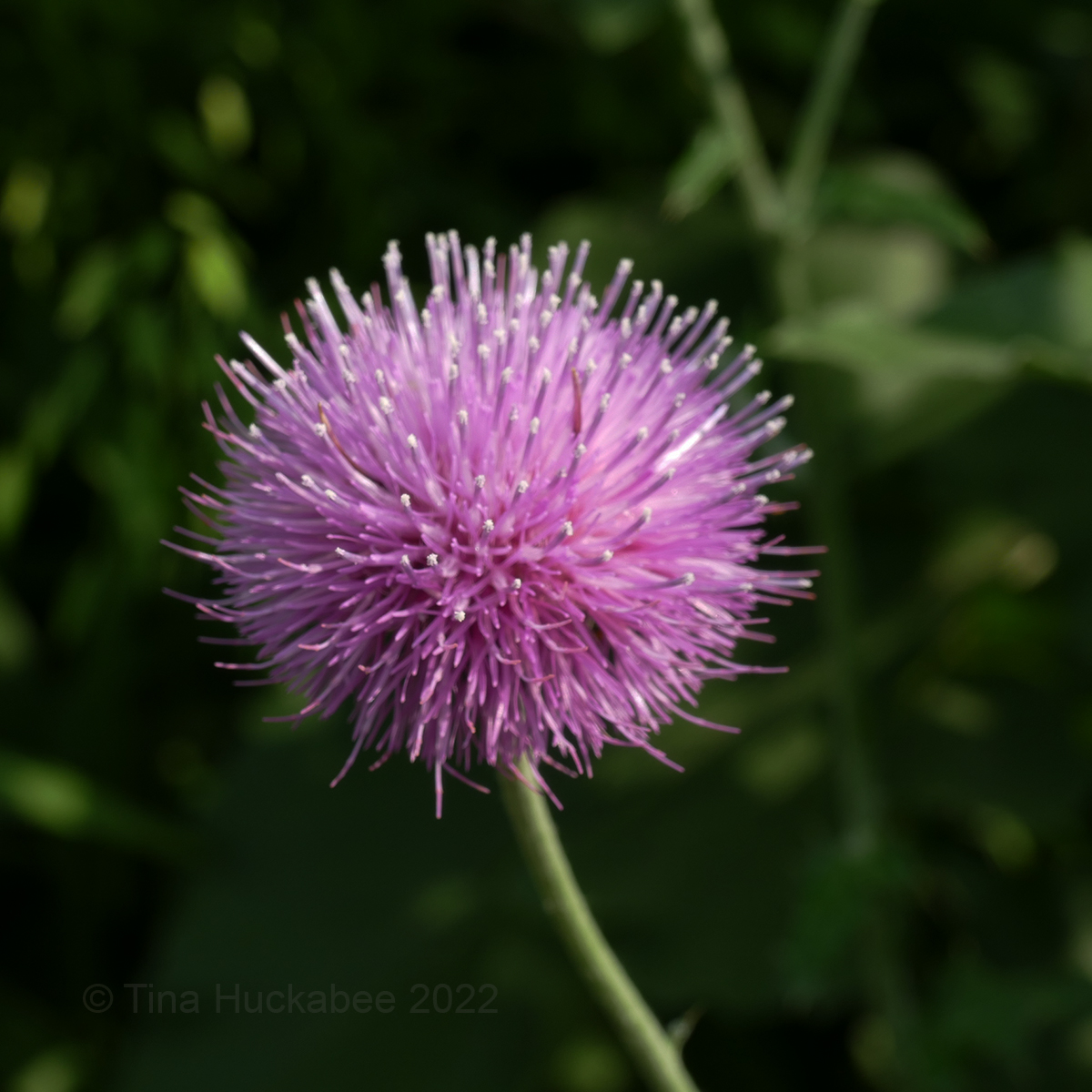
This year, Texas Thistle, Cirsium texanum, was the wildflower nymphs’ gift of choice.
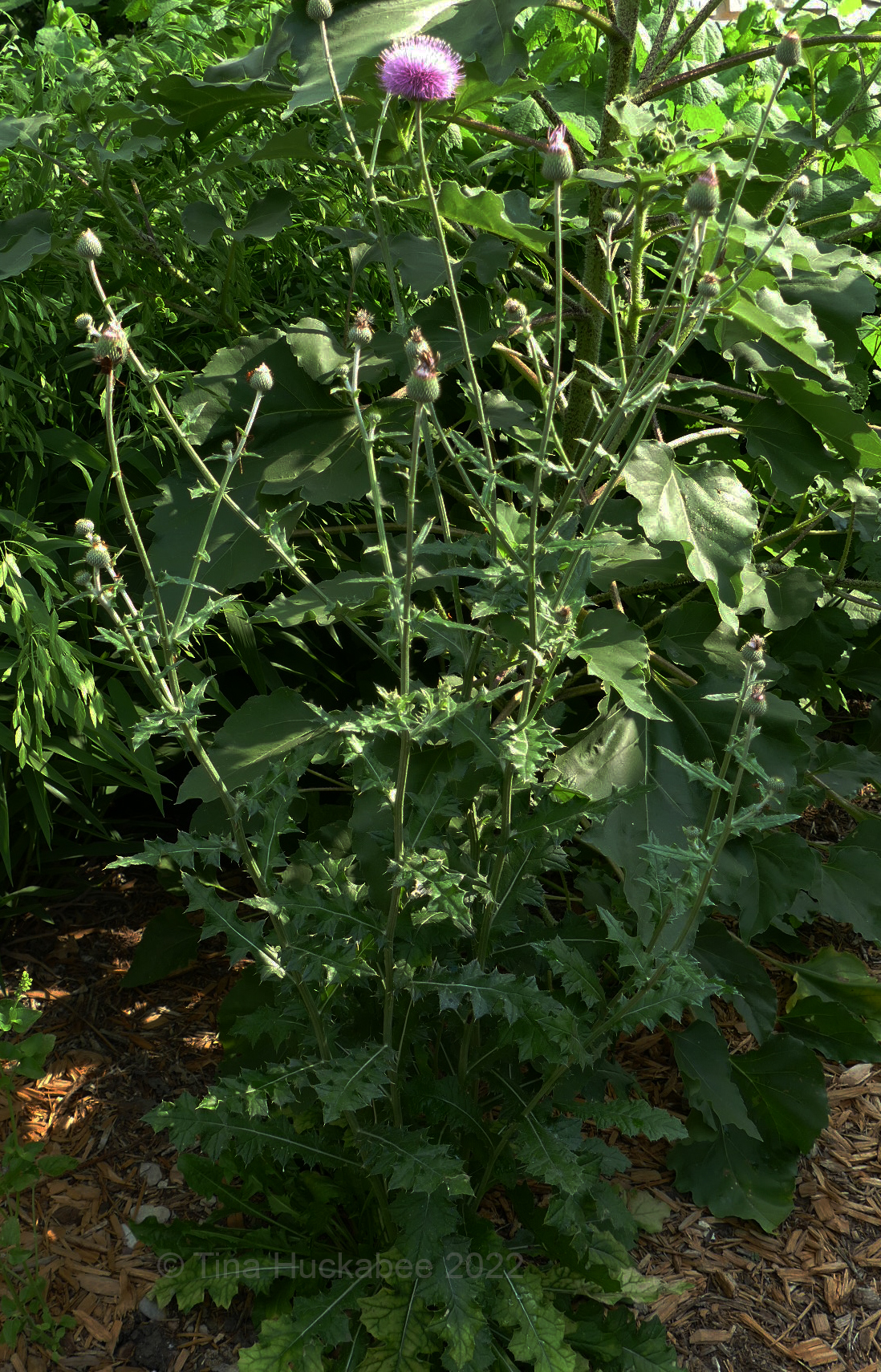
This pretty-in-pink flower bloomed in June and July, having arrived as an attractive, though prickly, evergreen rosette. Trust me when I say that those prickles HURT! Actually, the wildflower nymphs left the rosette last year, but no flowers appeared, as Texas Thistle is a biennial, blooming in its second year. I was aware of the rosette last year, but left it alone and unidentified.
While I never observed any eggs or larvae on this foliage, the Texas Thistle is a host plant for the Painted Lady butterfly, Vanessa cardui. Indeed, I enjoyed the presence of several flitting Painted Ladies earlier this summer. Thanks , Texas Thistle, I’m glad someone likes that foliage!
Bright blooms develop atop stems with few leaves, about 18 inches from the base of the plant. Once open, they resemble deep pink Koosh balls.
Insects, especially native bees, are big fans of this plant. Here, a Leaf-footed bug, Leptoglossus, and its nymph (immature form of the bug), rest on a bud. They were probably doing some bug-like slurping, but I didn’t see any damage to the bud or plant.
I didn’t bother the bugs. Generally speaking, I let bugs be bugs; mostly, they’re harmless.
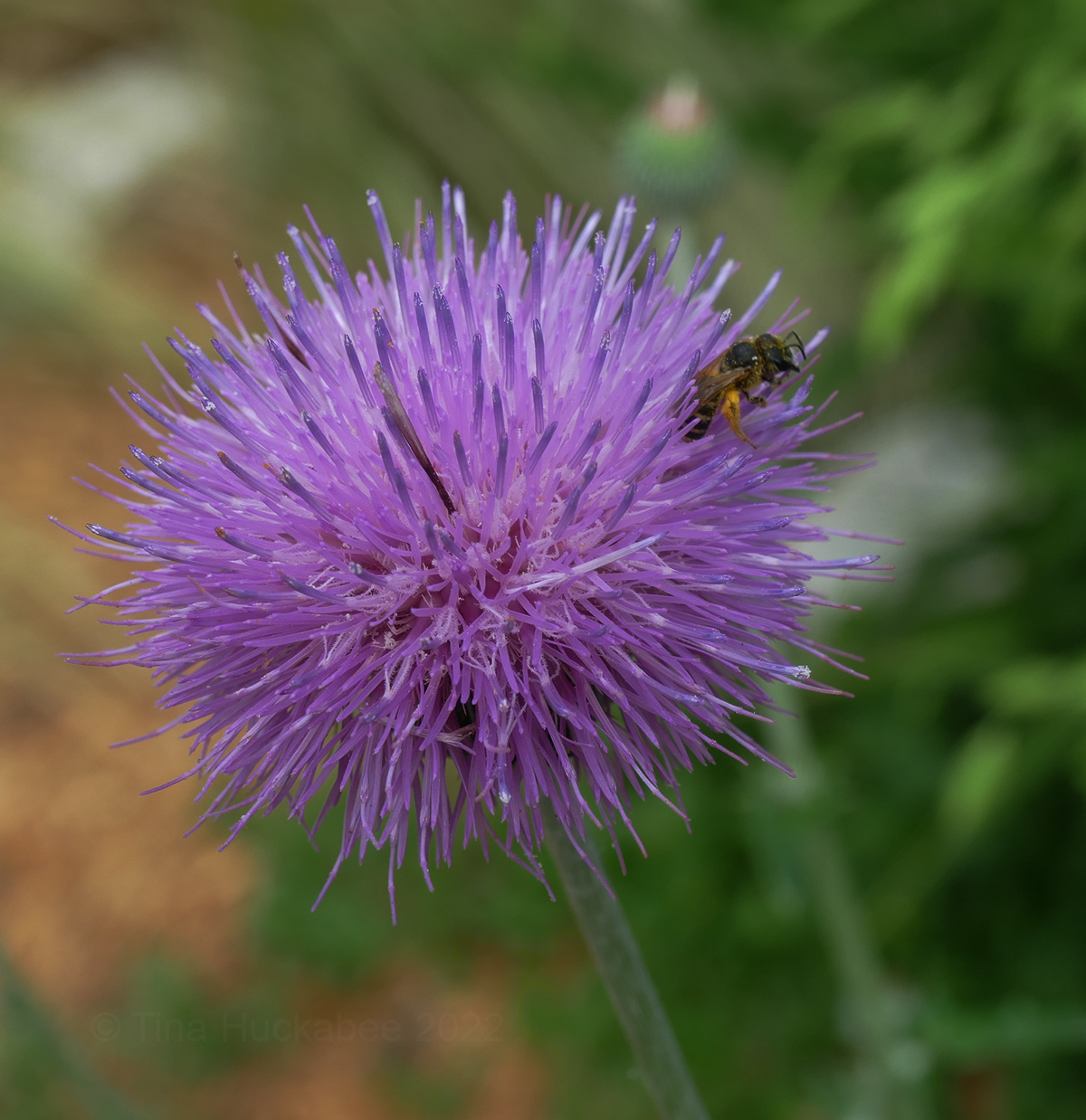
In the information about Texas Thistle from the Lady Bird Johnson Wildflower Center website, the bumble bee is specifically mentioned as a frequent pollinator of thistles’ disk blooms. Lots of bumbles have graced my garden this year, though I observed none of them on the thistle flowers. However, other native bees relished the nectar offered and picked up pollen as they worked the blooms. I’m not sure what species of native bee this little one is, but its pollen pantaloons are packed with rich pollen, gifts from the flower.
Most years, the wildflower nymphs have gifted one individual plant of one species. This year, there were two thistles that magically bloomed: the one of this post, growing in full sun along the side of my house, and a second, in a pot of variegated American Agave, in part shade, in my back garden. That one didn’t produce as many flowers as this one, but both completed their life cycles; I hope that the seeds will assure some thistles in my garden in future seasons. Also, the other nymph wildflower gifts have been annuals, but as mentioned, Texas Thistle is a biennial, 2022 its year to flower. Those wildflower nymphs, they like to mix-it-up and keep me guessing.
So, wildflower nymphs–what will it be for 2023? I await your gift(s)!
There are more than a few birds in my garden this summer, but plenty of projects, hellish heat, and a decent dose of seasonal laziness has slowed my interest in photographing avian acquaintances.
Also, birds frequently fly away when I step outside to take their photos.
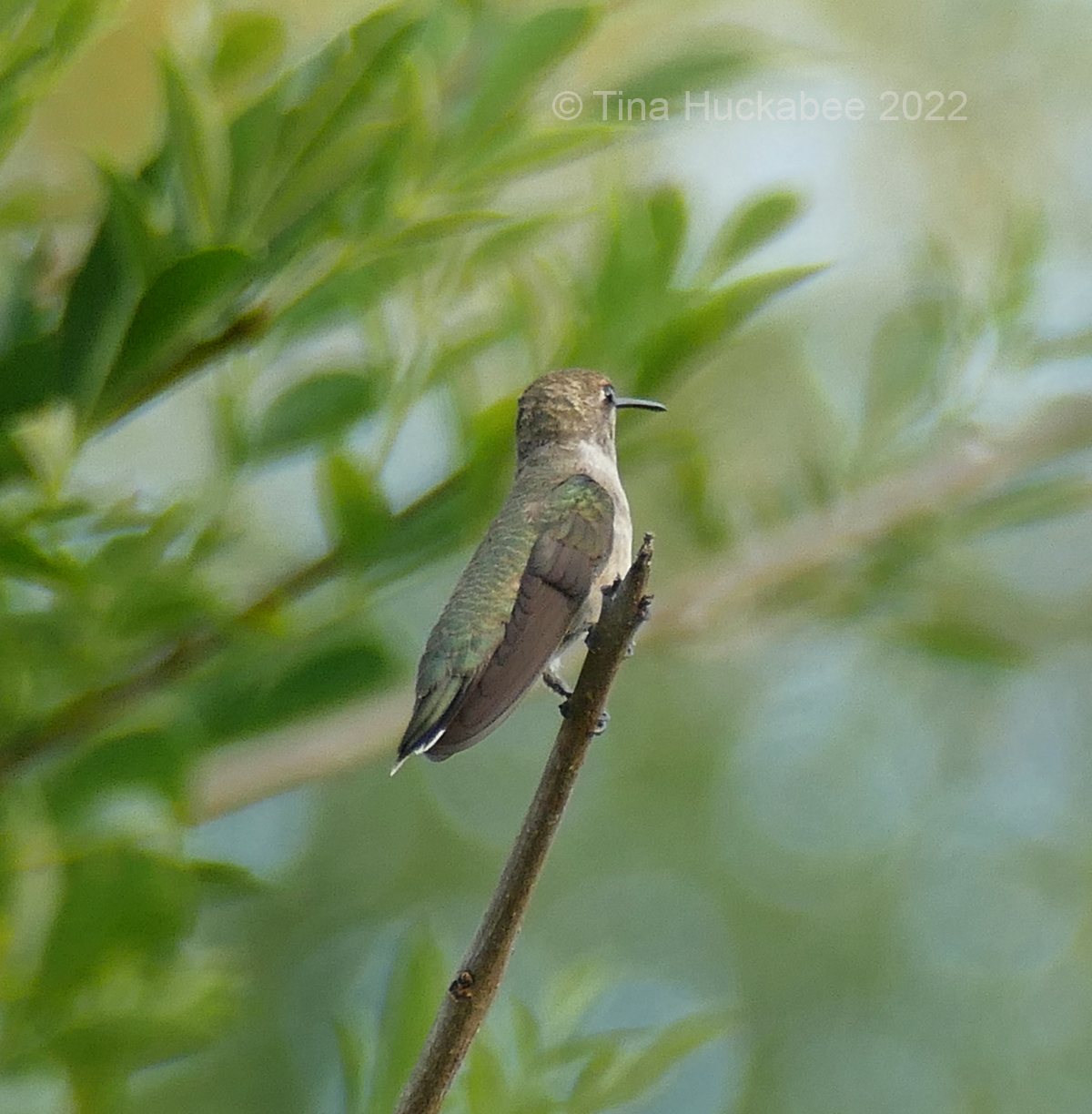
Sometimes though, I’m lucky and the birds cooperate. One hot July evening, sitting in my front garden, I observed with amusement three female hummingbirds chasing one another around the garden, each, no doubt, claiming the territory as her own. I captured this lovely as she rested and surveyed her territory, keen eyes watchful for invaders. She didn’t perch for long, zooming off on her mad dash to protect her home from The Others.
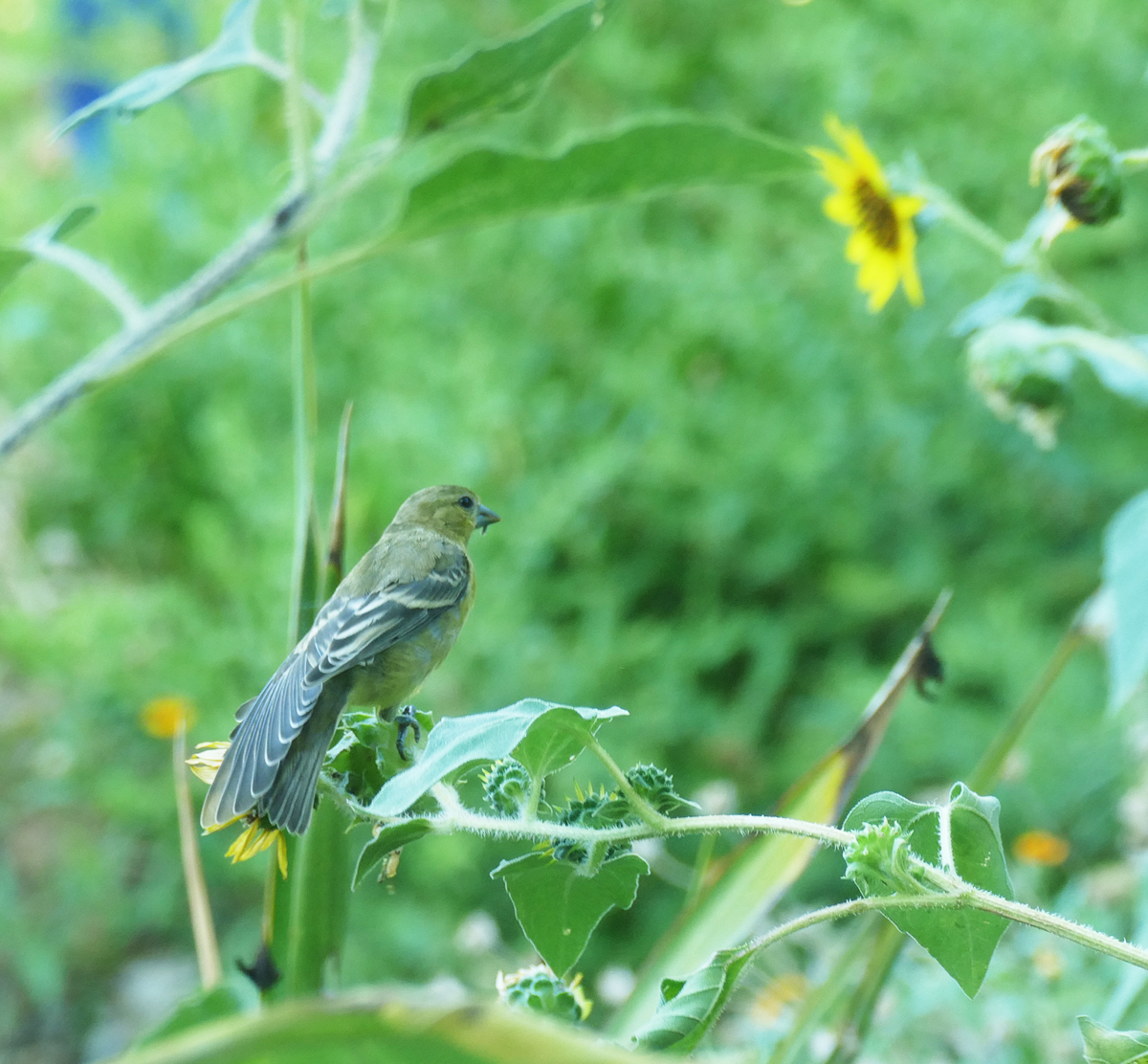
A significant crew of Lesser Goldfinches, Spinus psaltria have hung around all summer, noshing on a variety of seeds in the garden. They’ve favored seeds of the American Basket flower, Zexmenia, Henry Duelberg sage, Rock Rose, and Sunflower. They’ve also been skittish, taking flight at the least movement, and capturing shots of these cuties has proved challenging. I spied this female through my front window, alerted to its snacking by my cat, Lena, who watched. I’m sure she wished she was out with the bird.
I like the way the finch’s feathers splay as she perches on the branch of the sunflower.
Mostly, it’s the usual suspects in the garden, though this year, the European Starlings, Sturnus vulgaris have over-stayed from their typical late spring visits and in their bullying ways, made themselves unwelcome. In normal years, they’re here in May and June, and once the fledglings are independent, take off for parts unknown. I guess with the drought, there’s not much ‘out there’ to draw them away, so Starlings are a constant in this urban paradise of water and food. They favor the peanuts and if I leave the two peanut feeders up, they’ll go through the supply within a few hours. For now and until the Starlings vamoose, I’m only hanging the peanut feeders during early mornings and late evenings to prevent them from eating a the peanuts supply. To their credit, their plumage is beautiful and they are masters of murmurations, but as backyard visitors, they are pests. I don’t have photos of the Starlings because I’m annoyed with them.
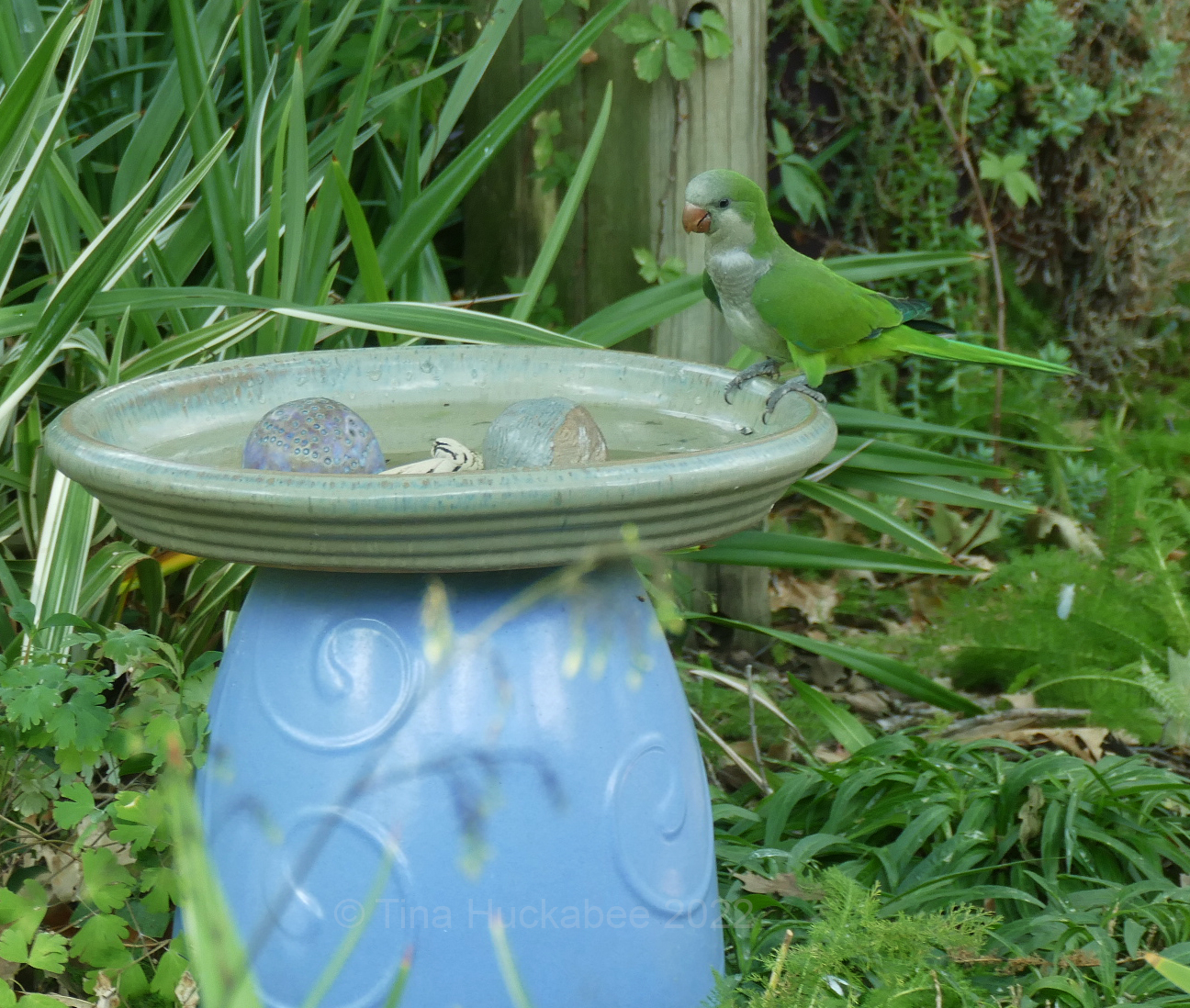
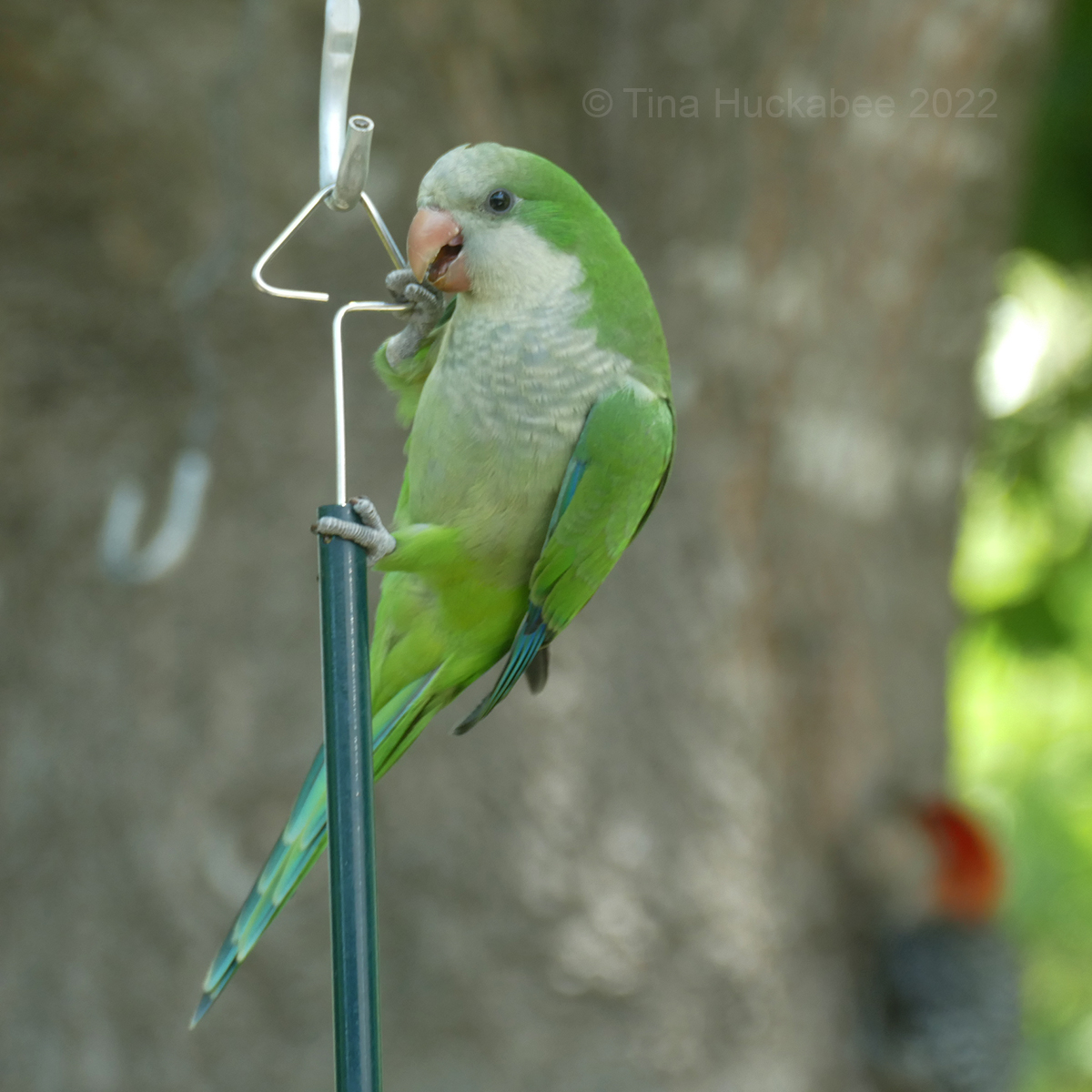
Another bird spending summer in our neighborhood are some of Austin’s Monk Parakeets. I can’t help but admire their beauty and chuckle at their personalities.
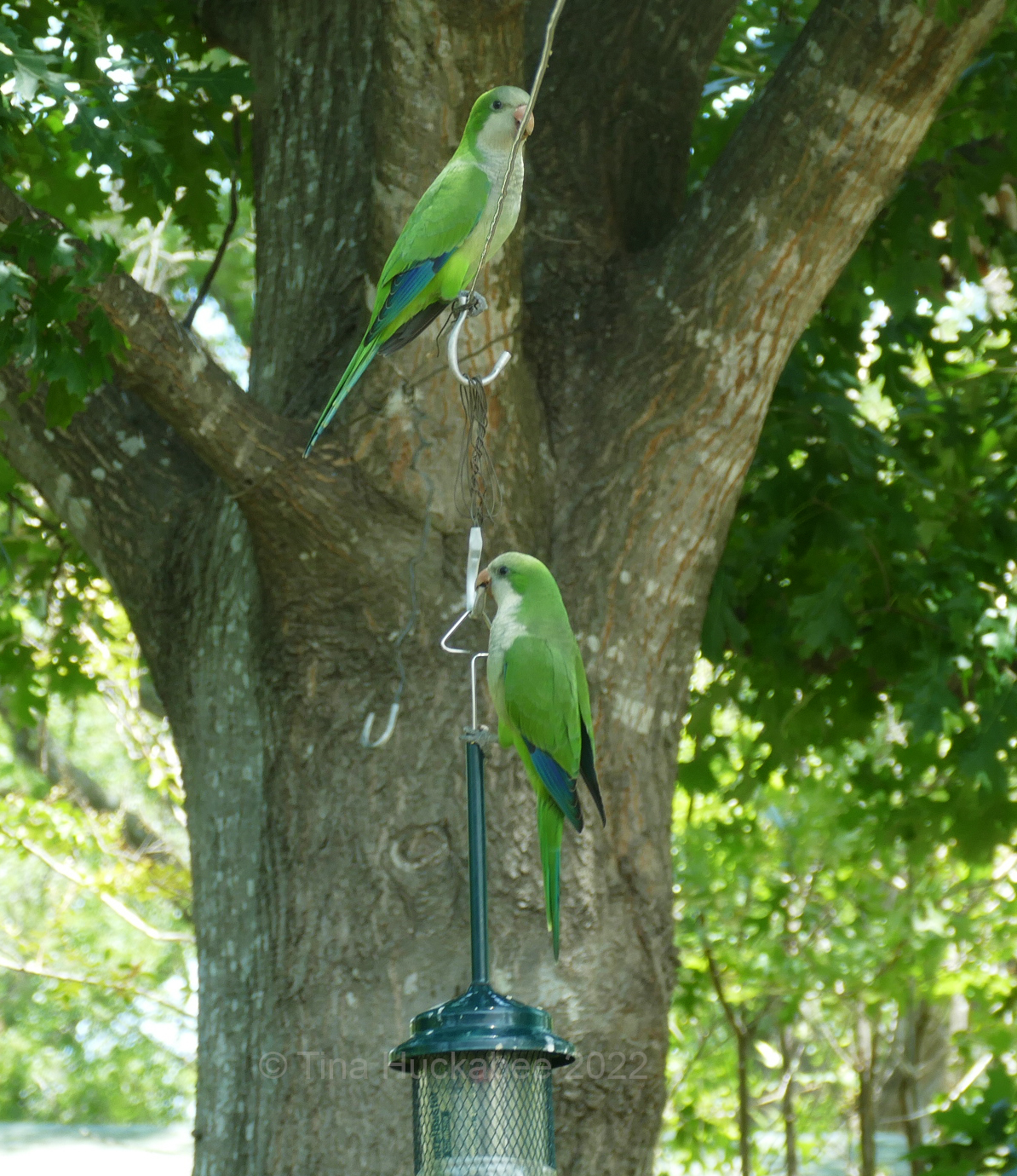
There are always a few Monks who come to my garden in late spring, checking out the bird feeders and perching on the utility wires along the back of my property. This year, they’re still around in August, cawing loudly and flashing green and blue as they streak across the sky. The Austin Monk Parakeet population descend from pets let free in the 70s and 80s; these striking birds are successful colonizers of urban areas. Fond of nesting atop electric towers (which have caused fires), apparently they have no negative impact native bird species.
Gosh, they’re pretty birds!
I appreciate that the Monks are the only birds who push back at the Starlings’ bad manners at the feeders; the Starlings always give way when there’s a Monk around.
I wouldn’t mess with that beak and those claws could cause some damage!
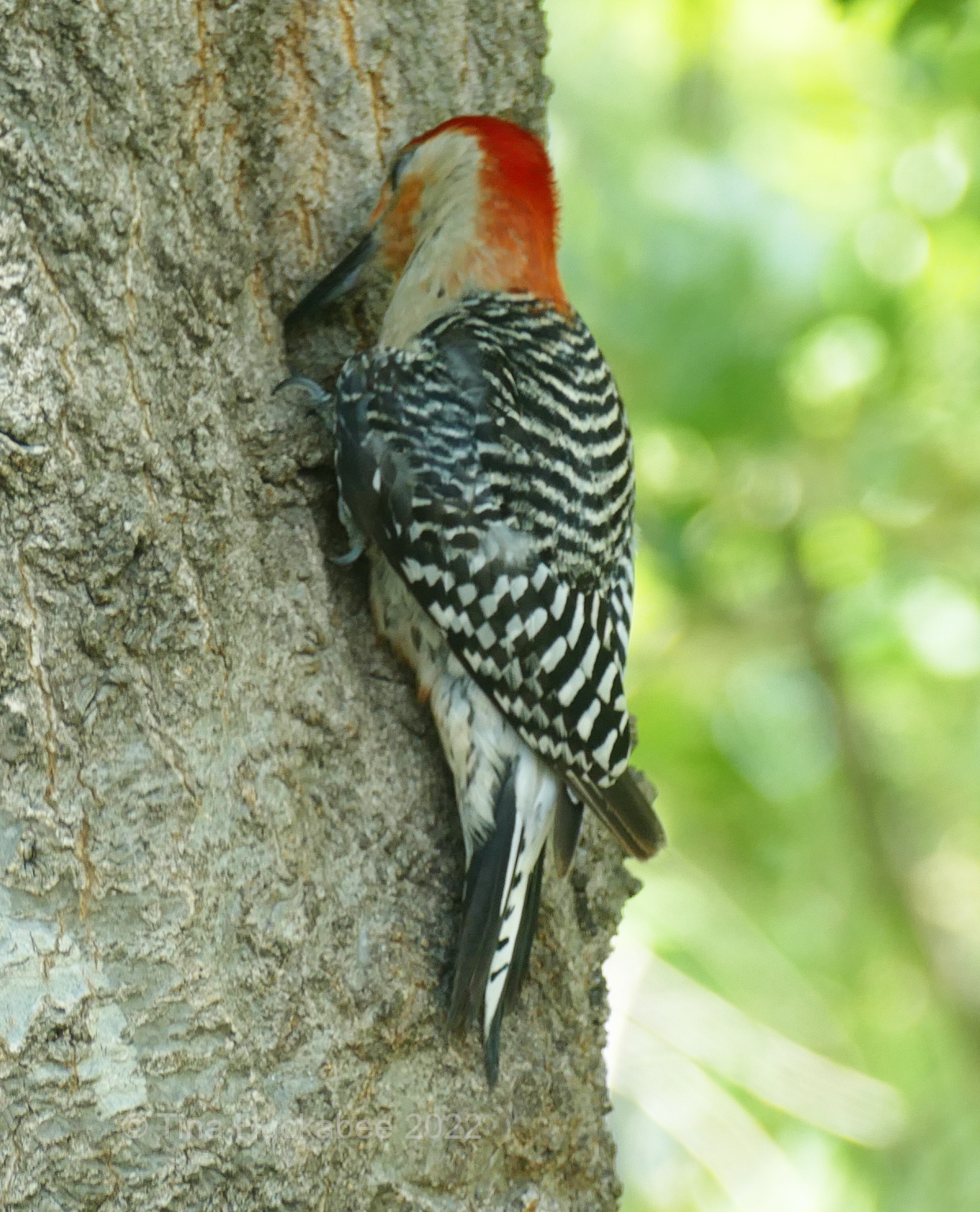
As I admired this handsome bird, another flit into the background–a male Red-bellied Woodpecker, Melanerpes carolinus. Last year, I observed a Dad Red-bellied stuffing peanuts and seeds in a hole in this oak tree. He then worked with his young offspring, presumably teaching how to cache food and retrieve it. I haven’t seen a ‘junior’ this year, but it doesn’t mean there isn’t one around, ready to leave the nest and learn the woodpecker ways.
Dad looks satisfied with his efforts!
With hopes that the heat abates sometime soon so that I can more comfortably spend time with my garden companions, bird watching will become more compelling. The hummingbirds will ramp up for their migration southward and other migrating birds will appear in my garden on the way to their winter digs.







 My Gardener Says...