A Lost Boat

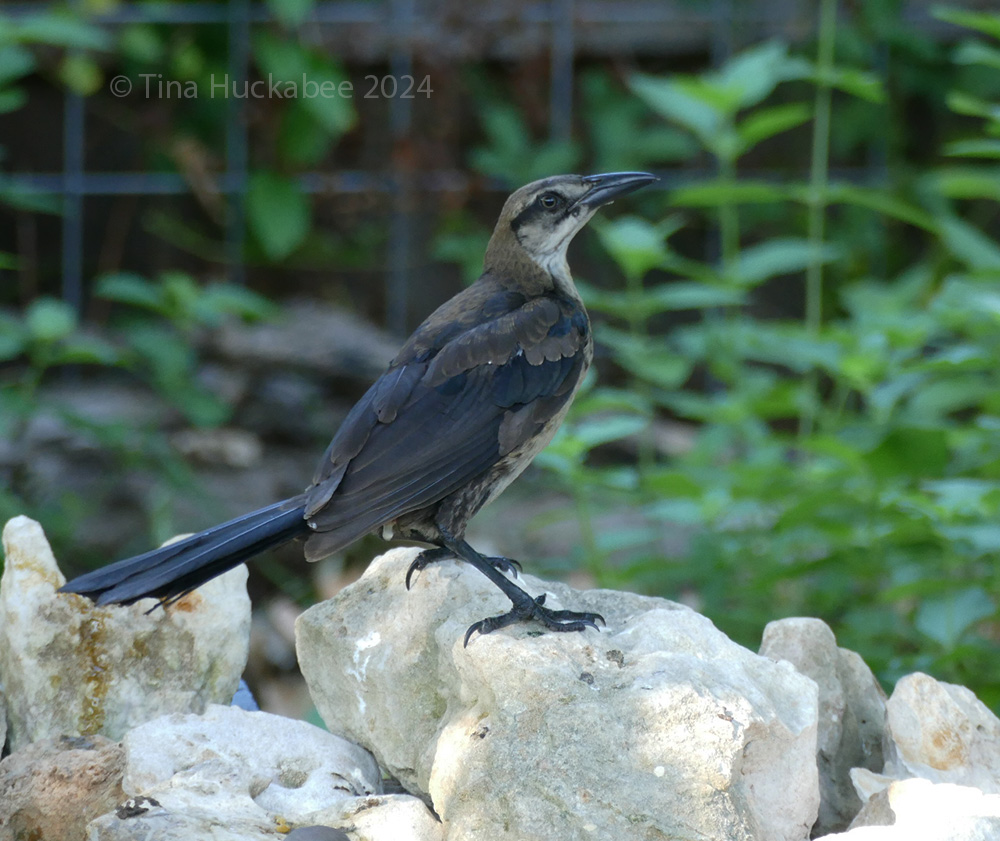
A new-to-me bird has visited the back garden this past week. I thought it kinda looked like a grackle, but it’s larger than either the Common Grackle or Great-tailed Grackle that are the usual grackle suspects here in Central Texas. Also, it has a mottled coloring, which I assume means either a juvenile or a female bird. It likes water. A lot. From the waterfall and bog of the pond, to the shallow bird baths nearby, this bird likes to bathe, spending most of its time splashing and dipping its impressive beak.

And look at those big feet!
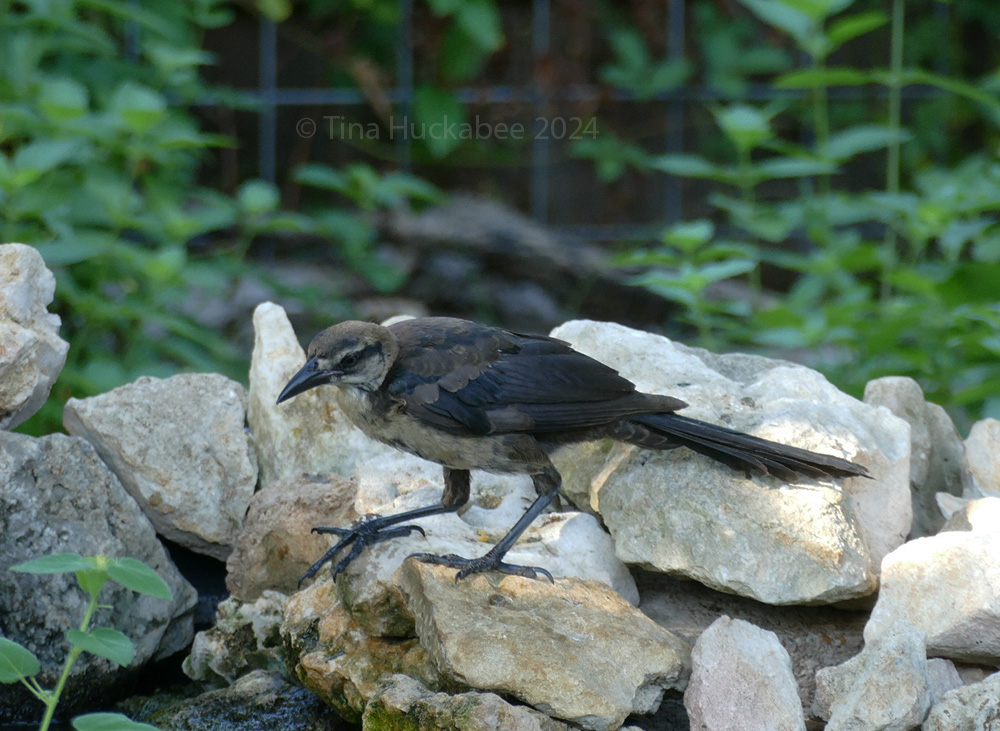
I checked my go-to resource for all about birds and Cornell Lab of Ornithology identifies this fella as a Boat-tailed Grackle, Quiscalus major; the Merlin app categorized this bird as rare for Central Texas.

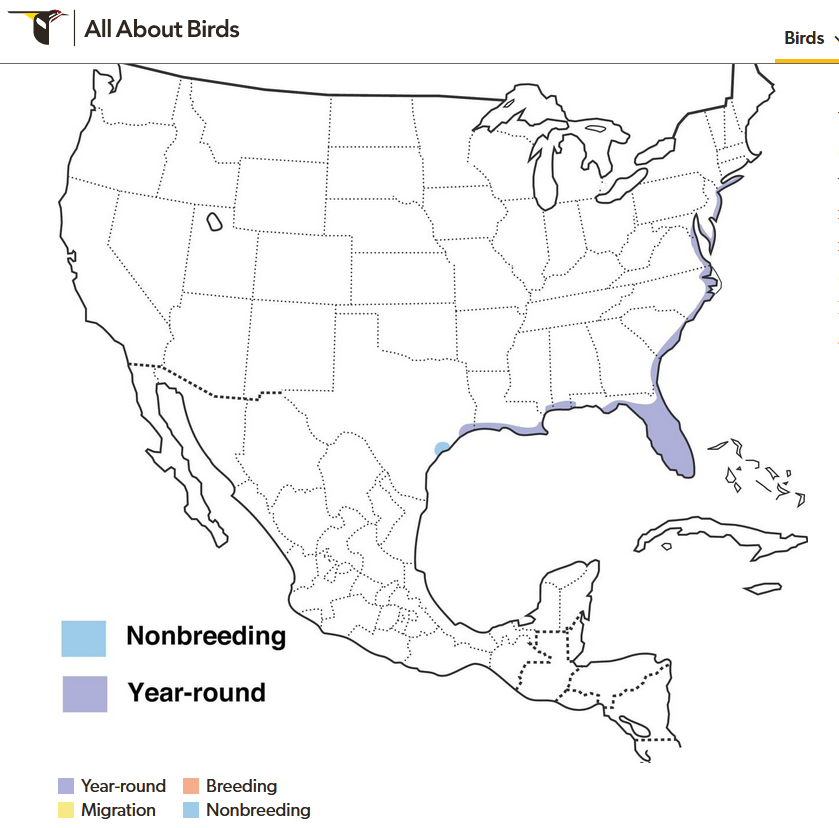
This is the Cornell map of Boat-tails’ range and it’s clear that this Boat is out of its normal stomping and bathing grounds. Along the east coast of Texas, some hundreds of miles east of my garden, one blob of blue indicates a non-breeding area for these birds, and nearby, a smidge of lavender, which is part of the Boats’ breeding range. Neither of these are anywhere near my pond!
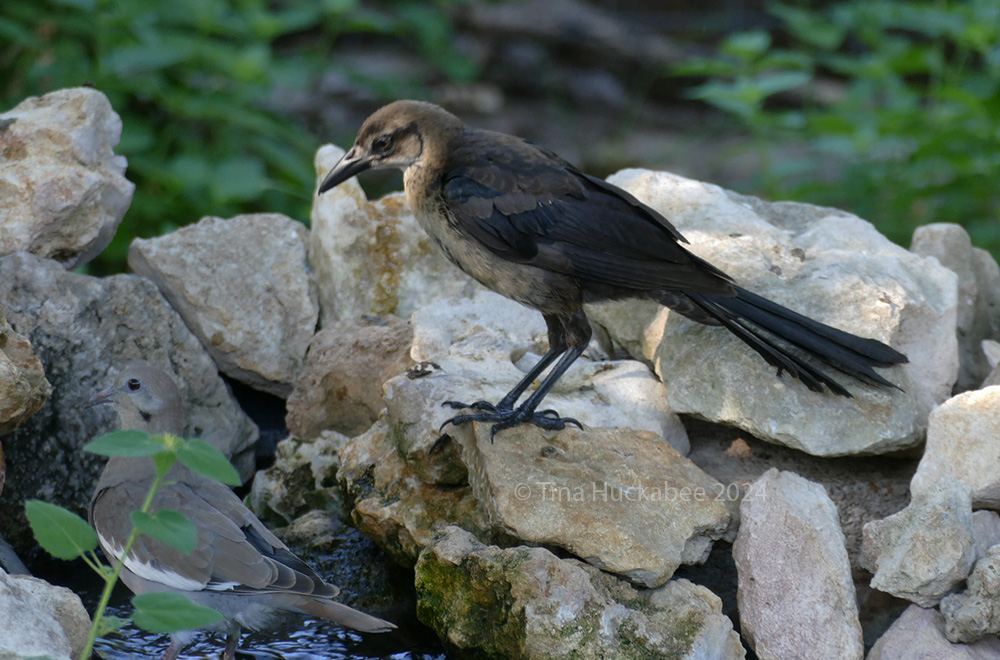
I wonder how and why this juvenile male Boat-tailed Grackle wandered so far away from home?

He’s a bit aggressive with other birds, particularly the White-winged Doves (who are a bit aggressive themselves), though that might just be the teenager in him. I like how he looking at the dove, who who managed to plop itself in the cooling spillway of the pond’s waterfall ahead of Mr. Boat.

If looks could kill…
A nice rear view shows the tail feathers, which are beginning their turn to rich, luscious black that he will carry as an adult. Adult Boat-tailed Grackles are handsome birds, particularly the males with their long, dramatic tails, glossy in sunshine. Females are smaller and copper colored, though sweet-looking in their own way.

While perhaps not the prettiest bird in the back garden at the moment, this juvenile male does exhibit a kind of presence that foreshadows his adult self. Bright-eyed, strong of beak and profile, these birds are good-sized songbirds.
Along with bathing, he has eaten safflower and sunflower seeds on the ground. Grackles are also known for their preference for garbage, though currently, I’m not offering that delicacy for him.

It was interesting to see him hanging out, but I hope he finds his way back home to a mate and community. Fly to the coast Mr. Boat–where your birds are!

What’s Black and White and Cute All Over?

Migration season is mostly done and in my garden, it was a meh event this spring. I observed very few of the usual suspects either around my pond or in the garden proper. Those who showed up, Summer Tanagers, Lincoln Sparrows, Common Yellowthroats, and Clay-colored Sparrows, were brief in their visits. Absent were the Painted Buntings, Nashville Warblers, White-crowned Sparrows, and Orioles. I didn’t see any of those and I miss them. I enjoyed a quick look at a Canada Warbler, which I haven’t seen in a few years.

My pond has always been the draw for weary migratory birds, but the front garden is in full bloom and seed production with quite a bit of bird activity, and that’s the place to be if you’re a bird or a birder. The front garden is also a much more challenging area in which to watch birds; there’s no window for me to hide behind and no good place to plant myself where I won’t disturb my feathery friends. I also suspect that the wet spring in Texas has allowed for plenty of water and food sources for the migrants, so fewer dipped into urban gardens.

During an outing at Travis County Audubon’s Baker Sanctuary, I was privileged for the first time to observe some endangered Golden-cheeked Warblers. Males, females, and fledglings put on a nice show for excited birders, the birds swooping around native trees, cameras and binoculars pointed upward to catch the winged things. I knew I wouldn’t be quick enough with my camera, so chose to observe and appreciate this rare sight. Central Texas is the only place where Golden-cheek warblers breed and their breeding areas are in very specific habitats. These are not common birds in backyard settings.

In recent weeks, my backyard birding has been focused on watching hungry, often noisy, fledglings who are out of the nest, but still learning from their parents. Most are in trees, squeaking, squawking, and flapping their wings, foliage obscuring baby birdie meal time. Occasionally, parent and chick visit the feeders together, like this mama and fledgling Downie Woodpecker, Dryobates pubescens, pair.

Baby is at the left of the photo, hanging on to the pole that holds the feeder. It looks like she’s already had some food, as she forgot to wipe her beak. As an aside, I’ve seen her land at the pole, then slide down, fluttering up to hold on to the pole, unable to maintain her grip. Learning where the food is and practicing methods for proficiently obtaining that food is all part of her learning process.

The young one flit to the feeder, where mama was ready with a peanut.

I watched these two for several days, then noticed the fledgling visiting the feeder on her own. She was reticent initially to land on the feeder, but eventually gained confidence–and peanuts–as she became successful in feeding herself. I’ve seen young Blue Jays, Northern Cardinals, Black-crested Titmice, and Carolina Chickadees in similar situations. It’s much harder to observe the fledglings while they’re in trees, but as they learn to feed at the feeders, it’s enjoyable to watch and cheer their learning progress.

I’ve heard and seen our fledgling Eastern Screech Owls, but only rarely. I think they’re still around, but their territory will widen as their hunting skills improve. Summer backyard birding will be watching the neighborhood birds, seeing the fledglings molt to their adult plumage, and anticipating the fall migratory birds.

Hanging by a Thread

As I wrapped up some necessary gardening chores early this morning, I saw a newly emerged Pipevine Swallowtail, Battus philenor, resting near its former home, the shell of its chrysalis.

I should have dropped the pruning shears, wiped the brow, and grabbed my camera, but I didn’t. By the time I remembered that there was a photo worth getting, the butterfly was off to its adult business: its wings dry, its proboscis unfurled for nectaring, and the search of a mate a keen objective.

Every day, I pass by this seedling where the caterpillar made its home for a few weeks; I never noticed it. The chrysalises are such small, unobtrusive things, it’s easy to miss them in the lush of the garden. I’m not a scorched earth pruner, but when it’s hot and humid and I’ve had just about enough for one morning, it’s sometimes easy to forget the garden’s purpose. I guess the chrysalis isn’t the only thing hanging by a thread.

I’ve seen a Pipevine flitting in the garden today; I’m glad it was up and out in the early morning, shedding its temporary home for the wider world.