I’m a proud and punctilious pollinator gardener. Even so, sometimes gardening goals are thwarted by circumstances well beyond pollinators’ needs and gardeners’ plans.
For years, I’ve grown passion vine in my garden. Early on, I grew a Purple passion flower, Passiflora incarnata, that my mother gave me. The original vine happily draped itself along a wooden fence, regularly attempting to clamber over perennial shrubs standing in its way. Over time and with increasing shade, the passion vine declined, but to this day and in their best imitation of unwanted weeds, strands of the plant continue to pop up underneath the shade of the large oak tree . The Gulf Fritillary butterflies, Agraulis vanillae and I know that these are not obnoxious weeds, but that the vine serves as a nursery and food source for the juvenile stages of the butterflies.
Some years ago, I planted another variety of passion vine, the Blue passion flower, Passiflora caerulea. It grew along a trellis which separates the back garden from the compost bin and garden work space. I enjoyed observing the blooms when they happened, but even more, I was entertained by the ebb and flow of a vine full of foliage, which hosted busy, hungry caterpillars who gobbled the vine to its skeleton state. I knew that the vine nurtured the development of a new generation of Gulf Fritillary butterflies and that knowledge more than compensated for the stripped, and let’s be honest here–temporarily unattractive–vine.
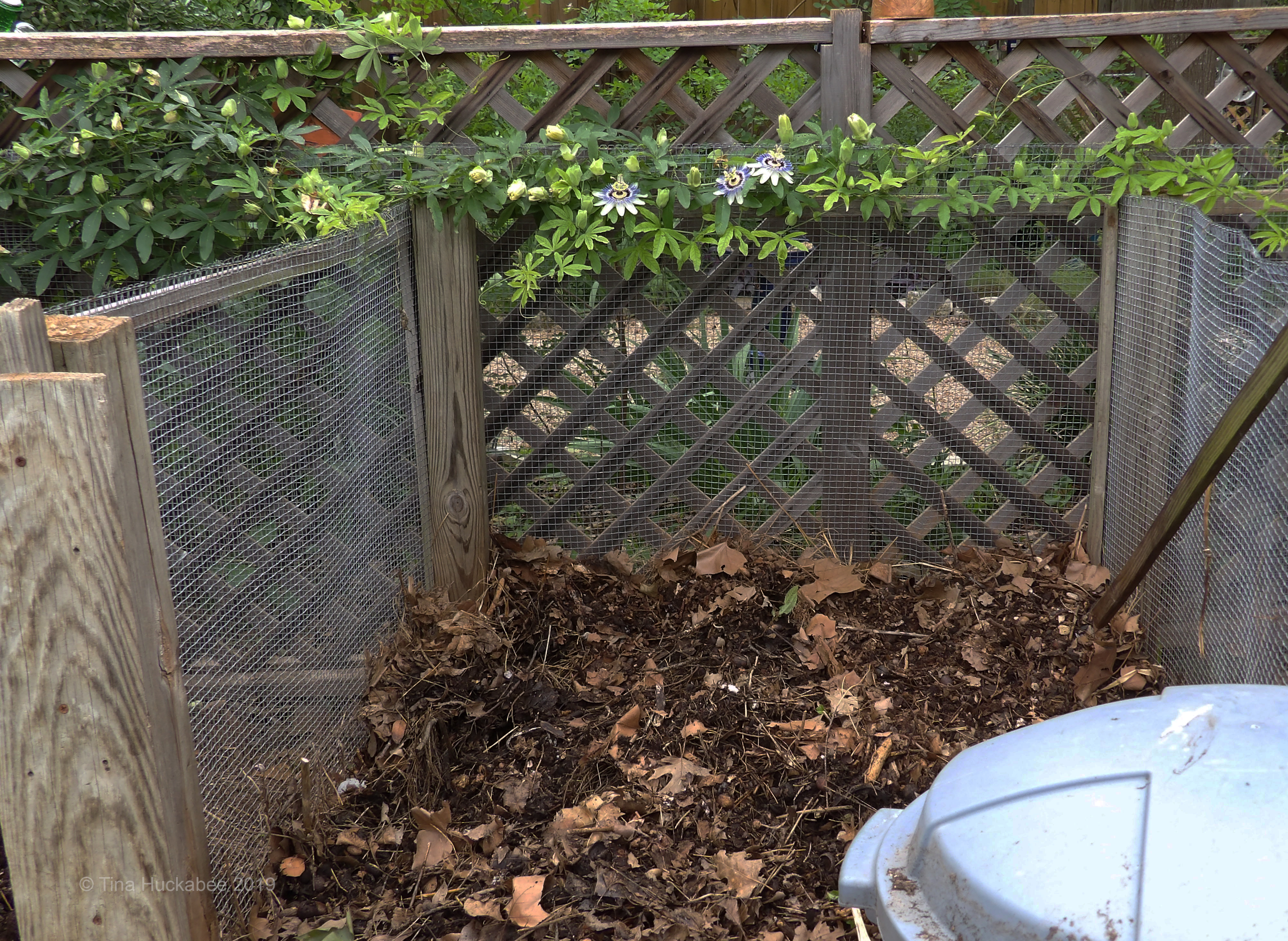
P. caerulea is evergreen during our milder winters, but dies to its roots when temperatures dip below 25°F for extended periods. The vine didn’t return after a couple of very hard freezes during the winter of 2016.
I purchased a new P. caerulea two years ago and planted in a different spot so my garden would continue to host Gulf Fritillary butterflies. Last year was the vine’s first year of growth and didn’t see many fritillaries around. I wasn’t particularly fussed about the lack of flying orange beauties because each year is different: some years there are scads of a particular insect, other years that insect might be scarce, but something else is plentiful. So nature goes.
Recently, this well-worn Gulf Fritillary flitted around the passion vine over the course of a couple of days.

She stopped at various points along the vine, curling her abdomen to oviposit, doing her bit to continue the species.

Do you see her lovely golden egg on the left side, toward the bottom left of the right side leaf?

I’ve seen a few caterpillars on the vine, good sized ones at that, but not many, and certainly not in numbers representative of the adult fritillary action around the vine.

Additionally, while there’s some foliage damage, there aren’t the number of munched leaves I would expect with a healthy crew of baby fritillaries feeding on the foliage.
So, what gives?
For a while, I was concerned that maybe I’d purchased a plant treated with the neonicotinoids. Neonicotinoids are pesticides toxic to insects and used in the agriculture industry to control insects considered pests. The neonicotinoid downside for pollinators is that butterfly and moth host plants with insecticide-fused foliage and flowers kill the insects reliant upon those host plants. Caterpillars (larvae) eat the foliage, ingest the poisons, and before the caterpillars morph to their adult stage, they die. The peril for pollinators becomes obvious when a landscape plant, promoted and sold to support the life cycle of a pollinator (egg, caterpillar, adult), carries an insecticide and delivers that insecticide to larvae. The larvae will never morph to adult pollinators.
I purchased the passion vine at a nursery whose products I trust and I recall asking whether the plant was grown with neonics; the answer was a firm ‘no’. As an aside, when I’ve purchased milkweed plants for monarchs, I always look for aphids on the leaves–and buy the plants with aphids. Aphids are fond of milkweed and while rendering the plant somewhat unattractive, their presence indicates a pesticide-free plant. Neonicotinoids are especially effective pesticides against aphids, so aphids serve as a good canary in the coal mine indicator of whether there is a deadly insecticide in the plant. When I see a milkweed plant with perfect foliage–no aphid in sight–I’m suspicious about the possibility of a neonicotinoid tainted milkweed and I don’t purchase it for my garden. Until fairly recently, the nursery trade used neonics in growing some plants, but with evidence of how the damaging the pesticides are to pollinators, many growers have ceased, or soon will, using these chemicals.
Even if–and it’s a big if–the passion vine I purchased was originally grown with neonics, the chemicals are probably depleted by now, or in such small quantities, that there is no real impact on the larval stage of fritillaries.
As I’ve observed the eggs laid by the adult fritillaries, I’ve also kept an eye on the rogue Purple passion vine “weeds” in my back garden. Interestingly, I haven’t seen any eggs or larvae on those passion vine bits either.
The plot thickens.
What also thickens is the caterpillar goo that I’ve seen on a couple of occasions on the passion vine. This glop of slime is all that remains of a good sized Gulf fritillary caterpillar. Clearly, this larva will never be an adult butterfly.

I haven’t found any fritillary chrysalises this summer, though they’re very good at camouflage and I’m not necessarily a keen cocoon sleuth.
Why am I observing so few late stage (larger) caterpillars and why are the fritillary larvae not evolving to chrysalis stage? Is there something–parasite or disease–preventing the full life cycle of the Gulf Fritillary butterflies in my garden? I’ve noticed lots of wasp activity, especially around the passion vine, and there are other insects which also parasitize and kill caterpillars, as well as a variety of viral diseases which kill butterfly larvae. Could it be that the early stages of caterpillar development are thwarted and others are nipped in later stages?
The truth is that I don’t know why there are adult Gulf Fritillaries in my garden, seemingly healthy and regularly laying eggs, but with few caterpillars developing, and so far, no observable chrysalises. In reading about Gulf Fritillary butterflies, I haven’t found anything similar to what I’m witnessing this summer with my vine and its butterfly buddies. The adult fritillaries I’ve seen are hatching and maturing somewhere, and then flitting to my garden. The cycle appears to glitch once they’re here.
In life–and in the garden–answers are not always clear and solutions sometime elusive. I’ll continue observing the Gulf Fritillary activity as time trundles on. I hope that I’m able to witness the Gulf Fritillaries return to their full cycle of life: mated adults, laid eggs, offspring nurtured and matured with consumed foliage, and a new generation of valuable pollinators in place.
For more information about neonicotinoids, check out these links:
Buying Bee-Friendly Plants: Neonicotinoid-Free Nurseries, Growers, and Seed Sources
Neonicotinoids and Bees, Xerces Society
EPA Cancels Registrations for 12 Neonicotinoid Pesticides, The Scientist
Do you have unsolved critter mysteries in your garden? Please share your wildlife happenings and remember to leave a link when you post here and happy wildlife gardening!






 My Gardener Says...