The Yellows

The fall yellows are out, brightening already sunny days, cheering the rare gloomy ones. One of the stalwart yellows is ZexmeniaWedelia acapulcensis var. hispida, and it’s blooming once more after its end of summer sabbatical. Pollinators are busy at the small blooms.

This Gray hairstreak rested from its flitting just long enough for me to capture it with the camera.  Occasionally, it shared flower space with honeybees and two different native bees.


The brightest of the bright are the flowers of Plateau goldeneyeViguiera dentata.

Goldeneye grow into unwieldy, floppy shrubs, more so if not pruned sometime in late summer.  I neglected to prune by half several that I grow, resulting in too large shrubs, some of which are now toppling over, heavy with yellow goodness. 

This one stands tall, a well-behaved daisy extravaganza.
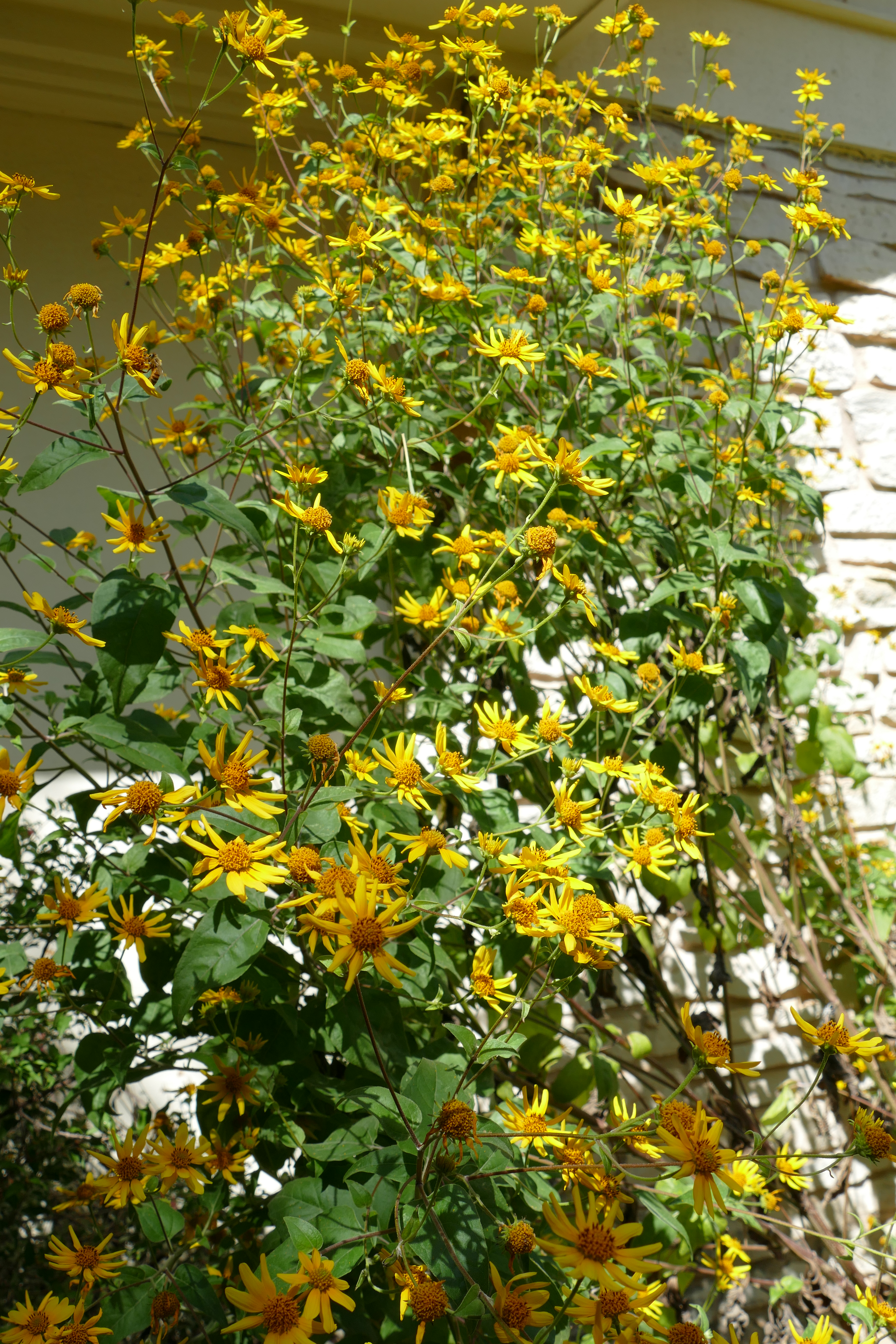
Multiple blazing blooms fill each shrub–top to bottom, inside and out.

Honeybees are all over the flowers and even finches are in on the buffet, as flowers fade and seeds appear.  Check out the orange pollen on this bee gal’s corbiculae, also known as pollen baskets, or in Tina-speak, pollen pantaloons.  The pollen pantaloons on this bee are the puffy orange pillows situated on either side of the bee.


A favorite fall flower of mine is the Texas Craglily, Echeandia texensis.

Not as brilliantly yellow as the other two perennials, this pretty produces somewhat muted yellow-orange, petite lilies.  It’s a showstopper, with the multiple flower stalks rising above the soft, green foliage.

I didn’t get any photos with pollinators, but I have noticed that it’s mostly the native bees and smaller butterflies which visit these belled beauties.
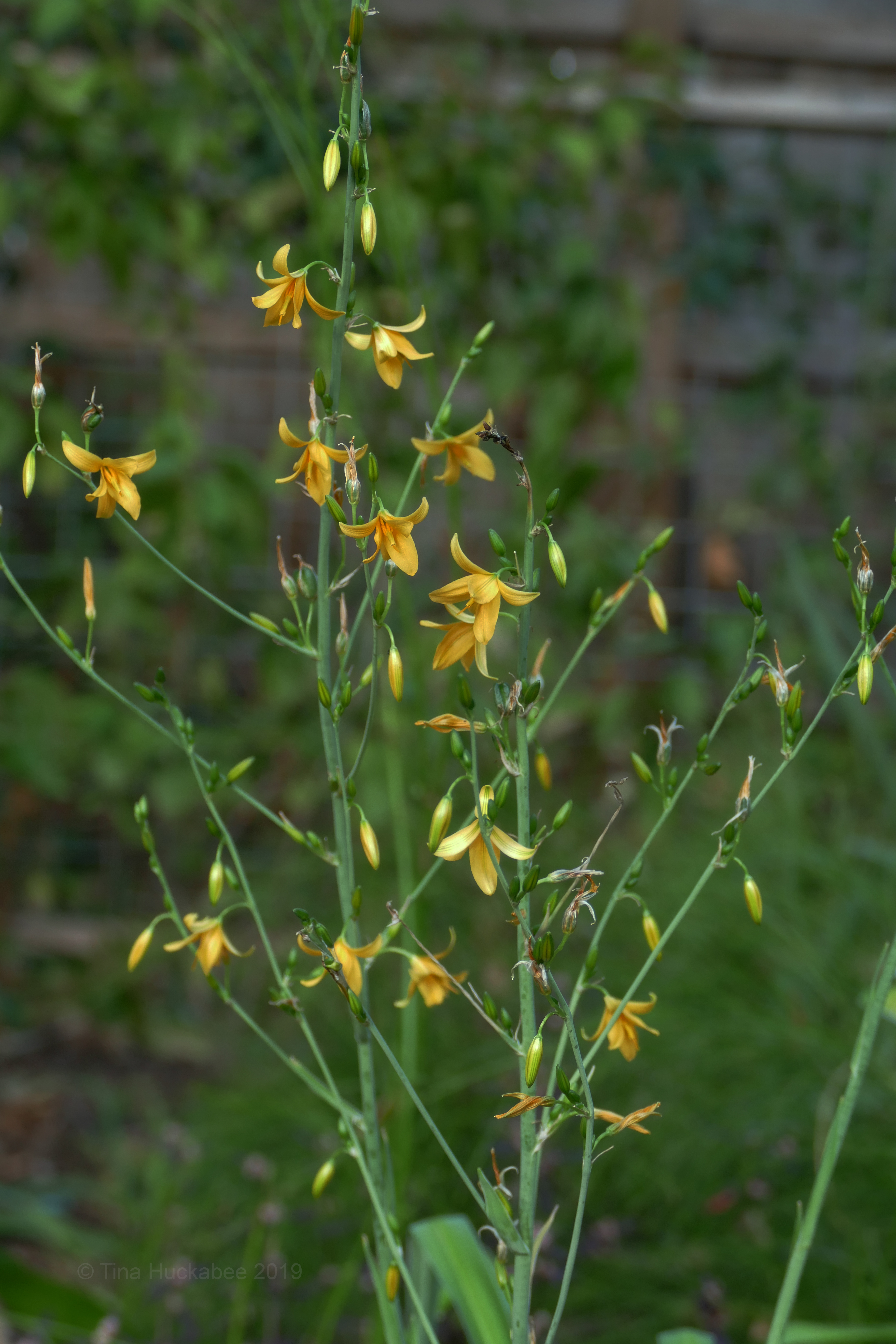
Craglilies are graceful, remarkably delicate looking, but truly tough Texas perennials.  Fleshy grass-like foliage appears late in spring and remains green and fresh during summer;  slender stalks reach skyward during September and October.  The stalks are dotted with lovely little lilies.  In my garden, the Craglilies are happy in a spot with some direct sun, but are shaded during the hottest time of the day.

Rain or shine, each of these yellows are fab fall flowers.  With an abundance of cheer for the gardener, they also provide late season sustenance for pollinators and seeds for wintering birds.

Bloody Red

With scary Halloween just around the corner, I don’t want to alarm readers with the Bloody Red title.  Rest assured, it doesn’t indicate gory events ahead, but instead, something bright and cheery–and bloody red.

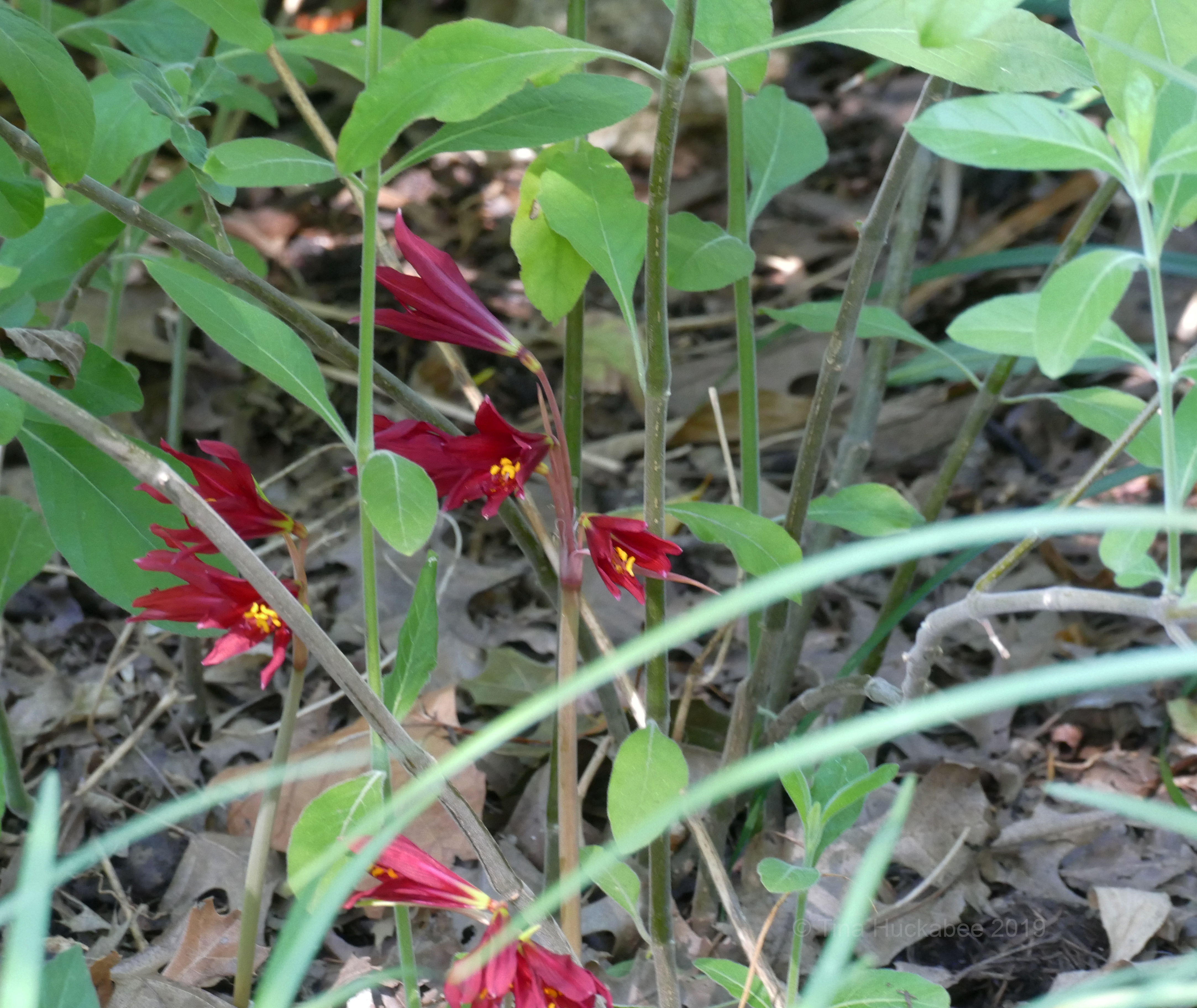
Oxblood lilies, Rhodophiala bifida, are naturalized autumn bulb beauties scattered throughout Central Texas. The plants originated from Argentina and Uruguay and were introduced to Texas by German immigrant and botanist, Peter Henry Oberwetter, who settled in Texas during the mid-1800s.  He collected plants, gardened, and bequeathed following Texas gardeners a legacy of brilliance.  Scott Ogden, in his book Garden Bulbs for the South, writes that Oberwetter made both Oxblood lilies and the Texas native Rain lilies, Cooperia pedunculata, available for the budding nursery industry.

The first fall rains which typically occur in late August and September–those soakers tasked with breaking the summer heat and drought–give permission for Oxblood’s fleshy stems to stretch up and out from the buried-in-the-soil bulbs, seemingly overnight.  In the next days buds appear, with gorgeous crimson flowers to follow.

My Oxbloods were a little late this year owing to our hellish hot and dry September, but they’ve arrived with the dribbles of October rain.  Pops of scarlet look at me! flowers are peeking out from underneath and up alongside, other plants.

The little crew in the above photo will need transplanting to another spot, or perhaps, to several spots, because they’re currently snuggled underneath a shrub that will become denser with time.  The Oxbloods will eventually be overgrown and disappear–and I don’t want that, do I?

I’ll mark the spot with a stake so that next spring I remember to dig up the bulbs and transplant them to a new place in the garden.  After the Oxblood flowers fade, green, grassy foliage replaces the blooms and stalks, and that foliage remains evergreen for winter.  At some point in spring (that I never notice until too late) the foliage disappears.  If I don’t mark the spot in the next months, by spring the foliage will have vanished and I won’t recall exactly where the bulbs are located.  Been there, done that.

Why not dig up the bulbs now?  An Oxblood truism is that it’s best not to transfer bulbs until the foliage has faded so that the plant completes its natural cycle.  That said, I have been guilty of moving Oxblood bulbs just after they bloomed.  The Oxblood world did not come to a crashing end, though I can’t remember if blooms happened the following fall.  My guess?  Probably there were no blooms until the following year. Plants whose life cycles are disrupted, sulk, and then get their revenge by refusing to bloom.

 Because I am able and I know it’s the right thing to do, I’ll be a fastidious, rule-following gardener, staking precisely and transplant appropriately.

The bloom period of individual Oxbloods isn’t long–just a few days each–but with a number of these bulbs planted throughout my gardens, the blooming is staggered over several weeks, providing a lovely splash-of-scarlet show and welcomed fall color.

Boasting of a bit of Texas (botanical) history and bloody beautiful Oxbloods, I’m joining today with Anna and her Wednesday Vignette.   Check out her beautiful Flutter and Hum for musings of various sorts.


They Have Arrived

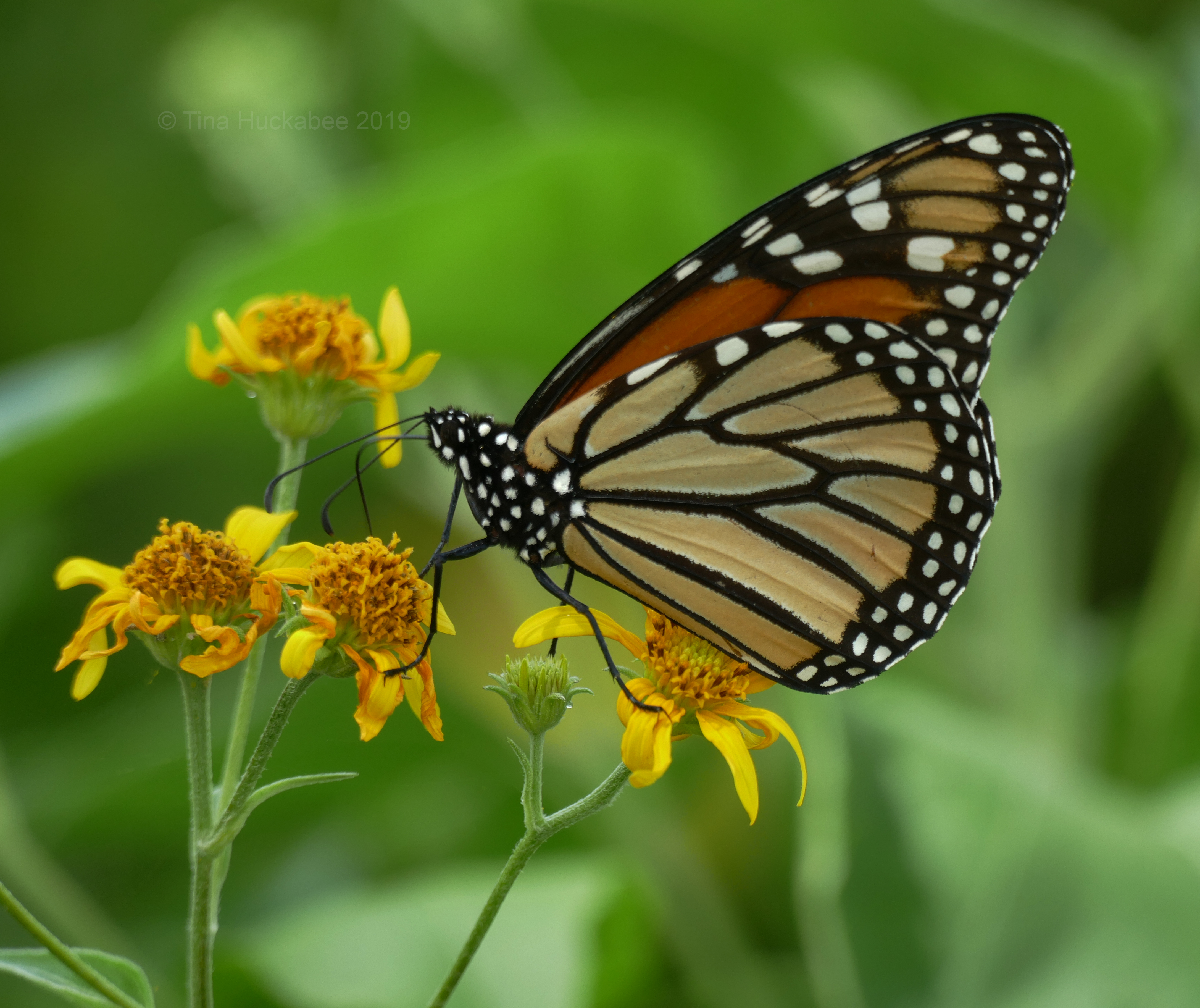
They’re back.  The Monarch butterflies, Danaus plexippus, are now wafting through Central Texas, orange and black wings gracefully flit against the Texas sun before alighting at blooming plants for nourishment, sustaining their long flight, continuing their annual life cycle.

Like so many of us, Monarchs face an uncertain future:  climate change, deforestation in Mexico, overuse of pesticides and herbicides in urban gardening and commercial farming in the United States are just some of the challenges to a viable population of these insects.

I am joyful at the first Monarch sighting in spring and then again, in autumn.  Currently, my garden offers a diversity of flowering plants–native and nonnative–in which the butterflies nectar from before they move southward toward their winter home.  In autumn, it’s all about providing blooming flowers for these hungry, hungry butterflies.

In spring, the availability of milkweed (Monarchs’ host plant) is paramount for the hungry, hungry caterpillars.

Female Monarch on Frostweed (Verbesina virginica)

This generation of adults are those last born in the northern parts of the United States and Canada and are now headed to Mexico.

Female Monarch on Plateau goldeneye (Viguiera dentata)

Once these remarkable insects arrive at their destination, they will gather in dramatic clusters by the millions, high up in the Oyamel fir forests of the Sierra Madre Mountains in Mexico. The unique situation offers cold temperatures and high humidity during the winter–the evolved perfect environment for Monarchs’ winter rest.

Male Monarch on Frostweed. The two black marks located on the hind wings, plus thinner black webbing indicate a male.

The adults who overwinter in Mexico are those who will return through Texas (the major migration pathway) next March, laying eggs on a variety of native milkweed plants.  That first (or is it the last?) generation begins the life cycle all over again: adults mate, females lay eggs, the adults then die.  Eggs hatch, caterpillars eat the milkweed, morph to the next generation, the flights resume.  The ancient rhythm continues in leap-frog fashion, northward through spring and into summer.

Female Monarch on Skyflower (Datura erecta)

At some point in August, six generations later, because of a change in light and through a magnetic pull that the Monarchs have responded to for eons, the last set of adults turn southward and begin their 2000 mile journey toward the Mexican mountain firs which await winged occupation.

Stopping briefly as they migrate to Mexico, Monarchs are enjoying a respite in my garden; the first of many arrived a couple of days ago.

I am an appreciative witness to this natural event.

I’m joining today with Anna and her Wednesday Vignette.   Check out her beautiful Flutter and Hum for musings of various sorts.