It’s a Kind of Magic

I took this photo of a (probably) female Black-chinned HummingbirdArchilochus alexandri, several weeks ago.  She was guarding a stand of blooming Turk’s cap, Malvaviscus arboreus var. drummondii, with all vigor and spunk.  That’s the hummingbird way, after all:  tough and territorial, they fight with one another for the pick of nectar sources, and in this particular case and as it’s so late in the season, I’m certain she was preparing for her flight south, her fueling for migration a requirement for survival.

I doubt if the British rock band, Queen, had bird migration in mind with their 1986 song, It’s a Kind of Magic, but I find the pull and drive for migration an enigma, something so astonishing that it’s hard to fathom, and something pulsing with a kind of magic.
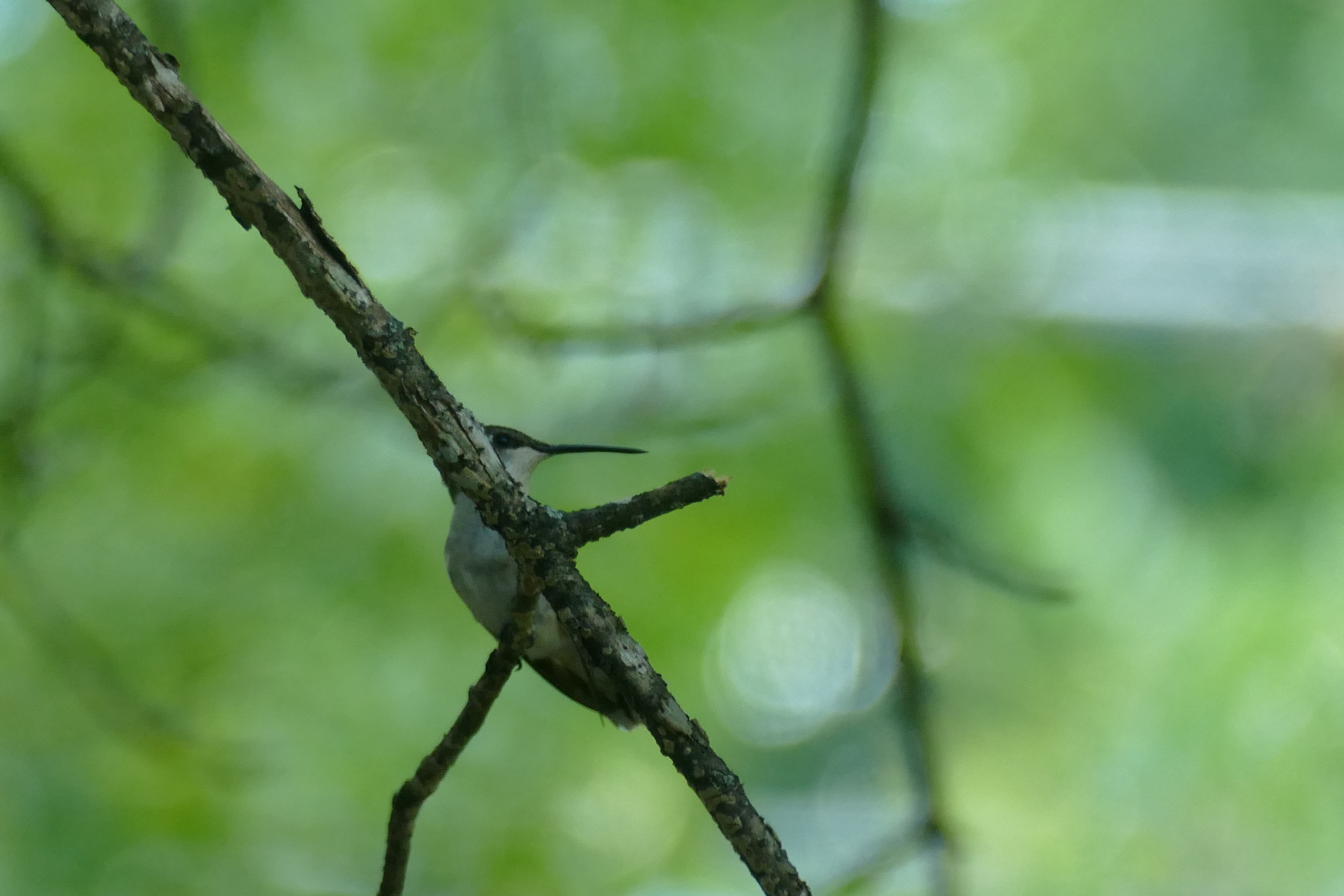
Nevertheless, here in my oak tree, resting between sips of Turk’s cap nectar and bullies of other hummingbirds, she looks quiet and contemplative.  I wonder–does she think about her journey, or is she driven purely by instinct, by forces beyond her control?

Does she plan her trip? Does she fear it?

The Turk’s cap blooms are done for the year, the hummingbird gone; I hope my garden provided what she and her kind needed. Please, may she return in spring to guard next season’s blooms.

Appreciative for the gifts a garden bestows, I’m joining today with Anna and her Wednesday Vignette.   Check out her beautiful Flutter and Hum for musings of various sorts.

*The Queen video is comprised of work from visual artists worldwide, submitted to accompany the song.  It’s a fun one!*

Iddy Biddy Swarm

A couple of weeks ago, early in the evening, I was closing the blinds at a window when I spotted this.

An iddy-biddy, teeny-weeny honeybee swarm.

That’s a first.  In addition to its being a very late swarm of the season–not unprecedented, but odd–it’s just so…tiny.  And, isn’t it kind of cute?

Do you see it?  It hangs from a branch just above and to the right of our hive, Buzz.

Those honeybees!  Every year, they throw something new at us.  Each beekeeping season, there’s some event, some honeybee goings-on, some mischievous behavior,  that we haven’t witnessed or experienced previously with our honeybees.  In baseball parlance (in honor of the World Series–go Astros!), there’s always a curve-ball with our bees.

The girls like to keep us on our toes.

I didn’t see the swarm as they formed and flew to the tree, but had seen buzzy activity (more than normal) around Buzz, so I must assume the little swarm was from that hive.  There are cast swarms that are subsequent swarms after a main, spring swarm.  Maybe this was a cast swarm? I’m still not certain.  There was a major swarm in the spring which situated itself for a few days in the oak tree above the hives, then moved on somewhere else.  I also know that both hives produced their own queens after the established queen died, or was killed due to its weakness. You can read about that here.  But a mini-swarm? Never, ever have I seen that one before.

A day or two later, the tree bees made their way back down to Buzz (some hung out on Woody) and over the course of a few hours, a honeybee battle ensued.  By the next morning, there was a pile of dead bees on the ground at Buzz’s feet.

Sheesh, honeybees are tough ladies!

In our recent hive checks, we noticed that both Buzz (especially) and Woody (less so) were packed with full frames of honey.  We contemplated whether we should take one or two honey filled frames from the second (top) brood box of Buzz and add new frames for the bees to comb out and the queen to lay more eggs.  This remedy would also relieve the honey bound issues.

And so we did.  More about that soon…


The Yellows

The fall yellows are out, brightening already sunny days, cheering the rare gloomy ones. One of the stalwart yellows is ZexmeniaWedelia acapulcensis var. hispida, and it’s blooming once more after its end of summer sabbatical. Pollinators are busy at the small blooms.

This Gray hairstreak rested from its flitting just long enough for me to capture it with the camera.  Occasionally, it shared flower space with honeybees and two different native bees.


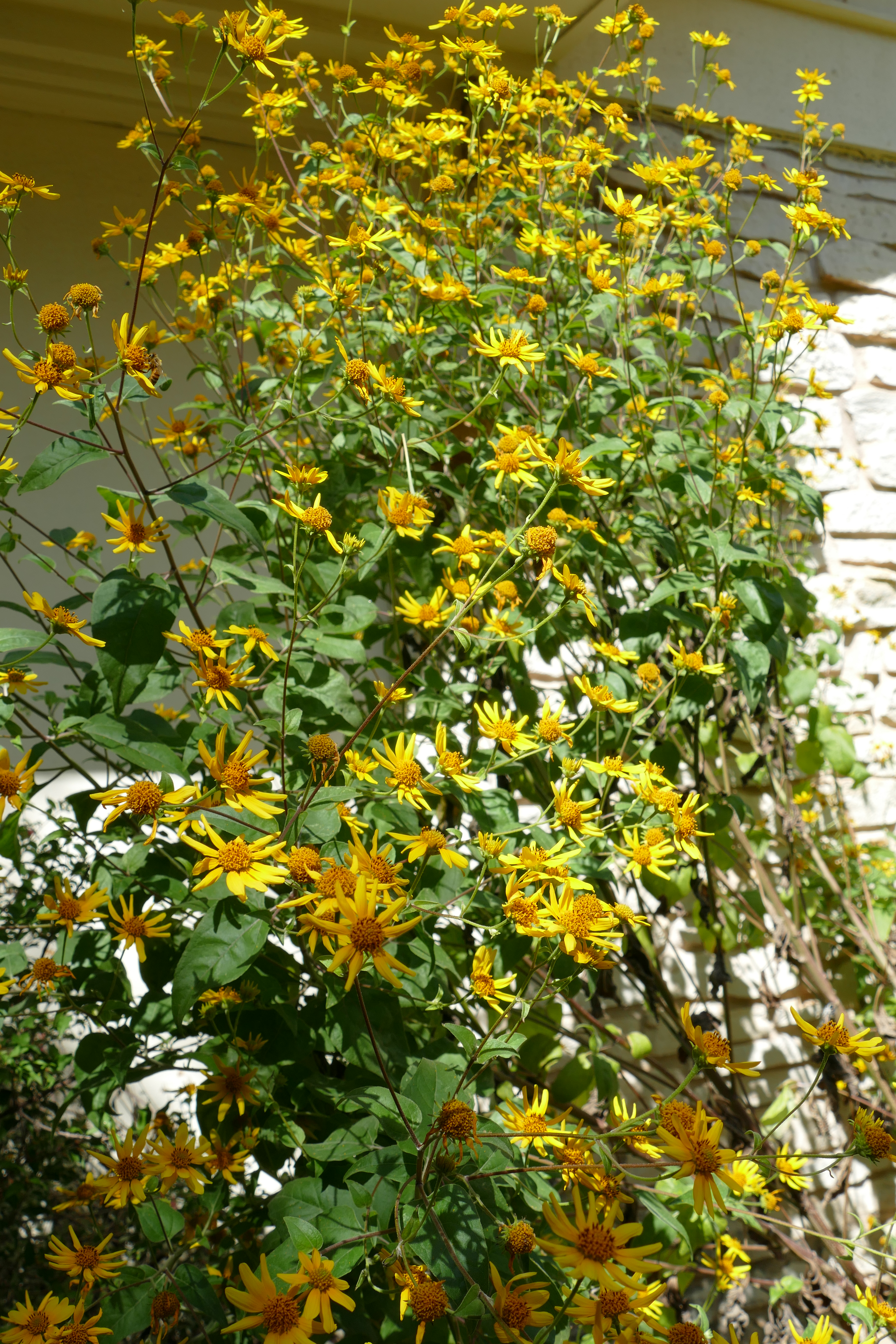
The brightest of the bright are the flowers of Plateau goldeneyeViguiera dentata.

Goldeneye grow into unwieldy, floppy shrubs, more so if not pruned sometime in late summer.  I neglected to prune by half several that I grow, resulting in too large shrubs, some of which are now toppling over, heavy with yellow goodness. 

This one stands tall, a well-behaved daisy extravaganza.

Multiple blazing blooms fill each shrub–top to bottom, inside and out.

Honeybees are all over the flowers and even finches are in on the buffet, as flowers fade and seeds appear.  Check out the orange pollen on this bee gal’s corbiculae, also known as pollen baskets, or in Tina-speak, pollen pantaloons.  The pollen pantaloons on this bee are the puffy orange pillows situated on either side of the bee.


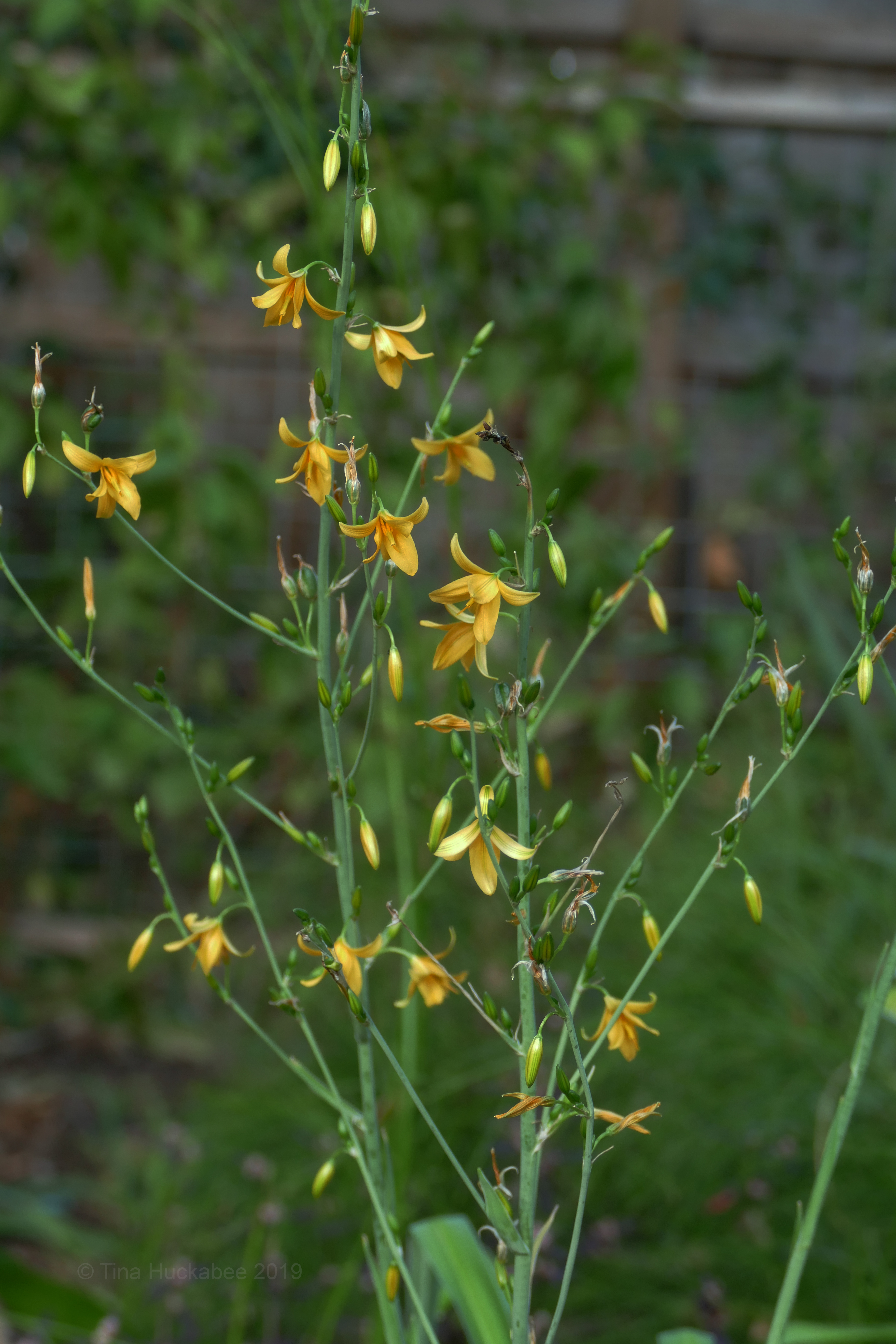
A favorite fall flower of mine is the Texas Craglily, Echeandia texensis.

Not as brilliantly yellow as the other two perennials, this pretty produces somewhat muted yellow-orange, petite lilies.  It’s a showstopper, with the multiple flower stalks rising above the soft, green foliage.

I didn’t get any photos with pollinators, but I have noticed that it’s mostly the native bees and smaller butterflies which visit these belled beauties.

Craglilies are graceful, remarkably delicate looking, but truly tough Texas perennials.  Fleshy grass-like foliage appears late in spring and remains green and fresh during summer;  slender stalks reach skyward during September and October.  The stalks are dotted with lovely little lilies.  In my garden, the Craglilies are happy in a spot with some direct sun, but are shaded during the hottest time of the day.

Rain or shine, each of these yellows are fab fall flowers.  With an abundance of cheer for the gardener, they also provide late season sustenance for pollinators and seeds for wintering birds.