Doing Its Job

As is typical for December here in Central Texas, our roller-coaster weather has delivered a couple of light freezes, but also record warm temperatures.   Native plants and their companion critters have evolved to roll with that coaster, continuing the blooming and the pollinating actions well into late autumn.

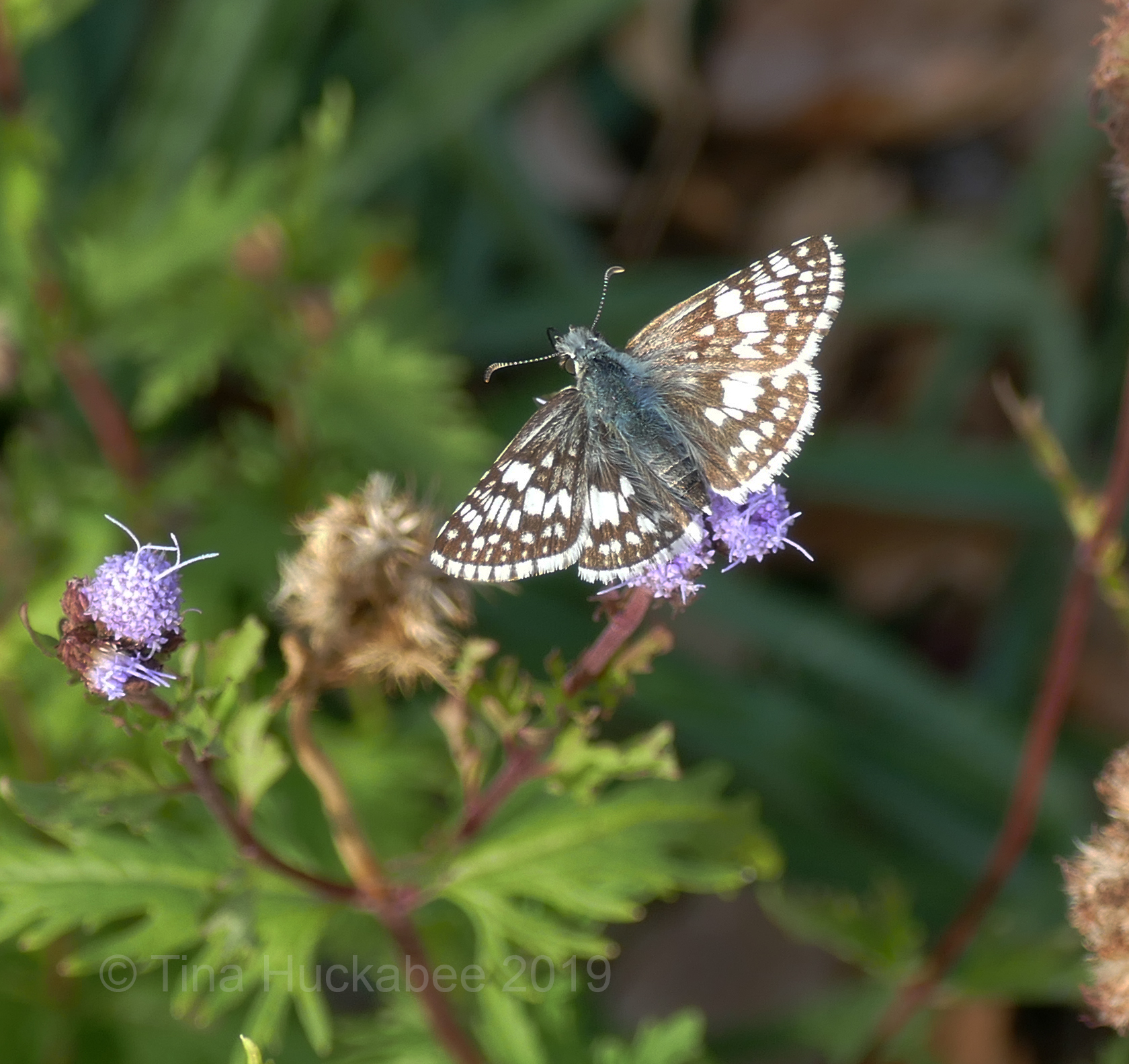
On a windy afternoon, I watched this tiny Common Checkered Skipper, Pyrgus communis, flit near to the ground while visiting the remaining open blue blossoms of Gregg’s MistflowerConoclinium greggii, and sometimes alighting on the driveway, wings spread to catch the rays of the sun.

This particular mistflower is a relatively new addition to my garden.  Gregg’s has grown in my back garden and there are still sprigs which pop up, but with increasing shade,  those individual mistflower stems are growing less and blooming only sporadically with each passing season.  I was determined to find a place in my shady garden to grow Gregg’s Mistflower and with some rearrangement of the garden furniture, I opened a spot in my front garden for the perennial groundcover, alongside the driveway and adjacent to the street, where full sun and reflective heat will be a boon to this tough, lovely native Texas plant.

Gregg’s Mistflower is a powerhouse pollinator plant.  All sorts of butterflies, big and small, colorful and plain, love this sweet-nectared pretty.  The original Gregg’s in my back garden–a passalong plant from a friend–blooms a paler blue flower and with brighter green foliage.  This new plant–purchased from my favorite local nursery–sports deeper blue-purple blooms and a richer green foliage. I bought a new plant because I didn’t want to transplant the sprigs, with their bits of root, from the back garden so close to winter and possible killing frosts.  Those stems of plant-with-roots might have survived winter, but I didn’t want to take the chance on their succumbing to a freeze, delaying growing Gregg’s in the front garden.  The gallon pot of Gregg’s Mistflower will go dormant with a hard freeze, but its full, lush root system will allow the perennial to reemerge with strength in spring, ready for a new year of blossoms and food for bees and butterflies.

Despite the strong breezes, the Common Checkered-Skipper seemed besotted with its choice of meal.  The host plants of this skipper species are several in the Malvaceae family, but adults nectar from a wider variety of blooms, including many in the Asteraceae family–like Gregg’s Mistflower.

The mistflower produces gorgeous blue-purple blooms. Spent blooms are a warm, toasty color.

The skipper’s blue-tinged hairy topside suggests a male; female Common Checkered Skippers’ hairy parts are black. This fella spent a minute or two on the fuzzy blooms it visited, working each in full before moving on.   I was pleased (and surprised!) with these shots, as the wind was challenging to catching the skipper in something other than a blur.
Native plants and their critter companions are vital for a healthy environment.  In this garden vignette, both the bloom and the butterfly were hard at work, doing their jobs:  the blooms, providing nutrients and sustenance for the insect; the insect, partaking from a food source for its own benefit, but also, providing the impetus for the production of more mistflower by the action of pollination.  The plant and its insect continue a time-honored cycle and add beauty to the world.

And isn’t that what gardening is all about?


Will He or Won’t He?: Wildlife Wednesday, December 2019

Tis the season to owl watch and at least one owl is providing a bit of show.  I’ve heard occasional territorial trilling and have seen an Eastern Screech Owl, Megascops asio, in our nest box on and off for a few weeks now.  At this writing, it’s been about 6 days since Mr. Screech snoozed during the day in Tina’s Owl Chateau, but owls are like that: they show up, hang out, disappear and don’t say where they’re going, and then, maybe, show up again.

Who knows what an owl thinks or how he makes plans?

This is the Screech, resting comfortably in the nest box one afternoon.   What you see is his back and tail feathers.

As well as seeing him peek out at the hole of the nest box (sorry, no photo of that as I didn’t want to spook him!) and observing his daily rests through the lens of the owl camera, I spied him in my neighbor’s tree last week.

Isn’t he cute as he glares menacingly at me?  On second glance, maybe it’s more of an annoyed stare.

Tree holes are the traditional, preferred spot for owl nesting, though in all my years, I’ve never seen an owl in this particular hole (just feet from my front garden) and wouldn’t have observed him, except for the alarm calls of Blue Jays, Carolina Chickadees, and Lesser Goldfinches.  Our nest box, which resides in a tree in our back garden, has attracted Eastern Screech Owls for most of the past decade, with varying degrees of familial owl production.  The nest box is a human affectation for attracting the darling predators and it’s mostly proved a snugly spot for chick rearing.

I don’t know with certainty that this tree owl is the same as my nest box owl, but it’s probably the same little dude. Am I sure it’s a male?  More than likely, because it’s typically the male who checks out suitable digs as he works to attract a mate for the upcoming breeding season.

Our owl luck has lacked in the past three years, so while I’m tickled that there is at least one Eastern Screech Owl experimenting with the local real estate market, it’s no guarantee of a settling down, a mating pair, or the creating and caring for chicks.  Time will tell and wildlife gardener patience is a must.

Appreciative of the quirks of wildlife, I’m marking Wildlife Wednesday and also joining in with Anna and her Wednesday Vignette.   Check out her beautiful Flutter and Hum for musings of various sorts.

Crowning Glory

Winter Texans have arrived in Central Texas.  They’re here in the form of seed and insect munching, delightfully feather-sporting, song-singing warblers.  I’m in warbler-watching nirvana because these birds are such pretties: tiny and colorful, sweet-faced and dulcet-voiced, warbler-watching provides great entertainment as I observe their bird business in the trees, at the perennials, and along the pathways.

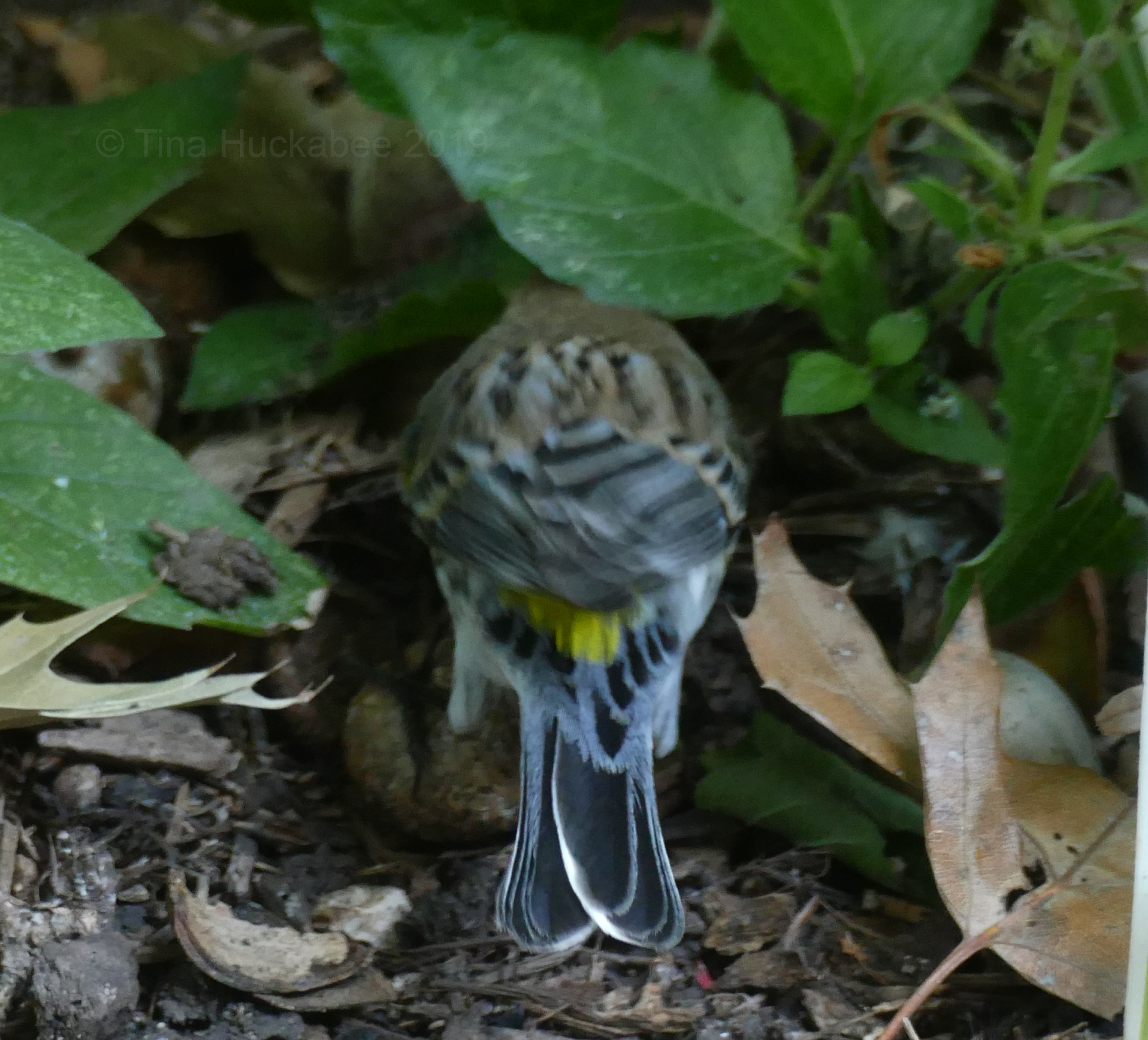
I’m enjoying suet and peanuts visits from a female Orange-crowned Warbler, Leiothlypis celata, and recently, this little Yellow-rumped Warbler, Setophaga coronata, has joined in with some autumn/winter decoration of my garden.

Her cheery cap is charming and that flash of sunshine under the wings?  It positively swoon worthy!  Her little face is darling, too.

But(t) the crowning glory is–drum roll–her yellow bum.

Affectionately called Butter Butts  by avid birders, Yellow-rumped warblers’ show of their lemony rear-ends appears when they’re flying and when hunting for seeds on the ground.

Celebrating cute bird bums, I’m happy to join with Anna and her Wednesday Vignette–check out other colorful butts or perhaps less bottom-centric garden musings for today.