With each of this winter’s freezes and accompanying ice, I’ve assumed that the plants which create ice sculptures are done with their frosty shows until next winter. But with the latest round of mid-to-low 20s, more curling and swirling appeared, some on plants thus far unmolested by the cold, and some on plants that previously froze and were pruned.
These cut stems are all that remain of a mature Frostweed, Verbesina virginica, that I pruned in late January after an earlier hard freeze. Clearly though, there was just enough stem material left for the ice fairies to appear.
I hoped that the Mexican Honeysuckle, Justicia spicigera, would be spared a killing freeze this year and remain green. That hope was dashed Thursday and Friday as temperatures dipped to the lowest point so far this year. The wilted mush of the once bright green foliage will require pruning to the ground for each of these shrubs in my garden to make room for new growth.
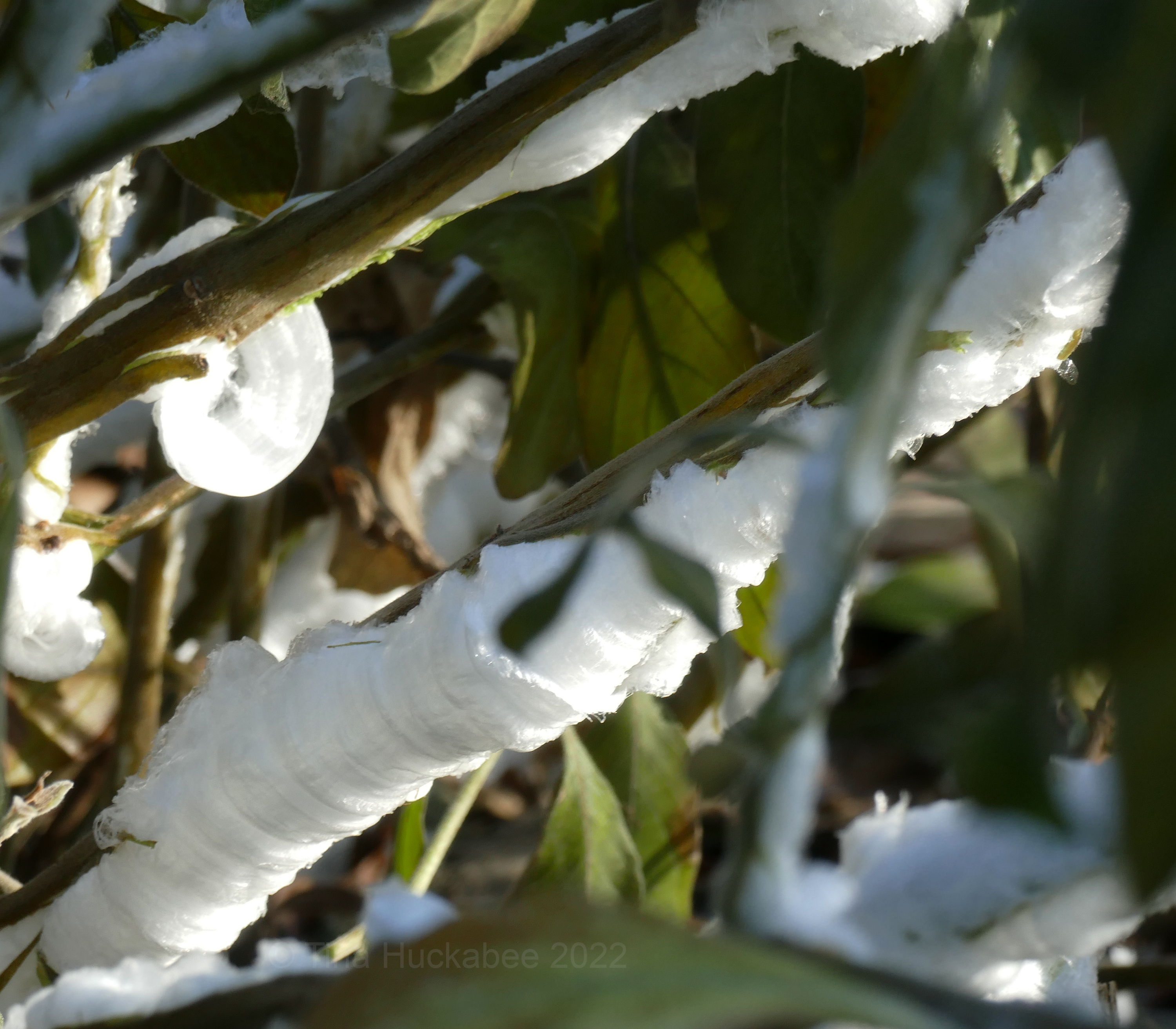
On the positive side, the water-turned-ice-crystals in the stems created some lovely, if short-lived ice art.
I’m now in full winter perennial pruning mode. When I prune herbaceous perennials I typically leave 8 to 10 inches of stems, sometimes more. On the remains of a Plateau Goldeneye, Viguiera dentata, the ice formed, puff pastry style.
I think the January/February 2022 plant ice capades has completed its final act. After the upcoming year of growth, it’ll be interesting to see if early freezes in November/December bring an encore performance.
Last August, a native plants and wildlife gardening buddy, Deb, sent to me a link to a New York Times article which I’d somehow missed in my own subscription. Written by author and podcaster, Margaret Roach, the article profiles landscape architect Darrel Morrison’s gardening philosophy, developed throughout his remarkable career. Roach also highlights Morrison’s knitting of ecological diversity with traditional design elements, as well as a thorough description of his “four principles” of landscape design.
The first principle involves planting for “natural diversity” to lessen water and chemical use in the garden and to mitigate climate change. Morrison suggests that a variety of plants native to a region offers the best outcome to achieve a diverse garden. Avoiding the use of invasive non-native plants is paramount to achieve this goal.
Morrison’s second principle promotes an “experientially rich” garden, one with active pollinators and other wildlife. Additionally, gardening with plants of differing structures and growth habits adds life and movement, enriching the garden community.
The third principle is that a garden should reflect where it is. My garden in Austin, Texas should look, feel, and smell different than one situated in Eugene, Oregon or Madison, Wisconsin. A garden should be of its geographic place.
Morrison’s final principle is that of change. A garden should be “dynamic,” changing with time and seasons, which is opposite to the typical American outdoor space of expanse of green turf and pruned shrubs which looks the same year-round. I like Morrison’s quote on this particular point: “Painting is two-dimensional; architecture and sculpture, three-dimensional,” he said. “But landscapes are four-dimensional, with time being the fourth dimension.” Seasonal change, and planning for it, is important.
March/April blooming Gulf Coast Penstemon, Penstemon tenuis.Gulf Coast Penstemon in late July-August: dried seed heads that have opened and spread seeds; leaf stalks turned burgundy with summer’s heat and drought. At the base, evergreen rosettes keep the plants’ place in the garden.
In my garden, I’ve mostly followed these principles, though I’ve never assigned names to them. While I am a native plant enthusiast and grow quite a few, I’m not a purist. Most of my non-native choices are Mexican, as these are all excellent pollinator plants and hardy in Central Texas. Other non-natives provide for structural and/or evergreen appeal. Some non-natives have an emotional connection, as they originally came from my parents’ garden or as pass-along plants from friends.
Early on in this garden adventure, I developed some guiding principles of my own. I knew that I wanted a garden of mostly native plants, chosen for their beauty, resilience, and variety. I also wanted plants that require little supplemental irrigation. In short order, I recognized that planting natives meant that a whole new world of wildlife soon followed. In brief: if you plant them, they will come. My garden is alive with movement and life–in the air that surrounds and on the ground that supports.
For me, design elements are least important, though I recognize that it’s a more attractive garden if there is a conscious blend of evergreen and deciduous, a deliberate pairing of soft form with structure, and glorious pops of color throughout the year, changing with light, time, and temperature. Whimsical or elegant, non-plant items also enhance a garden and add a human touch. Pathways allow experience of the garden.
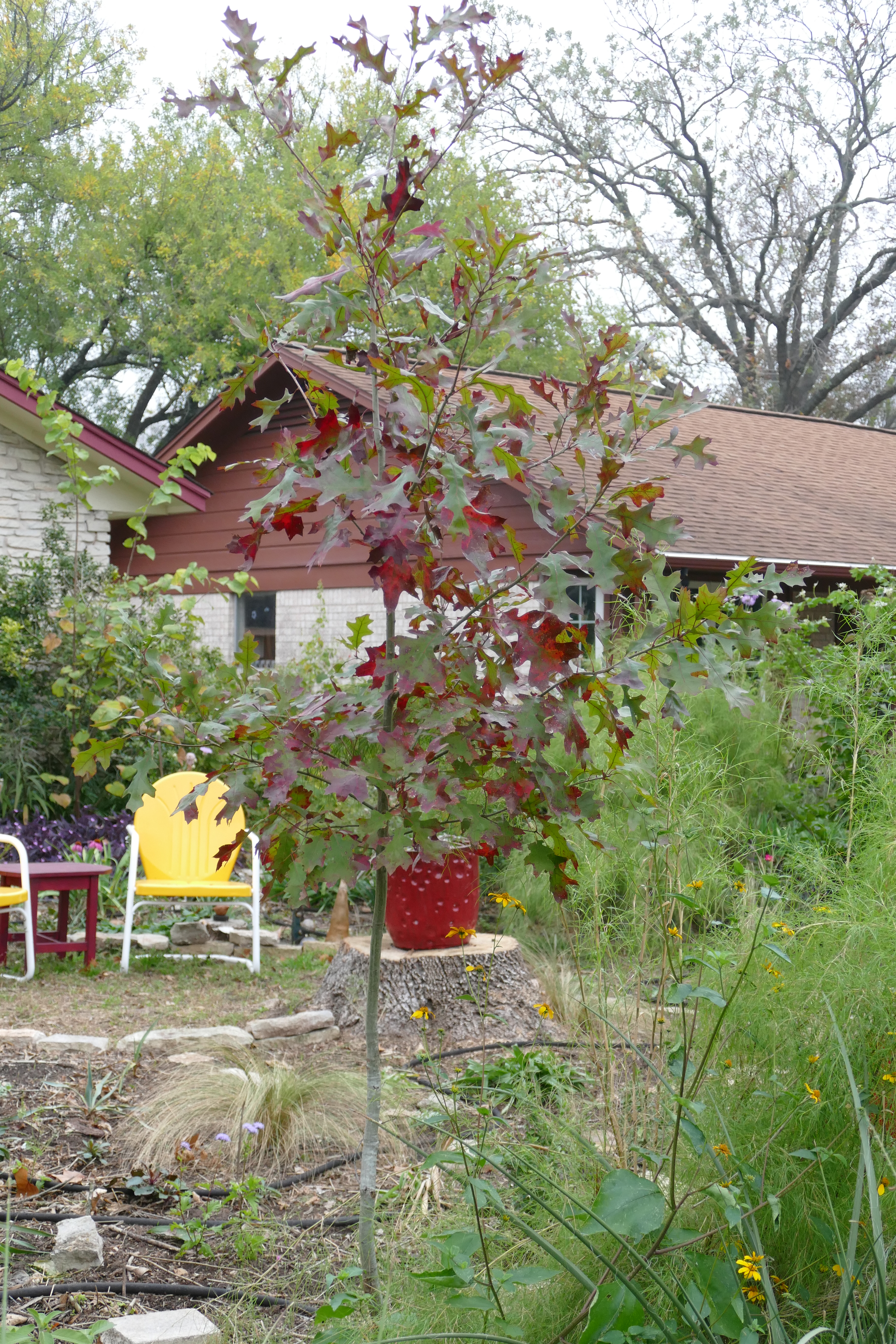
My garden is different today than it was five years ago, ten years ago, twenty years ago. The back garden was once full-sun, but oaks grew it to mostly shade. With recent freezer-burned thinning of the trees’ foliage, it now straddles those two extremes. The front garden was shady; going forward, the Texas sun will shine on it for years to come, until a small oak tree grows up and eventually casts its form over the garden.
Garden creation requires experimentation and mistakes are part of that process. Garden creation also requires patience and observation.
At the conclusion of the linked article about Darrell Morrison, the author recounts a story about how he began his work on the Lady Bird Johnson Wildflower Center in Austin:
For Mr. Morrison, ever the willing pupil, every place has something we can learn from, especially the natural areas.
In 1992, when he was engaged by the Lady Bird Johnson Wildflower Center, nine miles from downtown Austin, he borrowed a sleeping bag and tent, and spent the first night camped out on the 42-acre site.
“It’s a good thing to do: to see the sun go down, smell the smells of the junipers, hear the morning birdsong,” he said. “I think you do know the place better for it.”
Apparently, that got the former first lady’s attention. Years later, Mrs. Johnson was receiving guests at a reception. She had suffered a stroke and her eyesight was diminished, so when Mr. Morrison reached the head of the line, he reintroduced himself: “You may remember me, Mrs. Johnson. I’m Darrel Morrison.”
“Of course, I remember you, Darrel,” she replied. “I tell all my friends how you slept on the land.”
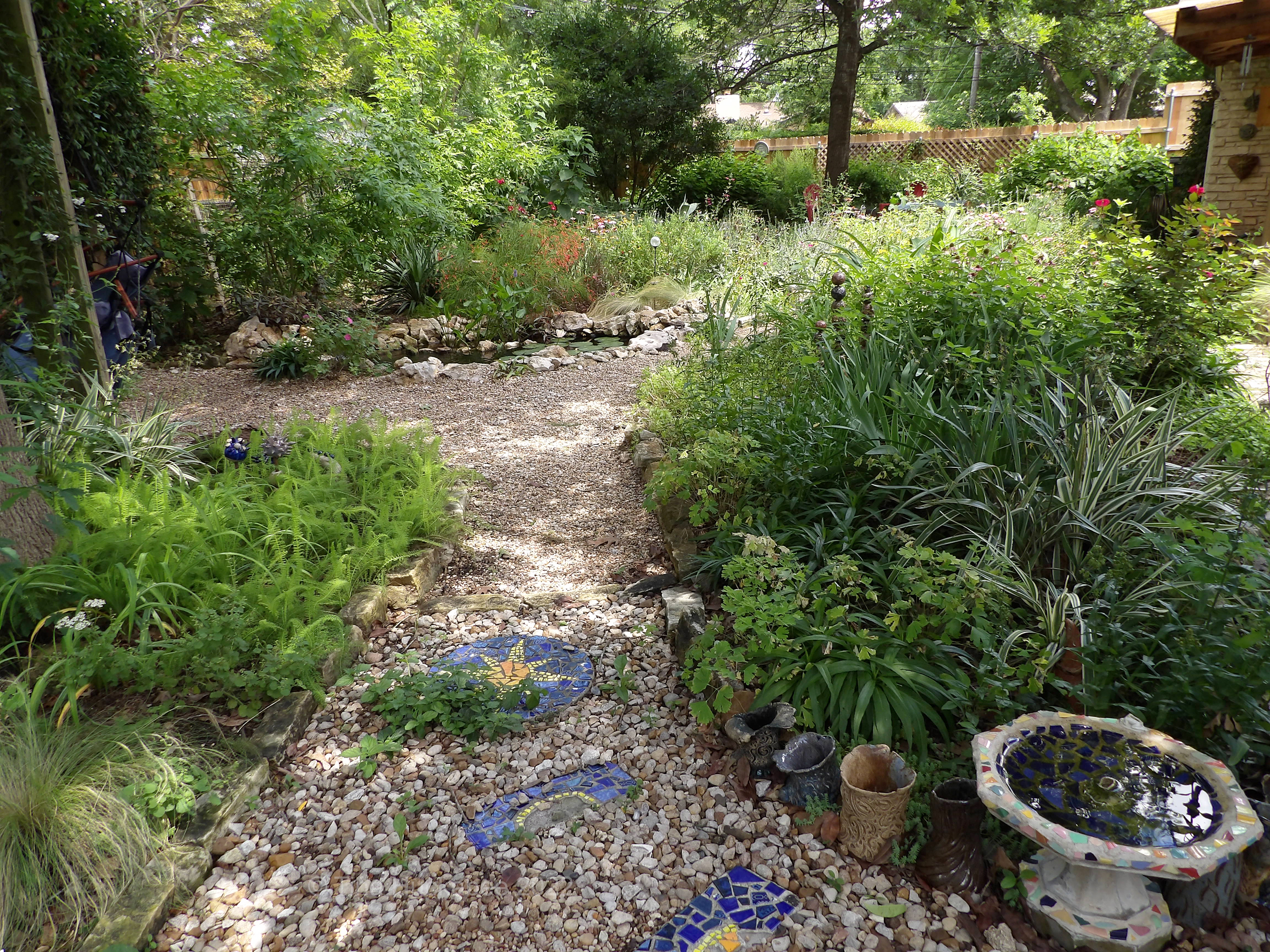
I garden in a moderately sized urban lot in a large city. While I’ve lived here a long time, I’ve never slept on my land, aside from some lazy afternoon snoozes in the swing chairs. But I have watched this space. I’ve observed the sun and shade, seen sunrises and sets, and felt the breezes. I’ve noticed the insects and birds, and lived with plants from seed to compost. The garden and I have experienced triple digit temperatures, snow and ice, and floods and drought.
A Yellow-rumped Warbler, Setophaga coronata, has finally arrived in my winter garden!
Most years I begin observing winter warblers in November. This migratory season, I’ve spied a zippy, hard-to-photograph Ruby-crowned Kinglet (a few times) and a female Orange-crowned Warbler, who is now making daily visits to the the peanut and suet feeders. But the Yellow-rumps have been tardy, or maybe just elusive.
This Yellow-rumped is a Myrtle Warbler, easily identified because of its white throat. During breeding and nesting season, Myrtle Warblers tend to spend time East and North, the Audubon species hangs out in the West. In winter, I’ve seen both species in my garden, but usually, it’s the Myrtle that is more common. I also think this one is a fella bird, given the little dab of yellow on his head. He isn’t yet in breeding colors, so perhaps he’s a hatch year dude, not quite out of his juvenile stage?
But he does rock that yellow rump. What a cute bum!
I’m glad to see the yellow rump flashing in the trees and hope that, instead of being a flash-in-the trees, he’s a daily visitor and that some of his butter-butt buddies will join him.







 My Gardener Says...