On roughly an every-other-year-schedule, Cedar Waxwings show up in droves during January, remaining in Central Texas through March. On a daily basis they visit my pond by the dozens, even hundreds. Gregarious birds, it’s rare to see a waxwing alone. They’re always with their besties, swooping in to bathe and drink, rushing upwards to safety when some unknown event triggers their (apparently very sensitive) flight mechanisms.
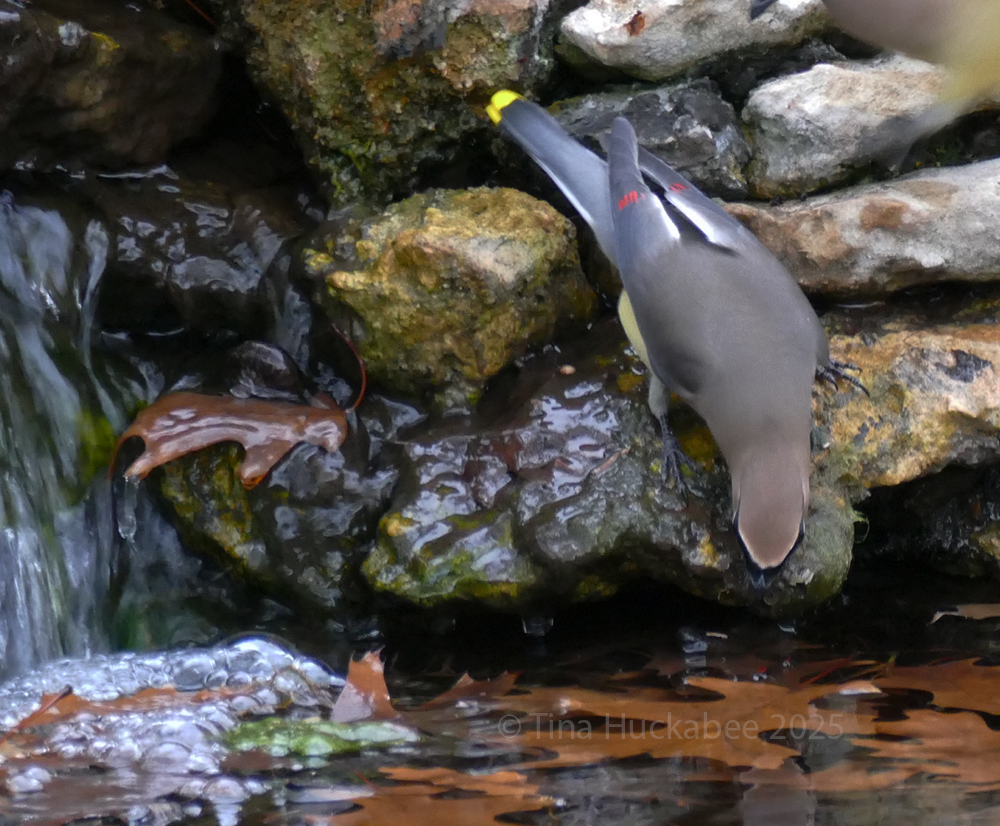
This Cedar Waxwing, Bombycilla cedrorum stayed still long enough for me to observe and snap a photo, posing to show its good side.
It dipped and drank, gracefully exhibiting the signature waxwing yellow tail feather ends and red wing feather tips. Cedar Waxwings are stunningly beautiful birds.
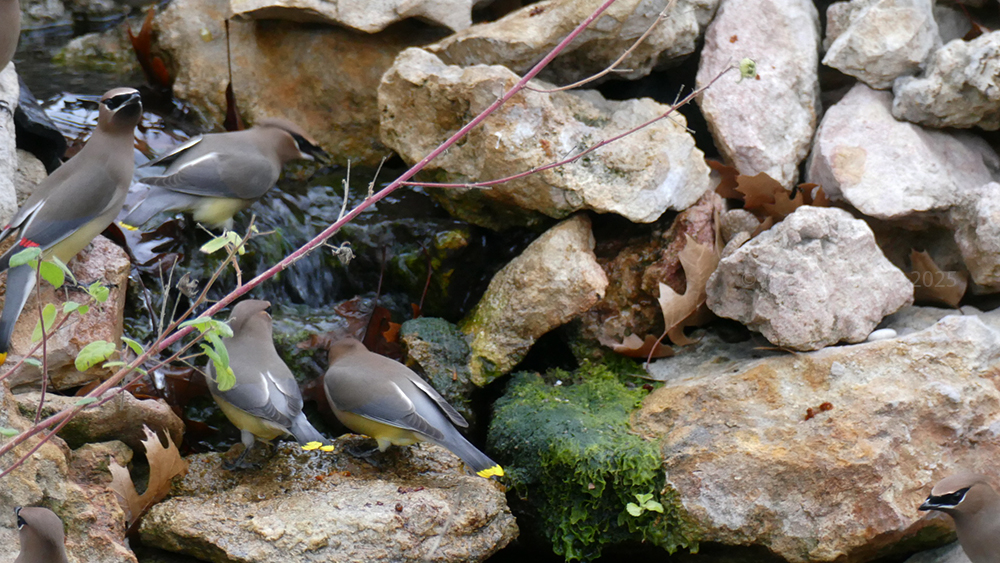
I felt lucky to grab a photo with a small group, none of which fuzzily winged from the frame just as I snapped the shot. Thanks, birds!
While the waxwings certainly enjoy the pond and visit it throughout their winter vacation here in Austin, the most important thing they get from my garden are fruits from various plants. This waxwing is aiming to pluck a ripe, red berry from my Possumhaw Holly, Ilex decidua.
I couldn’t get a perfect photo of a waxwing eating a berry; either the berry was smeary or the bird was smeary. At least in this shot, it’s obvious that the bird is leaning down for a bite of berry.
Within an afternoon or two, these cheeky birds, with assists from a couple of Blue Jays and Mockingbirds, stripped the tree of its fruits for this year. I’m sorry to see the pretty berries no longer decorating the tree, but I’m pleased that my garden provided a favorite food for these lovely birds. There are still red fruits on my non-native Burford Holly, Ilex cornuta, but one day soon, the waxwing mob will descend for a communal nosh and those berries will be history–just like the Possumhaw fruits.
I love seeing these charming birds in my garden, with one exception: berry bird poop on the patio, chairs, plants, rocks…
Bee Daddy and I have been honeybee keeping for 10 years, hiving our first bees in April 2014, which you can read about here. As 2024 winds down and another year of beekeeping is under our veil, a review of this year’s bee happenings is in order. I’ve learned much about bees in this last decade; they keep us on our toes with their fascinating and complex biology, each season teaching (or confounding) us with behaviors we haven’t previously seen from them.
Last February, an odd little swarm hung out on our Mountain Laurel tree for about a week. As I recall, the weather was cold and wet and the small swarm just stayed–until they were gone. We’ll never know if they went back to the original hive or if they moved on to find a new home. If they chose the latter, it’s doubtful that the small group survived, but I always hope for the best. In October, I wrote about our hive, Woody, which absconded in June, leaving us with only one very productive hive, Bo Peep.
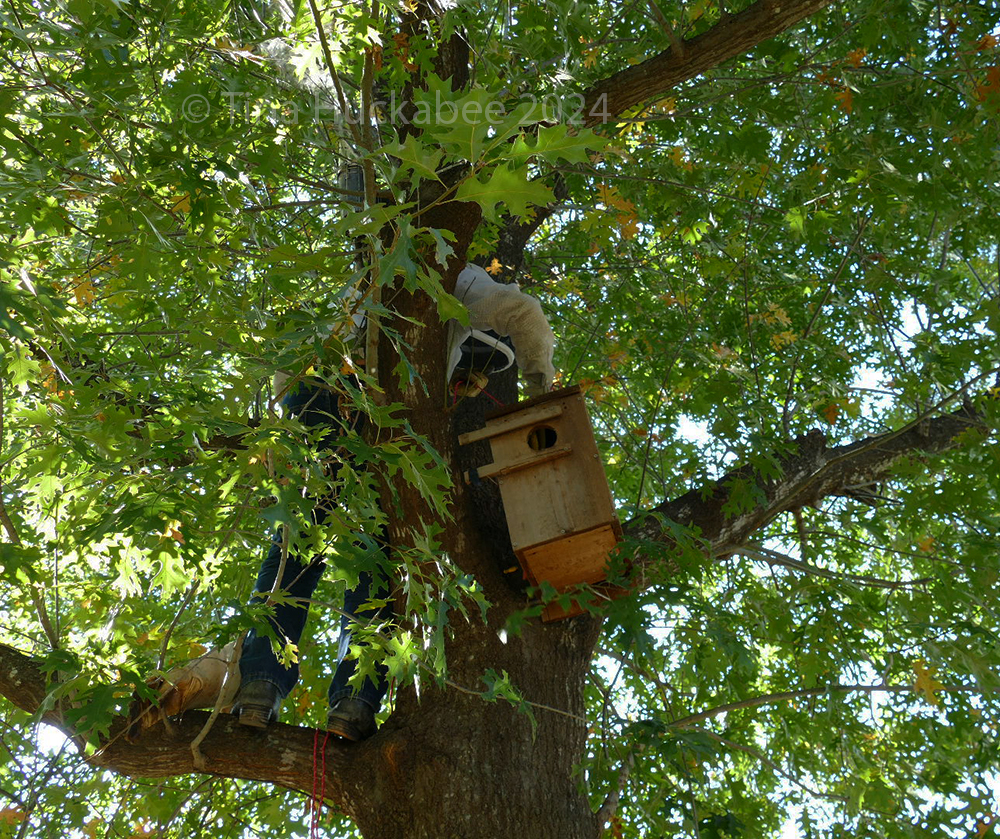
In spring, with mama Eastern Screech owl in the nest box, but before her eggs hatched, I observed scout honeybees buzzing in and around the box, mama owl vigilant and nervous. I wouldn’t have noticed the bees if we hadn’t installed a camera inside the box, but thankfully, we did! Once I saw the buzzy bees on my computer screen, Bee Daddy and I sprang into action, as we guessed the bees were looking to swarm, owl boxes being a favorite real estate for honeybee swarms. An owl box is a ready-made spot for a bee hive: up in a tree and safe from predators, enclosed (except for one entry, well guarded by the guard bees), and a cozy spot in which to build comb.
We belong to two local beekeeping groups and we sent out a notice requesting advice about the situation. A beekeeper in a nearby neighborhood responded with an offer to lend his swarm trap.
A swarm trap is any type of wooden box with an opening at the bottom of the box, so that the bees have access, but can protect from invaders. Bees like enclosed spaces where they can safely and efficiently build their hive. Professional and hobbyist swarm traps usually have some frames installed, so that the bees get right to their obsessions: making honey!
Initially, we set up the swarm trap near (just under) the tree where the owl nest box resides, but decided to move the contraption a little farther away, next to the house.
We set up the swarm trap and dabbed some lemongrass oil around the trap. Bees are attracted to lemon fragrance, so we hoped they’d find the lemony box an appealing place to hive. Additionally, we painted some almond oil, which bees do not like, around the entrance to the owl box, to discourage the bees from further exploration of that potential hiving place. Within hours, a swarm of bees moved into the swarm trap.
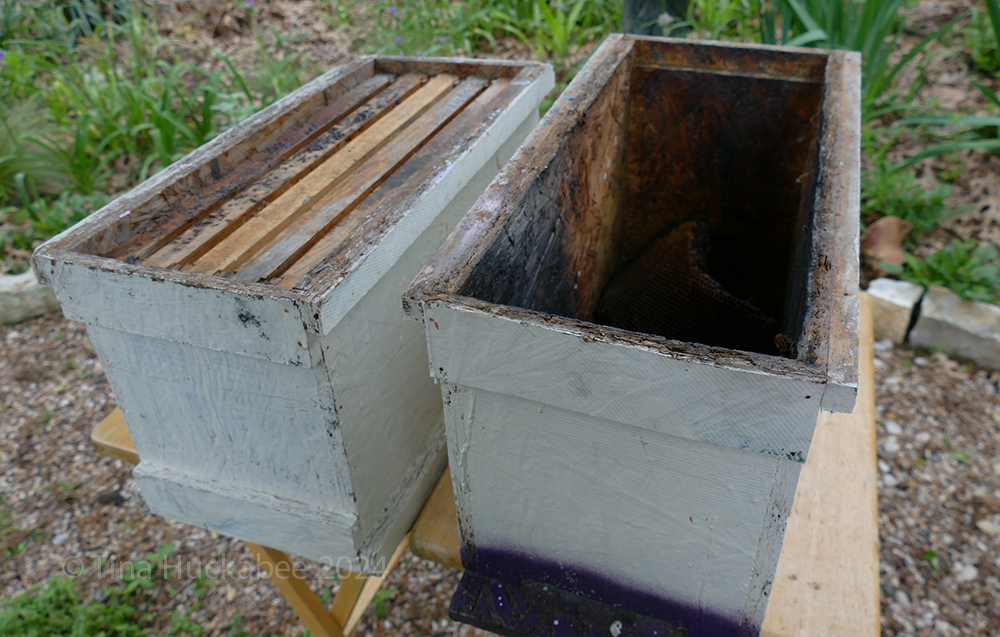
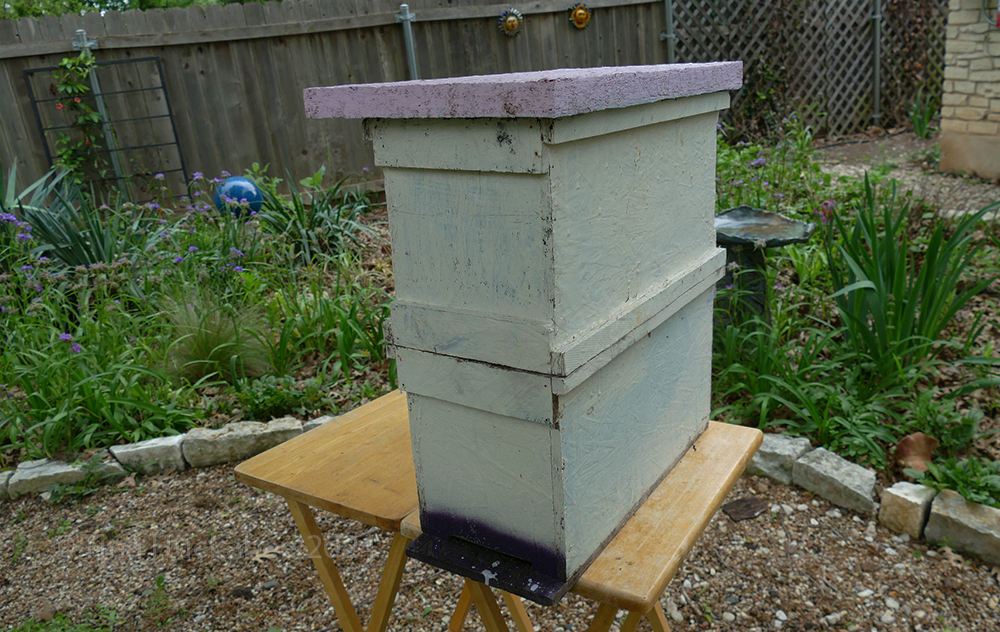
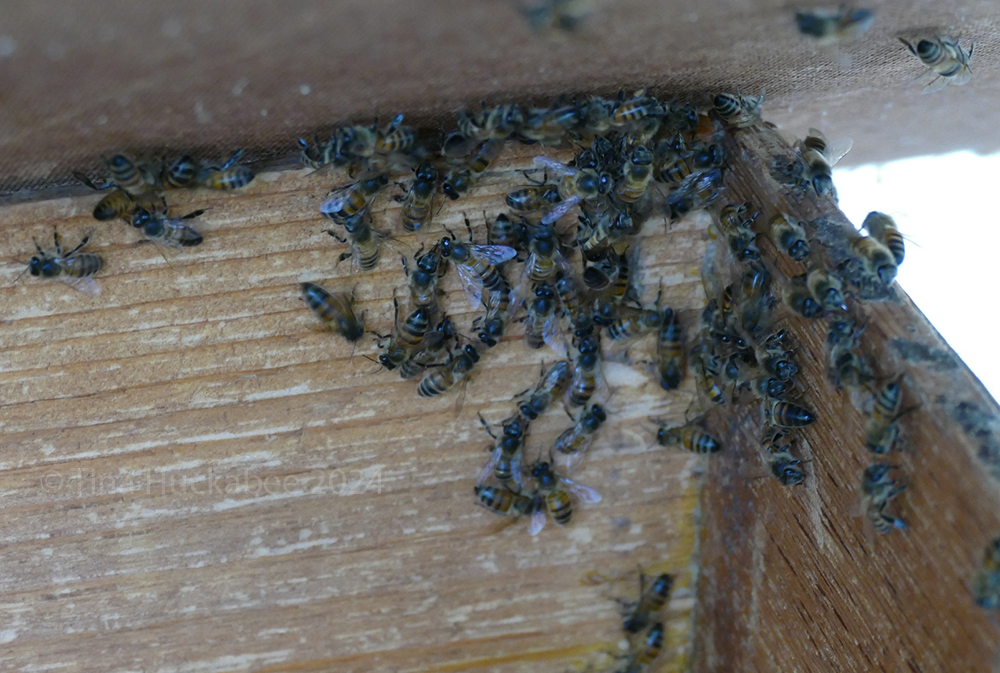
The next afternoon, the beekeeper came to close up the swarm trap and deliver the bees to his brother, who owns some land outside of the Austin area, the bees guaranteed a chance at building a healthy hive. Because it wasn’t near sundown (which is the optimal time to close up the trap, as most foraging bees are inside by nightfall), some bees were out doing their thing with flowers. When our wayward–and now homeless–foragers returned, there was no home for them. Just before dark, I noticed lots of bees aimlessly flying in the area where the trap had sat; they were clearly confused, looking for the hive that had been a temporary home. I quickly set up a safe haven for these abandoned bees: a regular bee box with a plywood cover. I dabbed lemon oil on the box and the the bees moved in for the night.
For the next few weeks the little band of bees (maybe 200?) hung out in that box, some foraging during the days, others staying in the box. Over time, the population dwindled, and eventually, the bees all died. Honeybees only live about 6 weeks and though most of their hive mates had left for parts unknown, at least this group had a safe enclosure to spend the rest of their days.
One afternoon in September I noticed bees crowding in the hole of the owl nest box.
Bee Daddy had built a sliding door over the the entry so that critters–like honeybees–couldn’t get into the box during the owls’ off season. At some point last spring, the door broke, life happened and we forgot that the door needed replacing. This vagabond bunch of bees noticed the attractive box and settled in. I watched them for a few weeks, thinking they would move on, but they stayed. We attempted to attract the bees with a makeshift swarm trap, sweetly anointed with lemon oil, but the attractant was ignored. These bees were clearly pleased with their owl box hive. Weeks later, we decided that we had to take the house down and figure out what to do with (what we thought) were a few bees in the owl nest box.
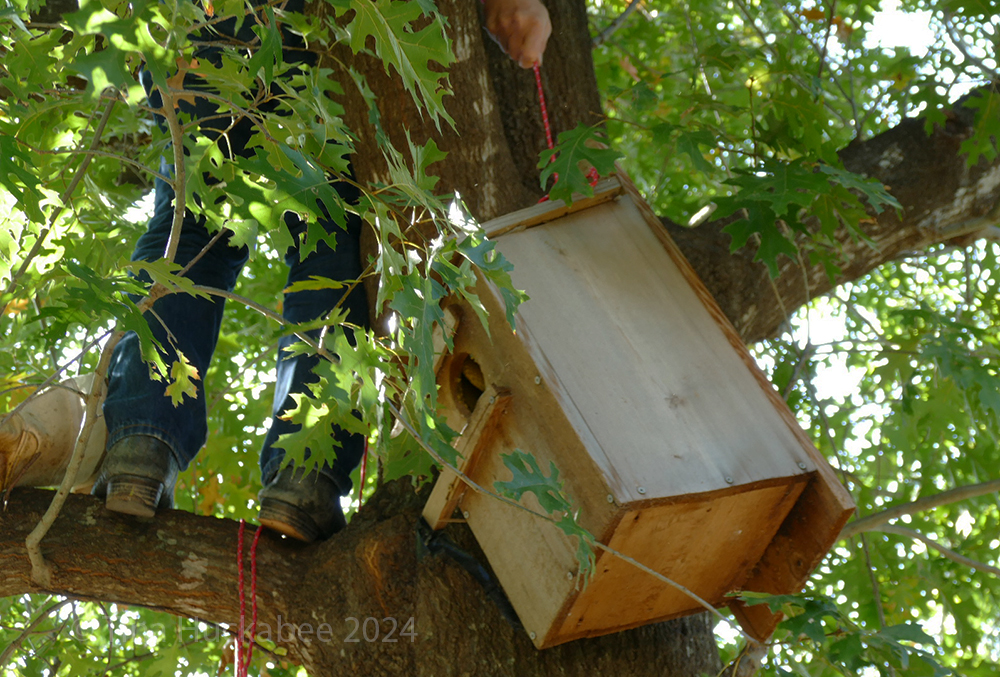
As Bee Daddy was up in the tree (let’s hear if for dangerous home projects!), he suggested there were lots more bees than we had assumed.
He lowered the nest box and yes, there were lots of bees and some stunningly beautiful comb.
Those darn bees!
We placed the owl/bee box near Bo-Peep, hoping the bees would go home, since they likely came from Bo. Instead, they remained in their newly hived home, so we simply put the roof back on the box and let the bees be.
From the time I first noticed the bees in the nest box to when I saw the last few dead in the box was about 6 weeks. This band of bees was a ‘late swarm’ and realistically, had no chance of surviving winter. There were too few of them to stay warm during the coldest days and there was no queen, so no hope for growth or replacements for aged bees. I’m baffled why they left the safety of a large hive, but honeybees do weird things. I guess that’s really my take-away from beekeeping: honeybees are weird. Beekeeping is three-fourths science and one-fourth art, the art part being about accepting that honeybees have their own agenda and humans play (at best) a limited role in honeybees’ lives.
As we enter 2025 and a second decade of keeping bees, I continue humbled and awed at our bees’ drive and sense of purpose and community. Bo Peep, a lonely sentinel in the back of the garden, still active in this mild winter, is also resting for the upcoming season of growth and honey production.
Will Bo have a new hive neighbor? I’m not sure. I would be content with just one hive, but since hives abscond or decline for a variety of reason, I would have to accept that if Bo disappeared (whatever the causes) we’d be left with only one hive until spring of ’26. I’m not ready for that decision. I am sure Bo’s bees are content to live their lives this winter, safe in their cozy hive when it’s cold and wet, spreading their wings to pollinate and gather nectar during mild days, and waggling to communicate with their sisters.
Honeybees may be weird, but they’re also wonderful and it gladdens my heart to see them in my garden, as they collect pollen and nectar, knowing that they’re fulfilling all of the other responsibilities inside the hive which humans are not granted daily witness.
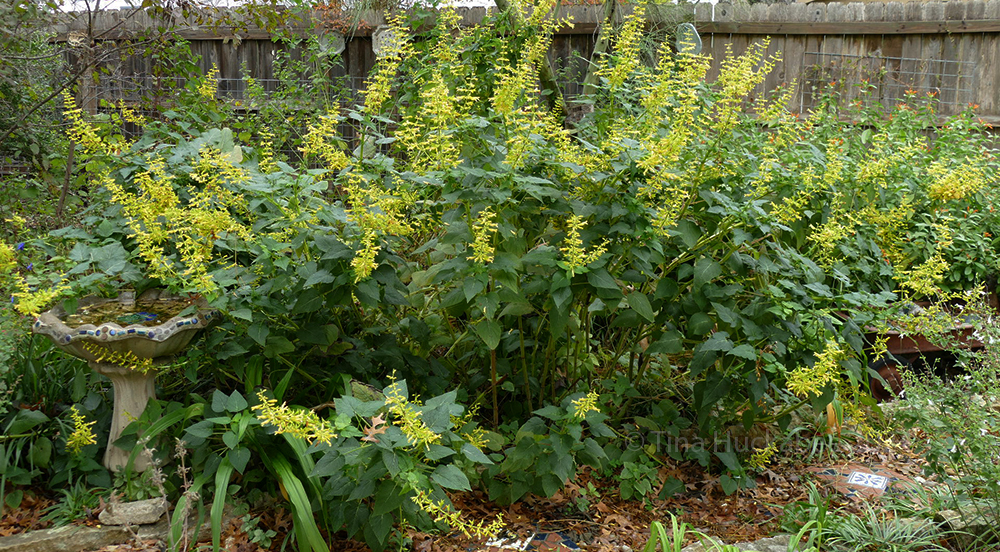
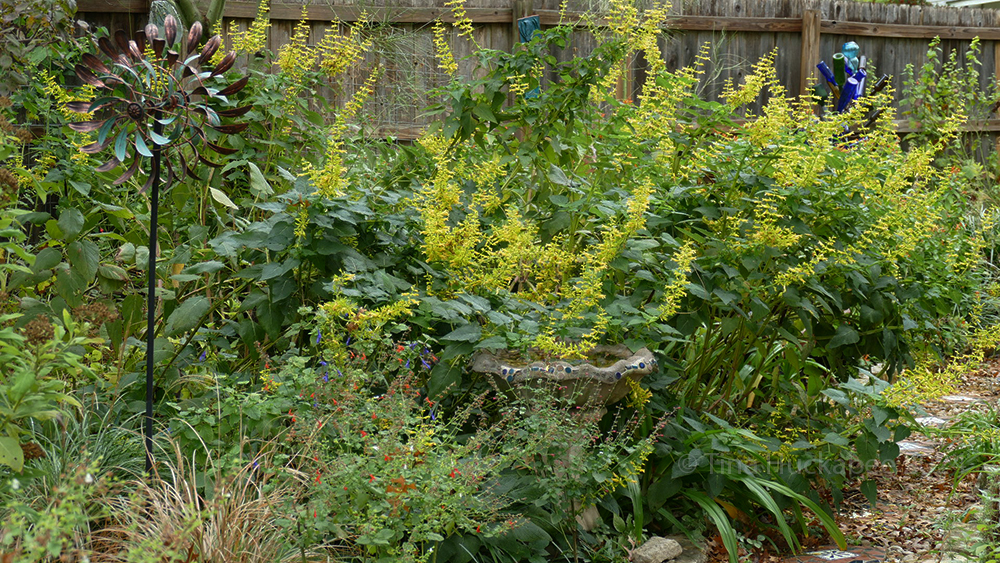
During this time of year with shorter days, clouds impeding sunshine, and regular rain, the Forsythia Sage, Salvia madrensis, reigns supreme–and yellow–over the garden. This native plant to the Sierra Madre Oriental mountains in Mexico is right at home in my Central Texas Garden.
Many years ago, a generous gardener gifted to me some sprigs-with-roots of the delightful perennial and I’m always grateful for its graceful presence in my garden. Its foliage is a lush blue-green during late spring and throughout summer, the many flower spikes a cheery yellow, blooming from late summer until a hard freeze ends its season. Forsythia sage is one of the last plants in my garden to provide a big, blooming show.
This salvia likes some extra water during the hottest and driest times of summer, so I oblige by dousing the soil in which it thrives in between my once or twice per month irrigation. That being said, I’ve sometimes not given the extra drink, and other than looking a little sad, the plant always rallies with the next rainfall or soaker hosing–whichever comes first. Never has there been even the slightest hint of a brown or dying stem.
This sunny sage hasn’t seeded out, though it spreads by roots and is easily controlled. Mine is planted in a spot that receives brief full summer sun, but is protected from the late afternoon broil. Morning sun with afternoon shade is the ideal Forsythia sage situation.
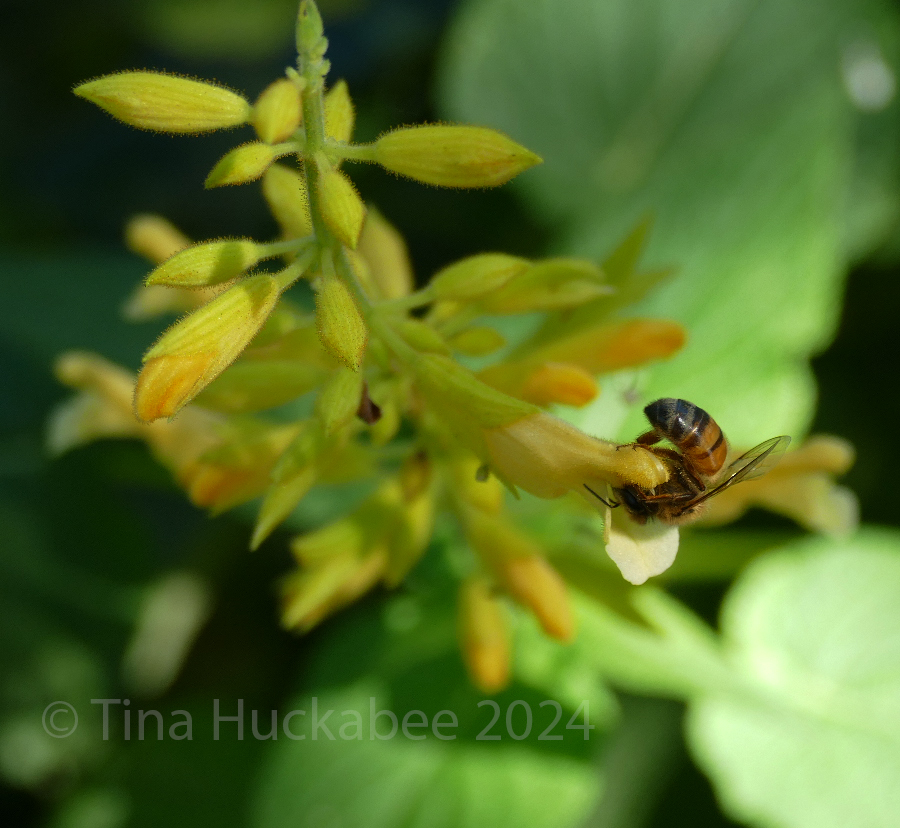
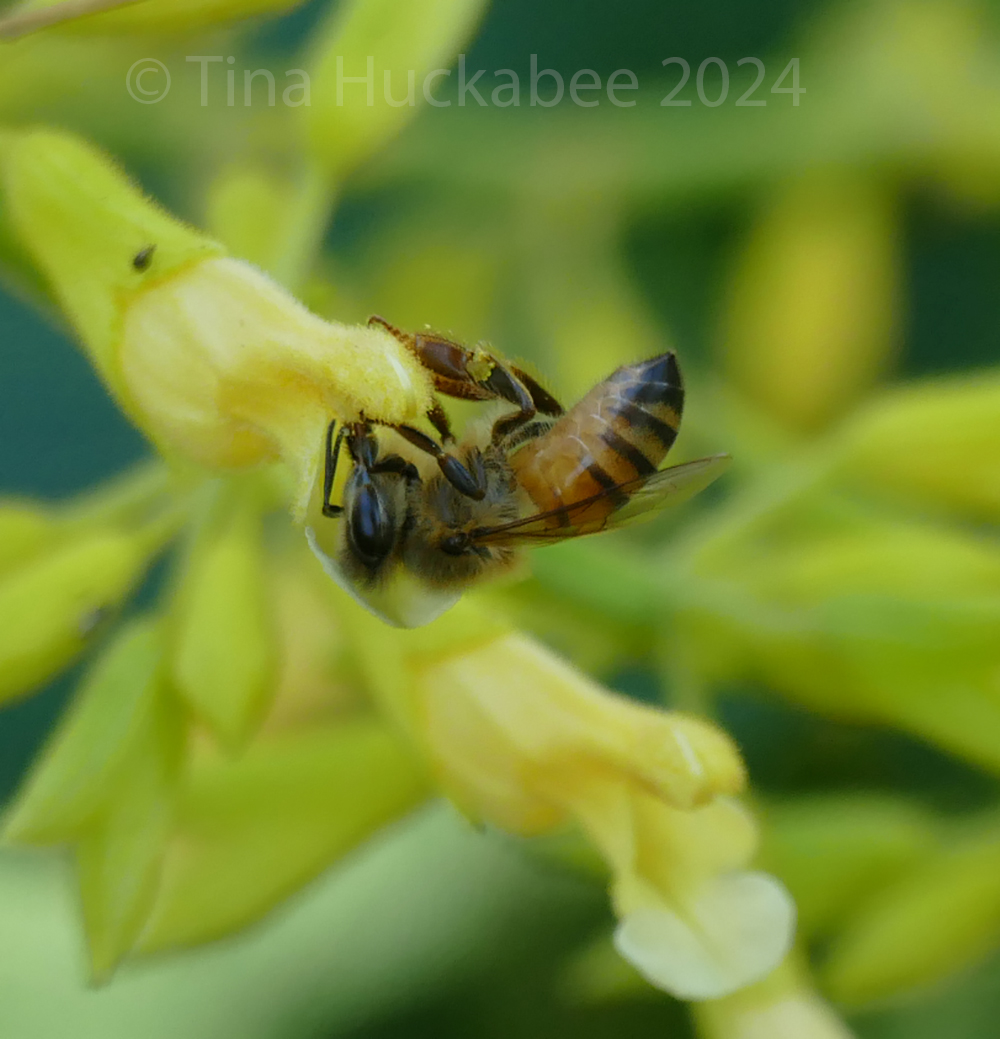
My honeybees and one native bee, the Horsefly-like Carpenter bee, Xylocopa tabaniformis, are the two pollinators that I’ve observed at the flowers.
Honeybees are happily busy in the dark time of year.
I’ve seen plenty of squirrels and little birds use the dense foliage for cover and who knows what critters of the overnight wildlife shift also take refuge in the protective cover.
The first freeze of the year in my garden occurred recently, landing right at 32 degrees. I noticed that a bird bath in my front garden was left with a thin layer of ice that morning. The back garden, probably because of the shelter provided by the two big Red Oaks, stayed above 32, with no ice found in any water feature. I was glad for that, as the Forsythia sage is still beautiful, providing shelter and nourishment for garden beasties.
A killing frost is coming at some point in time in the next months. For now, the bees and I will enjoy this hardy and stunning perennial and appreciate its bright beauty in a dark time.








 My Gardener Says...