The Eyes Have It

A pair of Carolina WrensThryothorus ludovicianus, live near my garden and most days, I see at least one of the pair.  Often, I observe both wrens in the garden as they flit through underbrush picking plant lice from limbs and hop through leaf matter, tossing bits–hither and thither–in their endless search for yummy insects and spiders.  More delightful–and easier to observe–I’m witness to their landing on the sunflower or suet feeders, both placed outside the big kitchen window.  The Carolinas snatch tasty morsels, then zoom to safety on a low branch to enjoy their chosen treat.  These gregarious little wrens are (almost) effortless photographic catches, as they perch on fences, or on the multitudes of spots where they survey the landscape, watching for predators and planning the flight path to their next adventure–or meal.

I snapped this shot a few weeks ago as this adult rested on my back fence, looking this way and that, chirping all the while.  As I watched him or her (going forward, wrens will be “its,” as I can’t tell gender), something looked amiss.
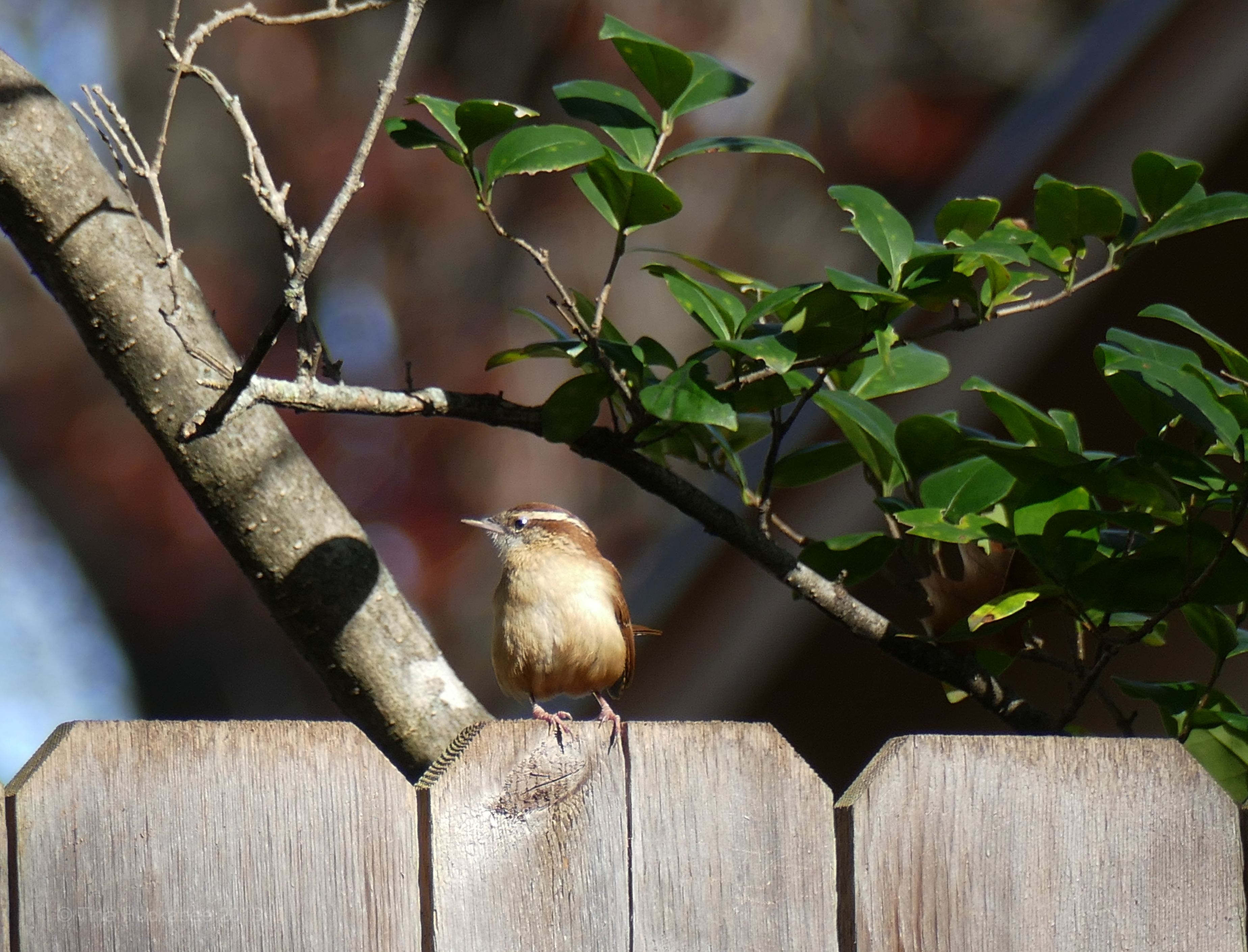
Once I downloaded the photos, it was clear that the wren’s right eye was closed, or mostly so.

For this spunky Carolina Wren (they’re all spunky–that’s a descriptor of Carolina Wrens), one of the eyes has it, and one, apparently, doesn’t.
I perused bird sites for any information on eye diseases in wrens, specifically wondering if wrens are vulnerable to the same eye disease that House Finches and American Goldfinches suffer.  I haven’t found any information that suggests that particular connection, and finches and wrens aren’t related species of birds, except that they’re both, well, birds.

Ahem.

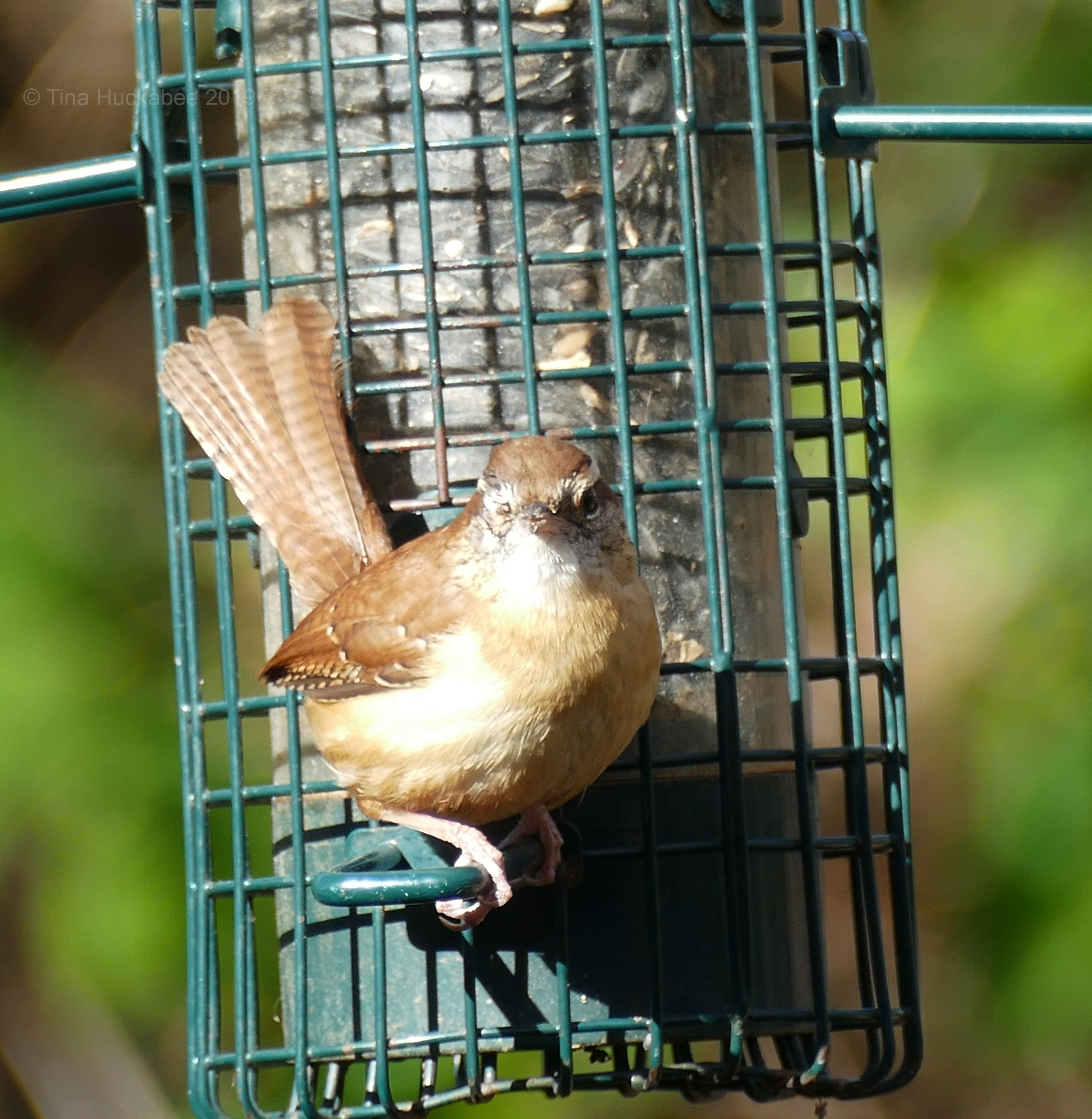
As I’ve observed backyard bird business over the last few weeks, I’ve paid special attention to the wrens, and with some good luck (and clean windows), have taken some closer shots of the currently one-eye bird.

The right eye is completely closed.


For comparison, this shot of the mate shows a darling adult wren with two healthy eyes.
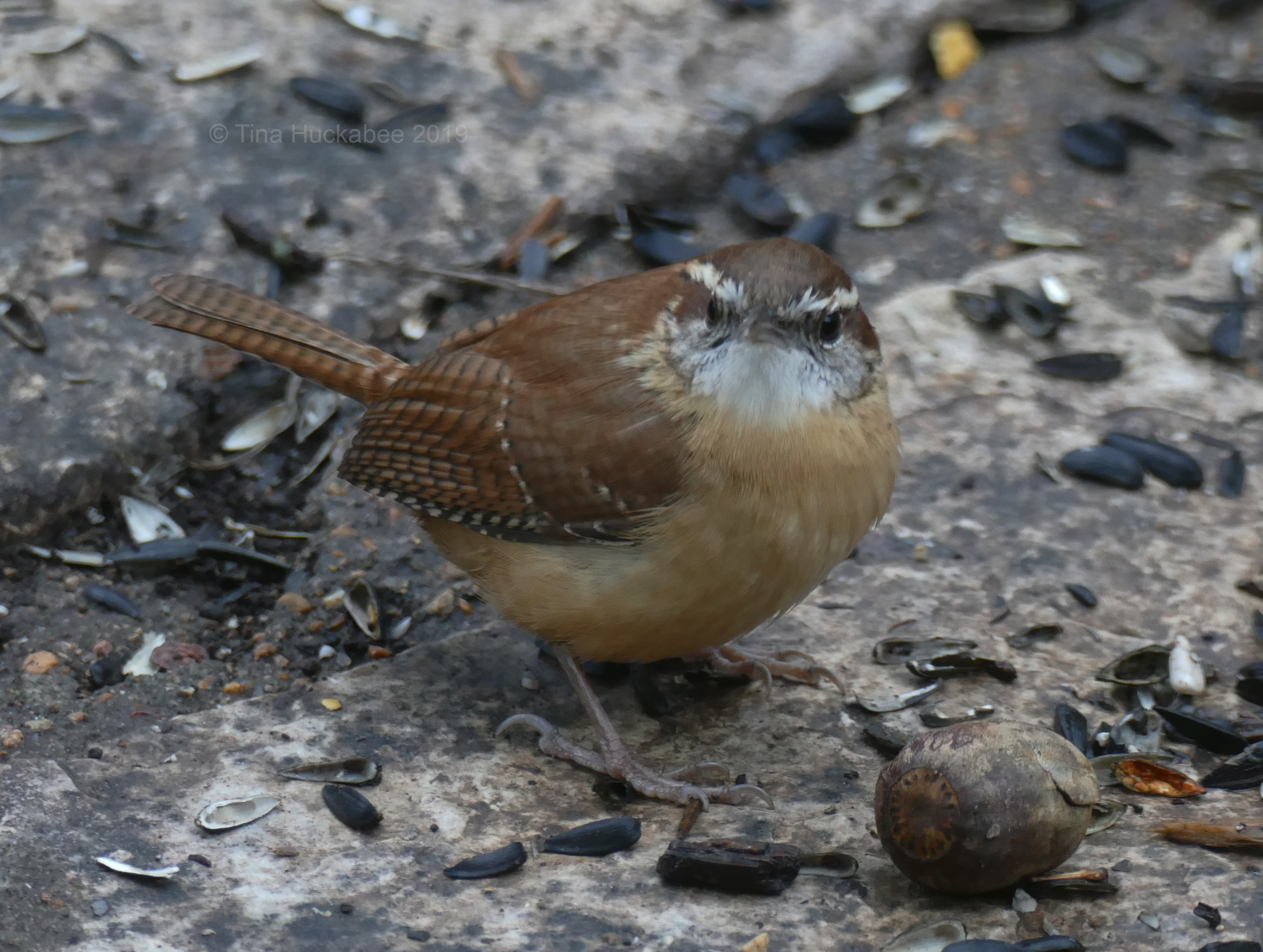
In the last two weeks, it appeared that the wren’s eye improved.

The eye is clearly swollen, but you can see a bit of wary eyeball peeking through the lids.

In this photo, taken a few days after the one above, the wren in on the ground below the suet feeder and the eye looks better.

Again, up on the suet feeder.

Injury or disease?  It’s impossible for me to say.  Except when the wren turns its head where I can clearly see the injured eye and identify the disfigured wren, I haven’t observed any difference in behavior of one wren from another:  they both fly normally, work, with verve, through the garden for insects and other snacks, and alight gracefully on the feeders for sunflower seeds or suet.  Perhaps the injured wren looks around more readily and nervously than the other, but I’m not sure that’s the case as Carolina wrens are busy birds who aren’t still or placid in their routine behavior.  As I anthropomorphize the wren situation, I wonder if the mate assists the impaired partner, who obviously has limitations of sight, or, is the disabled bird on its own for food?   Has the semi-blind bird learned to compensate for its eye problem by faster flying or furtive movements?  Is the eye healing, or is this a permanent situation? Should I fashion a tiny, wren eye patch and offer it as a gift, and would the wren accept it?


While it seemed like the wren’s eye was improving, in this distance shot of a few days ago, the eye looks closed again.

The mate landed on the branch just after I took the photo and the couple perched for a time, enjoying one another’s company for several minutes before flitting to a different tree in the distance.

The wren on the left is the one with the bum eye.

I assume this is the same pair who raised two chicks last spring and what a sweet show that was. I’m sorry for the wren’s injury, but there’s nothing I can do to help the bird–it’s wild, and by all appearances, has adapted to its eye problem.  Its actions seem wren-normal and it’s clearly able to feed and fly, and those two skills are the foundations of a healthy bird life.  But I do hope the little bird will enjoy restored vision, and will continue its wren ways, and further, that this couple can successfully raise another clutch of Carolina Wren cuties in spring.

I’ll be keeping my eye out for them.


Juxtaposition

A White-winged DoveZenaida asiatica, looms over a House FinchHaemorhous mexicanus.       .

Considered a medium-sized dove, this member of the bird family Columbidae, looks huge when paired against the smaller finch.  Both bird species are common here in Texas, especially as backyard birds regularly visiting feeders.  The dove’s gender is unknown to me, though I’m sure other doves can tell whether its male or female.  Proliferation of dove babies will be proof of the gender identification and the spring and summer socialization that will follow.   The finch is male in winter breeding colors.

There was no purposeful looming by the dove.  It was just two birds hanging out in winter-barren tree, each awaiting its turn at the sunflower feeder or water feature.


Martha and the Old Gay Hill

I’m guessing that the title captured your attention?  As well it should, because  Martha Gonzales rose and Old Gay Hill China rose are both rose shrubs worth noticing and growing, and both are stellar performers during a (so far) mild, drippy winter here in Central Texas.

I’m not a huge rose fan.  I like them just fine; I sniff the blooms and enjoy the results.  I think they’re pretty, when they’re pretty.  In general though, I prefer other plants in my gardens like grasses, perennials, and wildflowers. But I do like Martha and Old Gay Hill.  Both are antique roses, meaning that folks brought them to the New World, probably before the late 1800s, and planted them in small towns and on family farms. Due to hardy Rosa genetics, the roses flourished without much care and here in Texas, that’s the ONLY kind of rose that you want!

I accidentally purchased my Old Gay Hill rose shrubs some years ago.  I’d read about the rose, but was hankering for a Martha Gonzales, which the nursery didn’t have in stock at the particular point in time that I was hot to buy. But I had money to burn and energy to spare, so the Old Gay Hills came home with me.  I’ve never regretted that trip home as the roses have provided bursts of color, couple with an evergreen presence, excepting during the deep heat of summers and post-freezes of winters.

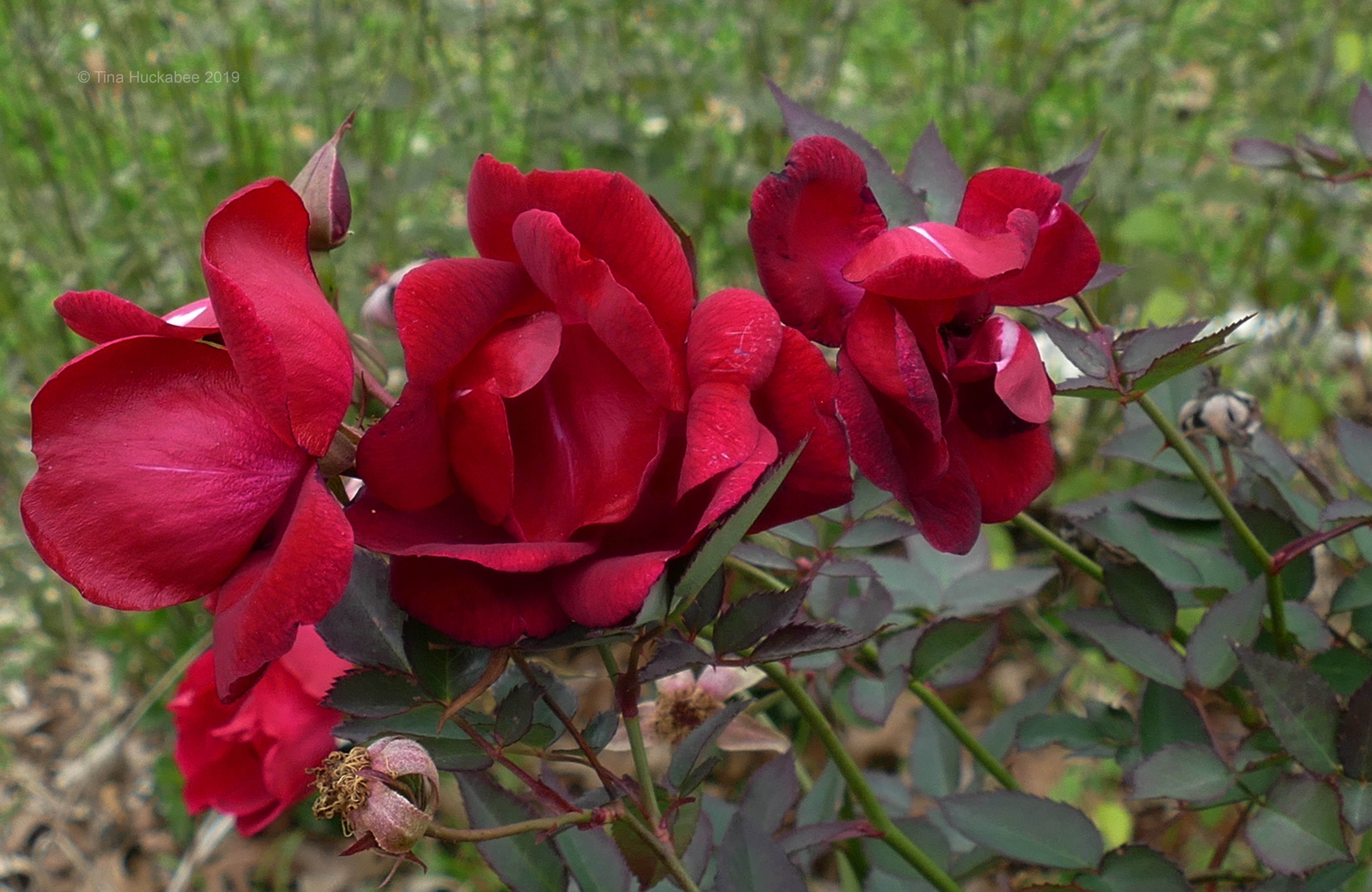
I’m charmed by the bride-of-Frankenstein stripes of white that each rose displays amid shouts of scarlet petals.

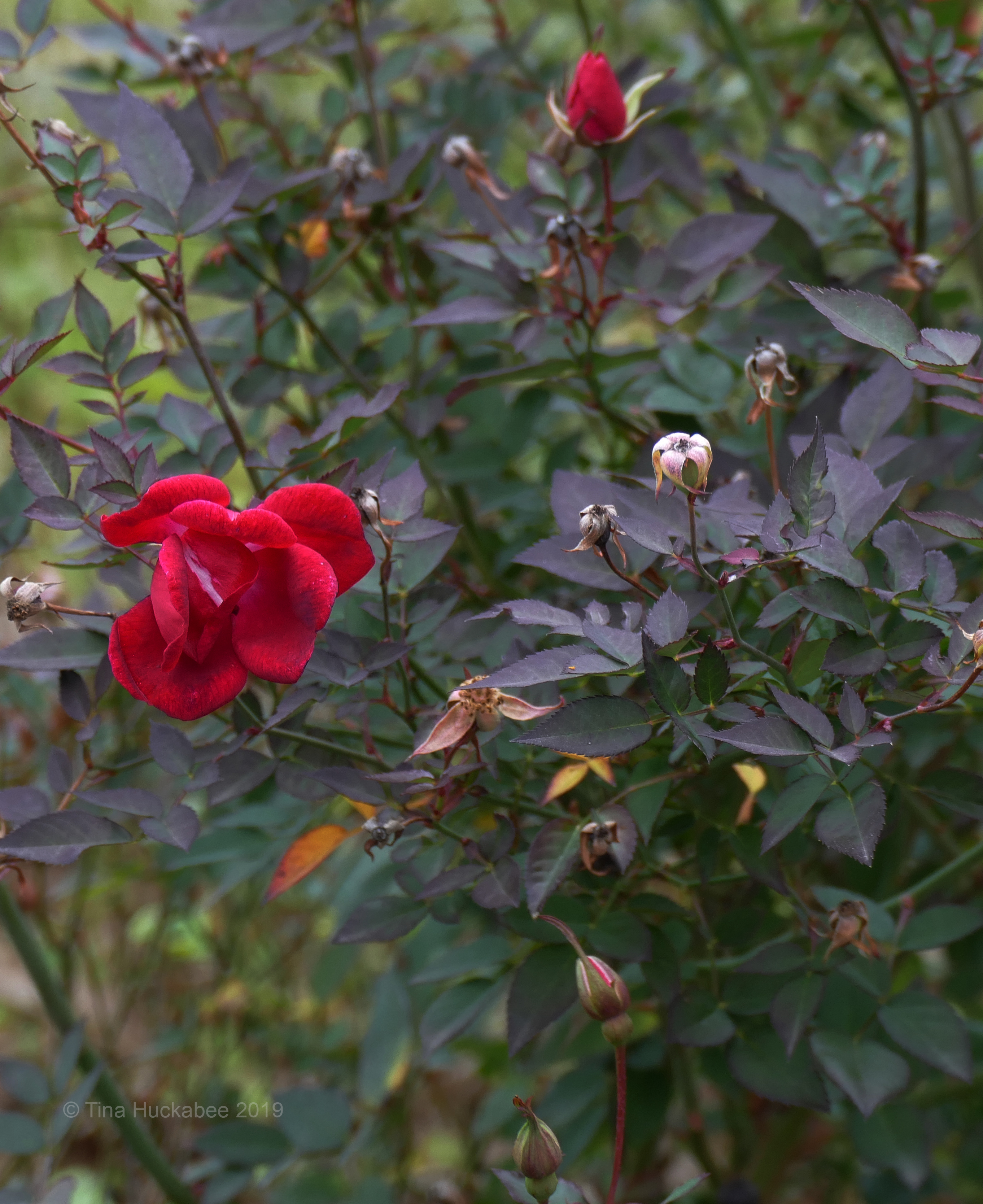
The shrub boasts good size (mine are currently nearly 4 feet tall), with handsome green foliage and pops of red.  This winter, Old Gay Hill has bloomed steadily.

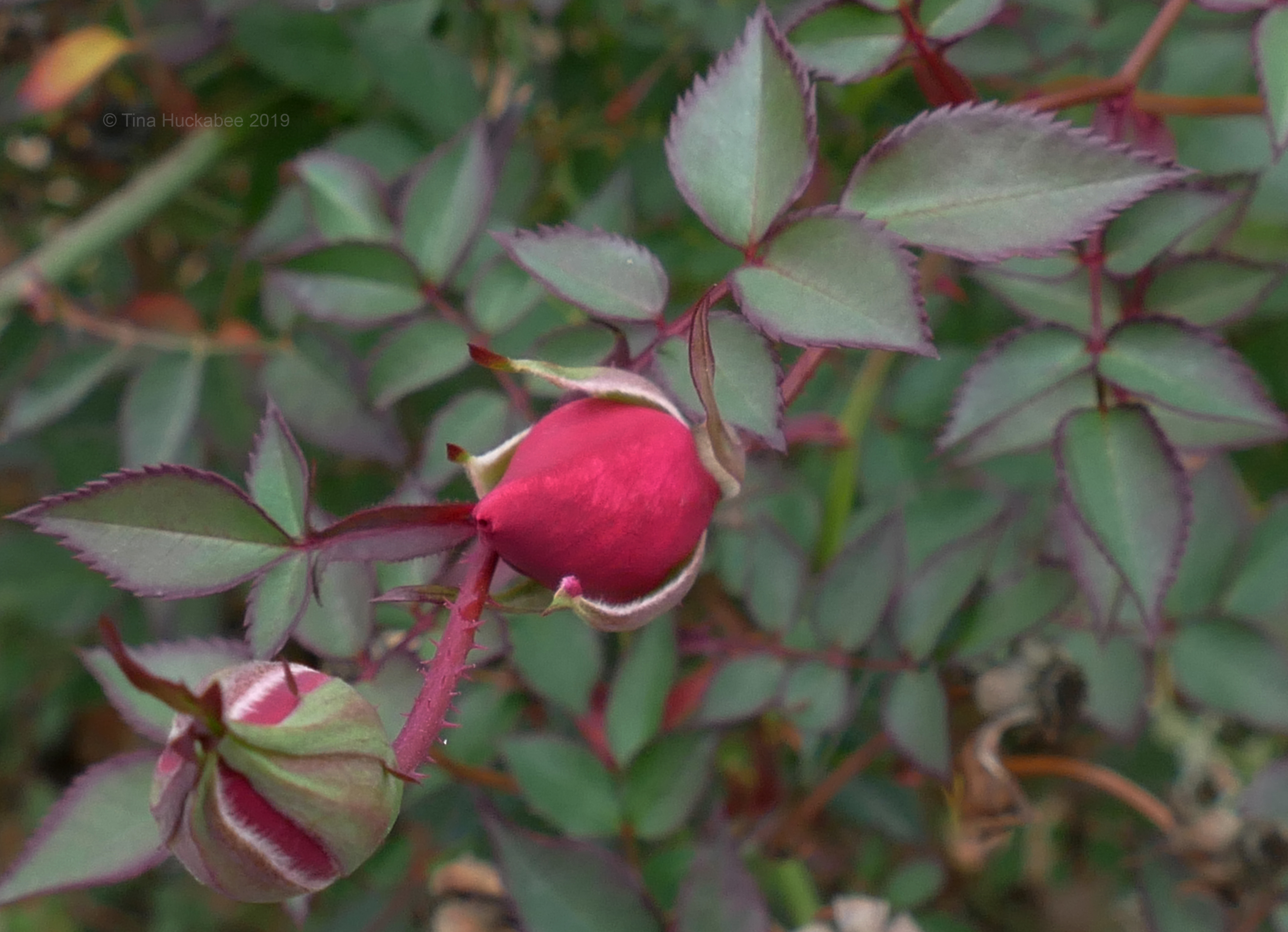
New foliage is bronzy, held aloft by maroon-tinged stems, topped with sweet buds which open to generous, fragrant blooms.  Mature leaves are green, with a border of bronze.

The Old Gay Hill was discovered in Washington County, Texas, near a town called Gay Hill.  It’s listed as a “native” rose in the link above, but many rose species were brought to Texas by European immigrants during the 1800s.  Like most immigrants to North America, the rose varieties settled in, accepted their new home–heat, drought, and everything else–and did what immigrants always do:  they made Texas a better, more beautiful place.


Apparently, I like red roses.  Unsatisfied with growing only Old Gay Hill, I eventually planted the desired Martha Gonzales roses.  The Marthas grow a smaller bloom, but rival Old Gay Hill’s in brilliance and beauty.  The petite roses are deeply fragrant, a delight to the nose. In my experience, the Marthas are better over-all bloomers than the Old Gay Hills, but they’re also located in sunnier spots.  The shrubs are foliage-dense, though haven’t grown particularly tall for me. I’ve seen Marthas grow quite large in both height and width, some in my own neighborhood.  Those are the ones growing with ample, year-round sun.

I’m especially fond of the foliage on this rose shrub.  The leaves are deep green, flushed with a tinge of burgundy, each leaf edged in wine red.   Though smaller than the green leaves of Old Gay Hill, Martha’s leaves are richly colored.  The pairing of carmine blooms with the vivid leaves is stunning.

The Martha Gonzales was discovered in 1984 in the Navasota, Texas garden of–you guessed it–Martha Gonzales!

Both rose varieties are disease free, nearly thornless, and are frequented by many of the pollinators who visit my garden, though right now, there’s not much pollinator action, excepting honeybees on warmer days.  During this mild winter, my roses have been stalwart bloomers and I’m enjoying the flowering.  A hard freeze is predicted in the few next days which may end the the show the immediate future.  If that happens, I have only to wait until  March or April for the crimson tide to return.

Winter red blooms are chasing away the winter blues for me.  Do you have winter blooms cheering your garden?