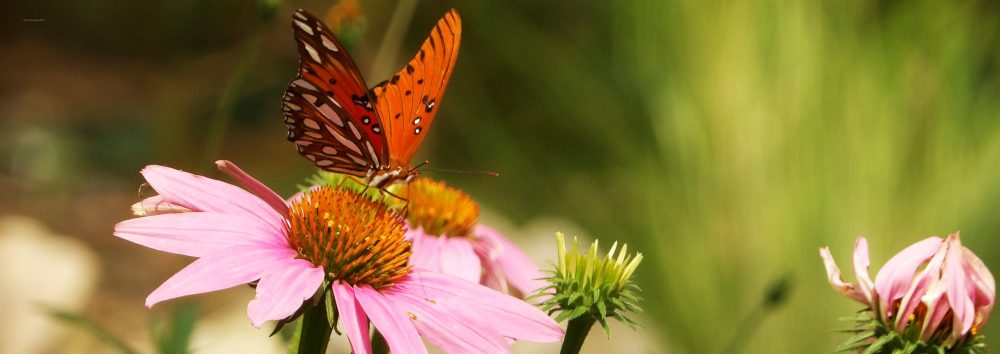
The honeybees are still at it: pollinating flowers and carrying pollen and nectar to their hive to provide food for their hive-mates and larvae, and perhaps in the future, a bit of honey for their human neighbors.
You might notice that I wrote hive not hives.

In August, we checked our honeybees, as we do roughly every two to three weeks during the growing season. We were late at this particular hive check; it had been closer to four weeks since we last peeked into the gals’ homes. Four weeks between hive checks is too long and a poor beekeeping practice.
What we found in Woody, our older hive, was horrific.
Lesser Wax Moths had infiltrated the hive and destruction ensued. There are Wax Moths in all, or certainly most, hives that reside in warm climates. We’ve seen Wax Moth larvae from time-to-time in our hives, and crush them when we do. A healthy, thriving honeybee hive will keep any invaders in check–honeybees are a tidy bunch and take care of their own. But if a hive is weak–for whatever reason–it becomes vulnerable to invasive species and the Lesser Wax Moth, Achroia grisella, is one of several insect species that can bring catastrophe to a hive. Hive carnage happens quickly.
We’d added a second honey box to Woody in late June; the colony was thriving and needed more space to make honey. In a follow-up check, it seemed like there were fewer bees, but we didn’t take a deep-dive into the hive to check one or both brood boxes for a laying queen and noticeable larvae. Our only excuse is that it was July and hot, and it’s easy to be lazy beekeepers. That shortcut was a mistake. The fewer bees gave us pause, but we considered that maybe Woody had swarmed (which takes the old queen and half the workers) temporarily decreasing the population. Swarming is a natural and healthy process and is how honeybees procreate; a hive that has swarmed is nothing to fret about. But fewer bees could mean that the queen is weak or something else has impacted the hive. Between hive checks, we observed from the outside, but there were no clues of impending disaster, only fewer foraging bees going to and from Woody.
What we found in the August check was the ruin of the frames and comb.
Poor Woody. Poor bees.
We disassembled Woody, top to bottom, pulling out each frame, in both honey boxes and the two brood boxes. As we examined each frame, we killed as many larvae as we could and scraped and smashed the pupae as we found them. Disgusting work, but it was necessary. There were hundreds (thousands?) of larvae of all sizes, and many dozens of pupae biding their time to release adult moths, ready to mate and create more honeybee hive killers.

We left the annihilated frames and fouled boxes out in the hot July sun for several days after our Wax Moth larvae/pupae killing spree. Wax Moth offspring like the dark, moist of the hives, but won’t survive with exposure to bright sun. Interestingly, Woody’s bees hovered around the comb during those days. For weeks afterward, long after we’d put away the damaged frames, I’d see a few bees each day nosing around the area. Pheromones are strong magnets.
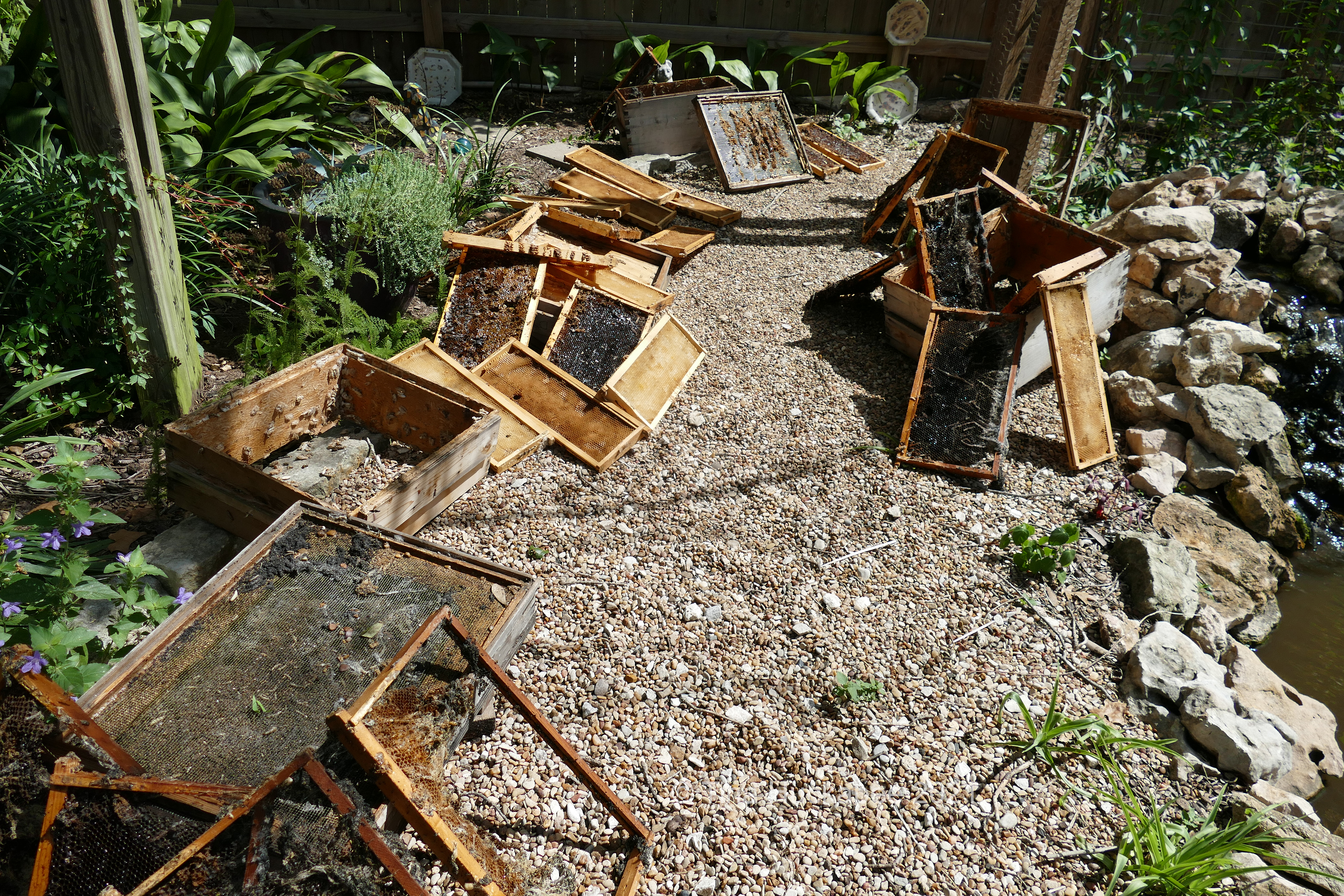
The honey frames and boxes were mostly unscathed, the primary damage occurring in the heart of the hive–the two brood boxes. Female wax moths fly to a hive at night and before dawn, ahead of the bees’ daytime activities, and lay eggs in an exposed crack or crevice. A single female lays hundreds of eggs in her lifetime. The eggs hatch and the larvae weave silk trails through the comb to protect themselves as they eat through the comb, honey, and honeybee larvae. Wax moths destroy the comb beyond repair.
As we worked that awful morning, we noticed that the other hive, Bo-Peep, had more bees hanging around the entrance. Also, Woody’s homeless bees had to deliver the minuscule amount of honey from their former home somewhere. We’re confident that Woody’s bees, after slurping the remains of their own honey, took that honey and joined up with Bo.
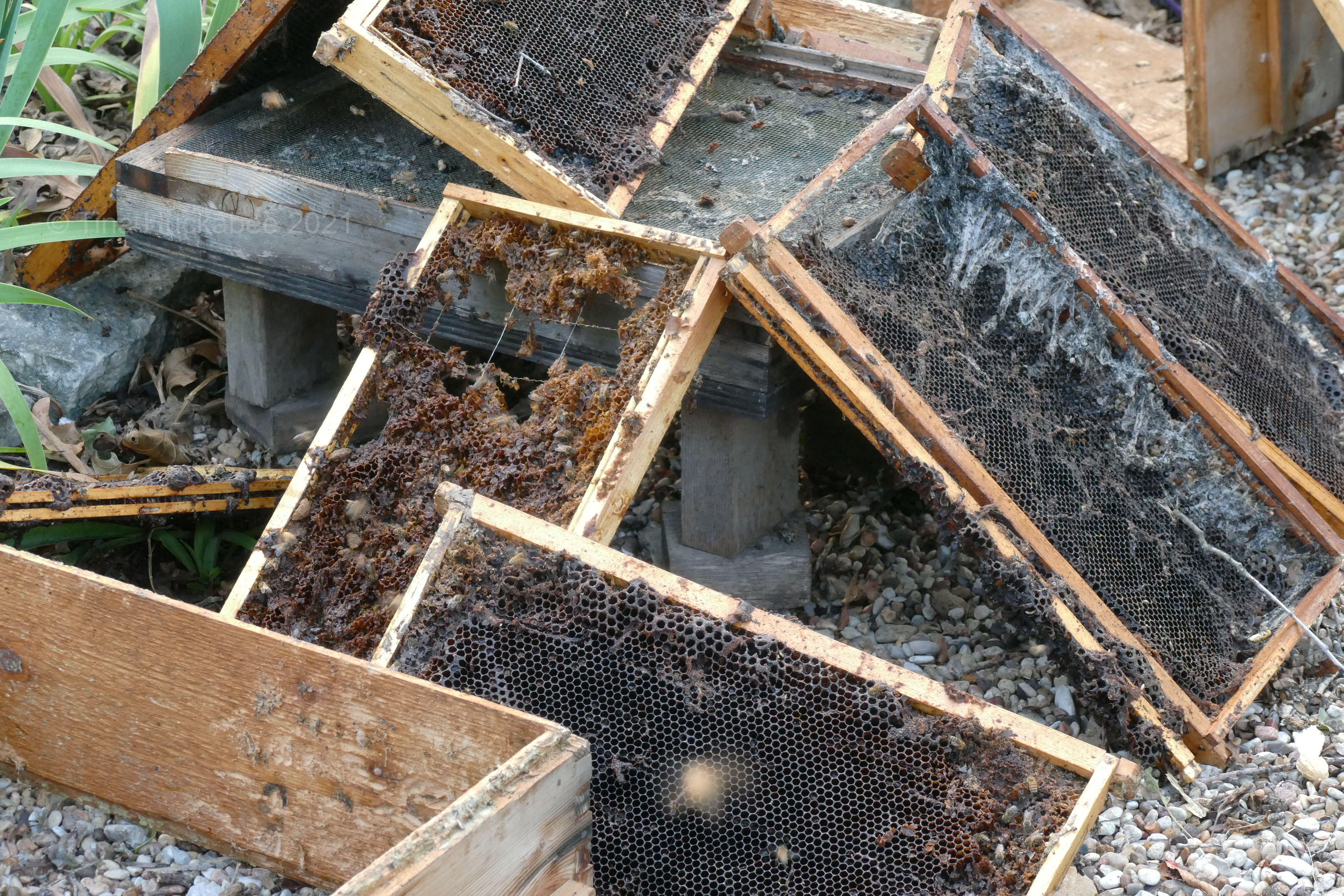
In the photo below and at the top right, you can see the remains of the chrysalises along the sides of the box. Looking at the frames, you’ll notice that some frames have intact comb, though it’s dark and dirty, but other frames only have bits of the comb remaining. The incomplete comb is the result of the Wax Moth larvae having eaten through it.

In this photo, the webbing spun to protect the larvae is obvious, and you can see that the caps on the comb cells (where baby bees are nurtured to adulthood) are all open. The moth larvae open the caps and eat not only the honey and comb, but the honeybee larvae. In a strong hive, the bees can re-cap and dispose of the moth larvae, but when overwhelmed by large numbers of moth larvae, the task becomes impossible.
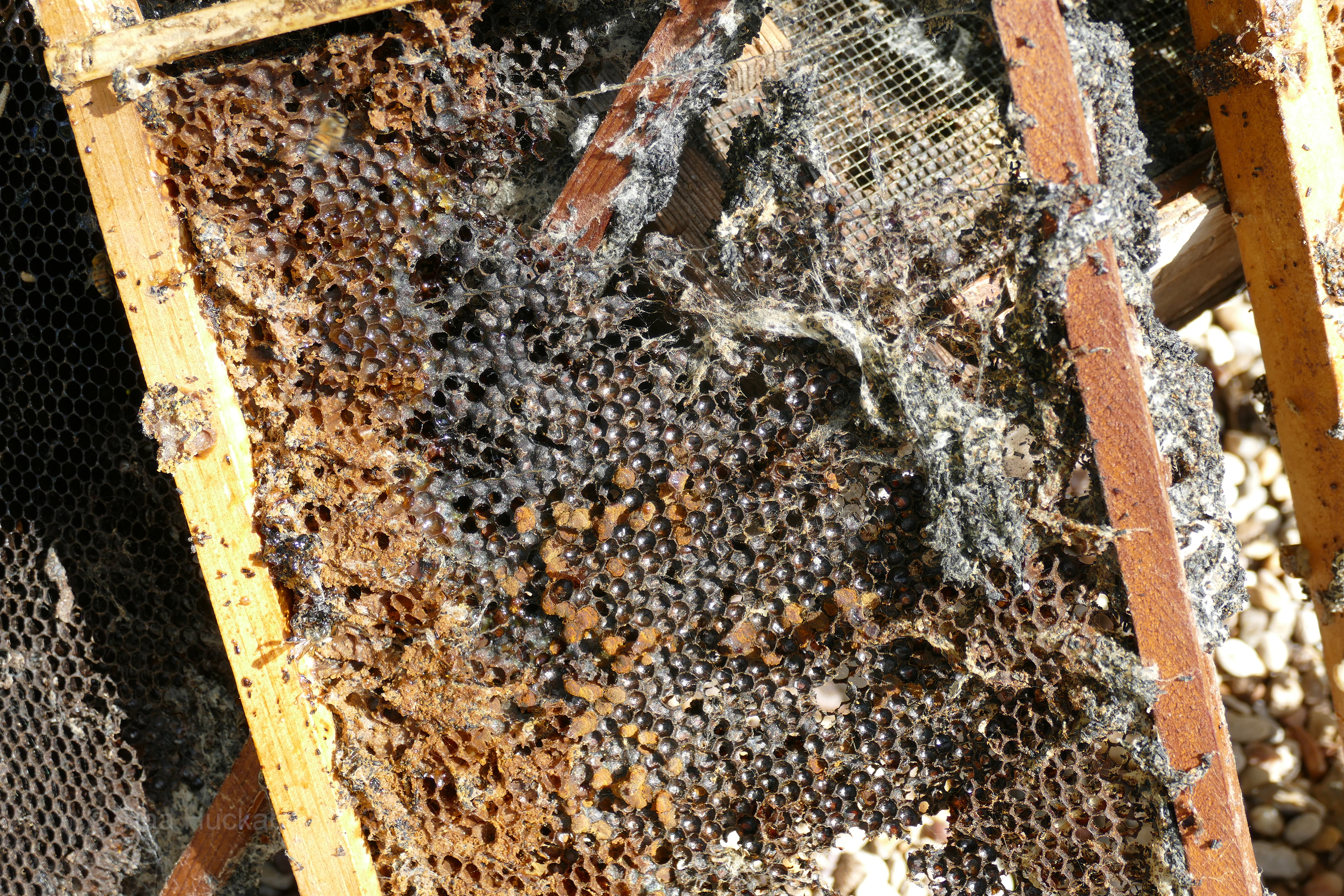
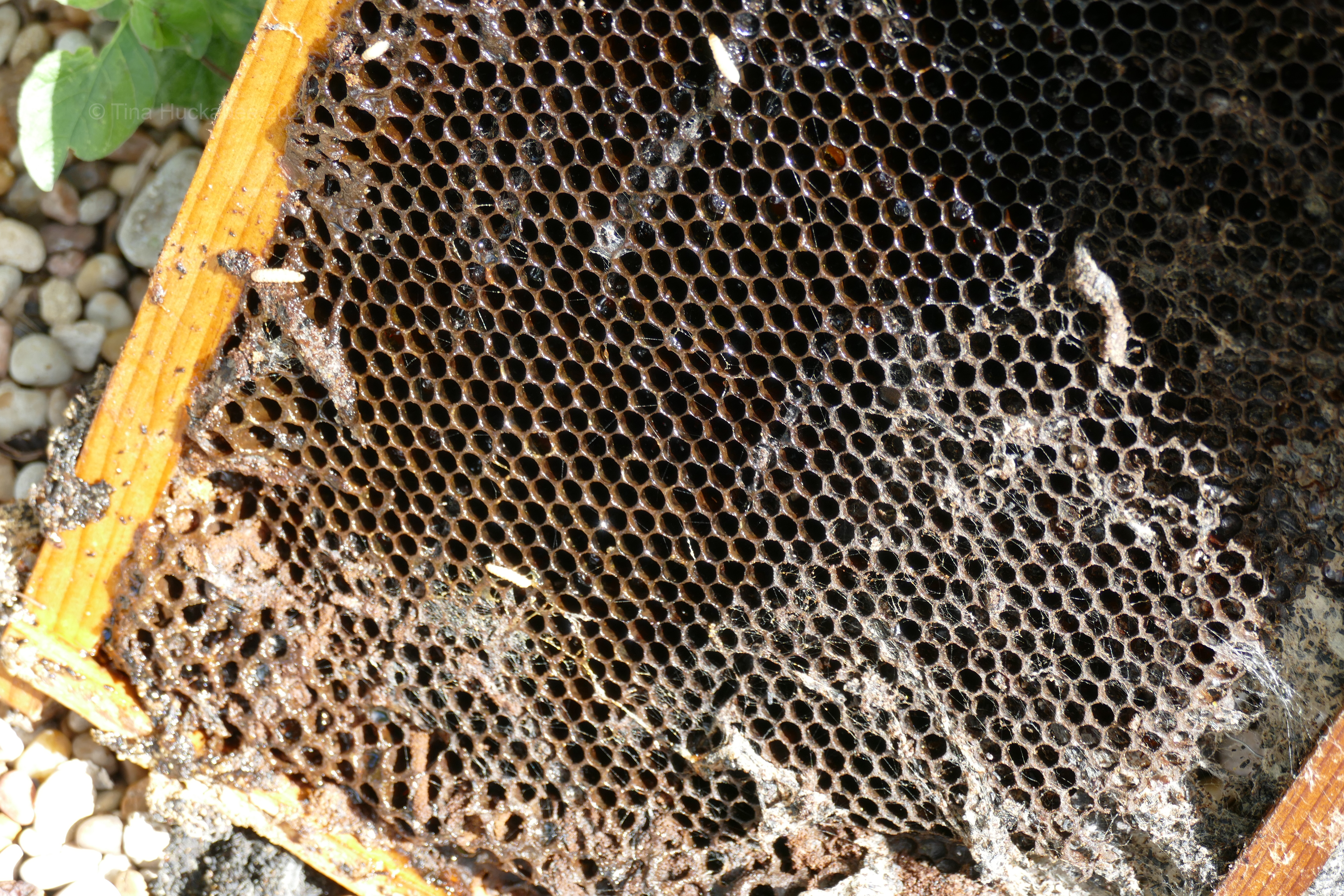
During the days that we left the frames out, I hope that some of the juicy caterpillars were snatched by birds, but honestly, we didn’t leave too many of the moth larvae alive.
Here are more disgusting, destroyed hive frames.

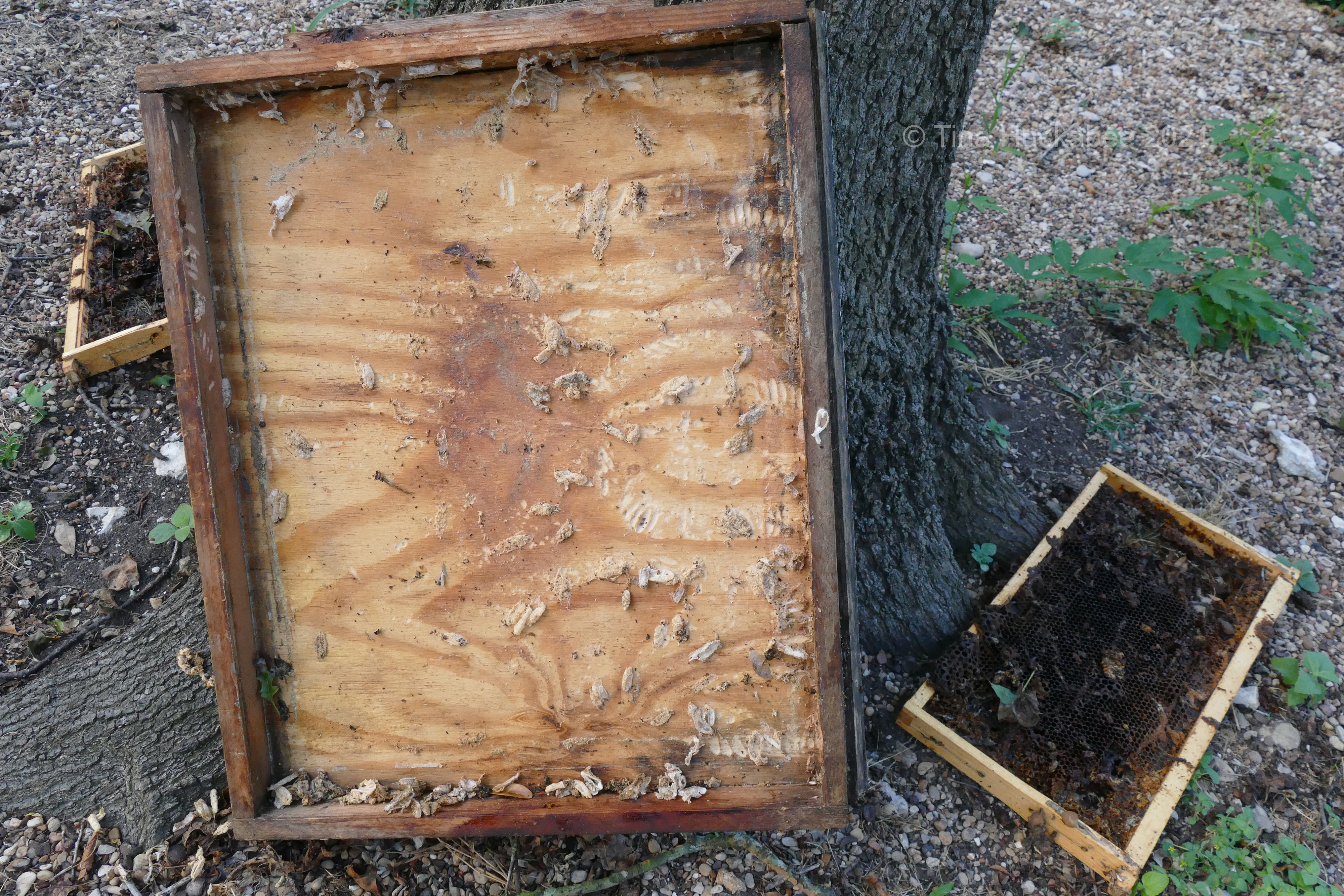
This photo shows the underside of the roof of the hive. All those bits that you see are the remains of pupae that we scraped and smashed.
So what do we do with the frames and the boxes? Through the rest of summer, we mulled whether or not we’d replace Woody. I’m a little burned out with beekeeping; it’s work and sometimes more of a burden than a pleasure. Our decision to purchase a new colony can’t be made until late September, when Beeweaver Apiary announces their honeybees for sale during the following spring, so we’ve had time to consider options. I wouldn’t mind having only one hive, but if disaster hits that hive, we’re fresh out of honeybees until the next year. With that in mind, we’ve decided to get another package of honeybees (a mated, clipped queen and 10,000 workers), and this winter we’ll prepare the hive for this new colony.
Visually, the honey frames are in good shape, but freezing the frames for 48 hours kills remaining eggs and larvae, though we haven’t seen any larvae. As for the brood frames, we’ve removed all the polluted comb (whatever was left), disposed of the mess, and will clean and freeze those as well. The boxes are too large to freeze, so we’ll scrub them with a bleach solution sometime this winter. They’ve been outside all summer and we’ll leave them out during winter, too. There’s little possibility that any Wax Moth eggs will survive and be a threat to the new hive next April or May. Fingers crossed!
We’ve never lost a hive to Wax Moth infestation until Woody. But we’ve learned that when we take honey frames from the hives and if it’s going to be more than a few days before we extract that honey (which is typical; it’s usually weeks later before we extract), there are always Wax Moth eggs and larvae in the frames. We might not see anything amiss initially, but given a week or two, they’ve hatched and are crawling around and eating the comb, potentially ruining our prospects for beautiful honey. Before we understood the importance of freezing the frames, we’d keep an an eagle eye on the frames and commenced the squish squad whenever we spotted the creepy crawlies. Now that we know that freezing kills the bad guys, we pop the frames into our freezer for a couple of days kill the eggs and larvae. Constantly checking the frames for signs of those nasty critters isn’t necessary.
We started our 2021 beekeeping with one hive, Woody, after our hive Scar froze in February. We end the season with only one hive, our newest, Bo-Peep. We checked Bo each week after Woody’s debacle to make sure it was healthy. At the the first hive check, we found 4 Wax Moth pupae attached to the underside of the roof. I smashed those immediately. Since then, Bo-Peep has been thriving at each check: lots of brood and honey stores, and her foragers are bringing home the goods.
Bo is a particularly sweet hive, too, which I appreciate, especially when we open her up and muck around in the hive. Her bees are very patient.
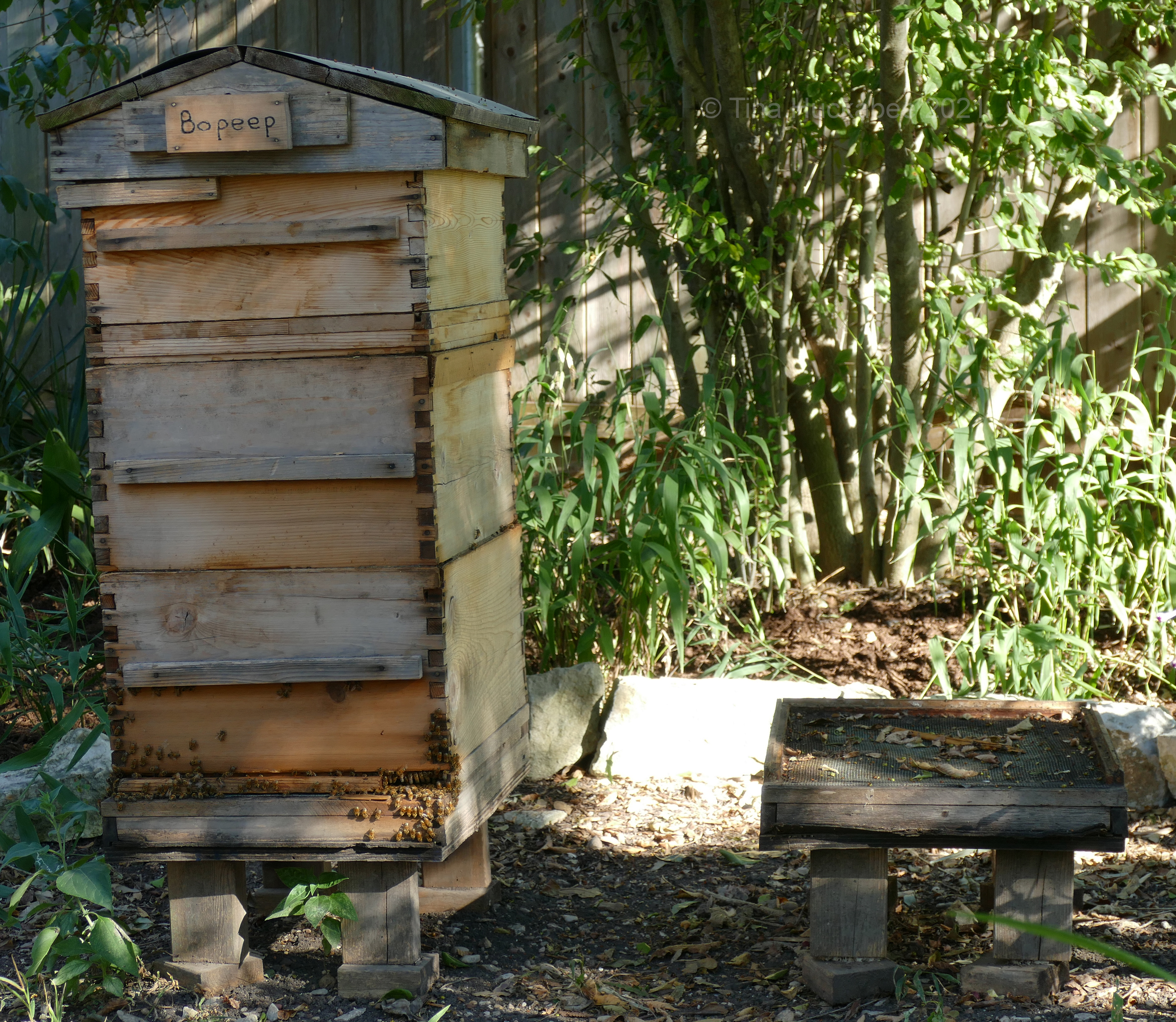
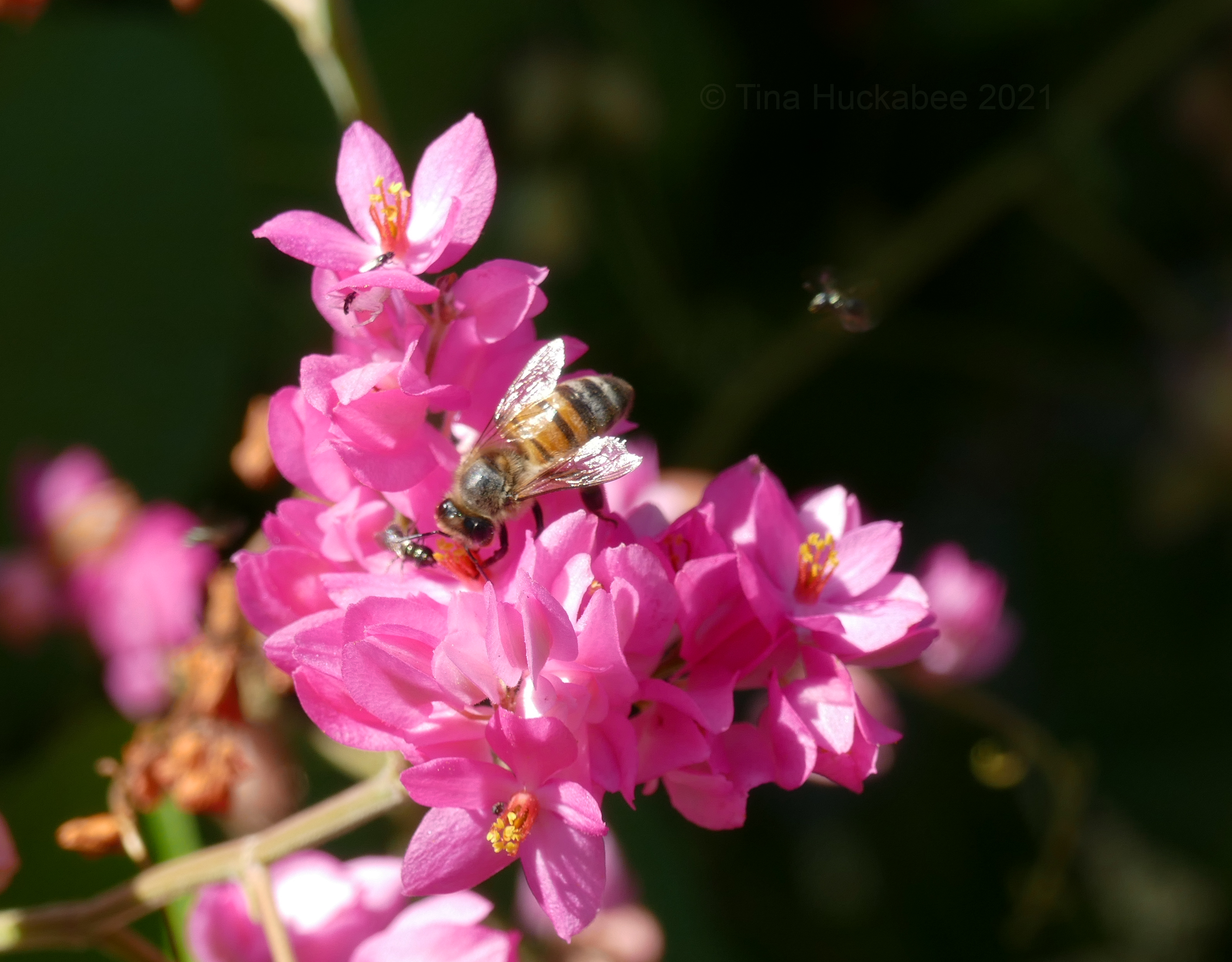
As the days grow shorter, bees are busy. Here in Central Texas, we’re heading into our second spring of mass blooming. There are at least two months of flowers available for foraging, and even in winter, there will be some flowers for the bees to visit. We’ll check Bo-Peep a few more times before it grows too chilly to open her up.
It’s been a mixed bag of beekeeping this year; I’m glad to have this new, strong hive, but saddened at the demise of our two beloved hives, Scar and Woody. While my garden enjoys the presence of a decent variety of native bees, it’s hard for me to imagine it without honeybees. Honeybees, along with so many other insects, are integral to the garden’s health, vitality, and beauty.
Rock on, little bees–do your thing.




 My Gardener Says...